| Smash Notes | Issue #5 · Nov 24, 2026 |
|
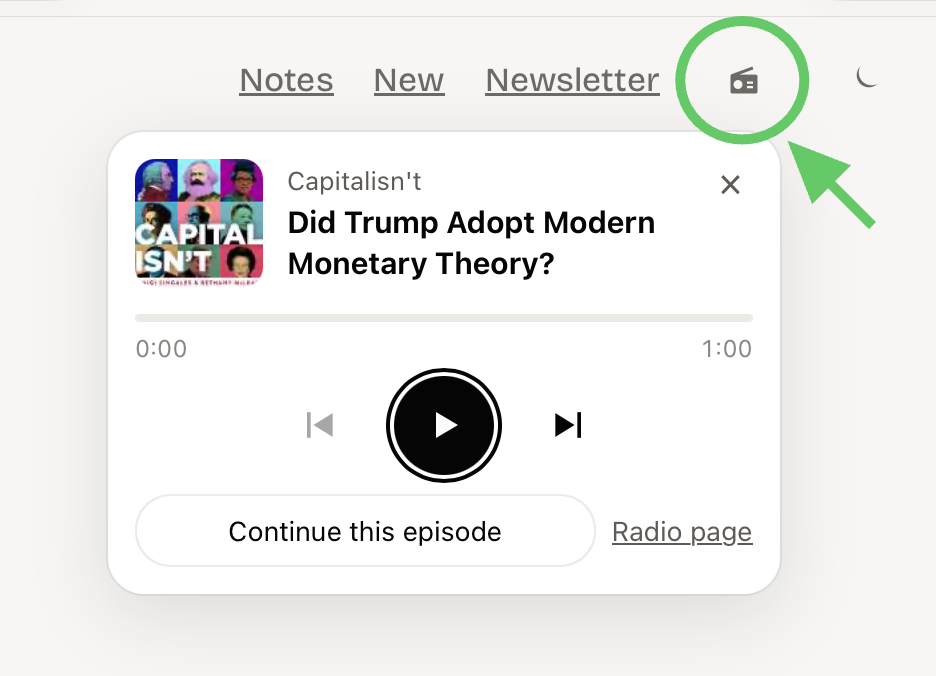
Hi, it's Kirill. In this newsletter, a few thoughts on $NVDA. Yes, we are late to the party. Jensen is back, but we have no podcasts about the return of the King. And yet, we have plenty of relevant thoughts. You might as well read them now, so you're ready for the Jensen the White. So... what do we got? Jason Calacanis talks about Anthropic and Nvidia. Diogo Almeida estimates coding agents speed up engineering by 40%. Ethan Mollick says a person can produce 100 times more code than before. AND, and, we have a new feature! Smashnotes Radio. Enjoy! |
|
New on Smash Notes
Sample a bunch of podcasts. Keep the one that grabs you.
Smash Notes now has radio. Sample many podcasts, then keep listening only to the one that catches your attention.
|
|
|
Business
What did Anthropic's IPO actually clear?
| A $2 trillion debut, or a filing that left retail out? |
This week
How big was Anthropic's IPO?
All-In · Jason Calacanis · Nov 21, 2026
Calacanis says Anthropic went public the day of the taping, hit a $2 trillion valuation, and raised over $107 billion, with the green shoe filled and demand enough that many more could have been filled. He frames the listing as surpassing SpaceX's $85 billion valuation, and as the moment token sales and frontier models come into public view beside SpaceX, Amazon Web Services, Azure, and Nvidia. | | VS. |
From the archive
Why is Anthropic's IPO filing still blank?
The Weekly Show with Jon Stewart · Ed Zitron · Oct 28, 2026
Zitron says Anthropic loses billions of dollars, fewer billions than OpenAI, and the latest quarter of its S-1 is blank. The figures he says a reader needs only go through June 30. Anthropic shared many of the numbers with investors at an investor day two weeks earlier, which he takes as the retail buyer being left out. He says the company scraped through the second quarter with a light profit because Elon Musk discounted its compute at SpaceX for two months. |
|
|
Sponsor

Is your argument any good?
Paste your draft. ArticleScore finds where your argument falls apart and shows you exactly what to fix.
|
|
|
Tech
Why is Nvidia falling after a record profit?
| A $2 trillion slide, or a still-rising share of CapEx? |
This week
Why is Nvidia falling after a record profit?
All-In · Jason Calacanis · Nov 21, 2026
Calacanis says Nvidia has shed $2 trillion in market cap over the last 30 days and is down 35%, and down 20% in the two weeks since Jensen Huang was pushed out, even after revenue and profit both doubled, to $116 billion and $65 billion. Colette Kress, the finance chief now acting as chief executive, did not inspire confidence on the earnings call, in his telling, even though the company beat on the top and bottom line. | | VS. |
From the archive
How did Nvidia's dollars per gigawatt more than double?
BG2Pod · Jensen Huang · Oct 15, 2026
Huang says Nvidia's market share is still increasing even though the company is already large and the share was already very high. The offering into one gigawatt went from about $18 billion, to 20-some-odd billion, to 40-plus billion. Six years ago Nvidia's percentage of the world's CapEx was in the single digits. With the world's CSPs, he thinks Nvidia is probably running about 40 percent. |
|
| |
AI
How far along is workplace AI?
| 10 to 20 percent at the big companies, or already past 50 percent? |
This week
How much could AI use grow at big companies?
All-In · Jason Calacanis · Nov 21, 2026
Calacanis is staying very long because he thinks AI use at big companies will spread from a small share of workers to all-day work with agents. Only 10 or 20 percent of workers at the major companies use the technology now, he says. The average worker at the startups he invests in spends five, six, or seven hours a day with AI. What startups do, the big companies eventually do, on a lag of two or three years. | | VS. |
From the archive
How far along is workplace AI adoption?
Freakonomics Radio · Malik · Oct 23, 2026
Malik says over 50% of American workers seem to be using AI, and the share is probably higher, but companies have barely begun to integrate AI work. He says that is why 2025 showed no deep productivity impact from AI. Workplace AI adoption, in his telling, is not even at first base. |
|
| |
AI
How much do coding agents actually speed you up?
| A 20 to 40 percent boost, or 100 times more code? |
This week
How much do coding agents speed up engineers?
Unsupervised Learning · Diogo Almeida · Nov 19, 2026
Almeida estimates coding agents speed up engineering by 20% to 40% on average, with error bars for long-term effects like skill degradation and tech debt. He treats the average gain as a decent but small boost. The number depends on the use case and on the skill of the user. A decent but small average boost is the consensus he has seen in the field right now. | | VS. |
From the archive
Why don't companies see AI productivity gains yet?
Big Technology · Ethan Mollick · Oct 28, 2026
Mollick says you do not get organizational productivity gains instantly from individual ones. A person can produce 100 times more code than before, which is great for a solo entrepreneur. Inside a company running two-week sprints, that 100 times gain becomes a barrier. Shipping stats show the same gap: 20 times more code produced, and 30 percent more products shipped. |
|
| |
Business
Do you take the money?
| No use for investors, or raise a quarter-trillion while you can? |
This week
Why did Mailchimp stay self-funded?
How I Built This · Ben Chestnut · Nov 20, 2026
Chestnut says Mailchimp stayed self-funded because the company was already making plenty and did not know why it would take investor money. Around 2010 it had a million users and was growing toward 2 million. He remembers making probably $10 million or $15 million then. Cash flow paid for hiring and for engineering. Investors still came and offered money. The reply was that Mailchimp had no use for it. | | VS. |
From the archive
Why should Anthropic raise $200 billion now?
All-In · Chamath Palihapitiya · Oct 17, 2026
Palihapitiya wants the IPO priced to clear the market for $200 billion of new capital, and he would rather see a quarter of a trillion. Two hundred billion, he says, barely buys a few gigawatts. Raising $80 billion at a $1.9 or $2 trillion valuation, then hoping a later shelf works, leaves more risk in the future than there is today. Ben Horowitz says that deal gets done all day long, and he would take the cash reserve over a valuation optimized for the founders. |
|
|
| Explore more on Smash Notes → |
Which of these five would you argue with? Hit reply and tell me. I read every email.
– Kirill |
You're getting this because you subscribed to the Smash Notes newsletter at smashnotes.com.
Did your email fall into Spam? The quickest fix is to mark it “Not spam” and add notes@mail.smashnotes.com to your contacts.
Smash Notes · Subscribe or manage |
|