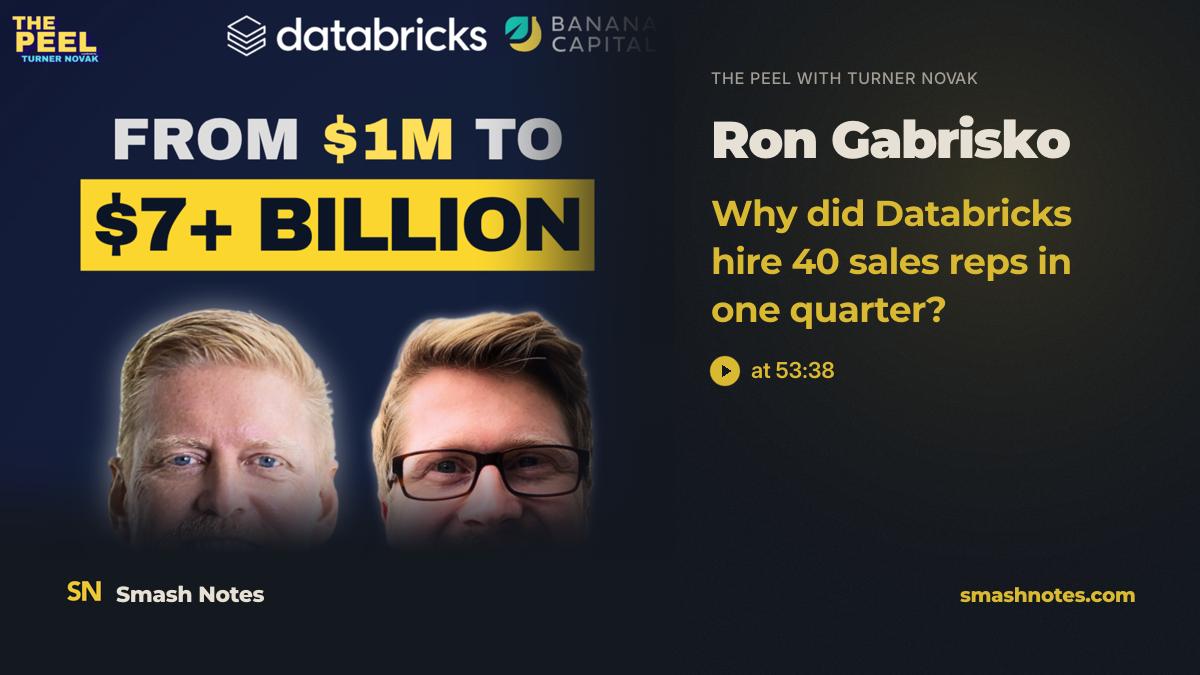
How Databricks Went $1M to $7B+ ARR in 10 Years | Ron Gabrisko, CRO
Ron Gabrisko explains why Databricks hired 40 sales reps in one quarter to learn what open source users would pay for, on the way from under a million dollars in revenue toward a public figure around 6.9 billion. He also covers why charging per user cut usage, when a sales team should expand internationally, and why enterprise AI depends on a company's own data.
People
Notes
-
-
-
What Is Databricks Genie? at 13:37
-
-
-
-
-
-
-
-
Were Databricks Early Pilots Free? at 1:06:10
-
Why Did Databricks Stop Charging Per User? at 1:09:19
-
Was Databricks Always Consumption Based? at 1:17:43
-
-
-
Related notes
- What Happens to a Later-stage Company When It Transitions to Maximize Revenue and Why
- What Are the Steps in Tackling Cloud Cost Optimization
- How Did Chris Degnan Leave Factory for Cognition?
- Does Databricks Still Have a Strong Sales Development Team?
- Why Does Scaling Sales Need a Playbook?
- Why Will Governments Regulate AI Compute?
Related episodes
-
![]() Aydin Senkut: Growing Felicis from $4M to $4B
-
![]() Building a Venture Firm Like a Product | Jeff Morris Jr, Chapter One
-
![]() From Nearly Bankrupt to $5B+ Revenue, with Ring Founder Jamie Siminoff
-
![]() Garry Tan on the Past, Present, and Future of YC
-
![]() His Customers Died. He Grew 51% a Month Anyway. | Ivan Burazin, Daytona
-
![]() How Gusto Built a $9.5B Company with Co-founder Tomer London
-
![]() 20VC: You Need $1BN To Do Seed Today: The Untold Truths of Venture | Who Wins and Who Loses in the Next Decade of VC | Why Margin and Price Matter Less in a World of AI with Sameer Dholakia, Bessemer
-
![]() Anthropic S-1 Shocker, Greatest Business Ever? Google's $500B Wipeout, Midterm Predictions


Original episode description
0:03
Ron, welcome to the show. Hi, thanks for having me. Excited to be here. Yeah, I think this will be a fun conversation. So you joined Databricks before you guys were really out of business. I think it was less than a million in revenue. And as of the time we're speaking, I think
Expand full transcriptCollapse transcript
The episode notes above make this conversation easy to skim.
0:03
Ron, welcome to the show. Hi, thanks for having me. Excited to be here. Yeah, I think this will be a fun conversation. So you joined Databricks before you guys were really out of business. I think it was less than a million in revenue. And as of the time we're speaking, I think the public disclosure is 6.9 billion in revenue. And I think actually by the time we publish this, I think it's going to be even higher.
0:27
So this is going to be pretty fun going deep on just how you did it, how you got there. Yeah, it's been a absolutely amazing journey. I mean, we're still growing super, super fast. We say it's top of the second inning, still early days. So it's an amazing business. It's been, it's been a, it's been a great journey. I love those baseball analogies.
0:47
Like when you're on an earnings call and like the CEO goes super deep is like, we're still getting in the seats. Like the game as we haven't even thrown the first pitch yet. Like, well, I'm a baseball player, you know, early days. That's what I wanted to be a major league baseball player. Oh, really? Yeah. Yeah, now I sell software. I guess it's the closest thing I could get to the big leagues.
1:08
What do you think is the key to success for Databricks? If you just had to sum it up in a couple sentences. The company's been around 13. I've been here 10 and a half years, so the company was less than a million. I think most of that growth has been over those 10 years, but yeah, the company's been around almost that long. Yeah, I mean, I think the keys to success at Databricks,
1:29
you know, I can talk about kind of how we built it in each stage is, but overall, like we made, you know, first of all, we have seven of the greatest, smartest founders on the planet, all PhDs from Berkeley. You know, they were at the, you know, some of the, like I said, the frontier of data and AI way before AI was even cool, right? So again, this is back in, 2014, 2015.
1:55
And they made some really strategic bets early on. One was on go all in on cloud. One was go all in on open source. And the last was go all in on data and AI. And that wasn't really the vogue uh back then and then i would say since then you know we have the best engineering and innovation machine like our product is the best i've ever sold that it's the best on the planet um and then i think we have the best go-to-market team on the planet right like to achieve that kind of growth at this kind of scale is is fairly unprecedented so i think the combination of those two things and obviously great people great culture That's been kind of the keys to success, for sure.
2:42
Yeah, I want to kind of talk more about all those things. I guess going in order, though, so when you talk about making a bet on the cloud, that kind of seems obvious today. Why was this such a big deal back 15 years ago? Well, back then, cloud was still pretty early, right? Most of the infrastructure was still on-prem. I can remember... You know, first kind of, you know, when I started, I took all the founders out to Wall Street.
3:12
I said, hey, if we're going to make a business here, we've got to sell to all the big financial services banks.
3:17
Literally, we met with most of them and CIOs. I got CIO meetings. It was crazy. They would bring hundreds of people to meet the inventors of Spark and Mateo would be signing autographs and stuff. That's awesome. Yeah, but they were like, we're never going to the cloud. We were a cloud only. They were like, literally never. But now, some of our biggest customers, a bunch of these big banks, uh you know they're all in on the cloud and you know it's it's already happened but back then that wasn't uh that wasn't a no-brainer for sure so that's that's kind of wild because it would be like someone telling you today like we're not going to use ai like we like think it's fake or
3:59
like doesn't work or something like how did what was the justification on not moving to the cloud like just was it not valuable enough and like too hard or expensive or early in any market right it's like you know security you know you got to overcome legacy so you know there's a lot of people saying like oh the clouds aren't as secure as you know our own dedicated security team which obviously is is is false right like I mean, these clouds have to have better security than any one individual company.
4:31
So a lot of that is like security, governance, regulations, right? Like a lot of the banks, regulated markets, they're regulated. So like, you know, it's similar challenges to early days of AI, right? And once you kind of solve those challenges around security, governance, scalability, regulations, things of that nature, the market takes off.
4:53
And so... It was a great bet. Obviously, like, you know, everything's moving to the cloud and,
5:00
you know, we could move faster than a lot of the on-prem players because they were stuck having to deal with legacy issues. So it was a great bet for sure.
5:11
And then with the open source versus closed source, I feel like today, like open source is not that crazy. Was it a little bit crazier at the time? Like, was it just not really proven yet? I mean, you think of it like back then, like, you know, what were the big open source projects, maybe like Hadoop, Linux, and the model for how you monetize it was just supporting services, right? And so if you think about one of the ways Databricks changed the market too was like, how do you monetize open source?
5:46
And we built a managed service. We built one of the first managed cloud services for open source. Now, a lot of the hyperscalers were using open source to monetize their compute, but not a lot of private companies were doing that back then. you know as we kind of built out this model because we're still you know open source core everywhere uh you know now we've had many many projects beyond spark you know delta ml flow you know on and on but you know building a managed service around open source and you know how do you monetize compute usage things of that nature is is the future but that was fairly new concept back then um that i think we kind of developed so So at the
6:32
time you had just a bunch of people using the open source product that was Databricks and you started to essentially like start to get people to pay. So how did you kind of make that transition? Yeah, no, exactly. So, I mean, there were literally millions of people using Spark. So Spark was the open source product early days. That's why I love the company as an opportunity too.
6:57
And, you know, first days we just said, go meet with all the, customer meet with as many customers as possible that were using Spark and understand how they're using it. What are their challenges? What would they pay for? And
7:12
it wasn't rocket science, right? And then you look for those kinds of trends, right? Like, okay, you know, people pay for security, people pay for scalability. So you start adding these features as a pay for on top of the open source.
7:27
And again, we're selling a managed service too. So early days, we were selling to a bunch of the Silicon Valley called digital native startups. With open source, they tend to love building their own stuff. But when you go to enterprise, they don't necessarily have all the expertise to build large open source projects. So they need partners.
7:50
They need a managed service to do that. So our break in enterprise was a really big step in how we scaled the company.
8:00
And when you say managed service, that means you...
8:04
do some of the work for the customer in a sense, you're kind of building some of the features or you're updating things for them. Like, how do you guys, how would you describe that for somebody who's never heard that before? listen, it comes like all the features are there, right? It's all ready to go. You're not having to set it up, you know, each particular product, each particular piece, each particular feature, configuring it.
8:29
I mean, obviously it's super configurable, but like if you were to try to build something like that from scratch, you'd have to get, you know, 20, 30 different open source pieces of software. You'd have to stand them up in different services on whichever cloud you're going to use. You'd have to configure all those things. You have to worry about security and scalability and governance and all those things.
8:51
You know, Databricks just comes, you know, right out of the box, ready to use, which was huge for like, you know, we kind of created the data science market. So like when early days I said, we're doing AI before AI was cool. People were starting to do machine learning, data science. So we'd just go straight to the data scientists and they were like, oh, this is awesome.
9:13
I can just upload my data sets and start doing that. I don't need to do a bunch of setup with IT and things of that nature. And obviously that evolved to all the things we see today around data engineering and data pipelines and AI and machine learning and all those kind of things. But yeah, creating kind of just an easy to use managed service on top of open source was a big tailwind for us.
9:40
This episode is brought to you by Numeral. Numeral is the fastest, easiest way to stay compliant with US sales tax and global VAT. It's easy to set up and they automatically handle all registrations, ongoing filings, and their API provides sales tax rates wherever you need them with all the integrations you need. Their solution combines AI-driven automation with human expertise to manage global sales tax compliance end-to-end.
10:03
Numeral supports over 3,000 customers, including companies like Brex and Character AI, and they pride themselves on white-glove, high-touch customer service. Plus, they guarantee their work, and they'll cover the difference if they mess anything up. If you want to get compliant, check out Numeral at their new domain, numeral.com. That's N-U-M-E-R-A-L dot com for the end-to-end platform for sales tax and VAT compliance.
10:31
This episode is brought to you by Flex. It's the AI native private bank for business owners. I use Flex personally, and I love it because they use AI to underwrite the cashflow of your business, giving you a real credit line. The best part is 60 days of float, double the industry standard. Flex has all the features you'd expect from a modern financial platform, like unlimited cards, expense management, bill pay that syncs with your credit line, and their new consumer card, Flex Elite.
10:57
Flex Elite is a brand new ramp-like experience for your personal life. A credit card with points, premium perks, concierge services, personal banking, cars and expense management for your family, net worth tracking across public and private assets, and a whole lot more fully integrated with your business spend. One card for your businesses, one card for your personal life, one card for everything.
11:19
To skip the waitlist, head to flex.one and use my code TURNER to get an additional 100,000 points worth $1,000 after spending your first $10,000 with FlexLeap. That's flex.one and code Turner for $1,000 on your first $10,000 to spend. Thank you, Flex. And now let's jump in.
11:39
So how do you describe the Databricks product for somebody who's like never come across it before? And honestly, this would probably be helpful for me because like I've come across it, heard of it all the time. I don't really use it. So I'm not even sure I actually know what it is. Like what is the product for somebody who doesn't know? Yeah, no, the easiest way to describe it is we take massive amounts of data from many different sources and allow you to do AI and do predictions and analytics on it.
12:07
So like an example is, you know, I'm sure you use streaming service, Netflix or Disney or, you know, when you see kind of next best movie and it says, hey, it has 98% probability for you. What they've done is they've taken millions of data points from any other users against all the other things all the other data you've given them like movies you've watched or liked or things of that nature and they're using that to predict your next best movie and so then we apply that to pretty much every industry right so we find credit card fraud for banks and or how do they cross-sell, up-sell customers? How do you do loan approvals, loan origination, R&D for pharma? Early days, I
12:55
would say someone will solve cancer with Databricks. Lots of companies are doing that in pharma. So again, the problem set is like, You know, how can you build models, do predictions, do recommendations, build agents on data? And the more data you can feed those systems, the more accurate the predictions, the more accurate the models and agents.
13:16
You know, you even think in today's world of AI,
13:21
Obviously, everybody uses ChatGPT or pick your favorite LLM, Gemini, what have you. For an enterprise, how do you make decisions? It's all about having the context of your data and attaching that to AI. For us, we developed a product called Genie. And so what Genie, I actually have it on my phone, I use it to run our business, but it basically has all the contacts of my business and I can just ask it questions in English and it does all the calculations, all the SQL queries, does all the tech in the background, right? So if I ask it like, what are the top 10 customers that might churn in Germany, it'll go build the churn model.
14:01
It'll go try to understand the churn, you know, make recommendations. They don't even make recommendations on how to fix it. Like it's pretty cool. So that's, you know, anyway, high level overview on Databricks. Hopefully that helps. Well, I was going to ask you about Genie, because I know you said you run your team on Databricks. So it's kind of like the user-facing, simple-to-use and access interface.
14:28
Yeah, we run all Databricks on Databricks, right? So I can predict our revenue within 1% or 2%. I can predict which customers are going to churn. I can predict... you know, which products, you know, are the stickiest, like, you know, customer retention and all those things. And then Genie allows me to just do all the research and questions.
14:49
So like, it'll prepare me for customer meeting. It'll tell me everything I know about the account, which products they use, what are their opportunities to grow their revenue, because it'll do other research. And basically the interface is similar to any like LLM, right? You just start asking it questions. The difference is it can do all these, it's doing it on your data, right? Versus just generic publicly available data.
15:15
And then it's able to do calculations, graphs, predictions, launch agents. So it's super sophisticated for enterprise AI versus kind of the, call it the generic tools that are out there today.
15:29
Has that always been there or is that more of a newer-ish type of product? It's brand new. We launched it at Data and AI Summit. Now we literally have millions of users on it. If CEOs of banks, CFOs of banks, it's perfect to run your business. If you think of traditionally how you run your business, you have some kind of dashboard or analytics tool and Maybe it's updating real time, might be batch.
15:58
It's definitely not doing predictions for you. It's definitely not allowing you to just ask questions and knows all the context, not just from whatever that dashboard was built on, but knows context of all your data. builds out the ontology of, you know, all your data sources. So it knows where to go look for answers to certain questions.
16:17
And again, it does calculations, predictions, machine learning models, queries under the hood. So it's, uh, it's, it's the first of its kind and it's a state of the art. It's pretty awesome. Yeah. So it's kind of like, instead of having the guy on the team who you just like are pinging and like, Hey, can you give me the updated numbers? It's just like, you're like, you're like messaging genie, like the data works product.
16:39
It's real time because that is what everybody has. They have an analyst like, oh, can you go get me this answer, et cetera. And then it takes a day and they're like, no, change this, add this. Then it's a little bit stale. Can you get this week's data versus last week's data? It's all real time. So it's right at your fingertips.
17:02
you know i see like a couple other like you know you think about it we want every business user like i have you know we have huge like retailers like the store managers are like how do i maximize revenue like on this particular shelf or with this product or which promotion should i run which is going to be dependent on where your store's you know located you know you're going to have different dynamics based on know kind of your clientele things of that nature um rental car agencies like how do i maximize sales it'll give you feedback oh your c set's low on this you should probably clean your cars better you know what have you right like uh you know it's uh again it's
17:43
putting uh i had a gas station uh One of the big gas station retailers was like, I want to maximize sales of pizza. And they would have like a camera feed and it would actually measure like pizza and pizza pricing. So it's, yeah, like I said, put the power at the fingertips of every single business owner out there in your business. And, you know, like I said, that's the future.
18:09
That's pretty interesting. So you could, so in this pizza pricing example, the camera, I'm assuming it's like a security camera that they just already had in the store. Is it like, what kind of data does it take in? And then like, how does the pricing of the pizza, is it like real time pricing or there's just like, hey, it looks like we can charge extra 30 cents based on something like that.
18:31
No, I think more of it's like, you know, if they run out of pizza, they want to make sure they have pizza there, you know, like, so it's monitoring that stuff. Like I said, it could take video images. It'll also be like, you know, how many pizzas, you know, should you have that day? Like this managing inventory based on seasonality or maybe other promotions they're running, but yeah.
18:52
Again, that's a small example. I mean, the idea is like, how do I maximize my entire business? You know, a lot of these gas stations, it's about petroleum sales, but a big part of it's like the retail business, right? It's like all the things you're selling inside the store. How can you maximize the sales of all those things? And that's, again, gonna be independent based on location, promotions, you know, other independent factors and data that you'll have access to, so.
19:20
Yeah. So in terms of like Databricks versus the market, because I see all the time, every day, maybe it's actually tailed off a bit, but there was a time where like every day there was just like a new AI product that solved all your business problems or whatever, right? Like there's a lot of them that are out there at this point. So like, what do you think Databricks kind of differentiates on? I'm assuming this is a pretty standard question you actually probably get in when you're talking to customers.
19:45
Yeah. there's all kinds of new models out there right like i mean obviously open ai and anthropic heather models but now there's lots of open source models i'm sure you've read about them you know kimmy and glm and what have you um it's not really about the strength of the model uh the the key for databricks and even the key for a lot of these companies to be successful ai is all about the context of your data Like the models are already smart enough.
20:12
Like, you know, I ask these models all kinds of questions. They're as smart as I am, if not smarter. Right. And, you know, it's all about like the context that you provided. And so your ability to connect those models with your proprietary data and your context or business is really what unlocks the insights and the outcomes for these companies.
20:35
And so that's been the key for Databricks is just how we built out our data platform. Again, we were AI first from the beginning.
20:44
10 years ago, we were thinking about AI and machine learning before. anyone else. And so we approach the market from that perspective and how we govern data, you know, like our Unity Catalog, Unity AI Gateway, we serve any model, any catalog, you know, it doesn't just categorize your data, but all your models, all your you know, notebooks, everything else you're doing with your business so that we can automatically understand where's your data,
21:13
you know, which what is relevant to answer these questions or build models around it. That's the key to Databricks. No other company has that kind of, you know, breadth and expertize. And so back when you made this bet, this big bet on AI, like it was probably not quite as obvious back then. Like, well, what was the thinking? Was there like a oh,
21:33
artificial intelligence is gonna do what it did. Like what element of this was like, you kind of got lucky at how AI has evolved and like how much of it was like, you kind of saw where it was going. Like, oh, how would you kind of, uh talk through what happened there well yeah i think i mean part of that was just insightfulness from the founders i think in the first kind of products and use cases they built like spark was just a massive like data processing engine uh right which meant like the more data we could process uh you know the better you know we could perform versus other products that were out there right and so like if you think about it know we went after the
22:14
data science market first so people who are doing in a lot of these data science projects if you think about it like if they're doing a huge genome study they're trying to find you know like a new cancer treatment So they're taking a bunch of compounds and mapping them against different genomes, mapping them against electronic medical records, and trying to find trends, like which compounds should we test to try to accelerate R&D.
22:37
Well, these genome files are huge. And so traditionally, they'd be like, OK, let's run one model to try to predict something that might take 24 hours. Well, Databricks comes along, and now I can run that in a minute. So think about how fast I can accelerate my virtual R&D to try to find. Yeah. And so that's now reality, right? For every single business is like, how do I take billions, if not trillions of data points, analyze them, get insights, and then make decisions based upon that data for my business, right? That's been the key versus being unable to do that in the past.
23:23
I think it was insightful and certainly fortuitous to start in that part of the market, developing machine learning, data science, all those things. That's how we came at the market and
23:37
entered AI early days. And LLMs were not, I mean, I don't know if we had them or how good they were. No, they weren't a thing back then. No. So what was it just, what was the initial kind of like product like? Like what was it powered by? Yeah, again, like we had notebooks. We still have notebooks like data scientists. They're building machine learning models.
24:02
It's just it's all code. It's not, hey, I can just use plain English to build these things. So, you know, you had kind of the chat GPT moment when chat GPT finally got good enough and consumers started using it. We actually developed our own model back then, early days of that. It was actually pretty good. And then we ended up buying a company called Mosaic.
24:26
um i don't know it was probably three years ago to kind of start doing training for custom models things of that nature and so you know our ai r d teams as good as any on the planet but again we're really focused on how do we solve these enterprise
24:44
AI problems and outcomes for specific verticals and businesses versus like I would say the rest of the market is more in general intelligence, you know, and for consumers, right? And so that's been a big difference at Databricks. And again, that's our secret sauce. How do you connect the AI to the data in the best way and the most secure and governed way possible to unlock these insights as well as build agents, automate processes, things of that nature? When you can build anything, Amplitude lets you know how to build the right thing.
25:16
Use human language to get complex answers about your products. No more manually selecting events or building charts or dashboards just to ask. Use agents to sense changes in customer behavior, decide what's causing them, and ask you if it's okay to fix it continuously in the background while you work. Get the answers you need while building directly in the tools you are already in, like Clod, Cursor, Lovable, and more.
25:37
And for the first time, understand if your agents actually work. Measure quality, debug failures, experiment, and measure their ROI with agent analytics. Amplitude. With AI analytics, all you have to do is ask. This episode is brought to you by Merge, the connective infrastructure for production AI. hardest part about building an agent is everything around it connecting to the tools your team and customers rely on letting agents take action with the right permissions and keeping everything reliable and cost efficient once you're in production merge handles that all for you it connects agents to thousands of tools handles permissions and lm routing and lets teams move
26:16
faster without building it all themselves openai dropbox and ramp all use merge to move faster and build ai right visit merge.dev slash Turner to start building for free. That's merge.dev slash Turner to try Merge for free.
26:32
It's been pretty interesting how back when ChatGPT launched, I feel like there's a lot of excitement around consumer AI and rightfully so, ChatGPT grew super fast. But then when you really got deep on what it was, it was just a lot of people basically using it as Google, banging it, using it as a therapist, just tons of questions and you pay 30 bucks a month or whatever.
26:56
And you might actually lose money on a lot of those customers at the end of the day. Versus on the enterprise side, a lot of times it's like, hey, I'm doing this to complete work. And I think on the extreme end now, we have Uber paid a billion dollars in a couple months for their enterprise AI usage. So on the flip side, it's like the opportunity in enterprise is just over the past couple of years, insane how useful it's been, how much work you can get done with it.
27:25
Yeah, no, it's massive. I mean, like I said, I think we're still early days. Like, you know, everybody thinks like, hey, we're automating everything. You know, right now we've solved one use case front to end which is like how do you better automate coding like you know cloud code codex cursor all those guys you know are going after how do you automate coding accelerate software development um and i think the tools are really good for that i mean obviously we we serve all those through our unity ai gateway but How do you automate all these other processes? How do you automate finance? How do you automate things in sales, like a lot of the admin work in sales? We do a lot
28:07
of that automation with Genie and our Genie code and Genie agents inside our business and inside of our customers. I think that's still pretty early days because you have to understand the process, re-engineer the process. You're just not lifting and shifting. you know, the same kind of process. So, but that's, there's tons of upside. Like, again, like I said, like we're at very early days on how we do that.
28:33
And that's massive upside for this market. Do you think it, is it starting to tip in some of these other categories? Like, are you seeing, you know, practical usage, it's like actually, you're actually able to use it in the same way engineers are using some of the coding agents? Yeah, I mean, listen, I think it's, like I said, you have to get in there and we're like customer zero for this, right? So we're like, we're an AI company.
28:57
we're going to automate and use AI in our entire business. And so we bring a lot of those learnings then to our customers. But a lot of this is like, how do you get in there and the expertise? Because again, you have to redesign the process. You can't just... you know, automate the same process. And so, you know, that level of expertise, I mean, that's that's how we use our FTE motion.
29:21
That's how, you know, it's like you look at health care, like how do you automate claims authorization and claims payment and claims, you know,
29:33
find claims fraud, all that kind of stuff. You need to understand the process, teach the agents what to look for, make sure the agents are high quality, and then you continually have to make sure that they're doing a good job. I think we're still at early days on how we automate all those processes, but I'm starting to see the early wins at a bunch of these customers, at a bunch of Databricks customers, and so that's super exciting for sure.
30:00
So internally at Databricks, I guess you've, I mean, you probably added billions in revenue since kind of the chat GPT moment. How, how has it changed? How's using AI kind of changed how you operate the team, any like day to day or any like tactical things, somebody listening to this can be like, ah, I'm going to, I'm going to do that too.
30:19
Yeah, totally. Um, I mean, listen, I run our entire business on Databricks. Like I said, I can get. know super deep on any one customer genie will prep me for all my customer meetings you know we're starting to automate a lot of the sales sequences so anything i can do to automate automate like admin work like forecasting how do people enter things in salesforce you know we're consumption business so we call them use cases but anything i can automate to kind of increase productivity and increase sales time, I'm gonna automate.
30:54
And 100% of my sellers have Genie on their phones. So they can run their accounts, their business, they can do demos for their customers. Like, you know, I'll go to customer dinners and I can pick up the phone and just show them. I'm like, Hey, here's a, let me run G I ran Jeannie. I had them upload, you know, some, you know, tell me data sets for your business.
31:18
Like, here's how I, you know, here's how I can find particular opportunities and how you guys are handling claims or, loan origination or what have you. So we're going to put AI in everything we do.
31:34
It'll diagnose your account and be like, hey, here's the next best action. It'll know, oh, you have a retailer. You've sold them this use case. You should go sell them XYZ use case. You should go talk to this person and sell them this type of app. So it also makes recommendations um for all our sales people you know they can do their own demos like i said genie's super easy to use so it's like great to demo for pretty much any any user of data or ai so we're putting it in our entire business um i'd recommend that for everybody you know just because that's where the market's going um and uh it's been great for us Yeah.
32:17
And I think probably one of the most interesting things about kind of like your story with Databricks is you originally joined after a conversation with an investor in the company. So how was that conversation? How did it go and what happened? Yeah, no, I met Ben Horwitz from A16Z. I mean, guy's a legend, right? And he's like, hey, I have this little company.
32:40
It's probably smaller than any company you're looking at called Databricks, but it's got the most upside of any company in my whole portfolio. you know, maybe you can meet these guys, you know, make, you know, recommend somebody, you know, and I met the founders and just, you know, hit it off. I mean, these guys, like I said, are, you know, smarter than anybody on the planet.
33:06
Their brains work in a different way and they just understood the space and,
33:12
you know, I thought data and AI was the future. and uh you know decided to take a big swing at it but uh yeah ben was he was super funny he's like these guys are like you know berkeley you know vended out this great piece of software greatest piece of software on the planet gave it away for free i need somebody to come in and help them build a business out of it and uh yeah it's it's uh it's a fun story i've developed a great you know relationship friendship with ben as well over the years and uh he's just you know legendary investor and uh it's been awesome for our company so i have a question from uh one of my friends uh paul klein he's the founder of a company called
33:53
browser base he's a solo founder and his question he's like you got to ask him how do you put up with seven co-founders just like how do you how do you like do that it's like even So I get that question a bunch, right? Like, you know, especially from CROs. They're like, I can only handle one founder. Like, how do you handle seven co-founders? I think it's a massive advantage, actually.
34:15
You know what I mean? Because you have like seven true owners of the business. Like, and, you know, lots of, you know, companies are too. Like, hey, can I get a founder to speak at my event? Or can I meet with a founder? And they're all super technical, right? So it's like... You know, if you're talking to a technical audience, you know, I have seven times as many people to do exec alignment with CTOs and CDOs and things of that nature.
34:40
So, I mean, obviously I spent a lot of time early days. I think, you know, generally like engineers are skeptical of sales people. So, you know, I spent a lot of time early days getting to know them. you know, understanding, you know, their strategy, you know, how they want to develop the company and the culture and all those kind of things.
35:03
So that would be my recommendation, you know, is like, you know, and I think Ali, when Ali took over as CEO, know first thing he did as he sat down he said teach me sales um i want to learn sales and uh and we formed a great partnership together building the company like i said from early days so um you know i would that's my recommendation is like dig in you know the founders are you know the company especially early days they're gonna set the tone the culture everything so it's been a huge advantage with seven of these guys love them to death so
35:41
I think, doesn't Anthropic has seven co-founders too? Maybe that's the lucky number. I have no idea. Maybe. There's a lot. It's another seven or eight, I can't remember. Yeah, no, that's a good idea. And so you said something interesting. So Ali sat you down and he's like, teach me sales. So how how does that conversation go? Typically, when a founder asks you that, like, what do you walk them through? What do they usually kind of struggle with? Like, how does that journey usually go? Like, how should I approach that if I'm like trying to assume I'm super smart, just like, how do I learn more about selling things to people? Yeah, so I mean, first off, I would say most
36:25
early stage engineers are like, hey, if I just develop the best product and I have the best pricing, everybody's going to buy it. Well, it doesn't really work that way, right? The power of sales, especially for enterprises, salespeople are going to teach my customers how to use the product, how to get value out of my product, make them aware of my product, those kind of things.
36:47
I mean, I started on a whiteboard talking about organizations. So like, you know, listen, when you're selling to startups, there might be one person you need to sell to. It's the CTO or the founder. But when you sell to enterprises, they make decisions as an organization, right? So you need to understand like, org chart who are the players who are the decision makers who owns the budget how's that how are the decisions made how are the approvals done so just talking through you know and so now i'd be like okay like who's you know who's the decision maker who's our exec champion all those kind of things on how you develop relationships like do you typically just ask people
37:28
that when you're first meeting them and talking to them or is that like too tacky Like you have to like smooth. Yeah, like how do you figure that stuff out if you're just meeting someone for the first time like that? No, no, no. I wouldn't do that the first time. No, I mean, part of what you're trying to do. I mean, a lot of these sales cycles, like they'll take six, 12.
37:49
months or more right so you know initially you want to get to know a person and you want to be able to understand it's asking a lot of questions like sales to me is more about asking smart questions and listening versus you know hey i have the great glitzy pitch um like it was funny like when i was interviewing for the company they were like hey do the pitch i was like okay send me the pitch you know and And I looked at it and it was super technical, right? I was like, yeah, like the people probably just like zone out.
38:21
Like, I don't feel like looking at this like flow chart with like all these diagrams. I had a lot of acronyms in there, a lot of speeds and beats. And listen, like, you know, So I had some advice on, here's how I would pitch Databricks. But I also started with, they were like, okay, pitch us. And I was like, okay, what kind of company are you? I'm like, how do you use data? How do you use AI? What other systems do you use? What are some of your objectives that you want to get out of using AI with data? And they're like, are you going to pitch us? And I'm like, I am, right? Because it's like...
38:56
you know, the more information I can gather on what are your challenges, how can I help, how can my product help,
39:04
the more credible I'm going to be as a salesperson. It's kind of like you go to a doctor if they're just like, yeah, you just need surgery. Like, don't you want to know what's wrong with me first? You know what I mean? So sales is a lot about come in prepared, know about the customer, try to do as much research as you can on their challenges and issues and objectives and strategic objectives, going high in the org if you can, and
39:31
ask a lot of questions, get to know them, get to know how you can help, and then be very credible and diligent and responsible and trustworthy on how you follow up. Don't bug them, but if there's specific areas you can help, Like that's what a good salesperson does. you kind of have to assume if it the bigger the company the longer it's going to take to build that trust and get them to get under you know in some cases they're like moving their company over onto your product like it's a long process yeah yeah and like i said i mean there's a lot of technical validation in there doing pocs and things of that nature but you know start with understanding the problem what is
40:11
the you know what is the business problem they're trying to solve how can you help them get there faster or cheaper less risk um you know and then you know i talked with ali a lot about medpick and you know now he's an expert on all this stuff like you know he's not what's i've never heard of medpick before yeah medpick's just the process on how you govern sales it's like uh oh really yeah so what is it well each thing stands for a difference like metrics so what metrics are are you using to kind of justify like you know how do they measure their business what metrics are you actually changing uh you know with whatever solution e is exact sponsor d is like decision
40:53
process like each one each letter means something in a process to kind of develop uh it's a pretty well-known kind of enterprise sales motion Um, and then there's a thing called command of the message, which is similar, uh, for every company. I mean, those are two frameworks I would recommend for anybody that's trying to learn enterprise sales or build enterprise sales.
41:15
Um, those are probably the two most common that, that I use and that we use. So, um, and then obviously you branch off of that. It's gotta be custom for your company and your product. This episode is brought to you by Monaco. Monaco is the first revenue engine built specifically for startups. Monaco's AI-needed platform replaces your legacy CRM and sales point solutions.
41:35
It has everything startups need all in one place. Monaco helps build your TAM, generate demand, run outbound, capture every interaction, manage pipeline, and automate follow-ups all in one tool. They pride themselves on an effortless onboarding, white-glove activation, and get you to value in days, not months. And the product practically runs itself with built-in agents that are always working for you.
41:58
Startups that switch to Monaco book three times more meetings. start growing your revenue faster with monaco try it now at monaco.com
42:08
are there any mistakes you see people make usually when they're kind of first getting this like do they just try to ramp up too quick or what's usually the biggest mistake uh companies or sales people or both
42:20
I mean, maybe it's both. I don't know. Maybe it's the same thing. I don't know. What's usually the biggest mistake people make? I mean, I would tell you like the biggest mistake I see in salespeople is they start pitching before they understand, like I said, like, hey, I'm going to pitch you my product, but I don't really understand anything about you or your challenges.
42:41
So first thing, get to know somebody, establish rapport and ask some questions so you know what might be important to them.
42:51
from a company perspective listen like companies are growing faster now than ever like ai is a huge unlock uh for growing companies um you know i'm a big advocate of you know you need sales people to grow your company but the plg motion has been great for you know companies like anthropic and stuff like that like they're doing great with plg um i always say like you know there's kind of four stages of a company there's kind of zero to 10 or 20 million we're just finding product market fit From 20 to 100, you're kind of building a playbook.
43:25
It's gotta be repeatable system, repeatable trends. From 100 to a billion, you're starting to expand internationally into partners. And then multiple billions, it's a lot about having the right leaders and culture and systems and processes and continuing that kind of fast innovation and how do you continue to run fast. And so each one of those stages requires kind of different I would say things to grow.
43:54
And so like based on each company, you know, again, when I try to advise companies, you know, based on where they're at inside of their market, you know, again, you need, you know, usually you need salespeople to push your product because people don't know either know about your product or know how to use your product.
44:16
And even in the case where PLG takes off, you want salespeople then to be able to go talk to your enterprise customers. Again, enterprise customers use people that are buying stuff. If people are buying stuff, you want people to sell stuff. If it's intuitive, of how to use something, yeah, I mean, let it rip. Developers know how to use these coding tools, like awesome, they pick out their best one and they go, right? You need sales people to get through security reviews and contracts and things of that nature, but the actual selling part of it might be like, here are the advantages of my product versus another.
44:56
you know most products they need sales people to teach customers what their product does and how to get value out of their product and so you know i think there's you know ways to ramp that up in a thoughtful way depending on which market you're going after and i know you guys made a pretty strong bet on we're going to hire technical people to sell the product
45:20
I mean, is that generally that seems like the more technical the product, the more technical the salespeople have to be? Because you probably have to help the customers understand it and you need to know the language to help understand the problems, I'm assuming. Yeah, a thousand percent. My salespeople can demo our product themselves. We have an amazing pre-sales field engineering team, but everyone in my organization should be able to demo.
45:45
They should know the product. Because honestly, if you have technical buyers, you need technical sellers if you have technical buyers. Technical buyers don't like non-technical sellers. That's the difference, right? Is it because they feel like they don't understand what they're even talking about? It's like, I can't understand this person? If you don't understand it, that's even worse.
46:08
But if you don't bring anything to the table, like...
46:13
My time's precious. I'm only going to spend time with you if I'm going to learn something or you're going to help me solve a problem. If I'm a technical buyer, you need to bring something to the table that helps me solve my problem or get better or learn something. If you don't, I'm not going to waste my time with you. For us, we have a very technical product.
46:36
Obviously, with Genie, it's a lot simpler now. We're starting to sell to business users, but you know, early days, pretty technical product with technical buyers, data engineers, data scientists, data people, you know, they're technical, highly technical. I need technical sellers to be able to have credibility with them. So
46:56
That's how I would decide kind of the profile. And then, you know, a big thing, like as you're starting to scale an organization, you definitely need what's the profile of the seller that's going to make this company really successful. You need to know that. Like, obviously, it's not the same every time because, you know, what you look for, but you need to build that profile and that pattern for your company so you can scale it.
47:21
When you say profile, so how do I understand what kind of profile I'd want? Yeah, like I said, what are the main criteria I'm looking for in a seller for them to be successful here? Like you mentioned one of them, they need to be technical. So I look for people that are technical. I look for people that have experience in the data and AI market for certain companies.
47:44
I also test for like... grit and perseverance and hard work like i always say like hard work overcomes talent every single day right um you know we're looking for folks that understand how to sell consumption versus committed contracts um you know that's just usually you know having some cloud i like having people that have some startup experience like can they build like do they know how to do things without having a big machine behind them i also look for you know i avoid people that have a bunch of short stints like somebody that's had two three companies less than two years, like they don't know what tough looks like yet.
48:29
Every company comes across tough times at some point. So you want people that have seen that before and that are gonna dig in and push through that. And so, you know, I avoid people with lots of short stints. So, and again, I back channel pretty, I look at every profile we hire here and, You know, I'm probably one degree of separation from everybody in Silicon Valley, so I can back channel just about anybody.
48:53
But, you know, I'm looking for the best of the best on the planet because I think this is a once in a generation type company. When you talk about grit, determination, hardworking, how do you gauge that before someone's actually done the job? Because they could be like, oh, I worked so hard. They could probably set their emails up so it sends at 1 a.m.
49:12
so it looks like they're working or something. How would you actually gauge if I'm actually a hard worker, if I'm actually going to fight through it? I mean, listen, it's a little bit subjective. I mean, obviously, I'm trying to look for folks that haven't had a bunch of short stints, but I also like to learn about the person, the character, like how they grew up, you know, like what kind of challenges have they had to work through in their life, those kind of things, right? Like, you know, my dad was a construction worker, my mom was a teacher, like I grew up from nothing, right? And so like, you know, I want to hear somebody's background and understand them as a person
49:49
too. And then we also give them assignments, right? Like we make them build a business plan, We make them pitch to, you know, a CEO. Give me your AI vision pitch for a CEO. We'll give them the deck, but I want to see them pitch it. And then we also make them do a genie demo for their vertical. So, you know, we're making them do some work to show that they really want it because, you know, I think you get a job at Databricks, it's a lottery ticket.
50:15
Like, you know, so anyway, that's some of the ways I do it. And then obviously I try to... you know, if I know people that have known them, I'll ask them, right? Like, is this person gonna be that kind of, you know, caliber seller? Again, that's why I look at some of the startup experience too, because I think people in startups work crazy, crazy hard and have a lot of grit.
50:42
I mean, certainly we did early days creating this company. How do you do that kind of reference check? Because I might be good friends with someone and you text me about him like, oh, he's awesome. He's so great. You should hire him. What do you usually look for when you're trying to get through the BS and understanding what's actually going on?
51:03
Well, usually I'm checking with somebody I know and I have a relationship with, so they're not going to BS me because they value me. Your relationship is above who the reference is. They value that with you. At least it's like, hey, if I tell Ron this person's amazing and then they're not amazing, like... Like, that's not good, right? Like, again, I've lots and lots of, you know, again, one degree of separation from most sales leaders.
51:34
And so, you know, they'll be pretty honest because there are a lot of times asking me too, like, what do you think of this person? They're going to want an honest answer from me too, right? And again, I'm not looking for like, oh, this person like has nothing wrong with them. I'm just trying to understand like, You know, what are their strengths? What are the areas they need to work on? You know, obviously, I'm looking for the best of the best.
51:59
And then, too, I'll ask the question, like, is this the top 1%, 5%, 10% of the people you've worked with? Like, I'm trying to calibrate, like, where are they on the bar, right?
52:10
I mean, some people would be like, you know, I text some people that are like, no, pass. So then, you know, you know what I mean? So I think people, you know, I don't just check one. I check at least, you know, two, three, depending on the position. But they're pretty honest because it's a small circle. Yeah, I feel like you kind of have to know who you're getting a reference from.
52:34
Some of the founders I backed, they sold their company, made a decent amount of money. They did really well. And the references, it was some coworkers and they're like, I hate that guy. He's so mean. He's just always bossing us around. Because he worked at a big tech company and he was just trying to... He sold his first company to the big tech company and he just did not like the...
52:57
hierarchy and like the meetings about meetings to like do something and he was just kind of shipping stuff and people in the company didn't like it because he was just trying to get stuff done and so some of the references were like you know this guy sucks like i don't like working with them so it was kind of like you're kind of calibrating the references like okay that's actually good in this case because he was the cto of uh of a new company yeah you want to know what you're getting into is the thing right so i think all the feedback is good but you got to kind of yeah i mean you definitely need to know the source yeah and so one thing i think you did um back when you
53:35
guys were first kind of like building the sales team it was pretty technical you hired like a lot of sales reps i i think the number that i saw was you hired 40 reps in the first quarter that is that true i mean that's kind of insane Yeah, no is it was a funny story I would like literally be like OK all day Wednesday and Thursday on doing is interviews right and they bought they got me I was like you got to give me a break to go to the bathroom at least.
54:04
That's good. At least you get that. Yeah, exactly. But, you know, it was fun. I mean, a lot of those folks were from my network, too, right? They're people I trusted. Like, my early thesis was, like, Spark is everywhere.
54:20
My first task is to understand... you know, what are they willing to pay for? And who can I sell it to, right? Like what's the profile of the ideal customer? And so you hire a bunch of people you trust to just go talk to all those open source users and get that information and find those trends. And so like, you know, I think in today's environment too, like, i mean with you know a lot of funding getting thrown around like that's the first step like if you're trying to sell a product you need to hire you know a solid sales leader or at least some sales people that you trust and go you know especially an open source project like go talk to a bunch of customers that use the
55:02
open source and understand what they'll pay for and uh you know am i selling enterprise am i selling startups um that's job one and so you know we had uh you know we just raised additional funding i did a coverage model to just basically be able to cover all the different segments and find out you know which customers were more likely to buy and what they wanted to buy and so we moved pretty fast that first year, I mean, I think we went from less than a million to, I don't know, I forget 13, 15, but then we went to 50 to a hundred to 50, you know, obviously now we're whatever 6.9 billion plus and bigger.
55:43
So, um, but yeah, early days, like, you know, those were known quantities for me. And that was my first task is go find out what people will pay for and which segments we can sell to. So it wasn't like you had no one using the product and you just hired a bunch of people to then go try to get customers. It was, you had, I think you said millions of people already using it.
56:06
So it's like, okay, you're almost hiring like R&D customer discovery, like go out and figure out what's going on. What are people using it for? And then how are we going to make a business around this in a way? Yeah, and initially we thought like, hey, we tried PLG. We thought customers would just come to us.
56:25
and ask the questions like before i got here that's what they were trying to do and it wasn't working it wasn't working no well like what was the big block well customers in open source they don't really want to buy anything you have to ask them what they're willing to buy for. It's a little bit different, right?
56:51
Like if I'm, you know, I'll ask support questions. Once I get my question answered, I'm good to go. Right. So, you know, it's more about like salespeople open doors. They, you know, they get in front of people. Like that's part of the, you know, PLG is more about like people come to you. Sales is more about I'm coming to you. Yeah. It's the opposite.
57:15
Right. So, so it definitely will help open doors and open markets faster. Now,
57:23
That's being said, like if you have a great PLG motion, like our PLG motion was more around open source. It was like we have tons of open source folks coming in the door. We need to go people sell them the thing that we actually monetize and make money with, right? So I would recommend that for any... open source project that has traction for sure now if you have a product and nobody's used it i mean yeah you need a couple sales people to start going to get your beta customers so that you can you know also you know develop the product and you know again that's the zero to 20 million product market fit you know you're going to need a sales team to do that as well so And I
58:07
know you leveraged, I think it was A16Z, kind of a big initial wave of customer introductions. How did you do that? Because a lot of people will say, oh, use your investors to get customers, right? Sounds super easy. How do you actually do that successfully? Well, I mean, A16Z is a little special. Like, I think it's the best VC on the planet, by the way.
58:31
But, you know, they build these, like, basically startup teams, which are like pieces of your company. Like, you know, they have sales, they have marketing, they have... you know, like recruiting. But in this particular case, you know, they have relationships with like the CIOs, some of the biggest enterprises on the planet. Like they've built that for their portfolio.
58:54
And so they, you know, they would reach out to like Apple or Cap One and they would invite the CIO and all their staff to come in for, you know, Silicon Valley Day. And they would show them 10 different portfolio companies. So we would have like 30 minutes of, come in you know they wanted to do a demo like tell me about your your company and do a demo and you know that way like those cios and their staff we get to see 10 different amazing startups in one trip right and they would do it at like a16z's office so you know they'd roll out the red carpet and it's pretty cool because you get to meet you know ben horowitz and mark and treason and stuff like that, right? So they
59:33
had a pretty good draw. I think that the mistake that startups make, because I think those programs exist at some of the investors and some of them run them better than others, but don't just send... you know, any old salesperson. Like I did most of those early days myself. Cause one, like I get the opportunity to pitch my product to the CIO of a big company.
59:57
Like, you know, that's a big opportunity. And most of the time the CIOs are so thankful that you took the time to do it. They'll give you an opportunity. They give you a POC or they'll give you a small land. And now you're in the door. Now you have a big logo on your, you know, on a land, right? So, you know, I would, I would say as a founder, go pitch those CEO, CRO, head of sales, like make sure you take full advantage of those.
1:00:25
The, you know, hey, just make some intros to, you know, know some of your you know can you intro me to xyz like i think that's less valuable i'd want to go spend like i'd rather be you know smaller number of companies targeted um
1:00:42
where i can actually get you know a chance to talk to somebody and you know potentially add some value so a16z great great program we landed a bunch of our big customers that way Sounds like an in-person event where you get FaceTime. That seems to be like the most efficient or best way to do it versus just like a, you know, if you forward an email or whatever.
1:01:08
Exactly. Like if you want to ask your investor, I'm sure many investors do these, like they have a, you know, a customer day or something like that where, you know, they'll bring in 10 portfolio companies and pitch to either a panel of customers or maybe one customer. And this particular one was more each customer, you know, But that's what I would do.
1:01:30
That way you get some face time, get to develop some relationships. Again, what you're trying to come out of there is with at least one follow-up, one relationship, one POC, something like that.
1:01:43
So that's what I would ask for from an investor versus just, hey, can you introduce me over the phone or on email? Do you get invited to a lot of those things now? Are you guys considered like a big customer now? uh yeah no for i mean you know now i do a bunch of like kind of reverse like a lot of investors are like hey i have my portfolio coming in you know kind of hey can you do a fireside chat like you know talk about like because you know you think about a lot of these startups they're they're technical most of them are technical founders right it might be their first company it might not be but you know it's usually a technical led founding team and they're trying to
1:02:25
say like, how do I build that sales go-to-market engine? It's the number one thing I hear. And so, you know, most of the questions I get are, you know, similar questions we're talking about here, right? It's like, how do I build that go-to-market team? How do I find that first sales leader? How do I land those first customers? How do I figure out pricing? How do I build the first comp plan? Like all those kinds of things.
1:02:48
So like a lot of my investors, ask us to come in and just talk with their portfolios, their CEOs about those kind of topics. And when do you decide like yes or no on those kind of things? Like if I'm trying to do stuff like that, do I need to have an enticing pitch of like, hey, you know, it's at a cool event, like it's a cool venue or it's like a nice dinner or like how do you usually decide what's worth your time? Like is the guy on the other end now? I mean, me personally, like...
1:03:19
Well, I guess I'm kind of like trying to reverse this to where like if I was trying to like set some of this stuff up, what would I, what should I be offering to like the... both sides of the marketplace in a way of like making it worth everyone's time yeah fair enough um i mean certainly as a portfolio company i want to have access to customer executives because i want to try to sell to them yeah and you don't want to feel like you're getting sold to as the customer executive maybe Yeah, correct.
1:03:50
And, you know, like I said, on the customer side for these investors, it was like, hey, come see the best of Silicon Valley, right? So they would ask like, hey, what do you want to see? You want to talk about AI? Do you want to talk about security? Like they have portfolio of different categories, right? And so they would kind of cater the agenda and the portfolio companies like and they would let them pick like, oh, here are the companies I'm interested in.
1:04:13
And so a lot of like, I just hosted a couple big, one big bank and one big healthcare company on the East Coast, like brought their whole team because they're, you know, they're going to come to Silicon Valley and San Francisco and they're going to want to see, you know, Databricks and OpenAI and Anthropic and, you know, NVIDIA if they're in town or the big hyperscalers and everything.
1:04:36
you know, if your VC is a Silicon Valley VC, like they should be able to help host them and, you know, get you a sit down there. So
1:04:45
that's usually I would try to host them in San Francisco in that kind of way. But that's kind of what A16Z's model was. And it's pretty interesting. It worked really well. It helped seed a lot of these portfolio companies into these big customers, which is huge. So. you say that's what the model was is it is do they not do it anymore or is it different now or i'm just saying we're kind of beyond that like that size they've kind of moved on to the you know portfolio companies that are smaller i mean obviously we can get a lot of our own meetings now um with the ceos and the cios right i mean we're you know, multiple billions.
1:05:28
But, you know, for like early mid-stage companies, that's huge. But I still, you know, I'll still reach out to investors once in a while and be like, hey, do you know so-and-so? Can we get a meeting with them, right? If I'm having a tough time getting to somebody. So they can be super helpful. It's definitely something you want to look at when you're raising money.
1:05:47
So when you talked about trying to figure out pricing and some of these like early customers, like should I be willing to do like a pilot, give a discount, et cetera, to kind of land some of the initial customers to like get things going? Or how do you think about just navigating that? Because I mean, it always comes up as like, you know,
1:06:08
How big is the contract? What does it consist of? The timelines, like how long it is, all that kind of stuff. I mean, most of our POCs and pilots are all, especially early days, were all free. Oh, really? Yeah, we're not trying to make money off the pilots or the POCs. Like, we're trying to prove value for our team and our product. Now, you probably want to, like, I mean, a couple things.
1:06:31
One, you don't want that going on for a year. So, you know, you want to set some expectations around, one, you know, what are we trying to prove? So what are your success criteria? And then, two, what's the– you know, time period that you want to execute. Like, we're going to do this over the next 30 days. And then the third piece is you want to make sure you have at least some kind of executive sponsorship that is not just some, you know, rogue developer that's like, hey, help me do my project.
1:07:00
And then you have no chance of selling this. But like,
1:07:04
Those are the things you look at. Again, I think you need to prove value before you have an opportunity to ask for money and ask for a purchase. That's what a POC or a pilot, in my opinion, is really all about.
1:07:20
Listen, if you're a bigger company and you have references and you have a brand and you've
1:07:29
you know, succeed in a bunch of projects and you have a track record, then you can use a lot of those things and you may not necessarily need to do a POC or a pilot. But even in those cases, like I would fund the POC or pilot if I have, if I know I'm going to get, you know, an opportunity and a bigger contract at the end. So again, I think for those, you know, I wouldn't make pricing the POC or the pilot the gating factor.
1:07:59
would just make sure that once you're successful you have a good chance of actually getting a you know a contract after that that's the more important uh point yeah because i guess that first whatever you kind of land first it's probably not the final right like if you're gonna get more adoption if you do a good job they're gonna spend more money whether the initial pilot is paid or not like Yeah, it's usually a small piece.
1:08:26
It's like a small set of users, small use case, one department. You know, again, you're trying to prove value, get your first land. I mean, it's basically the land and expand model. It's land, prove value, build a champion, expand, get all the rest of those use cases in that department, start expanding other departments until you're across the entire enterprise, so.
1:08:50
Was there anything as you started to kind of like, you know, climb the ladder, people started to pay you, Databricks really started taking off, like anything that was kind of surprising or unintuitive that, I don't know, maybe you got wrong initially or you kind of like changed and just like things you wouldn't have expected as things really started to scale up? Yeah, I mean, that's a great question.
1:09:15
There's like 10 answers to that. I want all of them. That was actually a question from, actually one of my portfolio company founders asked me, she's like, I want to know this, so. You know, I think, so one thing that I noticed is like, when we started selling Databricks, we were doing like 15K, 18K deals, right? This is annual? Yeah, yeah.
1:09:39
That's pretty small. People say like, especially if you're doing enterprise sales, that's bad. No, exactly. Could be better. New rule, no deals less than my monthly Uber bill. So, you know, I think, yeah, but when I would talk to the customers, we're adding tons of value. But just a lot of the use cases, because we're usage-based, weren't driving a lot of use.
1:10:03
So then we started to say, okay, how do we capture some of that value? You know, like there's companies out there like Palantir that'll do value-based pricing. We weren't doing that. We were doing straight cloud-based pricing. So we, you know, we added like a platform fee. Then we added user fees. All these things to try to make our price points higher to match value.
1:10:22
Because again, your proper pricing model, price equals value. If your price is over the value, then no one's going to buy it. If the price is under your value, then you're leaving money on the table. So basically, you know, I mean, squint, that's what you're looking for. Is there a number? Is there like a 10X? Is there like a, you need to add like 10X more value than you charge? Or like, how do you think about it? Yeah, certainly there's like a payback.
1:10:47
Like if you're, you know, but some of this stuff might be lucid. I'm going to grow your revenue by a billion dollars. Like I can't charge you a percentage of that, right? Um, so a lot of it's like, you know, how do you compare with alternative, which is competition or build it yourself? How do you compare with, you know, the lowest cost alternative, you know, those kinds of things like, uh, that you have to kind of, you know, once you get, you know, again, like pricing's, you know, complicated, but, you know, find out what's, what's the base unit of value, um, For us, it was like the clouds were charging on compute and usage, and that was the base value unit we were going
1:11:28
to use. Then it was just relative to either a Cloud service or build it yourself or what have you. But again, we put all these features to try to raise pricing early days. One thing that wasn't intuitive was once we started charging for users, people would be restricting people using the product. Oh, interesting. Which then also drives down usage.
1:11:53
Drives down usage, exactly. So I was like, okay, let's get rid of user pricing. All the users are free. And all of a sudden usage took off, right? Because now everybody can use it. Everybody can get value out of it. And I don't know if that's intuitive. Like a lot of people use users and usage. I would say, you know, again, one of the best things we did early days was tie ourselves to consumption and usage.
1:12:16
because data is growing, queries are growing, number of people that want to ask queries of the data is growing, number of agents that want to ask queries is growing. All those things are tied to usage and I think restricting yourself on users, I think user-based pricing is a thing of the past, honestly. Really? Is it just gone today? Like, it just doesn't make sense to do that anymore? I mean, the companies that are doing user-based pricing are, you know, they're under siege because people aren't growing employees by, you know, they might be growing agents.
1:12:50
So maybe you're charging agents. But again, I think everyone is or will move to usage-based pricing. Even the coding tools, like early days, they were user-based. I remember talking to some of the early folks at Cursor, and I was like, you guys need to go usage-based, and now that market's just blown up with usage-based pricing, right?
1:13:13
Yeah. So, I mean, you got to pick the base unit and then you need to test out that. Well, one thing was like, you know, I don't think user-based pricing is a good idea. I
1:13:22
think it limits the amount of value you can capture in
1:13:27
most software. I mean, I can't say equivocally for everything, but I would say attach yourself to something that represents value and that's growing over time.
1:13:42
So like, it's been a great business model for us, obviously great business model for the clouds, for all the frontier labs, et cetera. I mean, they're selling tokens, but it's the same thing. It's usage. Well, because essentially then the revenue upside is kind of uncapped. Like if you just keep creating more value, you can keep adding more revenue.
1:14:04
Every day, more data in my customer systems, there's more people asking queries and doing analysis and doing predictions. And then there's more agents that are doing the same thing. um and so you know so then you're like okay what are the other pieces of tam i can go after internationally go after different markets different verticals like that's how you start to compound exponentially all those different markets together so that's one of the ten is there nine other unintuitive things like anything else like really stands out is like man i wish i knew that back mean first of all like just going out to the market we talked a little bit about it already but just going out
1:14:45
to the market trying to understand like what will people pay for um
1:14:50
what are the challenges like you'd be surprised at what customers will tell you when you just ask them like hey you know we're building this company like what are the things that add the most value what would you pay for like you know a lot of people want to help um And then once you're going into enterprise, some of the things that you got to think about, because a lot of companies will be like, well, I'm just going to sell to the people that, you know, want to buy right now.
1:15:16
And those people might be a lot of startups or AI companies or tech companies. They're going to be early adopters of technology. But if you want a super valuable company, trillions of dollars, you need to sell the enterprises and you sell the banks and health care companies and retailers and CPG companies. So one thing that early stage companies don't think about are like, what are those requirements? What are those requirements around security, compliance? So a good idea to understand those things upfront, because those will be big gating factors in how you grow your business.
1:15:52
And if you don't understand how those affect your product or your service upfront, it could be, you know, they could slow you down quite a bit to try to add those things on later. So that wasn't something that, I mean, you know, I said it out loud, so it's like, you know, kind of obvious, but like go under, if you want to be an enterprise, which I think if you want to build a real business, you need to be, you need to understand how those things are going to affect your growth and how you, how you support them like you want to sell the federal government you need to get clearance personnel you might need to you know quarantine those developers like there's all kinds of
1:16:30
extra requirements on how you do that you know you think about those things up front so we missed some of that stuff but uh mean obviously it sounds like it worked out for you at the end of the day it did we made it we made it so far and so how did has anything changed about kind of the go-to-market like philosophy strategy structure like how you sell as the products become more like ai native generative ai can like i mean you've always kind of been consumption based because kind of one thing i hear a lot about with these like ai native companies like you're selling essentially usage versus seeds so when you think about the move from on-prem to cloud there was just like
1:17:13
change in what got sold so you know the incumbents were kind of disrupted because they couldn't sell the seats and renew it renewing the the software with just like the license and then the shift from cloud into kind of this usage-based AI stuff. Again, they can't quite sell it because your usage is selling a seat that no one uses and it's like, oh shit, you actually have to use the product now and we can't make as much revenue and it just kind of messes up the business.
1:17:43
like how how did that kind of go for you guys this whole transition or was it was it not even necessary we were always loud we were always consumption right so like you know some of the gating factors for us early days was like who's in the cloud like i would tell our sellers like if they're not in the cloud yet don't waste a bunch of time with them because aws or microsoft or gcp have to convince them to get in the cloud before we can sell them anything right so um
1:18:10
You know, but I think one of the, a couple of the things that, I mean, each stage, like I said, has been a development for the go-to-market team. Like again, early on, it's more around product market fit and how do you build a playbook, but you know, how do you expand internationally? How do you expand with channels? Like we didn't have partners early days.
1:18:32
So building out your partner channel, how do you build out EMEA? How do you build out APJ? You know, those are all developments. And then how do you go multi-product? Like most companies start with one product. You know, now we have a pretty massive portfolio of products, right? So like as you start expanding your portfolio of products and trying to expand into additional areas of opportunity,
1:19:00
know that creates new muscles too right how do you build out specialist organizations for each one of those new products um you know and again like you know do that all in the world of you know how do i ai enable my entire sales team so they're using that every day to just be smarter and more productive so all those things i think are changing constantly like It used to be you'd do an annual planning cycle.
1:19:27
We were doubling or tripling every year, so I'd do a six-month planning cycle. We're still on that at this point, right? It's like splitting territories every six months to make sure you have coverage on customers. So every little piece of the building and operating and running this business at this scale, at this size, is new. There wasn't a playbook for it.
1:19:52
so it's been fun was there anything that um maybe like messed up initially or biggest unlock in terms of like how you expand internationally and or how you incorporate new products like anything that you guys wish you could have done differently and or you figured something you're like oh this is like this really unlocked it once we once we tweak this thing Yeah, I mean, international is one area where I think you have to be a little bit careful on expanding too fast.
1:20:21
Yeah, because I think you can do a lot of your initial sales, you know, remotely. You know, you're not going to build a multi-billion dollar business internationally by selling from America. But you can get some of your first lands, all those kind of things, because... know when if you hire the wrong leader you know the wrong strategy in a mere apj you're on a 10 or 20 hour plane flight and a lot of hours to try to fix that so you know you need to find the right leader on each of those markets and then obviously you know in amia there's you know germany is different than france different than london's different than you know, South Europe.
1:21:06
I mean, each one of those different markets, same thing with, you know, Asia and Japan and, you know, India, each one is a different market, different language, different culture. So you need new leaders for each one of those. So you need to have like, your playbook pretty set in Americas before you start going big internationally. Not saying you need to be at 100 million, but I would say somewhere between 20 and 100 million, you need to have a pretty good idea what your sales playbook looks like, who you're selling to, what types of companies, what are the requirements, all those kind of things.
1:21:44
And then, because you're going to want to translate that into those other markets. And, I mean, having the right leader is part of it, but then, you know, early days, I actually took some of my key talent from Americas and I said, hey, I'll pay for you to, you know, live in London for a year, teach the new team. Tried to do all this stuff with enablement, but there's still always a lot of, you know, kind of tribal knowledge.
1:22:12
Same thing with APJ, like seed it with some of the people that have been successful and have been here a while so they can understand, you can kind of, it'll help accelerate that growth. But I do think some companies make the mistake of going international too big, too fast. And then you spend a lot of money and, you know, sometimes it hurts your brand.
1:22:33
Like if you have a bunch of people that don't know how to sell your stuff, or aren't making customers successful, then it's harder to go address them later. So anyway, that would be my advice is just be aggressive, but be thoughtful when you expand internationally. So it sounds like bring some local, some of the local people who have been there, really know the product, know edge cases, pain points, et cetera, but then also hire somebody who knows Japan or knows India.
1:23:04
Like, this is the rule. This is how they do it here. Don't forget that you have to, like, do this one specific thing that is a custom here that no one else does or something like that. I mean, you're going to want the local leader because they know which great salespeople to hire, but they also know the customers. And then you want some, you know, kind of experienced knowledge.
1:23:23
And again, the local leader will probably learn it. It'll just take them a year. when you put the other experience with them, they're just gonna go that much faster in how you build international. So if you can do it, I'd recommend it. So talking about, I guess, actual enterprise AI adoption, what are you kind of seeing today? Like what kind of challenges, where are people having the most success? It seems like you probably have like as close to a front row seat as you can get.
1:23:53
Like what's kind of actually going on right now? Yeah, well, I've literally talked to thousands of customers. I think we did publish numbers like 1.7 billion just in AI. In revenue, 1.7 in AI revenue? Yeah.
1:24:08
It's been growing super fast for us. You know, it's every industry. Again, I think I call it the four Cs of what's important for a lot of these companies. The first, we talked a little bit about context. Like how do I attach AI to my data? It needs the context of my data to be able to be smart about the decisions and the predictions and things I want to make for my business.
1:24:34
Um, the second one is, uh, control, right? Like I also need a governed, I can't have everyone having access to all the data, uh, especially in the, in the world of models and agents. I need to know how these agents are going to use this data and make sure they're not disclosing the data. There's obviously a lot of compliance stuff too in regulated industries.
1:24:55
So control is incredibly, uh, important, uh, choice, uh, Like right now, we're seeing lots of, you know, things around model choice, but cloud choice is also important. I mean, we're open source, so, you know, you can kind of plug in anything into the Databricks platform, but we serve all the models. You know, we think frontier models would be really good for a lot of the you know, really complex tasks.
1:25:21
And we think open source models will be used for a lot of the other tasks and that market's going to grow super fast. So I think choice is really important because if you just get in locked into one, you're going to end up spending a lot of money. And that's the last thing is kind of costs. Like costs have been kind of out the roof on a lot of this stuff and so how do you govern those costs we we do all this stuff in the in uh in a product we call unity ai gateway just to give it a plug but uh but anyway i think cost is the last thing that a lot of these c ios and ceos i mean they're blowing through their budgets super fast so how do you put on the right cost controls
1:26:00
guard rails things of that nature. So, I mean, that's what I'm seeing in the market. But again, the use cases are phenomenal. I'm seeing new drugs discovered and accelerated, all kinds of financial services, use cases around automating, loan origination, fraud, things of that nature. Retailers, how do I maximize revenue with campaigns promotions how do i you know stack my shelves in the right way how do i do the right distribution how do i fulfill inventory faster um i
1:26:36
mean again it's every industry so uh market's growing super super fast uh again i think the biggest part is like know the models are super smart how do you get the context your enterprise ai data and how do you connect those things in the best most efficient governed way what seems to be like the the biggest challenge that some of these guys are facing when is it it's expensive is it that they don't know what to do Well, it's a lot of the expertise, yeah.
1:27:06
Like, I mean, everybody's got an FTE model. We do too. I mean, I think ours are the best on the planet, but you know, they need some help. They either need some help from us or from, you know, Frontier Labs or the consulting companies to be able to wire all this stuff together. It's not simple. right um i mean we're obviously trying to make it as simple as possible with a bunch of our new tech but still need still require some expertise uh to be able to do that and i would say the biggest challenge in all of it is you know everybody recognizes like the data is key into how you're doing these enterprise use cases but the data in a lot of cases is not in the right place yet
1:27:49
meaning it's know it's all over the place it's in legacy system or it's in old formats or it's in you know proprietary formats all these kind of things so getting your data in a good place to be able to attach ai is is a tough and complicated problem and i think databricks is the best on the planet to do that do you think is there any irony to like ai's doing all this stuff and we can't just say hey
1:28:13
AI, figure out how to do this for me. It's kind of funny that it does all this stuff, but then people were still kind of struggling to use it correctly. It's getting there. Genie Code now can start building data engineering pipelines for you. It does all the ontologies. It'll go out and find the datasets and label them. Again, you want to do all those things in a governed fashion.
1:28:40
We use Unity Catalog to do that. But AI is getting smarter about how it helps with you know, data problems. I mean, that's the main use case for us for genie code, which is part of genie. So it's, it's getting there, we have like a data engineering, you know, genie code, we have data science, genie code, like, you know, basically, it will go develop that stuff and automate it.
1:29:06
So it's pretty cool. When you say your FDs, your forward deployed engineers are some of the best on the planet, what makes them so good? Do you structure them as part of the sales team? Are they using Databricks as the product, which makes them better? What makes them so good? yeah i mean uh listen i mean this you got to start with trying to understand what the customer is trying to accomplish right which is similar to any kind of call it ps or consulting project but then no being you know a leader and a thought leader in how to solve these problems like which technologies what's the best way and most efficient way to do it You know, what are the downstream effects of
1:29:50
that? Right. Because like a lot of companies that are using FTEs,
1:29:56
you know, Palantir, you know, uses that model. Lots of people are using that model. Like one of the things you don't think through is like, what's the ongoing impact? upgrading and maintenance of what i build on databricks like we're a data platform data and ai platform so we're thinking through like we expect these solutions to develop and evolve over years and years and years they can't have like huge army trying to upgrade them and maintain them i know that's probably a great revenue model for some but for us we're thinking through like how does this thing evolve and grow over time and you know and we allow the actual team there at the customer be able to maintain uh
1:30:39
and that's why you need kind of you know a scalable unified data platform underneath all this so I'm sure there's lots of talented technical FTEs that can solve these solutions, but how you solve them in the right way where it's scalable, cost efficient, and again, evolves and grows over time without having to rewire everything. I think those are the keys and that's what makes our team the best on that.
1:31:04
So do they report to engineering typically or do they report to the sale? I've actually always kind of wondered what's the right way to structure that because they're kind of both. We have a group we call field engineering. So and that's all of our pre-sales. We call them solution architects. um that are doing kind of all our pre-sales architecture work but our fdes sit inside that organization so they go deep like on the product like those folks are engineers they can code they can build products They build out the pilots.
1:31:40
They build out the environments. They're engineers. We call them field engineering. So that does report up into go-to-market, but that's run by one of our co-founders, Arsalan. He's also a PhD guy. So they're crazy smart. They're awesome. I have to ask you this question because anyone who's listening at this point, they're probably like, oh, you got to ask them about this.
1:32:02
So Databricks is like $188 billion company. When do you guys go public? How do you think about, you just raised a couple billion more dollars. You could have done it. When does that actually happen? Because there's some companies that are like, They want to stay private forever, it seems like. What's the view inside Databricks? It's not a matter of if, it's a matter of when.
1:32:26
We run this company like a public company. Like, you know, we, you know, report our financials and, you know, every quarter we have board meeting where we, you know, go through our audit committee and we run this like a public company. So,
1:32:43
you know, I expect, you know, we're not here to, We're here to build a trillion dollar company. So, you know, we're I would say we're going public six months at a time. But, you know, like, again, you know, it's not a matter of if it's it's just when and we're not in a rush. Like I said, we're going to build this, make it a trillion dollar company.
1:33:04
So that's what that's the journey. was going to say man that's like a big goal but i guess you guys are getting closer and closer there to where it's like yeah you're actually pretty close to this point yeah i'm going to start saying multi-trillions so yeah you're going to have to adjust it to my god come on only a 5x from there you're not sure higher than that exactly exactly uh do you have a like a favorite uh business ceo or founder you can't say databricks can't say anyone at databricks just maybe or like historical figure from history that you just got a lot of inspiration from I love a lot of sports heroes, but I was gonna say LL Cool J, actually.
1:33:45
I started a business with LL Cool J way back when. Really? Okay, I did not know that. Interesting company. They did this virtual recording studio where
1:33:58
a kid could record a song. It was kind of pre-Skype back then. A kid could record from L.A. and New York together. But the guy's reinvented himself. many, many times
1:34:12
in many different industries, kind of an icon over many decades. And he's a good friend, so I thought I'd throw him out there. Interesting. What is he up to today? Because I don't really follow him that closely. know he he did his his show on ncis los angeles he did a bunch of that kind of he was doing a bunch of tv stuff so huh yeah wow he did that for like 14 years yeah exactly oh wow okay yeah that's great do you have a favorite um do you have a favorite athlete then you said there were some athletes yeah no michael jordan for sure is my favorite like you know the goat of basketball in my opinion and uh i don't know you watch this story like uh there's a book called
1:35:02
relentless out there the guy that kind of trained michael jordan and kobe bryant a lot of those you know elite basketball players it's uh it's a good book um so but yeah i don't know michael jordan maybe walter payton love walter payton i'm a bears fan grew up in chicago i don't actually know the walter payton story that much what's what's his kind of journey to the nfl and what made him so good Yeah.
1:35:30
I mean, Walter Payton was like, you know, he's, he was on the bears who were always like one of the worst teams and they literally, you know, they never had a quarterback. So they would just hand on the ball every time. And he would still break records running. He like would train, he would run up Hills and stuff like that. Um, and, uh, You know, he ended up dying, I think, of cancer early.
1:35:55
But, you know, he always won kind of the... There's an award now called, I think, the Walter Payton Award for, like, the best kind of humanitarian in the NFL. But he always gave back, too, right? He always gave back to, you know, kids and, you know, people who are struggling and things of that nature. So it's kind of made him a hero of mine, for sure.
1:36:21
it's good good to remember where he came from good to remember to to help people along the way exactly um well ron thanks for coming on the show this is a lot of fun super fun thanks for uh thanks for having me it was uh great questions a lot of a bunch that i never got before so appreciate it oh really okay do you have any like crazy stories like anything like just crazy that's happening in your life that no one would believe I mean, the LL Cool J story is pretty...
1:36:50
A lot of people don't know that, that I started a company with that dude. So that's pretty interesting. What happened with it? Did you get people using it? Did you sell it? Yeah, yeah, yeah. We got hundreds of thousands of people using it. We licensed it to Sony and Microsoft and Dolby and a bunch of that stuff. I think it's still out there, but obviously I don't have time to...
1:37:16
we never updated the technology. Like obviously the technology is way more advanced now than, I mean, we did that back in like 2013 or something. So it was like, you know, long time ago.
1:37:29
Yeah. But it was super fun. You know, I've been on stage with them like singing and, Yeah, I've been to a couple of Grammys where you hosted the Grammys and stuff. It was pretty fun. It was a good time. Different world than tech software, for sure. Yeah, sound software. Yeah, exactly. I mean, I talk a lot about like, you know, my upbringing as a, you know, I said Midwest kid out of Chicago, dad's a construction worker, mom's a teacher.
1:38:00
I think, you know, hard work and hustle. You know, again, I always wanted to be a major league baseball player. um you know i played in college i was a all-american big 10 mil honor but i never kind of made it but you know i've always kept that kind of hard work and grit and hustle it's a big cultural thing for me with the sales team here actually talk about it a lot because i think like that's where i want the next generation of sellers and business people and people starting companies entrepreneurs like they got to realize like this stuff like nothing comes easy like even if it looks like it's easy nothing comes easy because you know uh
1:38:43
it's always who outhouses i always say i never lost the game just the clock ran out if we kept going i would have figured out a way to to go you know further than the next person so yeah what do you what do you think like
1:39:00
The thing that separates the people that can do that and can't, is there an internal drive or what is it that separates people who can and can't do that? I do. I think it's an internal drive and I don't think it's externally motivated. People ask me like, hey, why don't you retire yet? Because one, I'm having a ton of fun and passionate about what we're doing, but I'm not done.
1:39:25
Like until we make this one of the, if not the greatest company on the planet, I'm going to keep going. You know what I mean? So I think it's, yeah, it's internally motivated. It's a drive. And, you know, again, from that Relentless book, like it talks a lot about that. Like, talks about cleaners and closers and, like, what's the difference between the two.
1:39:51
So... What's the difference? I'm looking up Relentless right now. I'll throw a link in the description for people to check out the book. Did you ever watch The Last Dance with Michael Jordan? It's about... I did watch it. Basically, Michael Jordan... I've seen it, yeah. I've heard of it. They talk about, like, his will to win...
1:40:13
Like, you know, I mean, he almost didn't even need a coach because he needed a coach to just make sure everybody else didn't quit. Okay. He was that hard on his teammates. He wanted to win that much. There's one page on there in that book that kind of explains the whole book. It's a lot of those kind of things. Like when everybody's hitting a panic button, they all turn to you, right? Like, you know, it's about being, you know, the best of the best.
1:40:46
So it's about being that person when everyone hits the panic buttons. Like who do they go to? Like you want to be that guy. Yeah, you want to be that guy. You want to take the last shot. Like all those things, you know what I mean? Which is, you know, me and Michael Jordan, right? Well, cool. This has been a lot of fun. Thanks for coming on the show.
1:41:05
Yeah. Thanks for, it was fun. Great spending a couple hours with you. Appreciate it. Like, it was fun. It was awesome. Can't wait to see it. Can't wait to hear it. And I hope that you had fun. Thanks again. This episode sponsors Flex, Numeral, Amplitude, Merge, and Monaco. If you enjoyed this conversation, please like, comment, subscribe, share it with the one friend who's trying to go from 1 million to 7 billion in ARR.
1:41:28
Make sure to check with the back catalog of over 100 episodes with investors like Gary Tan from YC and early employees at high growth companies like Will Gabrick at Stripe. Tune in over the next few weeks for conversations with Jeff Morris at Chapter One Ventures, Tomer London, co-founder of Gusto, and Jamie Siminoff, who founded and sold Ring and has since scaled it to over $1 billion in ARR inside Amazon.
1:41:49
If you don't want to miss any of these, subscribe to my newsletter, The Split, linked in the description to get each episode plus a transcript emailed directly to your inbox every week. Thanks again for listening. See you next time.