Smash Notes

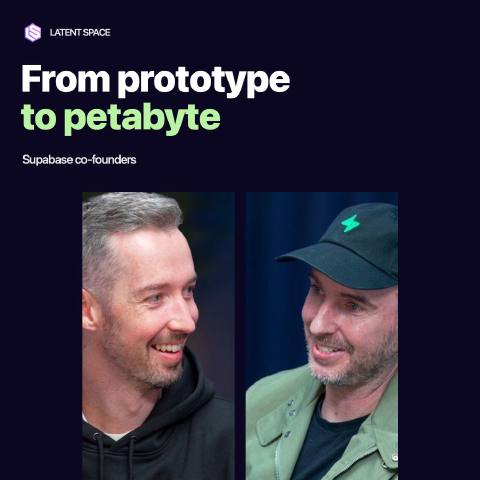
Back to Why Agents Love Supabase, with Paul Copplestone & Ant Wilson.

Why Did Supabase Rewrite the Postgres Operator?

Paul Copplestone says every Postgres operator they tested could lose data under some condition. An operator is the software that runs a cluster: extra nodes, failover, and backups. Supabase looked across the ecosystem and found a failure case in each one.

Multigres is the ground-up rewrite of that layer. The original goal was sharding for Postgres. What shipped first is an operator they are willing to trust. They ran a thousand sequential failovers and it did not lose data, and they tried to break it in the other ways they could think of. The release is open source. Teams running serious workloads can ask to use it on the platform. That access starts invite-only.

Transcript

Why Agents Love Supabase ·

From the transcript

So we're releasing it tomorrow in full beta, and we also made it Apache 2 license. It comes with a patent, and the Apache 2 license covers the patent. So we actually acquired the technology, continue to develop it, and then we pay for the patent and are now giving it away for free. One thing that you mentioned in passing, which I still don't, I can't get over, is that you tested every operator and you said every operator drops data in some situation.

Well, so this is for the second one. So scaling up. So that's Multigress. Yes. So Multigress is the second big announcement. Basically, we looked at the Postgres ecosystem, and we looked at all the operators. An operator, for those who aren't familiar, when you run Postgres, you start with a single node. But then with almost any database, you want to run multiple nodes, and you want things like failover, you want it to manage backups.
See in transcript

Latent Space: The AI Engineer Podcast

More from this episode

  1. Why Do AI Agents Need Compute Next to the Database?Paul Copplestone says Supabase Edge Functions, which run on Deno, stop at about two seconds.
  2. Why Is Supabase Preparing for Billions of Databases a Month?Paul Copplestone says Supabase already launches about 5 million databases a month, and the agent path they are planning for is billions a month.
  3. Why Do AI Coding Agents Activate Faster Than Human Signups?Paul Copplestone says the latest jump in Supabase signups came from the models getting better, not from a marketing spend.
  4. Why Do AI Coding Agents Keep Choosing Supabase?Shawn Wang says his tracking of model answers shows frontier models recommending Supabase as the default integrated backend: the database, auth, functions…
  5. Does Supabase Track Open Source Adoption?Paul Copplestone says Supabase deliberately does not measure how far the open-source project has spread.
  6. How Does Supabase Pay Its Sales Team?Paul Copplestone says Supabase pays sales only for the growth a help call adds on top of growth the account would have shown anyway.
  7. Why Won't Companies Migrate a Production Database?Paul Copplestone says a move from one production database to another almost never happens, and he would bet it almost never will.
  8. Why Were AI Coding Agents Breaking Postgres?Paul Copplestone says a database is harder to leave than a frontend tool, which is why Supabase can stay stickier than a coding app such as Lovable.
  9. Why Can't an AI Agent Read a Folder of SQL Migrations?Paul Copplestone says an agent cannot see the shape of a database from a folder of SQL migrations. Each change adds another file.
  10. Where Did the Supabase Co-founders Meet?Shawn Wang says Paul Copplestone and Ant Wilson, the Supabase co-founders, went through Entrepreneur First in Singapore, each on a different company, and…
  11. How Much Does Supabase Spend on AI Coding?Paul Copplestone says Supabase does not set one AI coding policy for the whole company.

People

More answers like this

More with Shawn Wang

More with Paul Copplestone

Related episodes

Plays from this note through the rest of the episode.

Weekly highlights

One letter a week.

The notes worth hearing, with the minute they were said.