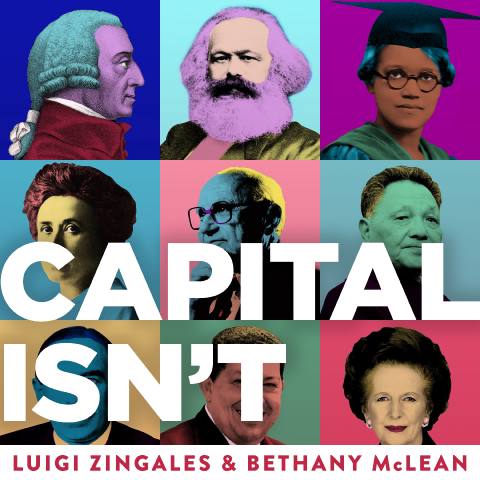
Luigi Zingales
Related people
Episodes
Notes
Capitalisn't · 2026 Midterms: Promises vs. Economics
-
Should Data Centers Pay Their Own Power Bills?
Bethany McLean pointed to bipartisan overlap on constraining data centers. Democrat Annie Andrews wants to propose a two-year moratorium in South Carolina. Mike Rogers, the Michigan U.S. Senate candidate, wants a one-year moratorium on data center construction. She asked how to square that with the Trump administration's drive to beat China on AI.
Luigi Zingales said that, at some level, democracy works: 70% of people are against data centers, so both parties try to cater to that demand. A paper he saw last year found that people claim to favor windmills, then refuse one next door because the machines go all night, and house prices drop 12%. Data centers, he said, run the risk of increasing
-
Should Credit Card Interest Be Capped at 10 Percent?
Bethany McLean asked about a federal 10% cap on credit card interest rates. Luigi Zingales noted that even Trump is campaigning on it. McLean added that Bernie Sanders and Republican Josh Hawley have also backed related legislation. From her work on the subject, the cap does not seem like a good idea, because it will carry unintended consequences for the availability of credit.
Zingales agreed the limit will definitely have an impact on who can borrow. The deeper question, in his view, is whether that availability of credit is good or bad. If it favors consumption that is not particularly useful, people may cut medicines or more important expenses in order to pay for that consumption. He di
-
Why Do Down Payment Subsidies Raise Home Prices?
Bethany McLean was struck that nearly everybody has a housing plan. Mike Rogers would let borrowers defer student loan payments while saving for a down payment. Ken Paxton promises a $50,000 deduction for a home down payment. She asked whether any of these proposals really fix the fundamental issue.
Luigi Zingales said they do the opposite. If supply is not very elastic and does not respond much to prices, as happens when people cannot build, giving a subsidy to demand will only increase prices. Subsidizing demand is a terrible idea. What is needed is to make supply more elastic, and that means touching the interests of homeowners, a large constituency among Democrats and Republicans. He ca
-
Why Does a Janitor Lose Money Moving to New York?
Luigi Zingales said the cost of housing is one of the main reasons the country does not see more internal mobility that helps lift all boats. In the 60s, a janitor who moved from Arkansas to New York gained, he thinks, 70% after the cost of housing. Today, a janitor who makes that same move loses 7% after housing.
The biggest problem, in his view, is that towns do not allow bigger buildings, and local codes are the biggest obstacle. If a rule required, he exaggerates, 100 acres before anyone could build, only the super rich could afford it and houses would cost a fortune. If you can build a high-rise on every corner, he said, the cost of housing would go down.
-
Why Do Few Candidates Offer a Federal Debt Plan?
Luigi Zingales said the U.S. deficit is starting to be worrisome, and that the country will need to be more fiscally disciplined. He did not see many candidates talking about that. He pointed to a Democratic candidate for senator in North Carolina who seemed to run on a more austerity package, which he called remarkable.
Bethany McLean corrected the state: the candidate is Annie Andrews in South Carolina, and she has the taxpayer pledge that calls for balancing the federal budget. In a field where really few candidates address the federal debt directly and almost none offer a detailed plan for making it sustainable, Andrews was the clearest example. Ken Paxton in Texas promises spending res
-
Why Is Promising to Bring Prices Down Reckless?
Bethany McLean asked whether bringing prices down is even the right objective. She wondered whether the better goal is purchasing power, and the price of essentials relative to wages. Lower tariffs, she said, might ease some prices, but that does not guarantee a return to older overall price levels. ACA subsidies might reduce household premiums without reducing the underlying price of medical care.
Luigi Zingales agreed, and called a promise to bring prices down reckless, because a huge deflation is generally terrible. The aim, at least, is for prices not to go up, and for wages to rise farther than prices. Ideally the price level stays relatively stable while wages go up. Gasoline is the e