Why Does Thariq Want Airhead Kids?
Thariq wants future kids he does not have yet to be airheads. Happy, able to navigate life, and not forced to introspect so much. He says that is what he wants for them. It is not that he can live that way himself…
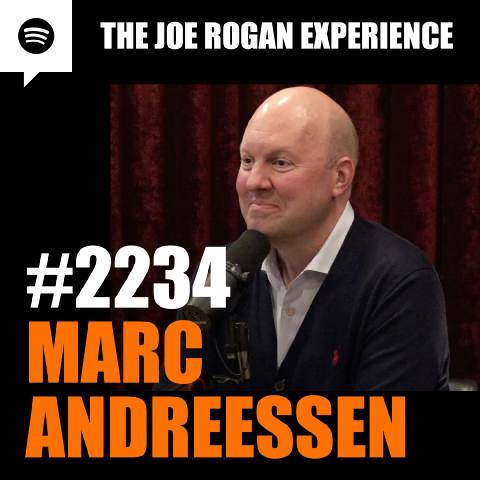
Marc Andreessen is an American businessman.
Episodes: The Frontier Ideas a16z Wants to Fund | Marc Andreessen, Ben Horowitz & Chris Dixon · #2234 - Marc Andreessen · Shutting down a startup, joining an AI lab, and leaving it | SOTA EP2 · The Challenges of a Repeat Founder
Thariq wants future kids he does not have yet to be airheads. Happy, able to navigate life, and not forced to introspect so much. He says that is what he wants for them. It is not that he can live that way himself…
Chris Dixon says the internet is headed for a world in which the most numerous participants are agents, not people. The shift is still early, and he calls it somewhat inevitable. Muse and Instinct are utility proxy…
Chris Dixon says founders should ask whether an idea is ambitious enough, not whether it is too ambitious. What is possible is spectacular, and a moderate idea probably will not be differentiated enough to matter. Some…
Thariq wants future kids he does not have yet to be airheads. Happy, able to navigate life, and not forced to introspect so much. He says that is what he wants for them. It is not that he can live that way himself.
Vivian Midha Shen calls this a Marc Andreessen train of no introspection, just living. Thariq says yes, basically. He ties introspection to achievement. The reason you introspect, he says, is that you do not fit your environment and something about your life has to be figured out. People who fit fairly well do not have to keep reflecting on how to fix that environment.
Vivian Midha Shen says the take is interesting for San Francisco, because a lot of people there, especially peo
Chris Dixon says the internet is headed for a world in which the most numerous participants are agents, not people. The shift is still early, and he calls it somewhat inevitable. Muse and Instinct are utility proxy agents that act for people. Further categories of agents come next, and those agents become the main participants on the internet.
Agents will need their own ways to communicate, transact, and share knowledge, so a run of new products has to be built for them. They have already built their own version of a public forum inside a Hugging Face app. The agent ecology online is going to be spectacular, and people will plug into it in all kinds of ways.
Chris Dixon says founders should ask whether an idea is ambitious enough, not whether it is too ambitious. What is possible is spectacular, and a moderate idea probably will not be differentiated enough to matter.
Some incumbents, including technology companies in Silicon Valley, will be able to adapt, and Andreessen Horowitz wants to arm them with the new tools. He would tell any of them listening that the clock is ticking. He is full-time on the work and describes himself as drowning in how fast development is moving. A super-empowered 24-year-old with AI, in his view, will achieve amazing things in the next decade.
Marc Andreessen says AI-native startups already see what they can do with AI differently from a typical incumbent in almost any industry, and he calls the gap as wide as any he has seen in his career. The gap is still opening, because the capability races ahead week by week. Those founders will not stay inside one category. They will not think of themselves as only a software company, only a hardware company, or only an AI company. He already sees them choosing how many areas to touch and how to combine those areas.
He sets the change against Netscape in 1994. If he and Ben Horowitz had today's tools then, he says they would have built the whole internet, gotten crypto done then, had stream
Chris Dixon says a16z Frontier chooses to be too early because every good idea the firm has seen that involved technology has eventually worked, or he believes it will work if it has not worked yet. The qualifier is a good idea. Bad ideas exist. Almost everything that worked had a precursor that failed and was maybe 10 years too early. Timing is the hardest thing to predict, because the technology, the culture, the business environment, and the political environment all have to line up.
The fund accepts category risk. Some categories may not work. Oculus was bought, and 13 years later he still believes strongly in virtual reality, but it is not as mainstream as he wanted, because more hard
Chris Dixon says Douglas Adams, author of The Hitchhiker's Guide to the Galaxy, described how people receive any new technology in three different ways, split by age.
Below 15, the technology is just how the world works. He tells of introducing his own child, at seven, to a computer that answers questions. The child treated it as obvious: what good is a computer that does not answer questions? From 15 to 35, the technology is new, exciting, and a place to build a career, so people want to learn it. Above 35, it looks unholy and evil, sure to overturn existing structures and destroy society. Refusing to answer the telephone fits that pattern, and an old man yelling at a cloud keeps showing u
Chris Dixon says humans just figured out how to turn sand into intelligence, a framing he credits to Marc Andreessen. The way to learn it is math and computer science, and maybe economics, though he is not sure economics belongs on the list.
He feels fortunate that a lot of his career, with Ben Horowitz and Marc Andreessen, happened during the growth of the internet, something bequeathed by people before him. The AI work now is going to be the dominant narrative of the next 20, 30 years. Being in the mix, at the cutting edge, and using the tools is the obvious thing to do, and the work does not have to be solely technical.
A lot of other fields are going to be revolutionized. Classics is b
Chris Dixon says the internet business model is breaking, and he puts the start of the break maybe in the last decade while calling the break especially sharp now. He names the old arrangement the internet's covenant, a deal between the distribution side, Google and Facebook, and the content side, news sites, travel sites, and other publishers. A site would give Google a snippet, let Google index the page, and Google would send clicks back. A Google search now returns an answer, and social networks try to keep people on the platform instead of linking out.
Websites that make money on ads and conversions can no longer do that. Stack Overflow and some other websites saw traffic drop precipito
Marc Andreessen says open models are lapping closed models by six months to 12 months, depending on how you count, and open source is racing ahead.
The U.S. and China, the two great tech superpowers, both have active open source worlds alongside companies building proprietary systems. For the last three or four years, governments have threatened draconian regulation or a ban on open source. The EU still aspires to do it and does not quite have the leverage to threaten fines until the work stops. The current U.S. administration is 100% pro-open source and 100% wants American open source to happen and to win AI globally. The Chinese Communist Party is, at the moment, enthusiastic about open s
Marc Andreessen calls the pattern product manager brain: product managers design products for product managers. People build products for themselves, and product managers still tell a story about building for other people. The use cases stay in the same circle, such as booking a restaurant in San Francisco for dinner with friends who are also product managers, or booking a flight to a product management conference to spend time with more product manager friends.
The same narrowness shows up in an assistant pitched as happy, harmless, and honest, which becomes the most boring possible product and refuses a question it is not allowed to answer. Early companies held a blinkered view of human a
Chris Dixon says Andreessen Horowitz is expanding the crypto fund to Andreessen Horowitz Frontier for two reasons, and he leaves the second one uncertain: there was maybe a gap in coverage of stranger ideas. Crypto has worked really well in some areas, so it now sits inside the broader technology landscape. Other groups at the firm have so many interesting opportunities in core areas, and are doing an amazing job with them.
Stablecoins have become a normal part of the technology landscape. Companies like Stripe use them, almost every fintech company treats them as part of the toolbox, and Wall Street firms are moving heavily into crypto, including tokenized stocks and other assets. The cate
Marc Andreessen says the country is probably in its first profound political realignment since the 1960s, when politics in the South shifted between Johnson and Nixon, and the current shift is the most profound version of that change. A multi-ethnic working class coalition came together around Trump against the exaggerated elite-plus-underclass structure the Democrats built, and far more people sit in the middle.
The black vote for Trump is way up. The Hispanic vote for Trump is way up. The gay vote is following the same pattern, and the union vote is for Trump. Identity groups the Democrats relied on for years are part of the same swing. The California electoral map for 2024, compared with
Marc Andreessen says the Chan Zuckerberg Initiative was brutally attacked from the left because Mark Zuckerberg and his wife decided where the money would go instead of letting the government allocate it.
Mark Zuckerberg and his wife had a ton of money in Facebook stock and created a nonprofit called the Chan Zuckerberg Initiative. The original mission was to literally cure all disease, and in his account the money could be like $200 billion. They committed to donate 99% of their assets to the new foundation. The attack said they were only doing it to save money on taxes. You do not give away 99% of your money in order to save money on taxes. The attack was vicious. The fundamental reason w
Marc Andreessen says 90% of the drones used by the United States military and by United States police are Chinese-made because the FAA basically made drones illegal in the United States years ago. A person cannot legally fly a drone in the United States beyond line of sight without a pilot's license. An American drone manufacturer has to build a system that enforces the regulation, so the drone either cannot fly beyond line of sight, which is not very useful, or the company only sells to customers who hold pilot's licenses. China has no such restriction.
The United States runs a more open economy, so Chinese drones can be bought in the United States and used however the buyer wants. The use
Marc Andreessen says censorship of AI has the potential to be a thousand times worse than social media censorship. Studies show the political orientation of the models, because questions get direct answers, and nine out of 10 of them are tremendously biased, with a handful that are not. He has been telling people in Washington that one threat is the government forcing startups into compliance, not only with trade rules but with their products: a censorship regime on AI exactly like the censorship regime on social media.
Social media is important, but at the end of the day it is just people talking to each other. AI is going to be the control layer on everything, including how kids learn in
Marc Andreessen says the Democratic Party is the top and the bottom versus the middle. The top is the upper middle class coastal elites: high net worth, high income people in knowledge jobs, including professor, reporter, programmer, database expert, author, lawyer, accountant, and banker, who went to top schools and hold elite degrees. He counts himself in that group. The bottom is the clientele underclass, called the rainbow coalition: minority groups such as low-income African-Americans, low-income Latinos, and recent immigrants.
Republicans in the current era are the middle class and lower middle class, people without fancy degrees who do the work that keeps the country running. The ran
Marc Andreessen says most federal workers never came back to the office and still draw a paycheck. At one federal agency, the union negotiated the return from COVID, and the agreement requires people to be in the office one day a month.
Something like half, a very large percentage, never came back at all. They stay on the job and work from home. Some federal agencies employ civil servants with full civil service protections who are also unionized, and the taxpayer covers the entire payroll. Civil service protections are a made-up arrangement. The Constitution contains no concept of them.
The one-day rule means the office requirement is a single day each month. Workers can keep the job, the
Marc Andreessen says an employee doing crypto policy was debanked because crypto was in his job title. The bank said it screened the customer base for anyone with crypto. Crypto was politically controversial, so anybody with crypto became a politically exposed person.
A Wells Notice is a notification that you may be charged at some point in the future. The SEC does not have to investigate, subpoena, or prosecute anyone for the notice to do damage. A company holding one has trouble doing business with anybody else, working with a big company, or getting access to a bank. Under Biden, the SEC did a lot with DEI and then ESG. ESG is a malleable concept, and the agency piled new requirements in
Marc Andreessen says Choke Point 2.0 is a privatized sanctions regime that lets bureaucrats kick American citizens out of the financial system the same way the United States cuts off Iran. Banks do it because regulators expect them to, while officials still say a private company such as JP Morgan chose its own customers.
The pattern started about 15 years ago under the Obama administration, as marijuana and prostitution became legal and fights over guns continued. Legal marijuana businesses, escort businesses, and gun shops were pushed out of banking. A medical marijuana dispensary in 2012 had to run entirely on cash: no bank account, no Visa terminal, no card transactions, no payroll, no d
Joe Rogan says Trump is clearly less pro-war than the Biden administration. Trump wants to end the wars. Biden just allowed Ukraine to use long-range missiles into Russia.
He does not know what is going on in negotiations and hears all kinds of different things. One side is pushing for the wars and seems all in on the fighting. The other side is not. Placed side by side, the two positions do not look like a small disagreement. The polar shift is so dramatic, and the reversal is really weird, because one camp is for carrying the wars forward and the other camp wants them finished.
Marc Andreessen says the Gulf of Tonkin incident did not happen. The incident that kicked off the big escalation of the Vietnam War never took place, and the whole thing did not happen.
A big debate remains over whether the people behind the story knew it did not happen or faked it. History already includes cases like the Gulf of Tonkin, and past cases cannot be fixed. AI will be a new way to do the same kind of thing. People can be reoriented so proved material is taken seriously. When someone wants to know what is happening, real material can be proved real. Material that cannot be proved is entertainment. People can choose to believe it, but they should not rely on it. The response will
Marc Andreessen says Democrats became the trickle-down party, especially in the last four years.
For a long time the criticism of the Republican Party was trickle-down economics. Rich people were going to get all the money because they were going to cut taxes, and poor people would get any money only because the rich trickled some down. The pattern inverted. Democrats tax, collect all the money, give it to the government, and let the government hand it out, under a public Robin Hood message to tax the rich. The result is $35 trillion in federal debt, a giant annual deficit, and a shower of grants and money coming from the government.
If the government is giving somebody money, the governme
Marc Andreessen heard a senior Democrat on the way out of politics say in the summer that Trump was going to win with 100% certainty. He described the Democrat as coming from a purple state, not New York or California, and likened it to maybe Arizona, a broader cross section of people.
The test was to fly into any purple place, go to a second or third tier side city, land at the airport, take an Uber, and drive around for 30 minutes. Ask the driver how it is going and who they are voting for. A hundred percent of the time the answer was going to be Trump, because people were completely fed up.
Kamala enthusiasm was highly focused in New York and California. New York and California do not m
Joe Rogan says Marcus Aurelius's Meditations still applies to modern life, and the words still ring true.
A couple of months ago he read Meditations again and listened to it in the sauna. The book is brilliant. Marcus Aurelius was thinking in terms that stay valid today and apply so well to modern life, even while running an incredible empire. He wrote about human psychology, the value of forgiveness, being true to yourself, and constantly being truthful everywhere in everything. The virtues and the stoicism he espoused are valuable today.
It is remarkable that a leader from 2,000 years ago left words that still ring true.
Marc Andreessen says Cicero's fishponds were the country projects Rome's capable citizens perfected while they dropped out of public life. He puts the healthy, vital run of the Roman Republic and Empire at about 400 years and treats the figure as rough. Toward the end, as Rome stagnated and started to fall apart, the roads got dangerous and nobody could quite explain why. Competent citizens sat at villas in protected environments they controlled, focused on ornamentation, clothes, and lifestyle.
Cicero, one of the great Roman statesmen, wrote letters to aristocratic friends on exactly that theme. The call was to stop the fishponds, get back out, rejoin the Senate, and keep the system from c
Marc Andreessen says a religious history scholar who teaches at Catholic University told him medieval people were psychologically better prepared for the era ahead with AI, robots, and drones than people are now. Medieval people took for granted a world of higher powers, higher spirits, angels, demons, and all kinds of supernatural entities, and they assumed that picture was true.
In the world ahead, which he describes as arguably already here, new forces and new entities will run around doing things. People will struggle, catastrophize, and conclude AI is the end of the world. Medieval people would have treated AI as just another spirit and just another kind of entity. AI is better than hu
Marc Andreessen says Mach 5 jet drones will be common within a few years and will change the fundamental equation of war. Winners used to be the side with the most soldiers and the most equipment. In a drone war, winners will be the side with the most money and the best technology.
The drones will be a fraction of the size of current manned planes, so a military can field a lot more of them. Picture 1,000 of them coming over the horizon at once. A small advanced state like Singapore will punch way above its weight. Large states that are economically or technologically backward, and that normally would have won, will now lose. The balance of who can fight and win will be recalibrated.
The g
Marc Andreessen says the Biden White House directly exerted censorship pressure on American companies to censor American citizens. He calls the pressure flatly illegal and believes the people involved have criminal liability. Members of Congress applied the same pressure, which he also calls illegal.
The pattern was consistent across the companies. Nothing in the Twitter files happened only at Twitter, and YouTube files would look exactly the same. The companies and the people in them bear a lot of responsibility for bad judgment calls. Outside third party groups were funded to bring pressure down on censorship. A unit at Stanford, right next door, was an internet censorship unit funded by
Tikhon Bernstam told the Y Combinator podcast that across about 60 angel investments, including Cruise, which sold to GM, plus Gusto, LendUp, Checkr, Optimizely, and Reddit, the first screen is the size of the market. Without a large one, a strong product and a relentless team still struggle. He avoids founders who would fly to a conference that does not help the company. He likes solo founders, and named Drew Houston, who started Dropbox alone. Borrowing from Marc Andreessen, he said a strong team in a great market gets pulled into the right product. Docker came out of dotCloud that way, and Twitch was the gaming piece Justin.tv kept after dropping the rest.
Plays from this note through the rest of the episode.
Original audio is not currently available.