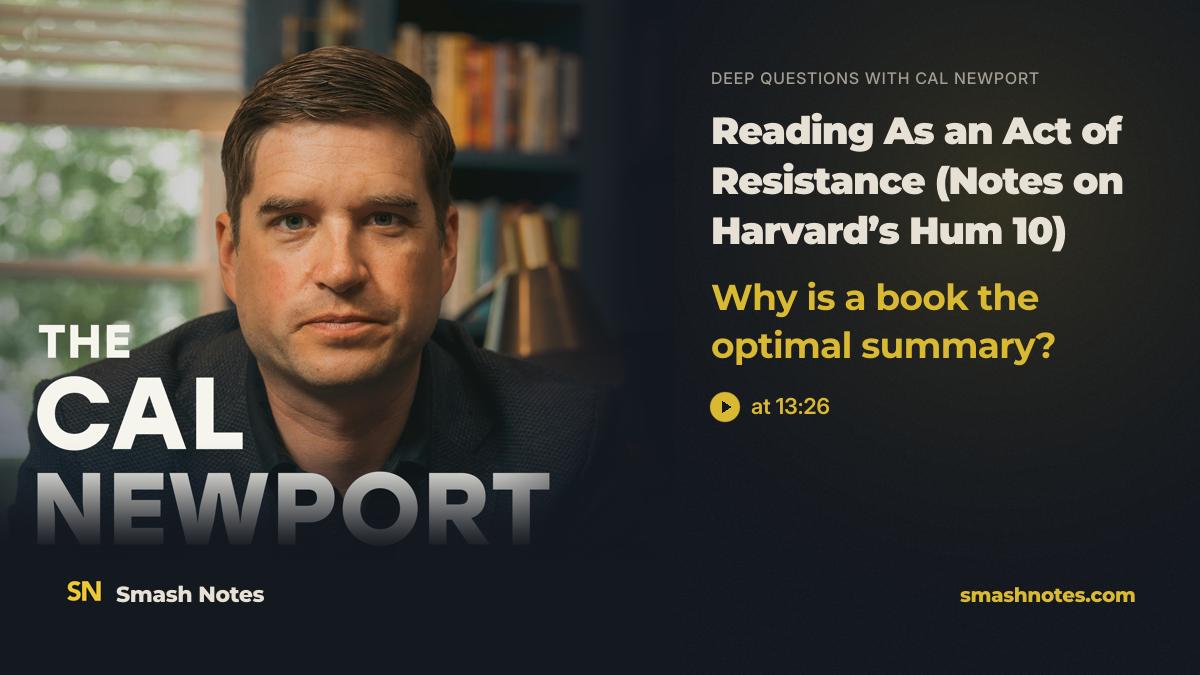
Reading As an Act of Resistance (Notes on Harvard’s Hum 10)
Two years ago, The Atlantic featured a distressing story about elite college students who could no longer read books. Last week, The Wall Street Journal offered some hope that things are getting better. An article by Pamela Paul described how Harvard’s ‘brutal’ humanities course, Hum 10, which requires students to read one hefty book per week, has become…
People
Notes
-
What Is Harvard Hum 10? at 1:07
-
-
Why Is a Book the Optimal Summary? at 13:26
Related notes
- Why Does Michael Lewis Put the Reader Ahead of the Subject?
- How Does Talking to a Chatbot Affect Loneliness?
- When Do AI Debate and Amplification Apply?
- Why Does Robert Caro Reduce a Book to One Sentence?
- How Does Cutting Social Media Affect Distressed Youth?
- Why Does Life Stage Matter for the 4-hour Workweek?
Related episodes
-
![]() Ep. 208: To-Do Lists Are Inhumane
-
![]() Ep. 218: Work vs. Meaning
-
![]() AI Is the New Social Media. Can We Protect Kids This Time?
-
![]() A Stanford Psychiatrist on Escaping the Addiction Economy
-
![]() Investor Elad Gil’s next moves
-
![]() Robert Caro – The master biographer reflects at 91
-
![]() #887: Q&A with Tim — The 4-Hour Workweek in a World of AI, Rebuilding Personal Agency, The 4-Hour Body After 40, and More
-
![]() Author Michael Lewis (‘The Big Short’) Pulls Back the Curtain
0:00
In our current age of smartphones and AI, have college students basically given up on trying to read full books or write on their own? Well, the answer depends on who you ask. So remember back in 2024, Rose Horowitz wrote a blockbuster article for The Atlantic that had an
Expand full transcriptCollapse transcript
The episode notes above make this conversation easy to skim.
0:00
In our current age of smartphones and AI, have college students basically given up on trying to read full books or write on their own? Well, the answer depends on who you ask. So remember back in 2024, Rose Horowitz wrote a blockbuster article for The Atlantic that had an alarming title. It was called The Elite College Students Who Can't Read Books.
0:23
Now, this article painted a pretty grim picture about collegiate literacy. Let me read you the introductory paragraph of that piece from 2024. Nicholas Dames has taught literature humanities, Columbia University's required great books course since 1998. He loves the job, but it has changed. Over the past decade, students have become overwhelmed by the reading.
0:45
College kids have never read everything they're assigned, of course, but this feels different. Dames' students now feel bewildered by the thought of finishing multiple books a semester. His colleagues have noticed the same problem. Many students no longer arrive at college, even at highly selective elite colleges, prepared to read books. All right, so that was a sort of a depressing article when it came out.
1:07
But just last week, Pamela Paul published an article in the Wall Street Journal that shed a ray of hope. This article was titled, The Brutal Harvard Class That Suddenly Everyone Wants to Take. And it's about a freshman humanities course that's nicknamed Hum 10. Here is how Paul describes it. This class is definitely not for padding the GPA.
1:30
Students read a hefty book a week and write regular essays. There is no pass-fail option. Digital devices are verboten and attendance is taken in every lecture. So Hum 10 feels like the type of course that the students described in that 2024 article in The Atlantic would try to avoid at all costs. Yet at Harvard, it's a hit. Paul actually calls it the surprise hit of Harvard's academic lineup.
1:57
You have to write an essay to try to get in. Over 180 students applied for only 90 slots in the most recent semester. So what has changed between these two articles for those kids? Well, I have a theory here, and I think it's an important one to discuss because it gives us some insight into how to resist some of the most dehumanizing forces from big tech.
2:21
So I thought I would jump on the mic here and record a quick episode to explain my idea. So let's get into it.
2:32
All right, so what's going on with this Hum 10 course at Harvard? First, I want to read a couple of quotes from students from the piece that establish what it's like, what the attitude is like for the students taking this course. All right, so here's the first one. It says, if you don't have the work ethic, I don't think you should be taking this class, said Jaden So, an aspiring opera singer from Chicago.
2:56
Most students complete most of the assigned reading, if not always on time, only a few cop to skimming one or two Of the denser books. All right, here's another quote from the article. It's the only class I took at Harvard where people would call each other out for not having done the reading said Ellie Powell, a Hum alum who graduated in 2025.
3:15
You didn't want to disappoint the seminar by being the only person who didn't read or whose comment really didn't add to the discussion. We all felt like we were building something and that was a remarkable feeling. All right. So this is important. The students in this class want to do the work. They like that you have to do the work. It's a point of pride for those who were there.
3:36
So why is this attractive? Well, we can get more insight into that if we return to the article where Paul uncovers some of their stated motivations for signing up. Let me read here. In their applications and in interviews, students expressed the urge to be forced to tackle the classics that they wouldn't otherwise read. The need to combat frayed attention spans and the desire for an antidote to the machine.
4:00
Several mentioned with disdain that people who aren't in the class wondered why they didn't just chat the books, i.e. use AI. See, now we're getting somewhere. The students in this course want to be pushed to read hard books. They want to be pushed to write, and they have a growing sense of disdain for their classmates who say, well, I don't understand why you would do all this work.
4:23
You could just chat about the book with a chatbot or have it produce the writing for you. So they are resisting that, and they want help resisting that.
4:34
All right, so I want to dig deeper into, I think there's an underlying phenomenon that brought students to that point where they wanted to sign up for Hum 10 and be forced to read hard books and to write on their own. There's a broader phenomenon that brings us there. Now, my name for this broader phenomenon is reward shortcutting. And I think reward shortcutting, the right way to think about it, is a consumer acquisition strategy by big tech.
5:04
If we go back about 20 years, we noticed that consumer facing big tech began to look for ways to use with their digital tools, to have the way people use their digital tools, deliver a shortcut to longstanding things that we have found long found rewarding, to shortcut rewards.
5:28
This is very compelling. And because of this, you could get massive user bases. And with massive user bases, you could get a huge amount of money for the early investors and founders of these companies. All right, so I want to explain more what I mean by reward shortcutting. Let me give you an example. I think this strategy really started with early social media.
5:50
So early social media, think about like Facebook in the 2000s. Early social media was about providing a shortcut to the reward of feeling social. We are social creatures. We seek out sociality. It feels good to be enmeshed within actual social networks. We crave it because it was important for our survival. Early social media really focused on helping you get a sort of much easier access to that feeling of being social because now you could just chat, leave a chat with someone, leave a comment on someone's wall.
6:25
Someone could come and leave a comment on something you posted. You could poke people. Which, you know, sounds dirty, but it wasn't. It was actually a feature of early Facebook where you could go to someone's Facebook page and click a poke button, which was just a way of leaving a note that said, I was here. And so it gave you this sense of being very social.
6:43
Other early social media tools actually built on this as well. Leaving comments, posting things, everyone commenting on each other's– the things they post will comment on each other's posted. It created this real sense of I've never socialized with more people before. That was very attractive because we're social beings.
7:03
Did it work? Well, it turned out when social psychologists look closer at it, this didn't make us happier. Why? Because the deep parts of our brain that care about social connection didn't know about whatever was happening on these digital glowing screens. They didn't know about that. That didn't feel like real socializing to the deep part of our brain.
7:25
Because the deep part of our brain, to think that there exists a social connection between me and you, wants to see that I'm sacrificing non-trivial time and attention on behalf of you. That's how you know that you're someone serious and my wife, and they want to see that reciprocated. So that's what we actually need to feel social. So social media, early social media, was giving us in the moment the sense of we're very social, but we have this paradox that researchers found where the more people were using social media, the lonelier they were getting because it actually took them away from that non-trivial sacrificing time and attention that we really need.
8:00
to feel social. And it gave us this sort of lightweight simulation, which was very easy and low friction, but ultimately didn't actually satisfy our social drives. So that was an example of reward shortcutting, making those early social media tools very compelling, but it actually left us worse off. All right, let's move forward on this timeline.
8:18
We get another example, post TikTok social media. So TikTok came along and really established forget sociality. Yeah, that's compelling and you get a lot of people to sign up for Facebook. But if you really want people to use these things all the time, that's not enough. We have to now shortcut the reward of feeling engaged in something. Because that's a reward we can offer all the time.
8:43
There's only so much that you can check in on what your friends are up to before there's nothing else to see. But engagement we can offer all the time and get a lot more use of the phone. So TikTok really figured out, let's just have really clean interfaces and a basic sort of multi-armed bandit style optimization algorithm to build out an implicit model of the reward center of your brain.
9:05
And they get very good at showing you things to give you short-term burst of engagement. your attention
9:12
captured by something in a way that feels good in the moment. And if we have this basic algorithm running with enough data, make the interface as simple as possible to get as much examples as possible, pretty quickly we can put it in my veins and give you a constant stream of engaging stuff. Now, of course, humans like to be engaged. We seek out things that are engaging throughout our history.
9:33
In all the different places humans have been, we seek out engagement. You go to an isolated Polynesian island, you go to Hawaii 500 years ago, and we're surfing. We want to find things to do that are engaging. So that is a compelling reward. Did it work? Well, no, we know it didn't work.
9:51
Because here's the problem. Real engagement requires a lot of effort to get to it. And because of that, the reward of real engagement is lasting engagement. And the footprint that engagement has on your life is constrained because of all the effort that goes in to getting it. Like, for example, it's, you know, I'm just thinking about this because I rewatched Zero Dark Thirty with my son recently.
10:14
Maybe you're like a real fan of Catherine Bigelow, the director. I'm going back to like when that movie came out. Maybe you're a big fan. You like the Hurt Locker. You followed this director. You've seen her work. You know about it. You know about her styles. You know what she's working on. You hear about this new movie. You're tracking this new movie's coming along.
10:33
You see the teaser trailer. You watch the real trailer. You're like, oh, Jessica Chastain in this is going to be good. Chris Pratt's in this. That's weird. Isn't he Andy from Parks and Rec? But he looks– we'll see. You know, it's all interesting. You see the early reviews. Yeah. Smart people taking it apart. Here's what's cool about this movie.
10:48
Here's what's meaningful. And then you finally get to go see that movie. And man, that's engaging because you have this whole intellectual, effortful context that led up to seeing that movie. And it really captures your attention and it's really lasting. You know how to pull deep meaning out of it. It changes the way you understand various things about that story and the art, et cetera.
11:05
And it lasts with you. That's what engagement used to be. When you just skip all that reward shortcut to like, oh, in the moment I'm very engaged by this video I'm seeing on TikTok, you miss all that context. And then the engagement is fleeting and its footprint in your life can be expansive because there's no hard work required to get it.
11:25
So you do more and more of it. It's always there because you don't have to work for it. And it's never quite giving you what you're hoping. And so you can't put it down. So again, reward short-cutting built up a very big consumer base. But ultimately, it didn't deliver us what we needed. Short-cutting the rewards causes problems. This brings us now to the technology that explains what's happening at Hum 10, generative AI.
11:50
So for a lot of people, the reward shortcut being offered by generative AI tools is we can jump straight to feeling like we have acquired or produced new knowledge. This is something, again, humans are very, we feel deep rewards when we learn something new or we feel like we produce new knowledge out there in the world. And of course we feel that reward because this was critical to the history of our species.
12:17
The ability to acquire information from each other is what allowed us to have cultural evolution that far outstripped the pace of biological evolution and allowed our species to bound the head of almost all the others. So we're wired to learning something new is important. To feel like we produce something new is important. That's how our species became so successful.
12:37
But Gen AI shortcuts it. It's hard to read a book. But it's easy. You can feed it to a model and it'll summarize it to the point where no effort is expended. Just, it's not this, it's this. And here's a point, here's the point. And it's pre-digested. And you just kind of see some points that all immediately make sense. Like I kind of feel like I learned something, but I didn't have to put any effort.
12:57
There's almost like a reward. Like you got away with something there. Same thing with writing. Oh man, I supervised a chat bot to help produce this report or paper. And I kind of sidestepped the strain of like facing the blank page and something came out that looked more or less reasonable. You know, you're like, I produced new knowledge and there's a little thrill of gotten away without having to have strain.
13:18
But just like with my other examples, when you shortcut to this reward, you missed the good stuff. Yeah. It's hard to read a book. That hardness is the feeling of changing your understanding of the world and yourself. That strain is similar to the strain that the athlete feels in the gym. That's how they know that their muscles are getting stronger or the burn they feel in their lungs as they run wind sprints, was their feeling of my cardiovascular health is getting better.
13:44
This is, I'm getting a real reward out of it. The cognitive strain of reading a book is how you know your brain is changing. You're learning something new.
13:53
the scaffolding on which you're understanding yourself and your world is actually reconfiguring. And that feeling of reconfiguring is what we might call cognitive strain.
14:02
So to sidestep the strain defeats the purpose. And this is the point I always have. I know a lot of people that say, why would I ever read a book anymore? I could get a summary from AI. But what they don't understand is the book is the optimal summary. The book is incredibly condensed. You have a, if it's a nonfiction book, for example, An expert who knows this world,
14:26
for he or she to actually convey everything you know about this world would be, you know, 100,000 pages. They have this expertise on the world, and they worked, and they toiled, and they struggled to figure out, like, what are the paths to this landscape of knowledge that are most fruitful and impactful, that if you follow, you'll come out with enough of the big ideas to be changed on the other end.
14:45
And they had editors work on it, and let's get this just right. It is the perfect summary.
14:52
That is the summary I'll write. To summarize it further doesn't make sense. It's like saying, I don't want to sit through 90 minutes of a movie, so I'm going to look at four clips in a one-paragraph summary. Well, that'll be easy to do, but you didn't get any of the benefits of watching the movie. So what was the point? Books are the optimal summary often.
15:11
If it's a novel, they've constructed this is the journey that's going to have the biggest psychological impact, right? If it's nonfiction, this is the path through this massive, endless landscape of information understanding that's going to deliver you to some sort of new awareness of what's happening in the world. And yeah, you're going to feel some strain, but that's just a feeling of the scaffolding of understanding reconfiguring.
15:31
You have to have some strain or what's the point?
15:35
Same thing with writing. Yeah, it's hard to write. Filling the blank page with your thoughts is hard. But that's where even more understanding happens. You don't truly understand something until you've grappled with trying to explain it. This isn't even for major complicated intellectual ideas. I was talking to someone recently who was writing up a schedule, an itinerary for an event.
15:56
And they're like, look, when I write this out is how I actually better understand what the event is the activities and how they fit together. And maybe after I try writing it first, I'm like, oh, I see I need to go back and change this or move it. Understanding comes from the strain of trying to produce the words is how my mind really loads this all up and I can really understand it.
16:16
So again, it's an example of reward shortcutting. Let's just get to like kind of simulating the feeling of I know something new by chatting with an AI about a book or that I produce something new by sort of supervising an agent to produce a report. When you shortcut the rewards, you miss all the good stuff. We don't end up better than we were before.
16:33
This is what I think the students that are taking Hum 10, this is what I think they're realizing. Reward shortcutting that generative AI is giving them on the reception and production of knowledge
16:47
is an empty promise. It's empty calories. It's the sociality that didn't really make you feel more social. It's the engagement that you didn't earn and ended up just making you feel emptier and more unhappy than before you began. It's the same thing. The reward shortcutting is not working. And so now we see this movement beginning and Hum 10 is an example of this.
17:07
There's many others. It's a movement that's emerging that says, I don't want to shortcut the reward. Hey, tech bros, strain is not bad. That is the feeling of something good happening. Sometimes real rewards often require effort. And that's what makes the rewards actually have a lasting positive impact on our lives.
17:28
So we have this vision of like, oh, young people, they don't want to do anything hard. And if you give them access to AI or something, they're going to shortcut all of it. And this is true for a lot of students. But there's also a growing group of students that say, I want the satisfaction of grappling with a book and changing my brain because of it.
17:45
I want the satisfaction of grappling with the blank page. And because of that, having a new understanding of what I wrote than I had from before. Force me to do it. Put me in a class that demands it. I will rise to the challenge. So again, this isn't everybody. But this highlights this general idea that all of us who want to focus on human flourishing and technological world should be aware of.
18:04
Big tech starting about 20 years ago said we can make a lot of money for a small number of people if we provide reward shortcuts. So we can get the sort of the dupes and the masses out there. We'll get them into our world so we can suck money out of their pockets and monetize their beings, their existence so that we can buy, you know, half a kawaii.
18:22
or have two giant lots next to each other in Silicon Valley, and we can tear down one of the houses to build a garden. By the way, that was Mark Zuckerberg and Steve Jobs I just described there.
18:34
And people are saying, if you recognize this, you're like, no, I'm not going to play that game. I'm willing to work for rewards. I want the satisfaction that comes from the real efforts. Give me useful tools that solve problems in my life. Stop trying to reward hack. Stop trying to make everything into a digital casino.
18:54
where VCs are the house that takes all the money from our gambling. Build us useful stuff. I'm going to go do useful things. So that is the optimistic trend. It's small, but it's emerging. That is the optimistic trend I'm picking up out of this Hum 10 story. And this is why I think this is happening. We are waking up to reward shortcutting is better for a small number of people than it is for the rest of us.
19:16
And we're getting fed up with it. Well, at least I hope I'm right about that. All right, that's enough for today. I'll be back on Monday. Thanks for listening. Today's episode was produced and mastered by Jesse Miller. Nate Meckler provided research and newsletter support. The video was edited by Ben Crane and Rob Montz. The theme music is adapted from an original composition by Jay Kirstens.
19:35
For weekly ideas for me to show up in your inbox, sign up for my newsletter at calnewport.com.