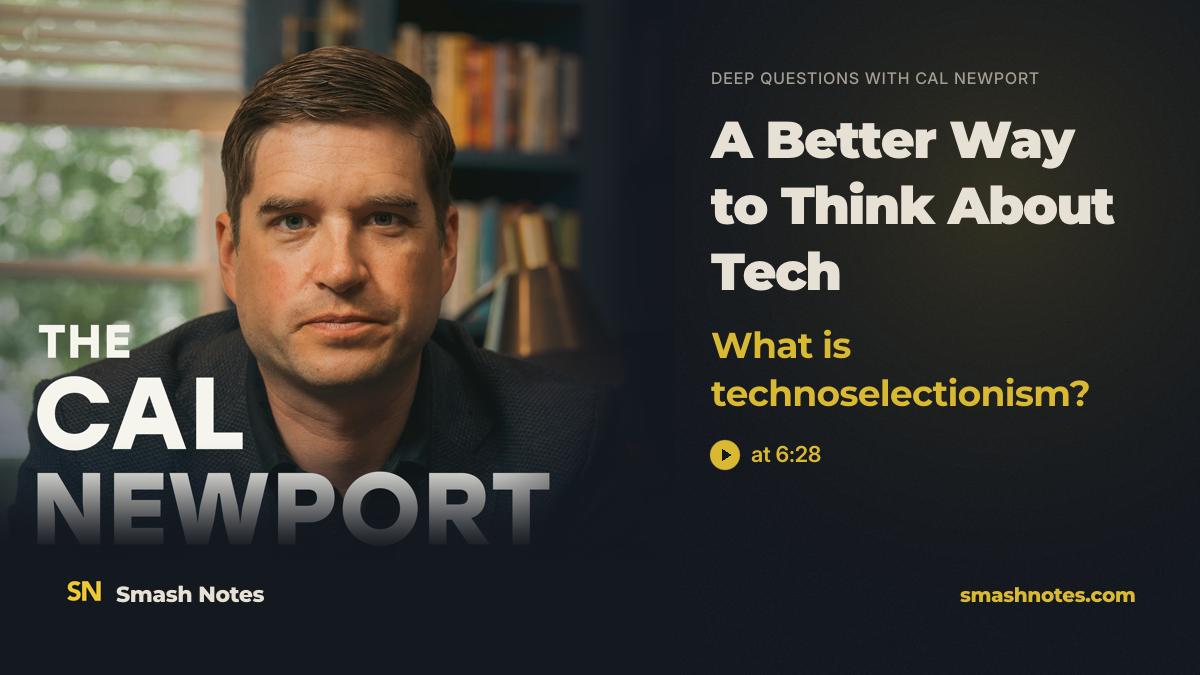
A Better Way to Think About Tech
Cal Newport defines technoselectionism as advancing technology on purpose: choose which tools to keep, constrain their use, and reject what causes net harm. After TikTok pulled users, Facebook, Instagram, and Twitter copied its algorithmic feed, and parents pushed 2025 bell-to-bell school phone bans. AI chatbots can quiz and explain, but offloading hard work can weaken skill and mental health.
People
Notes
-
-
What Is Technoselectionism? at 6:28
-
-
-
Why Did Social Networks Copy TikTok? at 17:31
-
-
-
-
-
Related notes
- Has Internet Gone Too Far
- What Is Going to Be the Future of Technology in Our Lives
- Why Does Removing Phones From Schools Improve Outcomes for Students?
- Do AI Tutors Actually Help Students Learn?
- Is Today's Media Shift Just Blogs All Over Again?
- Can AI Give Every Kid a Tutor?
Related episodes
-
![]() Ep. 208: To-Do Lists Are Inhumane
-
![]() Ep. 218: Work vs. Meaning
-
![]() Reading As an Act of Resistance (Notes on Harvard’s Hum 10)
-
![]() Twitter co-founder Ev Williams: “You’re selling attention”
-
![]() Adam Grant #4 (on the secrets of strong connections)
-
![]() Exit interview: Microsoft’s comms chief on CEOs, reporters, what he got wrong, and stories that stuck
-
![]() This AI Expert Argues We're Underestimating AI's Productivity Impact — With Ethan Mollick
-
![]() Stewart Alsop Iii Explores the Life in Silicon Valley Through a Conversation Between Peter Thiel and Eric Weinstein July 26, 2019


Original episode description
0:00
Have you noticed that it's become increasingly hard to talk about technology? I think this is because a lot of commentators have divided themselves into two different groups, both of which can become pretty extreme. All right, so on one side, we have what we can call the
Expand full transcriptCollapse transcript
The episode notes above make this conversation easy to skim.
0:00
Have you noticed that it's become increasingly hard to talk about technology? I think this is because a lot of commentators have divided themselves into two different groups, both of which can become pretty extreme. All right, so on one side, we have what we can call the techno-pessimists. Now, the techno-pessimists are worried about the harms that new technologies can cause and the things that we value.
0:24
that new technologies might make go away. I think the classic example of techno-pessimism would be the Luddite movement from the early 1800s who were worried about new automated manufacturing technologies like the steam loom and their input on artisan crafts. They felt really strongly about this. I have a letter here from 1812 written by members of the movement and signed by the sort of fictional creation of General Ludd.
0:53
And in this letter, they said they would rather die than see their children, which they called your neighboring fellow creatures, starve because hand weavers were going to be put out of business. Now, the thing about technopessimists is that they're often right in the sense that the harms they're worried about are real, and they are harmful, and they do hurt.
1:14
The issue with the technopessimist is that sometimes we have to go through short-term pain to get to long-term innovation that ends up making everybody's lives better. If we go back to the Luddite movement, let's zoom out to the Industrial Revolution writ large, and what we see is, yes, for a lot of professions, the Industrial Revolution was very painful in the moment.
1:37
Technopessimists of the time were right. But the Industrial Revolution also delivered essentially all of the wealth on which the modern world was built. We would not actually want to be living in a world today in which the Industrial Revolution never happened. OK, on the other extreme. We have what we can call the techno-optimists who really don't care about short-term harms or things we could lose right now, things we already value, because they are often in love with this vision of some sort of much better future that the technology will deliver, and the short-term cost in their mind is always worth it.
2:15
This can get to pretty unnerving places. Like, let me play you a clip here. This is Elon Musk talking to Peter Diamandis about humankind and super intelligent AI. I mean, several years ago, I said humans are the biological bootloader for digital superintelligence. Yes, we are a transitional species. We're a bootloader.
2:37
So what they're saying in this clip is that humans right now are essentially what they called biological bootloaders, basically just a step that gets us to the technological utopia they really care about, which is one in which we have a superintelligent AI that delivers us some sort of mystical world where, you know, everyone is happy and our consciousness are uploaded into a Dyson sphere powered celestial digital consciousness or something like this.
3:01
Right. I mean, clearly we see why the techno optimist view would push far enough gets to these sort of anti-humanist pretty icky places. So where does that leave the rest of us? Those of us who recognize that we need technological advances to continue to improve our the state of human existence and yet are also not really interested in hanging out with the biological bootloader crowd.
3:27
Like we actually do care about real humans who live right now and harms they might feel. I want to argue to you today that there is a third option for the silent majority of people who have a more nuanced practical view of technology. I call this third option techno-selectionism. Now, technoselectionism is not new. I actually introduced the term in an essay that I published in The New Yorker back in 2023, but I was rereading it recently and had this epiphany.
3:57
This is more relevant right now than it has ever been before. So that's what we want to talk about today. What is techno-selectionism? How does it differ from these existing more extreme ways of thinking about technology? And what action can you take right now to become a techno-selectionist? And by doing so, regain control over technology and its influence on your life.
4:17
All right, so we've got a lot to get into. Let's get into it.
4:25
All right, so to start our discussion, I thought a visual metaphor would be useful. I'm going to bring a picture up here on the screen that I drew. For people who are listening, I'll explain it to you. It's a map, I would say a beautifully drafted map. I think Jesse would agree with this. This is the dew on the leaves of the mountains, some in a view of a New England fall day or So I have a beautifully drawn map.
4:50
Here's what's important about it. In the lower left-hand corner is a region labeled current moment. In the upper right is a region labeled better future. And there's a bunch of obstacles all around this map. I have like scary snakes and there's fire. And I don't know, these X's, Jesse, I think are like... thorn thickets and we got some water or something like that.
5:10
So we got a current moment and then we see far away a better future. All right. So there's two different ways to think about this and I'll draw them. If you are a techno pessimist and I'll use a, I don't know, let's use a black line here. You're a techno-pessimist. You're starting a current moment. How are you going to navigate this landscape? You're going to stay nearby the current moment because there's dangers out there.
5:38
So we'll sort of work on technologies similar to what we have because we don't want to run into any of these dangers which could cause pain or harm. So I represented that with this black path that just sort of circles around the current moment. On the other hand... If you are a techno-optimist, you say, who cares about that? Let's just make a beeline for the better future.
6:02
So as I drew this line straight from our current moment to the better future, we went over all sorts of dangers. We hit a snake. We went over fire. We clipped over the water. So we go through all sorts of different pains and obstacles on our way to get to a better future, right? So either we have... The pessimist approach where we steer near the current moment, or we have the optimist approach where we go straight to the better future, but along the way we have all sorts of pain.
6:28
Technoselectionism is going to offer us a different route. Now, before I show it to you on this visual metaphor, let's take this down for a second, Jesse, because I'm going to load up that New Yorker article we talked about. And I want to read to you how I define technoselectionism, and then we'll go back and we'll add it to our visual metaphor of a map.
6:48
All right, so I bring up on the screen here a key quote from that New Yorker article. I'm going to read this here from the article. Technoselectionism is a perspective... that accepts the idea that innovations can significantly improve our lives, but also holds that we can build new things without having to accept every popular invention is inevitable.
7:12
Technoselectionists believe that we should continue to encourage and reward people who experiment with what comes next, but they also know that some experiments end up causing more bad than good. Technoselections can be enthusiastic about artificial intelligence, say, while also taking a strong stance on settings where we should block its use.
7:31
They can marvel at the benefits of the social internet without surrendering their kids' mental lives to TikTok. I'm going to jump down slightly where I then say... If we aggressively repudiate the technologies that are clearly causing net harm while continuing to embrace those that seem to be more beneficial, we can direct our techno-social evolution much more intentionally.
7:57
All right, so that is how I describe techno-selectionism in the pages of The New Yorker. So to put that more plainly, it's saying the middle route is one where we say we want technology to advance, but we do not do so without curation. We do not do so without change or analysis. We do not do so without intention, right? So if we go back to our map here, what the techno selectionist is trying to do, I'll draw their path as let's say a orange line here.
8:27
What the techno selectionist is trying to do is get from the current moment to the better future, but try to steer the path. Can we go around some of these obstacles? And maybe we still clip a few, but if we're more careful, if we navigate our path, we can avoid more of the pain and the harm as we try to get to our destination. So for those who are listening, I drew a line that, you know, it went around most of the obstacles, maybe clipped one here at the end.
8:58
That's what we mean by techno-selectionism, okay? So it means you are actively involved. Again, I'm going to keep hitting this point. To be a techno-selectionist means you're actively involved in trying to shape the adoption and development of technology to maximize the good while avoiding as many harms as possible, okay? Let's take a quick break to hear from some of the sponsors that makes this show possible.
9:22
Now, look, I know a little something about debt. I took out a lot of loans to attend college. And when it finally came time to start paying them off, the amount had grown to something sizable, especially for a young postdoc, which I was at the time. Now, do you know what tool I wish I had back then? Monarch, the personal finance app that goes beyond just telling you what you've spent but also helping you set goals, map out big purchases, and see if you're actually on track.
9:49
In particular, Monarch now has a debt pay down simulator and visualizer that can show your exact debt-free date based on your actual activity You can also test out different payment scenarios. You can simulate them side by side to see what the difference would be if I paid this much or that. What would the impact be on how long it takes for me to pay everything off? That is exactly what I wish I had back when I was first facing my student loans.
10:16
And this is just one of the many incredibly useful features offered by Monarch. I know this. because my wife and I recently started using it. We are carefully tracking our spending using Monarch so we can see if we're out of whack in one category or the other and make adjustments before we get to our monthly budget. One of our favorite tools, one of the cooler tools they have in there that we really like is the AI Assistant that you can ask anything about your finances.
10:42
It's like having a financial advisor in your pocket. So write your own money story with Monarch. Use code DEEP at Monarch.com to get your first year of Monarch Core half off at just $50. That's 50% off your first year at Monarch.com code DEEP. That's 50% off your first year at Monarch.com code DEEP. I also want to talk about our friends at Superhuman.
11:08
You know, I try to slow down and protect my deep work, but unfortunately, whether I like it or not, there are still countless docs and emails and meetings that can be hard to keep up with. AI has promised to solve this issue time and again, but ultimately what I want out of an AI tool is simple, to spend less time on administrative and logistical efforts so I have more time to focus on the things that move the needle.
11:33
This is where Superhuman Go from the makers of Grammarly enters the scene. It is different from the other AIs that I've tried because instead of jumping from tab to tab and shifting your context from the tool back to what you're working on or trying to go find where your AI lives and tell it what you're up to, Superhuman Go works along with you in your tab on the sites you are already using.
11:56
It's there when you need it. Now, here's why I like Go in particular. It's built for what I already do on the websites I already use. No new tabs, no gimmicky nonsense. You get what you need without losing where you are. So check out Superhuman Go from the makers of Grammarly and see what you've been missing out on. Find out more at superhuman.com.
12:18
All right, let's get back to the show. All right, so then the question becomes, how do you do that? So how do we be a techno-selectionist? This seems like kind of a hard balancing act. Well, I'm going to argue that there are four things you can do to adopt a techno-selectionist mindset. Because I like alliteration, I start all the names with Cs.
12:40
So I'm going to pull this up on the screen here. I have four Cs. up here on the screen, and I will fill them each in. So the first C, which represents the first action you could do to become a techno selectionist, I will fill in as choosing. You can choose, what technology you do use or do not. Just because a technology is popular or is a big part of the cultural conversation, or everyone on X keeps saying, holy expletive, and then has some sort of AI written statement about some new breakthrough of the technology, that doesn't mean you have to use it.
13:20
You are in charge of what technologies you use or you don't. Give you a couple examples. Earlier this fall, I had on friend of the show, Brad Stolberg. We were talking about what I call the AI resistance. And what Brad said, if you'll recall, is he said, look, I know there are use cases for LLMs, not for me. For what I do as a living, as a writer and a coach, I don't need the supposed efficiencies that I've been told.
13:48
And it gets in the way of me producing my best ideas and it makes me unhappy. Not for me. I'm not going to use it. Let me give you another example. Back in the 2000 and teens, when I came out and said, I'm not going to use social media. People got really upset. There was a fervor. What do you mean you're not using social media? I don't understand.
14:05
Are you Wendell Berry? Where's your horse? But I had done the calculus and I said, yeah, there's benefits, there's harms. And for what I do, the harms outweigh the benefits. I don't want to use it. And you know what? Now, 10 years later, no one thinks that's crazy. And a lot of people have actually joined me in that stance. So that's your first action available to you as a techno selectionist, choosing what technologies you use or not.
14:27
You're never required to use a technology just because a lot of people do or that's part of the cultural conversation. All right, let's fill in the second C here. And that is configuring.
14:41
I'll write that. So if you are using a particular technology, you're allowed to set the rules for how you use it or how you don't. You can place constraints on the usage of your technology that best reflects the things that you value. Now, in my 2019 book, Digital Minimalism, I get into this. This is one of the big things I suggest. The term we use in that book is fences.
15:08
You can put up fences around your own fences around how you use particular technologies. So back then in 2019, there was two big examples I gave. One involved Facebook groups. I don't know if it's the case anymore. I don't know just what people use today. I guess more like WhatsApp. But it used to be the case that Facebook groups was a very popular technology for if you have a student group or volunteer group or community group, it's how you would organize because the technology was easy to use.
15:34
And there was a lot of people who were self-proclaimed digital minimalists who said, I need to use Facebook for the groups because my biking club organizes on there. But that doesn't mean I have to be on Facebook all the time. For the young listeners, Jesse, Facebook was a social network that used to be popular and a lot of people actually used to use.
15:56
You read digital minimalism, it's everywhere. But a lot of these digital minimalisms came up time and again. My research for that book said, so I reconfigured Facebook so I only see groups. They would have it on their computer. They had different tricks they could use to make the newsfeed be empty. And so all they could see what was in their groups.
16:14
And so they were choosing, they were configuring rather how they were going to use the technology. Another example was Instagram. I gave a story in that book about a visual artist and he said, look, Instagram serves a purpose for me. I get inspiration by following the feeds of other visual artists because I need to see a lot of ideas that to spark my own creativity.
16:34
But also, I don't want to be on Instagram all day. So they just configured their use of Instagram. They said, well, here's what we're going to do. It's Friday. That's when I look at it. I only follow artists. I check on everything they posted on Friday. I have a glass of wine. It takes 20 minutes. It's inspiring and creative, and I don't touch Instagram otherwise.
16:53
Another person I talked to in that book was a fitness influencer, and he was like, oh, man, Instagram is so hard for me to get away from. It's very addictive, and you have to use the camera on your phone, so I can't get away from it because I have to take pictures of my muscles, and then I'm on the phone with the app. It's hard not to use.
17:08
You know what he ended up doing? He got a GoPro. And he would take the photos with that and had someone else in his company actually do the interaction and uploading to Instagram. So you're allowed to configure how you use technologies. All right, the third thing that matters here, third C, call it changing.
17:31
You're allowed to change your mind about what technologies you use or don't use.
17:39
Just because you started using something doesn't mean that you have signed some sort of Faustian blood pack and now you have to stick with it no matter what happens. It's completely fine to say, this seemed cool. I wanted to test it out because I like cool things. It's making my life worse now. Took a turn. I'm going to stop using it. You are allowed to do that.
18:01
That sounds obvious, but a lot of people don't know that that's the case. This has never been more clear than what happened with social media over the last four years or so, where essentially, and I wrote a a piece about this, an essay about this for the New Yorker that I recommend. Actually, it was a good piece. It was, it was called, uh, tick tock in the fall, the social media giants.
18:20
But basically what happened is we had these big incumbent social media companies and it was Facebook and it was Instagram. Um, and it was Snapchat and I don't know, whatever the kids were using, right? You had these like major, uh, networks and tick tock came around, right? Not a U S company coming out of China, bike dance, tick tock comes along and, and starts eating everyone's lunch.
18:38
It's doing really well. It's very addictive. People are on it all the time. And it's taking users away from the existing legacy. Oh, Twitter, I forgot to mention there. And so what did these legacy social media networks say? It's like, oh, we're going to be more like... TikTok. And see, TikTok doesn't care about your friends. It doesn't care about who you follow.
18:57
It doesn't care anything about any social graph that you created, which used to be the entire selling point of social media. It's just an algorithm that shows you stuff, thing after thing after thing, that in its mental, its internal digital simulation of your reward center seems to generate a reward. And all it wants to do is generate that sort of neuroengagement, right? And that's very effective.
19:22
It gets you to look at the screen all the time. So Instagram, so Facebook, so Twitter, they all move towards this model of, I don't care who your friend is. I don't care who you chose to follow. We're no longer going to just play the game where I show you stuff from people you said you wanted to see stuff from. Forget the social stuff. Put it in my veins.
19:40
Put it in my veins, right? Just boom, boom, boom, boom. That made those services really bad for a lot of people. A lot of people said, I signed up for Facebook or Instagram, like Facebook to follow my friends. I signed up for Instagram because there's like these particular writers or fitness influencers or trad wives or whatever, but like specific people I chose to follow because I like to see what's going on in their lives.
20:00
It's like my own TV network. And now I'm just getting these automatically fed, algorithmically curated things, which are very addictive. I can't put down my phone. They're making me miserable. It's not why I signed up for these services in the first place. You're allowed to leave. You're allowed to change your mind. I signed up for this. You did that.
20:17
I don't like it. I think we're seeing a lot of this with AI right now. Early adopters like, this is cool. I can talk to this thing like a person. I automated the spreadsheet tasks that I do. This is great. And then at some point, they're realizing I'm in full cognitive surrender. I can't even do the most minor of tasks. Like I can't even put my thoughts into an email without talking to the AI and having it write it for me.
20:41
I'm losing my ability to think. I'm suffering from mild psychosis. The line between fantasy and reality is being blurred. You're allowed to change your mind. Like, oh, that got bad fast. I think I'm going to step away from it. All right. You know, it's like you go on that blind date and you're like, oh, this person's attractive. We're having, you know, pretty good conversation.
21:00
They bring out the binder of the Pokemon cards. You're like, I kind of changed my mind about this date. I think I'm going to back away slowly from the table. I see a lot of the change of mind. All right. Final C, fourth C.
21:15
Complaining. You have the right to speak up. to the institutions and communities where you're involved, about the technologies they're using, and say if you like it or don't like it and why. This is where we get a pretty important bridge between the individual and the systemic. Most of the major changes that we have seen in terms of negative techno impacts being curbed because of community or institutional rule changes, they come from individuals speaking up and saying, I don't like this.
21:54
I don't like this for me. I don't like this for my kids. Explain yourself. Pressure from individuals is what moves things in this country.
22:03
Why did 2025 become the year where we got smartphone bans bell to bell in schools across the country? It's not because the schools, you know, got some new data or had a change of heart. It was parents. I don't like my kid being stuck on their phone all day. You've got to do something about it. I read John Hite's book. The data is compelling.
22:23
I don't want my kid on this all day at home. I don't want him on this all day at school. And that changed. What happened in 2026? A lot of people don't realize this yet, but there's been a giant groundswell of pushes coming out of legislatures and direct parental action about other types of tech in the classroom, so-called ed tech, the screens, the non-phone screens that students use.
22:42
Sixteen different states said, had their legislatures propose laws limiting how much time kids in their state can spend looking at one of these ed tech screens. This is all driven by parental pressure. Things are changing, right? So when you speak up and you push back, it has a big influence on the communities and institutions with which you're involved.
23:03
So this is what it means to be a techno-selectionist. You're not just... looking at everything in terms of the harms and saying, let's just stay where we are because beyond this is dragons and thickets and fires. But you're also not just saying the future is coming. We got to get there. Pain has always happened. Luddites, you know, they were wrong.
23:22
Industrial revolution was good. Let's just go. It doesn't matter. We'll destroy things left and right. Pain left and right. It's worth it. TikTok is good because I don't know, social media is the future, blah, blah, blah. We don't have to be either. We can try to navigate around the obstacles. And so those four C's, choosing, configuring, changing, and complaining.
23:40
Those are four things that you as an individual can do that not only allows you as an individual to navigate the technologies available in a way that preserves benefits and minimizes harms, but it's the foundation on which we have our communities, our institutions, and our culture navigate those changes as well. The more we have that foresee techno-selectionist mindset, I think the better we can actually navigate this current moment.
24:03
So I think we need a term and a plan for those who don't like the extremes.
24:08
And I think this is a bad moment for it. I've really definitely experienced this, especially with AI. I think it's because of the engagement pilling of the people on X right now who then influence a lot of other people, media and people in business or whatever. There's this mood out there right now where it's sharks and jets. And the one gang is the engagement pilled people who like the bigger disruption, the more they feel like their life has meaning when otherwise it doesn't.
24:33
And then you have like the other gang that like really doesn't like those people at all or what's going on. And everyone's trying to claim you from one side or the other. So if you come in, I speak from experience here, Jesse, but if you come in and say, hey, the way you're talking about this one thing that just happened, that's not quite right.
24:49
And you're kind of scaring people. Let's like make that more realistic. Then the sharks are going to come in and be like, you think the AI doesn't work at all. And look at this thing it did. So like you bad, right? Right. And then like you have the other gang over there, you know, they find out that like, oh, this there was the numbers are bad or this this this this was kind of a hype like Black Monday, Black October, this idea that there was this huge cybersecurity crisis because of a PHP bug.
25:21
I don't want to get too much into it, Jesse, but this is important. There was a lot of hype out there that AI was about to break the internet because it found a vulnerability in PHP, which a lot of websites use. Here's the thing. There's hundreds of vulnerabilities in PHP that we've been finding for years. Many of them have never been fixed.
25:40
We found them the way we always did with various computer tools. There was multiple vulnerabilities in PHP found earlier this year. But because an AI model was involved in this one, it caught a lot of attention. And then the swarms are breaking into the banks. These were individuals who got their hands on MUSE or DOTS, these new sort of personal AI agents, which I think you've got to be super careful about because, again, LLMs are very unpredictable.
26:03
And LLM-driven agents, be very careful about using them. It was just individuals got their hands on these personal agents and sent them to do banking for them. And the banks are like, we have agents trying to access their banks. Yeah, it's people being dumb. Anyways, I don't mean to belittle the cybersecurity threats of AI, but just all to say, this was a case where there was a huge hype around something that turned out not to be hype.
26:23
But you have people on the jets, in my metaphor here, be like, see, I told you AI doesn't work. So we're in this world where you got to be on one gang or the other. It's basically a techno discourse prison yard. And if you don't join You know, either the white nationalist or the fascist group or whatever, you're going to get beat up in the cafeteria.
26:41
And it's enough. Most people aren't a part of any of these gangs. And they're willing to say that's cool. That's not. So why don't we do more of that and less of that?
26:51
That's techno-selectionism. So we need a third way. I think most people want a third way. So that's what I'm going to offer. I want to end here by reading one more quote from my New Yorker piece. I actually don't have this one highlighted, Jesse, so I'll just read off my hard copy here.
27:06
Just because a tool exists and is popular doesn't mean that we're stuck with it. Given the increasing reach and power of recent innovations, adopting this attitude might even have existential ramifications. We have no other reasonable choice but to reassert autonomy over the role of technology in shaping our shared story. This requires a shift in thinking.
27:26
Decades of living in a technopoly have taught us to feel shame in ever proposing the step back from the cutting edge, but as in nature, productive evolution here depends as much on subtraction as addiction. So that's my suggestion. You don't have to be a super optimist or a super pessimist. You could say... Show me the good, and I'm on board.
27:45
When I see the bad, I'm going to call it out. Remember the four Cs. Technoselectionism, I think, is the right foundation for navigating our current technological moment. So there we go, Jesse. The four Cs.
27:59
I like it. I remember that article. New Yorker stuff.
28:07
The term doesn't like roll off the tongue, but techno selectionism. I think that's the right way to think about it. Can you explain the audience how you use AI for directions and stuff like that? For directions? You mean like GPS? Um, Oh, how to do stuff. Yeah. You gave me that tip a while ago and it's actually really helped. Yeah, okay, so people are always wondering, like, as a technical selectionist, what uses of AI do I choose, right? So
28:33
I use it a lot. What it's really good for, in particular, chatbots. There are a lot of different AI technologies out there, but there's a particular chatbot application I like, which is when you're essentially looking for a missing manual for some sort of piece of software or something like this, where you can say, I'm using this software, I'm trying to do this, I'm getting this error message or I can't figure this out.
28:53
What should I do? It's pretty useful for that. So I use, you know, for my Halloween decorations. I got them all running, by the way, Jesse. We'll provide a picture to the audience. We'll provide a picture. Maybe after Halloween so they can't track down the house. Maybe that would be better.
29:15
But, and I'll just say this, because I think this is an important innovation. I'm using the open source tools that the Christmas lights people use who do those like synchronized to music Christmas light displays or the lights dance while it plays like music or whatever, which is not my cup of tea, but I use their ecosystem to make immersive Halloween scenes because now I can have like thunder and the lightning flash and zaps of electricity and stuff like this.
29:41
But these aren't super well-documented tools. They're mainly open source. So I use a lot of chatbots. They're not perfect though, right? They hallucinate a lot because this is not super well-documented software. So it does Google searches. Basically, with these chatbots, they do Google searches, and then they process them to try to give you your answer.
29:58
They hallucinate things a lot, like menu items that don't exist or options. And you tell them, like, oh, you're right, that doesn't exist in the software, but try this instead. I had some troubleshooting. I had a lot of issues.
30:09
When I was the final push to get my display up and going, the issue is my controller, which runs on a Raspberry Pi, is on a local isolated Ethernet network with a lighting control in circuit. And then it's complicated because the Raspberry Pi is also on a separate wireless network so I can talk to it with my laptop. And I was just really having a hard time getting that local wire isolated Ethernet network to work.
30:30
I just couldn't access the lighting controller on it. and I was trying to use ChatGP to help me there, and it was kind of leading me down rabbit holes. I was like, I know this is wrong. I'm not going to do it. So I went over to Gemini, and it had the right answer, which was when Gemini will more aggressively use Google searching, unplug the Ethernet and plug it back in to the lighting circuit that's going to actually trigger a hard reset of the Ethernet configuration because I had changed the static IP address.
30:57
So I use it a lot for that, but, you know, it's hit or miss, basically. Yeah. There's a lot of like, I don't think you're right about that. But so it's like kind of having a friend that knows more about a lot of this, but is also not like your smartest friend. And like sometimes we'll come up with these theories for what to do where you're like, that sounds dumb, so I'm going to ignore you.
31:13
And that was actually been a pretty productive relationship. So like my main two uses of AI is that Halloween lighting decorations. Also, I have it right. Every word you're hearing here is an AI generated script that's being made audible with 11 labs. Is that an issue, Jesse? Yeah.
31:31
I haven't as a person written or spoken an actual human word in this microphone in two years. It's all AI scripts with 11 labs. I tried to use 11 labs. It's like a sound generator to make sound effects for my Halloween display. And they weren't very good. And so I just went and bought free ones. They work better. But there you go. I want to take another quick break to hear from some of the sponsors that makes this show possible.
31:57
Now, here's a stat that genuinely shocked me. Sales teams spend about 50% of their time on admin work rather than selling, building relationships, and closing deals. So what if instead every sales rep could walk in the calls brief and stay focused instead of taking notes and have their CRM be updated immediately? the moment the call ends.
32:17
That's where today's sponsor, Pipedrive, comes in. It's an intelligent, AI-powered sales CRM loved by growing sales teams. To save you time, Pipedrive remembers your deal history. You can create a pre-meeting brief that automatically pulls email records and previous conversations into one brief, ready before every call, so you always know exactly where things left off.
32:40
Their new AI note taker is a game changer as well. During your meetings, it records and takes notes so you don't have to. You stay in the conversation. Pipedrive handles the rest. So switch to a CRM built by salespeople for salespeople and join the over 100,000 companies already using Pipedrive. My link gets you an exclusive 30 days free instead of the usual 14 day trial.
33:02
No credit card or payment needed. Just head to pipedrive.com slash deep to get started. That's pipedrive.com slash deep. And you can be up and running in just minutes. If you're a small business, the right hire can be a make or break decision. Just hoping that the right people see your job posting isn't the best growth strategy. When the pressure's on and you need the right hire, this is a job for sponsored jobs.
33:30
When you need to find the right talent with the exact right skills and qualifications, Indeed sponsored jobs can provide the extra visibility that you need. Here's how it works. Sponsored jobs boost your job post and search results so you can reach the people that can help your business thrive. Plus, with Indeed sponsored jobs, you only pay for results.
33:53
People are finding quality hires on Indeed right now. In the minute that I've been talking to you, companies like yours made 27 hires on Indeed according to Indeed data worldwide. And sponsored jobs posted directly on Indeed are 95% more likely to report a hire than
34:12
than non-sponsored jobs. So spend less time searching and more time actually interviewing candidates who check all your boxes. Less stress, less time, more results. When you need the right person to cut through the chaos, this is a job for Indeed Sponsored Jobs. And listeners of this show will get a $75 sponsored job credit to help get your job the premium status it deserves if you go to indeed.com slash sponsored.
34:39
podcast. Just go to Indeed.com slash podcast right now and support our show by saying you heard about Indeed on this podcast. So again, that is Indeed.com slash podcast. Terms and conditions apply. Need to hire? This is a job for Indeed-sponsored jobs. All right, let's get back to the show. All right. It's Monday, so after we do our deep dive, we like to open up the inbox and see what you have to say.
35:07
Remember, if you have a question, a comment, or a reaction, or something interesting to send to us, send it to podcast at calnewport.com. We got a few questions today. Jesse, what do we got first? Our first question is from Robert, who asks about applying digital minimalism to LLMs. Digital minimalism to LLMs. All right, this is going to be relevant.
35:27
We can apply our techno-selectionism maybe. Let's see. I'm excited about that. All right, here's what Robert said. In your book, Digital Minimalism, in the context of social media, you stressed how important it was to not simply run digital tools on autopilot. Over-reliance on YouTube, Instagram, TikTok, whatever can easily be a time waster, but controlled and responsible access to it can make it very helpful.
35:50
All right, so I'll pause here for a second. That's the configuring C I talked about, techno-selectionism, that idea of you can have rules about how you use technologies. It doesn't have to be all or nothing. All right, back to Robert's letter. The same principle applies to LLMs. Simply using them to answer questions and offload your cognitive abilities is harmful.
36:11
However, you can control your use of LLMs and ask them to quiz you or guide you without directly giving you the answer. That's in fact the entire premise of AI study tools. When used carefully, just like social media, they can be really helpful for active recall. creating more practice questions, or to repeatedly explain things in ways that can be exasperating for human teachers.
36:32
Robert, that's a really good point. That's a perfect example of techno-selectionism applied to LLM-powered chatbots. Instead of just saying, if I'm going to use this, I'm going to use it for everything, you can say, what uses... Do I think, promote things I value, and avoid harms? How do I move closer to a better future while avoiding the obstacles? And this is actually a really good use.
36:53
You could say, explain this concept to me. I don't quite understand that. Why doesn't this work? I know as a mathematics professor that there's a lot of basic mathematics. It's actually really good if you don't quite understand something in your notes. It's a pretty good tutor. Hey, I'm looking at this new expectation formula. I don't understand why this works, or I tried this, and let me show you my answer, and this didn't work.
37:19
If you go back and forth on things that have a very logical or clear right and wrong answer and something it's trained on, you get tutoring out of it. And if you do that, instead of saying, just give me the answer, instead of cognitive offloading leading to cognitive surrender, you're actually becoming smarter and will do better on the test and understand the information better.
37:39
So I think that's really cool. CogAdm2, though, as I keep encountering, Be careful about what area in which you are doing this because it will also confidently give you wrong information. So you need to be careful. It's helpful if you point it towards a page that has an explanation you don't quite understand and say, I want you to make this simpler for me.
37:58
It's more likely to follow the structure of that and get it right. But anyways, stepping back, Robert is right. That's a way to think about LLM-based chatbots right now. All about the configuring C. What makes my life better, not just what's easiest, not just if I'm using this, I better use it for everything. All right, what else do we got? Our second question is about an overlooked negative impact of using too much AI.
38:24
Another one. All right, let's see what we missed here. This is from Augustino. In your newsletter titled The Good Thing About Hard Things, your newsletter, The Good Thing About Hard Things, was very interesting. I'm a professor in a medical field. I am also the chair of the Well-Being Initiative Committee for our house officers, the interns and residents.
38:42
House officers are increasingly relying on AI for medical records and who knows what else. My big question is that doing hard things is not only... Important for cognitive fitness, but also for mental fitness, which he puts in parentheses, mental health. When we overcome hard things, when we push our boundaries, we get stronger, more resilient.
39:02
We realize we are capable of hard things. I am so worried that using AI will not only impact the cognitive function, but also mental health because we're not able to do hard things anymore. Everything comes easily and fast. That is a really good point. So first of all, if you don't subscribe to my newsletter, you should because It comes out usually most weeks, and it's just me sharing ideas.
39:22
They're often more like in reaction to something I just saw, so you sort of see my thinking in action, but ideas about this general topic of human flourishing and technological world that we cover here on this podcast as well. So Agostino was talking about a recent newsletter called The Good Thing About Hard Things, where I was making the case for doing cognitively demanding things is good, and if you offload them, you can lose your taste for it.
39:47
And you can lose your ability to do it. But this is a good follow-up point. Avoiding hard things can also hurt your mental health. Again, this comes back to techno-selectionism. Just because a tool exists that we can use to offload certain types of tasks that we used to do doesn't mean that we necessarily should. If it's going to make our mind weaker for other tasks where we have to use our mind or if it's going to make us less happy, as Augustino points out, then we don't have to use it.
40:12
So this is, again, it's the techno-selectionist hat. These questions that we have, these first two are trying to illustrate this sort of techno-selectionist mindset. All right, what do we got next? We're doing well here. Next, we have Jay, who wants to share a story about how he reformed his relationship with social media. I always appreciate such stories.
40:32
Jay says, first, I quit Instagram and all other social media four years before when I was in high school and read your book, Deep Work, especially that chapter called Quit Social Media. Then I got a bit stuck with Twitter, but also left it after reading your book, Digital Minimalism. And now that I have started to fill the gap, now I've started to fill that gap by reading newspapers, which also helps me keep up with the world.
40:55
With limited and useful updates I wanted in the free time,
40:59
I wanted, in my free time that remained, I began developing the habit of reading, something which worked for me in different ways and just wanted to share with you. I edited this slightly. Jay was, English is not his first language, so I'm sort of editing it slightly, but what Jay was saying here He was just walking through an experience of reconfiguring, applying choice, and changing his mind.
41:22
He backed away from social media. But by backing away from social media, he had no idea what was going on. So he started reading newspapers. Now he had this good setup where he would read a newspaper, he knew what was going on in the world, but still had a lot of free time. In that free time, social media is still back in. So what did he do? he picked up the habit of reading.
41:41
And with the habit of reading, now his time is filled. it's fulfilling to him. So he's choosing a sort of landscape or menu of technologies here that he's kept up with the world, he's encountering interesting things, and he's not falling into these rabbit holes of digital algorithmic curation that he was stuck in before. That's a great example of someone taking control of their technological fate and saying, I'm going to reconfigure this into something better.
42:07
You can do that. That's what I mean by the choosing step here. You can choose not to use this and to use this instead. You can configure how you use what's still there. This is all within your control. All right, I think we have time for one more. What else do we have here? Finally, James shares an article that he thought you might like. I said Substack.
42:30
James says, this covers many things you touch on, focus, writing spaces, New Yorker staff writers. All this is missing is professional Halloween decorations, Jesse. Someone did send me an article, by the way, about AI and professional Halloween haunted houses. I was like, oh, that's a combination I love. They were complaining that a lot of professional haunted houses are using AI-generated graphics and flyers and stuff.
42:56
And it's like, come on, make those look better. All right, so let me load this article. It's from Substack. It's written by Brian Curtis. It's called Why Lawrence Wright Believes. It's about the acclaimed writer Lawrence Wright, longtime writer for The New Yorker, also the author of many acclaimed books, including The Looming Tower about the origins of the 9-11 attack.
43:19
Okay, so there's a cool article here about Wright's story. There's some cool points in here, including the fact that living in Austin took him more out of the mainstream of what was going on and events and hanging out with other writers like would have happened if he lived in New York. But he thinks that's what allowed him to basically just stay focused on writing.
43:41
Just writing stuff that really interests him, which led to better writing. There's one thing in here I wanted to show, though, which I found cool. All right, look at this, Jesse. This is his filing cabinet. And I think this is for the looming tower. So for those who are listening, this is the organizational system. That Lawrence Wright uses for his research.
44:03
It's a bunch of small folders. I think these are, I don't know if these are like notebook size or I'm not sure. And they each have just tabs on them. And there's what, like a hundred different Manila folders with tabs in here. I think we can, well, I can't zoom in on Substack, but, you know, I can see if I look closely. down here, this is looming tower, Osama bin Laden.
44:25
And then the one next to it's looming tower, Al Qaeda. So this like whole row here on the right is just cards with information related to Osama bin Laden as part of his research for the book, a looming tower. So one says cave. Another says Jews, uh, probably not nice things to say there. I don't think Osama bin Laden was fans of the tribe.
44:47
Um, health, uh, We got here Syria, Jihad, and Wright would actually just write quotations or notes or ideas as he came across them and filed them in this filing cabinet. Okay, why am I pointing this out? Looming Tower was a magisterial book. It won major, major awards. It was a really important effort in understanding the cultural, political, and religious conditions that led to the 9-11 attacks.
45:16
And this is a pretty old-fashioned organizational system. It's handwritten cards in folders in a filing cabinet. Here's why I bring that up because it comes back to our thoughts about we're just talking about the good thing about hard things. This isn't a super efficient way to do things. And our current sensibility would be no, no, no, especially if you're again on X with the AI people.
45:40
You have to have an AI agent that is categorizing the information automatically into some sort of cloud database that can do RAG-style queries on it and get you the information as you need it and put it in and polish it in a way that is easier for you to bring into your chapter that you're writing on. And you should spend days and days trying to get this thing working using AI itself, the vibe code, the various controls with a dashboard that you make and JavaScript.
46:08
And the whole thing is going to be great. And here's the point. None of that matters. Because the core thing to writing a book is not how automated is your research management system. It's the long, hard effort of touching on ideas, moving ideas, putting them on paper, moving the papers around.
46:27
when you're writing this section and Osama bin Laden's health is relevant, to go to that filing cabinet and find that and pull out those cards and look through them and find a perfect thing to say there. That's what you needed to do. And the slowness was probably part of it. The human brain is slow to adapt. That allows you to sort of reshift to what you're doing.
46:44
It allows you to craft something important, to craft something original and something beautiful. So to kind of put a bow on our whole discussion today of techno-selectionism, speed for speed's sake, who cares?
46:57
The publisher didn't pay Lawrence Wright for how quickly can you organize research. They paid him for how good of a book can you write. Efficiency for efficiency's sake. Who cares? Automation because you can. That's great if it's your hobby, but don't lose sight of the things that actually matter. Producing the things that are valuable. Using your brain in a way that's sustainable and enjoyable and meaningful to the people who are consuming what you produce.
47:19
Techno-selectionism says, yeah, those things matter. So when he cares about technology, you might say, I don't want to have an agent that's keeping embeddings of research in a RAG database. My filing cabinet slows me down enough that I can actually think and produce good work. That's good enough for me. Right. But when I'm writing, maybe I do want to use an AI grammar checker because I keep making the same mistake or I reuse the semicolons in the wrong place.
47:47
It's all about figuring out what matters most for doing the things that matters most to you. Right. That's techno selectionism. I thought this was kind of a cool idea. Cool example of that. So thank you, James, for the example. A couple of things about that. Holiday does the same thing, right, with his book creation process. He does, yeah.
48:06
He keeps index cards with stories and quotes on them from different individuals and stories because his form is story-based. When it comes time to write one of his books, he can take out and arrange index cards from all of his files and be like, oh, that's this chapter. And again, if you talk to Ryan, he'd be like, yeah. I don't want it to be faster than that.
48:26
I need to sit with these. By writing those down, he's told me this before, by taking the time to copy these quotes or ideas onto these index cards, they get filed away in my brain. So then when I'm working on something, my brain can be like, ooh, I think I know the perfect thing. It's much better than asking a chat bot and it's going to come up with some generic rule.
48:43
Hey, did you think about telling the story of like whatever? If we just want a generic, like obvious examples, we don't need to pay a lot of money to writers, right? We could just have sort of like generic examples. So he would say that that system is just exactly as efficient as it needs to be to actually be effective. You don't need an AI agent going through databases.
49:01
And then last week, I liked how when you were talking to Haley about touching on ideas, like on a weekly basis, it was a little different, but the same concept. Yeah, I thought that was cool, right? Where she was like, we needed the...
49:13
I forgot his name. They're all pseudonyms anyways. But one of our clients wanted to make progress on his most important projects every day, but it wasn't always reasonable to spend a lot of time on it. And they found that just doing a two-minute thing sort of satisfied his idea of, I haven't dropped the ball on this. I'm touching base on this idea.
49:31
I just read it, opened it up, looked at it, shut it again. I haven't given up on it. Even if some days I can spend more time, other days I can't. The brain is a weird thing. You've got to be worried about messing around with it to automate this, offload that. You know, there be dragons if you're in the business of using your brain to create value.
49:48
You've got to be very careful, which is what a techno selectionist would naturally do. All right, I'd like to end with a quick update about what I'm up to. I mentioned finally got my
50:01
automated, my immersive Halloween scene up and going. That was a big deal. We're making progress here in the studio. There's going to be a new
50:10
backdrop. So for those who watch, be ready for that. We've got to get rid of the black. I like the black, but it just... It doesn't work in almost any form. Whenever I am next to someone else on a video, like I'm doing an interview, it's like a black hole and the bright light of their scene. And it just doesn't look right. It messes up Zoom.
50:29
It messes up Riverside. It doesn't know how to deal with the black. We need a lighter backdrop. I'll miss it, Jesse. But that is what we have to do. I was going to update you on the October books, the books I read in October. October is not over yet when we are recording this, but I already finished my five books. I left the list at home.
50:45
So let's see if I can do this off memory. So I think I already mentioned the book Simplify.
50:53
And that was written by the founders of Axios. I talked about it on the show. And then I think I mentioned at some point I was about to finish the book Telephone from 1975, the history of AT&T, the first book where the author got access to AT&T files. So I did finish that.
51:11
I read Ari Emanuel's memoir, Roll the Calls. Ari Emanuel's the super agent, brother to Rahm Emanuel and Zeke Emanuel.
51:23
Pretty good. All right. It's good, right, because he's using the same ghostwriter who ghostwrote the Andre Agassi memoir and I think ghostwrote the Prince Harry spare memoir. Very good ghostwriter. And he wrote The Tinder Bar, right? Yeah. And he wrote his own book, The Tinder Bar, right? So he's a good ghostwriter. And so I thought it was– so it was psychologically astute and written in the tone of the way his mind thought.
51:47
The main thing I noticed because I know Hollywood books well, if you compare it to Mike Ovitz's memoir, which I also read– Mike Ovitz's memoir does something that I was expecting Ari's to do, but did not. Mike Ovitz's memoir is all about, let me tell you stories about the specific celebrities and projects I was involved with. So like an Ovitz's memoir would be like, let me tell you about working with Michael Crichton on Jurassic Park.
52:12
And like, that'll be a story. Let me tell you about signing Julia Roberts. Let me tell you about like her ascent and what deals I brokered or whatever. Ari really doesn't get into the detail of his clients. Yeah. He talks about his life and his career, but his style, for better or for worse, he does not tell a lot of Hollywood stories. Like Mark Wahlberg is one of his big clients.
52:34
Let me tell you about his rise and what role I had to play in it. Wahlberg was essentially the character in Entourage, right? Yes. That was Vince. Wahlberg was Vince. So Wahlberg was Ari Emanuel's client. And Wahlberg said, I want to do a show about my entourage when I first got to L.A. And so Ari brought that to
52:58
HBO and they did the show. And Jeremy Piven played the agent Ari Gold, who's based off of Ari Emanuel, which he said actually kind of became an issue because they got so conflated with each other. Um, and they, they really took a lot of things from Ari Emanuel's life for the Ari gold, uh, actual character. So, but it was, it was interesting book.
53:17
I was listening to a podcast with Ari recently cause I'm sure he's promoting the book, but he said he makes like a hundred phone calls a day or something like that. Yeah. Yeah. That's what's rolled the calls. So like you have an assistant who's on the line, so you never hang up. It just goes from one call to another call. All he does is call all the, I'd be the worst agent.
53:33
Yeah. I'd be like, do we really need to work this year? I'm going to call someone back. What are we talking about? Maybe the worst agent. Um, so then I read, uh, in memoir mode, um, Dave Portnoy, who found the barstool sports, which I don't know much about actually. Do you, do you do any barstool stuff? No, I don't, but I know that he has a house on Nantucket.
53:57
Yeah. I learned that from the memoir. He bought that early on and then he kept upgrading it as he, as he did better. Um, So I listened to his new memoir about starting Barstool Sports because it has a huge digital component. So podcasts are at the core of it. So I was hoping to get some sort of insights about what they thought about that industry and how they knew to make that pivot.
54:17
But it was more just stories about... stuff that happened to him that his fans know about and like he wanted to tell his story like when they got arrested for protesting roger goodell after the flight gate and they handcuffed themselves together in the headquarters of nfl and they went to jail and it's like a lot of stories like that which i guess if you know who he is you're like oh and and then a lot of him like defending himself against various like charges and stuff like that so it was interesting like i i went through it kind of quick but it he owns high noon right i don't know yeah he does the drink yeah that's popular You know how many big podcasts came out of
54:52
there? It was like Alex Cooper, Call Our Daddy,
54:58
came out of his network. And then Pat McAfee came out of his network. And then Part of My Take is still in his network or whatever. And there's a whole new book out just about that podcast. So maybe I should read that. But what I've learned is memoirs aren't really about business strategy. I got to learn this. Like this book does not get into how they surveyed the landscape of digital media and decided a shift towards audio was going to be whatever.
55:24
So it was fun, but it didn't have the niche thing I was looking for. What else did I read? Oh, Treeline. So that was a dense book. I like that book. It's an environmental book from like 2022, 2023. My neighbor lent it to me. And this environmental reporter, and my apologies, I don't have his name offhand, kind of went around the world looking at the tree line, like where the boreal forest or whatever type of forest it is, but like where the forest stops.
55:53
You know, in Siberia, at some point, the forest stops as you get to the Arctic. Or in Scandinavia, at some point, it stops. Or in Alaska, at some point, the trees go away. And he goes around the world to the tree line all around the world. One place he couldn't visit because of COVID, but he visited virtually. And it's sort of about the, I guess the tree line is shifting up because of global warming.
56:15
And so it's an environmental book and about these different places, incredibly deeply researched, slow going. More so than like other environmental writers like a Bill McKibben or an Elizabeth Colbert is going to be a little bit more, the narrative spinal move more. This guy is voluminously researched and it's in there. Like there's no, he's taking his time.
56:34
You're going to learn about this type of tree and that and this person, the history and this and that. So it's a very dense book, but very well written and just a momentous amount of research. So I think those are those. So does that count, does that add up to five? Yeah. Yeah, there you go. Those are the October books. I finished October early this year.
56:51
It was like October 20th or something. I was rolling. It's because the book on tapes just rolled. Got it. I did the two memoirs on tape. Those are like the only things I can listen to on tape. I know I started Warren Littlefield's because I listened to the Seinfeld Acquired. Oh, I just read the Wall Street Journal article about that. Yeah, that's great.
57:11
I might do a short podcast episode about an idea from that. So then I got Warren Littlefield, who was the entertainment executive of NBC that was there, who started Must See TV and was there for Seinfeld, his memoir about how they made Must See TV Thursday night on NBC a big thing. But it's not going well on audio because it's a lot of transcript stuff.
57:32
like they interviewed people and they have transcripts of it. So-and-so said this, so-and-so said this, like as opposed to a fully out narrative. And that works better in print, I think, in audio. But I'm still kind of going. I'm learning a lot about making TV in the 80s. So, all right, that's enough of this nonsense. We'll be back. Monday with another flagship episode.
57:51
Maybe I'm trying to do more shorter episodes in between when I can. So maybe you'll see me before Monday. But until you see me next, as always, stay deep. Today's episode was produced and mastered by Jesse Miller. Nate Meckler provided research and newsletter support. The video was edited by Ben Crane and Rob Montz. The theme music is adapted from an original composition by Jay Kirstens.
58:11
For weekly ideas for me to show up in your inbox, sign up for my newsletter at calnewport.com.