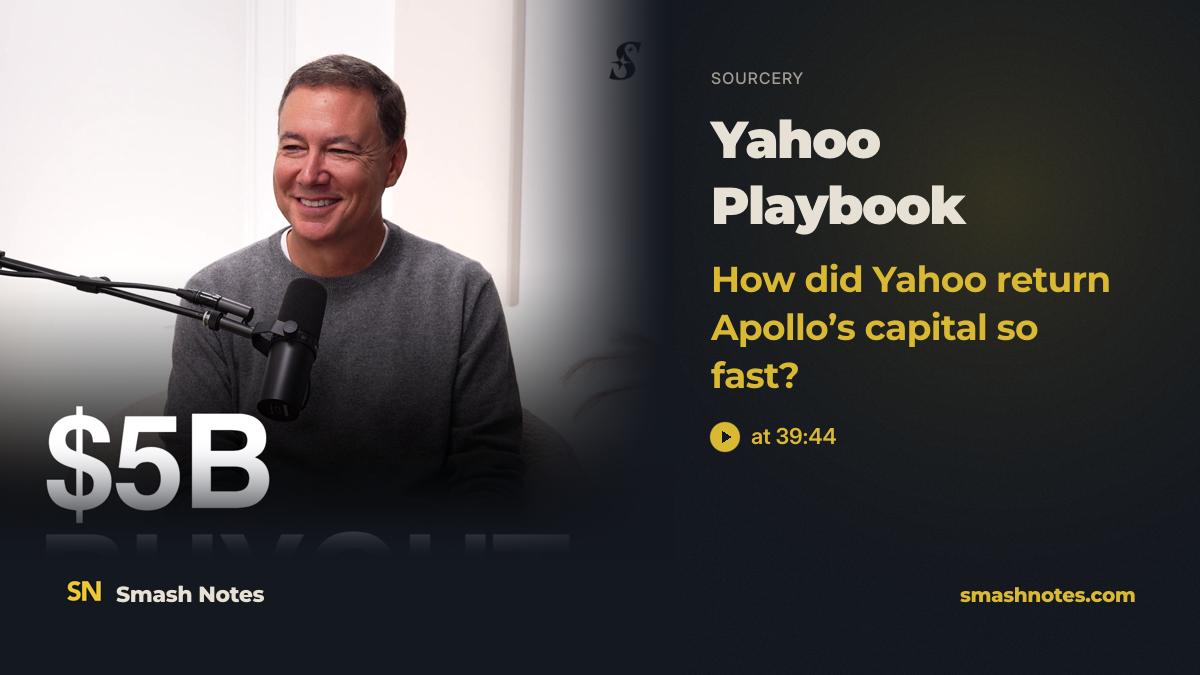
Apollo’s Yahoo Playbook, 5 Years After the $5B Deal
Apollo bought Yahoo and AOL from Verizon in 2021 for about $5B. 5 years later, Yahoo has returned Apollo’s capital in one of the fastest returning deals in the firm’s history. Jim Lanzone has been CEO of Yahoo since September 2021. Yahoo ranks among the top 5 internet companies in the US, reaching roughly 90% of the American online population and 700M…
People
Notes
Related notes
- What Does David Heinemeier Hansson Really Think of the Monopolistic Behavior in Tech
- How Did It Feel to Finally Get Out of the Dip
- How Did Perplexity Become an Answer Engine?
- What Happened When Yahoo Tried to Buy Facebook?
- Why Did Michael Eisner Turn Down AOL?
- Why Do Founders Think Their Startup Is the Next Facebook?
Related episodes
-
![]() Ex-Twitter CEO Says We’re Underestimating AI Agents by 10,000x
-
![]() Franklin Templeton CEO on SpaceX, Anthropic, Circular Deals & the State of the Market
-
![]() Google Is Putting AI Data Centers in Space. Planet Labs CEO Explains Why
-
![]() Inside $17B Index Ventures: Anthropic, Wiz, Datadog & the Future of AI
-
![]() Inside fal’s $1.65B Series E & F Led by Sequoia & Bessemer
-
![]() Inside Starcloud’s $2B Space Factory
-
![]() #424 Peter Thiel on How to Build a Creative Monopoly
-
![]() Investor Elad Gil’s next moves
Full transcript
The episode notes above make this conversation easy to skim.
0:00
Apollo has been one of the most prolific dealmakers of 2021. Private equity powerhouse. Apollo would be acquiring Yahoo from Verizon for $5 billion. Yahoo is one of the most iconic brands in internet history. This is a legacy brand. The original sin of Yahoo was giving search away to Google in June of 2000. There's this myth on the internet that they were defeated by Google because they took their eye off the ball or whatever.
0:23
It was worse than that. They outsourced it. Yahoo hadn't had its own search engine in 17 years. So where does most of the audience come from? Yahoo Sports, over 100 million users a month. Yahoo Finance, over 100 million users a month. Yahoo Mail, one third of all Americans have a Yahoo Mail account. So all those things fit together are what add up to 700 million users a month.
0:41
There are companies that are valued more than us who have less than one tenth of 1% of our user base. I really believe that the best days of Yahoo can really be ahead of it. I think now we're in comeback phase.
1:03
Jim Lanzone, welcome to Sorcery. Awesome to be here, Molly. Well, I know you're traveling all around the world. So thanks for making the stop over here. I know, we made it work. So you're here for the snap board meeting? That was, uh, yep. That was, that was why I was in town for, for this came straight from Aspen at the Forbes CMO conference.
1:21
And I'm on my way to Amsterdam next week for human X. So there's, this is, this is, uh, this is just that time of year back out of the summer, right into it. I understand. It's like back to school. Yep. A hundred percent. Well, I'm so excited to talk today about everything Yahoo and the legend behind Jim Lanzone. Oh, geez. Because there's a lot.
1:42
There's a lot going on there. But I think it would be great to start off with Yahoo because Yahoo is on a tear. So back in, I think it was 2021, that's when Apollo died.
1:54
bought Yahoo from Verizon and Verizon sold off a couple assets. It was AOL and Yahoo. So that was around 4.5, about a little more, a little more, a little 4.8 billion. Okay. So it was nearly for nearly $5 billion bought the assets. So could you walk me through that? What was that process like? Well, I mean, at the time was more, you know, I was somebody that they called in the process of deciding to buy the company.
2:23
So, you know, I wasn't part of Apollo then. I left another job to come do this, which we talked about, you know, why I did that. But,
2:31
yeah, look, the history was that. Verizon under different leadership had bought AOL, and then a few years later, Yahoo. They merged them into one company that was first called Oath. They then changed that name to Verizon Media, but it was all those assets under one roof. And then the new Verizon management team decided they didn't want to be in that business anymore.
2:52
I think it took them a few years to find the right buyer at the right price. But Reed Raymond from Apollo, one of the leaders of their private equity group, got in there and figured out how to construct a deal that would work. So what was the construction of the deal? Well, it was
3:10
just the ability to actually get the right framework for Verizon because they wanted to maintain some ownership, which they did. They still own 10% of us.
3:20
And then have a vision for what this thing could be going forward. I think combined, they were bought for about twice what we bought it for. And during that time had really–
3:34
had a different mission than I think either company had ever had before. It was really to help Verizon grow 5G and be a part of that. A lot of the decisions were based on that and not really the real mission of what Yahoo itself was about. So look, the company that was set up was a brand new company. We are a five-year-old company managing a 30-year-old brand at this point.
3:56
But it was a completely new company, stood up from scratch to house these brands under one roof. which closed in September of 2021. They bought it May of 21, it closed in September of 2021, and I started about the end of the month of September 2021. So it's been about exactly five years for me. Well, congrats. We made it. So this isn't your first turnaround.
4:18
So when you came in, well, one, where did you come from? And what were your first couple steps for the next maybe six months or so? Yeah. Well, interestingly, it was the middle of COVID. September of 21, if anybody remembers, was I think Delta variant was starting at that point. We didn't meet people in the office for a while still after that.
4:41
And the decisions were, if you come in, do you have to be vaccinated? I mean, that's what that timeframe was like. So kind of a weird time to... pick up a company, but I had just done it a year earlier with Tinder. I came in, I had worked for the IC family before they bought our company in 2005. It's how far I go back. And so that those same people brought me back to for that job again in the middle of COVID.
5:06
So that was July of 2020. So that was even more difficult time to pick up a company because we really never met anybody for that year. Here, we were back to work pretty quickly after that. But for me, this was actually the third time that I was going in to lead a turnaround. The first was Ask Jeeves, which is kind of the poster child for the Web 1.0 crash.
5:30
And however difficult this one would be, nothing would be harder than turning that brand around and those products around at that time. I think I was announced on 9-11, I think was the actual, my first day on the job officially. But they had bought my 90s startup that I was a part of, one of the founders of. And I joined there as one of the heads of product.
5:48
And over time, I'd worked my way up to CEO. We 50X that stock and sold it to IEC and Barry Diller. I stayed for another three years as CEO there. And then left to do another startup. And that was bought by CBS, the television company. I joined as the CEO of their internet group, which had bought multiple public companies over time that had, you know, just were not performing at their best.
6:12
And so that was turnaround number two. I think that is still the sixth largest internet company by unique users. I think we went from 70 to 220 million users with those properties. So I had been through big internet turnarounds before. So Yahoo is one that I knew both that it had great bones for a great turnaround. It had the thing that was hardest to get, which is traffic.
6:35
It had a lot of traffic, but the products had seen better days. Coming out of years at Verizon, the company structure and composition was not optimal. But those are things you can work with. And so the first six months were from the playbook that I had run before. Evaluate the team. I don't come in guns blazing on day one. I get in there and get to know everybody.
7:00
And there's always great people wherever you go. There's always things you don't understand from the outside until you are inside running a company. it's never exactly what you would think the data will tell you differently how the products work, who the audience is all those kinds of things. So those first six months are really getting to know it.
7:17
And then that leads into, you know, all the different steps of a turnaround that come after. So I think this is interesting because there's so many different angles to this. Like I just had a conversation with bending spoons, which is the opposite of a PE playbook, but this is also not really traditional PE turnaround because you're leading the way.
7:36
It's not like the private equity companies coming in and kind of just stripping out as much as they can, but you're really ushering this. So talk about how that's different for you and maybe the traditional like Apollo PE playbook. Yeah. I, um,
7:53
It's interesting because I would have people– I still have people always ask me, what's that like working for private equity? The reputation isn't always great for how they're going to manage these things. But I've had the opposite experience. Reid, I still talk to him almost every day in some form five years later. He
8:13
was wearing a Make Yahoo Great Again purple hat around. He really– PE's in it for a reason. They want an outcome, whether that's an IPO or whether that's a sale. They're not here to hold it to be Stripe and just never have an outcome of some kind. But at the same time, there aren't that many that they view that have asymmetric upside relative to others where you just run the PE playbook.
8:36
So they and they hired a team starting with me who wouldn't be here if they did. You know, I'm a growth person. I only do the turnarounds to get to the fun part, which is when you get to start putting irons in the fire for growth and you reap the benefits of the turnaround, start investing and building new things for your huge audience that you inherited.
8:55
And that really is how Apollo is treated the whole time. I have had to work for many different kinds of people, right? Venture capitalists, whether it was my first startup where I'd never had a real job before or my second startup where Bill Gurley was my, you know, and Jeff Yang were my main two investors. I mean, they're difficult to work for too, you know? Barry Diller, Les Moonves, I mean, these are...
9:19
Everybody has to serve somebody, and I have not found private equity to be, at least with my Apollo team, to be
9:27
some difficult force to reckon with compared to other people I've had to work for. So what are the main questions that you start asking once you get into the company? Yeah, so there's a couple things. One is,
9:43
speaking for Yahoo in particular, it's a conglomerate, it's not one brand. If you look at the other companies kind of our size in the industry, Pinterest, Snap, Reddit, Roku, these are all kind of one product companies for the most part. And with Yahoo, it's a conglomerate of many different brands that compete independently in their spaces.
10:02
So Yahoo Finance competes with Bloomberg or CNBC or
10:08
maybe Wall Street Journal. We have a new product that competes with TradingView and others in that space. Sports, ESPN, and others like that. Yahoo Mail, Gmail. I mean, they all have competitors that are very different. And it creates this ecosystem of brands. That's not the first time I've seen that. IEC had 60 plus brands. And with Ask, we joined that family.
10:32
CBS Interactive, I had 30 plus brands, many of which had nothing to do with CBS. So CNET was the leading technology site. Sportsline was one of the OGs in sports and fantasy sports. Last.fm in music. I mean, you go down the list, GameSpot and video games, we had all kinds of different brands that we had to figure out the right structure for.
10:53
I did it wrong at C++ Interactive the first time where we started off, I tried to have everything report to me. My background was all product and I was a pig in slop with these brands, many of which I was a user of. And it turned out that I was just going to slow things down, that we needed to run way faster. I had to hire general managers who could be entrepreneurial and be independent.
11:13
And my job was to work on their plans and hold them accountable and try to help out where I could to let them run. It was interesting when we got here, whatever had happened through the years of Verizon, they kind of evolved into a company that really had one head of product, one head of technology, one head of content, spread across all the brands.
11:33
There were people who specialized, engineering teams who specialized, but they were really kind of spread between them. And so the first thing that we did was reorganize the company into this more conglomerate structure with GMs in all these groups. That means they all get their own head of product, their own head of technology, their own head of content.
11:52
Even from central, they will have their own head of sales usually, marketing, PR, business development. So they'll be kind of assigned to those divisions. And so we had to put that structure in place. And then I had to go hire for that. So some of which were people internally who were great and were going to be part of it. Some I had to go get true experts who were badasses in their field.
12:15
And so that's what we did. We started putting that team together. And that really was that 2022 timeframe. The next step is once you have that team, you understand what you're doing. Well, now let's look at, you know, are we doing all the right things? Do we need to reduce our focus? Are there things that we should spin off? You know, where are we, you know, off of, you know, the mission of the company, which I should mention also had to be reinstituted because if you go way back, The original sin of Yahoo was giving search away to Google in June of 2000.
12:47
There's this myth on the internet that they were defeated by Google because they took their eye off the ball or whatever. It was worse than that. They outsourced it. First to a company called Ink2Me. And there were actually others before that. And then the crash happened. And to get a better deal, to save money on something that was viewed as a cost center search, even though 92% of all
13:08
I think sessions on the internet at that point started with search. It was viewed as a utility that was not core. One of the reasons was because there was no business model yet. So what became Overture and then what became AdWords and AdSense for Google didn't exist. All the search engines, and there were 10 plus of them that were public companies, Ask included, had banner ads everywhere on search results pages.
13:29
So just imagine how bad that was. So it kind of came from the right place. It just wound up being something that was really hard to recover from. So generations of Yahoo started to figure out other ways forward. In the 2000s, while they did some very interesting things in search and other places, it was forays into Hollywood. They had Yahoo Music and
13:53
TV and just all kinds of other things. They hired a lot of people from Hollywood. There were then a series of different CEOs. They then went back at Google in the 2010s and tried to go that way. And then eventually selling to Verizon, the mission of the company was to help Verizon in their mission. It turned out that underneath all that, the reason why Yahoo continued to be successful all the years with this huge audience were the places where it was still fulfilling the original mission of the company that Jerry Yang and David Filo had in 1995, which is just being the trusted guy to the internet, helping people through the wild west of, you know, that it had become to
14:32
help them get things done. In Yahoo Finance and sports and news and mail and, you know, different parts of search and weather and all these places where we still had leading brands, that's what the company was doing. And so we kind of had the benefit in 2022, 23
14:47
of just focusing on the things Yahoo's doing well. And we didn't have the burden of, first of all, being a struggling public company. That was hard. To make those changes in public is very difficult. And second, to just focus on the things that we did really well where we were already successful. So that's where our focus went during that time frame, which meant that we spun a lot of things out or shut them down.
15:10
That's really fascinating. It's also really funny to think back that Verizon bought Yahoo. Like what an interesting. Well, it was the first AOL. Yeah. And which had really
15:22
kind of tilted more towards media during that time frame. And Tim Armstrong, who's a great CEO and good friend, had gone that way. And Verizon had this vision, which if you remember, AT&T also had because they bought Time Warner. And so at that time, those two companies thought that was the way forward. AT&T made a much bigger bet with Time Warner that wound up obviously spinning back out.
15:45
And at Verizon, it was AOL. And then that team really was the one that convinced them to buy Yahoo and merge these two things together into this huge internet conglomerate that had just an immense audience and immense amounts of data that could then be used to target in really interesting and good ways, which is a really good vision, but it was inside of the wrong company.
16:10
So where does most of the audience come from now and then? It is back to the conglomerate structure piece by piece. So Yahoo Sports, over 100 million users a month. Yahoo Finance, over 100 million users a month. Yahoo Mail, one third of all Americans have a Yahoo Mail account. It's hundreds of millions of accounts.
16:31
And down the line, in the news, we're one of the top three properties as an aggregator. That was also another strategic move that we made was Going back to focus on aggregation as opposed to enterprising news and competing with the Associated Press and other places, that should not have been our job. It had kind of gone that way over the years.
16:50
So yeah, so all those things fit together are what add up to 700 million users a month, where we are every month top five in the US, usually top five globally, and
17:04
number one or number two or number three in all these different categories. You did mention that you guys divested a couple of things. You divested some pretty notable assets, whether it was AOL, TechCrunch, a handful of others. So what were the ones that you divested and what were the decisions behind that? Yeah, so look, AOL was the biggest.
17:22
We can talk about that. The first one was Edgecast, which was a content delivery network competing with people like Akamai that, again, we just viewed that we didn't have a right to operate. The second and probably the biggest transformation job that we had to do until now, where we're having to transform the whole company around AI...
17:44
was the ad tech business. So AOL and Yahoo had each purchased 30-plus ad tech companies over the years. What we inherited was a three-legged stool of a
17:58
SSP, DSP, and native platform that had a couple of issues. One was it lost a lot of money. So operating those things was massive and it was hundreds of millions of dollars a year out the door that we had to fix. The second is that it was, to help make that successful, it was the primary source of revenue for Yahoo. So instead of being able to play the field with our supply side platform and being able to pull yield levers and taking all comers onto that and
18:31
optimizing for the highest yield, we were only taking ads from the ad tech business. So offloading that actually did two things. One is we shut down money losing businesses or sold them. And the second is that we were able to now truly optimize revenue on Yahoo proper. So it was two things. As part of that, in February 2023, we actually had to let go of over 2,000 people.
18:57
Part of that was because we didn't want to sell the SSP. A lot of people wanted it, but we didn't want to give anyone preferential treatment the way we had been doing on our pages. We wanted to be able to yield optimize. So we had to shut that down. We sold the native business to Tabula and took 25% of their company. So that was those two.
19:15
And then while we did offload more things, like you mentioned, TechCrunch was one. AOL, we just did in October of last year, was–
19:30
was focusing on the DSP. So actually there, it wasn't just offloading things. There was actually the decision of, Oh, there's a crown jewel in here and we can actually invest in that thing. So a lot goes into all that. This episode is brought to you by Brex, my favorite. You become what you spend on. And I refuse to spend my time on work that shouldn't exist.
19:50
Expense reports, receipt chasing, and manual closes. The companies building what's next from Vercel, OpenAI, Anthropic, Granola, and Deepgram all made the same call. They all run on Brex. Brex is the intelligent finance platform that combines cards, expenses, and banking into a single stack. with a gentic finance built in. AI agents that handle expenses automatically, enforce policy before spend happens, and close your books in minutes.
20:21
That's why Sorcery runs on Brex, so I can spend time on building and not busy work. It's time to get Brex AF. Learn more at brex.com slash sorcery. That's B-R-E-X dot com slash S-O-U-R-C-E-R-Y. Bye! From handshake to signature faster, Harvey, the AI platform built for legal work, is trusted by 80% of the AMLA 100 and over 20% of the Fortune 500.
20:50
Learn more today at harvey.ai. That's harvey.ai.
20:56
AI needs more than chips. It needs power, land, and infrastructure. Zone develops next generation data center campuses, partnering with AI companies, site developers, and technology leaders to bring compute online faster and at scale. Zone is building the foundation of the AI frontier. Visit zonefrontier.com to learn more. That's zonefrontier.com to learn more.
21:21
In the conversation with Bending Spoons, the biggest misconception with the AOL transaction was, you know, it's actually, it was a really healthy asset. You guys got it to a really healthy point. So let's talk about the transformation within the company. What, because you joined during the height of this AI hysteria and like invention. No, it wasn't even on the map yet.
21:43
That was November of 22. We were... You know, we had no idea in September of 21. I don't know how you manage it, but like now we're in this crazy world of AI, whether it's transforming your company or your business model or competing with you and challenging everything around. Like, how did you think about rebuilding the company over that time period and then incorporating more technology? Well, look, the first thing is in a transformation job is you, I always tell the team, you can't skip levels of the video game, right? You have to go level by level and win each level to earn the right to the next one.
22:15
It always comes down to product. We're a consumer internet company. That's what we do for a living, building great products. If you're not doing that, it's like, you know, you're either, it's like Shawshank Redemption. You're either get busy living or get busy dying. That's how it is with this. And some of these products had not been worked on In like 10 years, some of these things have not really been improved.
22:36
And so it was get back to work. So hire great product people. And we have an amazing team now that I would say is a great product team relative to any other big consumer internet company. We brought great people in who share our passion for... putting this brand back on the map, all of whom have entrepreneurial backgrounds. Every general manager from me on down has been an entrepreneur at least once and started companies.
23:00
So we take that approach, improve the products is definitely game one. If you can do that and you can start getting growth going again, well, now you can actually get to building brand new things like Yahoo Scout, our search engine we launched earlier this year. Yahoo hadn't had its own search engine in 17 years. That's so crazy. Or college fantasy football, which we kind of broke the internet with when we announced it this summer and has been amazing.
23:26
And 40% of the people who have been coming to the platform where, you know, Yahoo Fantasy is huge. We had our three biggest days ever this year for NFL. But college, 40% of those users are brand new to Yahoo. So doing these brand new things is the reward you get for doing the hard work and the turnaround work in the first place. And then the next step is actually the brand, which has been one of the most surprising things about this.
23:51
You know, having been through the ringer with some other brands for the years, it has been incredible to see that Yahoo... has a lot of latent brand love in there for it, and especially with younger audiences. So I think we've talked about this, but over 50% of our audience is Gen Z and millennial. We have 75% of Gen Z is using Yahoo and are one of our products.
24:15
And when we market, we've done a lot of really interesting marketing. We have a great social media team. We have a really creative brand advertising team. We have seen like 31% absolute point lift in brand love, which is one of the things that you track with Gen Z. And that's, again, from our Cardi B campaign, from our Kyle Cook, the weather boy campaign, from Summer House, for all the social media things that we've done.
24:43
you know it really is it is met with great reception and so that really gives me hope that the more we turn that dial uh the more there is to do there again if you don't have great products you have no business even trying this is going to be a theme that comes up throughout the conversation because you are a product product expert but what i guess to to get into that further what makes a great product what are the hardest lessons you've learned in that process Yeah.
25:09
I mean, that's art and science. So it's going to start with data and understanding your user base and what, which again, you never really understand from the outside. You know, it's funny. I have a bunch of my UCLA college friends. To help me get to know this college product, I got a bunch of them on it. And they beat me up all day long for things that they're finding in the product.
25:29
And when I then go talk to the actual product team on the sports team, What's really driving things behind the scenes or whether something's really wrong or it's particularly one person's opinion is just different. Take that across search where what happens on the other side of that search box is so complicated compared to, especially now with AI, but even going back to the old days of 10 blue links.
25:52
You enter that query, but what we have to do on the other side to capture that and understand what to do with it is incredibly complicated. And how to do that for hundreds of millions of people and move the needle forward is different than what it might just be for one user. So data is going to lead you the way forward. After that, it is creativity and people who have a sensibility for users.
26:13
One of the benefits of having a huge audience is that you can A-B test people. your way to things so you can have a hunch, especially now with AI, we can do it even more. We can experiment more. I do think product teams can get a little too addicted to that or become too cautious and want to do 200 tests at one time.
26:31
You can't do that. You have to have some passion for what you think the product should be and lead with that. But the thing that Yahoo had that I had experienced at prior companies was this huge audience. And that is just, it's so hard. If you go look at the top internet companies in Comscore or SimilarWeb or others, it is incredible how many are from the 90s.
26:53
It's amazing how many are from the early 2000s, YouTube and Facebook. I mean, we're all, we're 30 years old, but Google is almost 28 years old. You know, YouTube, I think is 21 years old, Facebook, 22. I mean, we all are kind of in the same dating race. or whatever. I mean, it's all, you know, we're all about the same age, interestingly, at this point.
27:13
And new brands that get added to that really only happen once every three to five years, right? ChatGPT was the latest. Before that, it was probably TikTok, you know, Snap, Instagram. It just doesn't happen very often. So I think, you know, I hesitate to call it a moat because you can lose it so easily if you don't treat it right. But this level of distribution allows you to improve the products and have it work versus trying to light the wet log from scratch, which is what entrepreneurs have to do, which is why so many of the biggest consumer internet companies happened by accident.
27:49
They really weren't the thing that they intended to be a lot of the time. So we have a great platform to be able to build great products on. We're lucky to have that. Of the other companies that you mentioned, it's interesting because like you mentioned,
28:06
you have a great brand perception and brand love around it. But these other ones in this AI world have horrible brand recognition and are like skewed as evil. So why do you think you've built up so much trust and excitement around the brand versus like being cast into the doomerism side of the internet? I mean, again, I won't...
28:30
To be honest, on that one, it's because we're not building a large language model. We're not the frontier. We have built our search engine, AI answer engine, in an entirely different way that I think is bespoke and cool and interesting and provides really unique results compared to all of them who were all kind of created the same way and I think kind of start to blend together in certain ways when it comes to search.
28:52
But yeah, look, it's probably that. Yahoo did have a data issue in a different regime 14 years ago, whatever it was.
29:04
But other than that, over time, it's just been a really trusted brand and has continued to reward that trust, right? And if you're going to have your email be your vault of your life, your operating system of your life, which is what it is, it's why every one of these new agent products, the first thing they ask is, can we have access to your email and calendar? And which, A, I think gives us a place to play in that space.
29:29
Absolutely. It's the trend you see right now. It's our obligation. It's what we do for people anyway. We have to build those products anyway to do our job as best we can for our users. no matter what. But we also have trust. We already have them utilizing us for those things. And so, you know, but I think that's happened over 30 years. I think it's always been an irreverent, positive brand, too.
29:53
It's always had a little tongue-in-cheek kitschiness to it, even when it first started. That was kind of always part of the Yahoo brand. And, you know, we're really leaning into that. I mean, our social team has a lot of fun with that. A lot of the brand work we've done, you will continue to see us kind of lean that way. And, you know, we're never going to have a Super Bowl ad that tries to make you cry.
30:13
It's always going to try and make you laugh or be different. But it's ours to lose. I mean, trust is something that's yours to lose. And I
30:23
think new brands will always have to find that out. Yeah, it's interesting going into that world and talking about your new products, especially with Scout. So where does Scout lay in terms of AI search where ChachiBT, Perplexity, Anthropic, even Google don't hit? It's more, I would say from the jump, it was more like Perplexity. So Perplexity is not its own large language model.
30:47
They were kind of doing meta search on the others, which has happened before. There was a product called Dogpile in the early days of search that was the meta search engine on other people's search engines. Yahoo Scout's totally different. The others are all large language models. So Gemini, ChatGPT, Claude. Ours is a product based on our own data.
31:09
And there's so much interesting data, which I think another one of our, you know, again, I'll put moat in quotes because I'm always paranoid about it. It's not like you can rest easy with this. But it's an asset. And hundreds of millions of users a month over 30 years where we're still the third-ranked search engine in the U.S. So we have 30 years of search history.
31:28
Even though we're much smaller, it's still a ton of search history. Our publisher relationships, which is another way we've taken the company back. Instead of competing with our publishers, we're trying to make sure we are partnering with them. It's our job. It's our legacy that we send them traffic. Yeah. And we firmly believe in that. It's part of our job in the ecosystem.
31:47
And having been a partner of Yahoo's at other companies, I can attest to how much traffic they could send us. So publisher data, search data, our knowledge graph, our user data, if we know something about you. So the way Yahoo Scout works, our AI answer engine is we take all that data and then we ground it. And then we send it to a lightweight model.
32:09
At launch, it was Haiku from Anthropic. We use others today. And they process that, send it back to us, and then we do the rendering, the UI of it. And so what that creates is entirely unique results that only happen because of Yahoo data. And, well, it's interesting because we are also a top 20 publisher whose content has been taken by the large language models without permission.
32:37
And so you will see the Yahoo brand show up all the time in citations there.
32:43
For the most part, our content is real time. We excel in categories that are real time. So we weren't as susceptible to the evergreen content that the large language models kind of photocopied and took with them. So especially in certain categories that are more real time, our results are awesome and totally unique. The other reason why we had to do that is that for 17 years,
33:08
we were outsourcing search largely to Microsoft, who we are still great partners with, but that left us in a really vulnerable position for one of our most important products, one of our most important revenue streams. So the ability to fend for ourselves and own that asset again was just life-changing for us. Besides the fact that we are, including myself, I spent my first 10 years in search and Our old team, you know, we innovated a lot of the most interesting things, especially in structured data search.
33:38
The things that went beyond 10 blue links is already an area of search I was personally passionate about. So we have our own unique entry there, but it also was just a very strategic asset to own. It's like I think about this and I think about, you know, talking to all of the tech companies, the high growth ones that I've talked to, seeing all the pivots.
33:56
We were kind of joking about this earlier, but with Allbirds and their AI play and that kind of thing. But when you are taking the reins and you're rebuilding and transforming the company, how do you stay focused, not getting into these money grab areas of like, AI coding, AI assistance, becoming a neocloud all of a sudden, using your data centers for other stuff, and then just kind of staying focused on one product at a time.
34:21
For us, it went back to the thing that I think always falls into the cheesier side of this job, which is the mission. It really mattered here. And I took my time with it. I rolled out a brand new mission for the company with a 45 minute to an hour long presentation to the company. It was actually, by the way, much longer for the management team at my team offsite.
34:45
It was almost twice as long. We did a condensed version for the whole team. That I spent, you know, working on with the team, you know, almost a year that that was coming into focus, six months of really doing it. And everyone in our company understands it now and can recite it back and knows what we're doing and why at very real levels of detail behind it.
35:07
So. As I said earlier, going back to being the trusted guide of the internet, helping our users accomplish their goals no matter how big or small. We're not judging. A trip to see the Taj Mahal, beating the snot out of your friends from UCLA in fantasy, it doesn't matter. Make a dollar in Yahoo Finance, make a million dollars, whatever it is, our job is to help you do that.
35:26
And that's a mission that is 30 years old. It's also a mission we can do for another 30 years as things change. The internet is changing more right now than it ever has. That's both an opportunity and a threat for how we would deliver on being the trusted guide. But as part of that, we were very
35:44
specific in saying we're not going to be an enterprise or B2B company. We're going to handle your personal life. So Yahoo Mail is where that is most important because Gmail, it actually sits in the Google Cloud group now and is really a enterprise-level product. Outlook is an enterprise-level product. There are things you would do differently if you were focusing on someone's personal life with mail as opposed to their work life.
36:11
And so that's an example of where you would do that. So what are the assets around that? superior aggregation,
36:20
proprietary data sets that you can leverage then to do that. And then what we called
36:26
context, content that provides context. So that's why we got out of competing for enterprising breaking news. And some of these people like at ESPN, Shams, Woj in the early days, these are guys who started at Yahoo. And when I got here, there were things like, you know, we had people, we had White House correspondents, we had all these different things that TechCrunch is another example.
36:48
one of the most important brands in tech journalism, but it wasn't right here. Instead, we have the best fantasy analysts. We have amazing business analysts for analyzing the stock market. We just signed Deidre Bosa from CNBC is coming over to join Brian Sazian, people we already had. And so that's where we wanted to do content, was to help our users make better decisions to accomplish their goals.
37:11
So that's all cheesy, but actually provide a really important filter for what we would do and not do.
37:19
And that still guides us today. And we will look to add other brands to that. They don't have to be Yahoo branded, but they do have to be where we would be able to provide those services for our users. What's been the biggest pushback that you've gotten? Probably just, you mean from our own team? From your team, from investors, from the decisions you're making, products to launch, products you're not launching.
37:45
What is like the biggest friction or the thing that people want most that you're getting pushed back on? Yeah, I mean, I don't, I'd say the heart.
37:53
Probably the easiest version of that is that when you've been around a long time and even our user base is now skewing younger and our fastest growth areas, including in male, are from Gen Z,
38:06
is the people who have been around a long time, they don't want you to move their cheese. So evolving those products in ways that you know are better for future users of the product People have been around a long time, just don't want to see those things change. Especially just pure UI-wise, they want to stay the same. And the problem with that is you will lose tomorrow's users if you do it.
38:33
And I experienced this at other companies, especially in places like Fantasy Sports, where if you change it, you would lose certain users. They're like, I'm out of here. you know, even though maybe the place they're going has a lot of the UI or features that we just launched, they would just do it to, you know, because you change. So I'd say that's, that's probably always the hardest internally.
38:54
I think we have a lot less of this now. I think the team that we have is united around what we're trying to accomplish. There are people who all have the right chip on their shoulders to be at a company like ours that was going from turnaround to I think now we're in comeback phase. I think we've graduated to now it's a comeback. And they want to be here for that.
39:14
They love the assets. They love to build. But in the early days, you are telling some people that there's no Santa Claus and there's not– that's not– What? Oh, shit. Sorry.
39:27
So we accomplished that here today. But yeah, I mean it's just hard. It's hard sometimes to– you've been indoctrinated with certain things over the years and I show up to start heading a different direction. Some people are just going to not want to go along with that. So you already, I don't know if I can say this, but you already paid back pretty much the price of Apollo.
39:49
Yeah, we've said that publicly. It's one of the fastest returning deals in the history of Apollo. And there were certain things that went into that. Again, the AOL sale was another part of that. But yeah, we are playing with house money now for what the upside could be here. Did you feel pressure to pay that back quickly? No, because Reed and the Apollo team constructed a really interesting deal.
40:10
At first, some of the things that they put in place returned cash really quickly. And also, I worked with them for a few months leading up to this and knew I was pretty aligned with them on what the assets were that were probably not going to make it. So that was something we were pretty unified on. And the goal is to go public. So what do you think is going to surprise people most when you go public? Well, I think the goal, I would say it a little differently, which is...
40:40
And it's weird to think about Yahoo this way because it's like the OG. But we're the same as any later stage pre-IPO Silicon Valley company.
40:53
If we have created a lot of value, and I think we're still actually one of the most undervalued assets out there, an audience this big. Something I didn't mention is we're also not like an– one of these companies where our traffic is SEO. We get SEO traffic, but 75% of our users are coming directly to Yahoo. That's one of the highest percentages on the internet.
41:15
Every given day, most of our users, also around 75%, are logged in. So this is just a very loyal, dedicated audience that the other benefit of that is that we are incredibly effective for advertisers. So we're not a place to just throw rando money at. We actually provide outcomes and performance at levels that other people don't, which is why I like the DSP, which, you know, is an entrepreneurial venture here.
41:43
We went 9 out of 10 head-to-head tests, and that's because of our data. That's because of our first-party data with our audience.
41:52
So, you know, we have these incredible assets that I just don't think grow on trees. And so... I think that's very valuable. I think that that's very valuable to a lot of other companies, but, but, you know, if you are venture venture backed or you are private equity backed, I think an outcome is what your investors expect and not just to be a standalone private company forever.
42:15
So that's how, that's how I would think about it. What would be most surprising? I don't
42:22
know. I think weirdly, I don't, I don't know how surprising it'd be. We've been pretty open, you know, I think understanding our audience and our assets is pretty open when they hear our revenue and our profitability. It's, you know, they're really, they're both really good. And I think they'll probably be in a range that might be relatively expected.
42:41
So, um, some, but just maybe how healthy we are in growing the rate at which we are growing, you know, which is really healthy growth, especially for a 30 year old brand. What do you think the biggest mistakes are companies make at scale?
42:56
probably falling asleep at the wheel doing, you know, they just wound up becoming really conservative people who have succeeded by
43:04
climbing the company ladder, some of whom are probably great. And, and, but that kind of tends to lead to a certain kind of management and what those people have been rewarded for over time. If they're not honestly in our space, if they're not product driven leaders, it tends not to work in our space. You tend to lose sight really fast of what matters.
43:25
And what I've always seen is sometimes it's the things that are missed that by an executive team, the chances they didn't take, the company they didn't buy, maybe the thing that they sold, a deal that they did that maybe they wouldn't have done if a different set of leaders had been in place. Those wind up being the real things that make a huge difference.
43:50
And the problem with that is you would never know externally because you weren't a part of it. You don't know what was on the table and what wasn't. But you'll start to see things catch up to them, especially on product, they'll get beaten by a startup, you know, with something that they didn't launch,
44:06
you know, or something, you know, place that they didn't get out ahead of. So I just think product driven companies where,
44:12
you know, you follow the only the paranoid survive, and you were just going 100 miles an hour, seven days a week to try to crush it for your users is the only way to make this work. Are you worried at all about any startups? Always. Or are you pinching yourself or kicking yourself for any acquisitions you didn't make?
44:30
Well, here's what I'll say. No, because startups right now are so highly valued. There are companies that are valued more than us who have less than one-tenth of one percent of our user base.
44:47
And I was seeing that early on. If you look at Search companies that have launched were being valued at 6x what we were, even though we already had a shitload of searches and search users and our
45:01
overall user base and our revenue and our profitability. It is funny. So we have been at a moment in time when those things have been really expensive. I have benefited– and I was one of these a long time ago. My 90s startup that I was one of the founders of, it didn't work out. We were writing our S1 and the market crashed and we crashed and we kind of went on fumes until Ask Jeeves bought us.
45:26
But a bunch of us went over in the acquisition and we were really important to that turnaround. And we've had the same thing here. We've actually bought a few startups where–
45:36
You know, they weren't pure acquihires. We actually used the product. But the people that we brought in were incredible and have been leading the charge for us in some of the most important things that we've been building. And, you know, so we have been able to be active that way. But, like, are we going to do a merger with somebody that's based at billions but we bring all the value? We can't do it.
45:58
So... I don't know that we've really had the opportunity to buy anything that we would have missed on. There's a lot of things out there that I think are really interesting, right, in search and agents and all these things. So we, in fantasy and in finance, our Slack channels are very active on a daily basis with things that we are all looking at and playing with.
46:16
I would imagine. It's super exciting. Yeah. And we compete in so many areas that it's just almost hard to keep up with it. But that's why we have great leaders across the business. Because you've seen so many cycles, market cycles, when do you think this one pops?
46:35
Damn, if I only knew. It's funny, though, if you go back to the mid-teens, how many times that's been called. And people have gotten really conservative in thinking the market was about to crash and it has continued to go up. And if you tried to take your chips off the table at any point in time, it would have been a huge mistake. I have been through how many crashes? The first one,
47:02
the global financial crisis crash. There was a mini crash in 2022 on the other side of COVID, pretty much right after I started here. We went right into that one. And even now, I mean, with the war and certain tariffs last year, there have always been curveballs that are going to get thrown at you. And this is another place where Yahoo excels.
47:23
We're a very resilient company. And I always say that if we were able to survive before we had a team like this, building the things that we're building and growing the way that we're growing, we're going to be okay now. We're in a great spot to be able to survive if something like that happens. So I am in no way rooting for it. I would love it if we are in some golden age that lasts for 50 years, but we'll be okay if we're not.
47:49
How good is AI at real professional work? Mercore's AI Productivity Index, or APEX, tracks it with every major Frontier model release. Built with partners like Harvey and Cognition, see where the Frontier actually stands at mercore.com. Today's episode is sponsored by VCX by Fundrise, the public ticker for private tech, allowing investors of all sizes to invest in venture capital.
48:13
Learn more at getvcx.com. Public is a multi-asset investing platform where you can automate your investing with AI agents. create your own custom agent with a simple prompt agents can monitor markets execute trading strategies and manage your cash across stocks bonds options crypto and more want to buy at market close and sell the next day's open just tell your agent automate your investing at public.com Founders scale faster on Deal.
48:44
Set up payroll for any country in minutes, hire anyone anywhere, get visas handled fast, and get back to building. Visit deal.com slash sorcery. That's D-E-E-L dot com slash sorcery. I know we started this and I was like, I want to know about the Jim Lanzone lore. You mentioned so many people that you've worked with, worked for, that kind of thing.
49:07
Maybe we can go back to Barry Diller and what it was like working with him. But like, what is it like working with Barry Diller? I know at the time when we talked like a couple of months ago, this was right after the Dara interview. You also mentioned Dara. So it'd be great to get into that a little bit and like know what you've learned. Yeah, I mean, it's funny.
49:28
John Foley, who founded Peloton, was one of the people at IAC. And he
49:35
called me a journeyman. We were at this conference together. And he meant it as a compliment. He was like, you've been in so many different places and had seen so many things.
49:46
But it's true. I just kind of have been around a long time and have been part of all these different regimes and different companies. And that experience,
49:55
Look, if you're not naturally good at this stuff, experience probably doesn't help. But if you also have experience, it can help a lot. And the people you work for are a big part of that. It was a really interesting time at ISC. I mean, Dar left right when I joined. So he left to do, when Expedia spun out, pretty much right as... as I joined.
50:14
And I had a great first couple years at Barry. He was extremely intense. I mean, again, this is 20 years ago. It's very different than I see that Joey took over and that was run later. But we had 60 brands at that point, and they
50:30
kind of went through something that Barry later on said he kind of regretted, but it was trying to turn into an operating company. Jack Welch was one of his main– advisors at that point in time. And somehow the decision was made to kind of take these 60 brands that had nothing to do with each other and no common infrastructure and reverse that out and have them have a common central structure, which was just not easy at IAC given the way it was put together.
50:54
And then he and John Malone got into it in 2008. And that led to the breakup of a lot of the IAC brands. And it really changed the construct of why they bought ASK. We shut down search, outsourced it to Google, and that was kind of how I wound up leaving. But look, Barry's just such an original thinker. I still don't think there's anybody who is a better interview.
51:15
Like when you see him on stage or CNBC, just his language is just so unique and different to him. He's so smart. He's so bold in the things that he does. And I
51:28
loved working with him. And we really, you know, Steve Berkowitz, who is my, you know, probably the biggest mentor I've ever had in this space, who is the CEO of Ask Jeeves. When we bought We're Bought by ISE, that turnaround was so respected that Steve was poached by Microsoft to run all internet for Microsoft. Satya reported to him. And that's when I, and I remember as he was leaving and Barry and I had tussled over something, he was like, you guys are just so much alike.
51:52
I was like, huh? Like I didn't, when I've thought that, you know, I was like the Silicon Valley internet guy, but, um, but yeah, he's just very entrepreneurial and I just am still inspired by, I loved his book last year and told him that. So that was an amazing experience. Um, and by the way, the, the CBS years, we really had a, um,
52:13
That stock had gotten down to $3 a share a couple years before I joined. It went back over almost to $80. And at that place, again, I was the Silicon Valley guy going to a place where they had to wear suits. I was told that because I was the internet guy, I didn't have to wear a tie.
52:33
But, you know, at that era. But, you know, look, they were number one 13 years in a row and the stock was just a juggernaut and always delivered. And I think if we're lucky enough to be a public company, again, I learned so much from being a part of those public companies and how they were managed and how those teams were run and what made them special, what made them work that I can take with me.
52:55
So what was Tinder like? short and during COVID. Yeah, I mean, look, I was, you
53:04
know, I think those COVID times were difficult. I loved the team. I actually didn't change one person on that team. I loved the management team I inherited. I love the fact that, you know, Tinder from the outside was viewed one way, but if you were on the inside, like you've never met a team of people more passionate about the mission of helping people find their person.
53:25
and it was always perceived by others to be like a hookup app or whatever, but that is not how the team internally viewed it. They're also very big and proud on being the source of
53:36
diverse relationships, of the fact that if almost 50% of all marriages, I think it was 40% of all marriages started online and Tinder was 25% of online,
53:49
that almost 10% of all marriages in the United States were started on Tinder. This is something that the people are very passionate about. And I never would have left. And it's the only time I've ever left a job. Everywhere else I stayed for a long time. But Yahoo, There's a tweet someone found that I had in 2010, where I said this was the ultimate turnaround and these are the best assets for that.
54:13
And there was just something, I always wanted to crack at this one. I just was always very passionate that Yahoo deserved to be treated right, to have great products again, to put that brand back on the map the right way. Like I just, I just always, and maybe it was just part of me being part of startups and then turnarounds. Like I just always wanted to take a crack at that, you know? So here we are five years later.
54:37
Is there anything we haven't covered yet that you'd want to go over? I know we'll see it in the comments. Okay. I'll go on and answer. Okay. Yeah, I mean, I think a lot of it is still things that we can't even talk about. We have a lot of awesome stuff. What's the biggest secret you could tell us? I don't have an IPO date or whether it's happening or not.
54:59
I always am trying to keep the things that we're building a secret until we launch them. So we have some really interesting things that we're working on. And so I really believe that this is one of those times when
55:16
you know, the best days of Yahoo can really be ahead of it. It took a lot to get it to the spot, but we are jamming now. And I think people really have a really open mind to us as a brand again, which has been really gratifying. So we don't take that for granted. We want to deliver on it. So, you know, onwards. amazing i mean i was going to close out and ask what are you most looking forward to in the next 12 months yeah i can't tell you can't tell you it's a secret yeah but um but there's some some really great stuff and i just our team i love our team so it's it is um yeah it's one of those jobs where i get up every day ready to go like there's just not one day where
55:53
i'm you know dreading it it's just let's let's go Awesome. Well, Jim, thank you so much for taking the time. This was so much fun. Okay, good. Awesome. Thank you. Thanks, Molly. Hey, it's Molly. If you enjoy our interviews, check out our newsletter, sorcery.vc, where we deliver a once a week top deals and tech headlines email and also go deeper on our podcast interviews.
56:16
Subscribe to Sorcery today. And don't forget to subscribe to the podcast on YouTube, Spotify, Apple, or wherever you listen. Link in description to sign up.