Smash Notes

TED Talks Daily

Sleep is your superpower by Matt Walker

Sleep is your life-support system and Mother Nature's best effort yet at immortality, says sleep scientist Matt Walker. In this deep dive into the science of slumber, Walker shares the wonderfully good things that happen when you get sleep -- and the alarmingly bad things that happen when you don't, for both your brain and body. Learn more about sleep's…

Transcript

People

Notes

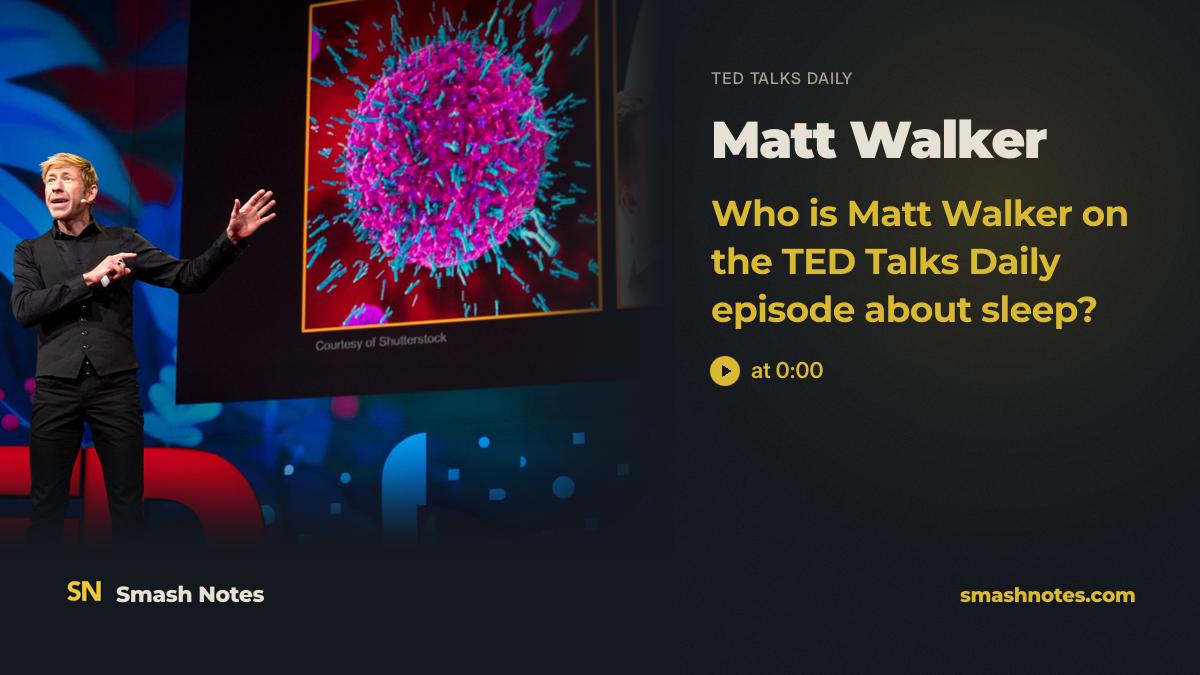
  1. Matt Walker is the sleep scientist, professor, and author of the talk Sleep Is Your Superpower, recorded at TED 2019 and replayed on TED Talks Daily. He opens on a finding he knows will get a laugh. Men who sleep five hours a night have significantly smaller testicles than men who sleep seven hours or more, and four to five hours of sleep leaves testosterone at the level of a man ten years older. From there he argues that sleep is a life-support system for the brain and the body, including learning, memory, and the immune system, and that losing it does measurable harm.

  2. It shrinks one and ages the other. In Sleep Is Your Superpower, recorded at TED 2019 and replayed on TED Talks Daily, sleep scientist Matt Walker opens with testicles. Men who sleep five hours a night have significantly smaller testicles than men who sleep seven hours or more. Men who routinely sleep just four to five hours have a testosterone level like someone ten years older. Walker says that shortfall ages a man by a decade on that measure. He uses the result to start a larger case that sleep is a life-support system, not a luxury you can cut without the body keeping score.

  3. Men who routinely sleep four to five hours a night have a level of testosterone which is that of someone 10 years their senior. Lack of sleep can age a man by a decade. There is an equivalent impairments in female reproductive health caused by the lack of sleep.

  4. Your brain needs adequate sleep to absorb, and to retain new memories. Scientist validated these assumptions by comparing a group of sleep deprived students to a group that got 8 hours of sleep before taking a test. The former had a 40% deficit in their ability to make memories. For some children, this could be the difference between getting an A and failing.

  5. A brain on sleep deprivation shuts down your brain's ability to commit new experiences to memory, according to the MRI images obtained from subjects in study.

  6. Broken deep sleep tracks the memory loss. In Sleep Is Your Superpower on TED Talks Daily, Matt Walker says that as people age, learning and memory fade, and sleep gets worse, especially deep sleep. His group published evidence that the two are linked, and that disrupted deep sleep contributes to cognitive decline in aging. They have since seen the same pattern in Alzheimer's disease. He calls sleep a missing piece because, unlike changes in the structure of the brain, it might be treatable. He rejects sleeping pills as too blunt. His lab is testing direct-current brain stimulation to restore deep sleep in older adults and people with dementia, and to salvage some learning and memory.

  7. No, they do not produce naturalistic sleep.

  8. Yes, sleep is essential for our body and specifically for the cardiovascular system. We can measure it during the Daylight Time transitions, where the rate of heart attacks before/after go up and down by 27% each year, indicating that even 1 hour of sleep deprivation can have a tremendous impact on the physiology of our body.

  9. If you are not sleeping enough, even as little as only sleeping 4 hours for 1 night, your immune system becomes significantly impacted. The link between lack of sleep and cancer is so strong now, some night-shift jobs are being classified as carcinogens.

  10. 1 - Regularity. Go to bed at the same time and wake up at the same time. It will anchor your sleep and improve its quality. 2 - Sleep in cool temperature. Your body needs to drop the temperature to sleep; 65 degree Fahrenheit is optimal for most people.

    Sleep is not an optional luxury, it is a non-negotiable biological necessity. Treat it that way.

Related episodes

Plays this note, then the next one on the page.

Weekly highlights

One letter a week.

The notes worth hearing, with the minute they were said.