Why great art requires risk | Alex Van Halen, David Lee Roth, Robert Vargas
Alex Van Halen and David Lee Roth — two of the rock stars behind the legendary band Van Halen — sit down with visual artist Robert Vargas to reveal the two-step recipe for great art: do your homework, then break every rule. Along the way, they swap stories about heartbreak, good luck charms and why you should rehearse for what goes wrong. Hosted on Acast…
Notes
Related notes
Related episodes
-
![]() 3 ways to build a happy marriage and avoid divorce | George Blair-West
-
![]() Sleep is your superpower by Matt Walker
-
![]() A juror's reflections on the death penalty | Lindy Lou Isonhood
-
![]() The lies our culture tells us about what matters -- and a better way to live | David Brooks
-
![]() The story we tell about millennials -- and who we leave out | Reniqua Allen
-
![]() Why we get mad -- and why it's healthy | Ryan Martin
-
![]() #4 — Kathryn McCarron — Cage-Free Entrepreneurship

0:00
You gotta go get your heart broken, then you gotta get it broken in a foreign language, and then you have to run away and join the foreign legion. Now you gotta song.
0:13
You're listening to TED Talks Daily, where we bring you new ideas to spark your curiosity every day. I'm your
Expand full transcriptCollapse transcript
The episode notes above make this conversation easy to skim.
0:00
You gotta go get your heart broken, then you gotta get it broken in a foreign language, and then you have to run away and join the foreign legion. Now you gotta song.
0:13
You're listening to TED Talks Daily, where we bring you new ideas to spark your curiosity every day. I'm your host, Elise Hu. According to David Lee Roth, that's the recipe for a great song. And as the frontman of the legendary rock band Van Halen, he would know. In this conversation, he and drummer Alex Van Halen, who co -founded the band with his late brother, Eddie, sit down with world -renowned muralist Robert Vargas, the artist behind a mural honoring Eddie in Los Angeles.
0:43
Together, they dig into a question every artist eventually faces. Where does great work actually come from? I think that the most important thing in art is that you do your homework, and you learn the basics, and then you break all the rules. That's right. The three trade stories about how they make their work, stepping outside their comfort zones, soaking up other cultures, and keeping their audiences close enough to feel like a community.
1:08
Robert, who has been painting murals since he was 10, explains his own surprisingly fearless approach. I don't use any grids. I don't use any projections, any stencils. I literally will eyeball something, whether it's this big or 20 stories big. David also reveals the musical trick hidden in nearly every Van Halen harmony, one that makes a song sound happy and sad at the same time.
1:31
You might never hear a Van Halen song the same way again. It's coming up right after a short break.
1:41
This episode is brought to you by Walmart Business. The best leaders might tell you the work that moves an organization forward doesn't happen in spreadsheets or supply chain emails. It happens when you have the space to think big. That's the idea behind Walmart Business. It's built to take the friction out of running an organization so your team isn't losing hours to procurement logistics when they could just be focused on the problems that actually matter.
2:07
With an ever -expanding business assortment, everyday low prices, and fast, reliable shipping, Walmart Business keeps your operations running smoothly. Shop online, in -store, or through the Walmart Business app. However works best for you. Simpler operations, smarter spending. It's Walmart built for your business. Sign up for a free Walmart business account at business .walmart .com.
2:34
This message is brought to you by Apple Card. Ah, fall, that cozy season where we swap the swimwear for sweaters and sunnies for scarves. But before the Halloween decorations are put away or the Thanksgiving table has been set, there's already holly jolly music playing in the grocery store, reminding you that the year is coming to a close.
2:55
Time to kick end of year into high gear. When you use Apple Card with Apple Pay, you earn 2% daily cash back on all purchases, including food, decorations, gifts, and more. Get a head start on your end of year purchases. Apply for your Apple Card in the wallet app on your iPhone today and start using it right away with Apple Pay. Subject to credit approval, Apple Card is issued by Goldman Sachs, Bank USA, Salt Lake City branch, terms, and more at applecard .com.
3:22
This episode is brought to you by TikTok. I used to think great work was about being in the right headspace. Then I found a TikTok video that made me think about my physical space. An interior designer explores how things like ceiling height and room size might influence how we think. Now I wonder how much of our environment shapes our work without us noticing.
3:43
Now I'm looking at my workspace, asking what kind of thinking I'm making room for. On TikTok, one idea can change how you're a see something you thought you knew. Your next discovery is waiting on TikTok.
3:58
And now our TED Conversation of the Day. David Lee Roth at your service. Alex Van Halen. Wow, it's a gas to be here. This is also a step towards world peace. A leap. This is momentous, a mighty time. Congratulations on an amazing work here, Rob. Thank you. It's great to be here. We want to talk about art, creative process, and our approach.
4:22
Well, what is the approach? Who wants to go first? Because we're diametrically opposed, and who even knows what that really means? That's what makes it work. That's what makes it work. Go ahead. Okay. I think that the most important thing in art is that you do your homework, and you learn the basics, and then you break all the rules. That's right.
4:40
That's how it works for us. What qualifies as homework? Immerse yourself into it and listen and watch everything you possibly can get your hands and your eyeballs on, and experience as much as possible. You've got to go get your heart broken, then you've got to get it broken in a foreign language, and then you have to run away and join the foreign legion.
5:00
Now you've got a song. That's right. Now you've got a painting, right? The bigger painting, the bigger the heartbreak. I think... Wait a minute. That's some zen. Yeah. Wow. Can I quote you on that? You should have been in a band. I think what one of our theory and orchestration professors told Quincy Jones and Leonard Bernstein, a couple of big posters that were on my wall as a kid, is that your music, your graphic arts, I'll expand it, your photography, your theater and stagecraft will never be anything more than you are as a human being.
5:37
And I translated that as I want to go everywhere in this National Geographic magazine. I want to get to know at least three people in each place, and I want to have whatever they're eating on page 26. That's right. I mean, it informs the process, all of these human experiences. I just came back from a world art tour, five countries just this month alone.
5:59
Which countries? I was in Paris, London, Greece, Berlin, Tokyo, and, you know, painting in all of these places, and coming in without having a preconceived idea and letting the experience kind of inform the process, you know, eating the foods, having the conversations. And once I really wrap myself around why I'm doing it, then how I'm going to do it comes together.
6:26
How long have you been doing this, Rob? My whole life. I don't remember when I was in Paris. No, but when did you start moving beyond hoodscrawl into something way more complicated? Well, I mean, my first mural, I was 10, you know, and then the next big mural I did, I was 15, and Gene Autry came to my unveiling at the Western Heritage Museum down in L .A.
6:48
I still have the wristwatch my mom gave me of Gene Autry when I was five years old. Wow. I looked at it this morning. I have, like, five different little good luck things. I have a chess piece from Pop. I have mom's glasses, you follow? It's like seeing a shrine at your favorite Thai restaurant. It means somebody specific, usually. Everybody needs something that they perceive to be good luck.
7:12
Somehow it raises your vibration to where you normally wouldn't be, and it's in those moments that these sparks of creativity go beyond what's already in you. Some people have a rosary for that. What do you use?
7:26
You know, I actually ground myself with the wall, with the surface. I have a way of kind of touching that space and really kind of centering myself where I'm at because I don't use any grids. I don't use any projections, any stencils. I literally will eyeball something, whether it's this big or 20 stories big. And you do that silently, or do you do it with music? A little bit of both, but, you know, I like to listen to the soundtrack of the city.
7:51
I like to keep people kind of with them arms reached instead of at arm's length, you know? I tried to exemplify that. We played Panama recently, and Alex and I are always arguing about tonal versus atonal music. Consequently, something you can hum or something that is more sounds layered on. I tried to take an atonal approach to the lyrics so that you would feel like what you're describing.
8:20
It's the sounds of the city and the sounds of what's going in on your head when you're moving forward at velocity. There's no actual story there. When I'm painting, you know, whether I'm painting here or somewhere else with different languages, it's a creative process that's bringing people together, bringing this community together. So when you hear, when you see what I'm doing, they're invested in seeing it through even if we don't speak the same language.
8:47
Someone may not speak English, but they know every lyric that he's singing. Hold on. Hold on. You're talking about the process and you have folks witnessing and being part of the process? Witnessing. Absolutely. I've always liked rehearsal way better than the show. No matter what, the show goes wrong, the elephant is late, the light falls.
9:08
That's just it. The foot pedal electrocutes the elephant. You rehearse for the things that go wrong, not the things that go right. Right. If it goes right, what the hell do you need to rehearse it for? That's right. That's right. It's all about the process. I just make my process accessible. And are you hoping that folks feel viscerally, physically the way you feel when you're painting, that they feel that same feeling? Or are you prepared to accept that you painted a Buick and I see a refrigerator? I love that.
9:39
I love that. I think that it's about... But that takes a little while to get used to that. Yeah, there's an alchemy there. Yeah, there's an alchemy there. Now the real trick in music is to do that without saying anything. That's the beauty of the power of the vibrational things that are involved in making music. And when Ed played, that's what it did for me.
10:01
We never talked about how or what we were going to do. He just played. We never showed behind the kitchen. These are the first times Al and I are discussing Hell's Kitchen in the back. Because the restaurant out front is like, let's hum the Bugs Bunny when things are calm.
10:22
And in backstage, Mom screams, Dad yells. That was family. And now showbiz as well. And Alex and I are famous for that. Oh my God. There should be a star in front of three different clubs in Hollywood where we practice Brazilian Jiu Jitsu over the set list. But that was exactly what made it happen. There was no one predominant style of creativity that took over.
10:50
And we are all very cognizant of that. And we're willing to share. Like there was stuff that Ed and I did that Dave later on added to and embellished. And it became better than it was before. A good example, the way it was explained to me was you can have an atom bomb. That's by splitting the atom, you get X amount of energy. But if you take and do fusion, fusion creates a hydrogen bomb, which is more powerful.
11:17
And the universe, according to Taoism, behaves in that fashion. And if you stick to those rules, you're guaranteed you're going to do something really good. I'm called Diamond Dave because I was part of the busing program and went to all black and Spanish speaking schools. They went to Ridgemont High in Pasadena High School, which were all a bunch of pale faces.
11:42
I listen still today to only, tell them if this isn't true, only exclusively. Absolutely.
11:50
Unless it's... Yo. If you mix it together consciously, you're kind of trying. I think you got to go live somewhere and become part of it. My community, I'm ultra high spectrum. I never got married, never had kids. So my community is the gal behind the deli counter in Kyoto. And the two waiters at the place I go to get Thai food in New York City.
12:18
Ray, how are you? Where's the deli in Kyoto? And we have conversation and we inquire, how's the wife? They ask me, how's your dog? My dog is very well known. I took my dog when I lived in Japan and he was great. Much more popular than I was. Oh yeah. Yeah. Icebreaker. I would go walking at five in the morning with Russell. He's a cattle dog with a raccoon tail.
12:46
A sweetheart diplomat. And we'd go walking and I would see, for example, a couple of older gals who've clearly been through the war. They're in their late 80s. They're not liking me. I look scary no matter where I walk, much less in Japan. But that dog, first thing they asked me, in Japanese, you know, come here, this guy, is that a wolf? And I said, no, I am.
13:09
Why? Oh yeah. And they asked the name and five weeks later they're asking, where's Russell? Russell? Lussell? How's Russell? Oh yeah, yeah, yeah. So, does Russell like Japanese music? That's the question. Japanese music is structured on a pentatonic scale. Think about that.
13:29
Ah, I saw this guy. Well to my ear it sounds like country. When you start to play, da da da da da da da da da da da da da da da. I hate to move to that scale, but a lot of Japanese classic music sounds like country because it moves on that minor key. It's, you know, he's not kidding around. Pentatonic. He says it funny, but he means it money.
13:53
If you strum a guitar to a lot of what we consider 1960s and 70s Japanese music, it fits beautifully. I saw an all Japanese country band while I was there and I saw a Japanese Michael Jackson who was actually as good as the original. Ah, whoo! And this is where Happy Trails came from. On the record that we put on the record, the first, whatever, second record.
14:20
Because music doesn't really know boundaries. It's only how people perceive it that they create boundaries. And if you put it in the right light or the right context, it can go anywhere.
14:31
That's about, that's all I can add to the picture. But that's what makes it fun. And it's complex and yet it's simple. Because the bottom line is you either like it or you don't. Yeah, but maybe we like different kinds of music for different reasons. Yeah, sure. But I mean, at the end of the day, we're talking about trying to be creative in a certain genre.
14:49
You don't have to be so nitpicky and elaborate in what you do and don't like. Because at the end of the day, it's going to become more confusing. The simpler it is, the better it is. And you do it for yourself. Of course. Yeah. But on the other hand... See, there we go. See? This is what made the band. Right. I grew up in my first house in Altadena.
15:12
This is when we had one car and it was a Volkswagen. Pop was just starting his practice. And right next door to us lived a very famous jazz saxophone player named Joe Henderson. And Joe played in that modal style that sounded happy and sad at the same time. We use that in all of our harmonies. I'll demonstrate. The McCartney note sounds happy.
15:39
Da -da -da -da -da -da. Da -da -da. Sounds happy. The Lennon note, which I prefer, sounds a little melancholy. Da -da -da -da -da -da. Da -da -da. Da -da -da -da -da -da -da -da -da -da -da -da -da -da -da -da -da -da -da -da -da -da -da -da -da -da -da -da -da -da matter what mood you're in, we've been for you. That's right. Remember, what we do is magic, and all magicians are actors pretending to be magicians.
16:11
I think about mark making and mark making as being language itself. You know, so pulling from these experiences to make and articulate these emotions. Okay. Are you doing action where you're physically moving to see that? Oh, yeah. It comes from here. Yeah? Yeah. You're breathing and kung fu -ing and chi -ing and kya -ing and really? And when I was a kid, I took sumi classes.
16:39
And just even the way you hold the brush, almost like wielding a sword. So when I'm painting, I'm putting my whole body into the mark to create that. So it comes from a different place. You know, at the end of the day, there should be no defined, clear differences in what style you like or don't like. I know that's kind of an oxymoron, but the fact is that every music style is almost all the same.
17:07
You know, meaning that if it brings forth an emotion, that's the best you can hope for. A lot of people add another dimension to it. They say it can enlighten them and make them higher spiritually, which I do believe. But if you can just hit the notes and get people to listen to it and forget what they're doing, you're halfway there. I think what we do in terms of audience response is somewhere between a Pentecostal, maybe a Baptist revival and a really exciting football game.
17:36
What advice would you give a young creative?
17:41
Life is short. Smoke them if you got them. Al? Learn that kind of sense of humor. You have to learn everything and then unlearn it, if that makes sense to you. Yeah. You can become free of all the chains and the restrictions, but you have to learn it first. You can't just pretend that you learned it because then it doesn't add up to anything.
17:59
Quicker, Al. We're landing like a helicopter. Auto -rotate. Be true to your work and your work will be true to you. It's something that you need to do, something that you feel. Go out there, paint and do it. And the way to do that is laugh to win. That's right. That's right. Sequel. Sequel.
18:21
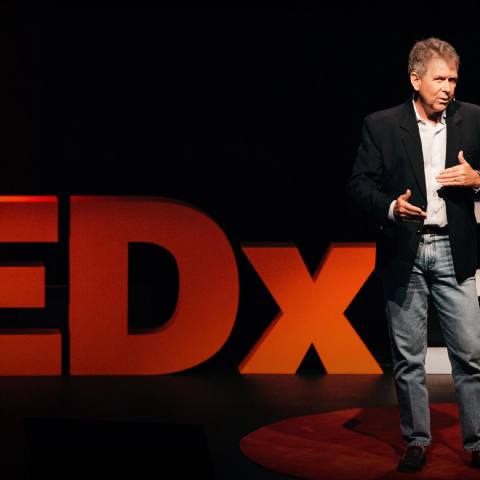
That was Alex Van Halen, David Lee Roth, and Robert Vargas at TEDx Fargo in North Dakota, U .S. in 2026. If you are curious about TED's curation, please visit ted .com slash curation guidelines. And that's it for today. TED Talks Daily is a podcast from TED. This episode was produced and edited by our team. Aspen Fitzgerald Dorsey, Oliver Friedman, Lucy Little, Shu Han Hu, Debbie Rolfe, Emma Taubner, Connor Titsworth, Tonsika Sungmar Nivong, and Hannah Yu.
18:55
Additional support from Isabella Aslarona, Daniela Balarezo, Valentina Bohanini, Ban Ban Chang, Christopher Fazey Bogan, Cinnamon Horn, Laini Lott, Matthew Polis, and Yadi Vasquez. Learn more at podcasts .ted .com. I am Elise Hu. I'll be back tomorrow with a fresh idea for your feed. Thanks for listening.
19:26
This episode is sponsored by Ashby. Every talk you hear on this show started as an idea, and every idea that actually gets built needs a team. Today's sponsor, Ashby, is the software that supports hiring for those ambitious teams. Ashby is the all -in -one recruiting platform used by the teams at Lovable, Notion, Plaid, and Clay. If you wish that AI could help you move faster through scheduling and scorecards, that you could find that silver medalist candidate from 18 months ago in a few seconds, or that you had better visibility into the state of your candidate pipeline, Ashby is for you.
19:59
See why over 80% of Forbes' top AI companies choose Ashby to hire the best talent. And visit www .ashbyhq .com.
20:14
Hi there. It's Adam Grant from Ted's Rethinking Podcast, and this episode is brought to you by ServiceNow. I get to spend my days studying how people think and what it actually takes to change our minds. It's work I find deeply meaningful. But even in meaningful work, there's still busy work. The admin, the repetitive processes, the invisible load that pulls attention away from what really matters.
20:35
That's where ServiceNow's AI specialists come in. They don't just tell you what you should do about your busy work. They actually do it. Start to finish. Cases closed. Requests handled. No extra work for you. To learn how to put AI to work for people, visit www .servicenow .com. Investing with Schwab is like spending a Saturday at a great farmer's market.
20:56
You can fill your reusable tote with a bit of everything. Maybe you go for some free -range, self -directed investing. Or perhaps you pick up a few farm -fresh trades while you peruse. You can even get help from a dedicated advisor. That's full -service wealth management. Mix, match, and change your mind whenever you want. Because at Schwab, you can invest your way.
21:16
No matter your goals or appetite for investing, Schwab has everything you need, all in one place. Visit schwab .com to learn more.