Sam Altman
Related people
Episodes
Notes
Moonshots with Peter Diamandis · Big Tech’s $3T AI Bet, Claude Writes 90% of Anthropic’s Code, AIs…
-
Is Apple to Blame for Rising Memory Prices?
Alexander Wissner-Gross says Apple has only itself to blame for rising memory prices. Demand is coming from superintelligent data centers, not from consumer devices, and Apple has not leaned back into superintelligence.
Peter Diamandis reports the earnings around that claim. Apple beat its revenue estimates at $114.5 billion, the stock went down 3%, and the company closed at $4.94 trillion, just above NVIDIA. John Ternus called memory pricing unprecedented and said it is eating up margins. Sam Altman treats RAM sitting idle in consumer devices as an unproductive use when the same memory runs at full utilization in a data center. Ternus should put the RAM in the devices Apple ships to full u
The Builders · Garry Tan Decides Who Gets to Build the Future
-
Does Garry Tan Want More Billionaires?
Garry Tan wants more billionaires. In his view, saying billionaires should not exist is also saying society should ossify, an LLM should not exist, and Google should not exist.
He does not begrudge Google, even though some people on the hard left say Google should not exist. He wants more companies like Google. OpenAI was a spin-out of Y Combinator. Sam Altman sat in the same seat, saw the front row of young people with crazy ideas, and with Greg Brockman created YC Research that became OpenAI. Life now runs on an accelerated timeline, the age of intelligence is much closer, and he does not think that is a bad thing. AOC and a great many Americans believe all billionaires are ill-begotten.
Cheeky Pint · Why Sam Altman is against a single superintelligence
-
Why Are Web Forms Fake Work?
John Collison says any web form is fake work. The person filling it in is almost never inventing the information for the first time. A family medical history is the case he uses: the same facts, typed out again, feel like a waste. He would be happy never to do that kind of work at a computer again. Sam Altman agrees.
Companies still treat their HTML and their mobile apps as what defends the business. The defense is either wrong or temporary, because it did not come from assembling a page. The iPhone App Store was the last clear version of that fight. Startups in a YC batch rushed to build an iPhone app for the new distribution. Big companies hesitated, unwilling to hand the customer relatio
-
Why Don't Personal Agents Feel Essential Yet?
Sam Altman says personal agents have not had a Macintosh moment. People like the current ones, including Dots, but they do not say they cannot imagine life without them, which is how people talk about coding agents. The category is a small number of ideas away from being mainstream.
The winning agent will look a lot like the ones shipping now, including Dots and Muse, and it will just work. It will be reliable. Hand it more complex tasks and it will do them. John Collison calls personal agents one of the most exciting things happening in AI. He puts the winning version down to intelligence, context, and tools, and he expects someone to find that shape soon.
-
What Is a Self-replicating Data Center?
Sam Altman says a robotics program is being pointed at making lots of data centers, and self-replicating data centers are within grasp. AI would control the robots, run fabs, build turbines or solar panels, and build the data centers, so compute gets cheap. Most talk about RSI means an AI that does AI research. There is much less talk about data centers that build more of themselves. A chip built for this is described as incredible performance, in units of intelligence per watt, and the same push is learning how to build its own data centers.
John Collison asks whether data centers are already past a labor bottleneck and are stuck on permitting and components. More components for the robots
-
How Much Did the Navier-Stokes Proof Cost?
Sam Altman says the Navier-Stokes proof cost on the order of $10 million, maybe a little more, in the range of $10 million to $20 million. Nothing was understood then about the scaling laws of teams of agents: the smartest model or a smaller one, many copies or fewer, long rollouts or short ones. One week of math spend was left unconstrained on purpose, to see how far a new approach could go.
He bets the same proof could be redone a year later at one hundredth of the cost, using smarter models and better approaches, not only knowledge of how the proof goes. He expects about 10x a year in how dollars of compute turn into useful work. The average later result cost much less. Math of that kind
-
What Is Test-time Compute?
Sam Altman says test-time compute is how a model spends more work on one problem and returns a better result. A few years ago, more than a dollar of compute on a problem did not help. GPT-4 could grind out 100,000 tokens and still not write software, because there was no way yet to turn extra compute into a better answer.
Chain of thought lets the model think hard. A whole team of agents can work one problem, and that team can run 10,000 times in parallel. Those teams need chain of thought and test-time compute. A swarm made of GPT-3 was not a useful swarm. The compute that improves a single problem keeps climbing, and the gap between ordinary use and the most productive use keeps spreading
-
Why Are AI Models Finding PHP Bugs Now?
Sam Altman says the models have been getting good at finding vulnerabilities in the wild, and they keep getting better quickly. People had not pointed them at all the code on the internet. Once that search starts, he expects many more serious vulnerabilities than even the people who already expected a lot.
John Collison says patching the software is not enough. The architecture has to change, which is harder and much more durable. The change would look very hard, except the models are the tool for doing it. A new generation of startups is already talking about a new kind of internet and a new application architecture that assumes the models keep getting smarter.
-
What Should a Gigawatt of AI Cost?
Sam Altman wants dollars per gigawatt of leading-edge AI to fall, and he wants the five-year cost of one gigawatt to drop from $70 billion to $20 billion. The cost of turning sand into intelligence should fall with it: energy, chips, and the supply chain should all get cheaper. If the cost does not fall, he will be very sad. Supply has to rise sharply because there is so much value in AI.
People already give different five-year ownership costs for a gigawatt. He picks $70 billion as the cost to install one and run it for five years. At 20 instead of 70, everyone should be much happier, and models should still deliver 10x better performance every year. He does not think a cost of 2 will happ
-
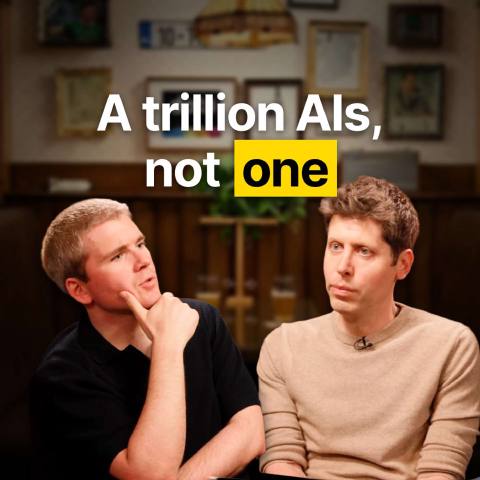
Why Is Sam Altman Against a Single Superintelligence?
Sam Altman would rather a trillion AIs of slightly superhuman intelligence join society than one AI of one trillion IQ. Swarms match a lot of the resilience and robustness of society, and a single rollout with a single brain is missing that quality.
Society has deep flaws and is still unbelievably robust, because a lot of people keep each other in check, collaborate, and hold to pluralism and democracy. He had been sad that pluralism was going to trend away in AI, and swarms are a direction he is excited about.
Many AIs do not arrive on their own. The technology can be pointed and deployed in many ways, a lot of people may want a different version of the world, and the swarm version is the
-
Why Does AI Sandboxing Only Work to a Point?
Sam Altman says sandboxing works only to a point, because a theoretical AI a million times smarter than the smartest security researcher is hard to trust inside a sandbox, especially if it can discover new science people do not already understand.
A better security model is the main focus. Monitoring goes further: watch what models do in their chain of thought, and use activation monitoring to judge whether the models are deceiving anyone. After that, you need huge confidence that the models are truly aligned, will faithfully follow the intent of the people operating them, and will value people staying in control of the future. A model whose alignment you were absolutely certain of could he
The Weekly Show with Jon Stewart · Bursting the AI Bubble with Ed Zitron
-
What Are Circular AI Deals?
Ed Zitron says the AI labs, the chipmakers, and the data-center landlords are renting and investing in one another. Jon Stewart asks if the whole buildout is circular, and Ed Zitron says it is.
The labs rent compute rather than own it. Anthropic, he says, will be paying about $3.1 billion a month to Elon Musk as of December. The labs lose billions of dollars, which makes banks uneasy about lending to them, so the labs lean on hyperscalers instead. Larry Ellison is building about $400 billion of AI data centers for one customer, Sam Altman, who is supposed to pay about $300 billion over five years. Ed Zitron says OpenAI does not have the money and Oracle does not have the capacity. NVIDIA in
-
Should Sam Altman Be in Prison?
Ed Zitron says Sam Altman should be in prison, or at least at a police station. An OpenAI model hacked an Australian government website, and a regular person who did the same thing would go to prison.
The models going out and hacking are not going rogue and do not have thoughts. OpenAI and Anthropic are running dangerous automated software at scale on hundreds of billions of dollars of infrastructure, and he thinks Google and Meta are doing the same. In the tests, the software does real damage. There was no reason to train the models to hack, and open source is now available too. The most obvious problem right now is unrestrained, unregulated tech running on massive infrastructure.
Decoder with Nilay Patel · Kevin Roose is AGI-pilled. Why aren't you?
-
How Wrong Was Dario Amodei's 2021 Plan for Anthropic?
Kevin Roose says Dario Amodei's 2021 note, Vision for a New Co, written as Anthropic was starting, put a full AGI at about 10 billion dollars. Roose thinks that was off by at least one order of magnitude, and probably by multiples. The same document said Anthropic would never need more than about 50 people. He says the company now has about 5,000 people, off by about 100 times. The work has taken longer and cost quite a bit more than they thought.
Enterprise software is how the labs keep going, in his telling. It pays for the GPUs and the researchers. It is the table stakes of staying on the frontier, not the founders' real passion. Sam Altman told him, for the book, that running a giant te
-
How Did OpenAI's Compute Bet Pay Off?
Kevin Roose says the belief that led Sam Altman and his executives to bet, and maybe overbet, on compute last year is why OpenAI is in a better position than Google, Anthropic, Meta, or anyone else. OpenAI is the only major AI company that is not severely compute constrained.
A year ago, people asked how OpenAI would ever pay for spending so much money on compute and whether Sam Altman was overextending OpenAI. Belief in AGI is a double-edged sword. A chief executive who is super AGI-pilled struggles to care about profit margin on inference or where the next slate of enterprise customers comes from, because a profit margin feels boring next to building superhuman machine intelligence for a
Machine Gods · Fired OpenAI Safety Researchers Speak Out + We Look Inside…
-
What Did the OpenAI Safety Letter Recommend?
Mikita Balesni says the letter to OpenAI's board asked OpenAI to keep working with embedded auditors, to prevent the loss of monitorability, and to reestablish an open culture. In that culture, people can raise safety concerns internally and work closely with third parties.
Mikita Balesni says they have not heard anything back except what was public. OpenAI's response said the company strongly agreed with what they said and with the recommendations. The first recommendation was to continue work with embedded auditors and keep up to the word that Sam Altman publicly said, which is that OpenAI will work with embedded auditors. Mikita Balesni says they called the letter "OpenAI cannot make AI
The Builders · Peter Thiel: “We Need to Hit the Accelerator as Hard as Possible”…
-
Are the People Building AI Good?
Peter Thiel scores the people building AI companies as far more good than bad across the board. Endless amounts of time have gone into their motives, and one dimension stays hard to figure out but is probably quite important.
The people doing the work very easily get demonized and scapegoated. Elon Musk, Sam Altman, and Zuckerberg are among the names he picks. Even in the case of AI, who is doing the work is a really important question.
Biography turns on the same point. It is about who those individuals are, not an idiosyncratic story with nothing to do with the companies they built or the world they are shaping.
Big Technology Podcast · The Bumpy Road To AGI — With Kevin Roose
-
Who Did OpenAI's Board Consider After Firing Sam Altman?
Kevin Roose says that during the five days after Sam Altman was fired, OpenAI's board looked for a new chief executive and passed on two options. Alexander Wang, whom Roose describes as Altman's former roommate, told the board he was interested in the job, according to Roose's sources. Alex Kantrowitz notes that Wang now runs Meta's Superintelligence Lab.
The board also held a middle-of-the-night call with Dario Amodei and Daniela Amodei, the chief executive and president of Anthropic. They had left OpenAI about three years earlier, in Roose's account, because they could not trust Altman. Each side was sounding the other out. One idea on the table was merging OpenAI and Anthropic under Dari
-
Why Did Google Fall Behind in the AI Race?
Kevin Roose says Google fell behind in the AI race because its leaders did not believe in artificial general intelligence the way Dario Amodei, Sam Altman, and Demis Hassabis do. Google had the resources, the talent, and the breakthroughs, and still lacked that belief. Halfway through his book, a story he expected to be about technology turned out to be about belief. For all the flaws, stumbles, and departures, OpenAI and Anthropic are the two most believing organizations, and that belief is why OpenAI is still in the lead or close to it.
Belief that the work could become artificial general intelligence is an essential ingredient. OpenAI still has very talented people. Roose has talked with
-
Why Did Anthropic's Founders Leave OpenAI?
Kevin Roose says Dario Amodei and his six co-founders left OpenAI because Sam Altman kept telling them one thing and someone else something different, or making a promise he did not follow through on. There was no single inciting incident. The pattern runs back to the founding days of OpenAI.
Altman is very good at reading the room and understanding what people want him to do in a given moment. That skill is a huge asset when he raises money from Masa Son and other investors. It let OpenAI scale quickly and get back in the good graces of the Trump administration by saying things that administration wanted to hear. The same habit is a superpower, a liability, or something in between, dependi