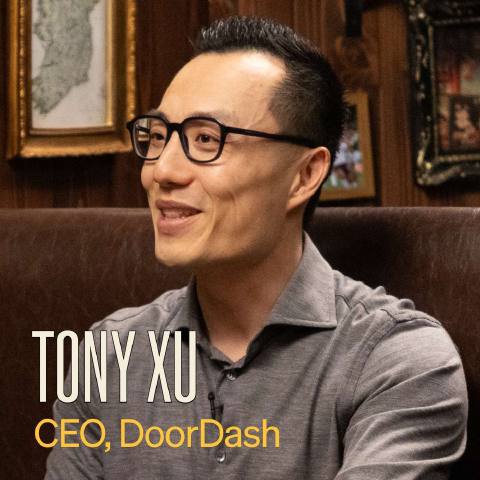
Tony Xu
Related people
Episodes
Notes
Cheeky Pint · The economics and trends of the restaurant industry, with Tony Xu…
-
Why Did Google Food Ordering Fail to Keep Customers?
Tony Xu says Google food ordering could send lots of traffic from Google Maps and Google Search, but it could not get retention. It launched in 2015 or 16, and he does not remember which year. The service was low friction, and a lot still happens after the checkout button.
Google did not know how to contact the driver, whether the driver could not find the customer, whether something was taking a little longer, or whether an item was out of stock. A chat interface is not obviously the correct interface, because many components still have to be solved. With a product like DoorDash, the company has to do the whole thing end to end, or keep great coordination, because cool interface work only
-
What Is Stripe Tempo Built for?
John Collison says Tempo is being built for very scalable crypto payments, with agents in mind. Paying for API consumption, or letting an agent pay for things around the internet, needs a really good scalable blockchain. Tempo is the new initiative for that job, and DoorDash has already worked with the team on it.
Stablecoins and AI are the two topics on customers' minds, and the AI piece is about changing buying through agentic commerce. He thinks DoorDash may not be where to start with stablecoins. Any cross-border use case is the place seeing tons of interesting work. Sending money to 100 countries is already a much better way to do it with a stablecoin than anything else. Long-tail cove
-
Why Are Boots Pharmacies Better Than American Ones?
Tony Xu says Boots pharmacies run a higher, more consistent standard than American drugstores such as CVS or Walgreens, the contrast John Collison calls night and day, because retail in the United Kingdom, Germany, and France is more concentrated than in the United States.
In the United States the retail industry is fragmented. Maybe hundreds of different big brands are strong in certain regions, while in Europe that regional split is less true. The same concentration shows up in Australia and in Germany. Pharmacies can be one category and apparel another. In the United States, tens of thousands of supermarkets and hundreds of big brands make the picture different.
Further up the funnel, t
-
Why Should a Restaurant Reservation Take a Deposit?
Tony Xu says a little deposit on a restaurant reservation makes a ton of sense, after John Collison likens it to a flight reservation you do not simply decide to skip. The implementation of the idea is what is difficult. Restaurants with very limited seating and very long seatings face a very high opportunity cost for a cancellation, versus a restaurant that may have infinite production capacity. The idea itself makes a ton of sense, and the implementation is what matters.
No-shows are being worked on right now, and there is not one single fix. The first step is helping people find reservations they want to go to. A lot of room is left to innovate, because there has not been that much innov
-
Why Is Offline Fraud on DoorDash So Hard to Catch?
Tony Xu says offline fraud on DoorDash is very tricky to catch because the dispute is hard to verify. A consumer says an order was never dropped off. A Dasher says an order at a grocery store was already shopped and picked, and DoorDash is not sure. Or a Dasher says an item is missing inside a store. The claims have offline pieces that are difficult to verify. Building an evaluation for the conditions is extraordinarily difficult, so DoorDash has to build the signals itself. There is no perfect science, and DoorDash has to invent the method.
DoorDash shipped SafeChat a couple years ago after finding that a physical altercation between audiences is preceded by a verbal altercation 90-somethi
-
Why Did DoorDash Build Its Own Delivery Robot?
Tony Xu says DoorDash built its own delivery robot, DOT, because no partner wanted the job. The autonomy work started in 2018 and 2019 with a plan to buy the best technology off the shelf.
A drone can cover a lot of ground quickly, so longer-distance orders look like a strong fit. Short, dense orders in a busy high-rise area are the majority, and a drone may not be the best solution there. DoorDash went looking for a specialist partner and planned to run the operations. Many teams wanted to build robotaxis. Sidewalk robots were too slow. Humans are already very good at delivery and at driving, so the bar is high. The vehicle has to be fast enough, and it probably does not need to be the siz
-
How Does Chick-fil-A Succeed?
Tony Xu says Chick-fil-A succeeds on the standard ingredients of a great consumer business. A highly retentive following comes back often, and the company spends very little money acquiring them. It is extremely efficient, with scale economies in equipment custom to the company, in service training, and in how staff are treated.
He went through hospitality training at Chick-fil-A in 2017, or maybe 2018. He does not remember everything on the checklist, but one rule stood out: the floors must be so clean that babies would lick them or could lick them. Many people he met have spent over two or three decades of their careers at Chick-fil-A. The restaurant industry has churn and difficulty staf
-
Why Do Restaurants Struggle to Know Regulars?
Tony Xu says knowing a restaurant regular is hard because a favorite food is probably not eaten every day, even though people eat 20 to 25 times a week, and the average staff may turn over every other day rather than every other week. A new waiter or waitress does not know the customer. An owner might greet someone or comp a dessert, but the gesture is sporadic and depends on the owner being there.
Airlines make it highly irrational for a frequent traveler to fly anyone but a preferred airline. Restaurant rewards stop at mass-market punch cards, like a 10th coffee free, or at that old-school greeting. John Collison gets Taiwanese food once a month or once every two months. The pattern is no
-
How Has Spending on Eating Out Changed?
Tony Xu says spending on restaurants for eating out has increased every single year for the last 75 years. The figures are rough, but in the 1950s, when the government was measuring it in America, people spent maybe 75 to 80 cents of each dollar on groceries versus restaurants. Today the shares are almost reversed: almost 60 cents of each dollar goes to takeout and 40 cents goes to grocery, and the split has kept moving in that direction.
Opening location number two is still really difficult in a lot of cities. Even the most popular restaurants and the hottest chefs struggle to raise the capital or get the permits to start construction. Making it as a single restaurateur stays hard — he was
-
How Many Restaurants Does China Have?
Tony Xu says China has over 7 million restaurants, versus about a million in America. Restaurants are pushed toward two extremes at once. One side is hospitality: close attention to service and a human-to-human connection that will never get replaced by AI. The other side is production. Restaurants are almost like manufacturing sites, a third space and a factory in one place. Retail splits the same way, into showrooms and warehouses.
In China, people move fast toward any opening in a deeply capitalistic market. The business does not have to stay a dining room. It can be a kitchen, or it can add merchandising and sell T-shirts, hats, and cookbooks with the food. Commercialism in restaurants
-
What Happened the Night Every DoorDash Order Was Late?
Tony Xu says he thinks DoorDash had less than two weeks of cash runway on a night when every single order was late, and the team still refunded everyone. The refund cost over 40 percent of the bank account, and the hit ran maybe a little over that share of the funds. The crew baked everyone cookies and delivered them at 5 a.m., before anybody woke up.
The night was a Stanford football game in 2013, while he was having trouble raising the seed round. He puts the crowd at maybe 100 customers. The refund and the early-morning cookies are the story that inspired the value in the first place, because the decision came when their backs were against the wall.
His test is which actions occur on th
-
Why Did DoorDash Win Food Delivery?
Tony Xu says DoorDash won because the company got more customers than other people, and the proof was customers coming back to the app and using DoorDash even with no money to market to them or discount offers to give them.
Restaurant delivery is judged on multiple dimensions at once: which restaurants are available, whether the order showed up on time, the quality and condition, how much it cost, and what the company did if it screwed up. Being good at one of them is not enough. Any consumer product is judged very simply by retention and usage. It is easy to disagree about whose app people like more, or whether apps look similar or different. A much higher retention and frequency of use is