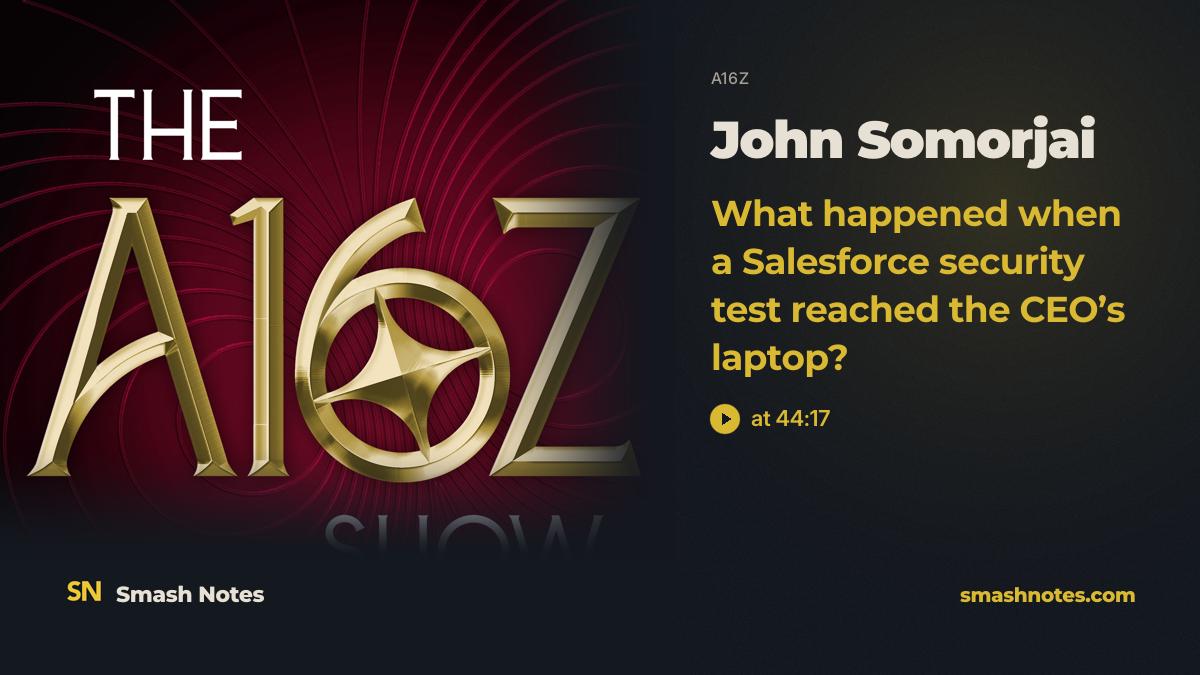
Inside Salesforce’s $100 Billion M&A Playbook | John Somorjai
What makes a startup worth acquiring when software has never been easier to build? Salesforce’s John Somorjai says the answer goes well beyond technology: the best acquisitions can accelerate a product roadmap, bring in exceptional talent, and put a startup in front of 15,000 Salesforce sales reps almost overnight. John joins a16z General Partner Alex…
People
Notes
-
-
-
-
-
-
-
What Can Kill a Salesforce Deal? at 41:23
-
Related notes
- How Do You Build a Product When You Are All Out of Time
- Why Was Listen Labs Revenue Too Small for Salesforce?
- Why Do Companies Avoid Upgrading Old Software?
- Why Do Seed Deals Assume a Trillion Dollar Outcome?
- Why Invest More After a Startup's Valuation Goes Up?
- Why Do Startup Valuations Keep Rising?
Related episodes
-
![]() Startup Lessons from Serial Entrepreneur Justin Kan
-
![]() Amazon CEO Andy Jassy on the $220 Billion AI Buildout
-
![]() Mark Cuban on Why AI Could Turn Solo Founders Into Trillionaires
-
![]() The Frontier Ideas a16z Wants to Fund | Marc Andreessen, Ben Horowitz & Chris Dixon
-
![]() What It Takes to Win as a Founder | Ben Horowitz
-
![]() How Bending Spoons Built a $20 Billion Compounder | Luca Ferrari
-
![]() AI Cyber Panic, Ken Griffin's Bubble Warning, The Fall of France?
-
![]() A quiet investor’s $10 billion bet on AI, chips, and defense



Full transcript
The episode notes above make this conversation easy to skim.
0:00
We have built an incredible service cloud business. It's now almost $11 billion. And the foundation of it was an acquisition. How do you describe Salesforce as a platform today? At its core, it's delivering trusted foundation for all of your enterprise applications. You can interact with it through Slack. You can interact with it through Cloudforce.
0:23
Software development is faster and more affordable than it's ever been. In this era of software, what is worth actually buying? There will be a reckoning that happens. A lot of these companies have valuations that are not sustainable that they won't be able to grow into. We've invested in more than 750 companies. We've acquired 29. So it's still a relatively small number of companies.
0:48
But I think if we ever see something really exciting, we want to stay close to that company. If you were going to start a company today and it was going to attack Salesforce head on, what are the openings that you see fit? When software can be built faster than ever, what makes a company worth buying? A16z partner Alex Immerman sits down with Salesforce Chief Corporate Development and Investments Officer John Somorjai, who has helped oversee nearly $100 billion in acquisitions.
1:17
John explains how Salesforce decides whether to build, buy, partner, or invest, and why distribution can transform the trajectory of a startup. They also discuss what founders should know before entering an acquisition, the red flags that can kill a deal, and why John thinks parts of today's venture market have become overvalued.
1:38
John, it's great to be with you today. Thank you for having me. It's wonderful to be here. You've been at Salesforce now for over 20 years. Mark Benioff is a Mount Rushmore -style figure for cloud software. He led the transition from on -premise to cloud. He is an incredible marketer. Dreamforce this year. He frame -mogged Jensen and Dario and Sam.
2:05
I'm curious. You've had a long career with him. What's it like to work with him? Well, I would also add visionary to that point as well. Yes, yes. Mark is quite a visionary, and he really, I think, can see where the industry is heading. And so that's how he helps the company transform itself. And when he thinks about growing the business, he thinks about organic innovation, but also inorganic innovation.
2:29
And that's really been the key to how we've grown the company and marrying the two together. And so acquisitions play a huge role in that. And when Mark sees that the world is moving in a certain direction, he will point me and my team to go figure out, go find the best asset to buy in that category and come up with those ideas all the time.
2:51
I would say the other thing that's very unique about Mark is just his level of curiosity and how he thinks about things with a beginner's mind all the time. And so he asks that of us as well. And I think it's really helped us find some remarkable companies to bring into Salesforce and also some really exceptional entrepreneurs. With that in mind, I really like that idea of a beginner's mind, the curiosity.
3:19
How do the two of you approach acquisition and investment ideas together? Well, I think that one of the things that's always been a hallmark of Salesforce is we listen to our customers quite a bit. And so we get a ton of feedback around what do customers want to buy from us? Where do they feel like our products are missing? Where are the gaps? And we take that and work with our product teams to really identify what are the best opportunities.
3:46
And that's certainly for the acquisition side. On the investment side, my ventures team meets with thousands of companies every year. And I think we get a very good sense of where is the traction? Where is the interest? What areas of technology are really growing the fastest? And we can bring all of that feedback and learnings back into the company and I think make better decisions as a result.
4:10
And you alluded to Mark as this big visionary. And of course he is. How do you and your team think about balancing Mark's big vision mindset with strategic and financial discipline? Maybe there's been times where you've had to tell Mark no on his big grand idea. I'm curious how that all comes together. So what we have is an internal framework that we follow, which we are pretty disciplined about following.
4:39
And we look at sort of three elements. The first would be where is the strategic fit and how much customer success can it drive? I think the second would be can we accelerate the business? Will it fit into our technology stack? Is there a good cultural alignment with the team? Do we see the talent there as people that will work well within Salesforce? And then the third part, which is probably the trickiest in this day and age, is how can we deliver value to our shareholders and to our customers? And what is the timeline for value accretion? Is the valuation reasonable? And that last point is probably the hardest right now because everything is expensive.
5:22
We're in a unique moment in time and we should use some time later to chat on that. Maybe to take a step back, Salesforce today, really large company. You're much more than CRM today. How do you describe Salesforce as a platform today? Well, I think it's always been a place where customers can go to buy technology to help them interact with their customers in new ways.
5:47
And that's sort of been foundational from the beginning. But how we think about it is that we have a platform that is, at its core, it's delivering trusted foundation for all of your enterprise applications. And then you can interact with it from different surfaces. And that's why we made Salesforce headless. And so you can interact with it through Slack.
6:08
You can interact with it through Cloudforce and through other places. And I think it's just as broad as a company wants to make it, a place where you can really deliver a lot of enterprise value. Absolutely. I mean, I think it has been really cool to see you guys leading the charge on the headless transition. I'm curious, as we all enter this brave new world with AI and there's new interfaces.
6:31
You referenced Cloud. There's obviously ChatGBT. There's a broad swath of them today. You're able to access Salesforce via them. Maybe a good portion of your customers are aspirational about requiring fewer seats in the future because they're able to accomplish more work today with AI than they previously needed to. I'm curious, under this transition, how do you think about Salesforce capturing value in this new world? Well, first of all, I mean, I think we have different ways to price our products.
7:06
But most importantly, consumption is a big part of how we price. And so many of our products, they are consumption based. Like MuleSoft was always consumption based, for example. And so I would say what we try to do is make sure that, first of all, we want to be delivering value that our customers really appreciate and want to continue to pay for.
7:27
And whether they pay on a per seat basis or on a usage basis, it doesn't really matter. But I think that the key thing is making sure that they're happy and successful and will come back. And that's one of the critical pieces about where the technology industry has been moving is more towards outcome based pricing where you're paying for resolutions.
7:49
And this is what FIN does so well, for example, and versus just paying for a seat. And I think that's definitely a trend that we are getting really behind and more and more of our products are going to be delivered that way. Yeah, Finn was certainly an early pioneer in the outcome -based, more resolution -based pricing. And by the way, the reason they can do that is because the time to value is so fast.
8:14
So Finn, you can get up running on average in 16 days. And immediately starts seeing the agents handling more and more of the calls that humans might have otherwise been escalated to handle. And so we actually decided, okay, well, why don't we just pilot Finn internally and see what it does for Salesforce? And we found that we had it up and running actually in 14 days.
8:38
And on our help .salesforce .com website, it's now handling over 40% of the traffic. Oh, wow. And it is delivering 65% resolutions without going to a human. So that is really quick time to value. And that's kind of a hallmark of, I think, what a great acquisition looks like. Yeah. And then with enterprise sales in particular, you're earning a larger share of the labor budget.
9:02
In your Finn example, that could be customer support, a little bit of sales. And so in a Salesforce context at large, that can be my AI team is prospecting, it's finding leads, it's qualifying leads, it's following up, it's closing deals. And so as you're earning a greater share of that labor budget, sure, your customers may be paying you quite a bit more than they did in the past, but their overall cost of selling has gone down.
9:31
Absolutely. And qualified is probably one of the great examples of what you just said. So that can replace your sales development rep organization, essentially, where basically it's taking all the traffic that's coming in through the website and answering questions with its Piper agent. And it's a very human -like experience where you're speaking to a very lifelike avatar, and they can explain what the products do and help set up meetings for you all automatically without touching a human.
10:06
Makes a ton of sense. We just started to touch on a number of your acquisitions. You have a long history of acquisitions, I think nearly 100 billion of acquisitions over the course of your tenure, 12 over the last year. Really amazing. As you think about M &A as your strategy, there were the large ones like Slack and MuleSoft, Informatica.
10:31
And then more recently, you've gotten to the AI native companies. You mentioned FIN, Listen Labs is another. Your framework for acquisitions you touched on, like financials is the third component, the second strategic, and then first was what are your customers asking for? And also, how can we accelerate them with our distribution? I mean, remember, we have 15 ,000 sales reps.
10:57
And so if you can plug one of these acquisitions into that really, in the case of Listen, you know, only a handful of reps, you suddenly make it available to your entire sales team, you're going to grow that business. And so maybe, like, imagine I'm at the other side of the table.
11:16
And I am at Alfred, I'm at Listen Labs, I'm a really ambitious AI founder.
11:24
I get approached, I'm spending time with Salesforce. And it sounds great to partner with your 15 ,000 sales reps and get me pushed through your channel. I would love that. How do I think about partnering with Salesforce versus, you know, selling to Salesforce?
11:46
Well, I think we approach partnerships in a very open way. And so we have probably more than 8 ,000 partners at this time that we work with. These are ISV partners. Sometimes we invest in the partners, by the way, as well. And that's part of the role of Salesforce Ventures. But we want to have an open ecosystem where we're bringing as many solutions as possible to our customers and they make the decision.
12:14
They can buy a partner solution. They can buy a solution from Salesforce. But I think the hallmark of our company is making sure that we have this as broad of an ecosystem as possible because you want to have as much to offer as you possibly can. So there are definitely ways to partner with us. We have multiple types of partner programs and a great organization that does that.
12:39
And so, you know, maybe like as I think about, you know, I'm an ambitious AI founder and selling to Salesforce. Why is that the like more ambitious choice for me? Well, imagine having to build that distribution channel on your own and how long that will take to hire the reps, ramp the reps, enable them and get them productive. It takes a very, very long time to build that at scale.
13:09
Oh, and by the way, you've got to do that across small business, medium sized business and enterprises. Oh, and you also have to do that globally. Absolutely. It's a heavy, heavy task for anyone to take on. And I think that, you know, entrepreneurs have to like make that decision. Is is this the right time to sell and plug my technology into a company that already has that? Or can I continue and go alone and try to build it on my own and continue to raise money and dilute yourself further and further and further and further? It's just many years of undertaking versus getting your your technology in the hands of customers as widely as possible and as quickly as possible.
13:52
And that's the decision you have to make. Fair enough. And as you try to integrate these folks into your culture,
14:02
they bring a certain entrepreneurial spirit, their own way, which we love. Yes. And so how do you think about bringing them in and integrating them appropriately so that that spirit can continue to spread and thrive while being a part of the larger platform? I think that's one of the most exciting things about what we do when we buy a company is is bringing this exceptional talent to help transform the company and in many ways refresh us, you know, and make sure that like we're bringing in that entrepreneurial spirit into the company and thinking about new ways of doing doing things.
14:42
A key focal focal point of the integration team is on the people and making sure that they're successful and onboarding, learning, learning how things work within Salesforce, but also growing their careers internally. And we've had many, many stories of people who have come in, sold their companies to us and have risen to become our chief product officer.
15:08
It's happened actually four times now. And or people who have taken on big roles within our sales organization or other leadership roles. And so I think I think it's been an important part of how we've grown the company to through bringing in new talent. Yeah. I mean, you have 80 ,000 employees. I can imagine you bring in these companies.
15:30
They help like turbocharge certain areas. Is there an example of one of these acquired companies that you point to as having a big impact on the culture of the organization? Well, I would say, you know, one one that springs to mind is David Schmeyer's company, Velocity. So we didn't really have much of an industries bent within Salesforce.
15:54
And yet, you know, so many there's so many important verticals that are a key part of the growth of the entire software industry. And we now have 13 verticals, actually. And that all really, that sort of focus on the industries, focus on the specific use cases for that industry, that came through that acquisition. And so David came on board, brought Velocity in, it brought in six verticals.
16:20
We've added another seven since. And he went on to be chief product officer, now chief strategy officer. And I think he's definitely helped us think about selling to those industry verticals in ways we never would have otherwise.
16:38
That's very interesting. And like, one of the pieces that's also been impressive about Salesforce over the years is like, there are large companies built on top of you that are just focused on verticals as well, like Viva and the like. And Sino was probably a great example of that. And that was one of our early investments in the Ventures program.
16:59
And they created an incredible company just based in financial services.
17:07
Today, as you're thinking about build versus buy, you probably are told way more that we can just build that. Software development is faster and more affordable than it's ever been. And so a part of your job must be figuring out when that's actually true. Yeah. I'm curious, like in this era of software, what is worth actually buy?
17:38
Well, you know, when we think about the, you know, do we build by partner? I mean, we go through a lot of analysis with the product teams around what their roadmap should look like for the next three years. And do they truly have the people that can build what they're trying to deliver? Do they have the internal expertise for it, for example?
18:04
And or can they go out and easily hire it? And you know how hard hiring like AI engineers right now? Very, very, very hard. And so in many cases, you can really speed up the development process through an acquisition if you can find the right one and if you can integrate it quickly. And that's that's also, you know, one of the things that you have to consider, because a typical acquisition end to end from the moment you start with the idea to when it's actually integrated could be six to nine months.
18:37
And so could you deliver something on your own much faster than that? And so those are the types of calculations we make and try to try to think about. But when the right asset shows up, you know, you really know it. You you can have a sense. And that was the case when Alfred and Florian came came to meet with Mark and demoed Listen Labs to us.
18:58
I mean, they were just brilliant. And I think we had we thought the not only was the technology outstanding, but the interface was so easy. It was so easy that my team started using it with, you know, no enablement whatsoever. Within 10 minutes, we had we had a survey out and and and started and it was it just could not have been easier. Is that how you diligence to listen? Listen Labs is part of what we did a survey on Listen Labs to their customers.
19:30
Yeah, actually. And that that was incredibly effective. But we do, by the way, our diligence process is pretty rigorous. And the customer element, the customer feedback that we do is is one of the most important ways of really judging how good the product is. And, you know, are these customers likely to renew? We're happy Listen Labs customers ourselves and use it as a diligence tool as well.
19:58
Very cool. Maybe on this piece of like accelerating capabilities.
20:06
Another acquisition that you were talking about earlier was Finn. You guys have long had a role in customer support. Maybe talk about what capabilities Finn brought to you all and maybe the story behind that acquisition. Yeah. And I think I think it goes back to what we talked about earlier. Mark's focus on having a beginner's mind. And so we have built an incredible service cloud business.
20:34
It's now almost 11 billion dollars in in AOV. And and the business actually the foundation of it was an acquisition that we made in 2008. A company called Instranet, which was Alex Dayan's company. Another person that went on to be our chief product officer. Amazing. He's exceptional. He's, you know, has one of the greatest entrepreneurs to come out of France.
21:01
And I think that what was very clear to us is that the whole movement towards native AI applications and the way that they were priced based on outcomes and the very fast time to value, how quickly you could get it implemented and up and running and having happy customers using it. It just wasn't something that we could build quickly enough.
21:28
And so we had a wonderful relationship with Owen, who we had known for years. We got to know his AI team in Ireland who are just outstanding. Absolutely outstanding. Some of the best AI talent actually in Dublin, Ireland. And we we realized like, wow, this could just turbocharge what we're trying to do with service cloud. And and so we were able to to buy the company.
21:53
And it's it's really as I said earlier, it's it's proving to be quite a very valuable acquisition for us. Yeah. I mean, that that one's an amazing story from a rebirth of the company perspective to with, you know, the transition from Intercom to Finn and, you know, him coming back as founder. And he's having a big impact at the company like he is.
22:15
Owen is someone with a loud voice and he makes his views known and he's really and he's really trying to shake us up. And that's that is another benefit to bringing these people in. Amazing. Amazing. Another product that, you know, I use every day. Certainly you do is Slack. I'd be curious if you were to rewind the clock like you had a rationale for acquiring Slack.
22:44
Slack's role today in AI is pretty important and different than maybe what you could have expected then. I'm curious, like how you're thinking about Slack has evolved over the years. I think the core thesis for why we bought Slack holds true today, but it's even bigger than I think we all imagine because it is the perfect conversational interface for AI.
23:08
And when we thought about it back in so we bought the company in 2020. So it's now been there's a there's a rumor out there that Mark only spent an hour with Stuart before the acquisition. I don't know if that's typical, but a lot more time than that. Definitely, definitely. And and I think we know we looked at it very closely. We had been using Slack.
23:31
It was clearly a beloved product in in among its users and and something that needed more distribution. Like it was just really it was losing to teams and they were really they were stuck. I don't know if you remember back in 2020, but there was like one bad quarter. It's stock went down. And and that's really what triggered a lot of the discussions is that, you know, how can we bring these two companies together and turn Slack into what it really needed to be, which was the user interface for everyone and the collaborative tool where humans and apps would work together.
24:11
And now agents. And now agents, yes. And we didn't know the agent part. That came later. But you can just see that it was the perfect interface for that. We also knew that it would be the interface for all of our products. And so you can access all of Salesforce products now through Slack. And that was always, you know, one of the key strategic rationales that we had at the beginning.
24:36
So since then, Slack revenue is now almost three times from where it was when we bought the company. And it is our fastest growing product. So it is taking off like wildfire in this day and age because it's just perfect for agents. It makes a ton of sense. I think of Slack in this current era as the unofficial org chart. Like it knows who reports to who, how people talk to other people.
25:07
It has all the context on how decisions are made. And so it's a really important corpus for AI. But it's an interface product, as you alluded to. And so as other products are more headless, it can be the central, you know, repository central, like ground for decision making. Absolutely. And because it has all the context from all of your work, if you use Slack bot ever, like you can just get the richest answers that you've ever seen from AI right there within your interface.
25:44
And so it it just couldn't be easier. And we're we're thrilled that we were able to buy the company. And, you know, it's been like five years and a quarter since we've owned it. And it's it's just, I think, transformed Salesforce. Amazing. And maybe just to like hit on that, right. Like you said, it's grown nearly three X and, you know, a bit over five years.
26:05
That's really strong growth at scale. What about that, you know, story, that integration? What has gone so well with that one relative to, you know, other acquisitions? Yeah. And I think, you know, it was it wasn't clear that it was going to go so well from the beginning, especially when we were buying it during the pandemic. Right. And we basically negotiated the deal, did everything, all the diligence through Slack, you know, by the company without ever, you know, having a lot of face to face meetings.
26:36
And and then, you know, it took a little bit of time for the integration to really hit its stride. But once it did, it has taken off. And I think getting again, it's like it's like great technology that was starved for distribution. And I think this is sort of the point I was making about Listen Labs as well. Like this is the benefit that an entrepreneur can get from a great acquisition partner.
27:05
How many of those face to face meetings happened to happen in Hawaii?
27:11
Well, it was it was a lot later, actually. That was not the common ground in COVID times? Not no, not not then. I mean, there were so many restrictions on even travel to Hawaii. Sure. But I would say we Hawaii is very useful now. So, you know, I think about like Braze, for example, which is our most recently announced acquisition. I think that the meeting that the two CEOs had in Hawaii was critical in terms of like jumpstarting that process and building the camaraderie and seeing the alignment.
27:46
And it just did. Hawaii is a magical place. All good things start in Hawaii.
27:52
So we've spent a bunch of time talking about buying companies and partnering with companies. You have a third option, which is investing in companies, letting them run independently. I used to think of Salesforce Ventures as you partnering with your ecosystem, you know, your close partners. Today, it seems that you're investing much more freely, much more broadly.
28:19
So, of course, Anthropic, Mistral, close partners of the company, Fall, Base Power seems a little more, you know, out there from a strategic fit. Curious to hear like how the strategy has evolved over the years. Okay. Yeah, that's a great question because it really there's been an evolution for sure. But, you know, when you think about it, the through line has always been the same, which is how can we make sure we're finding the companies that will be delivering enterprise value, whether it's today or in the future.
28:56
And so it started off in 2009 when we invested in companies like, you know, that were part of our ecosystem, like DocuSign, like Encino.
29:08
And they should closely fit with your with your software. Twilio was another early investment. Makes complete sense. And and we integrated with them. We partnered close to them. We also did a lot of services investments as well to build out our whole ecosystem of services partners regionally. And and those were were very successful. We then ventured more into new areas where the industry was heading, like companies like Snowflake.
29:37
That was a very, very critical investment that we made several rounds and then the IPO round. We also invested in cybersecurity because we could see how that was going to become a massive problem for the industry and we needed to stay current. So WIZ was one of our investments. And then, you know, I think when AI became so obvious as as the next wave of the industry, we wanted to be very, very big in investing in the best companies there.
30:09
We created the billion dollar AI fund at the beginning of 23. But but but in addition to Anthropic, we also invested in Mistral and Cohere in in several companies that were more at the at the infrastructure level level. We've invested in voice with 11 labs who invested in video with runway. And now we're actually venturing into physical AI, too, which I think is really a new, fun and exciting area.
30:39
And very you can see with the improvements like with with in robotics, with dexterity and mobility. This is going to be a huge future for for the industry. And so we want to be there. Totally makes sense. I mean, very broad mandate. You know, it seems to cover all of technology wherever there is growth in the sector at large. How are you spending your time personally?
31:08
I divide my time between finding new companies to acquire the working with the integration team and making sure that the acquisitions are successful and then the ventures program. And so I'm I'm split a lot. As I said to you, I've never been busier than I am now. But I think that's sort of a hallmark of how just the rapid evolution of the industry and how quickly technology innovation is happening these days.
31:36
You just have to move faster. And however fast you move, it's not even fast enough.
31:42
What in all these areas on the venture side, what are you most excited about right now? Well, as you know, I think the robotics companies are are just fascinating to see. Like I I absolutely love that. I have we have an investment in figure AI and humanoids. We've got investments in physical intelligence,
32:07
dyna robotics, skilled, and a variety of other companies. We have Zipline, which does drone delivery, for example. We love many of those companies. We're doing things in new areas that aren't just about software, but it's very clear they're going to be really important to the industry. I'm enjoying that.
32:31
We have investments around the world, and so we're seeing some really interesting companies in Japan, for example. We invested in a robotics company there called Mugen, which is really, really big in logistics and in the Japanese market. We have investments in many in Europe, in Israel, and in other parts of Asia and Australia, for example.
32:58
I think seeing the globalization of technology has been a real interesting vantage point.
33:07
For the robotics side, I agree. We're starting to see the early signs of scaling laws within robotics, which is really exciting. Then a bunch of these companies have gone a bit more vertical in their go -to -market, and so we're starting to see revenue start to scale up, which is really exciting. As you think about your investment aperture, How often are you looking at companies and thinking, hey, potentially one day they could compete with Salesforce? And would you invest in a company that might take that position? I think actually we probably should.
33:47
It's good to stay close to where the technology is going. And maybe that company may turn into an acquisition target someday. So, you know, one of the things, just to give you some numbers, we've invested in more than 750 companies. We've acquired 29. So it's still it's a relatively small number of companies. But I think if we ever see something really exciting that, you know, maybe it's an acquisition target in the future, maybe not.
34:17
Maybe it's just a great partner. You know, we want to stay close to that company. Yeah. I mean, you mentioned a good portion of those 750 are in areas that you wouldn't say are core strategic areas. Like robotics today doesn't strike me as, you know, the next thing in line in the Salesforce roadmap. But we want to be partnering with them.
34:39
But you want to be partnering with them. How do they think about the value proposition of partnering with Salesforce Ventures? I think the biggest value add is probably how we can help them access customers. And, you know, we have we have the broadest set of enterprise customers that are interested in buying technology. And so we help our portfolio companies get in front of these customers.
35:02
I think we also provide a lot of meaningful advice from an operational lens around what is it like to build a business in this particular area? And having, you know, been been through so many stories, we can really help these entrepreneurs grow their businesses. If you were going to start a company today and it was going to attack Salesforce head on, what are the openings that you see fit? What I what I would say is I don't know why there continue to be new CRM companies at this point.
35:36
Like it just it is interesting, like how. And why do you feel that way? There are a bunch of AI native CRMs. There's Lightfield, Monaco. Curious, your take. I just think it's very hard to. First of all, there's so much great CRM technology in general. And we are continually improving our products. It's just very hard to build something that's particular and particularly specialized and niche in that area right now.
36:09
And so I'm not I I have yet to see something that's so novel that it's going to turn into a large multibillion dollar company in that space. Yeah. I mean, my perspective would be maybe there's an opportunity down market from where you're traditional. I know that you guys play in SMB, too. But in terms of getting up and running quickly. Maybe more very down market.
36:37
Yeah. There could be. Yeah. I could see that. But it's still a small, a small area. And like, you know, venture. And the way we approach it is we only invest in big opportunities. And I think most VCs look at that. And so just to invest in small niche opportunities that might be a little different than what the incumbents are doing. I just don't get it.
36:57
Fair enough. I I the parallel story might be, you know, Stripe started with, you know, small companies and was able to grow with a lot of them over time. And I imagine that these startups might have similar aspirations. I just think there are too many of them. There are too many of them. There's too much funding going into them. And and I think the VC community should focus on like really new, important areas that haven't been done before.
37:26
And as you think about the VC community at large, we're in a unique funding moment in time. I'm curious, like what you make of it, how you how you're making sense of valuations these days. I think there's a lot of irresponsibility going on. I think that there is there's the valuations are, of course, way too high. But but also just the the buyer universe is so small.
37:56
The you know how when you think about investing, you want to think about what are my exit opportunities? And not every company is going to go public. In fact, very, very few companies go public, probably one percent or less. And so it is. So the exit opportunity is critical. You want to think about who could be buying it. And once you get above 10 billion dollars, for example, there are the buyer universe is so small.
38:19
And yet how you're seeing so many of these these enormous multibillion dollar valued companies out there. And there simply is going to be there will be a reckoning that happens. I don't know when, but it is it it is inevitable because there a lot of these companies have valuations that are not sustainable, that they won't live in. They won't be able to grow into and are also, I think, going to be bad for their employees.
38:47
And so this is this is why I say it's it's irresponsible. And and unfortunately, you know, you try to have this dialogue with entrepreneurs and they they have, you know, they just want the highest valuation that they can possibly get. But that is not the best decision usually. And do you think so much of it is a result of just like power law thinking like, you know, Anthropic is likely to go out at a valuation north of a trillion, let's just say, obviously, SpaceX at two trillion.
39:20
Those companies grew to those valuations in, you know, certainly Anthropic and then OpenAI's case in a relatively short period of time. Right. And those are generational companies. Absolutely. And they're very, very rare. And when you when you find one of those, they're amazing. And that's why we invested in six rounds of Anthropic, because it was clear.
39:39
It was clear from the first meeting we had with Dario and Daniela that these were special people. They were some of the most brilliant minds we'd ever met and they were going to build something great. And so from that vantage point, it made sense to keep investing. But those companies are rare. And I see a lot of sort of mediocrity in in in entrepreneur entrepreneurs and their ideas that are not going to become those generational companies.
40:07
And they shouldn't be commanding the 10 billion dollar plus valuations. But yet they get them. And so that's where I feel like a little bit more discipline is warranted right now. I agree that in certain pockets of the ecosystem that exists, I think part of my optimism comes from like what a top one percent outcome was 10 years from 10 years ago is very different from what a top one percent outcome is today.
40:36
Even on the M &A side, you mentioned Wiz earlier, Cursor. So there have been these these larger outcomes that drive the returns for the ecosystem at large. Definitely. And I, you know, and I'm an optimist. I could not do my job if I was an optimist. But just know that I see the thousands of companies every year that don't make it because they all come to us to try to be acquired.
40:59
And so we we see we see that part of the industry that, you know, you don't read about in the press. The press doesn't like to cover those stories. And and so it's just an important fact when when when an entrepreneur is thinking about raising money, what's the right valuation? What's the appropriate way to build this business? You know, they have to think about all of that.
41:23
You've been involved in some of the largest enterprise software transactions. Sometimes those deals go south and don't happen. What kills deals? I think when you go through the diligence process, first of all, it's really important that you're ready and you're organized so that the data is flowing and it doesn't look like you're having trouble getting access to data.
41:51
I think one of the things that we found is a lot of times companies don't have strong controls over their financials or they don't have data on their customer contracts. They don't really understand what customer attrition really is. I think one of the mistakes that a lot of founders are making these days is they focus on one metric alone, which is ARR.
42:19
ARR is a wonderful metric, but it masks attrition. It's really important that you think about what is the– that you understand the attrition of your customers and you do something about it because that is– when you meet with a company that has very high attrition, that usually means that there are a lot of not just unhappy customers, but there might be some product quality issues as well.
42:44
And so it is one of the big red flags that we look for. I think another area is how are you handling your data privacy? How are you handling your security? So security is the one function in all– we have 14 functions that we work with on all of our diligence processes. And security is the one function that can hold up the red flag and say, I'm killing this deal.
43:10
And so if you have built your technology stack where it's easily open to hacking, that's going to be a real problem for us. And so what you also want to do and be prepared for is try red teaming your technology stack and see what happens before you go into diligence, because we're going to do our own penetration testing and find the problems.
43:33
And you definitely want to identify the vulnerabilities before we do. But so nothing goes better in a process when a company is totally buttoned up and when they have all their data accessible, when their tech is secure. Then the diligence process moves really, really rapidly and we can get through it quickly and painlessly. But when they don't, that's when deals can die.
44:01
Is there an example at the 11th hour of a deal not going through? Of course you can't name names, but maybe a painstaking anecdote for you or for the founder? I think that it usually doesn't happen at the 11th hour, but it'll happen after the term sheet is agreed and you've negotiated price and the major terms of a deal. But then you get into the deep diligence process.
44:32
You know, we have found problems where one example was we were, when we did the pen test, we were able to not just access all their source code, but even get into the CEO's laptop and get information about their employees. And so it was all... When you shared that back. And we shared it back, of course. We always share back what we find and try to help them fix the problems.
45:01
But it was so bad, like some of the worst that we'd ever seen, that it was unrecoverable. We've had other, by the way, security incidents that are recoverable and you can identify sort of what are the P0 problems, P1s, P2s and have as a condition to close, or maybe it's a condition of signing even, that we won't sign until these are fixed.
45:23
We won't close until these others are fixed. And so it all depends on how bad it is, but you've got to have your house in order when you go through one of these processes. Makes sense. There's an amazing photo of you and your mother online representing your father in 2023 for his Fermi Award. Your father was an extraordinary figure. He survived the Holocaust, fled Europe, came here and had an incredible scientific career at Berkeley.
46:01
We'd love to just close with your experience growing up with your father, what he thought of your career,
46:10
how he shaped you. Well, my father wanted me to be a chemist, to be clear. So he, you know, he found it. You came pretty close. He founded a field of chemistry. Well, you could argue M &A is a lot of chemistry in what we do. But, yes, he founded a field of chemistry called surface chemistry and also spent a lot of time in catalysis, won many awards.
46:36
We got to go to the White House when he won the National Medal of Science. It was very, it was incredible to grow up with a man like that and meet with his colleagues, too. And we had some of the most incredible minds in the world come to our house for dinner. My mother loved to host these incredible dinner parties. And so that was what life was like growing up.
47:02
And it was one where you were really encouraged to be curious and also think about the future. And so that was really part of the way I grew up. And I think it's really shaped who I am today. Yeah, I mean, that does seem to have a lot of parallels to what you do. And, you know, maybe those dinner parties and hanging out with the chemists had some similarity to hanging out with the AI researchers of today.
47:33
That definitely. And I also, you know, had a father who loved to teach all the time. And he would teach at the dinner table. He would teach in the car rides. He would teach when he was driving me to school. And so it was you were just flooded with with information and knowledge all the time. So it was he's he was a remarkable man. Amazing.
47:52
Well, thank you so much for spending the time with us today. This was really fun. Thank you, Alex.
47:59
Thanks for listening to this episode of the A16Z podcast. If you like this episode, be sure to like, comment, subscribe, leave us a rating or review and share it with your friends and family. For more episodes, go to YouTube, Apple Podcasts and Spotify. Follow us on X at A16Z and subscribe to our Substack at A16Z .substack .com. Thanks again for listening.
48:21
And I'll see you in the next episode. As a reminder, the content here is for informational purposes only. Should not be taken as legal business, tax or investment advice or be used to evaluate any investment or security and is not directed at any investors or potential investors in any A16Z fund. Please note that A16Z and its affiliates may also maintain investments in the companies discussed in this podcast.
48:43
For more details, including a link to our investments, please see A16Z .com forward slash disclosures.