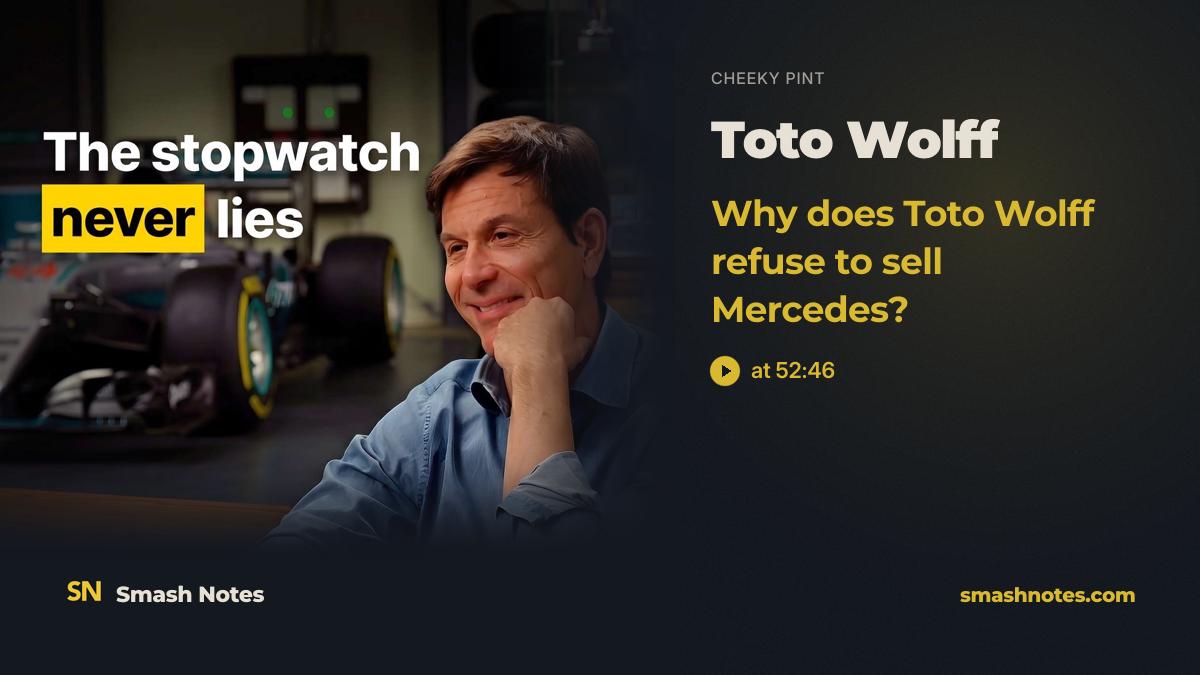
How Toto Wolff built the most valuable team in F1
Toto Wolff, Team Principal and Co-Owner of the Mercedes-AMG PETRONAS F1 Team, joins John Collison for a pint to discuss the engineering, management, and economics behind modern Formula 1. Toto breaks down how Mercedes spots generational driver talent as early as age eight, why they enforce a strict "No Dickheads" hiring policy across 2,500 employees, and…
People
Notes
Related notes
- Why Do Companies Keep Chasing 1% Improvements Instead of 10x Bets?
- Why Does David Tisch Take 1 Percent Ownership?
Related episodes
-
![]() John Collison, Stripe: AI Agents Will Rewire the Internet
-
![]() Muse Wonder: Zuckerberg and Wang's $100B AI
-
![]() The airline CEO putting Starlink on every plane
-
![]() The company building America’s uranium supply from scratch
-
![]() The company building underwater drones for $50,000
-
![]() What comes after smartphones, with Snap CEO Evan Spiegel
-
![]() The Difference Between 1% Improvements and 10x Growth | Immad Akhund
-
![]() 20VC: David Tisch on Why High Ownership and Concentration is BS | Why No Manager Actually Wants to Stay Small | Why Competing with the Mega Platforms is a Losing Game | Why the Lean Startup is a Fake?

0:01
You know, as a continental European, I kind of never got the tradition of standing at the bar and having a pint or two or three and then having a conversation. What do you talk about? Cheers. Cheers.
0:20
Christ, many jobs are in the talent spotting business, but you're especially in
Expand full transcriptCollapse transcript
The episode notes above make this conversation easy to skim.
0:01
You know, as a continental European, I kind of never got the tradition of standing at the bar and having a pint or two or three and then having a conversation. What do you talk about? Cheers. Cheers.
0:20
Christ, many jobs are in the talent spotting business, but you're especially in the talent spotting business. How do you actually spot a Kimi? How do I spot a Kimi? I think when it comes about spotting racing drivers, you can... judge pretty early on in a kid's karting performance whether that kid has the potential to be a professional racing driver.
0:46
Even with the tiny ones, you can identify the ones that are doing better than their peers. Either because they are younger, you know, if someone that's eight years old beats the ones that are ten in that group, You can have those very early signs of whether that kid has the potential. You can see when someone is comfortable in the car, you know, going at 100 kilometers an hour in the rain and that kid does his first lap and comes across the corner, you know, sideways, you know, okay, there are the ingredients for being good at it.
1:18
How quantitative is it? Like, you know, in certain sports, in cycling, you know, there's a metric called threshold power, and Tadej Pogacar, the best in the world, is very clearly just the best in the world on this single metric of, you know, how much power for your weight can you produce. Is there some number that, you know, Kimi and George Russell would stand out on compared to other racers? This is what makes our sport so unique.
1:42
There isn't any. With Daday Pogacar, you know, you can see that threshold watt per kilogram or VO2 max. These are things that are measurable.
1:56
But I don't know what Daday's metrics was when he was 12. So maybe that was not best in class. Maybe that came later. And ingredients of success that you can't measure. Personality. How resilient are you to pressure? how much can you play the team game when it comes to racing drivers
2:20
the there are obviously similar uh kpis the stopwatch you know the stopwatch never lies but put them in the same car the stopwatch is going to decide whether you're being judged good or not but underneath the stopwatch there needs to be technical ability to set your car up in the right way, interact with the engineers, have some kind of social competence of making sure you have sponsors, treat them well.
2:52
There have been extremely talented kids that never went anywhere because they were just simply bad people or not intelligent enough.
3:01
And then there is the kind of overwhelming part, and that is what we call speed. What is speed? And all of your cognitive abilities and neurosenses, the sheer billions of senses that a human has, that give you an ability that not many have. It's actually to feel what the car does underneath of you. And you can see with the extraordinary drivers, they feel much more, they feel more connected to the car and the road than anybody else.
3:37
One example is, you know, old friend and driver of mine, Lewis Hamilton. You have two axles, a front axle and a rear axle, and you have the chassis in between. And when you call a
3:47
car understeer, it means when you turn the wheel and it goes straight. And that happens over the tires and the front axle. It's pretty normal. But Lewis once said something when talking about the car. The car understeers from the front axle to where I sit. Well, that's the middle of the car. How can that understeer? And the engineers couldn't really identify what he meant, but that is what his body told him or his brain told him the car is doing.
4:16
And if a driver is able to have that underlying layer of
4:22
ability, then that becomes unbeatable. But that is, you know, genetics. The great drivers strap the car onto themselves. You know, they don't sit in the car and there's a connectedness. Absolutely. connectedness is the right word. It's actually being one with the car and with the road. How did you decide that you weren't good enough to be a professional driver on this topic of talent identification? I mean, that's one decision.
4:51
Talking about humiliation and trauma. as ingredients for later success. When I was a child or a teenager, there wasn't really anything differentiating me or outstanding, be it academically or in sports or socially. And when I was 18, by sheer coincidence, I ended up with friends on a racetrack watching an F3 race, which is a junior formula.
5:21
And when I stepped into this paddock, it's like I've gotten my identity. This is what I wanted to be. I wanted to be a racing driver, someone that is able to tame this machine. And this is when I started. Basically, my career as a driver. But I came too late to the part. I didn't have all of this karting background that teaches you the fundamentals of the physics of how to position your car in the race.
5:49
But I became a pro. I went through the various stages of junior formula racing. into what we call GT cars, touring cars or sports cars with a certain amount of success. And it is, you know, like you do about your business, I guess. And what I'm doing today is, you know, I woke up with that desire and I went to bed with that desire. And that lasted for quite a few years.
6:20
The other, maybe less talked about part, you know, obviously there's a huge amount of fixation on driver selection and who'll get the next seat and everything like that. Presumably a lot of what you spend time on is recruiting the right engineers and aerodynamicists and things like that. How does spotting that kind of talent work? Are you trying to pull people from other Formula One teams or from other industries and outside? And how are you...
6:41
Just what have you learned about talent outside of drivers? So... When you look at the Formula One team from outside as a fan, you see two drivers. You see then a guy like me who is sitting in front of a screen. And then you see the mechanics and sometimes the engineers on the pit wall. This is what you expect to be the racing team. But this is just the tip of the iceberg.
7:06
It's about 150 people that go to the tracks, including marketing. So it's 90 technical operational people. But we are two and a half thousand. You know, here in the UK, we have two hubs, one that does the engine, the other one, what we call the chassis. That is the works team. And we are 2,500 people in an organization that is quite vast if you look at the two cars.
7:32
And for me, the selection process of the people that I want to work with is the same or is similar in terms of the pattern than for racing drivers. And I always say, there's not two superstars in the team. There's two and a half thousand. And I treat all of them equally. And we've learned from the All Blacks 10 or more years earlier. And they have a saying, which is on their training ground that says, no d***s.
7:58
And we have continued to run that motto. The
8:08
extraordinary scientist or engineer that hasn't got the right values of humility, integrity, honesty,
8:22
enthusiasm, will have no future in the organization. And we're trying to filter that out pretty early. Sometimes you find out later, but no place for the
8:34
genius asshole. You're describing a lot the need for people to collaborate within the organization and the teamwork. But what's interesting is you have these different domains where you have aerodynamics and you have the battery systems and you have the internal combustion powertrain and traction and everything. So the R&D almost entirely goes towards cars where you know the rules.
8:56
There isn't much room for general R&D because you just don't know, like you're not going to work on batteries before you know what exactly will be permitted when it comes to batteries and things like that. You have to know the target that you're designing. We did it a long time ago, but Formula One introduced the cost cap a few years ago.
9:11
So every resource that you deploy into engineering is being counted for in the cost cap, which is 200 and a bit million dollars a year. And therefore, long-term R&D work, lab work, is actually unfortunately very limited because you need to decide between deploying compute power in a front wing that you might have in three months against some long-term So for all F1 teams, one of the things the cost cap changed is speculative R&D just had to go because ultimately you have fixed dollars and you have to put absolutely everything you can towards this season and next season.
9:49
I wouldn't say all of it had to go. You still need to
9:55
find the right balance between what you think future cars are going to benefit from, value the lap time effect it can have, versus the current cars. And unfortunately, that percentage of R&D development of science and lab work, which I love, has a more limited
10:17
scope. You have not only the overall cost cap, but you have things like limits on the number of wind tunnel runs and CFD simulations. Isn't that a bit weird that you can't spend your R&D budgets exactly as you want to? So there's two sides of that coin. The first one is to say Formula One was always unlimited budget and therefore ultra-sophisticated machinery, which led to a situation that the big teams, Mercedes, Ferrari, Red Bull, were leapfrogging all of the other teams.
10:53
Because for us, we had those big motherships behind us that benefited from either a shareholder that was extremely keen, like Red Bull, or Mercedes that said, this is a huge branding exercise for us, and the spending is relatively low in comparison to all of our marketing. So what happened is only these three teams actually won races. So Formula One said, we want everybody to compete on the same budgets.
11:19
And that was the reason why it was introduced. Now you can see that it limited very much the kind of science aspect of Formula One, but it brought also more competition. And that's one of the positive effects. The other one is that Formula One back in the day, Chase Carrick, who was the CEO, said, we need to protect you from yourselves. Because obviously I was against the cost, because I knew that Mercedes, we had might.
11:45
And that probably the worst case scenario was to lose against a Ferrari or against a Red Bull, but not against the McLaren or Williams or anybody else. So he said that to me. Eventually, it was a... take it or leave it. You are investing, trying to eke out tiny advantages in the car. And one of the things that's interesting is that there are the rules.
12:09
There are things that are clearly against the rules. There are things that are permitted. And then there's a spectrum between those of the gray areas. One of the challenges is you defend something that you think is great and clearly allowed, but then it's banned mid-season or it's banned in the next season. And so was it really worth all that effort to get a trivial advantage? Maybe, maybe not.
12:30
And I think the lesson we've learned is that it needs the dialogue with the governing body. If you feel you have an innovation, that passed the first red face test within the organization. That means the leading engineer, sometimes myself on the table, we are having a mock trial. The people that have invented the loophole or the opportunity play the prosecutor.
12:56
And so they need to fight their own argument. And then on the other side, there is the ones, engineers that defend the innovation. And then is our general counsel, Carrie, and myself, who are the judges. And you try to see how convincing the defense is? Yeah, exactly. How convincing is the defense? And how can you destroy the argument that is actually legal? So that would be an extreme case where there's something that we...
13:22
we struggle within the engineering community to define. But obviously, the dialogue with the FIA is important and bring them on very early. If you have a very secret proprietary improvement that you don't want to unveil, it would be totally top secret within Mercedes, but you will also bring the FIA into it? If we think it's 100% defendable, while crystal clear defendable, then we will deploy it on the car and then we will make the argument why it's right and normally the FAA will say we don't like it.
13:53
They could say we like it but it circumvents the principle of the regulation so we're going to ban it because the principle of regulation is most equal competition. So, if they're fair, they're going to say, ban it next year. If they believe it's really very powerful and it's not what they wanted to see or intended to define, then it could be banned much earlier.
14:14
This is where the politics come into play. So, basically, if they think it's a fair loophole, they'll give you one season of advantage. I would say this is, call it the kind of experience that we have. Because they are, you know, innovators and engineers too, and they will... respect if something comes up like this. You know, one example was the system that we call DAS, which was, you know, you have the various dimensions of the steering wheel, what you do.
14:39
I don't know if you've heard about it. You can steer to the left and you can steer to the right. That part I know. I'm with you so far. Yeah, so far. Yeah. That's like in an airplane. No, in an airplane, you can also go forward and back. Exactly. There's actually nothing like that. And here it becomes interesting. So what we did, we created another dimension with the steering wheel.
14:55
actually to push and to pull the steering wheel in a Formula One car. And what it did, it changed... Yes, I do remember this. It changed the way the front wheels were operating in terms of its toe effect. What it did is we were able to turn... We created a toe effect which helped us to heat up the surfaces of the tires by basically dragging them around.
15:20
You were running them inefficiently. And they respected the innovation. I remember the first test, Sky had it on board. They said, what's happening here? They're pushing and pulling the steering wheel. And when it was shown to me four or five months before we actually produced it, they called me to a rig in test and development. And there was the steering wheel.
15:42
And they said, now turn to the left and turn to the right. You know, I was a driver. And then I said, now... push it and pull it and i said but that doesn't go it's like you know i'm used to it in order to fix the steering wheel to this where i wanted to have it but it feels deeply uncomfortable actually to have this additional motion in the steering wheel and then the formula drivers got in and said no we'd like to try it and and it really worked so come back i think if you want to be you want to have the the exchange with the faa to make sure that you're not on the wrong side of the argument But so with that, did they end up banning it or they ended up permitting it in
16:16
every team? They banned it after a year. So why did they ban it after a year? Why didn't they say, okay, this is one of the things that F1 cars can do now?
16:23
I don't know. Maybe we lost the political argument that it was good. Other teams said it would cost so much to replicate it and they could, but is that really the intention of the regulations? Why did you do it as a push-pull rather than a button on the steering wheel or, you know, why was the push-pull the control mechanism? I think there were regulations that allowed to have a mechanical system.
16:47
The rule is the driver must drive the car. So it needed to be deployed for the driver through a mechanical system. I believe that was the reason. I see. So that was the best way to have it defensible. That's so interesting. What about the, where would you categorize the compression ratio kerfuffle, you know, ambient temperature versus, you know, measuring a temperature? Where does that fit on this spectrum? This was just...
17:13
other teams feeling sore about not having read the regulations in the right way. You know, today on any vehicle in the world with a combustion engine, you measure compression ratio in a cold state. Because how else would you measure it? What does hot state even mean at a certain temperature with other ambient factors that matter? And it could be a manipulative value that you have.
17:39
So the other team said, quite unfair, you know, the rules say it needs to be measured in the cold environment or cold engine. And what Mercedes has done is once it's running hot, it basically grew in size and therefore extracted more power. And we didn't confirm that. You had more thermal expansion than other engines did? Exactly. Because you engineered in more thermal expansion.
18:02
Well, I can't really confirm that. Okay, but that's what people say. That's what people say. Because the measurement was clearly identified to be in a cold phase of the engine. Yes. And...
18:12
So was it a loophole? Was it a shortfall of the other teams? I think it was a shortfall of the other teams. So it became quite a political argument. And then some compromise was found in how the measurement worked. And actually, you know, the funny bit is it didn't make any difference for us. So it was a month-long argument going back and forth.
18:32
And we fought it for the sheer principle of innovation. Is it hard to keep these top-secret improvements a secret? Yeah, it is because there is a natural fluctuations of personnel between the teams. Do you compartmentalize? It's like the Manhattan Project, you know, you need to firewall things. We firewall certain things and we don't, you know, I'm maybe more on the extreme side within the organization.
18:56
Not everyone needs to know everything. but eventually you will always have a group of what I call 20-25 people who need to be in there and they may change team and then that obviously leaks. Can you prevent people from changing team within a season? So there is the regulatory environment of every country. How long can you actually prohibit someone to work for another team? with our contract contractual frameworks and in the uk you can do it up to 12 months okay but there are countries like switzerland for example where it's three months okay so so you got to be careful who you hire in switzerland yeah we haven't got all these in switzerland for example you've got to be
19:35
half careful who you hire higher elsewhere yes but you always need to account for the fact that people may change teams because of personal reasons absolutely you know fair arguments yes and that's why how can you make sure that Things are not leaking too easily, but they will eventually always come out. If you could write the rules, how would you change them? Well, I'm in two minds, you know, the innovation part in me and listening to my engineers is free reign.
20:00
We have a budget cap that is 200 million and then make it as open as you want. Because that would be magnificent from a scientific standpoint, an engineering standpoint. But what would happen is the best engineers with the most capability also in terms of infrastructure will come out with a car that is much superior than some of the other teams.
20:27
And it would create a field where the leading car could be five seconds quicker than the next one. And that is not what Formula One wants. So it's becoming more and more restrictive. Is that good or bad? I think it needs to be sensible because this is still the fastest laboratory in the world. That is in our DNA. And I think that is still happening.
20:52
Obviously, engineers will always say, well, it's not as much fun as it was in the past. But it's still a lot of fun. Yeah, yeah.
20:59
You were describing one set of risks in developing new technical changes, which is the regulatory risk. You know, the risk, will you be allowed to have it even for one season or certainly multiple? But the other risk is just technical risks. You know, will it work? And I think in any R&D organization, you know, we have this tribe where we only have so much time, we only have so much money, we have only so much engineers, and we need to put them on the very...
21:23
you know, towards the projects that are most likely to work. And you don't know upfront what's gonna work. And so part of the special sauce is that ability to predict this product direction is a good one versus this one is just, I mean, it's not awful, it's just not the best. And you're fundamentally playing this game of where you spread the poker chips.
21:42
How do you manage technical risk how do you think about allocating those very precious chips and again they're even more precious now in the new cost capita so the unfortunate part of it is that your business is far more complex in my opinion why because you deal with the end customer or whoever the customer is an organization an entity or or a person because are you You can define technical specifications that you believe make the process better or more efficient or successful, but there is someone at the end that actually needs to buy your product, and that person or that organization is going to measure whether the humans that are actually his customers or her
22:22
customers are going to like it. How can you predict that part? With us, it's all data and the simulation. It's much more measurable. It's much more measurable. At a very early stage, we will define what is the lap time contribution that we imagine of that part. And that all starts in the virtual world. It's all simulation, whether it is CFD, whether it's the wind tunnel in the way we measure it, or we attribute downforce and drag, or...
22:52
whether it is mathematical models that we have. And all along the process, you continue to correlate with your expectations. And there are rare occasions where you believe that something eventually, when it ends up in the car, is gonna be a tenth of a second in average overlap. quicker and you realize it's not. Or you realize that the driver doesn't feel comfortable with it and isn't feeling safe enough to drive it.
23:24
So we need to consider also if the end customer which we know exactly, you maybe not, we'll be able to extract from that virtual, let's say theoretical, lifetime benefit, but it's much more measurable. engineers like to fall in love with their ideas and I just need one more simulation run or I just need one more... We don't have that. But you have to kill people's ideas because they're in love with them but they're just not going to work or you just don't have the resources to staff it.
23:55
I think we have people like this who, if they are also forceful, they might... put the organization under pressure to actually continue with the experiment beyond a reasonable point. But they are not part of the organization anymore. This is one of the personality traits that we hold dear,
24:15
that it needs to fundamentally contribute to the overall target of lab time rather than what we discussed before to the department's target. So there will be a decision within the group and then in the wider technical management to say, we're stopping this now. So if I was to talk to an engineer at Mercedes, I would find them surprisingly dispassionate and...
24:40
analytical where they're not falling in love with a particular technical approach or they're not falling in love with their idea it's either it works or it doesn't exactly you fall in love with the result yeah it's that these extreme emotions and gratifications that you feel when you win a race or a championship and therefore the kind of rational part of the engineer is i would hope is superior against like let's say an emotional falling in love with your development part i want to ask about your investing background because obviously that is how you ended up in the position that you're in in racing um first off
25:23
Were you a private equity or venture capital investor? I've heard it described as both in accounts. None of that, I would say. Because how it all started is that when I decided to stop my racing,
25:37
I had a short period of time where I was an employee in a steel manufacturing company, didn't like that, and then ended up
25:47
reading about internet companies in the U.S., And I know you had Marc Andreessen here. So one of the first companies that I got interested in was Netscape. And then you had Yahoo, AOL. These were the star companies of the time. The star companies of the time, exactly. And I thought, I lived in Vienna, and I thought, okay, I understand now what they were doing.
26:13
And I looked at the, let's say, the German-speaking countries to say, who is doing that in Austria and in Germany and in Switzerland? And I found out that these, that that existed, but sometimes it was just little startups that weren't even in a legal entity. Young people working out of their children's room or kids' room. And what I did is, Then, you know, obviously the effect of the Nasdaq started to kick in with absurd valuations for no revenue companies.
26:46
Then in Germany, it was the Neue Markt, which was the equivalent, but even crazier in terms of process of being able to list yes um there was no boundaries you can call it like this um and so i found out about all of these companies got myself into my car went there and said i like your business um i'll i want to help you to raise some equity or list your company on the stock exchange and if it was successful with the first or the latter i would like to have 10 50 of your company And that led to some, you know, shareholding, because some of the people said, well, my business is worth 10 million euros, and I knew it was not worth it.
27:31
But I said, okay, if it is 10 million, and I'll raise 5 million for you, or we IPO for 20, can I have half of the company? And they said, of course. So you were almost like an investment banker to some of these dot-com companies. You probably wouldn't have described it that way, but you were helping them with financing. I was wearing cufflinks and MS tie, and pin-striped, double-breasted suit, but eventually put it in a cave and never wore it again.
27:57
But that was another experience. But no, it wasn't. It was actually a hybrid between sweat equity, early stage micro investments
28:14
and equity kicker or options related to success. And that's how it worked at the beginning. And then eventually we raised capital, not fund like structure. It was still my company, but we got two private equity, two venture capital companies in that each owned 10%. So we got real money and then deployed some of them. And you also importantly had good market timing, right? Because I mean, for people who weren't around, the 99, 2000 period was crazy, whereas you say the valuations just became fairly disconnected from reality and then they crashed hard shortly afterwards.
28:47
And so a lot of the people who did well in that 99, 2000 era were people who were optimistic enough to get into these companies, but then skeptical enough to sell some of the proceeds rather than just watching the account balance go up and then down. and lucky so in in our case within two years we went from actually me pitching an idea to an entrepreneur that didn't have a company around him to an ipo which was crazy you know we found ourselves in the after ipo party which we used to do back in the day and we thought that we had zero value three months ago and now 100 million euros One of those companies that I pitched, I found out that there was a web portal, free SMS
29:36
web portal. It was called SMS.at. And what you did, basically, you wrote your SMS on the interface at no cost. And Austria back then had around 9 million people, and 2 million were using this because SMS were expensive. SMS cost money back then. Yeah, it cost money back then. 9 cents a message. Yeah, it was a lot. And so I found out that this was run by a teenage boy in Austria, in Graz, visited him.
30:00
And basically with the model, I'm going to raise money for your company, which then was very successful. You wrapped it into a legal entity. When I said to him, how do you do that? I mean, he said, I'm hacking. I'm hacking into the SMSC servers of the big telcos. I said, okay, and then? And I said, well, eventually they found out that the data volume was bigger than, let's say, on normal days, and they shut me down.
30:23
And I said, okay, and if that happens, what do you do? Well, I have a plan. So, for example, today I'm running on Nigeria Telecom. And next week it's going to be Norway. So, okay, we put it in an entity and I started to visit Telekom Austria, the biggest Austrian and T-Mobile then, the two biggest Austrian telcos. And they said, we hate SMSAT.
30:46
We absolutely hate it, but we can't shut it down. So what is it we can do together? And eventually, you know, within two years, that non-existent company was sold for 250 million to T-Mobile. For 250 million? Yeah. Wow. People forget. This was the year 2000? That is obviously, yeah. It was a different era. Different era. Yeah. You know, maybe the kind of 250 million today, when you look at the AI situation, that's going to be 25 billion.
31:17
But on a relative basis, yeah. Relative. It was unbelievable enormous money and valuation. So, and this was the lucky moment, actually. And they bought it to shut it down? No. They bought a large part of it and integrated it in, took over the customers and integrated it in their systems. So what happened is we signed the deal in Bonn, which was Deutsche Telekom back in the day.
31:42
T-Mobile was a subsidiary of Deutsche Telekom. And I flew back with my CFO, Austrian Airlines. And he was 15 years my senior and was running the M&A department of the Austrian National Steel Company. And we were sitting in Austrian Airlines and got a glass of cheap bubbly and said, that was a good transaction. And he said, something's going wrong here.
32:06
And I said, why? He said, that business with literally tiny revenue, but with a large customer base, that means with lots of potential, but no way of actually knowing how to monetize it or how to repay the CapEx investment, there's quite some correlation to the current markets now, was valued at this absurd amount.
32:30
compared to my specialized alu business that he had that was generating 30 million in EBIT. So something's going wrong. And I said to him, nothing's going wrong. The internet is gonna dominate. And can't you see the amount of customers? The new paradigm, you're old fashioned. Exactly, exactly. And he said, no, no, I'm sure this is gonna collapse.
32:53
The valuation's absurd. And we listed another company on the stock exchange, which was between pitching it to the bankers that scratched the eyes out of each other to do this to the day of listing in three months. And he said, I promise you, we need to look at that. I don't think this is sustainable. And that impulse that he gave me from this one-hour flight from Bonn to Vienna was enough to look at our whole portfolio of nine investments.
33:22
And we decided to exit all of them. And that was started end of 1999.
33:31
and went all through 2000. Obviously, when the market collapsed in spring 2000, people were still hoping for a rebound. It was just a glitch. And then the market never came back. And we exited all of those investments, bear one, an Israeli startup that we couldn't exit.
33:50
And we were out. And what remained was a skeleton of a venture capital company, very much downsized. to continue to look for opportunities whilst having the philosophical idea of this is not going to come back for a long time. I think this is an underrated... aspect of good investors is knowing when to sell. And I think there's an incentive in the investor ecosystem where they all like talking about, oh, we found this founder very early and we, you know, bought the stock and, you know, it grew and grew and grew.
34:22
And, you know, we we want to be on the journey forever. I think all of the myth making tends to be about getting in early and being a very long term partner. I notice a thing that doesn't get talked about, but is a very common trait amongst the most successful investors is they have this spidey sense for, you know, it's like the movie Heat.
34:44
You gotta know when to get out. And a lot of the very good investors have this very commercial sense for, again, you're in this period, like 99, 2000, and it's an important moment to sell. And it doesn't get talked about because it sounds cowardly or it sounds like you don't believe in this company that you made a lot of money from because you're now a seller, but it's an interesting aspect.
35:07
I came from a very financially or generally poor family background. No money. And
35:15
financial safety and opportunity was always a very strong driver for me.
35:22
And I owned 90% of that company. It wasn't a fund. I wasn't managing anybody else's money. It was a corporate entity. You had your own venture investors, but it itself was all holdings. Yeah, so it was a
35:35
private limited company from which I owned 100%, sold 20% to someone.
35:42
to venture capital companies. And all of the 80%, or most of it, we had some of my dear friends and colleagues who had a few shares, all of it,
35:56
I owned. So when the opportunity came of actually exiting and generating a vast amount of money, which was life-changing, generational wealth opportunity, it became easier for me to do that because I thought, okay, I never had any money. And now suddenly I was able to generate so much that I couldn't even spend it at the time I made the call.
36:23
I think it would have been probably more aggressive if it would have been other people's money,
36:30
generating management fees, potentially carry upside. But the fact it was your money allowed you to be pragmatic. Exactly. And have a certain sense of safety also, or a desire for being on the safe side. What was your best performing investment? Before the racing era, Mercedes, the F1 team. But before the Mercedes era, I was invested in Williams, which was pretty successful.
36:55
Before that, a company that I loved forever called HWA, which was... But these were all racing companies. That was all racing companies. So before that, I would say probably...
37:08
that the SMS company was called UCP. SMS entrepreneur turned racing entrepreneur. No, I was a race driver before actually. Racer turned SMS entrepreneur turned racing entrepreneur. So the exact sequences. Racer turned banking intern in Warsaw, turned steel sales manager in Eastern Europe, turned venture capitalist, although it was more venture than capitalist, and then turned young driver manager once I sold all of these investments, and then I started to invest in motor racing companies.
37:50
This is Toto's new Twitter bio just for you guys. And so, obviously, that… Yeah, I have no social media. Well, I mean, you have enough exposure. I think people know what you think without tweeting. Do you get to manage the team in a different way? Because, I don't know, you're less worried about job security. You can take bigger swings.
38:10
How is Toto managing the team different from all the other F1 team principals managing the team? I have had this opportunity, an immense opportunity given to me by the board of management of Daimler back in the day, led by Dieter Zetsche, the CEO. But actually all of the board members were very supportive of the idea. So what happened is they bought a small team, Braun, that won the championship in 2009, expecting it to be a dominant force in Formula One.
38:36
And it was the first Mercedes Grand Prix-owned team with its own engines and its own chassis. And it underperformed. year after year the results were really not satisfactory and until 2013 they won a single race only yeah and i was at the time running williams with the founder and we also won a race so one of the board members approached me and invited me to stuttgart and he said how can it be that your private little team can win a race and we mercedes we can't do any better than that So I said, I don't know.
39:14
So they gave me the opportunity to look at their setup, their numbers and everything. And I came back and said, what is your aspiration? And they said, well, winning world championships because we brought the team that did that. And I said, okay, then one of us is wrong because I'm working on the same budgets. And I'm thinking about finishing in the top six.
39:32
And they said, no, no, no, no, no. It's not the same budget. Look, we spend 100 million more. And I said, yeah, those 100 millions you spend on Michael Schumacher and Nico Rosberg. I have a pay driver from Venezuela who won the race, by the way. That's the main difference. So they didn't like that situation at all. And so I'm just a messenger, you know, don't.
39:51
And I'm going to go back to Williams. So eventually they came back and said, we think our model,
39:58
corporate running a Formula One team doesn't function because it needs to be much more entrepreneurially led. You need to be empowered to take decisions on the spot. And we want you to run this. And I said, I need to pinch myself because being the head of Mercedes Motorsport is probably one of the best jobs in the industry. other than being Ferrari, the Ferrari guy.
40:23
And I had to say no because I was a shareholder in Williams and I have been always an entrepreneur. And they said, funny that you say that because we've just bought 40% of the Abu Dhabi sovereign fund. We bought it back. You can buy that. And I said, I did well in my life, but I won't be able to afford it. But they helped you finance it, right? Exactly.
40:40
They said, how much can you afford? And I said, I'm always, you know, on the, let's say, conservative side. I've gone through financial hardship and I don't want to end up there. How much are you prepared to put into this? And I said, well, that's the amount. They said, okay, we're going to help you finance the rest. And here I was. And until today, with the change of management now led by Ola Kalenius and his colleagues, the CEO of Mercedes, they give me a framework that I can act in the best interest of the racing team outside of the corporate structure.
41:16
And I couldn't wish for a better co-shareholder. partner, and brand, mighty brand that I'm associated with. So the decisions that we make are quick. They are in the best interest of the team whilst thinking about the consequences for the brand. And I run it like a 20-people organization. And how is how you run it different from just hires team principals, how they run teams?
41:45
Every team is different. But for example, when you look at Ferrari, the team principal is one of 10 direct reports to the CEO. So the marketing person in the racing team is probably on the same level as the team principal. Then you have others, very much shareholder-led organizations like Red Bull, where you would have an employed team principal that's reporting to a group of shareholders.
42:09
Then you have a strictly corporate structure, like Audi, where you have people from the group and from Formula One are being hired to run the team. They have a salary, they might have a bonus. So that kind of long leash that I was given, today there's no leash because we are partners, but the ability of taking decisions was given to me was extraordinary because All of these people, they need to fundamentally report to someone.
42:36
And there's always the risk that if you take a decision without having actually escalated it through the hierarchy, you might be exposed and lose your job. So where I am until I really badly screw up, I'm responsible for my decisions and I'm very clear about that, but I can't be fired. Yeah. And that's what's interesting, right? I mean, you see this in Silicon Valley where...
42:58
Companies run by founders often have different strategic degrees of freedom available to them than other companies. And so you look at, say, with Meta, you know, it's not a company that's just run by the shareholders. It's run by Mark. And he has a strong view that being on the forefront of AI is very important. And there's been kind of previous waves where he's had strong views.
43:17
And now they're doing very well in the AI space where maybe a professional management team would not have had the, you know, license by shareholders or the board to spend so much money on that. And it took a long time to prove out and things like that. And you see that effect oftentimes. And again, this is the... Mercedes is kind of the only founder around F1 too.
43:38
But it's a little bit like you and your brother around Stripe. You are able to take decisions that in a dynamic environment may prove to be false or misjudged after a few years. When you look at the ability, the way Mark Zuckerberg leads the company is quite amazing because you can decide to pour quite some investment in a certain field And then say, okay, well, that hasn't developed in the way I thought.
44:05
And Dietrich Mateschitz, the founder of Red Bull, said something quite interesting to me one day. He said, as an entrepreneur, you need to be like a downhill ski racer, but you need to be able to stop and walk back up the hill. And I think as an entrepreneur, you can do that.
44:23
and you have the long-term horizon also. A manager will probably be short-term incentivized. You know, you have a three- or you have a five-year contract. You have stock options. You want to maximize the value of these. And there's a fear of failure. There's a fear of doing something that looks bad to the people who are grading you because you're always being graded.
44:43
Exactly. Exactly. So that's what I meant at the beginning. You know, my time perspective has changed. It's 10 years. And it's not one year. Yes. People know that you're a large owner of the team. I don't think quite as many people know that Jim Radcliffe of INEOS is also a major shareholder of the team. What's he like? So that was a real opportunity back in the day for Mercedes and for Jim.
45:09
And he's built an empire of an organization. This is a
45:15
chemicals conglomerate. and their three shareholders they run it in the way they think it's intelligent and back in the day nikki lauda unfortunately passed away he was my my best friend and those shares went back into the pool and jim radcliffe and ineo started to sponsor us with quite extensively actually and we ended up sitting on a table with the ceo of mercedes jim radcliffe and myself talking about the sponsorship And it was just before COVID hit.
45:49
Teams had no valuations. We were all loss-making. The sport wasn't anywhere near where it was today. And Jim said, I'm prepared to commit X hundred million as a sponsorship if I can have a stake in the team. And we said, well, that makes sense. I increased my stake a little bit. And then we were all one third. And today, Jim is a great resource that I use if I need to have a contrarian view.
46:11
if someone that is highly experienced but also shrewd in the way he looks at his businesses and a very enjoyable co-shareholder that isn't really interfering but because I guess we do well, enjoys the ride and is a resource that we can utilize. F1 teams have become radically more valuable, like this transaction valued Mercedes F1 at 4.6 billion pounds, and that's many, many, seven times the increase from even just a few years ago.
46:46
That phenomenon has also happened in other sports like NFL and teams like that. There's two explanations you could have for the increase in value. One is sort of a monetary theory that you have more rich people who want to buy into teams, and so the businesses are the same, but you just have more demand to become a sports team owner and more dollars chasing fewer assets.
47:08
The other is that you can say, and obviously this is somewhat true for F1, they've become better businesses. I mean, the audience has grown so much and you have Drive to Survive and things like that. Just as you think about the increase in value in Mercedes and F1 teams, how much of it is...
47:23
F1 teams have become a more desirable asset. And how much is it that they're actually just very good businesses now? Yeah. You know, when you buy a car today, you justify it with sometimes rational decisions, like lots of horsepower or good design or it's EV because I want to have an efficient car. The truth is, it's an emotional decision why you buy a car.
47:48
And the emotional decision is how you want to be. How you want to be perceived. Do I want to be perceived progressive? Do I want to be perceived affluent?
47:59
All of this. So that is going to be a longish answer. Sports teams are scarce, as I said today. In F1, there's just 11 of us. And you could potentially have another 12 that's within the ranks, but nobody's really keen. And it's the biggest global sport in the world today. The Olympics and the Football World Championship are bigger, but they're only every four years.
48:20
So this is the biggest global sport in the world. Then you look at the NFL, very scarce asset too. And for US-American, it doesn't go any bigger than the NFL. And I think how much, 32 teams or something around that. So the scarcity of the asset is... can be
48:38
a rational decision to own it and hope for a value increase because of that factor. Then there is the trophy asset angle. There's many very wealthy people that love the sport and say, well, I always dreamt owning an NBA or NFL team or Formula One team, and I enjoy going to the races, giving my input, and I can afford it now very well. very valuable, is a win-win.
49:07
But then there is the people that have so much money and feel in a way maybe not recognized enough. Because you could have earned 10 billion with a business that doesn't have as much visibility. And you're saying, you know, actually, I'd spend a large chunk of money just for the court side seat. Yes, yes, yes. And be... more prominent, it's also a decision that you can understand maybe.
49:40
That is that aspect of investing. The other part is fundamentals.
49:47
You look at the landscape and you can say, do I believe that this sport is going to continue to grow? What's the demographics of the sport? How much income potential has the league? How much does the team earn?
50:01
And that today, these fundamentals have become reality. In Formula One before, we were all loss making. It was a marketing exercise. But today, few of us are generating very healthy profits. In our business, more than 30% EBIT margin.
50:17
We are distributing dividends. So it's not like the US-American teams or the tax structure where you basically live in a debt environment. And we don't have a lot of capex because we don't own the stadium. Obviously, also miss some of the revenues. But so when you invest in a Formula One team today, you can attribute multiples to your investment decisions.
50:37
And when I sold part of the team last year, those multiples justified. the valuation you just stated. Today, I'll probably be able to generate 30% more, but I got the right partner, so that's okay. And those multiples are also
50:52
valid for most of the US American teams. What are the last publicly released financial figures from Mercedes? Well, we're generating around a billion dollars in revenue and 30% profit margin. Okay. So it's a very healthy margin. Sorry, 300 million of EBIT. Yeah. And so the $4.6 billion valuation is a 15 times EBIT multiple. So, I mean, yeah, Warren Buffett could underwrite this business.
51:17
Exactly. It was back in the day. It wasn't a billion and it wasn't 300 million. It was considerably less because we're growing very strong and the sport is still growing strong. But, you know, we are Europeans. We don't talk so much about valuations and money. But as a matter of fact, like you say, these multiples are actually on the conservative side.
51:36
And actually, it's very different from, say, an NBA or an NFL team, where I think every time one transacts, it's wackadoodle valuations that can only be justified by tax lecturing or courtside seats. But also, you know, when you look at the valuations of the U.S. teams,
51:58
you have fundamentals for some of the themes, but then there are some which are kind of being dragged along that are having valuations that are not real anymore. And if you look at Mercedes, we are probably generating, other than the Dallas Cowboys, the most profit of any sports team in the world. So we have kind of a USP in this world. When we compare our multiples to the NFL or the NBA in its latest crazy uplift of valuation,
52:31
I don't know what the multiple is, the revenue multiple, which is crazy. I'm a fundamental guy, fundamental figure, so I would never value a business on revenues. I would value it on return on investment, fundamental cash flow and profits. So that would value us at 10, 12 billion if you look at the Lakers sale, for example, whatever else happened in this frenzy.
52:57
But that's not the point. My horizon is so long-term that I'm a long-term bullish investor with all the ebb and flow that can happen in this sport that it becomes irrelevant to actually starve for higher valuation because it's just on paper. But we could value the business today much more than it was a year ago. Yeah, it's interesting. There can be an effect in tech where, say, if you look at the AI space, some of the most enduring businesses in AI, like a TSMC or an NVIDIA, that have these very long-term advantages actually trade at quite reasonable multiples, despite the fact that they're growing very quickly.
53:34
And similarly, the best team in the biggest sport trades actually at one of the most sensible multiples. yeah and that's okay you know i wanna we wanna be perceived as the serious people in there because we are not particularly interested in the in the trophy investor where we could maximize our valuation and and then the most important point none of us is actually interested in selling any shares here because we believe in the long-term development of the company and the sport you know particularly in this environment of ai humans watch humans and the driver in the car is irreplaceable not Because a robot couldn't go any quicker.
54:11
By the way, that's a different discussion. I don't believe in that. But because we want to go through the drama and the glory of the individual. Yes. So I believe that the sports, life sports generally are very resilient to whatever technological developments we see at the moment in the market. Will we see any of the F1 teams as public companies? Isn't that the next logical step? Because there are lots of people who would like to be a part of them.
54:39
We went public with Williams, and that was not a success. Because in a way, you're reporting 20 times a year with each of the races. And in this sport, it goes from mania to depression within a week. But that was a very different era. F1 was much smaller. It would have been a different shareholder base. Could it work now? I don't know if somebody wanted to monetize or raise capital by just being public, maybe.
55:04
But I don't think being public as a sports team is the right long-term structure. You want to be in control. Because you'll just get whipsawed so much. Yeah, exactly. And I would also want to be in control of that business, not because I think in legacy terms that it has no interest for me. But it's about creating the best sports team in the world in the time I run it.
55:30
Drive to Survive has been a smashing success for Netflix and a big success for F1, where it's brought lots of new people into the sport. And then people talk about women especially. You don't associate F1 with women, but the show is very popular with them. And then Netflix has tried... a very close copy of Drive to Survive with cycling and tennis and all these sports, and it hasn't really worked.
55:52
And you don't hear anyone talking about those shows. Why does the format work particularly well for F1? There's some shows that I personally found quite okay. The cycling was okay. But why? I didn't believe it would work. Back in the day when Formula One pitched it to us, Netflix didn't really pay any money, very little. And we were fighting a world championship against Ferrari, so I sat down with my colleague of Ferrari and said, are we doing this? And he said, we're here to win a Formula One championship and not play Cirque du Soleil.
56:27
So Ferrari and Mercedes decided not to participate in Series One. Yeah, famously. Famously. And that was maybe important for the success of the series. Because it allowed Drive to Survive to look at smaller teams and less... It was kind of underdog. Underdog, exactly. And then, you know, COVID came, people stayed at home.
56:50
Generations watched Drive to Survive from the granddaughter to the grandparent. Grandchild to the grandparent. And then we started to race as the only sport because we were able to contain our traveling circus very closely. So we were live also. And I think this is where we made a big step forward in terms of growing our audiences and demographic.
57:14
But why the sport is so strong today, I think it's not only because of the Netflix factor, it's also because we entertain. We have great characters that are very active on social media, younger drivers, we provide
57:31
Great narrative, controversial situations, the politics outside of the sport. You know, that is basically a 12-month live reality show. But... So F1 already is a soap opera, and that's why it works well in TV format. It is, but with a fundamental difference to other soap operas. We are credible sports. We have rules. We race based on those rules.
57:55
And if you win, best car, best machine wins. So this is the
58:01
fundamental base of the sport. And this is why the reality show around fits well. This, without that, wouldn't work. Yes. Entertainment follows sport, not the other way around for Formula One. And we've stayed true to this DNA. And that's why we've attracted an audience in sheer size that we didn't expect before. Our strongest growing demographic is young women, 15 to, I don't know what the bracket is, but 15 to 25 years.
58:31
And we have 42% female fans, which is an awesome... Unthinkable for a motor racing. Unthinkable. And then obviously... My wife Susi runs the female series from Run Academy, which is going very strong with young women driving those cars. And what she sees is that her demographic very much obviously buys into Formula One's demographic and they became an aspirational series for young women not only that want to be racing drivers, but also engineers or marketing people in a racing environment, or sheer inspiration that a woman can actually succeed in a male-dominated environment.
59:11
So all of this kind of universe kind of buys into the credibility of Formula One. I've always wanted, I personally find Drive to Survive a little too soap opera. I always want more of the technical details and more of the race craft. And so I think maybe there will be the opportunity over time for, you know, different sub shows or something like that, because I understand why they make the choices they do.
59:34
I think what they have is probably has the most mainstream appeal, but they'll probably find that there are sub emphases that would be interesting.
59:42
It's a good point. We actually haven't thought about it because we tried to develop, and Stefano Domi, Carly, who runs Formula 1, is excellent at that, to grow it in the right demographic. We are still niche in some parts of the world. We have a large group of fans in every continent. But when you look at the United States, It's very much big cities and affluents.
1:00:03
I can see that when you go to New York, Miami, San Francisco, LA, Austin, the spot is very present. People recognize you. I was invited to the Super Bowl in Arizona a few years ago. No recognition. So we're kind of not developed in the middle of the United States, which is NASCAR. And so this is very much the... demographic, the current demographic that Stefano is aiming at because it's niche, it's high-tech, it's, how can I say, it's very European and glamorous to a certain degree.
1:00:41
And we have this hardcore fans. Interestingly, many of the young ones follow Free Practice on Friday. They will know everything about the updates on the car, the era updates. They also know about the WAGs, the wives and girlfriends of the drivers, and all of these influences and blogs that are existing. Yes. We're kind of getting into what does it mean to be an F1 fan
1:01:03
these days, because it's interesting. You have this pyramidal structure where you can be extremely engaged and follow the team around, or you can go to one race when it comes to your town, or you can watch Drive to Survive, or maybe you just come across YouTube clips in your feed occasionally. And so now there are all these different layers.
1:01:19
And so how has that changed from a Mercedes strategy point of view, the fact that you have so many different types of fans now versus the old paradigm of you turn up to a race or you don't? You know, as a team today, we have so many different fan groups or not only fans, but stakeholders. You have obviously Mercedes. What is it we do for the car's brand to enhance reputation and fundamentally selling cars? So what is that? What can we do for...
1:01:54
So I have this customer theory. Customer is someone that makes your life better.
1:02:01
So my number one customer is Susie, my wife. So whatever I will do and say is always focused on, is she gonna like that or not? Because that has an effect of my life quality. My family, very important. The people that work for Mercedes, my employees. If I have them in a good space, then the car's gonna go faster. and the relationships matter, then it's
1:02:29
sponsors and co-shareholders. What is it I need to do for them to say that this is a good investment or a good platform? And you can trickle that down. And then it's the fans and then there might be the social media followers. You can trickle that down. And what I'm trying to do is in my priority list of customers, to identify the objective to achieve the best outcome.
1:02:55
So that is what I've always done in any of my, you know, the way of looking at life. Sounds a bit rational and brutal, and maybe the reality is it's not like this. No, you're ranking who's important to you. But I'm ranking the priorities. Exactly. F1 is interesting because you have the teams You have F1, the organization, the company itself, and then you have the FIA, which people might not realize is different.
1:03:24
What are the tensions between all of those groups?
1:03:29
I think tensions have been very limited recently, in recent times, because there was this pressure always between Formula One as being, you know, the commercial sides of it and the commercial rights holder. the FAA being the governing body, making the rules,
1:03:51
policing the rules, and then the teams. And there was, let's say, an umbrella contract between all three stakeholders, which is the famous Concorde Agreement, because it was signed on the Place de la Concorde in Paris many, many tens of years before. So the teams, we don't own the league, contrary to the NFL, for example. But we are getting quite a large percentage of the profits that Formula One does.
1:04:25
Liberty and the public shareholders retail or institutional investors own Formula One and we get the profits. The FAA is being paid by Formula One for their services. But the DFA is also the one that granted the rights to Formula One in a 100-year agreement. So they need to be respected as a stakeholder and not only as the policeman. And I think that was where cracks appeared a few years ago, or even before, you must say.
1:04:55
But today, it's more aligned. We're gelling more the three entities for the benefit of the sport. But if there is a disagreement, what will it likely be about? What could the disagreement look like? How do the profits split, for example? These contracts are being renewed every five years. The age-old debate. Yeah, exactly. Or where are we? Which countries are hosting races? Was that new Spanish circuit that nobody likes a mistake? So I'm a traditionalist.
1:05:32
I love going to the old circuits because they represent history for me. But also the racing is based on these. For whatever reason, the layout of the old tracks, which had vast areas that they were available because places were not as developed as today, provide great racing. Overtaking, cars being able to go side by side. That was the criticism of the new Spanish track.
1:05:53
Exactly. That there wasn't a lot of overtaking. But... Madrid did, and I'm not saying this to make anybody look good. Madrid as a city is spectacular.
1:06:06
The track that has built in this area is spectacular. I must say the job that they did over the few years since they've got the contract is nothing but outstanding. But I think where it didn't work is that the track is so spectacular in terms of for the drivers and the kind of camera positions with this long banked corner. But it didn't account too much for the new generation of cars for the difficulty to overtake.
1:06:33
And for next year already, I think they're going to change the layout of the track because it's not a permanent track to provide more straights. Oh, so it's not a permanent error. They can just rejigger it? Exactly. How configurable is it? Well, I spoke with the CEO of the track on the weekend, and he just mentioned a few corners that he thinks can be adapted or should be adapted.
1:06:54
So they are open-minded about it. Oh, that's cool. Yeah, so there's fundamentally this tension between you're creating a destination and you're designing a racing track, and there are some slight tensions between them. Maybe you don't have as much room as you want to work with, but you can break that trade-off a little bit where you can improve the track even more.
1:07:13
I don't think that is even... I don't think there's tensions. I think fundamentally, all stakeholders, including the host, wants to have a great Grand Prix. And that means having attractive racing whilst having good, you know, spots for the public. Well, there's sometimes intention. Like Monaco, famously, you know, you had not designed it that way as a racing track, but Monaco is not going anywhere.
1:07:33
And it's, you know, the... I think Monaco needs Formula 1, Formula 1 needs Monaco. But Monaco is such a traditional track that nobody actually wanted to change the layout because it's like breaking with the rules or kind of breaking the legacy. But fundamentally, I lived there. I lived there many years. I wouldn't know how to make it very different.
1:07:50
I mean, I have some ideas. Because I mean, for a long straight, Also, in Monaco, you know, they keep building new land, and so, you know, you could extend the track out into the Mediterranean. Yes, and that has been a great commercial success. I doubt that extending a race track into the sea is going to generate some return. Last question.
1:08:09
How do you set Mercedes up for succession? How will this work post-Toto, and how can you prepare for that? I've seen examples of entrepreneurs that were either so selfish or believed in their own
1:08:25
eternity and forever life that they didn't look after not only their families, but also the company. For me, it is not important to leave a legacy and
1:08:44
call the building the whatever total building or so
1:08:48
which i hear some people are doing nowadays yeah you already have the toilets named after you so yeah exactly i wish i would only go on this business that's massive especially now with ai exactly we should ask them to response for sponsorship so for me it's important to do to do what's best for the family and to do what's best for the team and that means looking at the structure going forward where this team can live without me And probably it's not going to be the same because I have the credibility as an entrepreneur that's leading my own businesses, but there will be a solid management structure.
1:09:22
And I believe that my job is going to be divided between two or three people that I'm vetting at the moment that I believe are already doing a great job with all of their strengths in various areas. And then it's going to be different, but it will be a successful team. Do you think you will...
1:09:42
set things up where maybe you moved to a sort of executive chairman type of role where you don't have to be there every race weekend, you let the new person set their direction, but you can help with personnel and be there for advice? Or do you think it's important to have a clean break and you get out and it's their show now? I think clean break is probably not possible if I continue to own it with my family.
1:10:05
So that kind of executive or non-executive chairmanship is something that may happen. But... It needs to happen in a very, very precise way.
1:10:18
Because you can't be on the sidelines and interfere into the daily business. I also don't want to end up in a situation that I believe the family can run it the best way and then be just mediocre. You have to earn your spot in running it and you have to contribute and my children also don't have any interest.
1:10:41
I believe that if you are a chairman, non-executive or executive, you need to exactly know your role. And that doesn't mean shooting from the outside and being the one that sits on the grandstand and says, you've screwed up and you've screwed up and this is how I would have done it. You're calling the drivers directly. You can call the drivers directly if it's about keeping the contact, but it's not about interfering into the daily business.
1:11:04
And that's how I would aim to be in the future. But I'm still enjoying it too much running it, actually. Yeah, well, that makes sense. Theoretical for now. Toto, thank you. John, thank you for having me and congratulations to what you have achieved. We haven't talked about it enough, but I can only take my hat off. Thank you.