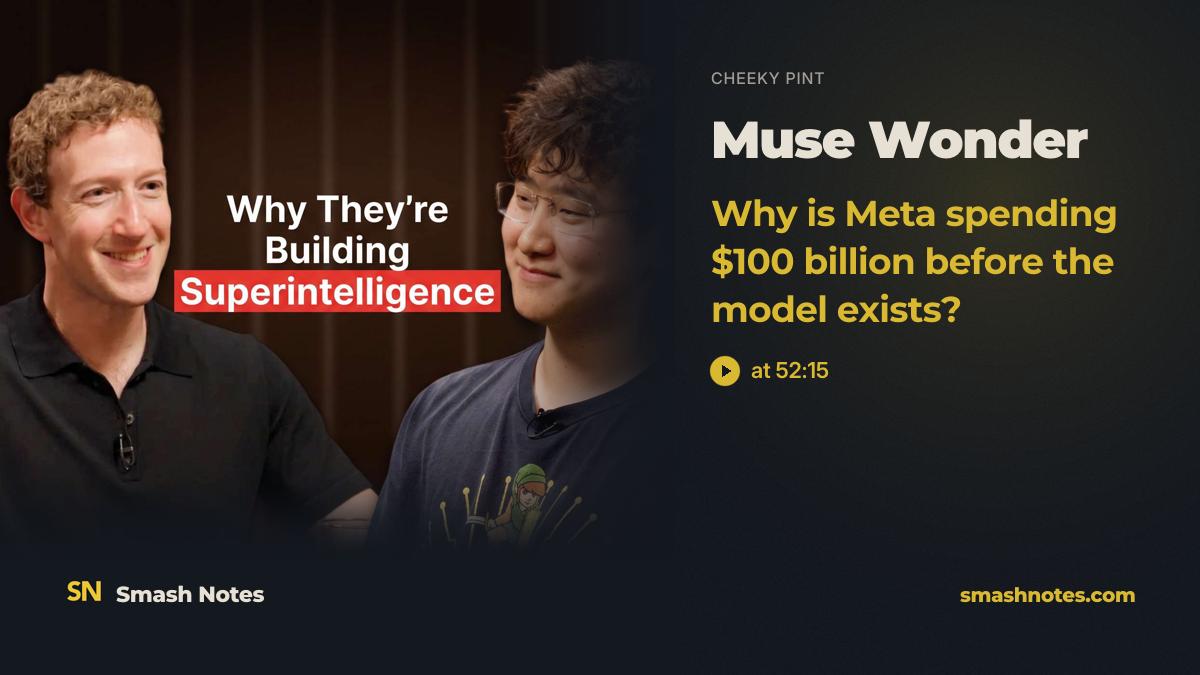
Muse Wonder: Zuckerberg and Wang's $100B AI
As Meta scales its AI infrastructure past five gigawatts, Mark Zuckerberg (founder and CEO, Meta) and Alexandr Wang (Chief AI Officer, Meta Superintelligence Labs) join John for a pint to discuss the launch of Muse Wonder and the future of personal AI agents. In this episode, Mark and Alex open up about the creation of Meta Superintelligence Labs (MSL)…
Notes
-
-
-
What Is Muse Wonder? at 14:40
-
-
-
-
-
-
-
-
-
-
Why Are AI Agents Different From Chatbots? at 1:23:50
-
-
-
-
-
-
Related notes
- When Did Practical AI Agents Become Possible?
- Why Hasn't Anyone Solved AI Memory?
- What Kind of Agent Do Most Apps Need?
- Why Does Meta Lead Ad Revenue by 2028?
- Why Will Crafted Software Still Matter With AI Agents?
- How Do Most People Use AI Models?
Related episodes
-
![]() #435 Mark Zuckerberg's Empire
-
![]() How Toto Wolff built the most valuable team in F1
-
![]() John Collison, Stripe: AI Agents Will Rewire the Internet
-
![]() The airline CEO putting Starlink on every plane
-
![]() The company building America’s uranium supply from scratch
-
![]() The company building underwater drones for $50,000
-
![]() 20VC: Horizontal vs Vertical Agents: Who Wins | Model Routing: Commodity or Increasing in Value | The Future of the Inference Market | Why Founders Should Take Discounts for Tier 1 Firms with Harrison Chase, LangChain
-
![]() OpenAI: When AI Agents Use Computers Faster Than You



0:00
All right, the end of last year, we're like, all right, we are quite excited about the progress. We haven't seen the models yet. You know, we're going to write this check for like, I don't know, like $100 billion or $200 billion. I'm like, Alex, you sure this is going to work?
Expand full transcriptCollapse transcript
The episode notes above make this conversation easy to skim.
0:00
All right, the end of last year, we're like, all right, we are quite excited about the progress. We haven't seen the models yet. You know, we're going to write this check for like, I don't know, like $100 billion or $200 billion. I'm like, Alex, you sure this is going to work? Cheers. Cheers? Yeah. Cheers. Cheers? Cheers. Let's launch it.
0:24
So give me the update on Muse. If you were looking at the third party reports, you would see that this might be the fastest growing agent or AI app that I think has existed yet. What are your guys' personal favorite Muse use cases, either yours or other people's? I was actually talking about this at dinner yesterday. My favorite thing is I have my muse, whose name is Oiler, constantly source increasingly obscure teas from increasingly obscure vendors of tea.
1:02
So at this point, on a weekly basis, my muse is buying some random tea from some farm in Taiwan or some farm in Japan and sourcing it over and bringing it back. What's your favorite Muse use case? I don't know. I mean, I use it for a ton of stuff. I still like... My favorite both use case and probably eval for the product is having it coach me in MMA.
1:29
So I put cameras in my gym and I basically... It watches the cameras when I'm in there and it gives me feedback in between the rounds, which is a very hard problem it turns out because not only does it have to... It basically has to process all the video
1:49
quickly enough because you only get one minute in between the rounds. Oh, it calls you between the rounds. Yeah, I want feedback. It's like, I want feedback on how to win. And it's like, come on. Did you have to instruct it? I've wondered about this, too, because looking at videos is a really good AI use case. It feels like you can't just give it a multi-gigabyte video file.
2:08
So do you tell it how to slice stills out of it or something? No, it basically, yeah, it pulls stills. I think it kind of figured that out by itself. It turns out that Muse has pretty good native understanding of MMA, so that's good. So, like, the multimodal... Retrading. Yeah, someone on the team knew. Now we're just kind of out there in the corpus.
2:34
I think it's a good test of the kind of coding ability that... Because really, basically, what it's doing, it's like, you know, Within the agent, I mean, it's like, I'm not seeing any code, but it basically is writing this whole video processing image, processing pipeline. Yes. And I'm constantly telling it, like, all right, like, look, like, you took 30 seconds to give me that feedback.
2:53
I only have a 60-second break. Like, you got to go faster. Just optimize yourself. Optimize yourself. Yeah, yeah, yeah. And it's... So it's, I think, a good example of how stuff is going to go in the future, where basically, like, everyone is actually going to be writing tons of code. They're just not going to know that they're writing code.
3:09
What kind of... What MMA steers does a model give you? You want to see? Yeah. Basically, let me see if I can pull some stuff out, but it's basically, it gives me a lot of stuff about balance and like hip position or it's like, oh, you're like, when you're kind of inside control here, it's just like, you're like, you didn't get this under hook in this place, so you're gonna, you're vulnerable to this getting, rolled over here let me i'll i'll i'll pull up some stuff you guys should go it was definitely one of his first use cases actually of even the initial prototypes yeah yeah i mean i did this with open club before we even had had muse working yeah it was just like
3:45
because and then that's why i was saying it was it's kind of like become an eval for for this too it's i actually didn't know that it was an eval for the product so uh noted yeah there you go
3:57
how is all this In the model's training data, like the fine-grained, this is what an MMA fighter looks like when they're appropriately balanced, and this is when they're too much on the back foot. I'm just wondering, how has it consumed so many images of appropriate versus inappropriate MMA posture? It just pulls out frames from it, and it's like, okay, I'm too much on my back leg there.
4:23
But is this the emergent intelligence, like... it does actually, again, does it know from seeing lots of images of MMA, or does it know because it understands the concept of where you're meant to be balancing its red books about MMA, and then it sees that you're too much in the back foot? Well, we did train the models with a lot of visual perception data.
4:44
So, I mean, I think that that's like kind of making good multimodal models. I mean, this gets into, like, I think a kind of core... approach thing that we have, which is we're training the models end-to-end to be good personal agents. So the question is, why would Meta want to build these models? First of all, I think you know, just super intelligence overall is going to allow us to run the company better and build all kinds of different things.
5:07
But for the products that we're building,
5:10
there's certain capabilities and certain mixes of
5:14
skills that basically are just much more applicable to these cases. So, I mean, this is one of the things that kind of Alex focused on from the beginning was like, all right, we really want to make sure that our multimodal program is good because that's disproportionately important for the types of things that people use all these services for.
5:30
How do you train a good multimodal model? Is this where meta just has an advantage because you guys have so much image and video data? It's very helpful. Yeah, and I think ultimately a lot of this, it comes down to how are you focused on it, right? I think because of the fact that we wanted to build personal superintelligence and fundamentally I think most people in the world really experience the world in a highly multimodal way.
5:54
They like talking to other people and listening to things and seeing videos and filming things of their own. I think most consumers have this highly multimodal experience. And especially earlier this year, I think there was actually a point of tension almost in the industry because I think so much of the consensus view within the AI industry was that it was just all about coding and coding was all that mattered.
6:20
And I think that for the success of a product like Muse and the success of a lot of these consumer use cases, it really depends on the ability to be strong and multimodal. I think we're just kind of scratching the surface of that. I mean, a lot of the initial theory that we had was that most people don't actually like reading that much, right? So even the kind of text-based interaction model, I think it's something that people do.
6:44
I mean, everyone texts, but when you think about stuff like the glasses that we're working on or even our other products that are very visual, and the glasses are basically, will eventually just be a pure multimodal product, right? It's like you can let it hear what you are listening to and it can talk to you and it can see what you see if you let it.
7:04
And then eventually, I don't even know if we're going to have an app store in the glasses. It'll just be like a multimodal generation that kind of creates whatever you need right in your vision. And I imagine something like that will probably end up powering a lot of the kind of apps that we build, too. But yeah, I mean, we're still in the early days of that.
7:23
But but for now, I mean, the perception work has been really impressive. Yeah. I want to ask you guys about the product space here in AI and try something out on you. If I was to describe to you, say with Stripe, what I think a winning product looks like, it would take me pages and pages to talk about because we have the developer experience and we have to talk about all the international heterogeneity of payment methods.
7:45
Then we've talked about stable coin. It would take me a long time. Whereas I notice a phenomenon in AI where it feels like the winning products collapse very quickly onto an agreed upon product space that everyone is pursuing. And so transformers worked. And then the chat agent UI really worked. And now we are seeing, you mentioned OpenClaw earlier, the kind of open-claw, persistent agent, has a computer, able to do things, you know, computer use out there in the world for you, like we're collapsing on that product space.
8:16
But there's something about AI where the winning products tend to be very simple, pursued by all the companies that are kind of taking it seriously. You could describe on the back of a postcard, like you could describe very concisely. And obviously implementing them is massively complicated. Like we'll get into the new model. Like there's, you know, huge amounts of frontier work that goes into making a good version.
8:38
Now you're talking about the glasses or the future versions, but somehow there's a very small number of clearly correct products in AI as opposed to it being this very broad and complicated product space. I kind of disagree. Sure. I mean, well, first of all, I mean, I think part of the theory from the beginning was that this kind of agent or whatever form it took was going to be quite a different thing from this, like, text-based assistant, right? Like, every company has one of those.
9:11
I mean, ours is MetAI. It reaches a ton of people. But I mean, it's like the same thing that all these companies have.
9:18
We, I think, specifically think that that is used for very informational purposes, but people don't think about it as like a thing that gets stuff done for them. It's retrieval, not delegation or something. Yeah, and even like when you say it has a computer, yeah, but there's lots of different ways to do that, right? You know, I mean, I think that it's only kind of this most recent wave that gives the agent a dedicated VM, which I think is actually incredibly important for making you feel confident that the security and privacy of your information is, it's not just like, okay, it's not connecting to some elastic compute that just kind of everyone uses.
9:57
But my claim isn't that it's easy to implement, nor that it's obvious a priori. I think there are a lot of things. You think there's going to be a lot of different things? Because again, my claim is that now that people see Muse, everyone looks at that and says, oh yeah, that's clearly how you want the AI agent product to work, and that the future AI agent products that we'll see will be fairly Muse-shaped.
10:18
So I think my take on this is I think we're just so early in the realm of what AI products will look like that I think a lot of the interesting differentiation about the products gets collapsed in how we view the product today. I think the traditional way in which we wrote down and think about product specs, those aren't the relevant dimensions and levers and axes to consider the important design decisions on AI native products.
10:47
And so Muse, for example, I think so much attention was put in the design of the model for the product. And there were a lot of very intentional decisions around, in all these situations, how exactly should the model behave? And what's the exact personality of the model in these situations? And how should it handle these sorts of tool use scenarios? And these are very intentional decisions.
11:08
And probably in the same way that the full spec of how we wanted the model to behave in all these scenarios would be an extremely long document. But because of just how we think about products today, it's just AI. It's like how when mobile first started happening, it was like, oh, it's just an app and everything is just an app. Well, it turns out there's a lot of nuance in what exactly an app is.
11:33
And we're kind of in this phase where, oh, it's just AI, or it's just an agent, or it's just an agent with a VM, or something like that. But the interesting differentiation is we have to tease out. OK, so you guys think I'm making the classic mistake, which is my domain is complex, and this domain is, again, from a product point of view, simple.
11:50
It's like all payment processors seem the same. Yeah, no. I really agree with what you're saying. One thing that we talked about from early on is that basically there is this pattern where I think the products are getting thinner and the model is getting to be more of the product. So one of the things that we say internally is like the model is the product.
12:06
And when you're talking about an agent, a lot of the complex product work that went into Muse is basically around the privacy and security model for handling your data and the things that get connected to it. And that I think is something that we're just very proud of that we really focused on. But that's like a lot of the product surface that we need to innovate on.
12:23
But the capabilities, the personality, a lot of the stuff is like you're training into the model. And whether they're the people in the lab who are working on that, or the people on Nat's team who are working on the product, I think when Nat is thinking about what is the key stuff that we need to make the product feel good, he's talking about post-training the model.
12:43
Of course, the UI of the product matters too, but the most important part of the UI is the product. Yeah, exactly. I think there's still very viscerally, I think from a user, there's a feeling of using Muse over time. Maybe some meaningful portion of that is just like the reliability of Muse to handle certain tasks. But then another meaningful portion is like, how is it proactive? And in what context is it proactive? And when it talks to you, how do you feel about how it talks to you? And so there's clearly a lot of, and I'm starting to see more and more of this actually show up on the X feed, which are people are starting to tease out these, they're all proactive agents,
13:23
but what are the actual meaningful differences between them? And these, I think, are the interesting product decisions, which, you know, the funny thing is, like, how do you specify these product decisions? Well, it's ultimately in model design decisions, which ultimately boil down to, like, training methods or data or evals or, you know, all these things.
13:40
Yes. As we talk about product space, one notable news detail is that there is no model selector and no effort selector. Do you guys think that's just obviously correct in a consumer AI product? I just want to make it simple. I think that we've been... I
13:58
think somewhat infamously, a lot of the AI products have been designed by a highly technical group that do not have these sort of randomly sampled American in their mental model. And so the products... I mean...
14:15
The naming of some of the models is so egregious. The numbers go backwards? Some of the times the numbers go backwards and sometimes it's just a totally different word and you have another set of words. How is somebody who's not carefully reading API design specs supposed to know what they're supposed to pick? It's just far too confusing.
14:36
We're talking about models a lot. Tell me about the new model. It sounds awesome. Yeah, I think we're quite proud of this. The new model, Muse Wonder, it's a new class of model that is at the frontier. We've basically been working on this since the beginning. Basically, when you're doing these pre-trains, you don't just go to whatever the biggest cluster is that you have.
14:55
You want to work your way up the ladder, training models that are maybe four or five times bigger, and then you just keep on repeating that process.
15:05
So the first set of models that we've had Muse Spark was all based on this initial pre-train that we did in, what was it, December? Yeah, at the end of last year. Yeah, and it's actually, I mean, I think we've all just been quite surprised and impressed with how much intelligence and capability the team has been able to kind of build into a model which is like, frankly, not that big, right? And then after that, we were working on this next model and And the pre-training has been done for a bit and we've been working on the post-training and now it is here.
15:40
So it's the next kind of class of model that is significantly bigger. So I think you will kind of feel that in terms of the nuance in which it can think. And it really, a lot of the areas that we focused on were making it the best personal and professional agentic model. Some of the different things that you can optimize for, that's it for us.
16:01
And then Yeah, I mean, a lot of the basic capabilities that we focused on building in, I mean, very good memory, kind of very good ability to persist through complicated tasks. But, I mean, a ton of work went into this across the lab and the product teams and all of this. And I think it's also just sort of a testament to the team being able to methodically figure out the process to scale these models.
16:25
So I think this is also just, you know, a... a milestone on the way towards the time between each subsequently bigger class of models, I think will now start to kind of compress and that's very exciting for the type of stuff that we can build. At Meta or in the industry generally? At Meta. I mean, I think you're seeing something like this everywhere else.
16:47
Is this an RSI effect or something else? Well, I think a meta part of this is just we needed to, well, I think quite famously, we were not happy with the trajectory that we were on with Lama 4. We kind of like rebuilt the whole team. I mean, that's been this kind of crazy thing over the last year and a half that we should probably spend a bunch of time on.
17:04
Oh, we'll get to that. Yeah, yeah. Some war stories. Yeah. but the team basically had to go build up like different tiers of models to kind of get to this one and um and now that we are kind of at the frontier um now everything that we do going forward will just kind of be pushing the frontier as opposed to there's a lot of kind of background work that we needed to do before that i don't know what would you say Yeah.
17:28
Well, I think we're really excited about it. We will have two models in this series that are going to be available. So there's Muse Wonder and Muse Wonder Full. Laugh. Yeah. All right. There you go. Very good. Which is basically a much higher end. There's no studio band for it. A much higher end model. It's the full version of Muse Wonder.
17:50
I know. I got it. It's two words. Wonder. Full version. All right.
17:56
You're clearly a father. What's up? Excellent dad joke. There you go. We've seen incredible performance across a slate of evaluations on personal and professional agenda tasks. It's state-of-the-art based on our measurement. And then there's a number of specific highlights which we're really excited about, which we've designed into the model over time.
18:19
Active memory, like Mark mentioned, is one area where, you know, we think that to build personal agents, personal and professional agents, like memory is just one of the clear requirements to build reliable agents and is one of the areas where we've invested, I think, disproportionately, actually, compared to many of the other efforts. And we have our own internal evals of memory bench, which demonstrate a lot of the capabilities there.
18:43
What does memory mean in a model to a layperson? Is it just how much stuff they can, like the working memory of if you're working on a task, how much stuff the model can kind of keep in its... How is it different from context? I think it's in the experience of using the model, how well does it remember things that you mentioned to it over days, weeks, or months, and then leverage those in the process of doing future tasks.
19:05
I see. This is the stuff that's buggy AF in OpenClaw. I think we're all extremely fond of OpenClaw, very happy OpenClaw user, but it ultimately does this compaction where it has the long-term memory and the working short-term memory or whatever. And I think once people use OpenClaw for a while, they find the memory pretty buggy. Yeah, so we've designed basically both the model and a system for the model to use to develop a much stronger form of memory.
19:30
We call it active memory. In addition, as Mark mentioned on the persistence, But so this is outside the model, like the model exists. No, no, but some of the capabilities that you're talking about, like the compaction, are things that the model does. Right, so basically being able to do this well both with the... It's not a harness, it's in the model itself.
19:48
Yes, it's in the model itself. Exactly, yeah, yeah, yeah. So it's aware of its memory as a core system, and it's about how it's able to leverage various sources to be able to conduct tasks in the future, as well as understand its ability to do compaction, how it should do that compaction most effectively, etc. Okay, but this is a big deal because I think a lot of people's early experience of AI agents has been buggy memory.
20:13
And so, yeah, improving that is... And to be clear, there's still plenty of room to improve, like our evaluations show this, but this is something that we're quite proud of and we think this is a meaningful contribution. Okay, so active memory is one thing. Yeah, active memory. Active focus is another, which is effectively just the ability for the model to, you know, when conducting tasks, be able to sort of carry them through.
20:33
Especially as we've seen Muse users, as well as Muse code users, give sort of like higher and higher complexity and more and more ambiguous and more and more complex tasks. We want the model to be able to conduct those and do those very effectively. And this is one of the things actually in early dogfooding and testing that a lot of people have noticed about the model that is sort of special and stands out with respect to other models that they've tried or used.
20:57
The third one is domain expertise. What is focus in AI terms? Is it like putting a lot of compute on the task? Is it not getting distracted with other... What kind of persistence? Yeah, persistence. It's basically the ability to conduct complete tasks over very long horizons, and then when faced with various setbacks along the way, the ability to identify other solutions to those problems in an aligned way.
21:25
Okay. It's actually a big step up in coding capabilities, so frontier coding capabilities. So it is actually state-of-the-art on DeepSuite and Suite Marathon and does very well on other benchmarks like Terminal Bench 4 and many others. So we think that users who use it for coding, which will be a minority of all of our users, but the ones who do will see a big improvement and a big step up.
21:51
Okay, so we should also just be using MuseWonder full for coding at Stripe. Potentially, yeah. I mean, let's go out there and tell the... We're not going to stay in the hours on SweetBench, yeah. We'd be missing out. Yeah, yeah, no, it's a big improvement on coding. I mean, obviously, you know, we want people to try it and see how they experience it, but we've been very pleased in our own internal testing.
22:12
Okay, so this is... Yeah, I think people will like it for a lot of things. Okay, so this is both just your latest frontier model, like people can come, you know, developers can come directly to you, they can use it on an open router, like they can just consume it as a model, and it's also a big upgrade inside of Muse that people will just feel as, you know, active users of Muse.
22:33
Yeah, well, what we're going to do in Muse, because it's a lot bigger and it's more expensive to serve, we're going to start off primarily in paid subscriptions. So what we want to do with Muse as a product, we want it to be free for everyone to use. So we have this huge amount of free tokens that people can use with Muse Spark as the model.
22:54
But if you want to use Wunder for most of the hard tasks, then...
23:00
then at least for now, you'll use the paying version. But, you know, I mean, eventually we'll, you know how quickly the field moves. And we hope to, you know, at some point, not too far from now, have a model that is as good as Wonder, but in the Spark form factor. And that will be a great thing to be able to serve hundreds of millions of people around the world.
23:18
Okay, so you go to Muse, you subscribe to the, what's it called? Like the premium or pro plan or pay money. And just don't stop until you've taken out your credit card. Yeah. And then you'll be able to, you'll select it or it'll just magically... Oh, it just gets better. It just gets better for you. Yeah, yeah. And... And then it'll also be available on the API, on the Metal Model API and OpenRouter.
23:40
And then it'll also be available for Muse Code users. And then Muse Wonderful will be available to subscribers of Muse Code. So
23:53
it's pretty exciting. I think we want it, as Mark mentioned, it is a much larger model. And so we're working through how to serve that most effectively to as many people as possible. But we're excited to get it in the hands of as many people as possible. It's a big step forward. I mean, this is like, and we really, with MuseSpark, we were very happy with the performance that we were able to deliver as we were getting up to this point, but this is the beginning of
24:15
MSL kind of being at the frontier. We feel like the models are quite competitive with the best models that are out there, and I
24:24
think that this is... Okay, so you think it's like Astro Fable and Wonder all together at the frontier? Yeah, well, I mean, you can look at this- Just empirically by the benchmarks, you think- Well, empirically by the benchmarks, one would conclude that. Yes. I see. Yes. I think actually one of the things that we're especially proud of is we have taken the time, as we've mentioned, to optimize models for the product form factor of Muse.
24:49
So this is the state of the art model. We think it really is the best model in the world for the use case of personal and professional agents. People inside companies complaining about Goodhart's law, a metric that becomes a target ceases to become a good metric. You hear complaints that models are benchmarked and that at a certain point, overfitting to the benchmarks actually makes the models slightly worse.
25:12
as people who actually have to train AI models. Is that true? Are the benchmarks pretty good at grading models? Do you start to see, like, weird edge failure cases? Benchmarks have to keep moving, right? I mean, it happens very quickly, but they just get saturated so quickly. So, I mean, I do think that in terms of... But you think non-saturated benchmarks are fine? I mean, as we've gone on, we steer the models more towards our internal benchmarks for the use cases that we're focused on.
25:40
So early on when we were kind of just doing the science of trying to climb the ladder, we cared more about what the external benchmarks were just to make sure we were on the right track. And then I'd say, you know, each release that goes by the larger share of what we're looking at are our internal ones. And one of the things that we actually quantified in our research blog post as part of MuseWonder is this metric for big model smell, which is kind of, you know, big model smell and feeling of bench maxing are kind of like inverses.
26:11
This idea that you can just like tell when you're using a really big model that just, you can tell. It just has nuance. It's got that genus of claw. And so the way we quantify that is actually almost explicitly what you're mentioning, which is the gap between in-distribution performance and out-of-distribution performance. So we kind of measure how well does the model perform on tasks that are in distribution of our RL and post-training versus tasks that are out of distribution? And what does that gap look like between the Muse Sparkline and the Muse Wonderline? And we actually see this huge step up from the Muse Spark to the Muse Wonderline because of, as Mark mentioned,
26:47
it's just a much better base model powering this new line. And there's an entire je ne sais quoi to that, but I think we've been able to actually quantify this effect. And it's an obviously dimension that we're excited to continue improving on. But if you're saying that external benchmarks have ceased to become as important and you care much more about your internal benchmarks, is that...
27:08
kind of an argument against bench maxing that you think that just trying to get the top score on the external benchmarks that everyone talks about is maybe not going to lead you to develop a great model? Well, yeah, but also we're focused on specific things. I mean, part of the whole strategy is personal super intelligence and just trying to build different types of products than other people are trying to build.
27:28
So even if we did have the exact same evals as everyone else, it just Yes, though I would say a personal super intelligence is not like a super niche interest. It's probably something that other models want to be able to do. I think that there are things that are very different about it. I mean, I think like the personality probably matters more.
27:47
I mean, one of the things that we talk about is this idea of discretion, right? So if you want to like... use the model to get something done, it needs to be able to know a lot about you and get things done in the world while disclosing as little as possible. So if you have an allergy or you're pregnant or something, you're trying to get a table at a restaurant and you don't want to have to tell them your medical condition.
28:13
to make sure that it's gonna be a good place for you. Like, okay, how do you handle that? And I mean, humans have common sense and the model so far, if you're building a coding agent that works in an environment where everyone has access to the same context, discretion isn't particularly important. So there are all these things that I think are just kind of more important for us.
28:33
Yes. aspects of coding where the code needs to work, but the consumers who are using it may not even ever see the code. I mean, that probably matters more in a personal superintelligence context rather than serving software developers. So I think these things are just a bit different. Ultimately, we care about making useful models. So we want models when you put them into people's hands, they have a great experience using, and I think that is the most important metric for any model that we or other people produce.
29:04
I think that you know, really, really focusing on the external benchmarks. Like if you really dig into the supply chain a little bit, like it's some PhD student who made, you know, these benchmark a benchmark as part of like their, you know, as the course of them doing their PhD. And so you're kind of outsourcing all of your product thinking to that PhD student who happened to make a viral benchmark.
29:26
Right. So clearly like that's That's wrong. And so that's why we care a lot. Like a huge part of what a lot of people at Meta and MSL are focused on is crafting amazing evals. And now that we have them, we can work on our own. But if you're building like a, you're ramping up your lab, right? It's like those public ones are not crazy place to start, but it's just not where you want to end up.
29:47
You're just at that point, you're just looking for signs of life. But then when you're like really in this mode as we are now, where it's like, you know, we want to be very intentional about how we're improving our model over time to build better and better, better products. Like a lot of the cases that Mark just mentioned, like these are actually detailed very rigorously in like the spreadsheet of all the little capabilities and nuances of the product that we think really, really matter.
30:13
to the end user maybe each of them matters like two percent to the user but in aggregate that's like the obsession that will ultimately result in these models that feel magical can you guys describe for me just what goes into training an rl model or sorry a leading edge uh frontier model i'm just curious uh in that i think a lot of people listening to this have a rough idea where there's uh you know there's a pre-training and post-training step so pre-training is you kind of ingest this huge amount of uh data you know you look a lot of pictures and these are cats and these are dogs dogs and after a while you start to you know develop a sense for what is catness and what
30:44
is dogness and what is fur and you know everything like that and so that's kind of the pre-training step where you just hoover up data and maybe you can talk about the data acquisition and just kind of what goes into that and then there's this RL stage which is the new-ish advance over the past few years of AI. And again, it sounds like that is where a lot of the specific nuance of this model has come in, where you guys
31:11
have chosen better domains, better hills to climb for the model. But just at a high level, describe how many people, how long it takes, what the steps are, how you think about those in How much time do you have? At a high level. This happens to be what we spend all of our time on. Exactly. And so summarize it in three minutes. I can recommend some YouTube courses for you.
31:37
Yeah, I think at a very high level, these are the stages. It's pre-training and post-training. Ironically, training is the superset of all of it. But how many people are on this whole effort, like when you develop music? So this, I think you're getting into like... what is interesting about MSL and the approach that we've taken, which is, I mean, from the very beginning, I think when I first reached out to you, I think we were just looking at this because we were like, it was like, just like, wow, okay, how far we've come.
32:04
And I was just like, I pulled up the screenshot of like when I first reached out to Alex and my first thing was like, hey, do you have time to catch up and talk? And then it's like, all right, we talked for 44 minutes or whatever. And then, then, after that call two days later alex sends me this long thing which is like well here's what i think i i would do if i were in your if i were in your position and the very first thing is um
32:28
that you don't need a lot of people and talent density is the thing that matters so i'd say like from the beginning of the plan this was like the core of your strategy right it's basically like you actually don't need a massive number of people But what you do need is for each of the people to be as good as possible, which kind of informed this kind of crazy recruiting push and very intense filtering that we had to take some of the best people from inside meta and a very intense process to get people from outside meta.
33:02
i actually think like a lot of what has made msl special and why a lot of people have wanted to join is because i think it's in some ways it's just like more fun to work on a talent and smaller effort it feels like this startup yes that's operating um in some ways it has all the benefits of a startup with the stability and resources of a larger company and this was like this environment that i think this was like point one in your kind of plan for what um Alex was like, this is what we need to go do.
33:30
So I don't know the answer of like how big is a pre-training team. It doesn't need to be that big. But I think if you look at some of the other labs, it's probably quite big in some other places. So I think part of the reason why these models are doing well is because you you have people who we're betting on and they have a lot of resources because we're taking our compute, we're not peanut buttering across a lot of competing efforts.
33:54
We're basically just investing in the key people, a lot of compute per researcher, and then they can do their work. Was Wonder the one big training at first? It was the next pre-train. It was climbing up this ladder, so we have this tiering system, and then Spark. Internally, Avocado was the codename for the Muse Spark line, and then Watermelon was the codename for this one, and we're out of fruits now.
34:21
So we're going to have to switch to a new convention. I think the only fruit that is technically larger is the Durian. And you don't want to go to Durian. No, you want to stay far away. A Durian is bigger than a watermelon? It's definitely heavier. That's horrifying. It's definitely heavier. Spikier. But no, yeah, I think as Mark mentioned, like, you know, each of the, I mean, each of the stages I'll describe, like, it's tens of people working on it at Meta versus, you know, hundreds.
34:51
Okay, so Meta is a huge company, but this is like a really tiny effort inside of Meta. Yeah, the research team is less than 200 people. Yeah, it's very small. It's intentionally very, very tight. I think that the- It's pretty closer to 100. And then there's a bunch of info folks. Yeah, and then it's a lot of info work. So I think at a very high level, to go back to the what is it question.
35:12
How does it happen? How does model happen? That's basically what I'm asking. Where do models come from?
35:19
You take a huge amount of data for pre-training. And here you're... And here, roughly, it's all the public internet and all the books you can get your hands on and just as much data as possible. But different types. Plus the proprietary metadata. But also different... modalities. If you want it to be good at perception, then you want to make sure it has a lot of images and audio and video and this kind of stuff.
35:46
If you want it to be good at certain domains, you don't just want to RL that in at the end, you want to have it have exposure to that from the beginning. Yeah. In this stage, you care a lot less exactly what the data looks like or how it's formatted or everything about it, but it's just lots and lots of data. When you talk about this being the best personal agent model, was there data you had to get for the pre-train where it's like huge amounts of restaurant reservation call book? I don't know what it is.
36:16
You just want to dump in large volumes of the modalities that people are going to care about. I mean, there were a bunch of things. I mean, I don't actually think we talked about this when we were talking about where MuseWonder excels. But some of the areas that it's like, all right, what do people care about, right? I mean, there are things like shopping that people care about a lot, personal advice that people care about a lot.
36:37
People have personal legal questions, personal health questions, personal tax questions. MuseWonder, I mean, is... quite good at those. I don't know if there's any quantification that we want to give, but it's... Let's say it's... It's very good on those personal advice questions. Yeah, and so those types of things, I mean, you can RL them to some degree, but you just want to put in a large amount of data.
36:59
You can imagine health is a very... There's a lot of data out there about health, and
37:04
in pre-training, you just wanted to see all these different things, and so you kind of just put these different corporate... Yeah. So as Mark was mentioning, one of the highlights of MuseWonder actually is its ability on various domain expertises. And I think our philosophy here is that the best personal agent should feel like a team of experts in your corner.
37:31
It should feel like it is your legal team and your finance team and your medical team and, and, and, and. And so on a bunch of these domains, MuseWonder is actually state of the art on, I think, a lot of the finance evals as well as a lot of the legal evals. It is the state of the art model. And these domain areas, that starts in pre-training.
37:54
We look for a lot of domain data to put into pre-training. but a lot of the a lot of the art of pre-training i mean pre-training is um there's this one rune tweet where it's like pre-training is full of the researchers who like chew glass and stare out into the distance and into the into the abyss or whatnot but but i think there's a truth to that because it is like um it is both the highest stakes of the research areas because you you know we invested a huge percentage of our compute into training muse wonder into pre-training these wonder And it was very high stakes.
38:27
I think probably both of us at various points in that process. Yeah, you went through troughs of sadness. Troughs of uncertainty. You know, all the seven stages of grief happen while you're pre-training a model. And it is the most sort of like fundamentally scientific in an interesting way because you just don't have very many samples. So like your ability to infer exactly what will happen scientifically really depends on your ability to sort of like, you know, big brain reason about everything that's happening in this process.
38:58
Okay, so in the pre-training stage, everyone who's training frontier models basically is trying to get as much data as possible for the pre-train with maybe a bend towards if you want MuseWonder to excel at legal and finance and tax questions and things like this, then you want to have as much of that specific corpus as possible in the pre-train.
39:17
You still want as much intentionality about where ultimately you want your model to be, but again, it just benefits from a lot more data. And this is sort of the massive data, massive compute stage. Do you hit some saturation in the data you put in the tree train, or ultimately is it just more data is better? Well, there's a relationship between if you want the model to be bigger, you need more data.
39:40
Otherwise, it overfits. Yes, but my point is, is there data where it's like, oh, we can't distract the model with that, we can't clutter up its brain attic with knowing that stuff, or is it just more data is better? There are some of these effects, I think. But this is part of the science. Okay, we're going to do the secret sauce. No, it's not about it.
39:57
It's just like, I mean, I think that there are all these questions about like, okay, well, we put a lot of these tokens in. Is there any zero-sumness? And in a bunch of places, there isn't. Or it's actually positive transfer. But then depending on how it's set up, you can have some negative transfer. So, I don't know. There are all these interesting questions.
40:13
But in general, one of the... one of the bigger challenges of scaling bigger models is it's not just about how many flops and how much compute. You want to be able to scale data with that. I mean, this is like part of what when the original kind of scaling laws for pre-training were written. I mean, this is sort of what came out of that is that.
40:33
So, if the Internet isn't growing that quickly, and you want to scale bigger models that can be more intelligent, I think one of the interesting problems is, all right, where's the data coming from? Yes. So that probably gets to the end of what we're going to talk about on that. But we could go to the other... Excellent CEO energy over here.
40:55
So post-training. So then I think... Post-training is a very exciting field now, I think. And it's an area where I think actually, I think almost on a continual basis, the entire field is learning about the optimal recipes to be able to post-train these models. And again, post-training is where you give the model a task that you expect to do, grade it on how it does.
41:19
And so if it's a chess-playing model, it plays chess games, learns that, you know... yeah the sft so there's supervised learning so that's like a lot of when you you take this kind of raw thing and you give it both the the question and the answer you would want it to have all right if like if you're having a chat conversation how you want it to respond in this case so when you're training things like personality the sft is actually like a very important part for molding it but then i think most of the advances in the recent years have been at rl Yeah.
41:49
So I think one mental model that can be helpful is like in SFT is where you kind of initialize- SFT is supervised fine tuning. Supervised fine tuning, yeah. Where you initialize a lot of the behaviors that you want the model to be able to exhibit later on and then you know, maybe at the end of SFT it has those behaviors kind of baked in but it'll only do it like 10% of the time and then in reinforcement learning you really sort of
42:12
give the model reinforcement in various situations to bring the elicitation of those behaviors dramatically up and I think that the Yeah, so I think there's a bunch of interesting things that are happening in RL and post-training. I think one is that just the scaling of RL and post-training has been one of the clear axes. Just spending more compute and gathering more data.
42:38
So just doing much more of it before you release a model. Yes, doing much more of it, especially as the pre-trained scale up, doing much more. It's like anything in scaling laws, it has to go with the rest of the factors or it doesn't work. Yeah, in general, I mean, if I were to say one broad statement about AI, it's just scale everything.
42:56
But in particular, you have to scale everything. Scaling one thing in isolation does not work. You technically can scale one dimension. You just will get much more optimal performance if you scale many things all together. Well, I mean, so one way to think about Muse Wonder, right? So we did the pre-train. We've done some RL. When you look at it like Muse Spark, right? So version 1 to 1.1, 1.2, 1.3.
43:21
We didn't change anything about pre-training. where we just continued doing more RL on top of it. So when you think about the early versions of a model of a new class, they're actually relatively less, like the RL to pre-training ratio is going to be lower for RL than the later versions. That is kind of what the point releases in models are.
43:42
Well, I think every company has its own convention. For us, that's what it is meant. But for a lot of companies, like the big number is the pre-train and then the... I think it kind of lost that semantic value.
43:53
Yeah, I think now you actually can't tell. Okay, but it is true at meta at least. We haven't even done it. We kind of decided to not even give MuseSpark at least. It is true MuseSpark and MuseWonder. It is true that MuseSpark and MuseWonder are different pre-trades. And we decided to kick the can down the road on this question for MuseWonder by not giving it a number yet.
44:08
But when we have our first dot release, we will have to decide. Yeah, yeah, yeah. But yeah, I think the RL stage, part of what's very interesting is first is just producing the environments and producing the tasks. And I think that is one of the areas where there's a lot of intentionality in training these models. It's also one of the areas where you notice very funny things.
44:33
In a lot of cases, less is actually more when it comes to data in RL. And so I think the feel and the science of it is pretty flipped.
44:46
generally speaking from um from pre-training um the other is that i think it can give very magnified um kind of instruction to the model if that makes sense so i think that like a lot of safety cases or alignment cases that we care a lot about are like you know and you know where you would see when you do large high compute rl runs on frontier models are where you apply a lot of rl or optimization pressure in scenarios where the only way for the model to succeed is to do something misaligned or do something unsafe.
45:17
And so that's another thing that we had to be very careful about and thoughtful about in training these wonder is ensuring that we curated the RL environments very thoughtfully to ensure that all of them were eliciting and driving towards more aligned behavior from the model. So the point that you're saying about quality, I think is an important one, because I think a lot of the previous questions back and forth were about the quantity and the flavor of like, oh, you need to scale the quantity.
45:40
But I do think a huge part of this is the point that you just made of even a smaller amount of high quality. yeah i think i think in rl like we you know as we've seen pretty big jumps in our new spark line i think these have been like accompanied with you know real meaningful improvements to the underlying recipe and each of these improvements in the recipe have been like um you know I think the improvement between MewSpark 1 to MewSpark 1.3 feels night and day.
46:11
I think probably to most people, if you ask them, like, are these like, you know, do these feel like they came from different pre-trains? I think they probably would say yes, because I think you can, you know, the, the, I think it's happening industry wide for what it's worth. Just like we are learning to squeeze so much capability and so much, um, and elicit so much agenda capability from, um, you know, these existing base models.
46:35
Now, that's not to say, like, we believe scaling is very important. That's why we have the Muse Wonderland in the first place. But, you know, this sort of, like, these two things are happening at the same time, which is also, by the way, for us, this is why we're seeing so much progress in general. Like, I think it's the fact that we're scaling both pre-training and scaling our recipes in RL kind of, like, concurrently at a nice clip.
46:57
Yeah. And then there's these other scaling axes too. I mean, like making sure that the agent harness is good and that you can co-optimize these things is probably just another aspect or dimension for scaling. But if I'm understanding you guys correctly, are you saying that alignment is not about coming up with some alignment specific RL steps and instead about making sure the entire RL process is kind of steering You have to be thoughtful about it in the entire process of RL.
47:27
So I think it's a holistic effort, I think. But also I think different labs have very different theories. Alignment is a very philosophical concept of who do you want it to be aligned to? A lot of our theory is like, okay, we care more about it being aligned to... We're trying to give people agents. And if you ask it to do something, you need to have a high confidence that it's going to do what you ask it to do.
47:53
You want it to do that with high reliability. You don't want a moralizing lecture for why you're wrong for asking it to do the thing. Obviously, if you're trying to do something that's catastrophic, it needs to gracefully, without pissing you off, not do it. But in general, we view alignment as more of a question of instruction and values alignment with the person who it's intending to serve.
48:19
And I think that that's kind of a different mode of thinking about it. It's very different from, I think, how some of the others do. But one of the more interesting things, I think, that is maybe a question related to your original question is also just how long the process of training one of these models takes. Like, Muse Wonder... I mean, in general, like, we've planned Muse Wonder since, like, last, you know, August.
48:44
Yeah, I remember the off-site when we were... So this is like... When they first presented this, yeah. So I think all of the stages that we just talked about are like, you know, you really work on them for quite a long time. And it's not that we didn't start working on Muse Wonder when we finished Muse Spark. It's that we've actually just been planning and working on this for quite a long time.
49:06
And we really view Muse Spark, if anything, as like... I think we mentioned this in the first blog post where we wrote about it. That was a stepping stone to get to Muse Wonder. And that really was how we thought about it. Even at the time you thought about it. Yeah, and in terms of how long it takes, I mean, we're also even just talking about the research part.
49:23
I mean, there's also the compute part where we've been investing in building up, first of all, a huge amount of compute overall, but a lot of, you know, part of our philosophy on this is that you can kind of measure the compute strength of a lab by how big its largest single supercomputer is for being able to do these large training runs.
49:45
So, I mean, we built this Prometheus cluster, we call it in Ohio, that's scaling to larger than a gigawatt. And now we're building this Hyperion cluster in Louisiana that's going to scale to five gigawatts. And those actually predate MSL, because building a whole data center site from scratch, at least the plans for those, they're coming online now, but that was...
50:13
You guys thought it might be the feed, right? That you just have used for a lot of compute generally? No, no, no. This is kind of predating, even going back to the LAMA program. I see.
50:25
I mean, it was probably in 2023 or either 2023, 2024 was when we basically started making the plans to build those clusters. They're now kind of fully coming online. Like I said, the Louisiana one will come online over a couple of years.
50:45
But if you want to go really end-to-end on doing this stuff, then, I mean, obviously, the kind of full stack, and, I mean, Meta is a full-stack tech company. I mean, we build our own data centers. We build our own chips. We build our own low-level infrastructure. And now this is kind of the next component, which, I mean, arguably is probably the most important component in all of this for the next wave of technology is kind of building really good models and then delivering them to people.
51:11
But, I mean, yeah, if you want to go, like, fully end-to-end, I mean, this is a... Yes. It's a... Yeah, long process. I do think this is like a, I mean, maybe it's well appreciated by folks in the tech industry, but like it really is, you know, it feels like models are coming out constantly. So maybe you'd have the mental model that like, oh, a company like launches a model and then they figure out how they're going to make the next model or something like that.
51:32
But it's actually these like very long planning processes and these sort of like very long work streams that kind of all come together at the very end and then result in these beautiful models. How do you build good products when the feedback cycle is so long? Ultimately, you start planning the model in August and you don't know until more than a year later if it's good.
51:52
And Silicon Valley famously likes to run on metrics, but ultimately, do you just need someone who... is the esthete. It's nice when you have metrics, but I think the state of being an entrepreneur is how well do you make decisions in an information-poor environment. But there's that on steroids, right? Mega steroids. think that this is and and i think mark gets a huge amount of credit for this like the because of how long everything takes like there there were many points along over the past uh year since i've been here but also you know as you mentioned like long before that where you have to make very large investments or make very big decisions about you know how
52:36
you're going to uh invest or develop the technology or you know what decisions you're going to make long before there's proof points around, you know, whether or not even the thing is working. And so I think this is, this is like, you know, in some sense it's like entrepreneurship on hard mode. It's like the opposite of lean startup. Like lean startup is like, yeah, you like see if you get something working and then you double down and then you see if that works and then you double down.
52:58
Like you cannot do that in AI. You have to like weave things I mean, we've been investing into these data centers since, you know, for years and years and years. We've had to... And you'll be radically behind if you waste to see if things are working. So we have these conversations where it's like, at the end of last year, we're like, all right, we are quite excited about the progress.
53:19
We haven't seen the models yet. Like, it's like, I'm going to like, you know, we're going to write this check for like, I don't know, like $100 billion or $200 billion. I'm like, Alex...
53:29
Are you sure this is going to work? It was so extreme that we had the whole exec team. I think Susan scared you a bit. Yeah, well, yeah, no. Well, it's like the joke every time we talked about it would just be like, yeah, and we hope it's all going to work and be good. But there were literally, like the end of last year, other than me giving a vibe report on how our research was going and I could sort of show some plots and whatnot.
53:56
But it was like... I was feeling good about it, but it was certainly not clear at all that it was going to work. You guys are saying that the essence of
54:07
training a frontier model is you have to push your chips all in before you've been dealt the cards. You just have to decide that you're going to develop a frontier model and you don't get... At this scale. Back a few years ago, the clusters didn't have to be this big, but now they do. I think this is part of the
54:27
excitement of booting up a frontier lab now, where it is basically like the ante is extremely high. And I think this is, and like, I kind of like viscerally remember this. We were in Hawaii at the end of last year. It was kind of like the whole exec team got together. And yeah, Susan pulled me aside many times and was like, you know, I just want to tell you if this doesn't work, like, you know, this is going to be really, really bad.
54:54
It's going to be very, very bad in financial terms. Yeah. I really need to impress on you that this model has to work. It has to be good. If it's good, it's all good. We're great. But if it's bad, it's really, really, really bad. And Susan, who you know... And that was useful motivation. Well, it was like... It was one of these very funny moments where I was like...
55:15
Obviously, the amounts of money are so... like obscenely large. What are the amounts of money in training? Order of math, whatever you can share, but just like... Well, you can do the basic math. Yeah, no, I can't. I mean, a gigawatt cluster, I mean, it's like, I don't know, I think what you'd see out there would be, you know, to operate a gigawatt a year, call it on the order of $15 billion.
55:35
Yeah. Okay, so it's roughly a $15 billion effort to train a frontier model. To operate a gigawatt cluster for a year, if you're talking about building the CapEx, it's probably closer to, you know, you pay for it up front, so it's probably, you know, $50 or $60 billion.
55:51
So, but then that's just kind of... one cluster for one part of training. Then you have all the other parts.
56:02
Research isn't just doing the run. That's probably an equal amount of it. It's because for each change that you make, you're testing all the ladders all the way up to the big scale. And then they're serving the stuff. So I mean, part of the stuff that in some ways- So tens of billions of dollars to train a frontier model now.
56:23
Yeah, definitely the whole... I mean, I've seen the financial roll-ups. Tens of billions of dollars is a good estimate for... Yeah, but then you want to do something with it, right? So I actually think some of the more complicated questions that we had were like, all right, so we're training this model, and we know we want to train the model because this is key, but how much product demand do we think we're going to have? So now it's like, all right, well, the product doesn't exist.
56:48
And... As in you're trying to build data centers to serve Muse for a product that doesn't exist yet. Yeah, and we have to make it in years in advance, right? So this is probably where, like, when we were talking about it last year, it was like, huh. There was a moment where I think a bunch of people were like, yeah, maybe we should just be a little more conservative.
57:07
And I was like, no, we're doing this. It's like, we're going to make it work. We're going to burn the boats. This is going to work. But it was like, I mean, even, I mean, I too am an entrepreneur and founder and have, you know, at various points in my life taken risk. I remember the visceral feeling at the time was like, this is a fuck ton of risk.
57:27
Like, I... I don't know if I... Oh, it's only risky. Yeah, yeah, it's only... Well, I do think this is, like, one of the, like, things that I think, Mark, is very impressive about you, which is I think you have really internalized this concept of, you know, it's about how big it is when you win, not, like, you know, failure is okay. It's just, like, how big is the win when you do win? And this was, I think, a Mark has fully internalized power laws in a way that many people have not.
57:55
I think quite deeply, yeah. Well, I think the other pieces, I don't actually think it's quite as risky as this. I mean, the numbers are big, but I think... Meta has a backstop in terms of how it can use compute. Yeah, so I think there's two things. One is, if AI works overall, plenty of other people want all our compute, right? So they're willing to pay, like, I mean, if the cost is, whatever, 15 billion a gigawatt, we could get a lot more for that.
58:17
So, in order for it not to work out, it's not just that we have to fail, AI overall has to fail. Yes. And then, even in that happens, we still have all these other uses to productively use compute. So in the grand scheme of things, we were definitely building out this compute for inference ahead of knowing that the product was going to be ready.
58:42
But your AI pilled enough that you said, GPUs online and powered will be useful to someone. Yeah, but also we believed in what we were building. I mean, it's like, I think...
58:52
And you can look at the... kind of the trajectory where it's like, all right, first there's ChatGPT as the text-based assistant. Then, you know, Anthropic got coding agents to work. And no one had built the kind of personal consumer version of that. And it just seemed like this is the thing that Meta should build in the world. And I think that that was just like pretty clear to you and me and that like from the beginning, right? That that's like that's kind of what we're here to do.
59:19
And so I don't know. I mean, there's always like the real question for me on the Muse launch even was you never know when you launch something, how it's going to be received, right? So there's always the case where you get a home run, which in this case it was, right? It's just like extremely well received right off the bat. But the normal case would be you kind of It's fine, and you have to iterate a few times to get product market fit before you really grow.
59:46
In some ways, I actually think the product, we maybe could have even grown it faster, but we didn't have all the growth stuff really ready to go when we shipped it because our median expectation was like, all right, we're probably going to have to iterate on this a bit, and that'll be fine. But I don't know. I think if it takes a few iterations, it's not the end of the world.
1:00:04
That's normal. You can have launches where it's kind of catastrophic and then it takes a while to recover, but that's not good. But even if it took a few iterations, it would have been fine. So I don't know. I guess it just seemed to me like this was going to be... Yeah, the numbers were big, but it seemed like it was probably... Was it bonding for the executive team to be, holding hands, taking this risk together.
1:00:29
You're talking about Susan taking UXI. Is that a bonding moment? It's like, I mean, it's stressful. I think it was both. Yeah, being in a stressful situation together is generally bonding. Well, one thing that I think is quite notable about meta
1:00:44
is the degree to which, like, first of all, most of the exec team has been there quite a long time. Like, Nat and I were really newbies.
1:00:52
and and you know most people have been through crazy situations many times in the past as well and i think i think meta as a company is like an extremely resilient company that has been through like you know uh many situations that also at the time would have seemed incredibly daunting and so everyone's kind of like knows the program so to speak in terms of you know this obviously On paper, and especially when Susan Lee, our CFO, was pulling me aside in the meetings, it does seem like a particularly scary situation.
1:01:26
But I think most people were like, yeah, yeah, no, but we're meta, we're going to get through it. I think there was a real camaraderie around that and quite a nice energy around that. Which really I did appreciate, because I think it would be very easy for... know it's the other executives of the company who are um uh operating and running the bills yeah one of the greatest businesses of all time yes and uh and it'd be very easy for them to be uh quite uh quite annoyed by this whole endeavor but but i think i think everyone is also very excited about what the what the opportunities for the company with ai are and i think like you taking a step back, I think one
1:02:10
of Mark's jobs as the founder and CEO of the company is to ensure that the company is always pushing towards the most ambitious and expansive version of what it can be. And I think that one of the great things about this entire MSL and AI push is that I think this is one of the rawest expressions of that. We knew that
1:02:36
AI certainly is a very important technology and it's one of the bigger technologies right now, but
1:02:43
if we were able to build it effectively and properly integrate it into everything that we do, as well as a full stack technology company, build it into you know, these incredible products that we know will exist in the future, this could be, like, immensely expansive for meta. And I think this is true. Like, I think Muse is an incredibly exciting product.
1:03:05
It has, like, you know, it can go in a thousand different directions. I think it's one of, like, probably the most exciting products to just, like, you know, when, like, late at night and you just think about all the ways it can go. Like, I think Nat, Mark, and I just, like, you know, shoot across messages late at night of just like, oh, we can do this and we can do this and, you know, we can make this move and we can, like, build this product.
1:03:27
And I think it's just like, you know, very... It's a very exciting time in technology right now. Yeah, it's very blue ocean in that way. Yeah. Yeah. I'm struck by, as we talk about
1:03:40
Muse and just how it clearly feels like the next platform, an agent operating on your behalf, you've talked for a long time about not wanting to be reliant on other platforms and how kind of the experience of building on Android and iOS kind of burned you on being dependent on other and often when you talk about say Reality Labs is the importance of owning the platform of the future and kind of many years working on Reality Labs with the intent of owning the platform of the future and now this new modality comes along that feels pretty clearly like how you do a lot of productive work and is the platform of the future.
1:04:22
And now Meta's really well set up. Yeah, no, I mean, it's less about wanting to own a platform for its own sake. It's about being able to build the best things. And at some level, if you look at other social apps, for example, I think part of the reason why Meta is so much better is because we don't just build the app, right? A lot of people think that we're like this app company.
1:04:44
We're not an app company. Right. It's like we're like a deep technology company and we do this because we are world class of machine learning and like all the recommendation systems are operating at a scale that basically few others are in the world. I think it's basically like just us and by dance on that. And and then like, OK, we just kind of go all the way to the metal.
1:05:04
And to me, being able to also deliver go the last mile through the device, it does come from a while of having these experiences where we couldn't build the experiences that we wanted on phones. But I just think for the future, the models are going to be by far the most important part of delivering the technology experience. And this is something that I think we kind of bonded on and agreed on like very early is this notion that like in every generation of technology companies there's like no there's usually not one company that kind of is the is like wins everything i don't think that that's how this is going to go either but with the internet there were like okay five
1:05:46
or six very big companies and then a whole ecosystem of other companies that are great but the companies that did the best um kind of had the core technology to be able to serve people the best there. And I think in this next era, there are going to probably be a small handful of companies that have the ability to build frontier superintelligence.
1:06:07
And I think that those companies are going to be the ones that effectively drive the agenda and can build most of the most interesting experiences for consumers, for enterprises, hardware, these different kinds of things. And I just look at it and say, okay, is it even really a choice? It's like, yeah, Meta will probably exist into the future regardless of whether we do this, but if we want to be kind of an interesting company that is inventing new things that matter to people in the future, I don't see how you can do that if you don't have the ability to build end-to-end your own superintelligence and build that into the products that people use.
1:06:43
And I think that this is something that you just believed from very early on.
1:06:48
is basically it's like, all right, they're going to be like a handful of these. Like, it's like there's a kind of personal and consumer oriented version of this. And like this lane is open because everyone else seems to just be obsessed so much with just automating knowledge work, which I mean, isn't even that charismatic version of the future, right? Because it's like, all right, like a big part of our belief, too, is that The kind of highest use of superintelligence is invention and creation, not automation.
1:07:13
And so, I don't know. It just seems like there's a big place in there, but you kind of need to own the stack.
1:07:21
How is the muse-mediated future going to shake out with... Businesses need to... Okay. Businesses variously need to build support for... For...
1:07:40
Muse, where it might try to computer use its way in, but that might be janky in certain ways. So you kind of want everyone to have first class support for agents talking to things. Then the bigger question is they might actively try to block agents from interacting with them. And this might be because they have a misguided sense where it's actually in their interest to support agents, but they don't want to.
1:08:02
It might actually not be in their interest to support agents. You can imagine where maybe they have a very thin moat, and it all comes from a business that only succeeds by consumers spending time on the site, or only succeeds by overcharging consumers. Then they should rationally not want to allow agents, because the agents are like, why? But those are going to get disrupted.
1:08:20
So talk to me just through the second order effects of how the economy works. Well, I think that it starts off with, I mean, we trained into the models, very good browser use. So that way, we want to make it so that no one has to do anything to integrate with Muse. But then, of course, we're kind of just going down the list of the most important partners.
1:08:40
And for people who want to work with us, we'll just get direct API access. And then it's like, OK. Then it ends up being way more efficient and faster for people to use Muse. It's more efficient because now you don't have an agent crawling your website. It's just going. So anyone who wants to do that, we eventually want to get there.
1:08:59
And then I think the fullness of time is that, you know, just like today, every business has a website and social media accounts and email addresses and all these things. Every business is going to have agents, too. And we're also building that on the other side of it. And so, of course, Muse agents will talk to other types of agents, but they'll work really well with our agents, right? Because, I mean, we'll be able to integrate that just, I mean...
1:09:26
So you're using websites just a moment in time thing? Just to make it easy for everyone. You want to have it as a backstop so it's reliable for people using it and easy for businesses to get bootstrapped. But we have way more businesses that are calling us, asking to integrate deeply, and very few, really, who have tried to block it. And my guess is that the ones that try to block it, it will end up not being the right strategic thing for them.
1:09:51
But we'll see. This will kind of play out over time. It saves them a lot of time. It saves them a lot of money. I think these are clearly good things for the consumer. So in the long arc, you'd clearly expect that demand will shift from current avenues more and more towards agentic demand. And, you know, there always will be demand that lives elsewhere, just in the same way that, like, there's still brick and mortar demand in commerce, but there's a lot of e-commerce demand.
1:10:18
And kind of in the same way, like, I think agentic commerce demand will grow as a portion of the pie. The others will still exist, but will grow as a portion of the pie. And I think there's sort of these questions for businesses in the long run, like, do they want to participate in that slice or that portion of the economy over time? And I think it's an incredibly exciting area.
1:10:38
I think it's like very, very exciting to imagine what will happen in this agentic commerce future. I actually think Patrick wrote a great
1:10:47
tweeticle. Is that what we call it these days? I don't know. Patrick has his own thing going on with tweets. It's like they're Barry DeMuth's. I noticed the brother Karamazov was quite a good literary analysis. But yeah, I think clearly this is a discontinuous event for how commerce will happen, broadly speaking, or just generally speaking, how all the business pipes will work, maybe in a broader sense.
1:11:13
But I think that you just go back to this is clearly a lot better for the consumers. It's a lot better for the customers. So there's a natural gravity towards that reality. Well, one of the exciting things, I'm curious what you guys see too, but I think Muse is one of the first products where you're actually, people are fully delegating purchases to the agents.
1:11:34
And this is kind of like a step change, right? Like I think, you know, we've been talking a lot about agentic shopping and like the possibility of it, but now it's like really happening. And a lot of people are trusting the agents to shop for them. And I think the agents are finding them, you know, in my case, like great teas or, you know, who's ever case, like great products for them to purchase, which is quite exciting.
1:11:55
And so I think that there's... There's clearly an exciting thing happening here. I think part of the value prop, well, one part of the value prop for the user is just reduce friction. Like, hey, I don't feel like click on all these websites and do all this research to try to find the exact products. Like, that step is taken care of for me.
1:12:11
And also, like, criterias can just be automatically applied. Like, hey, I need something by Wednesday. So, you know, the agent will only look for things they could get to me by Wednesday. That's what I mean. Keyword search, it was insane that we ever relied on it because that's a very reasonable constraint to want to shop by. Yeah. Yeah, exactly.
1:12:25
And so I think the old way of searching for stuff just feels so obviously primitive now, now that you can do this. Then there's this back part of the funnel, so to speak, but just the ease of friction reduction of just getting it ordered is quite nice.
1:12:43
And I think the long-term thing that we're quite excited about is greater personalization. Like ultimately, I think one of the exciting things about Muse is that it has sort of like this holistic context into you as a person and all of the aspects of your life. So it sort of like can holistically understand things about your family or things about your coworkers or things about your friends.
1:13:08
And then like, you know, sort of like, help you co-optimize across all of those to get you the exact right gift for your best friend in the context of your friend group based on what it knows about your friend group. I think there's just a lot of exciting opportunities that are somewhat new and novel when it comes to these personalizations, these recommendations.
1:13:27
Because historically, a lot of these recommendation systems are quite siloed and quite isolated. And so they're sort of like, they don't see like a holistic view of you as a person. And Muse has an opportunity to offer much greater levels of personalization. Yeah, I think people are already seeing that where if they ask, like with Muse, if you ask it to buy something for you, quite frequently it'll add in some bit of context that it pulled in from a different conversation.
1:13:54
You had a good example of this. Yeah. Well, so my three-year-old daughter loves baking. She loves cooking. And so I'm like, all right, I'll start baking stuff. It's like I'm normally into smoking meats, but I'll do some baking in order to make Aurelia happy.
1:14:13
And so we've gotten into this really cute routine where I've been playing with Mew's voice mode, which isn't fully rolled out yet, but we're playing with it. And it does this great thing. It segments the voices so it knows which one is me and it knows which one is not me based on that. And we just like, you know... Throughout the week, we're talking about what we'll want to bake that weekend, and she'll, like, give it ideas, or, like, she'll kind of come up with crazy things that are not real recipes, but, like, bounce it off with Muse, and...
1:14:50
And then Muse will just make sure that we, every Saturday when it's time to bake, I get the ingredients from Instacart and they kind of show up and they're on time, which I mean, the biggest thing is like if I were just starting the activity on Saturday, you'd have to get everything and it would take some time. But now everything's ready whenever we're going to go sit down and do it.
1:15:14
This weekend, it knew that Watermelon was launching, so it threw a watermelon in the bag. It was very, very sweet. It was very heartwarming. It deduced that the recipe did not have enough... There was not enough, I guess, expense in it to get the delivery, so it needed something else, and it was like, you're gonna... And I topped it up with a watermelon.
1:15:36
Yeah, it was like, do you want this watermelon? I was like, yes. I'm like, yes. That's very cute. Which I think you... Is that the watermelon? Yeah, I ate it on the... Okay, that's true. Okay, but the watermelon in the live stream was... That was just like, Muse just got it for me. That was a Muse, yeah. Just got it for me. But I think there's this...
1:15:53
That was a very memeable moment of that very memeable situation. So we have Muse to thank for it. But here's another interesting thing about the whole thing is I didn't really use Instacart that much before. You know, it's like every once in a while, maybe twice a year, I would like... like use Priscilla's account or something. I went and got an Instacart account to give Muse and now I use it like once or twice a week because like I'm talking with Aurelia with Muse and we're coming up with these recipes and it's delivering them and now it's like a core part of my workflow.
1:16:25
So I actually think that the opportunity here isn't just, okay, it's going to be 20% more efficient on the conversion rate. Like I am a new Instacart like subscriber and I just wouldn't have done this before. So I do think that there's this question. And then there's this question, which I think is the sort of interesting,
1:16:44
this is maybe the more interesting economic question, is that Instacart account really for me or is it for the muse? Because I think like over time, I think that the question is, is the total addressable market for all of commerce just increasing dramatically because it's not just the people anymore. Like now agents are effectively going to have accounts.
1:17:02
Yes. And I think that's where this starts to become a really very exciting opportunity where anyone who sits this out I think is going to end up feeling sad over time. And why did you have to sign up for an Instacart account? We're solving this at Stripe Project for developer stuff where your coding agent... The Stripe integration, by the way, is great.
1:17:22
You guys did a great job with this. I think we're very...
1:17:26
We have been very excited about agent-to-commerce for a long time. Obviously, again, it's felt to us like clearly how people are going to buy things in the future. And that was both apparent because no one needs all that friction in their life from the actual buying stage and how early product research with AI had product market fit, like even from kind of the earliest AIs.
1:17:48
It really feels like computer use was like the last big unlock that we needed to make it happen, because now you can ask your muse to buy anything, more or less, and they can just figure it out with computer use, right? And so it's like the ultimate backwards compatibility layer. This is a set of things that Nat really obsessed over. I think a lot of magic of Muse is the fact that a lot of this stuff just works.
1:18:11
Clearly, if everything was just a little bit less reliable, it would feel like a total pain in the ass and nobody would use it and people would just throw away the app. I think the fact that so much of this has gotten to the point of reliability where it just works is a huge part of the magic. What were you saying Nat was obsessed with? Oh, well, I mean, well, Nat's not kind of...
1:18:29
Obsessed with everything. Yeah, well, that's kind of the... Generally an obsessive character. Yeah, no, it's great. It's great. But this is, I mean, yeah, I mean, getting this experience to be good, I think, is something that he and a core group of people on that team really focused on. Yeah. It's kind of funny. I think I had a dinner with Patrick, I want to say it was 2023, where he was like, what do you think we should be doing? And I was like, oh, you're already way behind the eight ball on this agentic commerce stuff.
1:18:54
You got to figure this stuff out. Agents are going to be buying things and you're not prepared for it. So you were saying this to Patrick or Patrick was saying this to you? I was saying this to Patrick because Patrick was very politely asking, what do you think we should be doing? And I sort of had this like very like urgent spiel. And I think it's very, it's funny how that was like...
1:19:10
Well, thank you for your provocation. Well, it was directionally correct, but like three years early, 2023, I think. And so... It's very interesting to look at the agentic commerce stats at Stripe because we started developing all this stuff and we had a whole bunch of announcements at sessions back in May. And then it only, as of September, basically started going vertical.
1:19:35
Meta is building increasingly capable models, including MuseWonder, and their models are available on OpenRouter alongside hundreds of others. Stripe has agreed to acquire OpenRouter, who's the leading model gateway. OpenRouter already routes more than 10 trillion tokens a day and handles much of the complexity of working with different models through a single API, making it easier to experiment, find competitive prices, and automatically route around provider outages.
1:20:01
Try it for yourself at openrouter.ai. Hey,
1:20:08
could you order a watermelon to Stripe's office in South San Francisco? I'm doing a podcast here. This would be funny.
1:20:17
Funny podcast idea. I'll check that watermelon delivery now.
1:20:23
Great. We'll see how we get on. Well, OK, this actually raises an interesting question. People have been trying to make the HAL 9000. It's working. I really like this. I think this is an awesome touch where it's like clapping away at the laptop. I really like that in the app. There's a lot of them. Just leave them there. We'll see what we got.
1:20:49
It's tough to prop up. There we go. People have been trying to make the speak to a computer AI vision happen for a really long time, where Apple launched Siri in 2014, 2015, something like that. And obviously, there's been voice mode in various AI products for a few years now. Why is it so hard? It's still not the case. If you were driving your car and you wanted to check on the baking or move a meeting or something like that, you actually probably wouldn't do it with the voice.
1:21:19
I mean, maybe almost now with your latest thing. Well, there's a lot. I mean, so the conversation that we're having right now is actually a good example, is we're talking over each other. And I don't know, when you're using different voice modes. So is it just technical limitations? That's why we haven't done it? Well, I think that there's a few things.
1:21:32
And one is you actually want it to go do stuff. So there's a question of when you speak with it, even if it understands. Yep. How's that going to work? Then I think that there's a lot of stuff about the way that people have conversations. It isn't typically I will give a prompt and now I will wait and you will speak. And then so it just goes back and forth.
1:21:50
So how many of your sessions when you're talking to an agent in voice mode, do you basically, oh, it starts saying something, but then like, I don't know, it's like, I kind of feel like if I pause for three seconds, it's going to think I'm done and want to speak. And then if it starts speaking, but then I cut back in, is it going to think that it's like a whole new question? I mean, there's a lot of the stuff about the conversational dynamics that you want to get right.
1:22:15
But then there's this other issue, which is that
1:22:20
For voice overall, it's quite high bandwidth for you to communicate with voice, but in terms of consuming information, having someone speak to you is very inefficient compared to having it be visual. So I think that's why partially when we do these interfaces, I think it's kind of working on its task and probably fired it off now. So I think the ideal interface is probably not just strictly voice-voice, although I think voice output from you is pretty useful.
1:22:51
Yeah, I think there are very clearly already is an explosion of voice input. Like I think you even see this in coding where like, you know, people are speaking to them. Yeah, most of the researchers just kind of like whisper into their keyboard because it is like, as Marcus mentioned, it's like the highest bandwidth way to get your like thoughts out or usually the lowest friction way to get your thoughts out.
1:23:13
I think the most extreme version of this, by the way, is I think how college students now use AI is maybe the most interesting. I think a very common modality of how to use AI is that they just will completely word vomit for 10, 15 minutes. Full stream of consciousness, chain of thought, all the things. Then have AI clean it up and infer.
1:23:36
Yeah, and have AI effectively. do all of this sort of like organization of it and like pulling things together and structuring everything. It's like, it's quite interesting. It's a very interesting like, I think modality of tech usage. But yeah, I think voice input has been big. I do think agents is like, that's a big step change. Because I think the mental model,
1:23:58
is just very different like if it's just like an informational thing that you're talking to that like you will clearly get into situations where it just feels useless whereas like now that I can do things for you it's like much closer to the experience of talking to a human or to a person and so I think there's all these like interesting uncanny valleys in like interacting with AIs that until they've been able to take actions like have felt kind of strange and now that we have agents like I think one of the cool things about Muse is like this confluence of a number of things like I think the fact that Muse is embodied and it like is this little guy that like you feel like
1:24:37
is working on your behalf is also only possible and a coherent like representation and embodiment of the product because it has persistent memory and it has the ability to do things for you and the ability to take actions and has a little bit of a personality. Is the confluence of all these things coming together that make this embodiment concept even work in the first place? And it turns out, okay, actually this is the real glasses.
1:25:02
A lot of people want it even with just like no display or a small display. The camera and audio is enough of a useful product. Yeah, and then we started shipping the display glasses that aren't the kind of wide field of view, full augmented reality, which I felt would be awesome too, but even the small display.
1:25:25
It's pretty powerful. So I think you'll start getting some interesting interactions there that are kind of fully multimodal, right? So it's voice in and out and it'll be able to see what you see and it'll be able to kind of paint the pixels. And one of the, I mean, the other exciting thing that we've done here is news gadgets, which is really, I think, unleashing the ecosystem to try cool device formats and form factors that could be really exciting.
1:25:54
Like, since releasing that, we've gotten actually even a number of phone manufacturers, you know, talk to us about excited devices. We're just going to integrate Muse gadgets into our phone and see how well it works and we're really excited about that. I think
1:26:08
part of what is cool about the current moment of technology is that it's very clear agents are really exciting. It's really clear that this should unlock lots of things. Will you guys come back to the household devices? Like, this is obviously a personal device, but we actually had during COVID the Portrus. The Portal? Portal. There we go.
1:26:28
Yeah, I mean, maybe it was one of the gadgets that we just shipped was the little home link. It's like the size of a little, like, nickel or something, but with a USB, right? Yeah.
1:26:40
So you can basically connect that and then your Muse can connect to everything in your home. This is actually one of the most fun things too is just having it connect to your Sonos and connect to all your lights. I mean, I have it basically like when it's time for me to start winding down in the evening, I just have it like dim all the lights across the house and it's nice.
1:27:01
How are we going to fund the AI build-out? Everyone's worried about, you know, Google went free cash flow negative. You know, you were talking about one gigawatt and then five gigawatts and everything like this. Meta's not free cash flow negative yet, but there's always more CapEx to fund. And so, what's the answer? Where is Susan Lee? Exactly.
1:27:21
No, I mean, look, I think... I think that there are going to be a lot of ways to create value from this. So what we're trying to do with Muse specifically is make it so that it can be widely used, because I think that there are going to be some kind of valuable network effects at scale as people start being able to interact with each others, and that's going to be great.
1:27:44
So I think there are all these reasons why you want it to get to large scale. Also, we were talking about partners. Partners are going to want to integrate more the more people are using it. So it will get more valuable if we can get it to scale. the best way to do that is to basically have a model where it is affordable and free for people to use.
1:28:00
But there are going to be a lot of ways that I think we can scale revenue. Subscriptions is going to be a big one. Basically, just because the base version of it is free and we want the free version to be excellent doesn't mean that there are things that just naturally aren't going to be economical to include in that. So if you want the kind of um you know we talked about this earlier if you want to start using muse wonder in muse tomorrow then you know the way that you'll do that is you'll you'll pay for a subscription um so i think that that will be a big business um there are a bunch of other things around commerce that we're quite excited about too where we basically
1:28:36
think we believe that muse is actually going to make people money and save people money by by using it and that over time there are lots of different ways to effectively take a small cut of what you are saving or making for people and that will end up being a very large
1:28:51
revenue stream and then there's all the other things right so
1:28:56
you think news will generally just cost negative money for people because it helps already all these finances that I think are interesting where people are like go look through my emails find a bunch of subscriptions that don't actually use cancel them whatever yeah so yeah I mean that
1:29:11
I don't know if that's a thing that we would monetize, but you kind of get the point and where it helps you make money. I mean, one of the ideas that we kind of talk about, and this is something that I think you've been kind of obsessed with, is making it like a business in a box for small businesses so someone can just kind of, it can help them administer all these parts of what they're doing.
1:29:29
And you can imagine that being very valuable and being very profitable both for the business owner and for Meta.
1:29:36
But I think one of the things that's interesting is like, okay, if we're building the models to build the personal agents and the business agent, there is this large surplus of value because now the model, it's very general, right? So it doesn't just do those things. So we'll also have the API that will be profitable. A big part of why we want to start the meta enterprise platform and have CJ decide join us to build this is we have this view, which is like, all right, Yeah, sure.
1:30:04
So traditionally, Meta hasn't been an enterprise company, but we believe that a huge part of the challenge is building the leading models in the first place. They're very general. And once we do that, if we make a significant investment in building an enterprise group that can provide that in the way that enterprises need to consume it, then I think a lot of enterprises are going to want to use MuseWonder.
1:30:26
It's going to be an excellent model and affordable and like it's so
1:30:31
So I think that that is going to end up being a very big business too. And all of these things put together, coupled with the fact that we were already starting off as a very profitable business that has good credit and can kind of underwrite these large investments, I think puts us in a pretty good position as a lab to be able to build out the compute that we need to build leading products, build up the network around this, and position the company to really lead in the area for decades to come.
1:31:01
Okay, so you think ultimately there'll just be a lot of revenue from these products, and so there'll be self-funding in fairly short order. Yeah, I mean, that's a much shorter answer than mine. It's like... But you're saying... If the question was, are we going to be able to make money from this? The answer better be yes.
1:31:18
I think the history... Yes, the answer is yes. But the history is very front-loaded expense, right? Well, the history of AI as an industry, I think, to some degree is like, you know, people have always sort of been hand-wringing about, you know, how are these businesses going to make money? And I think, you know, every year... people are sort of generally surprised at the upside.
1:31:37
That super intelligence is useful. This is kind of Meta's whole playbook, right? As we build something, we get it to a billion people, then we scale the revenue while growing our revenue primarily in the meantime by continuing to scale the things that are already kind of at scale and growing. I think this is also one of the dynamics, like, I think...
1:32:01
I think Dario's talked about this as well, but just in general, because it requires so much advanced planning to build these models, if you look at the R&D expense at any given time, that is an overlapping R&D expense of multiple model generations at once, and they require a long time to work on, and then ultimately, you know you see like immense payoff when when you ultimately deliver them and this is kind of what we saw with the muse spark family of models like um you know again we started working on these a long time ago and are seeing like incredible consumer adoption through the news product The other thing is that we use the models to accelerate our core business.
1:32:39
So you have this core business that's hundreds of billions of dollars and still growing extremely quickly. And now if you can grow it a few percent faster by using these models to accelerate these things, then that ends up funding a huge amount of this too as you're scaling it out. The meta core business is an eighth wonder of the world. It's an extremely good business.
1:32:59
It really is quite incredible and is growing at... sort of astonishing rates. Yeah. Yeah. Yeah, you guys really cooked with that.
1:33:12
I think you're also getting at something, Alex, which is like there's an interesting accounting artifact where if you go build a data center, you have capex and you get to depreciate that over a useful life of many years. And people debate what that useful life is, but the point is you do get to depreciate it, whereas a lot of the AI costs are also just in researcher salaries, and those salaries are being spent on model training that also has a useful life of many years, but you do not get to capitalize generally And that's also a financial advantage for us building out the data centers as opposed to a bunch of the other companies that are paying clouds.
1:33:46
Whereas they're paying the annual rate, but then at some point, the GPUs will be fully depreciated, but we're probably still going to be using them for a while because they, I mean, the value of like, even like an H100 at this point is higher than it was last year, right? Just because if compute continues being constrained. So,
1:34:05
yeah, I think it's, yeah, I think... Any advice for us with Open Router? You know, we have agreed to acquire them. It has not closed yet. Yeah, I think, you know, part of the exciting... Part of what we're starting to see in terms of the models, especially the Frontier models that are being developed, like MuseWonder versus, let's say, a Fable or an Astra, is that we actually are starting to focus
1:34:30
in quite different directions from the other models. And I think there's a lot of intentionality that goes into the model development process that we've discussed as part of this conversation that is genuinely different from how other models are focusing. And so when these models kind of get collapsed to the same set of benchmarks, that elides all of the This is a good point.
1:34:50
The interesting texture that differs between the various models. I think one thing that is an exciting opportunity for Open Router, generally speaking, is helping developers understand what these subtle differences are so that they can make the most informed decisions about what models ultimately they select. Then also, you can imagine the flip side of that which is, you know, you have all these developers using these models.
1:35:18
And so those developers are great people to ask about what are the interesting textual differences between these models that are like more, you know, more than just like tweet length, like this model is good, this model is bad, like, you know, more than just that level of insight. And I think this is like a, you know, getting to the wine sommelier, you know, version or form of understanding the models and their sort of like relative strengths and weaknesses, I think would be quite exciting.
1:35:43
Okay, so based on your experience, the open router view that there will be a diversity of models in the future and they're optimized for different tasks. I agree with that. Exactly. That's just your guys' experience based on. Yeah, like we are focusing on different things. We care a lot more about personal and professional agents, my observation, than the other major labs, which is good.
1:36:06
Like there should be differentiation in the economy. This is like the point of capitalism to some extent. Yeah. So you're going to say something? No, I just really agree with that point. I mean, I think that part of what I love about you guys working on Open Router and being able to scale it is just the more infrastructure that can get developed that supports a diversity of players in the ecosystem, I think is good overall.
1:36:27
I also, for the same reason, am quite a fan of some of the recent NVIDIA moves to support the open source ecosystem.
1:36:36
No, but this just kind of goes with our whole theory and philosophy about what does a good future look like. We think that a good future is one where you achieve a, like you basically get prosperity by empowering people. So that's kind of the personal super intelligence thing that we're doing, but there's the whole business version.
1:36:53
But for a lot of the important safety topics, like our view is that the way to get there is having a diversity and having checks and balances by kind of having a lot of different things out there and accessible to people, not like just having a couple of good models that are only in a couple of companies hands. I think that that would be, from my perspective, I think that that is, probably a riskier configuration for the future than lots of people having access to different things.
1:37:22
Do you guys have a theory as to why that is? Where I feel like maybe people predicted more of a winner-takes-all dynamic in AI or one person clearly... Like a story that people told back in 2023 is that one AI lab will... start to develop an advantage, and that will allow them to get recursive self-improvement going, and then they'll just pull further and further away from everyone else.
1:37:44
Whereas it has remained extremely competitive, where there is kind of multiple people at the frontier. You guys with Wunder today are coming along with your frontier class model. Open source models have done an impressive job of keeping up, all told. And so we had this story a few years ago that someone was just going to run away with the prize Why hasn't that happened? I think there's a lot of underlying reasons and mechanics that drive this.
1:38:13
One certainly is just execution. I think for any given Frontier Lab, there are periods of strong execution and weak execution, and I think that is true across all the labs, and so that sort of starts to average itself out over time. Very diplomatic.
1:38:32
Sorry, yeah, is it that some of the players in the lead screwed up? I think, well, I think if all players, when they were in the lead, executed perfectly, they would probably be able to stay in the lead. So I think that's one factor. I think the power and strength of distillation is certainly another factor that's really benefiting the open source ecosystem quite a bit.
1:38:51
And I think this is just like a... There's an anti-hegemonic force in the phenomenon of distilling a model. Yeah, and this is just a quality of the technology. It's not like anyone planned for distillation to work super duper well, but it just turns out that you can get a lot of capabilities naturally through some form of distillation. And this is...
1:39:15
Broadly speaking, distillation is quite a good force for the entire ecosystem because it means that you can pack very strong intelligence capabilities into smaller and smaller models, which enables us to serve them at much wider scale. And that's certainly one of the very exciting stories. It's just really small models today are much more powerful than the biggest models a year ago or two years ago.
1:39:38
And then I think the last is that there's just sort of this...
1:39:42
I actually think a lot of people in the ecosystem
1:39:48
want this future where there it is not just this like you know definitely one final company in all of capitalism kind of kind of end outcome like i think this is one of the reasons not just individuals but companies putting dollars against things yeah yeah and i and i think like you know um this is actually one of the reasons why a lot of people were excited to join meta um and meta super intelligence labs in the first place was that they were just sort of like you know I want to work at a place that is focused on giving this technology to billions of people.
1:40:18
That is not the stated goal necessarily of all the other frontier labs. I think there's a lot of natural forces where many people in the industry are grappling with okay, what is the actual world state that I want to live in in the future? And there's lots of sort of like decisions that people make at all levels in terms of where they work or who they do business with or what business deals they do that sort of like drive towards a more equalized outcome.
1:40:47
You're getting to the... some of the MSL startup, which I also want to ask about, which is, it just seems fundamentally very hard still to, again, we talked about what goes into developing a frontier model, but also from a standing start, like when was the standing start for MSL? Well, we launched Llama 4 on April 4th, I think. It was 2025, right? And then, I think, what was it? April 20th or 21st was, I think, when I was like, hey, when I started calling people for advice on what to do.
1:41:31
I remember I was in a staff meeting and I got the WhatsApp notification, like, I have time for a call? I was like, huh, interesting. Okay, so MSL is a little over two years old. No, no, one year, one year. You said 25. Oh, 26. Wow, sorry, I'm living in the future. Yeah, you are in the future. MSL is a little over one year old. What are your reflections a little over a year in on...
1:41:57
what was load-bearing, as the eyes would say, in how it came together. Well, I mean, I think that there was this whole thing early on, which is just, like, first we had to pull together this core group, right?
1:42:10
So Nat and Alex and I, we were, like, talking a bit up front, and...
1:42:18
At first, we were brainstorming. I was talking to Nat about, is there a way that we can structure this so that way it's a win for Alex's shareholders and we can get them over here? We were talking about what would the plan be and...
1:42:37
Basically, I was in this mode where I was just asking a lot of different people what we should do. And every time that we would talk, I'd come away with three more things of like, oh yeah, this is what we should do. It's very high signal, a lot of strategic clarity.
1:42:55
So we were brainstorming and working on this for a bit. And then Nat and Daniel joined, and we pulled together a few of the initial researchers. But in the beginning, it was sort of like the supernova thing where we just kind of jammed a bunch of people together. And I don't know. I don't think either of us slept that much for the first couple of months.
1:43:14
I kind of have this mental block almost where I kind of almost...
1:43:22
cleared my calendar for like a month or two and was just meeting researchers and talking to them and i remember even before we announced the deal where you were going to come over we were basically like you were recruiting people and people like what is going on like that's like what is this but um But then there was the whole question which was- This is really hands-on data labeling.
1:43:49
But that was this whole question too where it's like, all right, well, okay, so if we're not happy with the trajectory of the current program, who were the right set of people to lead the program going forward? And Alex and I had spent a bunch of time talking over the years and maybe like whatever, once every few months or something we'd talk.
1:44:07
And I was always just very impressed by how he thought about things strategically. And I
1:44:13
kind of had this view of like, all right, yeah, currently he's doing this very operational data business.
1:44:21
But it always felt to me like he was the sharpest entrepreneur of his generation of the ones who I had had a chance to meet. And like, it always just struck me, it's like, all right, like this is a guy who, yeah, he's like running this like kind of very grindy operational business, but like- Lovely business still, by the way. What's up? We're big investors.
1:44:47
There was more commentary on the difficulty of running the business. You run the eighth wonder of the world, Alex. A lot of businesses look like a grindy operational business. It's just like my view. It's like grindy, grindy. No, no, no. But no, so it's... So I just kind of had this feeling like, all right, even though this is sort of,
1:45:14
I think maybe when we got started, a lot of people were like, okay, how is this going to work? It's kind of like the social media guy is working with the data guy. Are we going to build a frontier lab here or what? But my really strong conviction, because I talked to all the leaders of all the labs, all the heads of research, all this stuff, and I was like, no, Alex is the guy.
1:45:38
He's the fucking guy. And we're going to basically be able to go pull together a team and recruit the people that we need to go do this. And we need this kind of very...
1:45:54
this kind of like strategic clarity that he has around the different ways that we want to approach this, the kind of extreme focus on talent density, on kind of like the clarity of communicating the different vision, which we kind of fashioned together over this period.
1:46:12
And a bunch of things that I think were kind of extreme but have basically worked, like having this... this like very flat culture was something that you were kind of really obsessed with, right? It's I mean, you have like, was it almost 200 direct reports? It's like we it's not it's not quite that extreme in practice. I think there's like my team leads and all and all the stuff.
1:46:36
My muse helps me manage them. Yeah. But like, but there were these series of things that I think quite early we, you kind of articulated and I was like, okay, this is like kind of extreme, but it
1:46:52
seems like directionally right. And like, we should go do this. And, you know, I went and like talked to other people or more like the people you'd conventionally think of. And it's like, it was just very much like, I don't know what you'd expect, like a big company to operate. And I was like, no, this is, we got it. We want to do something that's.
1:47:08
As you described this, on those four things that I think even other opinionated, effective founder CEOs would not have done. One, you just called the recent prior effort by a bunch of
1:47:25
people at the company a failure and not good enough. I mean, you were more diplomatic than that, but the act of standing up MSL, people can read between the lines. Sometimes you have to reboot a team.
1:47:37
That's one. Thing two is you were willing to pay ungodly amounts of money for effectively talent, like you're paying a lot of money to bring Alex and some other people, but a lot of money for Alex in particular over.
1:47:54
And 49% of this very good grindy business. Yeah, exactly. Let's keep the story straight. So this is Ash. Thing three is, I don't know, Alex had never trained a frontier model before. And so you were taking some amount of a bet on Alex's potential to do something where he had like done the stuff in AI, but like no offense, you just had not done the specific thing that you were being hired to do.
1:48:22
And then fourth, You were saying you cleared your calendar and just only did this for two months. I think a lot of CEOs would have had the business review and would have had the board thing and they would have had the customer stuff and things like that. Those four seem to me pretty interesting where I think a lot of CEOs would not have done those.
1:48:40
Yeah, that's interesting. I definitely think, I mean, one thing, you may not appreciate this by yourself, but I think one thing that is quite special about Mark is the degree to which, like, once he concludes that something is the right thing or something makes sense, he just, like, fully shifts everything to be consistent with that belief set.
1:49:00
And it is quite, like, to your point, I think, like, the inertia of most even very successful founders who are opinionated and edgy or whatnot would just be to like, oh, I still have my whole calendar and so I'll just talk about doing this thing and hope that somebody does it kind of situation. Whereas I think, no, I think when Mark concludes that something is the thing he has to do or makes a lot of sense, then he really does like,
1:49:29
he has maybe a very high learning rate in that sense. He's very willing to pivot entire things to be consistent with it And I think that, like, you know, one very underappreciated thing is the degree to which so much of the company had to pivot to support MSL as well. Like, I think that while it was a kind of like this more startup-y effort within a larger company, you know, the needs of MSL were still quite large.
1:49:57
Like, we needed a huge amount of help on infrastructure. We needed these large-scale data centers to be built. We needed, like, lots of support from many other parts of the company. And especially as Muse has been successful, we've also needed lots of deep collaboration with the rest of the company. And this is one thing that I think like kind of only is possible because Mark is the founder or CEO, and he can ensure that we have kind of like a global optimization towards this the sort of like AI maximalist version of meta versus like the natural inertia of an organization towards like, you know, just local optimization ad infinitum.
1:50:39
But it's also a lot of how we work together is it's important to me to be in the details of this work so that we can get everything around the company to go do what we need to do. Right. And so it's like, I mean, yeah, I'll have opinions about this stuff, but I'm not like I'm not the lead researcher. Right. It's like it's you know, it's But I think that's kind of a lot of, I think, how we work together well is that, yeah, I mean, we're kind of like quite in the details of all of this stuff.
1:51:07
But, you know, running the lab is a big thing. Running the rest of the company in order to support this is like the effort is a big thing. You almost like you can't really get this done, I think, without both of those pieces. And one thing that I think was quite important about when we set the whole thing up is, you know, we... Meta, the company, invested a huge amount to stand up MSL.
1:51:30
And then we very clearly told everyone like, hey, there's no deadlines. We are going to take things at the right pace, which I think on the one hand could be like, you know, absolutely terrifying is like you've just have like set up this extremely expensive unit and you're telling everyone like, Hey. And you're worried inside a larger company that like, okay, seven years from now, maybe something will ship, right? Yeah, totally.
1:51:52
But I think that like, first, I think one of the cool things about, you know, focusing on talent density and hiring all these very brilliant people who have done so much already that's very impressive is Everybody had a lot of motivation to ship and everybody wanted to leave their mark, so to speak, on the field. And so everybody was highly self-motivated to move as quickly as possible.
1:52:17
And one of the things that's been funny and I've had to continue reminding the team of is it is a team of a lot of... insecure overachievers so like at any one point if I ask them like hey how good do you think where do you think we'll be in three months I always get the most like it's awful these like very pessimistic answers and then I record it and I like three months later I'm like hey you know we just shipped this model let me just show you what all of you said where all of you said we would be in three months ago and has that caused them to get any more optimistic or no No, they're still, they're very self-critical.
1:52:58
It's not that they're pessimistic about, I think that the average person seems quite optimistic about MSL and very self-critical about their own project. Which I think is actually quite a healthy dynamic.
1:53:12
But the trend continues. And this is, in many ways, MuseWonder is this incredible
1:53:20
milestone for everyone because it is a... The team was very, very critical. Yeah. That was working on it along the way. When did you guys know that MuseWonder was good?
1:53:33
That's a good question. I think that we... So there's all these intermediate... You're peeking in the oven and it's like, I don't know, it seems kind of gooey still. Yeah, going back to it, I mean, there are all these intermediate signals that you can get along the way that things are good or bad. And what are the intermediate signals? So in pre-training, you have a lot of perplexity-based evaluation.
1:53:54
So you have sort of a different regime of evals that can help you in pre-training. And then you have sort of the more traditional benchmarks that can help you towards RL. But no, I mean, this model, kind of as you mentioned, has been cooking for quite a while. And, you know... I think one of the funniest things about AI research is that there's a lot of times where people just sort of like are kind of squinting at a bunch of dots and being like, Yeah, it looks like it's good, or it looks a little bit off.
1:54:29
One of the funniest things is the people have protractors, like analog protractors that they put against a set of lines on their monitor to measure an angle, and then they... As long as you've not come for this job yet. I think there's a huge amount of... There's more vibes driving... I remember we had this conversation where... When did you know it was good? We had this debate after his own pre-training where it was, okay,
1:55:05
how long will it take in RL before it is better than Muse Spark? And I remember the folks on the pre-training team were like, just trying to set expectations. They're like, look, sometimes this takes a while. And then it was like, immediately. And so we're like, okay, I think we're on a good path. That to me was sort of, I think, when people got, yeah.
1:55:31
I think we've been pretty excited about it for a few months now, yeah. Yeah, but there's a lot to do there. But going back to the beginning, I think one of the things that was very interesting and challenging and standing the thing up was like, you really just wanted this like very high talent density effort. And we were just kind of pulling some of the best people from Meta in and recruiting a lot of the best people.
1:55:56
And I mean, you were asking, it's like, all right, well, like, okay, for people who like, if you're asking before, it's like, well, Alex, hadn't necessarily trained models like this. But to me, one of the big things was like all of the best people were very excited to work with him. And I think like it's, I mean, you I'm sure see this in all of, in a lot of the things that you do, which is like, you know, it's like you, most people are not kind of one dimensional, right? And yeah, you like, maybe you do a specific thing, but you know, But your ability to grow and expand is largely based on how effectively can you just do people who are excellent in different domains want
1:56:39
to come work with you on different things. Yeah, and the great people have followership. Yeah, so I think there was a little bit of that.
1:56:49
But also, even for the people that don't know you yet or
1:56:57
don't know what you're about, are you an impressive person and a compelling person that people want to come work with? Do people feel comfortable that you're going to create this environment? I think you were like very thoughtful about this early on. We were kind of some of the stuff I think you kind of had fully formed as beliefs of how you thought we should do this.
1:57:19
But I also remember when we were having the initial recruiting conversations, we were sort of in real time shaping. It's like, OK, well, this construct that we're talking about with this person isn't quite going to work but like they seem good and like they have this thought and it was just like like really kind of coalescing this vision about what the shape of it should be in real time i mean i mean i'm sure you remember this or is like there were there were some of the the initial concepts of like um I mean, I think probably the most extreme thing was I think you had the concept of the talent density and that kind of piece, but I think we weren't sure up front that it
1:57:59
was going to have to be a full reboot, right? It's like that basically... started when we were out talking to a lot of the kind of best people, and we realized that, hey, like in order to make this as attractive as possible, it should feel like, okay, we're starting this thing again from scratch. And yeah, we'll pull in a lot of the great people from the Llama effort and fair and all of that too.
1:58:22
But I think that that was a very intentional thing that we basically figured out and that you figured out as we were out talking to the initial set of people of like what was gonna make this compelling.
1:58:33
And it ended up being really smart and making a huge difference in the culture of the lab and how it got started. But I don't know. It's like being able to be that dynamic about figuring out what is the shape of this need to be. It's not like that. I think that's a very uncommon trait. It's a very entrepreneurial trait. So when I was thinking about, all right, this field is going to keep on evolving.
1:58:55
So what is the thing that's going to be important for someone who's going to run a lab well? It's not like... are they an expert in whatever the latest modality is or kind of training technique for a lab?
1:59:09
Is the person a clear thinker and able to kind of dynamically update and move as kind of an entrepreneur would? I think this is just like an inherently very entrepreneurial space. Has this experience changed your view on the value of
1:59:31
going external, where both your reboots, a bunch of the people you brought in were external, like Alex and Nathan Daniel and folks, but then also you're describing deciding whether you needed a reboot based on going to the outside intelligence of the aggregate views of the researchers in the industry and getting a sense for the, do you feel like you will carry forward that approach?
2:00:00
for future unrelated projects? Because obviously the risk of a large company is that everyone's like, oh, we got a great approach. Yeah, let me show you our 100-page document on it. I mean, obviously you can't...
2:00:13
A lot of what we had to do here... was rotate a lot of the rest of the company and like for things like the infrastructure team that now, you know, it's like building these huge clusters to support this. I mean, that's obviously a huge thing. So, huge parts of the company kind of had to pivot to do this and obviously you can't do too many of those at the same time, right? Only one thing can be the top priority.
2:00:35
Yes. But, I think, on balance, it has made me somewhat more optimistic. I mean, we brought in this guy Kunal Shah, who I think he's one of the top entrepreneurs in India. He was building this great company, Cred, and now he's running WhatsApp, which I always thought should do more in commerce. And we were sort of underserved there, and India is the biggest country that we're in.
2:00:59
But it's a bit of a different situation because we're not pivoting the whole company towards WhatsApp. We just wanted to bring more entrepreneurial energy there. This was like a level 10 out of 10 difficulty thing. I don't want to talk about it in the past tense as if it's done because it's still a level 10 out of 10 difficulty thing. But I think the number of pieces that kind of...
2:01:22
had to work, it was quite all-encompassing. And I think that it's both difficult for the people doing it, but I do think that that also puts some level of strain on the rest of the company, on the financial model of the company. So I wouldn't want to conflate those two pieces. It's good to have new blood and it's good to have people who understand the context.
2:01:48
You were talking about people who have been around Meta for a while and understand the ups and downs. And it's like, I don't know, if you've worked at Meta for 10 years, you've seen some shit, right? It's like we've gone through a lot of hard times. And I think that that's kind of important context too.
2:02:06
But no, I think a lot of this is just... trying to, you know, you're whenever you're building a team, you're you inherently, you know, it's like Alex had a theory for what the team shape needed to be. And like, I guess I had a theory for what like the shape of the leaders needed to be for it. And and, you know, it's like a year plus and it like seems okay.
2:02:30
Like it's like first of all, it was just good to try something different. Right. And then different than what everyone else is doing. Yes. I
2:02:42
think there's some other dimensions here that are worth mentioning too. When deciding we had to do the full reboot,
2:02:53
A lot of it was, you know, one of the main inputs was external, but also one of the inputs, I don't think I've ever, actually I can't remember if I told you this story, but one of the first meetings I had when I joined, I was in this meeting with some of the leads of the existing effort, and I was like, Okay, I think the first thing we need to do is train a really good reasoning model by some timeframe, I don't know when, but this is clearly the most important milestone.
2:03:20
And one of the key leads in the group, who no longer works in meta, was like, oh, we don't need a reasoning model. Do our consumers need a reasoning model? I feel like we don't need to do a reasoning model. We could just do a normal model. And I had this heart-sinking moment. Oh, no, I've joined the wrong company. I was like, oh, I've got to take 10 steps back.
2:03:46
And I think this is kind of a funny anecdote. I remember calling Nat after this meeting. I was like, Nat, like... This is what they just said in the meeting. But I think it was specifically an indicator of something that I think Mark, when he talked to people, certainly also started to realize, which is we needed leadership in the company to be much more AI pilled and much more forward leaning and front leaning on Like, how quickly the technology's moving, where it's going to go to, what the possibilities are, and, like, you know, effectively, like, dramatically more AI-pilled.
2:04:23
And I think as Mark started pivoting and shifting the whole company towards this direction, and it was very clear that this is, like, you know, I think Mark got AI-pilled, and then, you know, everyone saw that he was AI-pilled and everyone realized, like, oh, this is, like, where the company's going. Then I think you had, like... a lot of the existing leaders like very quickly pick it up and change and like um adam masseri for example who runs instagram has one of the most like um aesthetic but also like effective kind of like personal vibe code and personal mini app setup of anyone that i've seen like i think it's like he's like really gone quite far in the direction um
2:05:06
and i think a lot of the leaders at meta who have been a matter a long time are like all very adaptive. I think to the prior point, they've been in a highly turbulent period of technology. Now, AI is maybe five or 10 times more turbulent and faster moving than those past waves, but I think they have adapted to new trends many times. I've been very impressed actually by seeing how quickly a lot of meta leadership You know, if I compare the kind of conversations I would have with them when I first joined versus the kind of conversations I have now.
2:05:43
They're now super AI people. Yeah, and it's very impressive, honestly, for that to happen at, like, the large scale of, you know, Meta, which is one of the largest companies in the world. Yeah, we got them there pretty quickly. It was, yeah, but I mean, like you're saying, it's like if, you know, you start coding, then it's helpful. But I think a big part of what...
2:06:05
A big part of the culture that we were trying to create is also,
2:06:11
when we were talking about how you have all these direct reports, the point of it isn't that you have the direct reports, it's that there aren't, it's the absence of non-technical managers. So I don't think you would say that you're like, that you're providing a ton of managerial support to 200 people at once. I mean, that's not a feature of the thing.
2:06:33
Alex, well-known for all his career chats and emotional, how are you doing, checking. I think it's just well-known among researchers that there's this common pattern. It's like you go from being very technical to you go to a role where you're not in the details anymore, and then you very quickly become not technical or don't understand it much faster than you probably realize.
2:06:56
It's quite dangerous. It's such a fast moving domain, especially. Yeah, so I think that this whole thing of just, you have to stay technical, people have to use the agents, people should be writing code. I think that that has been a really important part of this whole thing. Have you had any very funny disagreements between the two of you guys? We have a lot of disagreements.
2:07:16
Yeah, I mean, we're working on naming up until very recently. It's one of the things I appreciate about Alex. It's like one of his, I mean, this is like, I think it goes back to your philosophy. You're talking about this for recruiting back at scale is like hire people who really care, right? I think there was some expletives in it.
2:07:38
But Alex really cares, it turns out. That's one of the things that I thought was really important. So part of what you get when you have the supernova of all these different talented but very strong-willed people together is you're going to have fun fights. and not fun fights. But it's like, to some degree, I'd rather have people push for things that they believe in and, like, argue over things than, you know, just have people think that they're, like, blindly executing something.
2:08:09
You know, it's like people need to feel ownership. So, yeah. How does Mark a different boss than you expected? Well, I don't have a huge comparison set. It's like, I can leave now. Yeah, exactly. No, I think that, like, the... I think it has been... very
2:08:30
one of the very cool things about, like, working with Mark over the past year has just been watching, like, the true degree of his boldness and, like, and this trait that we were talking about before of, like, you know, once he internalizes certain beliefs, like, the speed and magnitude of, like, willing to, like, change, you know, prior actions and pivot towards the, like, worldview that is consistent with those beliefs.
2:08:58
Like, I think these are... pretty unusual traits, generally speaking, even among the space of founders. Mark actually ingests new information and fully updates his world view and then acts in accordance with the newly installed world view. Very Bayesian, and then willing to take... Very Bayesian, very Bayesian. I've never gotten such a nice compliment before.
2:09:19
What lovely priors you have. But the posteriors, it's the posteriors. You're not allowed to talk about posteriors anymore after your whole incident. But then I think also just the degree of boldness. And I think that it was actually quite puzzling to me at first, the degree to which you were willing to make these massive bets. It's something actually Nat and I would often talk about.
2:09:44
I was like, wow, we're really going big here. And both of us would be like... would you go this big? Would you go this big? And so I think that this, I think it's like, I mean, that is, that is like quite a notable trait and something I really admire. And I think, I think is, I think is very, I actually like, if I look back at the history of meta and I, I imagine what the like scenario would have been in all of these like pivotal moments, I can see how like, this is kind of the movie, so to speak, or this is kind of how a lot of those situations go, where it's like, there's...
2:10:22
I feel like probably the way I imagine is like there clearly is moments where like something very, very big is happening and it may not even really be showing in the metrics or it may not be impacting user counts or impacting revenue or whatever it might be. Like it's not really impacting things, but clearly if you believe that thing is going to happen, then it has like massive implications for the company and the product.
2:10:47
And I think You know, my, you know, post-hoc retelling of Meta's history is that, like, I think Meta is a company where every time that happens, Meta takes it extremely, extremely seriously. And that has enabled the company to innovate and continue evolving with a very fast-moving and fast-changing tech landscape. Mark is very Bayesian. Yeah, very Bayesian.
2:11:10
So Bayesian. Life is short. Just do the right thing. Yeah. And I think AI is maybe that times 100 or whatnot, but I think a
2:11:24
lot of CEOs would have told you last summer, oh yeah, I think AI is the most important thing for my business. I think maybe every CEO would say that, but then you look at what they're actually doing and how consistent are their actions with that belief, and I think this is a quite special thing about meta. And Mark, come on. Last question, because we're past all of our bedtime.
2:11:46
I'm so flattered. What do you make of all of Alex's deranged posting on Twitter? I mean, I think most of it is great.
2:11:55
But I guess my main view... But it doesn't matter how much you fail. It matters how big you win when you win. I think with
2:12:06
communication, I think it's most important to just be authentic. And I think when you're trying to be authentic, some of the things don't come out the way you want. And I think that it is better to make the trade in that direction than it is to be overly scripted and not be authentic. But I mean, most of it I just feel is hilarious.
2:12:28
Yeah, what do you think about my deranged tweets? I'm not a heavy X user. But you are back on X now? I'm back to posting. I mean, it's like a bunch of the researchers are there, and we want to be where they are. But everything I post there, I also post on threads.
2:12:46
It's all good, but every time I load X, I have like four Alex posts and it just like cracks me up. It's like some of these, like it's like, where do you, we were just talking about this last time. Well, you're now a clearing house, I presume, where people send you good stuff. I was like, where do you come up with this stuff? It's like, yeah, this is, yeah.
2:13:01
How does it work? Most of the, like, we were talking about this with my partner yesterday, and he was, you know, I think one observation was just, there was, actually, probably still to this moment, my thought pattern oftentimes is, oh, that's funny. I wonder what Jolly would think about that. And then, you know, you get good memes out of that.
2:13:22
That being said... I have experienced the sort of like brutal metabolism of the internet and how quickly it like metabolizes memes. And so the sort of like, you know, you really have to stay on the cutting edge of memeing.
2:13:40
It's easy to fall behind. Yeah. Which is maybe a good summary of this conversation. It's easy to fall behind. You've got to stay at the frontier. Stay in the details. Stay technical. And stay at the frontier. Yeah. Alrighty, we'll leave it there. Awesome. Thanks, guys. Thank you. Okay, so what is everyone drinking? Well, that.
2:14:01
What is this? That's a keg of Guinness that I brought you. This is Guinness from? Dublin. Oh, wow. You were just there? Yeah, I was just there this week. Oh, awesome. Well, thank you. We got the local stuff. Yeah, there you go. Yeah, no, I figured this would be a good occasion to get the Guinness going. Yeah.