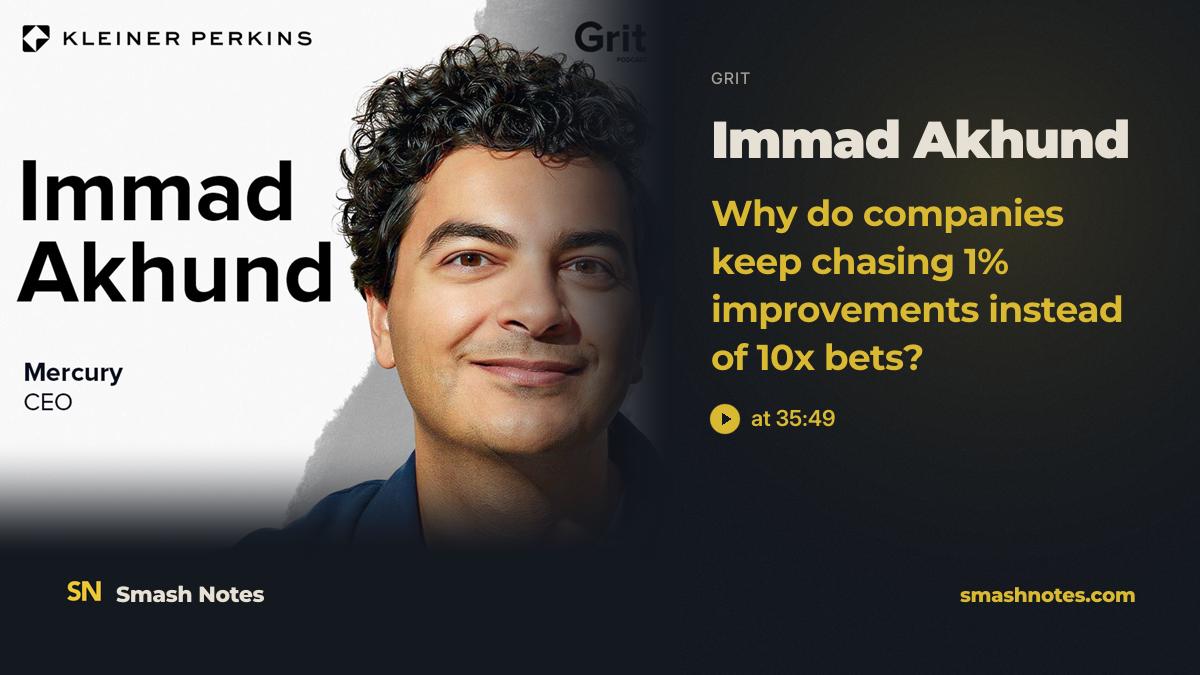
The Difference Between 1% Improvements and 10x Growth | Immad Akhund
Why do companies keep optimizing what works instead of building what's next? Immad Akhund is on his fourth startup, building Mercury beyond its core banking business. He explains why the next big opportunity may be worth more than another 1% improvement, how Mercury makes room for new ideas, and why founders should enjoy the process of building. Guest…
Notes
-
-
-
-
-
-
-
-
What Is a Good Sales Payback Period? at 47:04
-
-
Related notes
- How Do Startup Founders Sacrifice Their Mental Health
- How Should I Approach Starting a Company
- What Is the Biggest Challenge With a Notion of "overnight Success"
- Why Do Founders Think Their Startup Is the Next Facebook?
- What Stops First-time Founders From Seeking Help
- How Can a Startup Founder Remain Mentally Healthy
Related episodes
-
![]() How Vercel Is Rethinking Go-to-Market With AI | COO Jeanne Grosser
-
![]() Inside the AI Startup Making Customer Support 65% Cheaper
-
![]() The 20-Year Bet to Make Fusion Energy Work | Jeff Lawson
-
![]() The AI Race Has a Leaderboard | Arena CEO Anastasios Angelopoulos
-
![]() Ryan Hoover — Products of our Environment
-
![]() #13 — Matt MacInnis — A Beautiful Mind(set)
-
![]() Lessons of Greatness: Why You Need to Nail a Niche before Going Big
-
![]() Guillermo Rauch: One Stroke Dragon

Full transcript
The episode notes above make this conversation easy to skim.
0:00
We're definitely in a hype cycle. If you're doing something because you think it'll be better for the world, I think that's like a motivation that can outlast. Whereas if the motivation is like, how do I make the most money? Then when you hit a hard patch, it's hard to like fight through it. Such like a crazy mindset to think that's possible, right? To go from...
0:17
idea in your head, go write some code, go sell this thing, go hire the people and like get to a billion dollars in revenue. It is unrealistic, but you have to go out there and like believe it yourself firstly, project that belief to investors. You have to project that belief to customers and then employees, right? Yeah, I think the startup world specifically requires like a really extreme level of optimism to win in.
0:35
So Welcome to Grit. I'm Juven, partner at Kleiner Perkins, a show where we go beyond the highlight reel and explore the personal and professional challenges of building history-making companies. Today on Grit, I'm talking with Imad Akunt, co-founder and CEO of Mercury, the financial platform behind one in three U.S. startups. Imad grew up in a family on welfare, spent 10 years as a founder before his first real exit, and then decided to take on banking itself.
1:12
We get into all sorts of things about Iman, including his hot takes on company building, the intersection of what that means between his personal and professional life, and everything in between. Enjoy. Can I tell you one of the specific reasons why I wanted to do this with you? Yeah. The way you talk publicly in your LinkedIn posts and your tweets
1:36
very much aligns to... how I think, which is like the intersection of the personal and professional of company building. And there are tweets that you have about Mercury as your product. By the way, Roadrunner is now switching to Mercury. We made a mistake of starting on
1:56
SVB. Oh no. It was a mistake. Yeah. We're rectifying it now. So you were about to be a proud, a proud customer. Apparently like I couldn't, The APIs in SVB, like, I couldn't get a dashboard to work to, like, see how... I don't think they have APIs. I was like, is this a joke? So, anyway, that's why you're valued at $7-plus billion, I guess.
2:17
Anyway... Sadly, only 5.2. 5.2? Yeah. That was the last race? Yeah. When was this? When? In March. In March. You could say 7 now, probably, but... In March.
2:29
And... Anyway, I just like the way that you think about the world. I think it's interesting. You do talk about Mercury stuff, but then you talk a lot about... uh, company culture, like CEOing, like, uh, you have some, I think pretty unique takes on like having kids while you're running the company. And these are things that I think a lot about.
2:50
I've always talked about the intersection of the personal and professional on the show. Cause I think that stuff's like not that much talked about. Yeah. Weirdly. Like I don't, I think it ties to grit as well. Why is that?
3:03
I think like I talk to people and they're not running their company in a way that like is going to lead to more grit. Like if you're burning out, you're not going to be like the highest grit person. You know what I mean? Like you have to really have your personal, you have to have your personality, your personal life and your business life kind of in sync to make, to maximize your grit.
3:26
Because like grit is about like how long you can last through like adverse situations, right? So like, I don't know, if you're like super burned out, like when you get hit by something, like a customer says no or whatever, you can't raise money. Like, are you going to have the perseverance to kind of go through that? And that's how you frame grit.
3:45
That's one framing. I mean, like a grid is probably like a complex word. But yeah, to me, it's like, I think one element of grid is how long can you go through adverse situations, right? So like, and I think you don't get there without having all your ducks kind of lined up.
4:07
And yeah, I think there's different ways to frame it. I was just listening to an interview this morning with Ben Horowitz. I think what he was saying was like where most companies fail in his view is when the founder... comes into adversity and like can't deal with it. And that's usually where these things kind of start and stop. And he, basically his point was like the founder is the thing that matters.
4:32
It's always the thing that matters. Like the idea can't suck, but the founder is the thing that matters. The problem is in today's day and age with like venture capitalists and founders and how like the compression of time to get to know each other, you don't know how they're gonna respond in moments of extreme pressure. And he, you know, his point was like, this is why Elon's maybe the greatest entrepreneur of our generation, because like in moments of pressure, he's like rises up.
4:58
And then I thought that was like kind of an interesting framing that was like pretty succinctly phrased towards the moment in time of the companies where, when you perform, when all of the cards are kind of, all the chips are on the table is like what defines success. Yeah. I think one thing that's tricky, and I was actually talking to a founder about this just yesterday, is how do you respond to those situations? And
5:27
I have two things that I do, which I don't think most people do. Number one...
5:34
I think adversity is fun. Like if I have like a normal week and like, you know, nothing too tricky is happening and like, you know, it's all up and to the right or whatever, like it's just kind of boring. Like I kind of have fun when like, you know, I don't want things to go wrong, but like, I want to be challenged. Like I want to do hard things, right? Like I think sports is really good with that.
5:56
Like, you know, the mentality for like people who play sports is like, you want to do hard things. Like you want to lose. No, you don't want to lose, but you want to do things that might make you lose, right? Like it's boring just like if you're playing, I play tennis quite a bit. Like it's boring if you're just playing tennis and you're always winning, right? That wouldn't be actually a game.
6:14
So I think like, I think of that in the startup context a lot. I actually often think about like startups as like a game and it makes, you know, I think it's a good way to think about startups. So like you kind of want hard things and actually like every time Mercury solves something hard, like if we do something difficult, like we're going through this bank charter process, which, you know, I think is quite difficult and normal, you know.
6:37
my previous software companies don't have to deal with all of this kind of stuff. But because we're doing that, I know, assuming it's the right difficult thing to do, like at the end of it, we've created value to some extent, right? Like we've done something that our competitors might not do. We've done something that is hard, but like is valuable to our customers because, you know, we can build like the most kind of AI-pilled bank or whatever it is we're accomplishing.
6:59
But like doing hard things has like value, I think. And you have to like actually be put yourself in the mindset of like wanting to do hard things. And like, I mean, Elon's like this. He's like, yeah, he just seems like he's like CEO in five companies or something like that. Right. Like he's doing, he's willing to do insanely hard things.
7:18
But I think you have to enjoy doing those kinds of things. Like, I don't think it's like a normal, I don't think most people think like, wow, I need to make my life like a little harder. Do you think that's trained? Like, is that nature or nurture? I really don't know. Like I have three kids and a lot of, their personality seems like it's genetic.
7:36
Like they, you know, I raise them relatively similarly and they're all three so different. So there's definitely an element that you just get, uh, But I do think like, you know, things like sports, things like, you know, being an immigrant because, you know, you don't take anything for granted as an immigrant. I'm like a double immigrant.
7:53
I moved, my family moved from Pakistan to England and then I moved from England to here. Like that kind of trains you because you just like have to kind of, you know, you, maybe it's like self-justification. Like I face so many hard things that like you have to try to like enjoy them.
8:11
So yeah, so I was going to say, I think wanting and enjoying hard things is important. And I think the other one that is quite a tricky one also is like how... like what is your emotional kind of response to the events? Which I think is, I don't, again, I don't know if you can train it, but like, you know, if when good things happen, you like spike up and you're like, oh my God, it's amazing, blah, blah, blah.
8:37
And if like, you know, something bad happens and you spike all the way down to say like, I give up, like my life's too hard, you know, like why am I here? All this stuff, right? I think it's really hard if your emotional responses to events are like too positive or too negative. I think you have to, like, try to be, like, a fairly steady hand.
8:57
I think that's good for yourself. Like, I think, you know, my wife is actually doing a startup right now, and, you know, I see her, like, you know, something great happens, and she's like, oh, my God, we made so many sales, et cetera, and then... I'm like, you know, don't enjoy this. Like something bad's gonna happen. And then, you know, the next week she's like, and I think like when you are like very volatile in your emotional response to the situation, I think it's actually just hard to manage life.
9:24
And like, I think you have to, like startups are just like a rollercoaster. It's very- especially if you're doing hard things, it's very, you know, sometimes you'll feel great. And the next, like literally the next hour, you might feel really shitty.
9:37
And if you're just continuously like being volatile emotionally, it's, I think it's like really hard to have that kind of long-term grit. This like foreshadowing. that like something bad is going to happen. Like, why is that? Like, why is something bad always going to happen? Like, why is it- No, because you're doing hard things. Part of doing hard things is like some percentage of them don't work out, right? Like, actually, one of the funny things at Mercury is we've never really had like a super easy fundraise.
10:03
Is that true? I mean, okay, I should caveat this. We've always had a term sheet within three weeks. So maybe you would consider that not that bad. But it's always been like, it's never been like 10 term sheets within three weeks. It's always been like two or something like that. And partly it's because I always push for like the best firms and the highest valuations, like some combo of like all the best terms.
10:28
But either way, like- You know, at any one round, I could make it very easy for myself by just saying, like, I don't care about the VC or I don't care about the terms. And it would be easy. But because I deliberately make it like, you know, the right way to do a fundraise is to get most people to say no, in my opinion. Otherwise, you haven't priced it right.
10:45
to some extent, right? I'm sure there's some exceptions in the AI world. But I think this is like my general view on things is like, if you're pushing the envelope, like if you're launching products that might fail, if you're, you know, I don't know, trying to hire someone that's like kind of a reach for you to hire, like you're going to get no's.
11:04
So there's going to be things that like get you, you know, and most of these things, like you're putting so much heart into it, right? Like when you're launching a new product or when you're like fundraising or when you're like hiring, all of these things, like you need to put a lot of energy into it as an entrepreneur. So there's always going to be hard things.
11:20
Like I don't think there's a, I mean, maybe there's a way to do startups without having hard things, but at least if you're like going for it, right? Like I think. If you're going, try to be like 10x next year and all of this kind of, you know, pushing forward all the time, which I think you kind of have to have that energy to really succeed in the startup world.
11:40
You're going to get a lot of like disappointment along the way. In your experience, does the disappointment and hardship get harder or easier as time goes on? I definitely think there's a switch between how existential
11:56
the startup is. Sorry, let me be precise. When you are not profitable and your hard things can kill you as a startup, I think it's much harder. We've been profitable for four years now. It's rare these days. Yeah. I think in my previous company, we were not profitable for six years. In the last two years, we were profitable. I think it's a very different mindset between the two.
12:19
Like when you're waking up every morning and like, you're like, what's my runway? Like the numbers like shrinking, right? Every day. And you feel like, Even when you're doing well, there's just this kind of level of existential dread that you get from like a bank account going to zero that you don't feel afterwards. So I think that's definitely a turning point in my experience.
12:44
but it never goes away. I mean, I think even if you're profitable, you're trying to push harder, you're trying to grow faster. So yeah, I think it's always there, but it definitely gets less work. I think the main way I've changed is I've got better at handling it for sure. Mm-hmm. Earlier, when we started talking,
13:06
and you're asking me about Roadrunner, and I said, you know, we've grown out of two offices now. Yeah. You said, oh, it must be working.
13:15
That's like one of the things that scares me right now. Mm-hmm.
13:19
not just my company, but like generally in companies is that we are using yardsticks like people growth. It's like the easiest proxy to explain to somebody if you don't want to share like revenue. Yeah. But it's like kind of the, I don't know, maybe like it feels like the fake game on the field. it's like a little bit better than like how much have you raised,
13:49
but not as satisfying as like how much money have you made? You know? I'm curious what you think of that. Honestly, it used to be worse. It used to be all about number of employees. Now, I think it's actually changed a little bit where like, you know, teams are much more nimble. You don't necessarily learn as much as you used to from number of employees.
14:13
I mean, I think it's, I don't think it's all negative. I think at least when I'm talking to an entrepreneur, like I kind of want to be helpful. Yeah. And like, it's just, you know, if you're just starting out with two people, it's just like a different conversation. Like I don't have enough context. Totally. I don't think it's bad to like try to like gauge the person.
14:31
Yeah. Honestly, I feel like people are a lot more honest than they used to be. Like people, obviously we're in a podcast, you know, but outside these situations, people share revenue numbers quite a lot. Yeah. And honestly, I find that like the whole startup ecosystem has become a lot more open with metrics and things like that in a way. And maybe it's like the conversations I have or something.
14:51
But, you know, I feel like 10 years ago, no one used to ever talk about revenue. It was almost like a not safe thing to talk about. Now, you know, we see people talking about revenue online all the time. It's like become a lot more common thing. And I think there's like maybe a separate element to this is like, you know,
15:11
there is this kind of one side of the Silicon Valley ecosystem that's about like, hey, we're like doing big things that change the world and improve the world, et cetera. And then this other side of it, it's just like, I'm trying to build a big company and go sell it and make, you know, become like a millionaire or whatever it is. So, uh, i think there is like some tension there and it swings and you know just i don't know if you're at the top of the bubble or whatever but we we're definitely in the hype cycle uh and the swing in the hype cycle is much more towards like money and people who care about money and like uh those elements and then you know when it when it will
15:46
change and it will change probably at some point uh it will be once again a little bit more about like what are we doing to like improve lives i I personally like the other cycle a little bit more than this cycle. Like I like it when we're doing things. It kind of goes back to grit as well. It's like if you're doing something because like you really wanted to succeed because you think it'll be better for the world.
16:09
I think that's like a motivation that can outlast. Whereas if the motivation is like, how do I make the most money? Then when you hit like a, you know, a hard patch, it's hard to like kind of fight through it. You immigrated from where to England? Pakistan. And how old were you when you... That was my parents that immigrated. I was nine. You were nine.
16:29
And then how old were you when you left England? 23, and now I'm 42. Wow. Yeah. And you came straight to the Bay? Yeah. I did one startup in London, and I decided I need to be in Silicon Valley to do startups. So then I did my second, third, and now fourth there. Is this it? Is this the last one? I mean, as long as I have energy, I will probably still be doing startups.
16:56
Yeah, I'm really enjoying Mercury. I mean, one of the fun things about Mercury and why I started Mercury is I feel like some companies get interesting at scale and you can do more at scale, whereas other companies kind of converge, if that makes sense. Yeah, it does. Most companies tend to do one thing and then they improve that for the rest of their life, whereas I think banking is this really interesting...
17:21
thing where it's like it's got all your money it's the first thing you set up it's a universal product there's not that many universal products for businesses it's like every single business needs a bank account uh so it's just this platform where you can build a lot like we just launched mercury books uh three weeks ago uh but you know it's like it just fits so well into banking it's like you know the bank account you already sign up for a bank account before you sign up for an accounting system the bank account has most of your data uh it's like such an easy expansion uh and it's such a natural expansion for our customers as well uh but there's so many of those in
17:56
banking that it's just kind of a fun thing that you can like keep building and building i think if it was If Mercury got to a stage where there was like not that much new stuff and it was mostly like kind of incremental optimization, I would be kind of a bit more bored. I'm probably not the best leader for that. But I think Mercury has like almost infinite, like, you know, we just launched in Mercury Personal, which is like our personal product.
18:21
So there's just so much like forms of expansion that it just makes it like a really fun startup to work on. I am so impressed. that this is the fourth, like just, I don't know, like I'm obviously just far behind you, but, and I'm maybe like, let's just say a little over a year in, but I've never, and I would consider myself like a uniquely energetic person.
18:49
Like I have a lot of energy. I have to work out every day to like release energy because it's like too much pent up, you know? And I've never, I've never given anything this much energy in my life, like every day, just like a consistent application of force every single day. And I was just talking to my co-founders about this, like, man, can you imagine like doing it again from zero to one? Like, cause that's when it takes the most energy.
19:20
It's like get off the ground. Yeah, all to say, like, I'm really impressed that you have that in you. Like that is unbelievably
19:30
determined. So my third startup actually had like four full pivots, like literally starting from zero pivots. So even though it's my fourth startup, it's almost like my seventh or eighth major idea.
19:47
I think you have to like, and I mean, this kind of ties to grid as well. It's like, you kind of have to enjoy it a lot. Like you have to enjoy the journey. Like, so I think about this quite a bit it's just like and like actually ties to like why you shouldn't celebrate the ups and downs too much like you just have to enjoy the day to day so like I mean a lot of that time period like that's like 20 years of like being an entrepreneur I've been programming and like I've been like doing the code or whatever right like you know my last startup was still like 24 when it was acquired and I was still doing some coding.
20:18
Uh, I just enjoy it. Like it's fun to code. Like, you know, I guess if I, in another world, if I hadn't been a CEO, I'd be, I'd be a software engineer and like, it's fun. Yeah. I, I think you have to do things that are fun. Like it's fun for me to do product or talk to customers or think about like, what's a new thing we can do and all that kind of stuff.
20:37
So, uh, I think if you're enjoying your day to day, it gives you energy. Uh, And it kind of goes like, you know, if you don't get too attached to like, I have to, you know, every negative thing is going to like take me down. I have to like get really stressed about it and things like that. Then you can really just enjoy that journey as much as possible.
21:01
I guess that would be my response because I'm going to be doing something, right? Like I have to live life. So if I'm really enjoying doing a startup, I'll just keep doing it. So that gives you like this kind of sticking power. How many of the same people have you been doing these startups with? Any? So actually five people, five of the eight original people at Mercury were people I'd worked with for five years at my previous company.
21:23
And they all still work at Mercury. So I guess them specifically I've worked with for 14 years now. That's crazy. Yeah, it's cool. But yeah, we all enjoy working together. They also have like a similar mindset. And the company's remote. Yes, so we have an office in SF in New York and Toronto and Portland, but it's remote first, so people can't be anywhere.
21:48
Why do you live here? I love San Francisco. I mean, the weather's great. People great. I'm a very, like all my friends are entrepreneurs or VCs. Like I'm a very one track kind of person. I'm also an active investor, invest in like 300 companies. So I love it. I don't like it. I mean, the only major downside here is it's very expensive. But if you can get over that, I think it's a great place to live.
22:15
Can I read you some of my favorite tweets and posts. Sure, let's go. And have you expand on them? Is that all right? Yeah. We'll start with this. Founders should take the weekends plus vacations off. And then you outline three reasons. The first is time to think high level outside the daily grind. The second is the last 10% of time is the least productive.
22:42
And the third is avoiding burnout. Yeah. Always been this way? Yeah. So when I first started, you know, I didn't have any kids. I was very much like, wake up, get on computer, you know, work all the way till midnight, go to sleep, wake up, get on computer, etc. And then I had this, you know, I got married and I was 25.
23:06
And then even then I had this kind of mindset and it wasn't until I had my first kid, which was relatively early. I had my first when I was 27, where I was like, oh, actually I do have to
23:16
prioritize kind of outside my work life.
23:22
So I guess I had like this realization where I was like, you know, I'm at work all the time, but I'm actually that productive. And then you realize like when you don't have like a split between like work and life, which is I think a lot of like early entrepreneurs are like that.
23:38
You know, like really sitting there working all the time. Right. It's just it's not possible to like, I mean, at least a lot of that time I was coding, as I said. I have like a lot of energy and stamina, but like, you know, you just can't sit in front of a computer and code straight for 12 hours. Like you can do it as like one sprint, but consistently every fricking day for 12 hours, like I just don't think I can personally not do it.
24:01
And I realized I was kind of pretending to myself, like I'm there, you know, I'm on Hacker News, I'm on Twitter, I'm on, you know, I'm DMing people. And yeah, I'm also coding, but like, I'm just like switching between things. And I'm not really as focused as like, you know, the actual productive hours I get is not that much. And then anyway, so eventually I, you know, ended up reducing my hours to like something reasonable.
24:24
And I realized like, I actually, I was just as productive and maybe even more productive because I was like, all the time I was in front of a computer, I was doing one thing and I was like working and focused rather than kind of splitting attention between a bunch of things. Um, So that's one realization that like, I think you can do sprints, but like in general, if you're committed for multi-year kind of time period, you just don't get that much extra hours out of like working evenings and weekends and being like super extreme about it.
24:51
I definitely think this is kind of, I guess the first point I had is that you're doing the right thing matters so much more than doing the thing. If that makes sense. Like if you're like, even on like micro decisions, like if you're building the right features in the right way, that matters a lot more than like building a hundred features.
25:10
Uh, Uh, so like doing the right thing, I think does require like you, you know, I have my best ideas when I'm not in front of a computer and I'm talking to people and, uh, or not even doing work related things. Like it's kind of like processing in the back of your mind. So, so yeah, I think that's like another element of it, but yeah. But yeah, I just feel like sometimes people are kind of pretending to themselves.
25:34
Like, you know, I talk to some people, I'm like, yeah, are you really that engaged? And I think like, actually, it's like a, it's a form of stress, like this feeling that you have to work all the time to be like succeed. And I think that like, like that kind of like stressful work where you're like really anxious and you're like, you know, I'm like trying to get things done and blah, blah, blah.
25:54
Like I actually think, you know, making the best decisions when you're like kind of stressing, you know what I mean? Like, is it like, like are your best decisions when you're like fairly calm and you're relaxed and you're like approaching things with a fresh mind or are they when you're like, kind of like having slept properly and you're like stressed about something? Do you feel that way about everybody inside your company or for you? Meaning like, yeah.
26:15
Can I take the counter position and just get your reaction to it? Like, you have a 21-year-old engineer dropped out of school, joined your startup. Maybe you're a smaller company. Yeah. They have no experience, so they got to make up for it through, like, horsepower. Yeah. Like, do you feel that way for them, too? You know, I...
26:38
I try to not like tell people how to live their life. Like if someone wants to do it and they feel like they're most productive there and they, you know, they want to do the extra and they're getting something out of it, go for it. Like I, I mostly say these things from like, this is my lived experience. And I,
26:55
I would still say even for that person, right? Like, you know, if they worked, If they didn't work on a Sunday, let's just say they're working Saturday and Sunday, like would they be much less productive or would they even be more productive? I would suppose that they'd be more productive than working seven days a week. So then you can kind of work it to the limit.
27:15
Okay, you know, maybe they have more stamina than I do because I'm like 40 something. Maybe they can work, you know, like those five hours on Saturday and like it's just as productive. So yeah, you can definitely like say this doesn't, this model doesn't fit everyone. But I guess I would also go back to say, you know, Like, I want to do this my whole life.
27:34
Like, I want to, I basically, like, after I did my first startup, I was like, this is so much better than working for anyone. I will do this for the rest of my life. So, like, what is the most life-sustaining way of doing the startup? And, or, you know, whatever this 21-year-old is doing. And, like, yeah, maybe, you know, at the age of 21, they should go date someone and, like, go do things in the evenings and weekends.
27:54
And, like, that's probably fine. And I don't know if that startup will get hurt that much by, like, that extra 10% of time that they're losing. Yeah. Yeah. And you said you've like modulated it down to a reasonable amount of hours. What is reasonable in your mind? For me. Yeah. Yeah, I normally work like nine to six, five days a week. Yeah.
28:14
I mean, I'm still on Slack. I'm still thinking about it the rest of the time. So it's not like absolutely zero outside that. But those are my core working hours. A friend of mine is the CEO of ZoomInfo, Henry Shock. Have you met Henry? No. He's great. He's a great, great guy. I think he's a great CEO. And one of the things that he...
28:36
was telling me recently was that he's basically taken all of his work dinners. Cause you could be at a work dinner with a VC or customer or candidate all the time. And he's like, I just don't do them anymore. He's like, I just, there were coffees. They could be four or five o'clock coffees that have like decaf or whatever. There'd be lunches, there'd be breakfasts.
28:56
But he's like, I just don't do the dinners anymore. Yeah. And he's like that. And that's what he, and that's, he changed. Yep. And he has dinner with his daughter and his wife most nights. And I've started to try and do more of that. And I love it. I'm like, this is so nice. Like, I don't have to do any of these dinners. Yeah. Like I can just move the meeting.
29:16
yeah to whenever i think i should have yeah this is kind of what i was touching on earlier i really feel like people should just do what they want to do like they should just stop listening to other people and just do what you want to do like if you want to work seven days a week whatever do that but like yeah i feel like a lot of startup world is like there's like people who say things on on twitter on podcasts uh and then other people like oh i don't know how to run a startup like i'm gonna go copy what this person is saying i should do um
29:42
And yeah, if you're not enjoying the... And actually, one thing that I think it is a little counterintuitive is do things not that you just want to do, but that you enjoy doing. If you enjoy having those dinners, I think some people probably like networking and they like meeting those people and having those dinners, then go do those dinners.
29:59
But if you don't like them, just go... go do a coffee. You know, like you just have to like make these decisions. And like, I don't think there's that many wrong decisions. Uh, at least when it comes to like how you live your life. Uh, I mean, there's obviously like wrong localized startup decisions. I think the, probably the like LARPing of it is just like, you're feel like you're being judged by people, whether it's employees or VCs.
30:22
I mean, who's judging people? I mean, who cares? Yeah, I guess so. Uh, Yeah, I don't like, yeah, no one's, I think this judgment is like probably self-judgment more than other people. I don't think there's that many VCs. Yeah, like you think it's your own internal monologue. Yeah, yeah, exactly. I think it's like what you think you should be doing.
30:40
But yeah, at least my experience isn't like, I mean, VCs are like living a pretty relaxed life. That's my experience of it. So like, well, who are these people to judge you when they're like going on like six-week vacations all the year or something like that? Yeah. I mean, there are hardworking VCs, but I think you should just do what you want to do.
31:03
And I mean, there's like, obviously, like sometimes you'll have to work your ass off and that's just like part of being an entrepreneur. But I think that shouldn't be your default. Can I go to the next one? Yeah. And we touched on this a bit, but some non-obvious traits you need
31:19
to be an entrepreneur. unrealistically optimistic, calm, resilient and decisive under crisis conviction in your ideas, regardless of popular opinion. I think we covered the second one, but I'd be curious on the unrealistically optimistic and the conviction in your ideas, regardless of popular opinion. Yeah. Um,
31:40
I think a lot of entrepreneurs are like unrealistically optimistic. Actually, like if you think about this idea, and actually I think about this quite a lot, it's like, you know, you have this thing that's nothing, right? Like it's an idea in your head and you have to like go all the way to like, let's just say, I guess it used to be cool to be a hundred million in revenue, but whatever the, like, let's just say- The promised land is.
32:02
Now it's like a billion dollars in revenue or something, right? Like it takes such like a crazy mindset to think that's possible, right? To go from like idea in your head that I'm going to like, go write some code, go sell this thing, go hire the people and like get to a billion dollars in revenue. And actually it's like, It is unrealistic.
32:19
Like the percentage of startups that achieve it is like less than 0.1%, right? But you have to go out there and like believe it yourself firstly. And you have to like project that belief to investors. You have to project that belief to customers and then employees, right? And you can't like not believe it. Like it's very hard, I think. I think it's a relatively unconvincing pitch when like the person doesn't really believe this is possible.
32:43
So that requires like an unrealistic optimism, right? It's to go like, wow, I'm going to like, no matter. And then I think it's like, you know, you're going to get a lot of no's. You're going to get like a lot of like, you're going to have to wake up every day and keep having that kind of optimism.
32:58
And yeah, I think it is not a given. But yeah,
33:06
I think it's a good way to live life personally. Like I like, I like being optimistic. I'm just like most of the time I'm like, oh yeah, it'll be good. Uh, and it kind of simplifies things, but yeah, I think the startup world in specifically requires like a really extreme level of optimism to like win in. On the third point, the conviction in your ideas, regardless of popular opinion, Ali Godzi was, um, talking about how this data, I think it's called the data lake.
33:33
Does that sound right? I don't know, whatever they call it. It's like from the data warehouse to the lake house or something, something like that. He was like talking about how for three years, Everyone inside of the company at Databricks was like, this isn't going to work. It sounds like a ski, like a, like a, like a boathouse, you know, like people are familiar with the conventional phrasing.
33:56
And he was like, for three years, I was like, I forced people. no matter what, marketing, whoever. Call it data lake. Yes. And then he made it happen. And then he made it happen. And this point kind of reminded me of that. That like struck me. I was just like, oh man, like three years? That's so long to like persist with the category creation nomenclature.
34:21
I was like, so like, that's just so hardcore. Yeah, I think it actually also this kind of idea ties to like doing hard things. And like, if it's too obvious, then either everyone would be doing it and it'll be like competed away or it probably doesn't have value. Like it won't work kind of thing. So like you kind of have to start with like, you know, at least a somewhat contrarian thing.
34:50
Like, most people have to believe this isn't going to work, which is also, like, ties to, like, you have to be unrealistically optimistic in this, like, thing that most people think will not work. Like, that's just the... And most of the time, they're right as well, right? Like, most things don't work. So... But you really have to have, like, a belief that, like, you know, your vision for it can, like...
35:13
But, yeah, I also... you know, I do empathize with him kind of, you know, even when your company gets a little bigger, like there is like a, you know, the default mechanism for most people is an opposition to change. Like I think entrepreneurs, at least, maybe not all of us, but I'm a little weird. Like I quite like change. Like I like things changing.
35:38
I think that's kind of fun to have like change and dealing with change, but I don't think most people like change. And then once you have an organization around it, that kind of coalesces to not wanting change in general. So actually we launched Mercury Personal in February. And it was kind of like a mission to get everyone on board with it because we're a B2B company and it's generally B2B and there's so much to do on the B2B side, right? But the problem with
36:07
What I didn't want for Mercury, which I think most companies end up doing, is, like, it's very hard to do new things. Because, like, if you have a big thing that's at scale, right? Like, if we get, like, 1% better at doing Mercury for business, we're going to make millions and millions of dollars. And, like, it's relatively easy to come up with 1% improvements to Mercury business, right? It gets, like...
36:31
you know, we improve our go-to-market a little bit and like it's 1% better. 1% is not hard to get out of a machine.
36:39
But to get a new product out from zero to even one million in revenue, it takes so much work, right? And each of those bets is kind of low probability. So you have to do a ton of work to get a million dollars out of something, or you get a 1% improvement out of your core thing. But the problem with the 1% improvement out of your core thing is like, you kind of get to like a local maximum, right? Like where you keep doing this 1% and then like eventually you get like extractive or whatever.
37:10
Whereas like the new thing can potentially be that like next 10X thing, right? Like you can get into a new exponential, uh,
37:18
So part of like, hey, you have to, and I had to have like persistence to say like, hey, I really think Mercury Personal will work. In spite of what? In spite of people saying like, hey, why we, you know, all my teams are like, you know, overburdened and we could be doing X and Y. Like, why are we doing like, you know, why are we hiring for Mercury Personal, right? Like- And they're very logical.
37:41
Their arguments are very reasonable. So how I position internally, and I think we've built a good muscle around this, is to say, hey, it's a new bet, and we're actually going to think about it as an internal startup. So we're willing to put $4 million for a seed funding for this new bet internally. And it's, you know, it's a separate team.
38:03
They're not going to distract from everything. And we have $4 million already kind of earmarked for it for the next year and a half or something like that. And if it proves that, then, you know, it'll hopefully become a Series A bet and we'll give it $20 million and so on. So I try to do that internally. And that way it's not like, you know, no one else is like trying to steal engineers from them because I'm like, hey, they've raised $4 million.
38:23
Like we're not touching their resources. That's a good framing. Yeah.
38:29
But this is also what makes Mercury fun for me because I'm like, okay, I have like these, you know, it's not like I have a portfolio of startup bets within Mercury that I had various stages. Like we, you know, we launched our credit card in 2022 and it took like, you know, now it's like a really scale thing. Like we kind of think about it as part of our core mandate.
38:48
But, you know, for the first two years, it was kind of like struggling and like we had to keep kind of going like, oh, should we still be investing in that? And like, it's a competitive kind of space and all that uh but now it's like a core bet so you know the the vision with like all of these bets is like eventually they become like a core part of what we do uh but yeah so uh i guess coming back to the original thing like you do have to have to do anything new in any way even that even in your own company you have to have like a lot of kind of conviction that like you know regardless of what other people say that can work every founder I have met will raise at market
39:25
valuations and in frothy markets raise too much. Yeah. I thought that was particularly timely. Yeah. So I think it's kind of funny because like VCs especially love saying this, like they're like, you know, don't raise too high. Like, and it's like, I think it comes from a reasonable place, but it's also obviously self-serving, right? Like you want to, you know, if someone is on like, 2 million revenue and they're raising at like a 200 million valuation.
39:54
Like, you know, if you're VC, you're like, you should raise at my 100 million valuation term sheet. And here's like a set of reasons why you should, et cetera. I think that's all reasonable. But the reality is, you know, when a founder goes out, they go to the market, right? And like, you go pitch like 10 people and two of them, and like, normally it's the good VCs, like good VCs give you like high term sheet, high prices, right? Like I don't, at least my experience has been like actually good VCs tend to have like more conviction.
40:25
So you've got good VC with good terms, and then maybe also good VC with like worse terms. You're just not going to take those worse terms. Like at least I haven't never seen a founder like go do that.
40:37
Like maybe they take slightly worse term, but they're not going to take 2x worse term. So then it comes down to like in this market, same thing in 2021.
40:47
I was making $12 million in revenue and we raised at a $1.6 billion valuation from Kotu, which honestly was a little crazy, but that was the market, right? It was 120x valuation.
41:02
And that's what everyone was doing. So I think instead of like going, you know, all these other people on Excel was like, oh, raise less money, blah, blah, blah, like lower valuations. I think it's better to say, okay, you know, if you're gonna do it no matter what, how should you handle it? My mental model, and like, I would say we raised too much for our series A, too much for our series B, and then we were profitable.
41:22
So like, actually we also raised too much for our seed. So we raised 6 million for our seed, 20 million for our A and 120 for the B. So I've tried to hold this mental model and think we've stuck to it. It's just like, just assume you raised how much you would raise in a down market. So to me, that was like, my seed round was like a 3 million raise.
41:41
My series A was a 10 million raise and my series B was more like a 30 million raise. So that's my mental model. And I'm like- Wait, sorry, explain that again. But you didn't end up raising those amounts. No, I raised the full amount. Yeah. I'm just saying in my mental model, I was like, this is how much we would have raised if the market was not so good.
41:59
Yes. Right? So not like completely shitty market, but like if it wasn't like a frothy market, or like if I wasn't like good at raising, I would have raised less. And then I try to allocate my costs against that versus how much I actually raised.
42:14
So I will, you know, I will try to do, and mostly like for us, at least it's hiring, you know, for token companies, probably slightly different. But, you know, for us, it's mostly like, what does the hiring plan mean if I had raised, you know, half as much or whatever it was. And then I'll only unlock the rest of the money if I think I'm doing like, you know, if I have...
42:36
grown enough to justify like spending more money. Like if it's like, you know, I'm like so sure that like I've gone way beyond like what the next round would look like that I'm like, okay, you know, now I can unlock the rest of the money. So basically like, I think it's fine to raise a lot of money. Just don't spend it. But it does require discipline.
42:55
But I, at least my observation hasn't been like VCs are like telling me to spend it really. I think this is probably like separate point. I don't know if you have it in one of my tweets, but like,
43:06
I don't, my experience at least with Mercury has been like, you want VCs to be your partner. If you're ever in a situation where VCs are telling you to do things, you've kind of screwed up that relationship already. And like, it's, I am telling VCs like, hey, what do you think? Like, I'm thinking of doing this, et cetera. And I've, yeah, they have opinions, but I've never had any of our VCs say like, hey, you know, do this instead.
43:32
And I think you should go do this kind of thing. It's been much more like, okay, that's reasonable. Like, what have you thought about this, et cetera? Like it's, it's very collaborative. And I think that's how VCs like to operate with the entrepreneurs. I think this whole model of like VCs are telling me to spend money or like VCs are telling me to do X is like kind of a, a flawed model that I don't think entrepreneurs should like fall into.
43:53
And so I guess the counter argument, let's take the VC point aside, because obviously I agree it's self-serving. Yeah. But the argument that they would make. Yeah. Which. in some ways, maybe hold some water in my mind, is like you limit your paths. For example, okay, let's just say like, okay, if you raise it 1.6 and the business didn't do as well as it has, like obviously now that decision in hindsight looks great because you took less dilution and you've raised 3x that valuation.
44:26
But if that wasn't true and you, let's just say you raised it, I don't know, 800 million instead,
44:34
And you got acquired for a billion because it was, you know,
44:41
it still made sense for an acquisition. That would be like one argument. Argument two is
44:48
the raising at an extremely high price puts...
44:54
In some ways, especially in B2B, like enterprise, like inordinate amount of pressure where there is, especially on go-to-market, like headcount equals revenue. And if you've signed up for this giant valuation, you're probably signing up for a bigger number than you otherwise would have, which maybe the market may or may not be able to sustain.
45:17
And now you start doing unnatural things. I think it goes back to my previous point that the founder is always going to take it. So you just have to like manage around it, right? So to me, the M&A point, I don't think it matters too much. I mean, like for most VCs, whether they get 1.2X or 1X, which is like the preference stack, it's like basically the same.
45:37
So, you know, it's like you're basically in like some sort of failure scenario. I'm not worried about the VC. I'm saying more from the founder perspective. Even the founder, it doesn't matter. Like it's like, again, if you're not spending the money, then like actually, you know, generally speaking, M&A is like sets a price and then they add the money on top.
45:51
So if you've got more money in the bank, you've got a higher valuation really. Um, So I don't think M&A is an issue. I think down rounds are more of an issue and it is like quite hard to do down rounds. In really frothy markets, when the markets turn, people actually, I don't think, at least my experience hasn't been in their mind doing down rounds.
46:08
There was a bunch of down rounds for like actually pretty good companies in 23 and 24. And everyone was like, okay, you know, everyone acknowledged 21 was crazy and that like it wasn't really a down round. This was just like the right size round. Um, so I think it's manageable again, if you're not spending all the money, if you're spending all the money and you've like overspend money, uh, and you didn't come up with like any productive outcome from it, like that's always going to be a problem.
46:33
Um, and that ties into my last thing. Like, I think you need really good discipline on spending money. So, but nobody has that. Do you say like, do you like, like, don't you think you're like, I just feel like most founders increase their burn proportionally.
46:48
There's a statement that VCs like saying that founders or CEOs have to be good capital allocators. And this is just a core part of that. How do you spend money? Let's just take sales and marketing. Or let's just take sales. I think it's easier to do that. You just have to understand if you hire... five salespeople, how quickly will they pay back their salary, right? I think that's the math equation in my opinion.
47:16
And like, you pick the right target. And to me, if you have product market fit and it's a good target, it should be around one year. So if you are spending money and you're growing the sales team and they're keeping to that kind of one year target, you're like pretty good. Like it basically means you, you know, if you spend 10 million on sales, you have 10 million more in revenue.
47:34
If you spend 50 million sales, you have 50 million in ARR or whatever, which I think is a pretty good math equation. And like you'll have, I would be shocked if you can't raise a future round if that's your math equation. Now what happens in these frothy markets is people like go way too heavy in sales and marketing. Their payback ends up being three years or five years and no one's going to fund something with like a three to five year payback on spend.
48:00
or, like, you know, whatever. Some negative thing happens there, but, like, you just have to have, like, some discipline about it. It's not like, you know, if you have, like, zero salespeople, you don't hire 50 salespeople. You hire two people, and then you hire five, and then you, like, make sure you're managing against that payback. But, yeah, it's not...
48:18
And again, if you went to any investor and any board meeting and you're like, hey, this is how we're thinking about sales. This is the payback we're targeting. This is how we're going to ramp up and we're going to measure the payback every month. And we're going to report that to you. No one's going to be like, are you crazy? Why aren't you spending all this money? Like, I just don't understand the situation where like someone's just like, I raise more, therefore I burn more.
48:38
Like, I don't know. Like, what are they doing? Like, that's not the job. Like the job is like going like every dollar you spend, you should be getting ROI from it. Uh, And if you can't justify our right, don't spend the money.
48:51
Yeah, I think whether you raise more or less, you're going to have to have a math equation that makes sense, whether it's sales, performance marketing, partnerships, whatever. On the GTM side, you're going to have to have a math equation that makes sense. And then on the engineering side, I think we've proven over time that more engineers does not mean more productivity, right? I think AI helps even more with that.
49:13
But yeah, I don't think it's ever been the case that 10x more engineers means 10x more productivity. What was your, maybe, can you do a year by year, roughly headcount from founding to year one, year two? We had like one year where it was 3X, but most of the time it's been about 40% more. So it's like, you know, we started with eight, we launched with nine employees actually in 2019.
49:37
And then when COVID happened, we were about 30-ish. So a year from nine to 30. Nine to 30. I want to say like maybe 60% And then 140, that was like a big year, like 2021. We also grew more than 4X. And then after that, I think it was about 40% every year. We're about 1,300 now. We actually found that year where we went like 3X or 4X was like, one of the worst years in terms of like, just like a very painful year in terms of scaling.
50:05
And actually like, you know, when you grow that fast, you don't actually get much more productive because like all your good people are like spending all their time on engineering, hiring or training. And, you know, obviously you make some mishires and that kind of stuff. So, but 40% is like what we've grown at fairly consistently, I think for the last three, four years.
50:26
And that's a fairly sustainable pace of like headcount growth at least. Yeah, that feels good to you. Yeah.
50:34
When founders come to you, like you said, you've done 300 plus investments and all your friends are founders and you spend a lot of time with people in the trenches. What are they generally worried about, struggling with? What are the things that you're like, yeah, that they want to pick your brain on? I mean, right now, I mean, you know, for founders, it's often about money, right? Like, it's like you're running out of money and you're thinking about that.
50:59
There's definitely, I would say, there's this kind of really strong separation of haves and have-nots in the market for the last year or so, where, you know, if you fit in the AI thesis category, You know, I guess anything to do with Foundation Lab or data company or like, you know, some of these kind of zero to five million in three months kind
51:23
of AI companies. It's like super easy and like it's much more this kind of conversation of like, am I raising too much money? And like, who do I raise from? And all that kind of stuff. But then there's everyone else, which is actually like a pretty large set of people. It's just people you don't hear about. Yeah, I mean, they're not like hot companies, but many of them are like pretty reasonable companies.
51:43
I mean, they're all like, at this point, like everything is like somewhat AI native, but like, that's just not by itself sufficient. I think there's like, there's thesis and like, you know, this AI wave is moving so quickly. Like you could be on thesis like six months ago and like now you're not cool anymore.
52:01
and they still get it done, but it's much harder to get brands done. It used to be you could get a Series A done with $1 million in revenue if you're growing 3x a year. That was kind of the rough benchmark, and most of the time it was doable. Now that's not good enough. If you're on brand, on thesis, and hot, you could have zero revenue and get a Series A done.
52:24
But I think like, at least what I'm seeing is like, if you're not in one of those things, you need like the same three X growth, but probably 3 million a year in revenue
52:33
to get like a reasonable series A done. So, so yeah, often conversations like that. Yeah, there's definitely like, there's a lot of like, AI kind of anxiousness right now like almost at every level like there's like the companies that think they'll get disrupted by AI there's companies that are like even hot AI companies going like oh my god it's so competitive and like you know it's anthropic and open AI gonna copy me like there's just like this insane kind of I've never felt like the level of like kind of
53:05
almost everyone in the business is, like, really anxious. Have you noticed that? It's like no one is calm and, like, going, like, okay, you know, I'm, like, having a normal day and I'm, like, having a good time or whatever. So it's a really interesting time. Like, it should be, like, a really fun, exciting time. And, like, you know, in Silicon Valley, it was, like, 2016, 2019 was pretty boring.
53:25
I don't know if you were here, but, yeah, everyone was doing kind of B2B SaaS and there was, like, these formulas and it was kind of, you know, there's just only so many, like, B2B sales SaaS companies I could like hear pitches from. But now it's like a really fun time. Like people are doing like really transformative things with like AI and defense tech and all this stuff.
53:44
But it's also like a really anxious time because it's like, no one knows what the, what the ground will be and what will be required in the future. You know, one thing that really helped, helped me with that is
53:57
I remember like even a year ago, I was feeling like some of this, like, you know, we were doing really well and we've been profitable, but there was definitely like, like, you know, my God, like, what does all of this mean? And actually this year, and especially in the last few months, I feel like much better about that. And, and part of it was like, we, you know, we launched our own kind of AI product, Mercury Command.
54:19
And, but we came up with this like idea of like, where do we fit in the, in the future? Which like, you know, I mean, I think, banks will probably exist even in, you know, in any kind of future super AI built world. But I still wanted to have like a really good answer to like, you know, what does that mean for Mercury? Like what would be, what would make me feel like 10 years from now, like we would be the best bank people should use.
54:48
And, you know, for me, the answer was like, you know, most entrepreneurs don't like dealing with kind of finance and operational in HR things. And actually like one of the nice things about having a bigger company is I don't have to deal with it either. Right. Like we know, you know, when I interview someone, I'm like, yeah, someone send them a job offer.
55:06
And like, this is roughly what we should pay them, et cetera. And I have to do the next part, right? Like sending them a job offer, getting them to sign it, getting, you know, getting them set up on our payroll system and benefits and all of this kind of stuff. Uh, So yeah, that's kind of what I thought about as our AI vision to like really make it so anyone can have like finance ops and HR ops in their pocket.
55:29
And because Mercury does a bunch of these things already and we're going to add more of those, we have a kind of a nice path to that. But that's definitely made me feel like You know, because I feel like we have a good path of how we fit in the future. It's made me less like kind of worried about like, where do we fit in the future? I don't know if this is like a formula that people can do though.
55:51
Is there a job that you or role that you felt like you waited too long to hire?
55:58
I mean, almost all of them. Well, with 2020 hindsight, if you knew you were going to grow. No, I actually think it's, I have a slightly funny answer. I think it's good to wait too long. for the following reasons. Number one, I think you should try to do the job yourself, even if it's like something you don't really understand very well, just to know what you really need for it.
56:20
I think it's easy to like, think you know what you need for something and then you go hire someone and you're like, yeah, how will you know if that person's doing a good job if you don't, you haven't at least failed at doing their job. So that's one thing. And then number two, to go back to this other point about like not spending too much money, I think one of the good ways of spending too much money is to go hire for a bunch of things that you think you want.
56:42
Uh, and I can give you a little rant about hiring, uh, execs too early in a second, but, but I think generally speaking, like try to do the job yourself and wait until it's painful to, and then hire is like a good general methodology. Uh, But places where we did this, like, you know, we didn't hire our first finance team person, like literally our first finance team person, like no CFO, no nothing like that until we're about 200 people.
57:06
And that was a little too long. We probably should have hired around 80 because it was quite useful.
57:12
But, you know, I could get my way around spreadsheets and things like that. So I was like, do we really need a finance person? And we had an accountant and all that kind of stuff, but no one internal. But yeah, that was too long. I mean, what other roles have we waited too long for?
57:28
One thing that we did really well, actually, I think about the right time was hiring a recruiter. And I think people wait too long for this one, generally. We hired our first recruiter when we raised about 20 people and we'd raised $20 million. I think generally speaking, if you're hiring, if you're looking to hire more than three people per month, you should have an internal recruiter.
57:46
And like the quality and speed and like almost every element of our hiring process improved a ton after we hired our first recruiter. Yeah. But yeah, that one we did well.
57:59
What else has been good? Oh, actually, this is a generally funny one. So I was really against hiring PMs. We didn't really, really hire our first PM until we were like 120 people or something like that. So I think generally speaking, when you're really small, let's say sub 30 people, the founder should be the PMs.
58:25
and the engineer should be a PM. Like, whoever else you have should be a PM. I think, like, you want to keep everyone, like, really close to the product and the founder should be, like, the primary product owner. There's just a certain point where, like, you know, you have enough teams and they need to coordinate with each other and, like, they need to, like...
58:43
keep moving and the founder can't like touch all of them enough that like that's when you need a pm and we ended up like we were like a little bit like religious about not wanting pms for for too long and then it took us a really long time to kind of get a world-class like product team which i think we have now what's your rant on execs oh ran on execs oh my god so all right you're not an exec if you're managing less than 30 people at a small company, right? Like, so I think all of the, probably you should almost never have titles, but that's kind of tricky.
59:16
But I think in general, what you, you don't want to hire someone who thinks of themselves as an exec and is really excited about being an exec at a company that's like a startup. Like at some point you need real execs, like if you have a 50 plus person engineering team or whatever, or sales team, et cetera, like you need execs at some point.
59:37
Before that point, you hire people that are like, you can give them a head of title and like don't go through exec recruiting. Like, you know, you want like early managers, like early IC types to be in those like small startup environments. Like, you know, they're used to doing zero to one, like they're not... Like, execs at bigger companies have infrastructure that supports them, and it's just a very different thing.
1:00:01
Like, they're managing managers, right? Like, it's just a different mindset. Most execs have never had to, like, do something from scratch, and it's just, like, so different. Like,
1:00:11
one of the earliest ones that most people hire is, like, a VP of sales, right? But like doing a sales system from zero to one, it's just a completely different skill set than like I have you know, I joined a big sales team and I like iterated their process and like they already had product market fit, et cetera.
1:00:33
So yeah, generally speaking, I'm like, you know, I often talk to small startups that are like, oh yeah, I'm hiring an exec for X. And I'm like, well, you know, what's your actual problem? Like, I'm like, at the end of it, I'm like, I don't think like exec is going to solve that problem. I agree with that. I agree with that. Are things keeping you up right now? Like, what are the things that keep you up?
1:00:55
Uh, I mean, I'm a big believer in like getting your sleep in, so not, not too much. Um, I think the thing that I, I always worry about and it requires like a lot of like continuous effort is, you know, as a company scales, uh, like, yeah, there's a general kind of entropic force to becoming like kind of lame over time. Right. Like on like almost every dimension, it's like, you know, you're willing to hire worse people or like, uh, you are you're willing to be okay with worse customer experiences because you're optimizing for something else or you know the culture kind of degrades over time or like you innovate less right like like almost everything about like what makes a
1:01:39
startup like why do startups outcompete big companies is because big companies have like these kind of natural things that kind of make them crappy over time um and I think that's especially harder in like a regulated industry where, you know, we're getting a bank charter right now. And like the, you know, the default path is definitely like, you know, you take a bunch of things that banks do and you copy paste them into like a FinTech.
1:02:03
Right. Uh, whereas like, you know, how I think about it is like, yes, you know, almost everything that like regulations and regulators and like, uh, uh, the guides and things like that, they make sense, right? Like it's like, yes, like we will be in a very entrusted position to like hold customer funds and, you know, like the set of rules makes sense, but you really have to go like, okay, you know, how do you implement these in a way that you don't forsake your kind of culture and you still stay innovative and you still stay customer aligned and you still hire great people and all that stuff.
1:02:36
And I think it's very doable and like that's kind of like the hard challenge for us to do if we can, you know, figure it out and we actually...
1:02:44
The two parts that we don't figure out and we end up being a lame bank like every other bank. Or we figure out and we become like a really interesting company that's like innovative and a fintech and all those things that has a bank charter. And I think the second is going to be better for the world and our customers and people that work at Mercury.
1:03:03
But it requires like a lot of effort. It's not like the default process isn't there. If you're growing about 40% headcount a year, what percentage are you churning out?
1:03:16
That's like net growth. Attrition in general has been pretty low, 10-ish percent. And then what about that you're managing out of the business yourself? So that's like total attrition is 10% I think. I'm going like rough last year numbers. I want to say like 6% were managed out and 4% left. Okay. That's very low attrition, partly because we've like grown every year quite a bit.
1:03:42
But also because we try to hire people that think a little bit more long-term. Like
1:03:49
I've, yeah. I have a hard time imagining how you build a company where like every one's leaving after two years, which is like actually the default in Silicon Valley and with execs. Like a lot of my exec recruiting is around like making sure like, you know, obviously we make mistakes, but my default is to make sure like people are excited about sticking around for like five plus years.
1:04:10
Fascinating. I appreciate you doing this. No, this was fun. This is so fun. Yeah. You kind of fire straight into it. I thought we were like still just sitting down when you started. No, no, no. I just let it rip. Yeah. Are you hiring? Yeah, we're always hiring. Any roles in specific? Lots. Yeah, tons of roles. Let's see. I'm currently the acting CTO.
1:04:31
So yeah, that's a role I'm hiring for. That's a thing. Yeah. If you've previously managed like a 400 plus engineering company and you're like, you know, excited about Mercury, definitely relevant. We're hiring a ton of roles around kind of this AI agent that we're building.
1:04:52
So yeah, especially like founder type people who've kind of done it before. And then, yeah, I know almost every role in Mercury we're hiring for. So would be anyone listening, check it out, mercury.com forward slash jobs. And I ask everybody the same question when you hear the word grit, what do you think of? I feel like you kind of answered that.
1:05:11
Yeah, I feel like I answered it. But yeah, I like perseverance as a word. I think it's like just sticking with it no matter what kind of thing.
1:05:20
Man, thank you for doing this. It's so fun. Thanks for having me.
1:05:25
That's it for now. If you liked the episode, please leave us a review or go back into the archives where we've done more than 200 episodes with some fantastic folks. This podcast is a Kleiner Perkins production, and I'm Jubin. Thanks for listening.