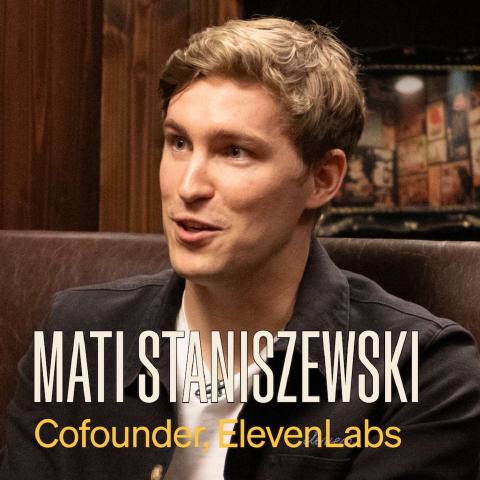
Back to The world of voice AI, with Mati Staniszewski of ElevenLabs, with Mati Staniszewski.
Why Are ElevenLabs Voice Models Cheaper to Train?
Mati Staniszewski says ElevenLabs voice models are definitely cheaper to train than language models and image and video models because they are significantly smaller. A leading-edge voice model has a few billion to the low tens of billions of parameters. Leading language models run in the hundreds of billions of parameters, with smaller variations used at lower scale.
Capital spending is still high. ElevenLabs recently raised half a billion at an 11 billion valuation to keep building the best models and hire the best researchers. His co-founder leads the audio work. Inference cost follows usage. Text-to-speech is usually charged per text token. A voice agent or transcription is charged per minute, and per-minute work is the bigger share. Business customers sign an annual agreement, and a bigger spend brings a bigger discount.
A new model is offered at cost so customers can try the best quality. It costs ElevenLabs more to run than any previous generation, quality is higher, and the price stays competitive. Early on, reliability might not be there, and people do not yet know what the model makes possible. Wide distribution lets customers show what is possible and shows ElevenLabs what to improve.
The world of voice AI, with Mati Staniszewski of ElevenLabs ·
From the transcript
Yeah, definitely cheaper than the LMN and image video models. Significantly smaller models. OK, so the models are smaller. Smaller. What's the parameter count for a leading edge voice model? few billion to low tens of billion parameter models. And for context, I think the, I mean, kind of like, you know, CPUs moved away eventually from gigahertz as like the metric as they moved to more cores.
I think we've mostly moved away from just raw parameter count, but I think the leading edge LLMs are in the hundreds of billions of parameters. I think the leading ones, yes, but of course, you know, you have the variations that you will use at lower scale. So CapEx is still pretty high. We've, of course, raised recently half a billion at 11 billion valuation.