Smash Notes
How Did Ross Edgley's Dad Keep Coaching With Cancer? · Huberman Lab

Huberman Lab

Unlocking Persistent Motivation & Extreme Resilience | Ross Edgley

Andrew Huberman talks with Ross Edgley about staying motivated through extreme swims. Edgley describes hiding rocks in a backpack as a boy, finishing the Great British Swim because he said he would, rushing the Iceland swim before his son's birth, and swimming Loch Ness in water near freezing. They also talk about the anterior midcingulate cortex, brown…

Notes

  1. Ross Edgley hid rocks in his backpack at ten because a huge hike with his dad and two brothers was not enough of a challenge, and he wanted the harder version… Full answer

  2. Andrew Huberman says the anterior midcingulate cortex enlarges when people do hard things. It shrinks when people tend to shy away from hard things. Full answer

  3. Ross Edgley finished the Great British Swim because he had said he would, and because he would know he had quit a swim he was still able to finish. Full answer

  4. Ross Edgley rushed the finish in Iceland because his first child was due in a week's time and he feared missing the birth. Full answer

  5. Ross Edgley picked up cellulitis on a 56-hour nonstop swim of Loch Ness. The water was about four degrees, barely above freezing. He did not stop for sleep. Full answer

  6. Andrew Huberman says activity in a top-down circuit from the prefrontal cortex drives persistence and winning when other factors stay roughly equal. Full answer

  7. Ross Edgley says black bears on the Yukon in Canada were skittish and felt fine, while brown bears were not skittish and looked at him as if they were… Full answer

  8. Andrew Huberman says his lab recorded great white sharks in the wild to bring into a VR lab. Full answer

  9. Ross Edgley says outside doubt became less and less useful across his career because fewer people doubted him. Full answer

  10. Ross Edgley fueled the swim around Iceland by picturing his dad in heaven, a tennis coach looking down and telling everyone else that the swimmer circling… Full answer

  11. Ross Edgley says a Japanese idea of a reason for being is why you get up in the morning, made of four things that all have to be there: what you love, what… Full answer

  12. Andrew Huberman says neurosurgeon Robert Heath let patients with electrodes in the brain stimulate themselves. Full answer

  13. Ross Edgley says initiation with the Yaminawa tribe felt cathartic. The ceremony ended with a good feeling, short of euphoria, and a sense of wow, we did it. Full answer

  14. Andrew Huberman says deliberate cold exposure, done as a shower or a cold plunge and done safely, lets a person get familiar with a flood of adrenaline. Full answer

  15. Ross Edgley strength trains heavily between country-length swims because a ligament or a tendon is what stops the swim, not lactic threshold, VO2, or technique. Full answer

  16. Andrew Huberman says aiming vision at one target raises arousal and the ability to recruit physical energy and mental energy. Full answer

  17. When a cuttlefish sees something it wants to eat, the eyes move from the sides of the head to the front, and the animal becomes a depth-perception hunter. Full answer

  18. Ross Edgley says that toward the end of the Yukon swim they were getting into grams of caffeine, and that 400 milligrams made a hurting, mundane stretch feel… Full answer

  19. Andrew Huberman says that if someone is mildly or severely sleep deprived, 10 or even 20 grams of creatine the next morning can partially rescue some… Full answer

  20. Ross Edgley says a strength reserve is why he still strength trains. Full answer

  21. Ross Edgley primes a heavy pull-up with a short maximal hang so the nervous system is already switched on. Full answer

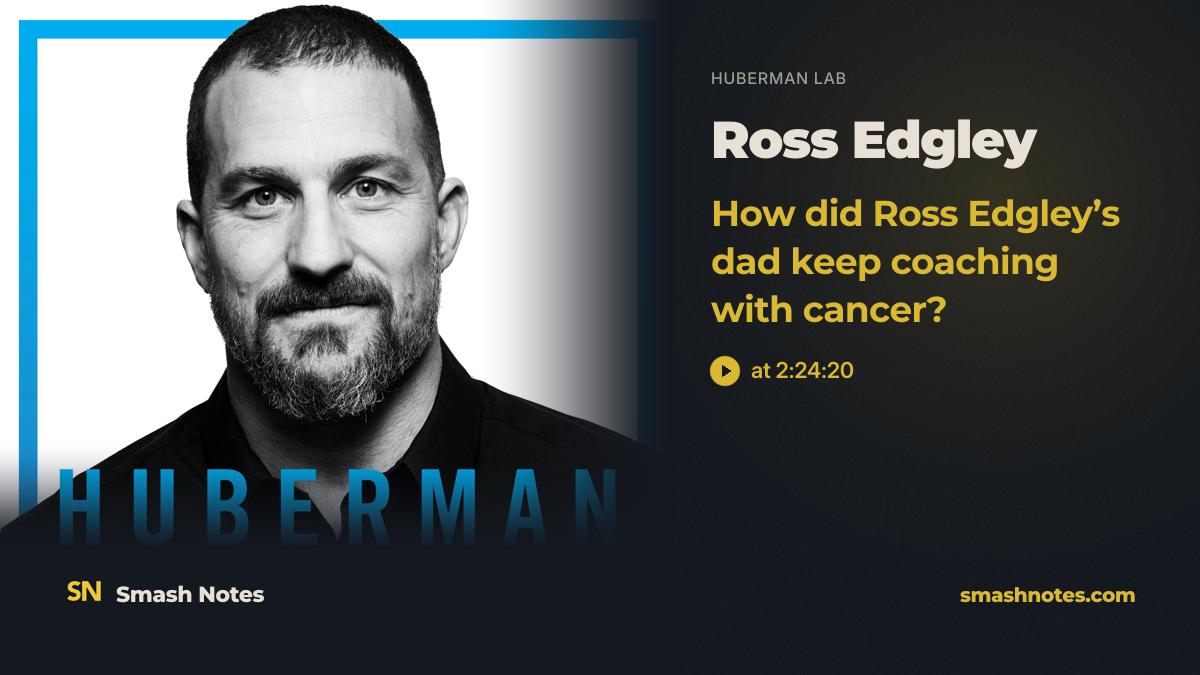
  22. Ross Edgley's dad kept coaching tennis after stage four skin melanoma spread through his legs and stopped him from running. Full answer

  23. Ross Edgley says a terminally ill man insisted on steering the boat for the Yukon River swim after doctors told him he had weeks to live. Full answer

  24. Ross Edgley says what makes a great champion can make a bad human. He says he knows some of his swims are bad for his health, but they are good for his soul. Full answer

Related notes

Plays from this note through the rest of the episode.

Weekly highlights

One letter a week.

The notes worth hearing, with the minute they were said.