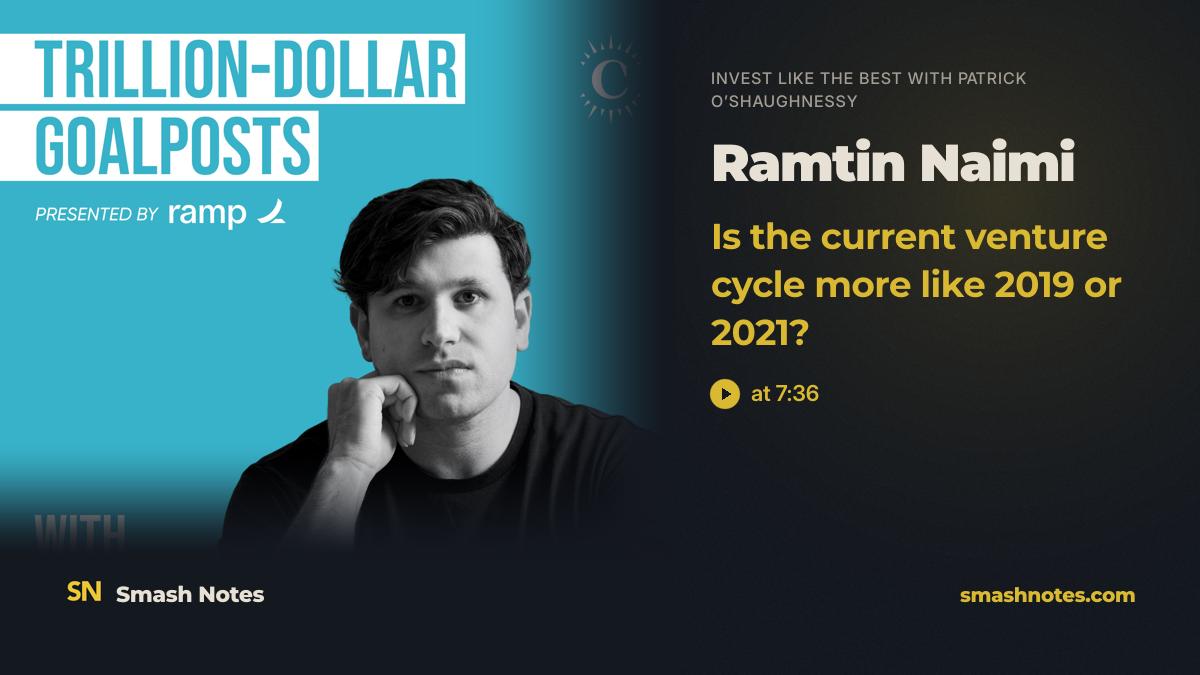
Ramtin Naimi on the State of Venture Investing
My guest today is Ramtin Naimi, the founder of Abstract Ventures, back for our second conversation. Few people see as many companies as Ramtin and his firm, so this time we zoom in on what they’re seeing right now. The question he keeps coming back to is whether this is 2019 or 2021: early in a run, or at the top of one. Hot rounds now come with a second…
Notes
-
-
-
-
What Is the Customer Value Fund? at 16:22
-
-
-
-
Related notes
- Why Are Good Ideas No Longer Getting Funded in Silicon Valley
- Should We Aim for Billion Dollars Companies After All
- Why Do Later Startup Rounds Dilute Founders Less?
- Why Is Today's Venture Market Not a Repeat of 2021?
- Why Raise a $10 Billion Fund When Valuations Look Frothy?
- Why Do Venture Funds Keep Raising More Money?
Related episodes
-
![]() Andrew Huberman - The Frontier of Neurotechnology
-
![]() Christina Cacioppo - Building an Enduring Software Company in the Age of AI
-
![]() Cliff Sosin - Owning the Complements to Intelligence
-
![]() David Vélez - Building Nubank and the Future of Global Banking
-
![]() Gabe Stengel - Building Investing Superintelligence
-
![]() Martin Casado on Frontier Model Economics, AI's Slowdown, and the Cursor Deal
-
![]() Chamath Palihapitiya: People in Silicon Valley are deeply unhappy
-
![]() Why a Chemist Left $7B to Bet on Physical AI Before Everyone Else | Bilal Zuberi, Red Glass Ventures




Full transcript
The episode notes above make this conversation easy to skim.
0:01
Ramp is the only platform built to make your finance team leaner, faster, and better, saving businesses 5% annually on average so you can stay focused on growth. Ramp customers grow 3.2 times faster than the average American business. Visa, Vercel, Cursor, Stripe, and 70,000 other businesses all run on Ramp. Mine does too, and so should yours.
0:20
Learn more at ramp.com. Rogo is the AI platform purpose-built for financial institutions serving tens of thousands of bankers and investors at hundreds of leading firms worldwide. Rogo's AI agents autonomously execute large chunk of your firm's workflows. They can screen deals, draft SIMs, run buyer outreach, and do diligence on data rooms, all with full security and compliance handled.
0:44
Every action feeds Rogo Intelligence, the firm's context layer, turning years of deal experience into a secure, governed institutional memory that makes each new transaction stronger than the last. To learn more, visit rogo.com slash invest. OpenAI, Cursor, Anthropic, Perplexity, and Vercel all have something in common. They all use WorkOS.
1:05
And here's why. To achieve enterprise adoption at scale, you have to deliver on core capabilities like SSO, SCIM, RBAC, and audit logs. That's where WorkOS comes in. Instead of spending months building these mission-critical capabilities yourself, You can just use WorkOS APIs to gain all of them on day zero. That's why so many of the top AI teams you hear about already run on WorkOS.
1:29
WorkOS is the fastest way to become enterprise ready and stay focused on what matters most, your product. Visit WorkOS.com to get started.
1:43
one of our mutual lps describes you as the person from whom he learns the most per minute about what's going on in venture markets when he talks to you and we're going to try to recreate that here today and really focus on not big picture stuff the history of abstract etc which we did the first time but really just like zoom in on this moment in time how would you describe the state of things right now like zoomed all the way in to the deal level here around san francisco It's very fast paced, insanely fast paced in the sense that rounds are happening quicker than ever.
2:16
Follow on rounds are happening quicker than ever. There are certain companies that just get a lot of attention very early in their life cycle, and they get a lot of demand for their financing, whether it's their seed or their series A or their series B. There is a handful of firms that those founders want to raise capital from, and those guys get preferential pricing, which is really tranche number one.
2:36
And there's a bunch of VC firms that lose that deal. and historically the vc firms that lost the deal would say okay we'll maintain a relationship we'll put in a small check or something to maintain that relationship and as the thing performs we'll do the next round and in 2021 you have the fast follow which was a couple weeks later they would raise a 2x evaluation from one of the people that lost that financing but in this market it's like okay we lost this round but we don't want to wait for the next round what do we need to pay to get into this financing today and it's usually not 2x it's usually like three to four to five x happening in tandem with the primary That's
3:06
the secondary tranche, which has become known elegantly in Silicon Valley as the cuck tranche. But the thing that's interesting is these companies are so capital intensive that they actually need that level of capital. And they don't want to raise all that in that primary tranche. So I don't think that tranching is a thing that's an unhealthy sign of the market.
3:24
I think it's actually a necessity of these types of companies in the environment that we're in. Sometimes you get into the early tranche, other people get into the second tranche, and sometimes you're the one getting cucked. I think anybody who tells you they've never gotten cucked is completely full of shit. Everyone's gotten cucked once or twice at least.
3:39
And anyone who says otherwise is lying to you. Things like that are happening. You're also having people running around like chickens with their heads cut off. trying to just keep up with the market, throwing out offers very, very quickly. And then you're also seeing some bad behavior where people are changing those offers quickly after the fact or pulling those offers.
3:58
A lot of things that are somewhat reminiscent of 2021 in that sense. But the other things you're seeing is the pace at which things are moving kind of makes everyone feel like they need to do something to stay ahead of the curve. In this market, getting markups is the bare minimum requirement to be keeping up. So to the point where markups don't even feel like good anymore.
4:15
Markups just feel like you're keeping pace with the state of the market. Once every three weeks, you have something happen in your portfolio that makes you feel pretty good. And you're like, okay, cool. I'm doing really, really well in this market. Then the subsequent three weeks, you see things happen to companies that you're not in. Then you're like, holy shit, I'm falling behind once again.
4:31
You see the pace at which things are happening. You're seeing exits. that are the largest in history happen and then it's news for like two days and people move on to the next thing. So I'd say the pace at which things are happening is not unprecedented because I think the similar pace happened in 2021. I think the pace is more healthy today because there's real value creation.
4:49
These companies are doing truly amazing things. I do think the thing that's a little misleading about this market is the story behind the revenue with all these companies. You do have companies growing 10, 15, 20x year over year, but I think any company that's growing at that rate has something interesting about their revenue. It's not a clear, clean, pure play, SaaS revenue, 90% plus gross margins, annualized recurring revenue contracts.
5:14
They all have something that's either ridiculously high growth, but very low margins, either low margins or negative margins, ridiculously fast growth, but really high customer concentration or annualizing revenue because they're selling data and whatever their revenue was last month, they multiply by 12 and that's their annualized revenue or it's consumer-based revenue and not enterprise-based revenue or it's usage-based revenue and not contractual revenue.
5:40
So There's a lot of that. And I think that could be somewhat discouraging to founders whose companies aren't growing that pace when they see those numbers and they think like, oh, my God, I'm completely left behind. But I think if you peel back the layers and you start looking at it, you need to actually compare your revenue growth to companies within your style of company versus the absolute top line figures.
5:59
You have data labeling companies growing at insane rates with their margins are 15 to 20 percent because getting that data is expensive. You have other companies that are reliant on foundation model providers to power their products and all of the margin goes to the foundation model companies. But the cool thing that you are seeing is that these margins are improving at really rapid clips.
6:18
Anthropox were 85% in the first half of this year, they said. in our portfolio that are going to grow 200 to 700 this year, but their margin profiles are going from negative 15% to positive 35%. So you're getting massive revenue growth and margin growth simultaneously. And then you have other companies that are like vertical SaaS businesses that are getting 100x revenue multiples.
6:37
And then you look at that and people are like, well, how do you compare that to the public markets when the SaaS multiples publicly are at 13x revenue multiples? And you look at these and you're like, well, are these actually SaaS businesses or are these labor replacement businesses? And then some people don't buy the labor replacement thesis, but the way you actually kind of have to believe in it is these companies are still growing 5, 7, 10x year over year, even at like the massive scale they're already at.
6:57
I haven't seen them actually start to replace labor yet. But the pace at which they're growing, you know, if you look at companies that sell to law firms, you look at the total amount of money that law firms spend on software every year. And you're like, oh, these companies can't be that big, actually. But you look at how much money that these law firms spend on paralegals every year.
7:13
And you're like, oh, that's actually a really big number. So if these companies can capture 20% of that, the scale of work doesn't actually so the math starts to really really work if you were to compare this to 2021 which you lived through and were very active through obviously two very euphoric frothy seeming markets what are the most notable differences and similarities If you look back to 2021, the companies weren't that interesting when you looked at them.
7:37
It's just we didn't have anything else to compare them to. You were looking at SaaS companies growing, what was it? 5X, 3X, 3X, 2X. And everyone was like, that's best in class. And you would have companies with $8 million of SaaS revenue raising a billion dollar valuations. And they had very constrained TAMs. And you kind of had to look at these things for like a seven-year timeline to get to 100 million of ARR.
7:55
And that was what venture was back then. And that was exciting. And now you look at companies today, you're like, I can't believe we even got out of bed for those types of opportunities back then. So... In terms of the round structures, the volume of deals, people feeling the need that they need to keep up with the market is all very similar.
8:11
In 2021, there was a period of time where if you pretty much ask every VC and even LPs about this similar situation, there's like a six month window in 2021 where VCs were just ripping checks. And if you ask any of those VCs to look back at their portfolio for 2021 in that six month window, a lot of them are like, yeah, we like that grabbed our heads and being like, what were we thinking doing all of those deals? I'm not saying we're at that point in the market today, like we could be in 2019 and not 2021.
8:35
But some of the things that I'm starting to see happen today in 2021, that was like, Public market investors trying to aggressively come into venture is very actively happening right now. How frantically people were trying to do deals back then versus how they're trying to do them now. Some of the things we started seeing near the late end of 2021 were companies getting term sheets very, very quickly and then term sheets getting pulled also very, very quickly or reneged or renegotiated in one way or another.
9:01
And in the last six, seven, eight weeks, I've probably seen a larger amount of deals get renegotiated after being offered than I have since 2021. But the thing that's most dissimilar is kind of the enthusiasm around the companies. I don't think people were investing in companies in 2021 thinking that these companies were going to be category defining or be global scale companies within 18 to 24 months and that you're kind of just seeing in this market play out.
9:28
You're having companies find product market fit at a faster rate than ever before. I'm looking at companies in my portfolio that I'm using very actively. And I can't think of anything I invested in 2021 that I was using personally. And now I'm actually starting to see like how much value these things can drive. Family members that are using some of these products that never would be an early adopter of AI products or tech products, period.
9:49
And they become integrated as parts of their daily life. So I think there's like a huge paradigm shift in terms of the technological innovation in this market that people truly believe that If there is a window of opportunity where you can't afford to sit on the sidelines, it's in this moment in time. Can you drill a level further down the stack, which is to the LP side and the funds that are being raised? So this money comes from funds going into these companies at record paces and amounts.
10:13
VCs also have to raise money themselves from a group of LPs that have historically been the reason VC exists, endowments and foundations and things like this. And like at some point, it seems like what the market is doing is we're all spending so much money so quickly that The sources of capital themselves are starting to ask deeper questions.
10:32
So when a venture capital fund typically goes out to raise capital, they're raising for an 18 to 24 month window initial deployment period. That means that's the amount of cash they want to deploy into initial checks. And then they reserve whatever they reserve for follow on to keep financing those companies to maintain their ownership. I think in the last 18 to 24 months, the mega platform funds that you guys hear about that are raising these record-sized funds have probably raised two to three times in that same 18 to 24-month window.
10:59
So the deployment periods are about 3x faster than they thought they would be. Now, what's interesting about that is when venture capital firms go out to raise, these are the guys that have their pulse on the market better than anybody. And they always raise an amount of capital that supports their portfolio construction model, which means they want X number of bets with X amount of ownership over X period of time, typically 18 to 24 months.
11:20
Every single one of the mega firms has dramatically underestimated how much capital they need to actually get that level of ownership in those companies over that window of time, which basically just means that there's a larger number of companies they want to invest in than they thought they would. The price of those companies is higher than they thought it would be.
11:37
And the ownership they got in those companies, in order to get that ownership, they need to invest much more than they initially modeled out. So that's where you're seeing these guys not only come back to market sooner than they initially anticipated, they're also coming back for much larger sums of capital. So that's the most interesting thing that you're seeing in this market is LPs are kind of looking at these guys and realizing that there's two things that are happening.
11:58
They either maintain their ownership in these companies, but they end up with way fewer shots on goal, or they end up with way less ownership in these companies and end up with their same shots on goal. The shots on goal basically is your hedge against not being a great picker. You get the shots on goal that you need to have the number of winners you need to have a good venture capital fund.
12:16
But if you're not getting your ownership, your upside will be capped in one way or another. And then the alternative is you're like, hey, we actually need our ownership. So we're going to just invest in fewer companies this vintage because we have to invest more capital in the companies we want to invest in to get our owners. And that aspect, you just need to be a better picker.
12:32
But you could still produce outsized returns because you're getting the core positions in the companies that you want core exposure to. From an LP perspective, I think those guys were expecting dramatically more liquidity at this point in the cycle than they've actually gotten. And it's actually funny because you look at LPs that had 35 to 50% of their exposure into venture capital.
12:50
But if you actually peeled out a layer back, it's not 30 to 40% of their 50% of their AUM in venture capital. It's 30 to 50% of their AUM in like three to four companies. And at SpaceX, anthropic and open ai and databricks and a number of companies like that those are the names that need to generate liquidity for these guys to get their exposure levels to the asset class down it doesn't actually have to do with all of these companies you're hearing about there's just a few companies that really move the needle for all of these lps and if you're an lp that wasn't in a fund that had a lot of exposure to spacex you haven't gotten any liquidity Basically, the LPs that are
13:24
going to generate meaningful liquidity are the ones that have exposure to funds that have meaningful exposure to those companies. Outside of exposure to those companies, LPs aren't getting much liquidity back at all. I think that puts the funds that don't have LPs that have exposure to those companies in a position where they're trying to actually extract new sources of capital for their companies because a lot of the LPs are limited on cash.
13:46
The traditional LPs that you and I would think about as the guys who fund the venture capital ecosystem. Could you give an example of a fund, again, without naming it in rough numbers, not specific, of the sort of history and the accelerated pace of deployment? I know one fund that raised $2.5 billion and started deploying in July and told me they're going to be back in market in January.
14:05
I know of another fund where my LPs told me they gave them $3 billion nine months ago and now they're back looking for $5 billion. And they'll get it. These guys are all great managers and they'll get the numbers they're looking for. But that's the intensity of the pace. The other thing that's really interesting about this market is... Not only do these guys need more money quicker than they thought they needed it, but now it's actually starting to have ripple effects.
14:26
So the companies that are getting their term sheets in terms of when they actually get the capital that they were committed to. So I'm seeing companies in the last eight to 12 weeks, and this is the first time I started to see this in the cycle where the VCs are giving them term sheets and saying, hey, we want to put $150 million in your company.
14:40
Is it okay if we fund it in like mid-January, which is three months from now? And founders are like, wait a second, you need three months to fund? And they're like, no, no, no, we're good for it. And they are. all the money in our current fund is already committed to existing companies and we're in the middle of closing a new fund but by the time we get all those docs in and onboarded and we got our capital facility set up it's going to be like mid-january before we fund we had another company that got a 50 million dollar term sheet from one vc firm and the vc was going to do 40 out of the 50 and they said we could wire 5 million upon closing and we need another 8 to 10
15:09
weeks to fund the remainder of our commitment so that's kind of interesting in terms of like these guys are committing deals before they even have the money to finance them. They'll get the money, but it just draws attention to the pace that these things are really getting deployed. To step all the way back, this seems furious and unsustainable and maybe understandable given that it's funding the most interesting technology build-out any of us will ever see or in human history or whatever.
15:34
But the Anthropic S1 came out, which makes it an interesting day to be having this discussion. The most glaring stat in that thing is that they've raised $140 billion and they've spent 10 of that. And they have $132 billion on the balance sheet. That's pretty amazing that they've burned $10 billion of cash. Forget about all the future commitments and the liabilities and all these things for just a moment.
15:54
But $10 billion of cash to get to the revenue numbers that they're at with 85% gross margins is unbelievable. Does all this make you wonder if we need some innovation in financial products? It seems like when you boil down why everyone needs all this stuff, the answer is always just compute. It just makes me wonder, are we trying to solve a very modern problem with what's become an antiquated instrument or style given this psychotic behavior? Yes and no.
16:23
There are no shortage of new debt vehicles to finance growth in companies. I think GC has like their- Yeah, their customer value. Customer value fund. Exactly. It's like, if you could prove that for every $10 million, it unlocks $30 million of revenue, we'll give you the money to finance that. I guess that sort of makes my point though. Like that thing's been from a product perspective, enormously successful.
16:44
Like they've raised tons of money. Yeah. If you just think as a product, like it's done really well. What I'm wondering is, do we need like way more things like that for each type of spending that's happening in these companies? Lots of which is panic buying or reserving of compute ahead of anticipated demand. Some of these personal agent companies are thinking about how much money they're going to need to spend to grow to the daily active user counts they need.
17:08
I think there are vehicles that are emerging. There are some VC firms that are financing companies with compute as opposed to cash. And for a lot of the founders we talked to, that's actually more attractive. Like, hey, if you bring this compute instead of cash, you guaranteed your allocation this round because we're going to take this money and spend it on compute out guard lists.
17:22
So I think there are some people doing that, but then you have to go secure the compute. and you have to make sure you're getting good pricing on the compute. And then it's a little complicated in terms of do you give them the compute in perpetuity? Do you give them the compute for one training run? How many times can you recycle that same amount of compute to actually make up for the amount of capital you have deployed? Like, can you recycle the amount of compute you have three times, two times, one time? How much of these things actually get degraded every time? I think there's a lot of complexities in that.
17:47
I haven't seen much else. Getting new capital structures to get widely adopted in Silicon Valley is complex and challenging because VCs by default like their companies having clean equity that don't have unique covenants that can put the company in a tricky spot if they don't think about them. I think by default, most founders are like, we just want a clean equity deal where we know we gave away what we got in return.
18:10
GC's value creation fund is doing great now. But I think in the early couple of years of it, it was a very significant like education process. Why this is a good product, why it should be right for you. Because founders usually for anything capital related, rely back on their VCs for opinions on whether this is a good capital source. And VCs historically don't like venture debt products.
18:28
So they give you a million reasons why you shouldn't do it. And then I think the other side needs to give you the million reasons why you should do it, because it does make sense because it is a new product created for this day and age of venture capital. I think there's always room for innovation on capital structures to fund a new paradigm of companies that billions of dollars in equity capital to spend all on compute might not be the best use of equity capital.
18:51
Vanta automates compliance so your team can spend less time on security reviews and more time getting customers. Vanta cuts audit prep by 82% and gives you instant up-to-date proof of trust without all the manual work so you can close deals faster and with less friction. Customers report a 526% return on investment and more than 16,000 companies use Vanta, including Ramp, Harvey, and Snowflake.
19:16
Get started with $1,000 off at vanta.com slash invest. Ridgeline is the first end-to-end system of record with embedded AI for investment management firms running portfolio accounting, reconciliation, reporting, trading, and compliance on one unified platform. Firms are moving off legacy technology and onto Ridgeline because of how far ahead Ridgeline's AI features are compared to anything else in investment management software.
19:41
And no amount of AI enthusiasm changes that requirement.
20:02
Ridgeline is built on exactly that foundation, which is why I believe that the firms that come out ahead in the AI era will be the ones running on Ridgeline's unified platform. If you're serious about your firm's AI strategy, Ridgeline should be part of that conversation. And you can request a demo at Ridgeline.ai.
20:19
We were just talking about the weird nature of the market, where on the one hand, you've got Elon saying there's going to be all this stranded capacity and compute, and Neocloud's having quite a tough week in the markets. At the same time, literally nobody can seem to get generation prior, let alone current generation Vera Rubin or something allocation from NVIDIA.
20:42
And the price of GPUs just looks unidirectional. It seems to me like a very bizarre moment in the market. The thing that we're seeing in our portfolio companies is that we are routinely helping them find compute because finding compute for them is not easy. A lot of the largest neoclubs, and we have relationships with a number of them, aren't really interested in engaging with compute deals that are like sub $200 million in scale.
21:05
And so companies that don't have that level of scale are, you know... trying to lease some capacity here some capacity there but those guys on a relative basis don't actually make up for the scale of this market the people that are actually moving the needle for how much compute is necessary and this ecosystem are the hyperscalers the frontier model labs and then you know the companies that are private neo labs raising one billion dollar plus seat valuations effectively I think the only thing that limits demand for compute over time is if their compute needs from these companies diminish or the companies that have these compute needs have a harder time raising capital.
21:43
There's a subset of companies that you know, I know that are gonna continue raising because they're the best assets and they'll have all the cash they need to buy all the compute they need. I think the most interesting segment of the market, which on a relative basis is still small compared to the hyperscalers, but if you aggregate all of them together, I don't think the scale is that small.
21:58
It's sort of the neolab segment where people started looking at neolabs and there was going to be like two or three great ones. And now there's probably 80 or 90 neolabs that are raised somewhere between one to five billion dollars. And the funniest thing with them is that they all need to raise tons of cash. We met a Neolab a couple weeks ago that was raising a $1 billion.
22:15
I think this was their second round of financing. And they were going to spend the entire billion next year on Compute for one training run. And they said they would probably need to raise another $5 billion throughout next year. The tricky thing with these companies is... it's very hard to underwrite how well they're doing. The funniest thing with Neo Labs is like you kind of underwrite how well they're doing this and how much money they're raising.
22:34
But oftentimes, they're launching things that are very impressive. Oftentimes, it's hard to discern whether they're launching something that's truly impressive on a generalizable scale, or if they launch something that was specifically tuned to perform really well on benchmarks. So that's the whole benchmark maxing concept of whether these things are truly groundbreaking and innovative, or they did something that shows really well on the benchmarks, but isn't really commercializable yet.
22:57
It's not going to be commercializable for the near future. But I think there are a lot of those companies that have massive capital needs, and it'll be interesting to see if all of them continue to raise, if 50% of them continue to raise the capital they need, or if it's like 10% of them continue to raise. Could it just be capital is the actual constraint that if the capital markets dry up, then that will be what causes the compute story to change? That's it? Potentially, and I think it's more on the debt side than the equity side.
23:22
I think a lot of these guys that are building these things, they need debt in excess of 5 to 10x of the equity that they raised. Given what happened in public markets with some of the neoclods in the past couple of weeks, I think their cost for debt is going to increase. So I think it's less about whether these companies are able to raise the equity they need to produce this compute for the demand is going to be more along could they raise the debt they need, the terms that make sense for business viability to continue for the show to go on.
23:48
What about commenting just on seed as like a concept? Some seed deals that get done at just crazy prices and don't really feel like seed. They're like seed risk for a series D pricing or something like this. Of course, with the promise that these new markets are bigger than ever and everything can be $100 billion company now as it's part of every single pitch.
24:09
How do you feel about seed given that's where you've spent most of your career? Every few years in Silicon Valley, the goalpost moves for what terminal outcomes can actually be. So like when I got started in early stage investing in 2016, people looked at every company from the lens of in a best case scenario, this could be a $10 billion outcome and price deals accordingly.
24:28
And then you started getting towards 2021 when you had Stripe and Databricks and Airbnb and DoorDash approaching $100 billion valuations. Then everybody started looking at companies from the lens of, in a best case scenario, this company can be worth $100 billion. And then they started pricing deals accordingly. Turns out the companies that were on track to be $100 billion companies in 2021 give or take two or three more, ended up being the only companies that were worth $100 billion, but every other company started getting prices if that was the potential outcome for them.
24:56
And then now we're at a new goalpost and a best case scenario, this company could have a trillion dollar outcome. Then now between SpaceX and Anthropic and OpenAI, you have three trillion dollar companies. My bet is there might be two to three more and not 40 more. But now everyone's looking at companies from the months of, in a best case scenario, we have a trillion dollar outcome.
25:14
So like, what is a $1 billion entry valuation or trillion dollar outcome scenario? So I think that's what ends up happening that shifts the dynamic for what these valuations happen at. But if you look at every stage in venture, there's always opportunities to get good pricing on great companies. I think generally speaking, the investors that don't do great in bad vintages are the investors that deploy the majority of their capital into the most obvious thing.
25:41
Venture capitalists that deployed the majority of their capital into the most obvious thing in 2021 were VCs that were doing 100x revenue, multiple SaaS deals with pretty much the entire bulk of their portfolio. And they're probably now the bottom quartile or bottom 75% of venture capital funds for that vintage. But I think generally speaking, if you are at the early stages, at least if you're backing great founders working on obviously good ideas, you're going to pay sky high market pricing, especially in frothy markets.
26:08
But if you back great founders working on non-obvious ideas, that generally tends to be the best way to generate alpha in markets like this. Because if you are truly backing the best founders, they're not... working on bad markets, they're usually just early to markets. I think in venture capital, there's two ways to make returns. One is by being reactive and the other is by being proactive.
26:30
And I think reactive, if you pick correctly, allows you to be a top quartile manager. And I think being proactive allows you to be a top 5% manager. Being proactive means trying to back great founders working on markets that aren't yet obvious. And if the ideas aren't yet obvious, that means you're not going to get a lot of competition. You can price these deals accordingly.
26:46
A couple of examples for this. We seeded a company like nine months ago called Conduit, which is working on BCI brain computer interviews. Really interesting people. Really interesting people. But anybody who met those founders would have told you they were brilliant. But nine months ago, nobody in the Valley really cared about BCI as a category.
27:03
But the thing that these guys are doing, which is super interesting, is Neuralink is implanting chips into your brain and they get perfect readouts as a result. These guys are extracting brain information via a product you wear on top of your head. When I met Conduit, they had a small amount of human training data. And by the way, their model showing scaling data is the more data it gets, the more accurate it gets at actually understanding your thoughts.
27:24
It showed that if somebody typed their thoughts out, prior to them typing their thoughts out, their device, their software, their model... basically with an 80% accuracy, understood what they were thinking. So if you read what the model thought they were thinking versus what they actually typed out, you got the same end result, but the words were different.
27:41
And now they have 30,000 hours of human trading data. And then in the last eight to 10 weeks in Silicon Valley, BCI became a very popular category. And as you know, Conduit raised a very large round, highly oversubscribed 13 term sheets, because now it's a great team working on a market that everyone cares about. If these guys succeed and now they're going to go do a million hour trading data run up their scaling laws hold, you could see a world where five, 10 years from now, you and I have a little device that we wear over our ear that understands our thoughts and communicates with our agent and can discern between actionable thoughts and non-actionable thoughts.
28:10
And everything you're thinking about your agents is running for you in the back end. You just became the most efficient human being in the world. And now everyone's like, wait a second, somebody could actually build a trillion dollar outcome company in DCI and conduits latest round prices that into it. But perfect example of backing a founder who's brilliant, but on a market that people might not be that interested in at the time, but they were just early to a market because I think smart people generally tend to understand markets well before the market starts to pay attention to them.
28:37
You have a perfect example with Gavin Uberti from Etched. Gavin met every great investor in Silicon Valley and everybody walked away from the meeting thinking he was brilliant. I don't think there's a single VC who met Gavin that didn't think he was brilliant, but a lot of people just assumed. A startup company cannot out-compete incumbents on AI chip fabrication.
28:55
It's just never going to happen. And it wasn't until Sequoia blessed them with a $10 billion valuation that everyone was like, oh, wait a second. Now we actually believe that startups will totally run circles around the incumbents on this market. And you saw every other chip company in the market raise an astronomical valuation because now people are like, this is now an obvious market to place bets in.
29:14
But the market was obvious to these founders before it was obvious to the general market. If I was to shrink all of that set of observations down to one metric, would it be there's like an ideal number of term sheets? Say Gavin's, because I know that story. It's not that he got no term sheets. He just got whatever number of handful. You know, he met every VC and got a small handful of term sheets from great investors.
29:36
Is that the right way to think about it? Like almost what you want is for the companies you're backing to get like two or three or four and not 15 or something like that? I mean, if a company gets 15 term sheets, it's going to get very, very expensive. If a company gets two to three term sheets, you're probably going to get reasonable pricing because you have less competition and you have a lot more of a competitive advantage if you're a great investor to convince that founder to take your money and getting a core position in that business.
29:57
I think it's more so if a lot of people take a meeting with a company, they're generally taking it because the founder is very impressive or they've heard great things about that founder from people in their network because... For a company to get a large number of meetings with great investors, as you know, a lot of people need to vouch for that founder as a high quality founder.
30:17
But if that company walks away from those meetings with a small number of conversions, it's probably not because everybody thought it was actually a bad founder or not that great of a founder. It's because people walked away thinking it wasn't that interesting of an opportunity. The default of venture, most of the time, it's not that interesting of an opportunity.
30:32
But in a few subset of cases, it's actually a very interesting opportunity. And most VCs, as I mentioned, are reactive and not proactive. And nobody wanted to be proactive about learning about that opportunity. But this clearly very special, very intelligent person has decided it makes sense to dedicate the next decade of their career to at a minimum to working on something within that category.
30:49
If you think about the landscape today of seed versus whatever you want to call it, early stage A and B versus late stage, anything else that's especially unusual to you about this period of time versus your whole history of doing this? The valuations in this market, you really have to have like a really big imagination for what these companies can turn into to justify the prices you're paying for these companies.
31:13
It's easy to have that imagination when you're looking at companies like the Anthropix and OpenAI's raising that trillion dollar valuations and going public. The market has allowed you to actually expand your imagination to that point. When you look at what these deals are getting financed at, the thing that I'm saying that is probably in this market that's reminiscent of 2021 is it's getting harder for people that actually know the market to understand what something will clear out pricing wise.
31:39
In a somewhat normalized market, I can tell a founder, hey, I think if you go out and we get a number of term sheets and we have some leverage, we could probably get this valuation ballpark from a high quality partner. And I think the current place we're out in the market, I think you can get a term sheet as low as here and as high as here.
31:55
And that's like a forex difference in price. I'm not even on the money when it comes to where these things will price at because it is so erratic that somebody might just come in and do something irrational to not lose the deal. And the irrational thing might be to pay triple what the second highest bidder is willing to pay. And part of the reason that's happening in this market is every single founder you want to lead a financing round for has an expectation for what they want to raise a financing round at.
32:20
And oftentimes it pegs off. They have a friend with similar company with similar traction that raised at this valuation. And the valuations that friend may have raised that may have been because one person paid three X a second highest bidder. You have these situations in this market where you'll give a founder an offer, which you think is generous, and they'll generally be offended by that offer because they can point to an example from someone they know who was at a comparable stage that raised like 3x or 4x the price.
32:42
Do you think then in this market, the most rational thing to do is go all the way to the other end of the spectrum, to the businesses where we can really investigate them? Everything you're describing feels so untethered from any underlying reality of a product or traction of that product. Anything that the business is ultimately going to get built on, it's literally just reputation and this weird multiplayer game of pricing, totally untethered.
33:05
Whereas Databricks, where I think you're a big shareholder, it's just so much simpler to understand or think about an investment in Databricks from here. There are fantastic companies growing really fast that are really big. Do you think that perhaps the smarter thing to do is to go to the total other side of the spectrum given this craziness? I think that's probably- Less competition there.
33:26
It's less competition. You could deploy large sums of capital into those companies and be a passive investor. I think it's probably a safe way to know that you have exposure to great companies. The main question is if you're pricing those companies in today's environment, you need to kind of answer for yourself whether you believe it's 2019 or 2021.
33:43
Because in 2021, you could have invested in Stripe at $100 billion. And Stripe was a great company. It still is a great company, arguably one of the best. But today, Stripe is $179 billion, which is great. But that's what, like an 11%, 12% IRR over five years, which, by the way, is still better than like the bottom 75% of ventures. So you can probably...
33:59
secure yourself a top quartile position in the venture market by backing the best companies at the highest prices because they are great companies and great companies tend to continue to be great companies they do tend to compound over time but i do think the thing that gives me a little concern around that strategy is how consensus the approach you described has just become recently because i've seen a record number of vc firms in the last 18 months honing on the same idea of There is a handful of obviously great companies that can absorb a huge amount of capital.
34:30
And as a VC, if you can demonstrate access to these names, you can raise large funds and become a passive investor with large sums of money in these companies, almost to the point where it's become a consensus strategy of an easy way to deploy large sums of money and do well. And you might have more data on this than I do, but I can't really think of many times in history where an easy strategy turned out to also be a good strategy.
34:53
long term. So I think that's kind of the interesting thing about this market is if everybody believes that's an easy way to make money, it's probably not a great way to make money. But I can't think of any strategies that were considered easy money at the scale that people believe it's easy money right now. What about the data companies where the narrative for years was this is more like a trade than a company? We need to arm all these models with tons of data.
35:13
But once we have the data, we're going to be good. Seems like maybe that narrative has shifted and these things seem to be more persistent than one might have thought or bigger than one might have thought. What do you think of data companies? Data companies are kind of like a conundrum to most investors because I think the belief historically was These companies don't have long-term sustainability because eventually the people they sell the data to will get all the data they need and not need their data anymore.
35:36
But I think people have dramatically underestimated the data needs of these model builders. It seems that their data needs are only increasing and there are certain companies that are just ahead of the curve on knowing what data they need. They can deliver the data at the quality they need it at. And they're going out and collecting that data.
35:53
And some of the data is harder to collect than others. And those companies charge accordingly and their margins are treated accordingly. I've seen two types of companies that sell data and robotics. I just believe data is a gigantic business and we can continue selling data for the next 10, 15, 20 years and collect tens of billions of dollars of revenue as a result of doing it.
36:11
I don't think there's ever going to be an end to the data needs of these companies. And there's subset of VCs that believe that and just want to invest in a lot of data provider companies. And then there's other companies that are selling data that are like, we believe that data has a means to an end and that ultimately there is an end in sight to how much data we can sell and how much we can scale our business.
36:30
But we believe selling the data is a really good way to finance our own research, to train our own robotics model, because We know this market better than anybody. We know how to collect the data and we can either go out and raise tons and tons of equity capital, which we'll do as well. But we could also finance our research by selling the data to the other model providers as well.
36:46
So it's two camps and they're both incredibly well-versed in the category, but they have two very different perspectives on what the ultimate outcome of a data selling business actually is. Your finance team isn't losing money on big mistakes. It's leaking through a thousand tiny decisions nobody's watching. Ramp puts guardrails on spending before it happens.
37:05
Real-time limits, automatic rules, zero firefighting. Try it at ramp.com slash invest. As your business grows, Vanta scales with you, automating compliance and giving you a single source of truth for security and risk. Learn more at vanta.com slash invest. Ridgeline offers one unified platform that automates away the complexity across portfolio accounting, reconciliation, reporting, trading, compliance, and more, all at scale.
37:31
Schedule a demo at ridgeline.ai. Every investment firm is unique, and generic AI chatbots don't understand your process. Rogo is built by finance professionals. It's connected to your data, learns your process, and quickly produces client-ready outputs. Check them out at rogo.com slash invest. The best AI and software companies from open AI to cursor to perplexity use WorkOS to become enterprise ready overnight, not in months.
37:58
Visit WorkOS.com to skip the unglamorous infrastructure work and focus on your product. What do you think the impact is going to be of the newest influx of angel investors, all the people that are going to get incredibly wealthy from these big three companies and maybe a few others going public? Some of the balance sheets of the employees are the size of huge angel fund or huge seed funds even.
38:21
I think it just continues making the Silicon Valley the best place in the world to start a company. I think the reason that no other ecosystem has ever taken off the way Silicon Valley has is because Silicon Valley has the largest density by like an order of magnitude of probably 100x or greater of individual people running around writing 100k to $1 million personal checks off their balance sheet to help put companies in the business before they're institutional.
38:45
And I think that's just a unique thing you won't have anywhere else. People that'll write you a million dollar check and if they lose it, they don't care. It's the mentality you have here. And I think it's probably good for innovation. The more and more people you get that do that. I do think a bunch of people making huge amounts of money off of early angel investments is probably good to continue startup innovation.
39:02
I'm sure you want abstract to keep evolving. How are you thinking about that evolution? Like you've been kind of a pure play seed investor for a long time. and establish yourself as one of the seed firms that founders come see when they want to raise money. Do you want to stay that? Do you want to evolve into more than that? We have evolved into more than that.
39:19
So I think in recent years, we've dabbled a little bit more at venture stage, which is defined as series A through C. We've led some series B financings in companies like Socket and companies like Doctronic or Dust. And then we've also banned some passive growth investments into companies like Crusoe. We put, I think, like 15% of our 2023 vintage fund into the formation round of XAI.
39:41
So we were a big investor in the Series B round of Polymarket. We've scaled. I think our first fund was $100 million. The latest one we just raised is $800 million. But to give you a sense of how much the market has shifted from when I went from $100 million fund to an $800 million fund is when I was raising $100 million seed fund. It was 2018.
39:59
And I got so much shit from LPs saying that it was raising too big of a seed fund for a fund one and that I should raise a smaller fund. And in this latest vintage, I went out for 800 million and I got LPs commending me on my discipline for staying so small. So it's just funny that 100 million was seen as a large fund in 2018 and 800 million is seen as a small fund in 2026.
40:17
But I think if we look at some of the best deals We've invested in over the years that have produced the lines of the returns for our fund. And almost all of them were never allocation constrained. We were capital constrained. So I think we have a lot of data points that support. We have very good relations with a lot of the companies in our portfolio.
40:34
We have great conviction in those companies, but historically our fund size hasn't given us the option to be a lead investor in those financings. Having a relationship with a founder that trusts you and knowing them early and showing up outside of a traditional financing process and giving them a number that they don't feel like they need to shop and taking enough of the round that they don't feel like they need to do much besides go ask their other investors for pro rata is probably the most easy way for us to continue piling capital into our value driving positions.
41:00
But Most managers that are building a venture capital firm or franchise at the stage that we're at, I think oftentimes they're overly fixated on what their fund looks like in the future and not fixated enough on what their current fund that they have could be. My general take is if you deploy the capital you have as well as you possibly can, by the time you go out to raise your next fund, you'll have more optionality than you would have otherwise.
41:24
Every time we go out to raise, we basically base it off of about six months before we go to market. What is our position in market today? How does it compare from our position in market? You know, we raised our last fund. Do we believe that we can deploy more capital into the same quality of companies, if not greater quality of companies than we were in the previous vintage? And if so, do we believe we can raise a larger fund without compromising on the return profile we've created for ourselves? And if the answer is yes, Then we raise a fund size that corresponds with what we believe we could actually deploy.
41:54
Somebody asks me, what's like the biggest mistake I've made since building Abstract? And the idea is actually we've always raised our funds too small. In every single fund that we've had, I could have maintained an identical return profile with probably 2x the capital. we had there. So from an LP perspective, they would have gotten the same quality of return.
42:10
From our founder perspective, we could have given them more capital. We could have been a lead investor more frequently than we were a co-investor. And that would have improved our position within those companies. And then our name in the ecosystem is a firm that not only leads seed rounds, but also leads later stage financings as well, if we had the ability to do so.
42:25
So I think, if anything, the model is going to continue to be do the best you can with the money you have and then evaluate your position and raise accordingly at the next vintage. I thought it'd be fun at the end to ask the same three questions at the end of each of these. The first two are like one through ten ratings. The first rating is how exciting the opportunity set of companies, if you just think about like the current moment, feels to you relative to your own history.
42:49
You're one of the people that has the most reps, you and your firm, just looking at companies. So opportunity set kind of versus history, one through 10, 10 being the highest. Frothiness, one through 10. Self-explanatory, 10 is the most frothy, maybe like early, mid-2022 is like a two or something. The third question is what you think the bellwether companies are today? The companies, you can name one, two, three, whatever, and don't just say Anthropic.
43:14
Other companies that you think if you watch them, they'll teach you a lot about what's going to happen or what is happening in the marketplace. You can answer them however you want. Sure. In terms of enthusiasm around the opportunity, I'd say it's a 10 relative to my time in venture, which is coming up on 10 years now. And you see it with the subset of the market.
43:32
It's not that people are funding all the best companies with huge amounts of capital. People want to fund so many companies. It's the largest number of companies we found that we want to be investors in relative to any other vintage in terms of opportunities that it's a 10. In terms of frothiness, I would call 2021 a 10 and I would probably call this market a 6.5 to 7 because while the frothiness is there, there is also a lot to justify the frothiness.
43:57
which I think is really interesting because the rate at which these companies are growing and getting adoption and product market fit is kind of unprecedented. And that would warrant frothiness. I think if you leave out the obvious, the companies that are the IPO candidates near term, and you kind of look at what are the next generation of companies that we're probably looking at five years from now, those are the companies you definitely want to have exposure to in this vintage.
44:18
I would put like New Limit and Chai Discovery really high up on there. Isomorphic really high up on there in terms of bio and in terms of can you build AI native next gen Genentech and the market opportunity for those companies is 500 billion to trillion dollar outcomes. It's even bigger if they execute on their ambitions and they have the best teams, the best investors, the access to the capital they need to actually pull those things off.
44:39
I think those companies are super interesting. I think the idea of owning your own data, owning your own knowledge, intelligence is a really unique idea. And I think the company that probably pioneered that as the leader in the category is Applied Compute. So I think it'll be really interesting to watch that as they continue to execute. I think it'll be very interesting to see how the prediction markets play out in a few years.
44:59
But currently, I mean, the rate at which those companies are growing is insane. And they're not even AI companies. They're just true consumer businesses. I think physical intelligence is super interesting. I think that could be a multi hundred billion dollar, trillion dollar company, exceptional team. a huge magnet for talent huge ability to retain exceptional talent i think those are kind of the things that i always look for is in the market that you have an adventure in silicon valley there is no shortage of talent in silicon valley but as a company retaining the highest quality talent is probably the single hardest thing you have to do as a company building in venture
45:31
because the best people you have at your company can get a job anywhere they want at a higher comp and equity package and you're paying them at your company So whenever I see companies that have a high density of that talent and ability to retain that talent, I just get extra bullish on those companies. Fun three questions to end with. It'll be fun to compare in future episodes.
45:48
Ramtan, thanks so much for doing this. Of course, man. If you enjoyed this episode, visit Colossus.com. You'll find every episode of this podcast complete with hand edited transcripts. You can also subscribe to Colossus, our quarterly print, digital and private audio publication featuring in-depth profiles of the founders, investors and companies that we admire most.
46:07
Learn more at Colossus.com slash subscribe.
46:12
To learn more, visit psum.vc. You know how small advantages compound over time. That's true in investing and just as true in how you run your company. Your spending system is your capital allocation strategy. Ramp makes it smarter by default. Better data, better decisions, better economics over time. See how at ramp.com slash invest. As your business grows, Vanta scales with you, automating compliance and giving you a single source of truth for security and risk.
47:16
Learn more at vanta.com slash invest. The best AI and software companies from open AI to cursor to perplexity use WorkOS to become enterprise ready overnight, not in months. Visit WorkOS.com to skip the unglamorous infrastructure work and focus on your product. Ridgeline is redefining asset management technology as a true partner, not just a software vendor.
47:36
They've helped firms 5X in scale, enabling faster growth, smarter operations, and a competitive edge. Visit RidgelineApps.com to see what they can unlock for your firm. Every investment firm is unique and generic AI doesn't understand your process. Rogo does. It's an AI platform built specifically for Wall Street, connected to your data, understanding your process and producing real outputs.
47:56
Check them out at rogo.ai slash invest.