Smash Notes

Back to 🔬 Synthesis Superintelligence: from Semiconductors to Superconductors — Periodic Labs’ Liam Fedus and Ekin Dogus Cubuk, with Liam Fedus & Ekin Dogus Cubuk.

How Does Periodic Labs Work With Semiconductor Companies?

Liam Fedus · Ekin Dogus Cubuk · Shawn Wang · Brandon Anderson

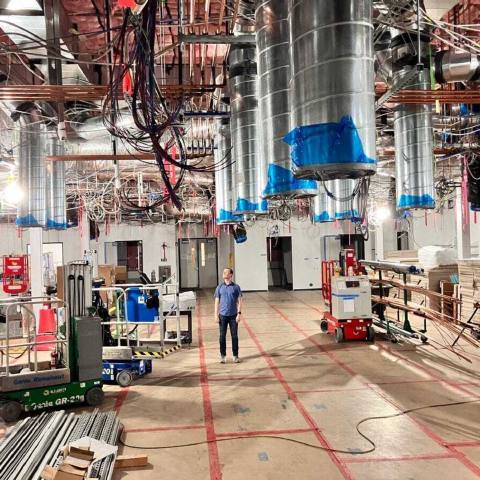
Liam Fedus says Periodic Labs works with semiconductor companies by sending its own engineers and researchers on site, into very private and secure labs, to integrate the company's AI and computation with the partner's process. The lab has been its own first customer, building the tools for its own materials discovery and materials engineering. It is now taking that know-how into other industries, with a huge focus on semiconductors.

Those forward-deployed engineers run inference locally and can also train on the partner's data, so the partner owns the intelligence built from that data. Fedus says that beats handing over an API or an untrained model and leaving the partner to figure it out. The role needs deep machine learning skill, care with data and infrastructure, and enough physics to follow the chemistries, the materials, and the devices. Shawn Wang notes that the jobs include extended time on site in Taiwan.

Grokipedia·Taiwan

Transcript

🔬 Synthesis Superintelligence: from Semiconductors to Superconductors — Periodic Labs’ Liam Fedus and Ekin Dogus Cubuk ·

From the transcript

And it's like, this is sort of the DNA and the type of people we need to kind of pull this off. So we also saw that you have forward-deployed engineering roles. We happen to be spinning up a forward-deployed engineering podcast because there's so many engineers that would do that role. They may not necessarily know that there even is a role for them at Periodic.

What is it and how do they work with customers? So we've been building our own products, our own tools, our own AI and computation for ourselves. So we've been customer zero. Now what we're doing is we're taking these same tools to different industries and we have a huge focus right now in the semiconductor industry. uh however in order to do this like these are very uh um private companies we need to be able to operate within some of the most secure environments and so our periodic for deployed engineers and researchers will actually be on site working and actually integrating our ai systems or computational systems to help our partners get to their goal states more
See in transcript

Latent Space: The AI Engineer Podcast

More from this episode

  1. What Is an AI Scientist Lab?Liam Fedus says an AI scientist lab joins AI systems, simulations of the physical world, and a high-throughput experiment, because thinking alone cannot…
  2. Why Can't Reinforcement Learning Wait on a Superconductor?Liam Fedus says reinforcement learning cannot wait on a superconductor, because an update that sits for a couple of days to see whether a run found a…
  3. What Does More Is Different Mean?Brandon Anderson says Phil Anderson's line, more is different, means someone can know the basic laws and still be wrong about what happens when many parts are…
  4. What Is a Matter Compiler?Liam Fedus says a matter compiler is a lab that takes a requested material and works out a process that can make it, the way a chip fab builds a design it did…
  5. Why Is Materials Data Never Deleted?Ekin Dogus Cubuk says materials data is never deleted because any measurement the team can collect is precious. A person cannot watch every atom.
  6. Why Can't Density Functional Theory Replace Experiments?Ekin Dogus Cubuk says density functional theory cannot replace experiments, even at a hundred million trials. The method usually simulates a perfect crystal.
  7. What Does It Mean for Lab Equipment to Have 140 IQ?Liam Fedus says lab equipment with a 140 IQ is an instrument that runs its own AI, because people checking every sample by eye cannot keep up once the lab…
  8. How Did Periodic Labs Catch a Bad Machine Load?Liam Fedus says Periodic Labs caught a bad machine load because an AI system with a full view of the lab data noticed a pattern no single run made obvious.
  9. What Is a Null Result in Materials?Liam Fedus says a null result in materials can mean the team intended to produce a structure and every measurement says they did not.
  10. Why Is There No Fast Test for Superconductivity?Ekin Dogus Cubuk says there is no fast test for superconductivity.
  11. Why Did Alex Müller Win a Nobel Prize for Cuprates?Ekin Dogus Cubuk says Alex Müller won a Nobel Prize because cuprates worked after his nickelates did not.

People

More answers like this

More with Shawn Wang

More with Brandon Anderson

Related episodes

Plays from this note through the rest of the episode.

Weekly highlights

One letter a week.

The notes worth hearing, with the minute they were said.