Smash Notes

Back to 🔬 Synthesis Superintelligence: from Semiconductors to Superconductors — Periodic Labs’ Liam Fedus and Ekin Dogus Cubuk, with Liam Fedus & Ekin Dogus Cubuk.

What Is an AI Scientist Lab?

Liam Fedus · Ekin Dogus Cubuk · Shawn Wang · Brandon Anderson

Liam Fedus says an AI scientist lab joins AI systems, simulations of the physical world, and a high-throughput experiment, because thinking alone cannot create new knowledge. The universe is too complicated for a person to reread the textbook, disappear into a room, and think through every experimental outcome, the expected ones and the unexpected ones. A conjecture has to be checked against what the experiment actually does.

Periodic Labs was built around that loop. The model, the simulation, and the physical lab were in the plan from the start. A different kind of intelligence emerges when those three sit in one place, instead of a digital setup that only optimizes against answers already written down in papers.

Transcript

🔬 Synthesis Superintelligence: from Semiconductors to Superconductors — Periodic Labs’ Liam Fedus and Ekin Dogus Cubuk ·

From the transcript

It seems so straightforward, but why is it non-obvious? Okay. I think that's sort of the thesis and premise behind Periodic that Doja and I thought when we were building this, which is you can't just think your way to a solution. The universe is so complicated that in order to actually push the frontier of knowledge and to make progress, you need to create these conjectures and then actually see whether or not it holds.

No amount of rereading that textbook or paper and just thinking and disappearing into a room is going to allow you to think through all possible... experimental outcomes, expected and unexpected. And you really need this like iterative process. And that's our core belief for putting this together. And that's why from the very beginning, we're like, we need to have the AI systems, the simulations of the physical world, but then also to build up the physical high throughput experiment.
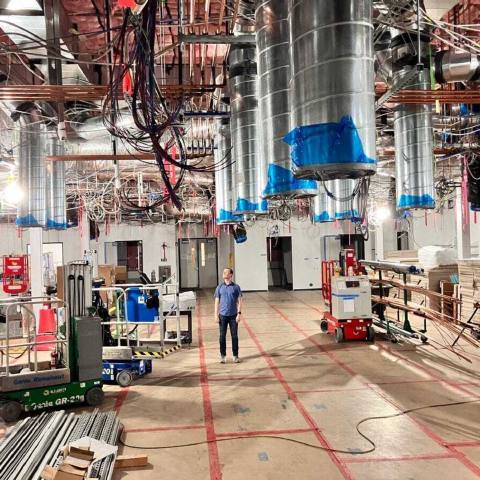
See in transcript

Latent Space: The AI Engineer Podcast

More from this episode

  1. Why Can't Reinforcement Learning Wait on a Superconductor?Liam Fedus says reinforcement learning cannot wait on a superconductor, because an update that sits for a couple of days to see whether a run found a…
  2. What Does More Is Different Mean?Brandon Anderson says Phil Anderson's line, more is different, means someone can know the basic laws and still be wrong about what happens when many parts are…
  3. What Is a Matter Compiler?Liam Fedus says a matter compiler is a lab that takes a requested material and works out a process that can make it, the way a chip fab builds a design it did…
  4. Why Is Materials Data Never Deleted?Ekin Dogus Cubuk says materials data is never deleted because any measurement the team can collect is precious. A person cannot watch every atom.
  5. Why Can't Density Functional Theory Replace Experiments?Ekin Dogus Cubuk says density functional theory cannot replace experiments, even at a hundred million trials. The method usually simulates a perfect crystal.
  6. What Does It Mean for Lab Equipment to Have 140 IQ?Liam Fedus says lab equipment with a 140 IQ is an instrument that runs its own AI, because people checking every sample by eye cannot keep up once the lab…
  7. How Did Periodic Labs Catch a Bad Machine Load?Liam Fedus says Periodic Labs caught a bad machine load because an AI system with a full view of the lab data noticed a pattern no single run made obvious.
  8. What Is a Null Result in Materials?Liam Fedus says a null result in materials can mean the team intended to produce a structure and every measurement says they did not.
  9. Why Is There No Fast Test for Superconductivity?Ekin Dogus Cubuk says there is no fast test for superconductivity.
  10. How Does Periodic Labs Work With Semiconductor Companies?Liam Fedus says Periodic Labs works with semiconductor companies by sending its own engineers and researchers on site, into very private and secure labs, to…
  11. Why Did Alex Müller Win a Nobel Prize for Cuprates?Ekin Dogus Cubuk says Alex Müller won a Nobel Prize because cuprates worked after his nickelates did not.

People

More answers like this

More with Shawn Wang

More with Brandon Anderson

Related episodes

Plays from this note through the rest of the episode.

Weekly highlights

One letter a week.

The notes worth hearing, with the minute they were said.