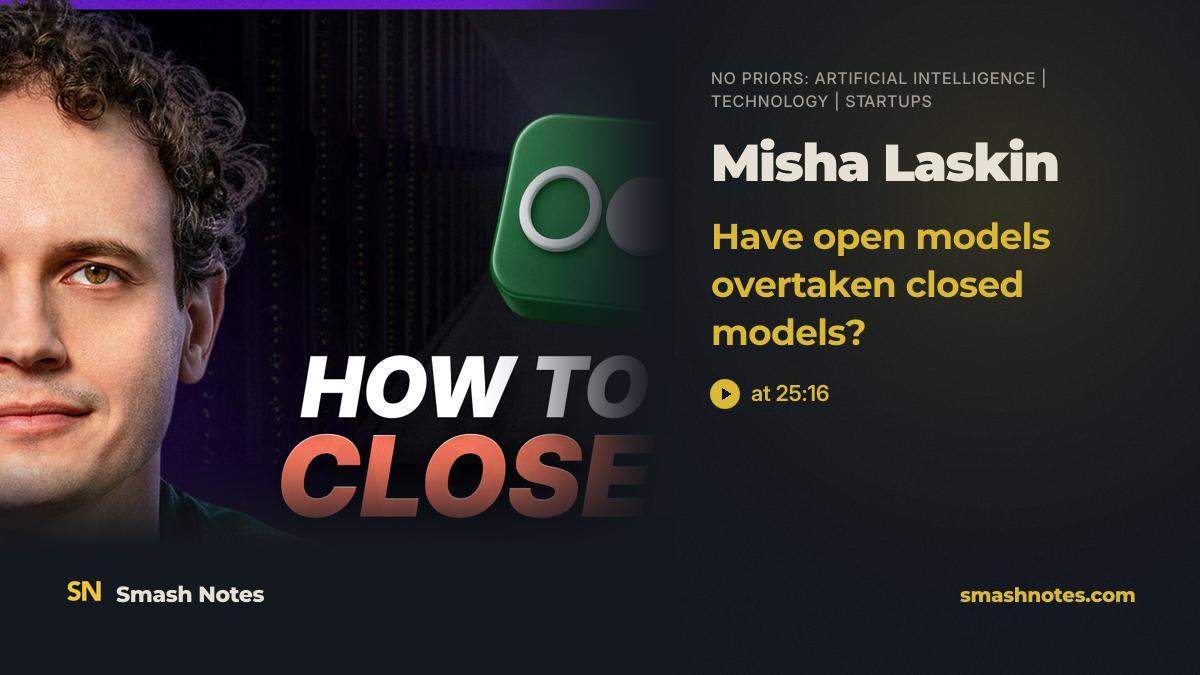
Beam: The Great American Open Model with ReflectionAI Co-Founder and CEO Misha Laskin
Is the future of frontier AI open or closed? ReflectionAI co-founder and CEO Misha Laskin joins Sarah Guo and Elad Gil to discuss the launch of Beam, the company’s 500 billion parameter open-weight reasoning model. Misha breaks down the pre-training and reinforcement learning required to produce Beam’s reasoning efficiency, the shift in enterprise compute…
Notes
-
-
-
How Was the Open Model Beam Trained? at 12:21
-
-
-
-
-
-
Why Is Openness Safer for AI? at 45:43
-
Can a PhD Take a Week With AI? at 56:28
-
How Does Beam Choose Its Next Training Bets? at 1:01:02
-
Related notes
- How Did OpenAI Get So Many Math Results So Fast?
- Why Does Ben Affleck Call the Slowdown a Cartel?
- How Fast Did AlphaZero Overtake Two Years of AlphaGo?
- Are Chinese Open AI Models a Gift to American Startups?
- Why Are Open AI Model Builders Six Months Ahead?
- Should Cybersecurity AI Models Be Open Source?
Related episodes
-
![]() Taking on ServiceNow: Coding Agents the Rest of Us with Serval Co-Founder and CEO Jake Stauch
-
![]() The Changing Physics of Cybersecurity and Drug Development with OpenAI President Greg Brockman
-
![]() The New Apex Predator: CrowdStrike CEO George Kurtz on Adversaries Armed With AI Agents
-
![]() Democratizing Security for the Agentic Web with Cloudflare CTO Dane Knecht
-
![]() Frontier Chips for Frontier AI Labs, with Walter Goodwin, Founder/CEO of Fractile
-
![]() Investor Elad Gil’s next moves
-
![]() Big Tech’s $3T AI Bet, Claude Writes 90% of Anthropic’s Code, AIs Editing AI Brains | EP #308
-
![]() Jensen Huang | Does AI Revenue Justify Capex, '27 AI Bottlenecks, Singularity, Open vs Closed & more


Full transcript
The episode notes above make this conversation easy to skim.
0:00
When you remove cyber offensive capabilities, you also remove cyber defensive capabilities. The state of the world today is that we have a few hundred safety researchers within closed labs that understand how these things work. And despite their best intentions, it's impossible to cover the long tail of unintended consequences that these systems might have.
0:17
A very powerful closed model went and like hacked into another company. And the only way that company could remediate itself was by using open models to protect itself. That's the empirical evidence of the world that we're in. Linus' law, with enough eyeballs, all bugs become shallow. I have the belief that with enough eyeballs, most security and safety vulnerabilities become shallow as well.
0:42
Today, we're joined by Misha Laskin, the co-founder and CEO of Reflection AI. Reflection provides open-weight models to power the future of intelligence. Misha Pryor was a researcher at Google DeepMind and received his PhD in physics. Welcome to KnowPryors. Great to have you here today. Yeah, it's great to be here. Thanks for having me. Could you give us an update on where things are at? I mean, obviously, you guys have been pioneering really interesting work in open-weights and open-source models, particularly with the U.S.
1:08
bent. Can you talk a bit about what you've been up to and what you guys have been building? So for the last 12 months, we set the mission of the company to build frontier open intelligence and make it widely accessible. And effectively, it's been a sprint to set up a lab that is capable of doing such things.
1:30
It kind of feels like... Maybe there's a Reid Hoffman quote that, you know, you're assembling a plane as you're flying it. And that's been the case. We were maybe around 30 people about a year ago. But it does take an order of 100 plus. So, you know, a couple hundred researchers and engineers to build one of these things, like a true rocket ship project.
1:50
We're now at around 300 people and assembled all the teams on pre-training, mid-training, reinforcement learning, scaled up, trained our first models end-to-end, and just released a model called Beam, which is Reflections' first open model. What has been the most challenging part of that? Because when people talk about scale or scaling up models or starting to build these models out, one issue is compute and procuring enough compute, particularly a training cluster that's cohesive in terms of the ability to use it.
2:22
Second is talent, and obviously there's been these huge talent wars in terms of how much people will pay for researchers, et cetera. Third is scale of data. Which of those has been the most limiting or the most challenging? What's been interesting about this experience is that I got asked this question at all hands at the company, what's been the hardest thing in last year? And the reality is that everything is extremely hard.
2:50
Everything has been hard. And it's also sometimes people might ask, well, what's the thing that really made your models work? Is it better than others or something like this? And Again, the answer is everything. You actually have to get 30 things right, and that's why everything is hard, because you have to get 30 things right. You have to get the talent.
3:13
You have to retain the talent. You have to have a strong mission and culture that keeps the talent working together and rowing in the same boat. You have to get the data. You have to get the compute. You have to build the infrastructure to ensure that the compute is actually usable. And a lot of these things, when you're at an existing big lab, there have been years of build-out that enabled them to have this kind of stable surface.
3:38
So I was at DeepMind before this, and a lot of the tools that we just take for granted, or I took for granted as a researcher because they just worked, you have to build. So I would say, yeah, everything has been hard, but also very rewarding that you can do it. Can you talk a little bit, you said about a year ago, you guys really committed to do this.
4:00
Can you talk about the sort of shift in ambition and commitment and what drove that? When we started the company about two and a half years ago, our bet was, so maybe I'll contextualize it, where the world was then. My co-founder, Yanis, and I had been working on the first series of Gemini models. We were working on the reinforcement learning team.
4:21
Yanis was leading it. And we had just shipped the Gemini 1 and 1.5 model. And that was, you know, that early era that was like similar to the first chat GPT experience, which was primarily a chat experience. There was no coding really, nothing agentic. These models were just good at chat. And they were primarily, you know, 95% of the compute spent was spent on pre-training.
4:46
So they're primarily pre-trained models. uh... we're reinforcing researchers that's been our lineage uh... yannis michael founder was one of the founding engineers a deep mind and uh... was key contributor to all the big are all projects that came out of that mom including alpha go and are bad was because we're working on the RLT and we saw it URL for aligning on chat models works you know there's only so much you can align them right well now there's a lot more ahead you know that their agents but at the time there is chat so RL was working, and we just thought that, well, if you take that and apply it to domains where, like mathematics, coding, that you could make these
5:33
systems agentic. That was the big bet. And we thought that you could do this as an independent lab much more capital efficiently because we started seeing open source, open models materialize. There was a Small model from Mistral at the time. Llama 2 had just released and we saw Llama 3 coming. This feels like ages ago. Yeah, this was a while back.
5:58
I guess two years ago. And we thought that there would be a great open model base that someone would build that we could build on and do our research and scale reinforcement learning. And over that first year of the company, what ended up happening was that, one, reinforcement learning started working faster than we thought it would, both within our experiments, but also within industry.
6:22
01 came out at that time. We actually thought it would take longer, just because the journey from ImageNet in 2012 to RL Systems that worked at scale was about four years. So we thought maybe something similar, but every year moves faster than uh than my prediction the previous year uh and so about a year into the company we got to the point where they're actually like all the good open models are coming from from china they were not really good uh you know western open models and we needed one as a base for kind of the technology that we were building uh and decided for a number of reasons um that The most impactful thing we could do, given the state of play, was to just
7:09
build open models ourselves end-to-end and combine the RL bet together with just building models end-to-end. I guess there were enterprise reasons, there were geopolitical reasons happening, but also there was the research reason that it turned out you actually do need to pre-train your model in order to make reinforcement learning work very well at scale.
7:30
So you actually kind of do need to do, the things are just so tightly coupled that you do need to do both. The conventional wisdom has been that pre-training at the scale of the frontier is impossibly expensive, or at least extraordinarily so. Clearly, there's been a huge shift of compute toward post-training. Feel free not to answer this, and we can just cut it.
7:53
But how did you think about just the resources needed or the ratio, or did you have design principles around the model that made this feel tenable to you at the beginning, or did you just say, we need to do this, we'll go resource it? Well, the nice thing about being an open model lab is that you can also talk about things openly. So you do need a lot of resources to build something meaningful.
8:17
You don't need the same amount of resources. Once you get to the frontier and you're really, really at the frontier of intelligence, then you need the same amount of resources as any other frontier lab because you can kind of think about research as exploration of new ideas versus execution of known ideas. Mm-hmm. Part of why getting great talent matters a lot is because you get to cut down on exploration and then you can focus on execution of the things that work.
8:48
So all this is to say is that if you are catching up to the frontier, you can do it a lot more capital efficiently. How much capital do you think it would take to catch up to the frontier? Well, I think that it depends. The frontier keeps moving. So each year, it's actually more capital. And I'll get back to the question on the resourcing between, let's say, pre-training and post-training.
9:08
I would say that a year ago, or maybe 18 months ago, it would have been, and I say orders, meaning that order of 100 million, so hundreds of millions of dollars. I think that now, or let's say even six months ago, is probably order billion, so billions of dollars, single-digit billions.
9:27
Going into next year, I think order 10, you know, you can kind of think about it as for every generation of model, there's a 4x multiplier in compute, roughly. And one heuristic that I have is like
9:41
when, let's say like we talk about like the chips that are currently considered, you know, the ones that, you know, a frontier chip and maybe a couple of years ago was an H100 chip. And maybe it was 100,000 H100s. Then, you know, Astra, right, was trained. And that was just a big run, right, on 100,000 Blackwells, which is roughly a 4x multiplier on an H100.
10:01
Now the next generation is going to be around 100,000 Vera Rubins, I believe. So that kind of gives you the scale and it moves from hundreds of millions to billions to tens of billions. Yeah. It seems like at some point that has to asymptote then because ultimately relative to revenue scale of these companies, even potential revenue scale, you start to tap out in terms of the ability to invest against what you're actually going to produce from an economic value perspective.
10:23
Absolutely. So do you think we're heading into that asymptote in terms of model size or at least training cluster size? Absolutely. I think that in terms of, you know, there's only so much CapEx that you can do, right? And Frontier Labs are now putting hundreds of billions of dollars into it. So will they be putting trillions of dollars, you know, in the next year or two? I It's probably unlikely, but there are a couple of things that are happening.
10:50
One is that the use of that compute is becoming a lot more efficient because the models are themselves becoming tools that help build themselves. So I think that when it was just human researchers doing the work, there's probably a 7x improvement each year and you can actually track these things very technically and in pre-training you do it by you know you have your pre-training loss and then you measure you know your compute efficiency gains against you know you made some changes now you have a new pre-training loss and it should be you got to the same point with less compute and so when you say 7x it's actually a very concrete thing that you're studying.
11:29
uh and now i would say across the systems of you know i mean pre-training is probably a bit more hardened but there's a lot of um a lot of headroom and reinforcement learning we're probably at a point where it's you know 30x like efficiency depending how good your model is for actually improving itself so that is one thing that's happening 30x per year or over what Yeah, something like that, yeah.
11:52
I mean, it depends on, you know, what metric it is, but it roughly, I do think that the SPI is probably four or more times faster than researchers just doing it alone, and they'll probably accelerate. So the amount of intelligence you can extract per training flop is increasing. So at some point, that asymptote is okay. And then also, like, the amount of revenue that each flop can generate also increases, right, the more you pack intelligence.
12:20
So... going back to the question around how does this distribute across pre-training and reinforcement learning and to train beam which is a 500 billion parameter model total 23b active it was 6 000 uh gb 300s we ran it i think for for a few weeks but now you know like with infrastructure efficiencies we can do it in about 12 days maybe less so right it's a coupling of scientific and infrastructure efficiencies Reinforcement learning was a little over 10,000 GB300s for four weeks.
12:55
So actually there were more flops spent on reinforcement learning. Reinforcement learning jobs are more complex in the sense that you do both a lot of inference at scale with all sorts of sandboxes for agents and training.
13:10
This actually, the reason I got into AI was I saw my co-founder's work on AlphaGo. And I was a physicist at the time. And there was a moment, like there was a plot in AlphaGo where it just never stopped improving, right? It just kept improving. And they just cut it off at some point because what's the point of improving it further? You already beat the world champion.
13:31
Yeah. And I thought that, well, if you figure out how to apply that recipe to stuff that is economically valuable, then, well, at that point, it becomes an economic question of how much money do I want to put in to just keep improving the system. And we as a field are there. And one of the things that I'm really excited about in this open source project and the tech report that we'll have in it is that we'll describe how these things are built.
13:56
Indeed, this reinforcement learning system never stopped learning. If you look at our plots, they just keep going up. It's just a matter of compute basically in terms of scaling it further. That is to say, we as a field are there where you have these RL systems that are very general that don't really stop improving. You want to make them a lot more efficient to extract the most intelligence from your compute.
14:19
But that means that you move from a question of can you train these things to where can you get the data and what is economically valuable? And it's just an economics decision of how much money do I put into X to get some kind of improvement out of it, which is incredible. This was not true two years ago. What can you share about where you've already decided we should turn the crank in terms of just continuing to invest in capability? this is almost to some kind of dissatisfaction to some scientists and that it's moved.
14:53
I mean, it is a science, but it's, you know, I would say feels more of an engineering discipline. Like it seems more like a,
15:01
Again, the rocket ship analogy and the way that building rockets is a science, but most people think about it as an engineering discipline with some scientific work in it. And that's roughly how it feels. So the stages are kind of set in that the axes of scaling are today. And now there might be something kind of totally blue ocean that we don't know.
15:22
And there's some new labs exploring it, but it's...
15:26
pre-training, synthetic data, reinforcement learning. Or in some sense you can say just training and reinforcement learning. And there are architectural improvements that can be made, there are data improvements, algorithmic improvements, but
15:44
It doesn't feel like a Wild West the way I felt five years ago or something. Something that was kind of beautiful about both Think DeepMind and Google Brain, and even if you look at early open AIs, how diverse the bets were, and people were doing just crazy fun stuff. And now it's really narrowed in. And part of it, there's also a bit of a hardware lottery kind of thing, because once something starts working, the hardware also starts co-optimizing against it.
16:12
And so it's harder to find, even if you have a great new idea, if it's not really a good fit for the hardware.
16:19
It doesn't make sense. So to answer your question,
16:23
I don't see, there hasn't been an asymptote of how much juice you can get out of better pre-training. We're not seeing a slowdown in compute efficiency gains. You keep seeing stuff. There's a lot of headroom in reinforcement learning. I think that that one is probably
16:39
There's a lot of stuff to be discovered there, but again, it feels more like an engineering discovery than groundbreaking understanding of a new science or something like this. And you mentioned investing against some economic activity or some productivity out of this that then allows you to keep going from a capital, et cetera, perspective.
17:01
I know, for example, Anthropic placed a pretty early bet on code. OpenAI kind of did that too. They originally had a coding model that they're working with GitHub Copilot on. And then they obviously diversified into consumer and other areas.
17:16
Are there specific application areas that you all are most focused on from the perspective of economic value creation? Is it code and agentic workflows? Is it something else? Because that seems to be the basis for a lot. I'm just curious if there's a hypothesis on where your model will be used the most or where you need to direct it most.
17:31
Yeah. I think the code and agentic stuff sets a foundation for the intelligence. The intelligence is
17:41
interesting. It's jagged in the sense that one, it's generalized in a surprising way. I was surprised by
17:52
how quickly our model got to a level of capability that
17:57
is fairly fresh and recent, that other labs are discovering not so long ago. And so there is some kind of stitching, like generalization happening. At the same time, it is somewhat jagged where it quickly adapts to data once you have the right data for tasks you want to do. But there is a jaggedness about it. It's even between the various benchmarks, the various versions of terminal bench.
18:27
You don't see clean generalization between different harnesses. But once you have something working, you have the general agentic capability, and you get the data for a new harness, it actually starts adapting to it pretty quickly. So what that means is that you have this like pretty adaptive thing that you need to, and then it's a matter of like, where are the economically valuable pools of data? That's, I mean, part of what makes open models, I think, powerful is that both enterprises and customers can take it and customize it for their own stuff and get something that is kind of Pareto optimal for their workloads, like the lowest cost for the highest performance.
19:04
And so it's an empirical question. You go to kind of customers, you actually see what is valuable to them and you see like whether it's possible to, and usually when it's economically valuable, like you can generate data because you're, It's not even that you're going to be training on the customer's data. It's more that you're setting up evaluations.
19:24
And if you can set up a good evaluation for their tasks, then you can generate synthetic data that are approximated and you get good generalization. And so concretely, finance, like various know your customer flows and compliance flows in finance are very valuable things. A lot of things, different things in cybersecurity, cyber defense in particular, are quite valuable.
19:44
Legal, like there are all sorts of kind of like agentic verticals like within enterprise that are valuable and have a pretty similar pattern in terms of how you get something working there. One thing that stands out on Beam is the reasoning efficiency of the model. Could you tell us a little bit more about that? So Beam is, so it's a model, right, that was trained for coding and agentic tasks.
20:05
That's where it excels. And an important thing in model building is not just the capability, but how quickly an agent achieves a thing. So it translates to faster workload times, cheaper costs for customers. If you've ever sat around a
20:21
your favorite AI chat and ask it something and took it 10 minutes. Much better if it does it in one. So Beam tends to be three to four times more efficient than models of the same capability class and
20:37
much more efficient when it comes to, there are models that are larger out there.
20:43
where the efficiency gains then end up being something like 10x. And the reason it's so efficient is because we prioritized both a strong pre-training base for reasoning, but then amplified it with reinforcement learning what we believe to be the largest scale it's ever been done in open source. I've not seen a 10,000 GB 300 for four weeks run documented yet.
21:11
And reinforcement learning, the way you tend to set it up is that you want to extract the maximum amount of capability in the least amount of time. And this is the same thing that happened in the previous systems like AlphaGo. The first AlphaGo agents were pretty, you know, meandering in the way that they were solving the problem. And then by the time you got it to Lee Sedol level, it was just very smart in its
21:37
search. So that's really what enabled it to have that capability. So the more reinforcement learning you run, the higher the capability and the faster these systems solve it. Awesome. That seems very pragmatic. The intention, I guess because we are kind of RL believers, and so we always believed that that was the path to AGI was, you know, through reinforcement learning with actually a really strong base.
22:05
We forget that the first AlphaGo systems had, they were trained on expert amateur human games. So they did this imitation learning first and then reinforcement learning. Mm-hmm. So you kind of need those things working together. And a byproduct of it is that you get this really economically kind of valuable thing that it's very reasoning efficient and makes a really nice workhorse model for enterprises and
22:35
public sector sovereign. And from a monetization perspective, what is the, there's different ways to commercialize both open source and open weight models and Mistral and others were early in terms of different, different, uh, approaches to doing so. Is there a specific direction that you all have been heading and that you can share? Yeah, I think that commercialization of, let's say, open and closed models is in some sense pretty similar.
23:00
What you're really trying to do is you're trying to maximize inference. That's really what you're trying to do. And the difference is that
23:07
It's basically like rental versus ownership inference. So an example is that when you're buying a token, you're renting like a piece of a whole stack, which is the harness. If it's, you know, like if there's an agentic harness in there, the model, the
23:23
It's inference software, the cluster management software, the GPUs that it's running on, and all of that is sort of like amortized into a token, and you're renting a piece of that whole thing. When you want to own your intelligence for a number of reasons, and I liken it to we start typically off renting our apartments, but then as you grow up, you want to own a house for various reasons, even if it's a bit of a headache, right? I mean, it can be.
23:49
Yeah. uh but you know as you get to a point where you know you're financially mature enough and you have a family and so forth you want to you want to own it and uh ai has matured as a commercial like in a commercial market to the point where enterprises are spending a lot of money on renting their intelligence and then want to start owning it for various various you know reasons around control and so going back to monetization like what's the difference between a closed and open model well The open model is permissive, but in order for a customer to make use of it, they need all the other stuff that went around it.
24:24
Like the stuff that you kind of take for granted from a closed model, you need the cluster management software, you need the inference software, you need the harness and so forth. And so we provide to large enterprises, sovereigns, all the tools that they need to make open model deployment successful. And even when we think about services is because a lot of enterprises, most enterprises need some handholding on this.
24:49
We think about services is how do we go in, unlock really valuable use cases that drive a lot of compute demand, right, inference demand. And in a sense, services and open model is like a demand driver for a much, you know, for an inference business. What do you think, I won't ask you to project too far because it's just very hard, but over a one or two year time horizon, the mixes of tokens that is open versus closed? Well, I think you're kind of starting to see the trajectory now, which is that maybe six months ago, it was majority closed, minority open when you go to any gateway like OpenRouter or Vercel.
25:27
And it's flipped almost exactly from 70-30 closed open to 70-30 open close now. I think that's only going to accelerate. And I suspect that the world is going to look not too dissimilar from
25:43
operating systems where 95% plus of servers, computers in the world run on an open source operating system like Linux. That doesn't mean that the closed stuff is very valuable. Microsoft and Apple, these are extremely valuable companies. So
26:01
the market for this stuff is really big. So I think that we'll see most token demand going to open. A big difference here is that I think we'll also see a lot of economic value going to open simply because even if the model is
26:19
fully permissive or perhaps has a license on it, everything else you need to run it is still expensive. The compute is still expensive. So you're in a different world than
26:31
hardware accelerators like GPUs and others, it's a more expensive compute substrate than CPUs, right? And so you have a different kind of cloud that needs to be built around it. So I expect majority of tokens to be going to open source, extremely valuable closed model companies to exist, a valuable ecosystem of open model companies and various distributors around them to exist as well.
26:59
Do you have a sense of what proportion of the open tokens are RL'd versus not, versus sort of base model? I think every single like open model that's out there at this point has been RL'd to some extent. Oh, yeah. But I mean, for a specific use case or application. Yeah. In a custom model. Yeah. So I think that what I've heard kind of statistics that, you know, some of like the kind of open model dedicated inference providers say is that It's actually vast majority, 90% plus customized.
27:29
But there's a caveat there because today, the biggest customers of dedicated inference are AI natives and maybe digital natives who have a whole product that is just one big customization of an open model. You know, like a Cursor or, you know, Cognition, Average Harvey, like these kinds of companies that have a product that's built around something that's big and customized.
27:53
So that would make sense then, well, if you're supporting those workloads, the majority of them would be fine-tuned. I actually have a different take of what's going to happen in enterprise. I think that the majority of enterprise token consumption is going to come not from customized models, but from customized systems. Meaning you took an open model, you didn't actually fine tune it yet.
28:17
You just customized a system around it, like your agentic harness around it to make it work for some KYC flow or something like that. And then once you're sophisticated enough, you might start fine-tuning and moving to that. But I actually think that in enterprise, it
28:35
will be kind of reversed in the sense that the journey that AI natives went through, which was start with a closed model, then move to an open model, then customize it. They went through it very quickly because they set up native products that are data collectors. Enterprises are mostly architecting this around their existing products and existing tools.
28:55
And I think that there are a lot of frictions there to just do a straight shot to fine-tuning. So in enterprise's perspective, it'll be a bit different. And do you think they'll still start with state-of-the-art models or the closed models and then they'll move over, but the harness will be the mechanism by which they customize the open model? that has been our observation that the point at which an enterprise is considering open models and a lot of and most the enterprise we talked to are considering now is uh by time they've ramped up some significant workloads with closed models uh and right it's uh i have not seen kind of a basically straight shot kind of sprint to an
29:33
owner ship market but it's you have to go through the rental stage to become a big enough cost driver for your enterprise. And then you say, how do I cut costs? And this is valuable enough for me to keep it. And so then I switch over. Yeah. If you're spending, let's say, $100 million plus, which is not uncommon at all on closed models a year, then you start thinking about, well,
29:53
you know, maybe I should figure out like a more optimal way to do this. And I think there's an interesting resurgence of on-prem in the sense of also because there's a compute shortage. And so it sometimes becomes, if you're an enterprise and you're consuming from
30:11
your favorite hyperscaler. Very often, there's just not enough compute. It's hard to get good rates there. But you're spending so much money, so you might go with an infrastructure provider like Dell and say, I just want to set up the bare metal, but I want to serve stuff into my enterprise. And then, well, what happens then? Who helps them with that layer between the bare metal and actually making them successful? And you view that as your role in the open model world? yes yeah so i mean we view our role as enabling enterprises to build successful solutions so it is very it is solutions driven in the sense that the thing that enabled uh ai natives to adopt uh open models
30:54
well it's building their own solution but enterprises just need more more help there and so it's really around going in assessing what are the biggest value things you can do there and A lot of these enterprises can go, like they might have built, you know, an agent that spans, you know, hundreds of millions of customers on closed models that they really want to scale out.
31:20
And so the scaling factor is very high. It's very hard to go in and just say, we're going to give you inference. I have not heard that word. That has not worked, you know. The closed model.
31:33
Model ecosystem is a competitive one. It looks increasingly like the open model ecosystem will also be. What do you, I mean, tell me if you disagree with that. No, I agree. It's all very competitive. Yeah. I mean, large markets tend to be. What do you think are the important dimensions of competition when you think about yourselves and like how you position in the long run? Yeah, well, I have kind of a pretty simple formula for, you know, ultimately the way anyone wins in this is by, well, it's how much revenue, right? How much durable revenue are you generating? And the formula is
32:07
what intelligence density are you able to offer times how much compute do you have times how much trust do you have with organizations that they would want to work with you? Basically, how good are you at solving their problems? And because something that's interesting about this market that maybe you all know more, more than I do, I actually, you know, the previous markets in terms of what we're limiting factors, but compute is scarce.
32:32
So there are, you know, a lot of things that previously were, and maybe this is a temporary thing, but I don't see this as being a temporary thing for some time, uh,
32:42
So in previous competitive instances, you might say, oh, these few players are all undifferentiated. But then it turns out, if you're really good and you have the compute, that it's OK. I mean, I see the whole space being competitive across the whole stack.
33:02
you know there are arguments around well this part is getting commoditized and that part is getting commoditized in reality everything is getting commoditized like everything across the whole stack is so hyper competitive that it's getting commoditized and the model margins are going to be compressed right there is an open model tension right with uh with closed models it does i think does lead to a margin compression the application stuff margins compress the you know inference layer and the bare metal so We see a lot of the AI-native companies negotiate their closed deals very aggressively because the open ecosystem exists.
33:37
So it's explicitly true. So I think that for any one of these companies, and you can think about any even AI-native company as what is the intelligence density that they serve to customers, how much compute do they have, and how much trust do they have with those customers because they're driving successful solutions for them.
33:57
Which means that if those are the three factors, then
34:01
so long as there are great open models, so long as you have great intelligence density out there that is accessible, there should be many successful companies. Because then it's a matter of how much compute can each one, you know... assemble. Now, we are actually in a world where when you're a great kind of intelligence builder and you're able to, and this is kind of what's happened with the closed companies, that your revenue really shoots up and you're just able to amass more compute than anyone else, then that puts you in a strategic position.
34:32
But that is what I think is required to win. You have to serve great intelligence, have a lot of compute, and have trusted customers. Yeah. How do you think about, so if you look at the era that you mentioned at the very beginning of this conversation, two years ago, a lot of the open weights or open source models were Western in origin. So Mistral was developed in Europe, obviously Meta was a mix of Europe and the US.
34:55
And what's happened over the last year or two is we've really seen the rise of Chinese open weight models. In some cases, there's the perspective that they've been distilling a lot off of the state of the art models. And so that's part of what's allowed them to make very rapid progress. The labs are now trying to now roll out or the big sort of closed labs are trying to roll out tools to prevent as much distillation from happening or at least making it more challenging.
35:17
What do you think happens over the next year or two in terms of Chinese open source or Chinese open weight models? Do you think it remains where it's at? Do you think it evolves? Like what happens? So I think the first thing is that the fact that a great open model ecosystem came from China is actually a massive benefit for the world. There are so many companies in the West that have been able to build more durable businesses as a result of that.
35:43
So there is a sense in which it's a very positive thing and a gift because you could imagine a world where such a thing didn't happen and then there were just no open models, right? And there's a kind of a tall poppy syndrome that happens when if you're an application builder and you build something that's great, well, then it gets subsumed into a closed model provider because, well, it's a business that needs to generate revenue.
36:06
So I view it as positively. The thing that is, the things that you don't want a world that is kind of...
36:18
like monopolar in any given way, right? That you either have all sort of resources and compute concentrating across
36:28
closed labs or like a handful, let's say. I think if it was like 10, 20 closed labs, then fine, you have a competitive ecosystem. But it's one or two, that's a bit scarier. And similarly, you don't want
36:41
the source of intelligence that everyone else can build on when they want to own it to be coming from one country. Ideally, it'd be also 10 or 20, but the capital expenditures are very high, so at least two would be great. And so I think it's extremely important that there's an ecosystem that competes with China in the West, but it's not really a West versus China thing.
37:07
It's more of a... If there was one country other than China where all the great open models are coming from, you'd probably also want some competitive tension. Competitive tension is just good. I think that the Chinese models will continue to be great. There is an advantage that they have in... They have a number of advantages and a number of disadvantages, but the advantages are...
37:33
They certainly distill closed models at industrial scale. That is true.
37:39
They have access to data that is much cheaper and free because you can just train on PDFs that are copyrighted in China. It's okay. Just different regulation.
37:56
And I think that and there is a notion in which those companies do have some state support, like whether directly or indirectly for, you know, like these, you know, these companies were not making any revenue for a long time. Yeah, I always thought the Chinese open source was basically a subsidy by the Chinese government to U.S. enterprise or to Western enterprise in terms of if you actually looked at what was happening.
38:15
Yeah, exactly. And I think that continues. I mean, now these businesses are like these companies are turning into businesses.
38:23
And, you know, they're while the models are open abroad. Right. They are within China. They're kind of the equivalents of the closed model labs here.
38:34
So like there are real businesses that are being built there. And I think that they'll. Continue building great models. Do you think they're going to keep them open here? In other words, why do that if you now have an economic driver and pattern? What do you think is the incentive for them to keep the models open in the West? In the West or in the- In the West.
38:52
Yeah, this is a really interesting question. So fundamentally, right, there is a lot of demand from enterprise public sector sovereign for
39:03
Western open models for a number of reasons. But there are kind of regulatory fears or uncertainty, rather. And it is the case that you want not just a model, but a partner that will help you kind of serve that model. So we have seen that most of Fortune 500, the open model footprint is actually pretty low today
39:27
because of sort of resistance or aversion to Chinese models for a number of reasons that are both, some are rational, some are irrational.
39:36
And so it's very clear that building those things is important. And so if you can sustain an economic engine that builds, well, one builds a lot of trust that the enterprise wants to work with you as the model builder.
39:51
And, you know, two, enables you to secure compute. Then, right, if there's a commercial engine around this stuff, then... Yes, I totally agree that having a Western open weights model that provides incremental services and potentially inference to other things over time is really valuable. And I know that that's the direction you all are heading in.
40:11
I'm just a little bit curious in terms of what is the incentive system for the Chinese model companies to continue to leave the models open. So the question is on the Chinese side. So I think there it's actually that my hypothesis on that is that
40:30
China is somewhat of a captive market that you can build open models and still make a lot of money in that market. Something that's interesting is that in the West there are I mean, there are great companies that don't build open models but serve them into various companies. I'm not really aware of that dynamic happening in China as much.
40:51
You'd think it would because that's the... Why not? So there's something interesting there where the... the open model providers are kind of the intelligence providers in that country. And I think that the continuing to release great open models is very geopolitically advantageous to China for a number of reasons. But one is that you want, you know, As a country, and this is for America and China and any other country that has the capabilities, that you want other countries building on your stuff.
41:20
There have been previous escalations or tensions between the US and China in 5G fiber layout and the Belt and Road Initiative.
41:30
Ultimately, when you go in and you provide something cheap to another country, it then gets locked into your infrastructure. there are just commercial and geopolitical advantages for that. I think it's almost like rare earth minerals or something. It's you have a component that other people will use for all sorts of purposes, and therefore you have geopolitical leverage through that.
41:49
yes so you know the one way I can think now is that open models are trojan horses for the infrastructure they bring in with them so you have an open model that data alone is not very useful so you buy into the entire software ecosystem infrastructure ecosystem a given country so that would be okay maybe today allied country US ally country X you know might run a Chinese model on American ships But pretty soon, if not, I mean, and we're seeing this already, is that, you know, Chinese companies like Huawei are going to be coming in and offering a full stack solution and then locking into, you know, to that country's supply.
42:28
So I think that if we kind of think about AI or like chips and data centers almost as like railroads or something like that, like, you know, it's kind of fundamental infrastructure.
42:42
But no other country can actually build their own railroads. They all have to go to you or another country. You have a lot of geopolitical leverage. I see. It could just be, for example, inferencing a specific model will occur in a more performant way on a specific chipset, and that chipset happens to be provided by Huawei or something. Yeah, so these stacks are in real time getting optimized end to end because in some sense the paradigm has been set, right? Like this is that there are going to be other ways to scale intelligence possibly, but this is clearly the first one that really scaled, so now everything's being optimized down the entire stack.
43:19
And where China has a disadvantage today where their chips aren't as performant,
43:25
They have an energy advantage, and they're very good. They're catching up on the chip side, too. And that's how they accelerate with the models, right, in terms of model usage to design next-generation chips and things like that. Yeah, certainly. And then I think there is the thing in terms of it is, again, geopolitically competitive with the United States specifically.
43:48
The notion of, you know, American companies and startups building on, you know, building on foreign technology, this notion that the rest of the world builds on your stuff. And by the way, America has done this with all other meaningful industries. technologies like internet, open protocols, open source, the world basically. American currency is like the widely established gold currency.
44:14
Free trade works because we have a navy that's everywhere. So that's been actually the American playbook for a long time. It's interesting that in this case,
44:24
I think the United States has been on the back foot when it comes to open source. No longer. Yeah. Well, I think we have to be clear. It's like the competitors in China are just really, really good. And so there's an ecosystem that is just starting to form now in the United States. But there is some catch up to be had. The biggest criticism from the closed labs of open models tends to be safety and controllability.
44:55
What's your philosophy on this? And is that like a legitimate concern? No, it's definitely a legitimate concern. And I think that, so I do think that the safety worldview that has been established has been established, you know, from one particular perspective with one particular point of view that has become almost kind of, you know, kind of dogmatic.
45:15
Like if we were looking at from first principles at AI before, you know, considering closed or open or what have you, this technology is getting built and you kind of had the foresight to know that, you know, it's going to have these capabilities and so forth. And you were thinking about safety, right? How would you actually design it from scratch? And there are, I mean, one way, one analogy to take it to is, well,
45:40
software, you can kind of think of AI as a more advanced version of software. It has many similarities, actually. It is a digital utility. And there were debates, by the way, around software being dangerous, particularly in the early 1990s, around strong encryption protocols. They were actually closed at the time, and there were debates between the NSA and kind of civil liberty advocates around whether you should close it or open it.
46:06
And ultimately, the decision after some catastrophic failures on the closed side where effectively a small handful of engineers designed certain systems that had unintended consequences that they couldn't predict and got easily hacked effectively, that strong encryption protocols became open. And that actually gave birth to the whole field of cybersecurity.
46:25
So the way the world, the default state of the world is actually it's openness is safety. That's a default state that we'd be going into AI with if we were just thinking about continuation of technology.
46:37
And models actually have a lot of similarities, but kind of exacerbated, to software in that the long tail of vulnerabilities is larger.
46:48
It's harder to understand in software because it's a black box and the long tail of vulnerabilities, and hence unintended consequences, is larger. And Linus' law, creator of Linux, is that with enough eyeballs, all bugs become shallow. And I have the belief that with enough eyeballs, most security and safety vulnerabilities become shallow as well.
47:09
So the state of the world today is that we have a few hundred safety researchers within closed labs that understand how these things work. And despite their best intentions, it is impossible to cover the long tail of vulnerabilities or unintended consequences that these systems might have, which is why The symptom of this is that when we actually look at what major cyber security issues have surfaced, well, it's that a very powerful closed model had unintended consequences where it went and hacked into another company.
47:42
And the only way that company could remediate itself was by using open models to protect itself. So that's the empirical evidence of the world that we're in. When you say safety, by the way, because I feel like people really conflate notions of safety. And safety means three or four different things to different people. There's safety in terms of cyber attacks or the use of AI for hacking or other things.
48:02
There's safety, and I think this tends to be overstated in the short run, around bioweaponry or... you know, terrorism and then there's sort of safety from the perspective of an existential threat to humanity. Um, and again, I feel like people kind of talk about these things as if they're one thing and each one of these are sort of separable.
48:17
So when you're talking about safety, are you addressing all three of those? Do you mainly mean, uh, and by the way, I don't necessarily agree that these are all like true things that are going to happen in any realistic timeframe. It's more just, I'm a little bit curious how you think about the, the span of things that benefit from openness and benefit from these approaches.
48:35
Yeah, I think on the safety spectrum, there's basically a spectrum of reality to, like empirical reality to theoretical scenarios. And I will grant that AI, there are sci-fi bits to it where something that was... totally a theoretical thing last year is like a reality which is like the cyber capabilities of these models for example so it's not to discount the theoretical stuff but we have to be clear that there's you know real empirical stuff that's happening and that we can predict you know with some you know confidence will be happening in the next six months and then there is like uh you know maximal theoretical stuff yeah i mean the the prior versions of that for
49:16
example would be the thought that the atmosphere would catch fire the first time we set off a nuclear weapon Yes. Right. So there's that theoretical fear. It didn't happen. But there was a lot of churn amongst a small subset of researchers in the physics community around that as an example. So there's been a lot of these theoretical things that could happen.
49:31
I remember there's also when people talk about nanotech, they used to talk about Grey Goop and how you'd accidentally release a nanobot and then suddenly it would eat the entire world. Like this was something that was discussed in the 90s in labs as people were working on, you know, microfluidics. Yeah, exactly. Things like that.
49:50
challenge with AI is that it's so top of mind and it's permeated in everyday culture, and it's so easy to humanize that
49:59
it's kind of, I think, it feels like there's, from a perception perspective, almost like a not even uniform distribution around what safety means, but it's actually like peaked at the doomsday scenarios. Whereas the reality is that there's probably like a, the service will peak to address is like the reality. And then there's a decay into, into the theoretical.
50:19
Um, but it doesn't help when, you know, when leaders of companies say like on the theoretical side, there's a 10% chance that we all die, you know, that, that, that doesn't help. It's not substantiated by any specific, right it's just kind of a made up number it is so I tend to have again like as a scientist distributional thinking which is kind of peaked at the reality and then okay like six months ahead definitely worried about you know misalignment like that these you know these like unintended consequences of the systems and then continue to get more powerful
50:57
but we have to take the perspective that these are These are engineered tools. I think that there is a certain class of companies or researchers who claim that things around consciousness or emotions and so forth, which is maybe true, but it's so hard to define what those things are in particular that it's unclear what it is. So I think that thinking about these as like intelligent tools and having like a yeah, just like a reality sort of spectrum and so while I think that the Theoretical doomsday stuff is good, you know dinner conversation the thing is like when we like let's say Alignment, right? That's a big part of safety.
51:43
How do you align these systems to behave in intended ways? and The reality is that alignment so far, the science of alignment, has been deeply boring and unsatisfying from a perspective. There's no magical alignment equation. It's like a whack-a-mole thing. If you remember the early models before chat GPT, there was some models released that were pre-trained and toxic.
52:09
And then there was this notion that, oh, these models are toxic, can't fix it because it can be toxic in so many ways. And then it turned out, No, with enough post-training data, you can just patch all those things, and it, like, generalizes in a way that it actually becomes pretty hard to jailbreak. And now you're kind of seeing the same thing, that the reality with these alignment, you know, issues, that they're probably going to be very mundane and boring, where you've got, you know, you've discovered a bunch of these vulnerabilities, you have data that patches them up, you have some algorithms or some...
52:40
And when you say algorithms for detecting them, it's typically... asking a language model to detect this thing.
52:47
So there's the theoretical kind of alignment, safety, philosophical stuff, and then the mundane reality that you just like are patching up all sorts of bugs. And then it becomes a, well, shouldn't there be a hundred thousand like researchers and computer scientists looking at and patching up these bugs? Wouldn't that be safer? I feel like there's a sort of important philosophical distinction, which it sounds like you're on one side of, but I'll let you be explicit about it, which is just, you know, even if they are very intelligent tools, and if you just say we can, as an ecosystem, manage the unintended consequences, we don't want individuals and businesses to have such
53:22
powerful tools. That is kind of coming from a standpoint that we can have access to powerful tools, but other people can't because we're effectively better. We're better at managing these tools. To be fair to the claim, I think this is not my belief, but to be fair to the claim, it would be like the negative impact that any single person or company could have is like too large.
53:46
And that's scary. But we can have. Yeah. Yeah. Well, I mean, it's also like on a scale of like, you know, weapons. Right. Like that's a you know, we have like the U.S. government sells like jets into other countries. Right. But I think that. more broadly, it's not so easy to take a model, especially a model that's been, even like an open model that's been, you know, trained to be safe and, you know, like, put in the compute and work and efforts to
54:26
make it very dangerous. Now, I'm not saying it's impossible, but it's just like, again, when we think about cybersecurity, very intelligent hackers can go take and wreak havoc
54:40
as they have. But you have an ecosystem where the defenses tend to outweigh the offenses. And again, if we come to that as a default, that that's the way people secure software, and that there are positive and bad actors on the internet, and ultimately the internet is an ecosystem. where it's kind of like having an ecosystem of white blood cells and enabling more people to have the defensive capabilities actually helps you protect against the offensive capabilities.
55:09
When we look at, again, the empirical reality of what happened is that it's really hard to separate cyber defense from offense. So when you remove cyber offensive capabilities, you also remove cyber defensive capabilities. And as a result, the players who would want to help defending are incapable of doing so. And we saw that in some of the recent things that happened with opening a hugging face incident where they reverted to using open source.
55:34
Right. Because they weren't able to use the existing state of the art labs because of the guardrails. Right. They were placed on the models. So. Yeah, I think that these arguments go into a place where they're very absolute, where you kind of say, these things are so powerful that no one ever should have access to them, right, except for us.
55:55
And the reality is that That's never, you know, it's hard to, you know, except for like some really rare exceptions where there are actually not that many positives, where,
56:10
you know, where such absolutist perspectives worked. What are you most excited about if you think ahead two to five years in the AI world? It's very hard to predict right now. But as you think ahead in terms of the curve of technology, the curve of adoption, what do you think is some of the positive things that you view as coming? like there's so many positive things that are coming and they have been coming.
56:31
And an example is that I'm personally very excited about scientific progress. As that's, you know, got into science is, you know, when we moved to the States, got a developed interest in physics and always kind of had this like lifelong pursuit of science since then. And one of the prompts that I was trying with language models over the last few years is
56:56
giving it my PhD thesis, which granted a lot of getting to the point where you have the right question of the PhD thesis is kind of that that's a lot of the work, but then actually executing the rote work takes a really long time as well. And overall between finding the right question and executing the answer, write a PhD, I think took a few years.
57:16
And so I was asking language models over the last couple of years, like given this prompt of my thesis,
57:25
A couple of years ago, well, it was just chat, so it couldn't do anything. Then a year ago, it started answering things, I would say, at an undergraduate level. That would have been my answer if this was given to me as a homework in undergraduate. Six months ago, it
57:41
solved it at real PhD level. solve it correctly. And now when I actually tried, it actually even gives me some like interesting, like new information that, you know, I hadn't considered at the time. And so we've gone, so now you can, like, if you have the right question, you can just put it into, you know, a chat box and have it do like all the calculation and give you something really interesting.
58:05
That's so exciting. Right, which means that your iteration speed, like, why do you need a few years? Like, what's the point of a few-year PhD? You can do a PhD a week, right? Yeah, similar to the recent news from OpenAI, I think it was the last day or two in terms of all the various
58:20
mathematical theorems that were proved in the last, you know, couple weeks by OpenAI. So, yeah, it's kind of crazy what's been happening. No, it's absolutely incredible what this is going to do for science.
58:37
I think that the other stuff I'm really excited about is
58:42
know not just theoretical science where the environment is basically uh you know a well would be equivalent of a chalkboard or something but real world science life sciences material science chemistry i think there are a lot of places where you can have an ai interfacing with a real experiment where you can set up proprietary data flywheels and it's going to be a bit slower well much slower than the chalkboard stuff but dramatically faster than what it was before so
59:16
the I think we kind of underestimate continue underestimate how dramatic of a shift this has been for software engineering and how much more you can build
59:26
it's I think it's already very incredible and in positive tool in many ways also at the At the blue collar
59:37
level as well, I toured Stargate some weeks back and the thing that struck me was the amount of cars in the parking lots. There's so many people working there. These data center projects create tens of thousands of jobs that are high-paying jobs. To me, it seems like data center now is what a factory used to be. You have these railroads and factories in the 20th century.
1:00:12
It'd be like a shoe factory that makes a town produce a vibrant economy within a town.
1:00:21
That is, at least when I'm on the ground seeing the stuff that's getting built, there is fear of data centers, but then the reality is you go on the ground and it actually creates a lot of jobs, a lot of tax revenue for local communities. And while there are certain things that I think need to be done very tactfully, like these things are noisy, so you need to kind of...
1:00:45
insulate the noise or put them in places that are less close to residential. But it is certainly the case that for local economies, these things do create jobs. They generate tax revenues and just feel like what a factory used to be in terms of job creation. How do you direct the scientific and experimental effort now from Beam going forward? And within that, assuming that you are trying to use the models themselves to improve your training effort, what is the role of the science team today? The way we direct our research, and a lot of this falls under my co-founder, Yannis, who leads research and technology, among other things.
1:01:34
It's, you know, it's really, you know, there are a lot of things that we know work that, you know, we weren't able to put in. It's just a timeline thing. You know, we trained, so we trained the final model on, you know, the SpaceX cluster that we received in July. And so it was, you know, a few weeks of pre-training, then, you know, a few weeks of, you know, synthetic data on RL and then shipping it.
1:02:02
And so there's a, A lot of stuff that didn't make it in that we're really excited about. There's a trade-off of the careful execution of known things or bets that have a bit less risk around them and then going on to more risky bets.
1:02:25
Exhaust all the high-impact things that you know work and then start expanding some of the risk profile and and writing the way you do this is that you on the risk profile you You have scaling experiments where you do stuff at small scale I think the interesting bit is that some interesting things don't emerge at all until you're at large scale so there's a bit of an art and science of you know, am I going to put in more compute to find out the next thing or go on to the next idea and
1:02:53
As far as model in the loop goes, I find it to be very empowering for researchers because again, things that would have taken
1:03:08
a long time individually now can be just done fairly fairly quickly so I these models are fairly jagged in their intelligence we have to kinda feel like where their where where they have kinda tight loop and where there's like human creativity is still important but you can't you get a feel for it pretty quickly and so the place where you can do things I you you do that I and that especially I mean there are all sorts things around hyperparameter searches and some of the more granular things on infrastructure that these things can be helpful in.
1:03:42
But they're still, I actually think they're very exciting tools because they enable a scientist to exercise their intuition. It's kind of like having a very fast and eager colleague that actually listens to you. If it's aligned, if the colleague is aligned correctly. And
1:04:01
And so I see researchers just getting a lot more, like, ability to move a lot faster than they had before, which is why maybe the rate of improvement, you know, annual was roughly, let's say, 7x before when it was just manual work, and now several times that, say, maybe 4 to 5x. And so it's actually really exciting for a researcher to have these tools.
1:04:28
There's this question around, at what point do you not need a researcher in the loop? I was going to ask you, if you need 100 people today, do you need 20 next year for the same effort? For the same effort, yes. But I think it's... But you're constantly expanding the ambition of what you can do. And so we find ourselves...
1:04:52
you know, constantly, you know, understaffed rather than over. But there is actually, I mean, there's basically a staff to sort of compute ratio that you need to keep in mind. So it's not like it just goes on forever. Like there isn't, I think 3,000 researchers would not be very helpful, but, you know, a couple of hundred, very, very helpful.
1:05:11
Yeah. The argument I've heard is that given the amount of compute you need to allocate per person and And especially to your point, if you want to scale certain experiments up over time and then couple to that, often there's a bit of a distribution in terms of contributions. In other words, there's a handful of people who contribute the most from an idea perspective in every field, physics, biology, whatever.
1:05:32
Eventually it collapses into you want to give every incremental piece of compute to the most productive subset of people. And so therefore you end up with some static or shrinking number of researchers over time. That'd be kind of the argument in the extreme in terms of where you end up. I'm not saying it's correct. I'm just saying that's kind of an argument I've heard being made.
1:05:48
The argument definitely has merit. So these projects actually, they never needed like a crazy amount of researchers to really, you know, when you think about projects like AlphaGo at the time was maybe order of 10 people. And now I think that maybe for a large effort like the one we're doing, maybe an order of 100 or 100. So it's never been the case that you needed an
1:06:13
extraordinary number of people. And the question, you know, whether it collapses, you know, back into 10 or not, it's hard to say. I would estimate that there's going to be some steady state in that kind of order of 100. They're just a...
1:06:30
There's just a lot of things to do, but there'll be a lot of job creation in applied research. Like going and taking these things and actually applying them to real problems, I think there's going to be. I think people really lose that when they talk about engineering and research. in terms of the diffusion of those roles out into a broader swath of society and not just building language models.
1:06:50
And so at your point, there's lots of other model types to build. There's lots of closed-loop systems to build. But even when people talk about engineers and the potential displacement of engineers, and so far the evidence seems that many companies need more engineers versus fewer, there's also the diffusion of a certain level quality of engineer out to actually deploy the technology in organizations that never would have been able to access somebody.
1:07:11
Of that sort of talent level on a relative basis, or at least not at scale. And so I do think that's kind of lost as people think about the economy. They tend to centralize it into a handful of big tech companies instead of saying, what is our overall GDP and how does that get transformed by the diffusion of people bringing this technology out? I think that's correct.
1:07:29
Again, the amount of researchers and you do these things, it's not like it's changed dramatically over the years. It's always been big project, okay, around 100 people. I don't think you need the thousands on a big project, but maybe on different product surfaces, okay, then you need a bunch of people. What's interesting is that when you look at the distribution of why do you even need hundreds of people? And a lot of it is also you have teams that do evals for different things and collect data for different things.
1:08:01
When you're generating, it's not by accident these models have capabilities. There are pods of five to 10 people that go and target a particular capability. And within coding, there are five to 10 capabilities.
1:08:17
So that's for bringing the general capabilities to the model.
1:08:21
But now when you want to take that model and apply it to real world capabilities, you basically need a pod for any real world capability. And each enterprise has many, many of them. So I think that the job creation for this new type of for a deployed engineer that is a bit more scientific and evaluations-oriented and knows, has some intuition for these models and the harnesses, which is actually what the evaluation researcher does, right? So it's actually the same skillset as the researcher building the core thing, which is deployed to work on unreal problems.
1:08:54
Um, and that is, you know, we'll take as many of those people as possible. Like that's actually, it's more of a training gap on that. Like that is like a, you need to, you know, train engineers to, to become good at this, uh, than it is, you know, we would take as many as possible today. Congratulations, Misha. Having the first Western model that is in the class of the frontier has just been a big step forward for the ecosystem.
1:09:22
Thank you. Thank you so much. Thanks for joining us.
1:09:27
Find us on Twitter at NoPriorsPod. Subscribe to our YouTube channel if you want to see our faces. Follow the show on Apple Podcasts, Spotify, or wherever you listen. That way you get a new episode every week. And sign up for emails or find transcripts for every episode at no-priors.com.