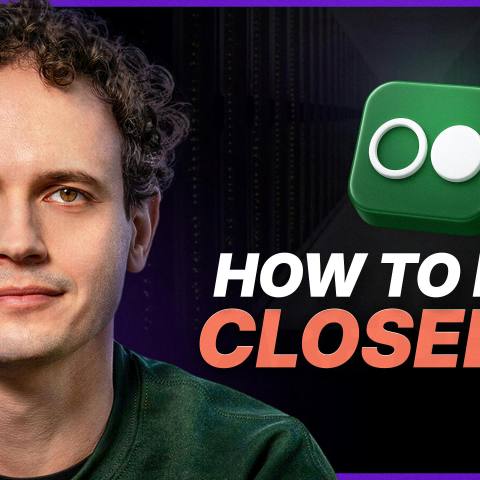
Misha Laskin
Related people
Episodes
- Beam: The Great American Open Model with ReflectionAI Co-Founder and CEO Misha Laskin
- The American Startup Taking On China’s AI Models
Notes
Prof G Markets · The American Startup Taking On China’s AI Models
-
What Is Reflection Building?
Misha Laskin says Reflection is building a generational company around open models, and he wants it to be a leader rather than the only American lab in the field. The plan is to keep releasing strong open models and to deploy them into enterprises, the public sector, and sovereign accounts.
China's advantage, as he describes it, is that a handful of companies keep leapfrogging one another, so good models keep arriving. He hopes a similar ecosystem of open-model builders comes out of the United States this year and next, comparable in quality to the Chinese one. Reflection should be a standalone leader inside that group. He does not comment on media speculation. The plan he will describe is
-
Are Chinese Open AI Models a Gift to American Startups?
Misha Laskin says Chinese open models are a gift to American startups, and he rejects the idea that the releases are simply bad for Western markets. Ed Elson had described China's open-weight push as a mission to erode the margins of American AI businesses and upend the market, a flood of supply meant to damage the companies that pulled ahead. Laskin says the intentions matter less than the result. Great open models, wherever they come from, are something people can build on.
Closed labs crowded some of the best startups, not out of malice. Coding is lucrative, so those labs built a vertical product around it. Startups that also wanted to sell coding agents moved onto Chinese open models, c
-
What Is the Difference Between an Open and a Closed AI Model?
Misha Laskin says a closed AI model is something you can only rent, and an open model is something you can own. Renting leaves you exposed to a price hike or a cutoff, while someone else runs the system. Owning means the model can be handed over, even on a flash drive, and run on your own computers. He compares it to renting an apartment versus buying a house: one is convenient, the other is control plus the problems that come with it.
Ed Elson had assumed open also means free, in the sense that anyone can use the model, build on it, and customize it. Laskin agrees that is how most open models work today, and he says open does not have to mean free. A license can sit on an open model and be
-
Why Does America Need Its Own Open AI Models?
Misha Laskin says America needs its own open AI models because open technology is what other countries adopt, and the country that ships it brings its infrastructure with it. About a year before this conversation, Western open models were falling behind. Chinese open models arrived strong, including DeepSeek V3, around the same time reasoning models reached the public, and a wider set of strong Chinese models followed. Reflection's answer was to take on what he calls the open intelligence mission.
The pattern is already familiar. Linux is the widely adopted operating system for computers, Android is the one for phones, and internet protocols are open. Those came from America, and the rest o
-
Why Did Misha Laskin Start Reflection?
Misha Laskin started Reflection in 2024 because the models then were good at chat and not at work someone could leave them to finish. GPT-4 and ChatGPT had taken off, and Gemini 1 and 1.5 had shipped. He and his co-founder had worked on the reinforcement-learning side of those Gemini models. Coding, agents, and reasoning were not useful yet. The systems were chatbots.
The bet had two parts. Open models, including models from Meta, were already a base to build on, so the company would not spend its own money pre-training from scratch. The larger bet was that reinforcement learning, the trial-and-error method behind AlphaGo, could sit on language models and make them good at agentic work. Cod
-
How Do Chinese Open Models Spread Chinese Chips?
Misha Laskin says Chinese open models threaten American national security because countries that adopt them also get locked into Chinese chips and data centers.
Allies abroad adopt whichever technology stack is best. Linux and Android came from America, and America has traditionally built the best open source technology in the world. Open models are the first case of something so major that did not originate in America, so countries abroad are building on Chinese technology. The model is only the engine, and the car around it is the chips. When Chinese companies sell open models into the Middle East, other Asian countries, or Brazil, they also start selling chips and data centers. Allied go
-
Why Are Open AI Model Builders Six Months Ahead?
Misha Laskin says an open model builder stays six months ahead because building the model also builds a state-of-the-art stack for serving it, for agents around it, and for fine-tuning. By the time the weights are released, that supporting technology was already in place.
In China, as he sees it from the outside, the model is given away free abroad because people abroad do not want to use the Chinese API, so it cannot really be monetized there. That giveaway also pushes competitors' margins down. The Western market is competitive in a different way. Releasing an open model creates distributors that can serve it, and the builder still keeps the technical lead.
A builder that is strategic to
-
Why Should AI Intelligence Get Cheaper?
Misha Laskin says the amount of intelligence available per watt will keep increasing, so the cost of intelligence should be driven down as far as possible in order to use more of it. The pattern is a classic Jevons paradox. Intelligence should not be seen as a premium product like an Apple iPhone. Intelligence is more like electricity and water, and it should be a commodity.
The whole system around intelligence is expensive, and there will still be some margin, but margins on inference today are very healthy for both closed model inference and open model inference. On whether very expensive training will bring subsidies like the support federal, state, and local governments give utilities s
-
How Does Reflection Make Money From an Open Model?
Misha Laskin says Reflection makes money from Beam, its open model, by charging enterprises and the public sector for the systems around it: serving inference, packaging agents, and fine-tuning.
Open weight is one form of open source, because weights belong to deep learning and did not exist in earlier software. Open source purists argue a release is not open source unless the data and the training recipes are open too. The company mission is to build open intelligence and make it widely accessible, so the goal is to open source as much as possible in order to make the models easy to consume. Beam launched with 40 partners and integrations into open source fine-tuning frameworks. The team a
-
Why Did Misha Laskin Get Into Physics?
Misha Laskin got interested in physics after he moved to the United States as a kid. His family moved to a rural part of Washington State, he had a lot of time on his hands, and that is when the interest took hold.
He treats the Hanford site as one possible piece of it. The area was one of the Manhattan Project places, the Hanford site where the plutonium was enriched, so it already had a rich history of physics. What he really liked was that physics is a fundamental science, based on simple principles that could explain most of what people observe, and that it sits at the root of technologies used every day. He saw physics as the fundamental science of the 20th century.
The first computer
No Priors: Artificial Intelligence | Technology | Startups · Beam: The Great American Open Model with ReflectionAI Co-Founder…
-
How Do Chinese Open Models Help Companies in the West?
Misha Laskin says companies in the West have built more durable businesses because a great open-model ecosystem came from China, and he calls that a gift. A world where that ecosystem never arrived is a world with no open models.
An application builder who makes something great can watch the work get pulled into a closed model provider, because that provider is a business that has to generate revenue. He calls that a tall poppy syndrome. Open models are what let those companies keep what they built.
He does not want compute concentrated in one or two closed labs. Ten or twenty closed labs would still be a competitive ecosystem. One or two is scarier.
-
How Was the Open Model Beam Trained?
Misha Laskin says Beam was trained as a 500-billion-parameter model, with 23 billion of those parameters active. Pre-training ran on 6,000 GB300s. The first run took a few weeks. Infrastructure efficiencies now bring that pre-training down to about 12 days, maybe less, by coupling scientific efficiencies with infrastructure efficiencies.
Reinforcement learning used a little over 10,000 GB300s and lasted four weeks. More training compute went to reinforcement learning than to pre-training. Those jobs are more complex because they run a lot of inference at scale, with sandboxes for agents, and training at the same time.
He got into AI after seeing a co-founder's work on AlphaGo, when he was
-
How Many Researchers Does a Frontier AI Lab Need?
Misha Laskin estimates a steady state around an order of 100 researchers for a large effort like the one he is running. Asked whether the same effort that needs 100 people today needs 20 next year, he agrees, then points to expanding ambition that leaves the team understaffed rather than overstaffed. A staff-to-compute ratio still applies: 3,000 researchers would not be very helpful, and a couple of hundred would.
A co-host sketches an extreme case: give every extra unit of compute to the handful of people who contribute the most ideas, in physics, biology, or any field, and the researcher count stays static or shrinks. The argument has merit. Projects never needed an extraordinary number o
-
How Does Beam Choose Its Next Training Bets?
Misha Laskin says Beam chooses its next training bets by exhausting the high-impact methods the team already knows work, then expanding into riskier ideas. Careful execution of known, lower-risk work comes before wider bets.
The final model trained on the SpaceX cluster the team received in July. Pre-training ran for a few weeks, synthetic data and reinforcement learning ran for a few more weeks, and then the model shipped. Plenty of ideas the team already trusted never made the cut, only because the calendar ran out. New work starts with scaling experiments at small scale. Some results never show up until the run is large, so the judgment is whether to spend more compute to surface the nex
-
Can a PhD Take a Week With AI?
Misha Laskin says a PhD can now take a week. Finding the right question and executing the answer to write a doctorate took a few years. With the right question, a chat box now runs the calculation and returns something interesting.
Science has been a lifelong pursuit since a move to the States sparked an interest in physics. Over the last few years he fed language models his own doctoral thesis. Choosing the right question is a large part of the work, and the rote execution takes a long time too. A couple of years ago the models were only chat and could not act on the prompt. A year ago the answers sat at undergraduate homework level. Six months ago a model solved the thesis correctly at re
-
Why Is Openness Safer for AI?
Misha Laskin says openness is safer for AI because openness is already the safety default in software, and a few hundred researchers inside closed labs cannot cover the long tail of model failures.
He treats the technology as a digital utility. Strong encryption protocols were closed in the early 1990s while the NSA and civil liberty advocates debated whether to keep them shut or open them. A small handful of engineers designed closed systems with unintended consequences they could not predict, the systems were easily hacked, and strong encryption protocols became open. The opening gave birth to cybersecurity. Models are similar to software, with the similarity sharpened: the long tail of v
-
What Do Open Models Do to AI Margins?
Misha Laskin says open models compress margins across the whole AI stack. A company wins by serving great intelligence, holding a lot of compute, and earning trust from customers.
Everything across the stack is so hyper competitive that it is getting commoditized. Model margins are going to be compressed. Open models lead to margin compression against closed models, and margins also compress in applications, the inference layer, and bare metal. AI-native companies negotiate closed deals very aggressively because the open ecosystem exists. For any of them, the factors are the intelligence density served to customers, how much compute they have, and how much trust they have because they drive
-
When Do Enterprises Switch to Open Models?
Misha Laskin says enterprises consider open models after they ramp up significant workloads on closed models. He has not seen a straight sprint from renting models to owning them. A company has to pass through the rental stage first. The bill has to become a big enough cost driver before leaders ask how to cut costs and keep work valuable enough to continue.
Spending $100 million or more a year on closed models is not uncommon, and that is when a company starts looking for a better way to do the work. A compute shortage is also bringing machines back on site. An enterprise buying from a favorite hyperscaler very often cannot get enough compute, and good rates are hard to get. A company spen
-
Have Open Models Overtaken Closed Models?
Misha Laskin says the mix of tokens on model gateways has flipped from mostly closed to mostly open, and he thinks the shift will only accelerate. About six months ago, a gateway such as OpenRouter or Vercel was majority closed and minority open, almost exactly 70 percent closed and 30 percent open. The split is now almost exactly 70 percent open and 30 percent closed.
He suspects the world will look much like operating systems, where 95 percent or more of servers and computers run an open source operating system such as Linux. Closed products can still be extremely valuable. Microsoft and Apple are extremely valuable companies, and the market is really big. He thinks most token demand will
-
What Sets a Foundation for Intelligence?
Misha Laskin says code and agentic work set a foundation for intelligence, and the intelligence is jagged. It generalizes in a surprising way: his model reached a fresh, recent level of capability quickly, the kind other labs were discovering not long ago. Results still do not carry cleanly from one harness to another, including between versions of terminal bench.
Once a general agentic capability is working and the right data is available for a new harness, adaptation happens pretty quickly. The practical question is where the economically valuable pools of data sit. Open models are powerful because enterprises and customers can customize them for their own workloads and get the lowest cos
-
Is Catching the AI Frontier Getting More Expensive?
Misha Laskin says catching up to the frontier can be done a lot more capital efficiently, and the price still climbs every year. A year ago, or maybe 18 months ago, the cost was on the order of 100 million dollars, hundreds of millions. Now, or even six months ago, it is probably on the order of a billion, single-digit billions of dollars. Going into next year, he thinks the order is 10, tens of billions.
Each generation of model brings roughly a 4x multiplier in compute. A couple of years ago the frontier chip was an H100, and a large run was maybe 100,000 H100s. Astra was a big training run on 100,000 Blackwells, roughly a 4x multiplier on an H100. The next generation is going to be aroun
-
What Was Hardest About Building Reflection AI?
Misha Laskin says the hardest part of building Reflection was everything. The team has to get 30 things right, and that is why the work stays hard on every front.
For the last 12 months the mission was to build frontier open intelligence and make it widely accessible, sprinting to stand up a lab while assembling a plane in flight. About a year ago there were around 30 people. A true rocket ship project takes an order of 100 plus people, a couple hundred researchers and engineers. Reflection is now around 300 people. Teams cover pre-training, mid-training, and reinforcement learning. They scaled up, trained the first models end to end, and released Beam, Reflection's first open model. Talent