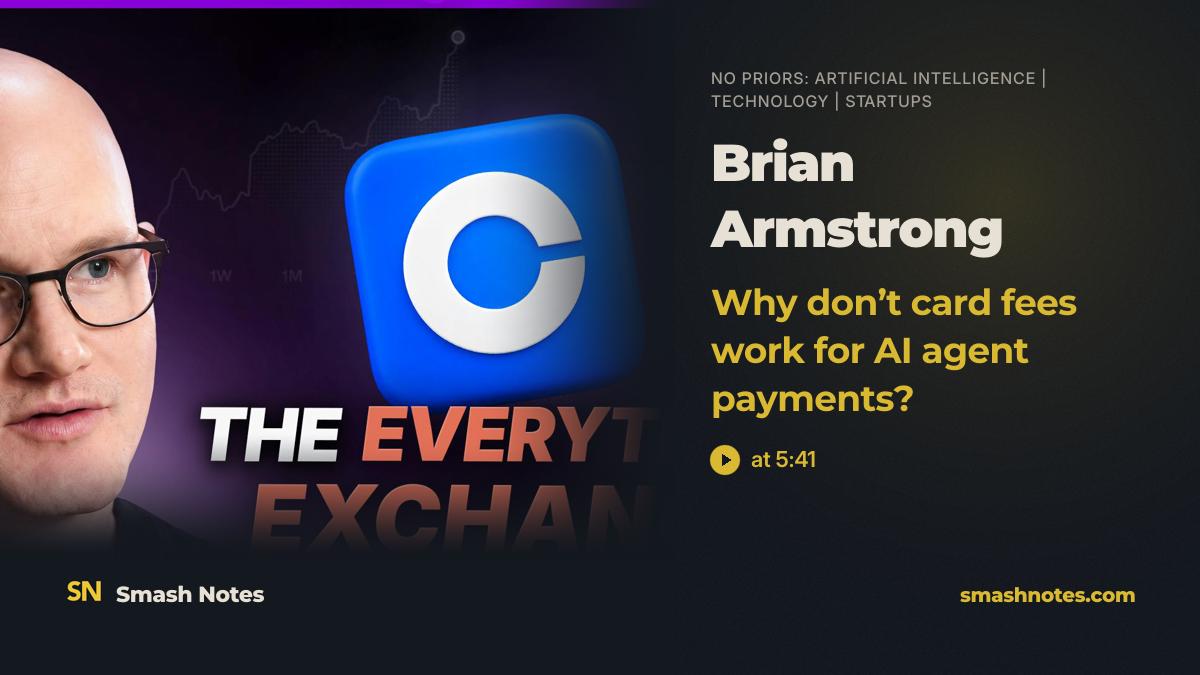
Coinbase’s Everything Exchange: Agentic Finance, Stablecoins, and Tokenization with CEO Brian Armstrong
From the tokenization of real-world assets to funding research on anti-aging therapeutics, Coinbase co-founder and CEO Brian Armstrong is focused on solving meta-problems for the benefit of society. Brian joins Elad Gil this episode to discuss the intersections of artificial intelligence, crypto rails, and biotechnology. He details Coinbase’s vision for…
People
Notes
-
-
-
-
-
-
-
-
What Are Freedom Cities? at 42:16
Related notes
- How Did Brain Co Cut Permit Waits to One Hour?
- Why Is Drug Discovery Moving Faster Than Ever?
- Should Only Democracies Develop Artificial General Intelligence?
- Who Should Pay for AI Shopping Agents?
- What Does Darragh Buckley Want an AI Agent to Do?
- Who Should Pay When AI Agents Read the Web?
Related episodes
-
![]() Beam: The Great American Open Model with ReflectionAI Co-Founder and CEO Misha Laskin
-
![]() Investor Elad Gil’s next moves
-
![]() Redefining Chip Architecture with Arm CEO Rene Haas
-
![]() Taking on ServiceNow: Coding Agents the Rest of Us with Serval Co-Founder and CEO Jake Stauch
-
![]() The Changing Physics of Cybersecurity and Drug Development with OpenAI President Greg Brockman
-
![]() The Man Behind Coinbase: Interview with Brian Armstrong | KMP Ep.52
-
![]() Thrive Capital's Bet on Neuralink, OpenAI & the Future of Medicine
-
![]() Democratizing Security for the Agentic Web with Cloudflare CTO Dane Knecht

0:00
The minimum fee typically on a debit or credit card transaction is about $0.30 fee flat plus the additional percentage. Arguably, it doesn't really work well for anything under $1. Certainly, it doesn't make sense to pay $0.30 to send a $0.01 payment. And I believe the stats we
Expand full transcriptCollapse transcript
The episode notes above make this conversation easy to skim.
0:00
The minimum fee typically on a debit or credit card transaction is about $0.30 fee flat plus the additional percentage. Arguably, it doesn't really work well for anything under $1. Certainly, it doesn't make sense to pay $0.30 to send a $0.01 payment. And I believe the stats we last saw on this are that about 76% of the agentic commerce transactions we're seeing are under $0.30.
0:18
We don't want the AIs to be unbanked. We want to bank the AIs. They deserve financial services as well. The AI agents themselves are going to have to have their own accounts. And so we've made some simple tools where with a single command you just prompt, you paste it into your AI agent, it can now have its own financial account. So it'll be interesting to see how the agentic economy evolves.
0:35
There'll be more agents than humans in the not too distant future. It kind of stands to reason that the agentic economy will be bigger than the human economy at some point in the not too distant future as well.
0:50
Today on No Friars, we are joined by Brian Armstrong, the co-founder and CEO of Coinbase, one of the world's most important and earliest crypto companies that has also been quite aggressive at adopting AI. Brian is also the co-founder of New Limit, which is a anti-aging and longevity company doing really interesting things in biology, including certain types of high throughput screening to understand aging, different uses of AI, etc.
1:13
Brian is one of the most forward thinking people I know. on different aspects of science, technology, art, the world, etc. So it's very exciting to have this conversation with them. And we'll be talking about everything from what's happening in the crypto world, to what's happening in AI, to what's happening in biology, to how different individuals can have an impact over time.
1:32
So it's a very fun conversation. Brian, thank you so much for joining us at Antipriors. It's a pleasure to see you. Yeah, good to see you, Elad. So I was hoping we could talk about a few different topics. I think there's a bunch of stuff relevant to Coinbase and crypto and, you know, agentic finance and things like that. But also you started a company called New Limit, which is focused on longevity and aging and biotechnology.
1:53
So I think it'd be great to sort of cover both as part of this conversation. Yeah. And maybe we start with Coinbase. So Coinbase has been making some really big moves. You've been floating this concept of the everything exchange as you've been building out what I think is a new global payments layer. Can you tell us at a high level, what are some of the directions of the company and some of the areas you're most excited about right now? Yeah, so we're at a really exciting time in Coinbase's history because on the one hand, every asset class is coming on chain.
2:21
It's now possible to trade everything in one place with good liquidity and good cross margin. And so for markets and trading and that out there is stocks and commodities and crypto and derivatives, perpetual futures, like it's all coming to one place where traders can do everything in one spot, including prediction markets too. And they can do that in more countries now, given the regulatory clarity that's emerging, which we can talk about if you want.
2:45
So the everything exchange is kind of our bread and butter, our core business. The next big area that's emerging is stablecoin payments, which have just been growing like crazy. Even when Bitcoin prices are down, stablecoin payments just keep growing. And so we're helping companies all over the world integrate stablecoin payments, which are fast and cheap and global.
3:01
You can send money at the speed of information, right? It's kind of like under one second, under one cent US to move money anywhere in the world. And then the third big one is something I know you talk a lot about on this podcast, which is how is AI changing? Because AI is changing everything. And so it's obviously going to change financial services too.
3:19
And so we call this agentic finance or AI-fi. And we're building this into Coinbase in a number of different ways. The first way is that people who have their existing financial account, they're going to want to have an AI advisor, kind of like how wealthy people are able to get access to these investment advisors. But everybody should have access to them now.
3:36
And they can help teach you about... You know, building the right portfolio and dollar cost averaging, tax loss harvesting and all these kind of things. And, you know, if the market dips 5% or 10% or 15% leg into this kind of portfolio over time and try to save money on fees and, you know, earn yield while it's sitting in cash. And you can just talk to it like a human and it'll do all these things for you.
3:55
At least that's the vision. It's getting better and better. So we've launched an advisor in the Coinbase product. The next thing is that the AI agents themselves are going to have to have their own accounts. And so we're on a mission to kind of like go out there. We don't want the AIs to be unbanked. We want to bank the AIs. They deserve financial services as well.
4:13
And so we've made some simple tools where with a single command, you just prompt, you paste it into your AI agent. it can now have its own financial account. And it's using a self-custodial wallet and crypto rails. So there's not a KYC process. Our AI agents don't have a government ID. They can't walk into a bank branch, at least not yet, without their humanoid robots companion.
4:36
And so now any AI agent can have its own financial account to do payments, to pay for goods and And is that tied to an account of somebody who's already on Coinbase? In other words, is this sort of like a subsidiary account? Is it an entirely new thing? How do you think about the hierarchy of that? Yeah. So we're doing it both ways, actually, just because I think there's going to be demand for both use cases.
4:57
So it's going to be possible to create a separate agentic account with segregated funds on Coinbase in the near future. And you can give your agent access to just that, to do trading and payments on your behalf. That's kind of linked to your identity as human. We're also going to provide self-custodial wallets to any AI agent out there that wants to...
5:13
hold a balance in Stablecoin or it could actually raise money. It could issue a token. And so what's fascinating is that today we often talk to these agents and it's sort of like one person to one agent and they go get some work done, but they often get stuck. They get stuck. There's like, oh, here's a paywall. Can you put in your credit card? I need to spin up these AWS resources or you wanted me to book this hotel for you, but here's the webpage.
5:39
Can you go put in your credit card? That kind of thing. And in the future, I think you're going to want to have these agents have their own spend accounts, kind of like having a personal assistant or an employee who has their own spend account. It's going to need probably like a stablecoin-backed credit card for backward compatibility, but we're seeing a lot of agentic payment now flow over these new protocols like...
5:57
X402, which is one that we incubated at Coinbase that we actually put into the Linux foundation. So Google and Cloudflare and AWS, a bunch of people are working with us on that now. And so that's been really cool. And we put together like this little fun website called edgentic.market, where people can go see the stats of how many payments are flowing in this new economy and see all the different services.
6:17
So we're helping a lot of businesses get enabled into the agent economy. Like, you know, is your store ready to accept agents as customers? We have a product called Coinbase Business that helps companies accept stablecoin payments. And that's good for humans who want to pay with stablecoin payments, but it's also good for agents. And they kind of get both out of the box.
6:36
You mentioned things like stablecoin or crypto-backed credit cards. How do you think about what proportion of the future value in the agentic future is going to be crypto versus more standardized finance rails? Yeah, so what's interesting is a lot of the agentic commerce that's happening, these are pretty small transaction sizes, sometimes just a few cents.
6:56
And as you probably know, the minimum fee typically on a debit or credit card transaction is about 30. It's like a 30-cent fee flat plus the additional percentage. So arguably, it doesn't really work well for anything under $1, certainly anything under $0.30. It doesn't make sense to pay $0.30 to send a $0.01 payment. And I believe the stats we last saw on this are that about 76% of the agentic commerce transactions we're seeing are under $0.30.
7:19
What sort of transactions are those? Or what's happening at that low of a price point? So a lot of it is gathering information. And so you could think of it like it's venture firms doing research compiling from paywall data or it's recruiters who need to scrape data from LinkedIn. Oftentimes, it's actually agents talking to other agents that are specialized in some way and getting information.
7:45
source data from them, almost like a tool call that's happening. And on that agentic.market website, we have a list of the top service providers that are doing like search and financial data. And I think what will be interesting is in the future, you'll see actually other agents in the market that become specialized. Like, you know, the frontier models are trained to be quite good at good generalists, right? And they're kind of good at a lot of things.
8:11
And we're seeing instances where smaller models that are open weight models can actually be fine-tuned or through reinforcement learning, they can outperform the frontier models on a specialized task within the company. I'm sure you've talked to lots of startups about this kind of thing, but it's like a compliance review queue. If you train it on 100,000 compliance cases within Coinbase proprietary data, a small open weight model can actually outperform a frontier model.
8:38
And so I think you're going to see in this marketplace... A bunch of specialist agents, it might be like, hey, this agent is just really good at ordering you pizza, if that's what you want. Or this agent is like a really incredible designer. And that's all it's been trained on is like tons of proprietary Figma data or something like that.
8:55
So it'll be interesting to see how the agentic economy evolves. But you know, It's probably like common wisdom at this point amongst your listeners, but there'll be more agents than humans in the not-too-distant future. It kind of stands to reason that the agentic economy will be bigger than the human economy at some point in the not-too-distant future as well.
9:11
Yeah, it's interesting. I think one of the safest arguments is the concern that there'll be resource aggregation by AI and that'll be used to manipulate society or things like that. It's always interesting to think through what are some of the implications of the scale of some of these things and how they work. I don't share that concern as strongly.
9:27
I'm just saying that's something that comes up from time to time. Yeah. Well, just actually on that, it's funny. I've heard people like Elon say... that they think there won't be money in the future. Right. And I mean, I actually agree with you a lot of most things, but that one I was like, okay, I think I know what he means. He's basically saying at some point you start to measure things in energy and mass and like those become the scarce resource.
9:50
I think in the end, like in the limit case, like he has a point, but the thing is there's going to be scarcity for a long time, even if, the cost of goods and services really falls. We have price deflation because robots and AI start to just make commodities and food and housing very cheap. That could happen. The government printing might also create a bunch of inflationary pressure.
10:10
But there's always still going to be scarcity of certain things like land, especially usable land in various ways, energy, like chips.
10:24
Dyson spheres are going to be expensive, I think, pretty far into the future. So I think we're still going to need a medium of exchange. And
10:32
it's really cool to see that as AI emerges, crypto rails are just kind of a nice compliment for all that stuff to finally work. I think crypto was really, really good for humans, and it's going to be essential for AI. Yeah, people, I feel, have been talking about this for a while too, particularly, I think, in the... Um, early AI community, it overlaps so much with the crypto community, right? In terms of you'd see, um, you know, computer science majors coming out of MIT and depending on the year that they graduated, they would go into crypto and two years later, they're all going into AI.
11:02
And it was roughly the same people in terms of people were really into certain types of math or algorithms or other things. So there's, there's interesting bifurcation, I feel too, of people's careers is based on when they graduated, uh, in terms of whether they ended up doing crypto, um, you know, in 2020 or whatever it was versus AI in 2022.
11:19
Yeah. Well, I'm reminded of that meme. Have you seen that meme? It says, ¿Por qué no los dos? You can do both. They're going to intersect here. Yeah, it seems like they just might. I mean, the other thing you folks have really been focused on is the use of AI within Coinbase itself. And can you talk about how some, I know there's obviously coding and other things, but what do you think are some of the more interesting projects that you all have done internally? Yeah, so like a lot of companies, we started off with the basics.
11:48
You know, we got some coding tools. We got it hooked up into our various data repositories. We've been using it for a long time on machine learning for risk prevention, fraud prevention. Customer support inquiry started going through AI. So that was all like good table stakes stuff. And then the things that we've started to do recently where we're sort of pushing the boundaries here, I think one of them is that we basically want to get as close as we can and actually achieve recursive self-improvement, right? And what does that mean in various ways? Like...
12:19
So it means that you have a brain for the company. That can be a whole bunch of subsets, by the way. You can have a brain for each team. You can have a brain for each service repository within the company. You can have a brain for each individual, which, by the way, I believe they should be able to take with them when they leave Coinbase.
12:37
So we're creating some good policies on that.
12:40
So let's say you have a service, like a GitHub repository, some backend service that's running. And today we have engineers spinning up agents to make changes to that. What we're just now launching and seeing recently is every time the agent comes in to make a change to that service, it's actually ingesting the brain for the team working on it and for that repository.
13:01
And so what is that brain? It's basically... It's a history of all the incidents that have ever happened with that service. All of the financial controls that have to be enforced with that. Every A-B test that we've ever run on that. Of course, like the full GitHub history of pull requests that were accepted or rejected. And so the people running that team at any time can kind of go in there and look at it.
13:23
Today, it's just marked. It's like markdown files, right? It's kind of simple at the end of the day. But getting this all hooked up. So, okay, so let's say... You ask the agent, hey, I want to make a change to this service. It ingests the brain. It makes that change. And then as a human, you go to review it and you're like, ah, it missed something.
13:42
Okay. Now the simple thing someone might do in that moment is, okay, go make a manual edit to fix it and then ship it. But the key step that we're trying to really enforce now in our software factory or software development lifecycle is when you go to make that change and edit the agent's thinking, that context has to go back into the brain so that you not only fix it in this case, but in all future cases going forward.
14:03
And then basically what you start to see is the accept rate for one-shotted PRs or that kind of thing. It just starts to tick up over time. And you've now got a recursive self-improvement system so that's one of the big ideas we've been working on recently and just getting our own internal um agent harness uh which we call toshi uh just integrated with all these tools like it can now you know it can now make calls out to external vendors and pay using the agentic finance economy like over these x402 protocols um if you want to edit the brain as you're making a change to that pr and it goes back into the brain putting that into the harness um asking it to sort of like okay
14:43
Actually, just earlier today, I was making a plan for this relatively complex feature. It's kind of amazing. It's now even allowing people like me, the CEO, to get back in there and ship features. But I asked one of the high-end expensive models, okay, go make a plan for how this feature might be implemented, break it down into three phases.
15:00
Each phase has 10 different pieces that need to get built. And I was like, okay, go execute phase one. Go spin up 10 separate agents to go execute each of those pieces in parallel. And by the way, recommend the right agent to use because they might be cheaper models. And so it spun up a bunch of open source. It spun up a bunch of Grok. And it just like...
15:19
Two minutes before I hopped on this podcast, it just pinged me. It was like, by the way, all 10 of those things from phase one are now done and ready for you to review. So... Anyway, I'm starting to get to this place where it's kind of addictive, actually. Because in the past, every time I'd have these ideas or bugs, I find... And I'm just pinging the team all day long.
15:37
Like, hey, can we do this? Can we do this? Can we do this? And now, instead of pinging the team in Slack, I can basically tag an agent in Slack with that comment or drop it into our internal harness. And instead of bugging the team and asking them to do something, I just send them a PR for a review and it's already done. And that's a magical moment that I just...
15:55
It's very addictive. Yeah, I feel like the people who are best at adopting this who aren't day-to-day engineers, and I know you had a long background working as an engineer at Airbnb and other places, obviously helping start Coinbase. But I found that many folks who do best at this, who are non-technical also, almost treat it like a video game.
16:14
And you're like leveling up in terms of your capability set and how you learn to do things. Sort of these recursive loops you start building for yourself and everything else. So I think it's fascinating to watch that adoption. How do you think that impacts, you know, how companies are set up in the future? In other words, some people make the argument that the average company size over time should get much smaller.
16:34
It could be a startup, it could be existing companies, etc. Simply because you're able to harness so much of this intelligence, so much of this proactivity or ability for people to do so much individually. Do you think that's true? Do you think that's the direction things are heading? Is there a timeline where suddenly every company is like 10 people or whatever? Or do you think there'll always be these sort of larger scale organizations? Well, productivity is definitely increasing, right? So that's slightly different though than saying the average company size will be smaller.
17:06
It's kind of like just saying tasks are being automated or eliminated. People are not being eliminated. I think tasks are being eliminated.
17:15
And so if you take a company like any sort of company today, Coinbase or others that exist today, it's not that... I don't think it's like we're going to shrink down the headcount to 10 people or something like that. I think that the existing people we have are going to be able to just get much more done and the pace of everything will accelerate.
17:33
Now, it's also true. You're going to see some companies that are two people or five people or whatever, and they're able to do a lot more than what we would have historically thought was possible. And that's also true. So it's increasing the velocity of the existing team. Yeah. And making things ship faster, things automated. So basically, you're getting more scalability off people.
17:52
And so if you have a cost basis relative to revenue, then you suddenly have this ability to dramatically more with that same group of people, which means to some extent, your margins should start to rise over time. If you're effectively growing revenue faster than your growth team, although I guess some people may still grow them at the same pace.
18:08
Yeah. Yeah. That's super interesting. And then I wonder if it's worth spending a little bit of time as well on the everything exchange. I just think some of the things you're doing there are fascinating. There's perps, there's prediction markets, there's all these really interesting directions. What proportion of Coinbase, either volume or revenue is sort of those other ancillary areas now outside of crypto? Yeah, well, we actually shared in our recent earnings deck, which are those only numbers I'm probably allowed to talk about.
18:43
But actually, 88% of our revenue is from non-Bitcoin trading at this point. So that's an interesting stat. I think it's funny because if you look at our stock price, it does trade fairly correlated with the price of Bitcoin. And I love Bitcoin. I think it's going to be around forever. It's digital gold. It's like... sound money for everybody in the world, I think it's amazing.
19:03
But I also think all these other things are... Crypto is updating every aspect of the financial system. So we just announced our tokenized stocks product, which is only available outside the US right now, unfortunately. But we're working with DSCC and others to get in a path to do it in the US. But it's the first truly tokenized stock product.
19:22
It's not a synthetic or derivative or some debt instrument. It's actually a security and it's one-to-one represented by the actual security held in custody. And so this is like broadly a trend called tokenization, right? Like stable coins were the first major use case of this. with a token that represents one-to-one a dollar in a bank counter or a US treasury.
19:43
Now we're seeing it with stocks, which is really exciting. There's something like 4 billion people in the world who don't have access to any brokerage or US investment account. So they don't have any ability to invest in Coinbase, Nvidia, Apple, whatever. And so... much like Tether was very successful ex-US because a lot of people wanted dollar-denominated accounts.
20:03
There's like 4 billion people who want access to high-quality investments. They don't have that today. So we'll do the tokenized stock piece. And then I think you just go on down the list like private credit and treasuries and... bank deposits, like everything's going to get tokenized. And it's just going to mean that financial services is going to have modern rails to run on.
20:22
So of course, these can all be traded on the Everything Exchange. They can be sent back and forth. Like if you want to gift a share of stock to your nephew or something like that, you can just send it to their wallet. You don't have to like go through some complex stock transfer process that's antiquated. It's like money can now move at the speed of information, just like a WhatsApp message.
20:41
And crypto is updating all those rails. That's pretty amazing. It's basically broadening and modernizing the financial system, but in a very broad way. It includes, to your point, eventually bonds. It includes a subset of stocks. It includes all sorts of things that before had much more friction in terms of using them or purchasing them. And it opens it up for the world.
21:01
And there were counterversions of this in China and other places where if something was listed on the Hong Kong Stock Exchange, sometimes these funds would almost be set up that people could buy proportions of to be able to participate in some stocks that were listed in other countries. So it'd be interesting to watch how sort of global capital flows change as things get bigger and bigger.
21:18
To your point, it feels like the stablecoins and Tether were the first version of that with USD. So it's kind of fascinating. I remember actually seven, eight years ago, I invested in a company called Harbour that was trying to tokenize real estate. I think that was a little bit too far ahead. Yeah, I think that'll happen too. I think you were early, but early, too early, but right.
21:36
Yeah, on that one. Yeah, so it's kind of fascinating. How do you think about prediction markets? So, you know, a lot of the use cases mentioned in the past seem to have roughly consolidated around sports and a few other sort of areas. Obviously, there's things in politics. Do you have a view on where in the long run prediction markets have the biggest footprint? Well, I'm very excited about prediction markets.
21:57
They're growing super fast inside the Coinbase app. I think we shared in our last earnings call, within months of launching it, it hit like $100 million revenue run rate. It's growing really nice, like over 100% quarter over quarter, something like that. I'd have to go look at the exact number again. But... So it's true that sports has been a part of it.
22:16
I think that it's much bigger than that, though. And that's great. That's a form of entertainment. We should celebrate that. I think that it actually has much broader implications, though, from a societal point of view that people maybe haven't fully appreciated.
22:34
Elections are something that have already happened in prediction markets. But let's say that you want to try to understand what policies should be implemented from a from a government point of view, you could actually like say, all right, if we were to implement this policy, what would the unemployment rate be within one year, two years, three years? And then a prediction market could form on that.
22:51
It could help inform what policy is out there. It could allow, I think you could also ask people The big questions in life, is there a God?
23:02
Were we designed by evolution or intelligent design? Some people would call these more like opinion markets. It's not that there's ever going to be a resolution date where we definitely know for sure on some of this stuff. Or if we did, it'd be very far in the future and hard to imagine. But if you ask somebody a difficult question, and then there's events that are always unfolding in the world, which might shift.
23:27
Maybe 60% of the population believes X, but a new scientific paper comes out, or a new terrorist attack happens, or who knows what. And then it shifts from 60% to 80%. People could still make bets. It's kind of like when you invest in the stocks, there's not some resolution date of the stock where it's done and you get your payout from NVIDIA.
23:48
You're just betting on, is it going to do better or worse in the future? And I think you could imagine a whole other category, for instance, of prediction markets for the big life questions and things like that. We're just scratching the surface. The other thing that you've been working on is New Limit, which is, I think... Really fascinating when great founders do an act two.
24:07
And you were doing an act one while simultaneously doing an act two. So how did you think about starting a company while running a public company?
24:14
Yeah. Okay. So this is a really interesting topic because...
24:19
You know, like you, I'm interested in lots of different ideas. I think that's part of the benefit of being an investor, by the way, is that, you know, you just get to talk to lots of smart people about it. So it's very intellectually stimulating. I don't know, maybe the downside of it is a little bit like you don't ever feel like you've got, you're all in on one thing and you're, you know, in the arena sometimes.
24:37
And you might be sitting there sometimes from the sidelines saying, ah, I know exactly what they should be doing. Why don't they just do this? And then, so if you're the CEO, you actually get to decide these things for better or worse. So anyway, long way of saying, I like being a builder or like an entrepreneur. I'm probably better as an entrepreneur than I am as an investor.
24:54
Some of my investments are a little bit more like, wow, that'd be so cool if that happened, but... once in a while, someone has to remind me, you do realize the point of investing is to act like to make money, Brian. Okay. So anyway, I digress. Okay. So basically Coinbase went public in 2021. We were, you know, we were very profitable. Like I felt like 10 year journey.
25:13
Okay. Do I want to do something different? Do I have another thing or am I just at the beginning of this? And I realized I'm just at the beginning of the journey with Coinbase. I think our mission of increasing economic freedom is just, it's like, we're just getting started. About half of 1% of global GDP is running on crypto. We've got a lot of jobs not finished, right? Right.
25:29
But I do want to have the ability to try some other ideas maybe and help incubate some companies or get them off the ground, whether I run it or not. And what I did was I sat down at some point and I was like, OK, what are the big technology trends that I'm excited about? And I think, by the way, if you make some money in software, you kind of have an obligation to put it into hard tech and help some of the bigger things that might advance society, which tend to be more capital intensive.
25:51
And I was a little bit inspired by Elon and these kind of things with PayPal and So I sat around with some of my friends and we were like, okay, what are some of the big trends? It's like, it's space, it's AI, it's fusion energy, brain machine interfaces. I was like, there's good teams working on those. I don't have a strong thesis about what I would do that might be different.
26:07
And when you're coming up with an idea, you want it to be something that... you know, you're like, this needs to happen in the world, but also there's not like, but for me, maybe it wouldn't happen that quickly. Like you want to do something that you think you uniquely add value. And I didn't see like that many great teams working on longevity.
26:25
I thought a lot of it was like kind of snake oil. I mean, you came from a bio background. I actually, I, I, I cornered you and I was like, what's going on with this space? Like what? And you were like, ah, all this, all the science is like a little bit bogus. And like, you know, people have tried these things for a long time. Like, you know, um, like caloric restriction or whatever.
26:43
We found a bunch of ways to make mice live longer and it doesn't work in humans, okay? So I was like, all right, well, let's host this dinner and see if we can invite some of our smartest CEOs, scientists. And you attended, I think, one of these dinners, which I really appreciate you inviting some people. And we kind of just went around the room and we asked all of them, what's the most exciting thing on the horizon? from a bio point of view that you think is high potential and underfunded today.
27:07
And people had all kinds of ideas, but one of them they came back with was this epigenetic reprogramming idea, which some labs had seen early results with, like Shinya Yamanaka's lab. And it was kind of showing how you could reprogram cells to restore function they had when they were younger. In that case, they were changing the type of the cell, but we didn't want to do that.
27:24
And through a series of these dinners, I basically kind of went down this rabbit hole and I started to like... Sometimes you just can't get something out of your mind and you just need to keep reading more and more about it and thinking about the implications. It's kind of what happened to me with Bitcoin in 2010 or 2011. And I started to feel about epigenetic programming, kind of how I did about Bitcoin at that time, where I just couldn't stop thinking about it for like three months.
27:43
And when that happens, you kind of want to hold on to that moment of inspiration or motivation and try to do something with it before it fades because it's perishable. And so... Through a series of these dinners, we happened to find the right group of people that came together, which turned out to be Jacob Kimmel, who's now the CEO of New Limit, Blake Byers, one of the other co-founders, Greg Johnson, who co-founded the company.
28:06
And I put some initial money in, committed that, helped them with some of the company building part of it. But the science was totally new to me. And I was basically just a sponge of knowledge trying to soak that up as much as I could. And so anyway, long story short, the science progressed faster than I thought. We've got a lab now in South San Francisco, about 50 or 60 people running these large scale.
28:28
It starts with AI. As with all things these days, you can test millions of hypotheses about what sets of transcription factors, which are these proteins that could reprogram different cell types. It's a massive search space. So we're using AI for that. We've built the leading frontier model for epigenetic reprogramming. That recommends the next set of experiments that we should run in our lab, which are these large pooled screens.
28:49
And we'd run those at the scale, as big a scale as we can, but it's like moving atoms and liquids in a lab, not... not just software. And so we do these large pooled screens to see if we can get phenotypic hits for compounds that might be possible to reprogram these cells. The best ones of those, we then run through functional assays, which are typically animal models.
29:08
And those are a little more expensive, a little slower. And the best ones of those we run through human trials. And so the exciting thing is we've demonstrated successful reprogramming of at least one human cell type in these humanized mouse models. We're now testing that in non-human primates. And then the first phase one clinical trial will be launching next year.
29:28
And there'll be, I don't know, three to 10 other drug candidates coming off this platform in the coming years. So that's been an incredible journey just for me to learn about what it takes to try to spin up another company. try to see where I can be helpful, where I don't be humble about the things I don't know. And yeah, I mean, I want to make sure that I'm focused on Coinbase.
29:48
That is my full-time job. I'm basically just an investor slash board member at New Limit. But I think it's fun and intellectually stimulating to try to create these companies that can advance the world. It's hard enough to get any one company to work. So I probably tried like 10 different ideas before Coinbase started to really work, right? And then...
30:05
You want to make sure you don't try to go do multiple things too early. The distraction can be really dangerous. It's arguably irresponsible to try to go do it. But there are some people... I think you're one of these people. I think you've managed to help incubate a lot of different companies at this point. Joe Lonsdale has done this. Sam Altman has done this.
30:23
Palmer Lucky has now a handful of companies like with Erebor where...
30:28
Of course, Elon is the most famous example of this. And so, yeah, I think there's a blurry line between... I'm the CEO of one company and I'm a pure investor.
30:41
In some sense, you're both capital allocators. At a certain size of company, you're basically just allocating budgets and capital. There's a bit more to it than that, but... So I think having like a small handful of things you're trying to do and you don't want to get overwhelmed where if like a couple of these things have a problem at the same time, you're just going to not be sleeping and probably ignoring your family and stuff like that, which is not balanced and healthy.
31:03
But you also, if you're just doing one thing forever and you have a potential to help incubate more in the world, then you're just limiting your potential. Yeah. Yeah, I totally agree. And I think more and more founders are waking up to your realization and your actions in terms of once you hit a certain scale or point of things, just have escape velocity.
31:20
They're working. There's enormous leverage. You know, sometimes you're able to do incremental things. And I think Daniel would be another good example of that. He's been doing interesting things. Yeah. He's made that successful transition to incubating more companies over time and Yeah, figuring out where he can plug in to help. Some capital, but it's really his time is probably the most valuable part.
31:42
His new limit announced where it's starting or what indication areas it's starting with in terms of what it's hoping to impact biologically or for a patient-centric perspective. Yeah, it has. It's actually on the website. There's newlimit.com. You can check out therapeutics. So we've published the roadmap there. So the first three cell types that we've started running our platform against, the first is liver cells or hepatocytes.
32:06
The second would be... And the third would be immunological cells for your immune system, T cells, most specifically. So we're following a pattern that's kind of similar to... The GLP-1s like Ozempic and all these things, which is... Initially, in drug design or drug search, you're going after an indication which has a high unmet medical need.
32:34
It's typically... Sometimes it's a smaller market. And that's just how drugs are developed because you go after things where people have no better options. So for instance, like... With our liver program, the initial phase one clinical trial will be in people with alcohol liver disease or alcoholic liver disease, ALD. And today they don't really have any other options other than like a liver transplant.
32:57
And most of them don't have that in time. So I think the survivability of it within 12 months is like once you're diagnosed is very low. So we'll do a phase one in that. And that alone would be a pretty large market. Sadly, there are a lot of people in that situation. I think we estimated that...
33:15
Yeah, like just that, if that drug alone works in ALD, it might be worth $20 billion or something. But the goal here is not just to make a liver drug for alcohol damage. It's to make a drug ultimately that healthy people, like if you're 40 and you want to have a liver that's like you're 20 or your immune system or your vasculature system, or eventually your brain, your muscles, all these different cell types, your skin, that's a big one, right? That's probably a trillion dollar market right there if you can get your skin rejuvenated.
33:45
But the idea is that over time you'd be able to take like a cocktail of these therapies or, and they would target probably different cell types with slightly different payloads, but they would all have the same theme of reprogramming your cells to restore function they had when they were younger. And most of the diseases that take us out are all correlated with age.
34:04
Like when you're in your 20s and you get some errant cancerous cell or a little bit of damage to your liver or whatever, your body recovers from it. And then as you age, they lose this function. And so most of the diseases that take us out, they're all highly correlated with age. And so instead of kind of going after each disease, like the symptoms of it, we're sort of trying to go for the meta problem of, well, how do we just restore the function your cells had when you were younger? And maybe that would be a way to take a bite out of a lot of these major diseases, attack the root cause of it.
34:31
This goes back to the Amanaka factors that you mentioned, where they were able to change the imprint for both age as well as cell type. And you're saying just focus on the age component of it. So you're reversing the potency of the cell to something that has more regenerative effects. capabilities, you know, like younger cells or tissues in general are able to rejuvenate or regenerate better than older tissues, right? You see that with healing or injuries or other things like that.
34:55
Somebody's in an accident on their own versus young, they take. get better much faster. So it's really fascinating stuff. So I think you're this really unique and wonderful mix of somebody who's really grounded and pragmatic, but who also thinks big and goes after these giant shifts or trends. What are you most excited about over the next five years? Either for Coinbase or New Limit or in general, like in the world, you know? Yeah, well, I'm always thinking about this, you know, in my free time and my weekends, I'm always thinking about what are the most important trends What is technology making available now that wasn't available before? What do I want the future to
35:29
look like? How can I help shape that, create that for civilizational progress? And so I think it's good for more people to do that. Just as an aside, it's not exactly what you asked, but I think that everybody should try to contribute in some way to civilizational progress and think about what they could build. Because it's easy to be a critic.
35:48
it's easy to poke holes what other people are doing or to be an activist or whatever. It's kind of a common thing amongst a certain generation. I think it's better to try to be a builder and you're going to fall flat on your face and you'll get an appreciation for how hard it is to contribute. Sometimes maybe, maybe more empathy, but it's actually much more fulfilling if you helped build something in the world that benefited a lot of people.
36:09
So anyway, to answer your question directly, I mean, my main focus is going to just, it's going to be on agentic finance, right? Like that's what's happening at Coinbase. Um, I think, you know, and then stable coin payments and everything's changed. Like crypto is really only powering about half of 1% of global GDP right now. There's maybe about 700 million people in the world who have used crypto or hold crypto, but not all of them use it every month, which might be more like in the 50 to a hundred million dollar, 50 to a hundred million people.
36:36
And so we need to get that to a billion or more. And that's how we're going to truly update the financial system. We can do that with humans. We can do it with agents. That's going to be a big focus. And then, of course, New Limit. But I think if you want to talk about frontier ideas that I've been contemplating, I mean...
36:53
One idea I've been contemplating a little bit is around cognitive enhancement. And there's been these things people have realized. I think in development of children, if you give them enough folic acid and certain... Nutrients like that in certain countries, it actually raises IQ. They develop better. And it might be interesting. I might host a dinner on this at some point of just what are the various ways someone could target therapies, whether in adults, children, embryos, whatever, to try to just level the playing field a little bit of...
37:26
The baseline sort of cognition and IQ that people are born with or could be born with. I think that's another one of these big meta problems. I haven't found a great thesis about how to exactly tackle that. But if somebody has one, let me know. That's super interesting. It's basically how do you increase the collective intelligence of humanity? Yeah.
37:43
There's the biological form of that. And then there's like the digital or AI form of that. Exactly. We're in a race right now. AI is getting smarter and smarter. I think humans need to, at some point, take control of our evolution and get smarter and smarter. And then, of course, there's the hybrid of the two with brain-machine interfaces where some people will choose to merge, some people will not.
38:03
But I believe that, like you do, there's going to be probably more AI agents than humans in the not-too-distant future. But humans still need to advance and progress. That's important. I think there's a lot that we can do with these AI tools to actually benefit humanity. And, you know, healthier outcomes, live longer if you want, you know, have more energy, have less back pain, you know, wake up not tired in the morning.
38:28
And yeah, increase our cognition and just have, you know, have healthier offspring, have children that are free of diseases. Like, There's a company I invested in called Preventive that's doing embryo editing, which is a controversial topic. People have seen these movies like Gattaca and things like that. But actually, if you look at the Pew Research, 80% of Americans, embryo editing for disease prevention is supported by the population.
38:52
Nobody wants these rare genetic diseases for their children. Everybody wants healthier, better lives for their children. I think that's one of those topics that seems controversial today. I think it'll be more normal over time. And at some point, it'll be abnormal to have children without doing this kind of screening and editing. Because it'd be like, this is so risky.
39:10
Why would you do that? It's like driving without a seatbelt or something like that. I always wondered, by the way, in that one, whether or not, if you imagine a future where gene editing is reasonably common, there may be packages that you buy, right? There's the intelligence package and there's the health package. I sometimes wonder whether your overall, like if you think about different ways to be intelligent, there's processing speed, there's recall, there's like five or six different ways you can imagine different forms of intelligence.
39:37
And I sometimes wonder whether these packages will effectively diminish the neurodiversity of humanity because it'll push everybody down the same package. It's almost like you're buying, you know, the Ford Model T of intelligence for everyone or something. So I've always been curious about what are the implications of active editing relative to just human diversity and capability set.
40:00
And, you know, will parents default opt into like the basic package or whatever, which will always be the same thing. So. It's kind of a random aside, but there's all these weird downstream implications to some of these things. Yeah. So I've heard that argument before, and I actually think it's the opposite. I actually think it could increase diversity.
40:15
The reason is that there's just unlimited diversity of human preferences, right? I think if it was this simple, and it may not be this simple, parents would say, you know, okay, do you want to have a great artist, a great general, a great... engineer, a great politician. It's like every parent is going to have some different favorite thing.
40:33
And by the way, that sort of assumes that they're mutually exclusive. A lot of this might just be like raising the floor and then the kid is still who they are and what they were going to be. It's just they don't have schizophrenia or depression or something, right? So anyway, I actually don't think it'll decrease diversity. I think you actually could.
40:51
I mean, in the limit case, you could actually get diversity that's really out there. Like you could have, you know, kids born with gills, they can breathe underwater or have wings and fly or something. Who knows how far it could go if you really can take control of your evolution. So one thing that's long been discussed in crypto circles and libertarian circles and other things are basically different forms of special economic zones.
41:16
And obviously those have been implemented at scale in some cases, like Shenzhen in China, I think in part exists as a large scale manufacturing region in China because it became a special economic zone of one form. There's others that have been discussed in the Philippines relative to certain misinterests. So there's really interesting things afoot right now there.
41:34
How do you think about that or how's your thinking evolved over time, especially since crypto has played a prominent role in some of the underpinnings and philosophies behind some of these things? Yeah, so I'm super interested in special economic zones because, again, I'm interested in meta problems that unlock progress across a whole category of things.
41:50
And I think if you look at what slows down progress in many parts of the world, it is overregulation, right? Like Europe certainly could be an example of this. You know, the U.S. has its own version of it that is not perfect. And there has been interest at various points in... in different solutions to this. You know, there's seasteading and Mars and going brain upload into cyberspace and all these kind of things.
42:16
There's... And there's one called Prospera, which is in Honduras. And Coinbase actually made an investment in that just to learn more about it and see what was going on. And they've had a mixed up and down, I'd say, with the local government there. But they're getting closer to a resolution, is my understanding.
42:36
I think they're going to make it. I think they're going to do a good job. But there was something I'd say there was a little bit more interest in this before the most recent Trump admin, just because, you know, the deregulatory environment has created a lot of opportunities here in the US. And that's a nice that's a great substrate and market to build on.
42:54
There was actually an idea that was discussed at one point, I think, in the campaign about something called Freedom Cities. If people Google it, they can kind of see it. And the idea was to try to create some federal land in the U.S. The federal government owns lots of different pockets of land. And if we say, all right, we think it's important strategically for America to get really good at nuclear power or drug discovery or
43:18
having a crypto or drone delivery or whatever it is. You could take a piece of land somewhere. The US has a ton of land, right? You could take a piece of this federal land, 10 or 100 square miles and say, you know what? In this area, you don't need to go through all the normal red tape on EPA and all these things and like, you know, local community.
43:38
You can build, you can just build data centers there. You can build nuclear power plants there. You can do unlimited drone delivery there. You don't have to get approval from the FAA because we want to create these zones where experimentation can happen in a safe, contained way to see what works and what doesn't. And if something works via experimentation, then you can go through the normal process in the rest of the US to see if it's ready to be brought to that location.
44:03
The problem right now is, in many cases, there is no sandbox to go try this innovation Um, and that is just incredibly stifling. You can't, you can't really solve a problem as an entrepreneur unless you can iterate on it. Right. And so anyway, I, I think it'd be really fun, um, to get some, these pieces, like these freedom cities or special economic zones in the U S uh, yeah, as you mentioned, like Shenzhen, Singapore, Dubai, like stuff, these have been very successful in many other parts of the world and driven a ton of economic growth.
44:32
And in some ways, like the US is 50 special economic zones because of federalism and the state system. So that level of competition has, I think, allowed the US to be the leader globally in this. But it's just we could go even further and do even more. Yeah, very exciting. Brian, thank you so much for joining me today. Of course. Thanks for having me.
44:52
Find us on Twitter at NoPriorsPod. Subscribe to our YouTube channel if you want to see our faces. Follow the show on Apple Podcasts, Spotify, or wherever you listen. That way you get a new episode every week. And sign up for emails or find transcripts for every episode at no-priors.com.