Smash Notes

Back to Inside Starcloud’s $2B Space Factory, with Philip Johnston & Ezra Feilden.

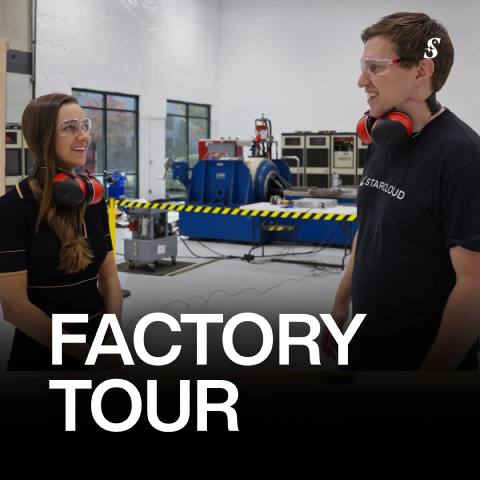
What Did Bailey Montaño Do Before Starcloud?

Bailey Montaño started at SpaceX in aerospace, spent about four years there, tried biotech and consumer product design, and then spent three years in fusion energy before she joined Starcloud.

She is the engineering manager. Molly O'Shea found her in front of Starcloud 2, where the team was leak-checking a fully fueled electric propulsion system, an ion thruster, after vibration testing, to make sure the test had not opened a crack or another leak. The biotech and product-design work did not stick. At the end of the fusion job she realized she is a space nerd and needs to be working on space to be happy.

Seattle had a lot of space companies. Starcloud, which had a different name then, was the one that stuck out. She got in contact with the founders very early.

Transcript

Inside Starcloud’s $2B Space Factory ·

From the transcript

Bailey, tell us a little bit about yourself. I know we're in front of StarCloud 2 and something just happened and you guys are testing things, but we'd love to learn more about you and how you contributed. So I'm the engineering manager here at StarCloud.

And what we're doing right now is a leak check of the prop system. So right now we have a fully fueled electric propulsion system, ion thruster, and we are testing it after Vibe to make sure that we didn't introduce any cracks or other leaks during the Vibe test. How did you come here? How did you get to StarCloud? It was a bit of a long journey.

So I started my career at SpaceX in aerospace. I spent about four years there. Then I did a couple other side quests in biotech and consumer product design. Those didn't really stick. Moved on to fusion energy, which was really cool. But at the end of that three-year stint, I realized I'm a space nerd. I need to be working on space to be happy.
See in transcript

Sourcery

More from this episode

  1. How Much Did Starcloud Pay for a Broken Vibration Table?Philip Johnston says Starcloud bought a secondhand broken vibration table for 200 grand after the team could not find a table in the US that would test a…
  2. Where Are Most New Satellites Built?Philip Johnston says Starcloud is based in the Seattle region because 90% of all satellites launched in the last few years by mass were designed, built, and…
  3. How Does Starcloud Cool Computers in Space?Adi Oltean says Starcloud cools computers in space with the liquid cooling that data centers on Earth switched to in 2025, because liquid cooling is the only…
  4. How Big Is the Starcloud 3 Spacecraft?Ezra Feilden says Starcloud 3 is the company's largest platform, a vehicle of about two tons, and as many as 50 can deploy on one Starship launch.
  5. How Easy Is Booking a Falcon 9 Rideshare?Ezra Feilden says booking a Falcon 9 rideshare is unbelievably easy.
  6. Why Would Anyone Put a Data Center in Orbit?Philip Johnston says a data center in orbit gets cheaper than one on Earth once launch falls to about $500 a kilogram.
  7. What Is Starcloud One Doing With Satellite Imagery?Philip Johnston says Starcloud One runs inference on satellite imagery in orbit, so the coordinates of a vessel can come down in minutes rather than hours and…
  8. Why Does Everyone Leave a Starcloud 2 Test?Philip Johnston says everyone leaves the building for a Starcloud 2 vibration test because a xenon tank under the satellite has about half the explosive power…
  9. What Did Miguel Rivera Do at Helion?Miguel Rivera was the welder for Helion Energy, where the team built fusion generators, and he ran their fabrication shop for more than a year before becoming…
  10. Why Is Shooting Down a Satellite So Hard?Philip Johnston says shooting down a satellite is a lot harder than blowing up a data center in Virginia, because satellites travel at about 17,000 miles an…

People

More answers like this

Related episodes

Plays from this note through the rest of the episode.

Weekly highlights

One letter a week.

The notes worth hearing, with the minute they were said.