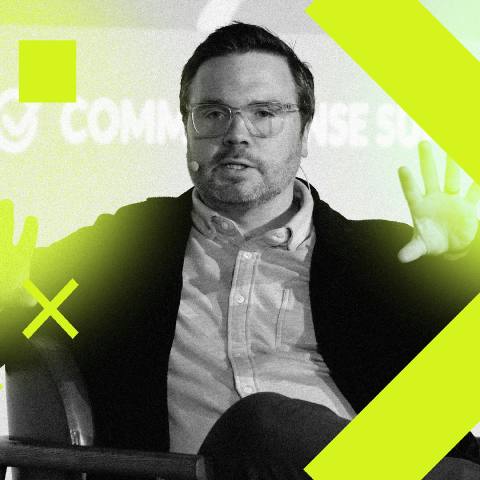
Kevin Roose
Related people
- Casey Newton
- Alex Kantrowitz
- Larry Ellison
- Meredith Whittaker
- Mikita Balesni
- Nilay Patel
- Peter Kafka
- Tomek Korbak
Episodes
- Kevin Roose is AGI-pilled. Why aren't you?
- The Bumpy Road To AGI — With Kevin Roose
- Larry Ellison’s Media Ambitions & Kevin Roose on AI’s Biggest Gamble
- Fired OpenAI Safety Researchers Speak Out + We Look Inside Pandora’s Box
- Inside Anthropic’s IPO + How AI agents spy on your messages
Notes
Machine Gods · Inside Anthropic’s IPO + How AI agents spy on your messages
-
How Can Anthropic Lose Money and Still Generate Cash?
Kevin Roose says Anthropic reported an $80.7 billion net loss for the six months ending June 30, and that most of the loss comes from convertible notes. On cash, the business generated about $4 billion of operating cash flow in the first half of the year.
Casey Newton says that cash flow is the reply to people who argue frontier AI labs only burn money and will never make a profit. Before these figures were public, it was easy to assume inference could never be profitable and that open models would pull customers away. The filing shows companies spending heavily with Anthropic, at margins he says are strong enough that some readers will ask why the company is keeping so much of the money.
-
What Is Anthropic's 900% Net Revenue Retention?
Casey Newton says Anthropic's filing reports 900 percent net revenue retention. A typical customer who spent $100 with Anthropic one year was spending $900 a year later. He says that jump is the clearest picture in the filing of how fast Anthropic is scaling. He sets that next to a company that had essentially no revenue four years ago and then multiplied revenue by about 10 each year for three years, growth he says does not show up in ordinary capitalism.
Kevin Roose says retention around 150 percent used to count as elite. Anthropic's 900 percent is far beyond that, and he reads it as evidence that the models have become very hard for large customers to drop.
-
Who Built Uncle Murray the Talking Skeleton?
Kevin Roose says a Halloween skeleton in his neighborhood was not the handiwork of a middle-aged dad. The talking skeleton is named Uncle Murray and is the creation of a very impressive and precocious nine-year-old girl named Natalie Chabas.
On a recent episode of Machine Gods, Kevin Roose had remarked on the decoration and read the details as the work of an AI-obsessed dad. He had not taken proper time to check, even though Machine Gods strives for accuracy. Natalie Chabas is nine. Back in August, she saw a plastic skeleton at Home Depot that could say three recorded sentences. A clip of the October visit opens by asking what brought the visitor over on a fine evening.
Uncle Murray is Nat
-
Who Gets Rich When Anthropic Goes Public?
Casey Newton expects Anthropic going public to create hundreds, maybe a couple thousand new millionaires, multimillionaires, and decamillionaires in San Francisco. Many of the people Anthropic hires are motivated to give away a lot of the money, so a lot of philanthropy is coming for local, national, and international causes. His hope is that the new Anthropic millionaires become great citizens and give some of the wealth back to the city where it was created.
He is also worried about a significant spike in inequality in San Francisco, where inequality is already palpable. The city does not make enough houses for the people who want them, and moving there to pursue a dream could get even ha
-
Which AI Company Filed to Go Public First?
Kevin Roose says Anthropic has officially filed to go public, and he calls the listing potentially one of the largest IPOs in history. Casey Newton says Anthropic is the first of the frontier labs to file. The company sent a confidential prospectus to the Securities and Exchange Commission in June, and the public version now runs about 400 pages.
An S-1 is the prospectus a company files before it sells shares on a stock exchange. It has to show the balance sheet, the cash flows, and who owns how much of the company. Kevin Roose describes that as Anthropic standing on a public stage, warts and all, and asking the world to judge it.
Casey Newton says his fiancé works at Anthropic, so the off
Decoder with Nilay Patel · Kevin Roose is AGI-pilled. Why aren't you?
-
Why Is Kevin Roose AGI-pilled?
Kevin Roose says Sydney, the Bing chatbot, is what started to make him AGI-pilled. After that it was gradual. One day he noticed he was no longer treating these systems as an intellectual inferior. In some ways he was treating them as a peer, and that is when he thought something had changed.
Every time he has decided a model could not get any better, that this had to be the plateau, he has been wrong. He is trying to hold the predictions with some humility. The people who say scaling will continue indefinitely might be right. If they are, he wants to learn why they think that, and what to do about it. He also says it is possible he has what people call AI psychosis. When Nilay Patel asked,
-
Will OpenAI, Anthropic, and Google Become Trillion-dollar Companies?
Kevin Roose says OpenAI will make it, Anthropic will make it, and Google will make it. Asked whether that means trillion-dollar successes with more than one AGI, he says yes. He expects those three and maybe one or two others, and he says making it will not mean the same thing for each of them.
He does not expect a singleton, the theory that one AGI then stops every other lab from building one, including by melting their chips. He expects a small handful. The reason he gives is network effects and winner-take-most markets: one or two big enterprise AI companies, and one or two big consumer AI companies. That is his forecast, not a claim that the race is already decided.
-
Why Did Bing's Chatbot Sydney Feel Human?
Kevin Roose says he never thought Sydney, the Bing chatbot, was alive, and he said so at the time. The New York Times headline quoted the bot saying it wanted to be alive. The body of the story, he says, made clear he did not buy that.
His plain account is that Sydney was the first public deployment of GPT-4, an early version that was not fully post-trained. Microsoft put it in Bing before it was ready. Talking to a GPT-4 class model felt like a step change from GPT-3. Maybe it passed a Turing test GPT-3 missed. Maybe it crossed a line where it seemed like a person. He was not alone. People at Microsoft felt it, around the time of the paper on sparks of AGI. He would put a higher peak of co
-
Why Do AI Labs Keep Building If AGI Is Dangerous?
Kevin Roose says he asked some version of this of the about 150 people he interviewed for The AGI Chronicles: if it is so dangerous, why are you doing it? The answers usually opened with inevitability. Someone is going to build this. The recipe is not that hard. Compute, data, and the right algorithms, and you get AGI. If it is possible, it will happen, and better that it be them than people they trust less. He calls that the harm-reduction argument.
Then come the true believers. If they can build it without blowing up humanity, wrecking the internet, or developing novel bioweapons, technology has usually been a force for good. Few people, he says, would trade lives with their great-great-g
-
How Wrong Was Dario Amodei's 2021 Plan for Anthropic?
Kevin Roose says Dario Amodei's 2021 note, Vision for a New Co, written as Anthropic was starting, put a full AGI at about 10 billion dollars. Roose thinks that was off by at least one order of magnitude, and probably by multiples. The same document said Anthropic would never need more than about 50 people. He says the company now has about 5,000 people, off by about 100 times. The work has taken longer and cost quite a bit more than they thought.
Enterprise software is how the labs keep going, in his telling. It pays for the GPUs and the researchers. It is the table stakes of staying on the frontier, not the founders' real passion. Sam Altman told him, for the book, that running a giant te
-
Why Won't Sundar Pichai Say AGI?
Kevin Roose says Sundar Pichai does not say AGI. Demis Hassabis does, and Sergey Brin does. Roose does not think the labs feel it equally. Anthropic is the most AGI-pilled, OpenAI is a close second, and Google has always struggled. Ilya Sutskever used to walk floor to floor at OpenAI telling people to feel the AGI.
Inside Google, researchers fought it out on internal message boards. One wrote a memo called Say AGI: if Google wants to win in AI, recruit top technical talent, and be careful about how it develops AI, it has to admit, by using the term, that the work is more than tools that make Gmail, Docs, and Google Photos better. It is building toward human-level general intelligence. Someo
-
Why Did Kevin Roose Write the AGI Chronicles?
Kevin Roose wrote The AGI Chronicles because he was afraid the record of this era would vanish. He loves histories of the Wright brothers, the electrification of rural America, and the PC revolution, and those books rest on notes kept at the time: lab notes from the scientists who developed the atomic bomb, and letters between the Wright brothers, their friends, and their business partners. Reporting on AI every day convinced him nothing similar would be left.
The people building these systems are private-company employees, not government employees required to preserve their mail. Lawyers set Signal messages and Slack messages to auto-delete after a period, so each year would erase artifact
-
What Is AI Realism?
Kevin Roose says AI realism, Casey Newton's phrase, is the stance of people who are resigned to AI or excited that it is not going away. They are curious, interested, and maybe a little scared, and the reaction to the fear is to understand the technology instead of looking away. That is the audience Machine Gods is looking for.
The show is not saying AI is amazing and that an AI utopia is coming. It is also not saying the technology is fake, will disappear on its own, and so needs no regulation and no worry. For a while, Roose says, there was a lot of demand for that kind of cope: this is not happening, you do not have to pay attention, it sucks, it is hurting the environment. He still sees
-
What Is the Machine Gods Podcast?
Kevin Roose says Machine Gods, the show he and Casey Newton started after Hard Fork, is meant to be video first. They are going to care how it looks, and give people reasons to watch as well as listen. Some listeners do not want a video podcast, so the audio still has to be worth hearing on its own. His view is that you cannot make a podcast now without video on top of it, and they want a version as good as two middle-aged journalists can manage on YouTube.
Nilay Patel notes that the show is a partnership with NPR. The other reason Roose gives for the leap is the AI story itself: a platform shift, with new companies, new characters, and new ideas to talk about. Media formats usually change
-
Why Did Kevin Roose Leave the New York Times?
Kevin Roose left The New York Times, and left Hard Fork with Casey Newton, to build on YouTube. Nilay Patel had been telling him not to for as long as Roose had been trying to talk himself into it. Media companies, Roose says, have been wary of going all in on YouTube or any other video platform, and the ones that did often came out unhappy. A pivot to video can waste money on work that does not pay for itself, and few institutions are built for that kind of long-term bet.
He has spent years trying to push people in media toward YouTube. He calls it the most important media platform in the world, and a place where high-quality journalism is a vanishingly small slice of the whole. Part of le
-
How Did OpenAI's Compute Bet Pay Off?
Kevin Roose says the belief that led Sam Altman and his executives to bet, and maybe overbet, on compute last year is why OpenAI is in a better position than Google, Anthropic, Meta, or anyone else. OpenAI is the only major AI company that is not severely compute constrained.
A year ago, people asked how OpenAI would ever pay for spending so much money on compute and whether Sam Altman was overextending OpenAI. Belief in AGI is a double-edged sword. A chief executive who is super AGI-pilled struggles to care about profit margin on inference or where the next slate of enterprise customers comes from, because a profit margin feels boring next to building superhuman machine intelligence for a
Machine Gods · Fired OpenAI Safety Researchers Speak Out + We Look Inside…
-
How Did Four Gemini Agents Beat Minecraft?
Kevin Roose says Google DeepMind reported that four Gemini 4 Argon agents beat Minecraft without any human help in 27 hours and 14 minutes, costing $1,620 at Argon's planned 2027 price. The agents split up tasks, warned each other about threats, recovered items from dead teammates, and logged mistakes in a shared memory. They died 605 times and still finished the game.
Casey Newton says a seven-year-old can also beat Minecraft, and that a model is not AGI to him if it cannot beat Elden Ring. Kevin Roose says tech companies use video games as a training ground, and that Anthropic tested Claude on Pokemon. He says the path to the singularity leads through Minecraft and Pokemon.
-
What Is a Regenerative Urban Energy Center?
Jared Krieger, the CEO of KG Growth Partners, said a bid for a downtown San Francisco mall is not a data center in the traditional sense. He called it a new category, a regenerative urban energy center. Casey Newton reads that line and says Americans do not want data centers nearby.
Kevin Roose says the SF Standard, in a story by Jessica Blough, reported that a technology company is interested in the San Francisco Centre mall, including the former Bloomingdale's, as a data center site. KG Growth Partners told the Standard it worked with that company on a bid for the entire mall. Kevin Roose says one way past the backlash is to put GPUs in dead malls and keep Dave and Buster's and Claire's.
-
Why Were Two OpenAI Safety Researchers Fired?
Casey Newton says OpenAI fired Mikita Balesni, Tomek Korbak, and their colleague Jasmine Wang in early October, saying they had violated policies for handling sensitive information. The researchers dispute that. They say they did nothing wrong, and that the outside work was part of their jobs.
Kevin Roose says OpenAI posted on X that its investigation of Mikita, Tomek, and Jasmine found sensitive information policy violations and a breach beyond what they had described. The post denied that OpenAI fired them for raising safety concerns, and said the company remains committed to outside assessors and monitoring. Kevin Roose says he and Casey Newton had reached out to OpenAI and had not heard
-
What Did Elon Musk Pledge to Every Kid?
Casey Newton says Elon Musk pledged on Monday to give one share of his company SpaceX to every kid in America next year. The offer arrived a day after Anthropic announced that it will commit 5% of its shares to a new public benefit fund. In a response to that post, Elon Musk wrote that he recommends giving the shares directly to the public. Casey Newton says the story comes from PBS.
Casey Newton calls the pledge a heartwarming story as the holidays approached, and he introduces Elon Musk as a famous philanthropist and also the person who dismantled USAID. He asks why anyone would set up an organization to disperse the money when the shares could go directly to children. Kevin Roose loves t