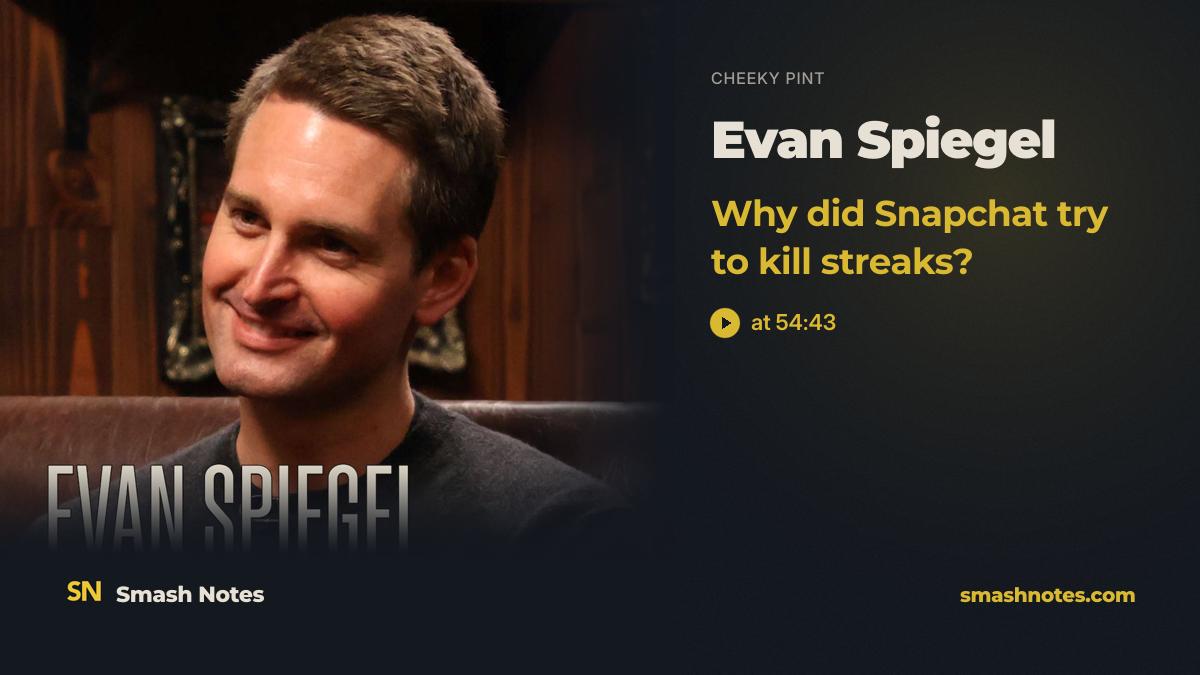
What comes after smartphones, with Snap CEO Evan Spiegel
Snap CEO Evan Spiegel joins John at the pub for a deep dive into Snap's "crucible moment" of 2026: the long-awaited consumer launch of Spectacles. Evan explains why he believes the smartphone has become an isolating legacy device and how true AR glasses represent the first step toward making computing human again. They discuss the technical hurdles of…
People
Notes
-
-
-
-
Why Won't Snap Build Camera Glasses? at 14:55
-
-
-
-
-
-
Related notes
- What Does Slack CTO Cal Henderson Tell Startups to Optimize for First?
- Will We Ever Reach a Peak Smartphone
- How Are Research Papers Changing Because of AI?
- Why Is Snapchat a Hard Place for Ads?
- How Should Discord Bet Outside Its Core?
- How Does Cutting Social Media Affect Distressed Youth?
Related episodes
-
![]() How Toto Wolff built the most valuable team in F1
-
![]() John Collison, Stripe: AI Agents Will Rewire the Internet
-
![]() Muse Wonder: Zuckerberg and Wang's $100B AI
-
![]() The airline CEO putting Starlink on every plane
-
![]() The company building America’s uranium supply from scratch
-
![]() The company building underwater drones for $50,000
-
![]() Slack CTO Cal Henderson
-
![]() #503 – AI Crisis in Math: Navier-Stokes, Riemann Hypothesis & Complexity Theory



0:02
This is pretty funny, playing chess in the pub. Cheers. Cheers. Good to see you. Good to see you. Thanks. So give me the Snap 2026 update. Product, business, just what do you spend your days thinking about? Well, we've described it as the crucible moment. Actually, we described
Expand full transcriptCollapse transcript
The episode notes above make this conversation easy to skim.
0:02
This is pretty funny, playing chess in the pub. Cheers. Cheers. Good to see you. Good to see you. Thanks. So give me the Snap 2026 update. Product, business, just what do you spend your days thinking about? Well, we've described it as the crucible moment. Actually, we described it as that towards the end of 2025, and it is just proving to be true.
0:23
in a major way for a couple reasons. One, we're about to reach a billion monthly active users, which is a big deal for us. We're really excited about the progress in the core Snapchat business. We're also on the verge of net income profitability, which is really exciting for us, especially as we invest really meaningfully in hardware and our specs glasses effort.
0:41
And that maybe brings me to the last point, which is that specs are coming to consumers for the first time later this year. So after 12 years of investment in glasses and the next generation of computing and trying to make computing more human, it's actually coming. So it's a pretty extreme time at Snap, and then we're doing all of that while transforming the business with AI.
1:03
So it's a pretty full-on moment. Why have specs been hard to get right? The vision you guys have had for a while, I think, has generally existed for a while. There were precursors like Google Glass. Actually, was it a precursor, or did you guys have specs before that? We've been working on specs probably since 2014. I think Glass came out in 2013, I want to say.
1:25
Anyway, similar times. You guys have been working on specs since very early on. Describe some of the technical challenges because it seems technically challenging with a lot of militarization challenges, but maybe give us an overview of why specs are hard to make work. Yeah. The technical challenges are extraordinary. I think the promise of specs is that you take the capability that people have experienced and pass through VR, but put it into a see-through glasses form factor.
1:50
That's the space that's unoccupied today. You basically have very low capability smart glasses or AI glasses, which are like AirPods with a camera sort of thing. And then you have very high capability virtual reality devices like the Vision Pro. And I think the sweet spot for specs coming later this year is the wearability of normal glasses, but the capability of a true spatial computer, something like a Vision Pro.
2:15
So the idea, and I think the promise of glasses, or at least what I love about glasses, is that it actually brings computing into the world. I mean, I think this is something that computing has suffered for a very, very long time is that it just by its nature has been isolating. When I was growing up, I loved computers. I built my own computer.
2:31
But to use a computer, you had to be in the computer lab at lunch when all your friends were on the schoolyard. And I think phones have continued that trend of pulling people into the into the screen rather than bringing people into the world, helping people share experiences together with their friends. The promise of see-through glasses is like you and I can sit across from each other, play a game of chess, design something, build something, watch something together.
2:52
That's totally unlike any computing experience that exists today. What do you think in, say, 10 or 15 years' time that computing mix looks like? You know, there's going to be some amount of glasses. Like, will smartwatches still have a place, or will the glasses do that? I mean, maybe it's useful for the wrist measurements. Do you also have, like, an Amazon Alexa-style AI speaker, and how many with you, if so? But I'm just curious, as you think about moving, you're describing moving beyond the smartphone.
3:20
What do you think that new equilibrium looks like? I don't necessarily think we're going to move beyond the smartphone. I think the smartphone's actually going to play maybe the most important role of legacy technology. Sorry, move beyond solely a smartphone. Ah, yeah. So, I mean, I think if you look at the capability of glasses, at least when it comes to specs, right, what I actually would estimate is that a lot of the large screen use cases are the first to move, right? So if you think about what's so interesting about specs, you can have a huge TV, right, with you almost anywhere, a giant screen with you almost anywhere.
3:50
Why would you pay thousands of dollars to put, you know, two or three TVs in your home when you can have any size screen through, you know, lightweight glasses, right? I think the same goes for a desktop display or a laptop. And I think that's really valuable when you're traveling, of course. I mean, I don't know, you know, it's super frustrating for me to work on a tiny laptop.
4:09
Yeah, exactly. And, you know, especially if someone's looking over your shoulder, you know, and I think it's really hard to get things done on the road. Okay, so one of the earliest things that glasses take is say, yeah, working ergonomically on a flight where you're not kind of hunched over your laptop, hunchback style. But what else moves and also what other devices do you think are in the mix? So I think when you think about use cases moving, I do think the screen-based use cases certainly are probably the best example of that.
4:39
What I'm more interested in though and where we're investing most of our time is actually on the net new experiences that didn't exist before. And I think that actually is what made the phone so meaningful. I mean, the desktop is still the best for word processing. It's still the best for information retrieval and getting things done. The phone is amazing for mobile communication.
4:57
Where glasses are really going to be extraordinary are experiences. right? And I think that's a really big deal. It's a big deal in terms of the way that people also want to engage with the world now. I mean, young people in general, it's not a secret. Folks want experiences. They want to do things together. They want to see the world in a new way.
5:12
And that's actually what glasses provide. So to me, what's so exciting is not necessarily replacing the television on your wall. It's playing laser tag with my kids outside in the glasses, putting dinosaurs in the backyard, building Lego with them together. I think those are the sorts of experiences that show people that computers can actually bring folks together in the real world rather than, you know, have us all staring down at a little screen.
5:35
Yes, yes. Maybe also usefully AGI-proof where, you know, the future is that you are, you know, at Coachella with your Snap spectacles and meanwhile Claude is off, you know, working on your desktop and doing the actual work. Well, this is hilarious. I mean, developers have already built ways to just, through specs, monitor what your agents are doing.
5:54
And you can just check in and kind of go on with your day. I mean, I think it's commonplace here in San Francisco. People will just carry their laptop around. They're at the bar. They'll quickly open it up, check on the progress, and then... It's like, you know, the joke about the more senior people are in the org, the smaller the screen, where, like, the developer has, like, the two parallel monitors, and meanwhile the boss is, like, sent from my iPhone.
6:15
And it's kind of that, but for everyone, is that everyone will be able to just monitor the agent's progress from the specs. I do think that's one of the really cool ways that computers are changing. I do think the paradigm that we all have to operate our computers all day long is going away, and I think that's hugely positive. Yeah. So what has been hard in the development of specs like battery, screens, motion sickness? There's all these things people talk about in the context of AR and VR, and I'm curious as you're at the coalface, what has been a challenge to crack or where does some of the Snap IP come in, in terms of defensibility you guys have built? Yeah, gosh.
6:51
Well, I'd almost want to say everything is hard about fitting a computer into a pair of glasses. But I can talk through the different pieces of our platform and how we've thought about it. One of the things that makes Specs so unique is we actually own every single piece of the stack. Everything from the developer tools called Lens Studio to the rendering engine called Lens Core, which we've now honed over a decade on mobile phones, especially low-end mobile phones, which is important when you're trying to manage power and thermal on a small device like that, but also our own operating system, As well, our own optical engine, so the wave guide, which is the piece of glass
7:28
there in front of your eye, and the projector itself, some other fancy stuff that we haven't announced yet. But all of these pieces really work together to be able to fit a full-fledged immersive computing experience into a pair of glasses. And all of those things are very hard. I mean, building a ground-up operating system on Linux was really difficult to do, but it's way more performant than trying to repurpose Android, right? We learned that.
7:52
I understand you don't use Android to build your own OS for it. Yeah, Android is way too bloated to work effectively on a pair of glasses. I mean, I think that's why you see the most recent Google experiment project, Aura, has a huge compute pack, right? We just don't think it's realistic for people to carry around a compute pack to use glasses.
8:10
The latest coding models are very good at working with Linux. They have a lot of training data for that. Have you found Cloud Code or Codex useful for developing in this environment, which is pretty different to what people envisage, the standard Cloud Code project? I mean, Cloud is transforming software development full stop at Snap in every part of our organization.
8:32
Can you describe that a little more, what that looks like? Yeah, I mean, I think it's extraordinary. Now more than two-thirds of new code is written by AI at Snap. That's happened really, really quickly. I think the rate at which these models are getting better is just extraordinary. So I think for us, we're really excited because we're so fortunate to be in a software business that has network effects.
8:52
Thank God. So, you know, we've got a service that connects people to one another, but fundamentally at its core, it's a software business. So the way that we write software, run our business is changing so dramatically. And at the same time, I think we're insulated from some of the effects of other software businesses that I think are being cannibalized very quickly by AI.
9:12
You've been much more of a believer in the AR form factor than almost anyone I know for a very long time. What gave you the conviction that this is the right form factor? You know, so much of what we do, actually everything we do starts with humanity, right? And like computing needs to be in service of humanity, that ultimately humans are the ones that decide how technology is adopted, right? And I think too often in the technology industry, we're focused on technology first rather than people first.
9:41
And I think that's a huge mistake. So I think when you start with people first, it becomes so, you know, glasses become so obvious, right? They're already worn by billions of people. They sit right in front of your eyes in terms of being able to you know, deliver a computing experience. You can operate them hands-free, right? When as humans, it's a big deal.
9:56
We do a lot with our hands. So having computing in a pair of glasses, I think is a better fit for our day-to-day lives. And then of course, having them at eye level and ear level gives glasses, you know, a really good understanding of the world around you, which is so important if you want to make computing more human, if you want to have computers understand the world and people, which we think is so key for getting the benefits of computing, but again, also for bringing people together.
10:19
So is it fundamentally a heads down versus heads up thing? You think the heads down smartphone way of being is fundamentally a bit antisocial and heads up is a more engaged, connected way of being? I think that's one part of it, but I also think if you wanted to build a computer or design a computer that actually understands the world around you, fundamentally it has to be out of your pocket, right? And ideally, right, because most of our human sensors for understanding the world are on our head, I think that, to me, is a really good fit for our glasses technology and in terms of the way that we can architect a computer that actually brings people together and fits better
10:58
into their lives. I feel like one thing that sometimes happens in the early stages of a new tech paradigm is that there's a lot of heterogeneity and people think there'll be a lot of specialization and then it all collapses. And so in the very early days, the smartphones like go back to 05, 06. It's like, oh, you'll have like the BlackBerry with the keyboard for people doing a lot of emailing.
11:20
And you remember like the Nokia N gauge that was like almost a PlayStation PSP type gaming platform. And then you'll have, so there was this view that you should have all these different types of smartphones. And then everything collapsed into just the single, you know, iPhone, Android form factor, and it's just going to be a big touchscreen and that's it.
11:40
Like, that's the only modality. Do you think something similar happens with specs where right now there's full VR, as you say, there's like smart glasses, the very lightweight version, and then there's your specs, exactly, which are kind of between those two. Do you think full VR, like Apple Vision Pro, has a place in five or ten years, or do you think everything just collapses into this form factor? VR may have a specialized role for more immersive training environments or things like that.
12:10
Surgeons and flight simulators and stuff. Yeah, but even then, I think folks really are going to want to be able to wear glasses and work together, right? I mean, you're going to want to be able to see your co-pilot when you're in your virtual cockpit, right? And so I think glasses are a better fit, right? Again, most things that humans do, because at the end of the day, we're very social species, right? That's one of the things that makes humanity so special.
12:30
So I think the idea that we're going to use technology that fully shuts us off from the world or results in us looking at the world through a screen, I just don't think that's realistic. Yes, yes. I mean, Apple does have with Vision Pro the kind of the look-through feature, but yeah, it's fundamentally you're a little blocked off kind of physically.
12:48
Yeah, that's, you know, pass-through VR where they re-project the world on a screen. But I can't imagine a huge swath of humanity wanting to interact with the world through a screen. I don't think that's a fit for who we are as a species. What do you think the ramp-up of specs look like? So when should I expect to be seeing a lot of them out in the street? Certainly, later this year, we'll make them available.
13:12
I think, you know, the early audience will be early adopters, folks who are really passionate about technology. I mean, I don't think folks remember, like, the Macintosh. In 2026 dollars, the Macintosh was $8,000, right? Yeah, it was really expensive. I mean, and I remember, like, vividly, my godfather bringing... You're talking about the 1984 Macintosh.
13:30
Yeah, yeah. I remember my godfather when I was young bringing us our first Macintosh. And he was so passionate about computing, the possibility for computing. That really changed my life, right? And I remember playing around with kid pics. And so I think when I think of early adopters, I think of my godfather, right? Yeah, yeah. Think of folks who really want to experience what's next in computing.
13:49
I think that's who specs are going to appeal to initially. They certainly won't be $8,000. I think that's a little pricey. But I do think that it's really important to engage that group of folks, especially as you look at how technology diffuses through society. I think the folks who are most passionate about this technology are also the ones who are going to become evangelists, who are going to show their family and friends, who are going to build new lenses.
14:10
We already have so many developers building lenses for specs, creating new experiences. Almost every day there's a new lens. As I think about the smart glasses success that has existed so far, a lot of it is sort of the GoPro competitor in a way, right? Where it's like, and even when I played with a smart glass and I had a super early version of the prior specs, which was many years ago at this stage, it's fun for if you're skiing or again, doing some kind of cool hands-free activity.
14:40
Is that an interesting market? You could say, oh, it's a niche, but actually lots of people like doing these activities and sharing them. It pairs nicely with the main part of your business. And so I'm curious, is that like a random niche for you or a big deal, the kind of GoPro substitute? You know, the problem for us is it violates one of our fundamental principles for making new products.
15:00
You know, which is that, and look, we learned that the hard way because we built camera glasses, you know, more than a decade ago, I guess. So we learned it the hard way. We also saw a lot of opportunity. We thought it was really cool to get the camera out of your pocket, right? You know, put the camera at a place where you can record hands-free.
15:15
You know, if you're kayaking or something, gosh, wouldn't that be cool to have point of view video? The problem is it's not 10 times better than the next best alternative, which is the phone. The rule for us in product design or when we're investing in a new product, investing in a new idea, if it's not 10 times better than the next best alternative, then there's no point in investing in it.
15:33
I think one of the other problems that we see is as a result, the market size is also quite small and the willingness to pay is very low. If you look at camera glasses today, low hundreds of dollars, maybe 150 bucks, 200 bucks to buy camera glasses. And I think what's fascinating is if you play that forward, the problem with camera glasses, if you're really successful, right? You really won't have been able to build a platform because they're not, they don't have an operating system.
15:58
They don't understand the world. They don't run applications. And therefore you're going to get undercut on price very, very quickly. quickly. And so the prize at the end of that rainbow, I think, is very small. And the customer benefit is also negligible when you can just pull out your phone when you're kayaking and make a great video. Or if you're really hardcore, put the GoPro on your head.
16:19
So I think we just didn't see a path to that being a 10 times better product. Okay. So it's not the right market. And so then... The way I think about new platforms is oftentimes customers buy them for a killer app and then that gets an install base and then they discover there's lots of other things that they'll use them for. And so you remember the initial adoption of personal computers and just early PCs.
16:43
a business might say, okay, I want a computer that can run a spreadsheet and I'm buying this spreadsheet box and it's a screen and it's a computer and a keyboard and everything for running spreadsheets. You realize it can do other things like, okay, cool. but later on you start doing other things with this, but it really started as the thing running the spreadsheet.
17:02
Do you think there's a similar adoption pattern for specs where there's one key, like people buy it because you can get a full size screen anywhere, and then they realize there's games on it, and then they realize there's other things they can do? Or do you think people will be adopting it for like a broad variety of use cases? In today's day and age, I think the killer app concept is a little bit of a mirage, frankly.
17:23
And so instead, I think- Great, you're telling me all my ideas are wrong. Terrible instincts for developing specs. This is good, I'm learning a lot. No, I think I understand why people, you know, see it that way and I just think that today, especially with how easy it is to develop software, that what's actually more important is to develop a platform where people can go after lots of different use cases that are highly relevant and highly valuable to them.
17:47
I think you're already seeing that today in enterprise software, for example. We have a calendar app called Saturn, which is really cool. It's actually built around your friends and your family, built for mobile. The team was using an enterprise service for bug reports and this kind of thing, probably cost like $100,000 a year. Today, they built a replacement for it in a day, saved $100,000.
18:08
But more importantly, they were like, this is a way better tool for us. It's built bespoke for me. I love this tool. Where I think we're at in 2026, which is fundamentally really different, is that there's literally going to be bespoke software. for people that they're going to be able to imagine, that they're going to be able to build and create really, really quickly that they can get an enormous amount of value from.
18:29
And so this idea of like one size fits all software, I don't think is as relevant in this new world. So your vision for specs is you have a new platform and you just have the era of custom software where you think up of what you want your specs to do and they can do them. And with Lens Studio, I mean, Lens Studio is becoming more and more agentic.
18:48
I don't want to ruin all the surprises that we have coming later this year, but I think what's so exciting about the promise of this platform is that anyone could build almost anything and see it in the real world incredibly quickly. And so that's a big change from the way that a gaming console works, where you really need that killer piece of software.
19:05
I think what's so interesting about the future, and I think you know, what's so different about specs is that people are going to build software that's, you know, what's best for them. And maybe they'll share it with friends or the world, but because building software is so easy now, it's a fundamental paradigm shift. Have you vibe coded any in Lens Studio, any of your own specs? Can you share what you've done or some of that stuff or what people at Snap have done? Almost daily, people are playing around and building new things in specs, playing around building incredible new tools.
19:33
I mean, it can be everything as silly as like a little airplane game, like drag your hand around and fly an airplane through the clouds, right? Or some folks are also, I mentioned that use case of seeing what your agents are up to, right? And being able to work together with them, right? that was also built with Agents. So I think the entire engineering paradigm, the way that software is built now, enables a totally different way of thinking about specs and about our platform, and frankly, overcomes the biggest hurdle that we were facing, which was the App Store platform lock in and moat, right? I mean, that's always been the biggest questions people have asked about a
20:10
new computing platform. How are you going to overcome the 1 million apps or 2 million apps on the app store, you know, that are locked into the Apple ecosystem? Today, it's so easy to write software. I'm sure you've seen my favorite graph, you know, has been the iOS app submission graph, right? Which is like bumbling along flat and now it's just exploded to the right.
20:28
The internal charts, as you can imagine, at Stripe are similar to that, where the rate of new business creation is just massively spiking. It's Unbelievable. So that to me is super exciting. And I think that unlocks a whole new way of thinking about specs in our operating system, Lens Studio, etc. The world's most successful creator platforms are becoming more and more like global financial networks.
20:52
They move money from millions of fans to millions of individual creators. But traditional payment rails weren't built to support this constant flow of funds across borders. With Stripe, platforms can send USD stablecoin payouts across borders instantly and at much lower cost. It means a creator on one side of the world can get paid just as quickly and seamlessly as the streamer next door.
21:13
So if you need to pay out a global base of creators or sellers, Stripe is here to help with stablecoin payouts.
21:21
I wanna talk about your core business a bit. Who do you compete with? Is it you narrowly compete with other mobile-first social apps, or is it you're competing with other entertainment forums, like Netflix is actually a competitor, because it's also a thing that you could do with your time. I'm just curious how you think about the set of competitors that you have.
21:42
I think our competitors are primarily messaging services. So I think that's, you know, the core of the services messaging when we launched Snapchat, it had no social features beyond messaging. I mean, that's always driven the growth of the service. And I think then secondarily, the camera as well. So, you know, If there's a moment happening in front of you, which camera do you choose to use? Do you capture with a snap camera or your lock screen camera? And I think that's another thing that we think a lot about.
22:06
I don't think people realize the scale of the number of selfies, for example. It was so funny. I think Apple announced last year, they were like, there's been 500 billion selfies captured on iPhone this year or something like that. And I sent a message to our team. I was like, that seems so small. How weird is that?
22:26
And sure enough, they came back and they're like, oh, well over a trillion selfies have been captured on Snapchat, right? And so I think when you, you know, over the same period. That's so many. It's so many, yeah. And we, you know, low-balled what we announced publicly. So I think, you know, what's funny about... I'm sorry, that's a thousand per MAU.
22:44
Per, like, lifetime. If there's been a trillion selfies lifetime. Over a year. Yeah, yeah, yeah. A year period. Almost a billion monthly active users, yeah. Yeah, yeah. That's a lot. That's a lot. Yeah. But I think people don't realize the scale and the engagement in the Snapchat camera. Okay. So messaging services of the competitor. And then how does the business work? I actually don't know that much about how the business works.
23:06
So you're approaching a billion MAUs and then monetization is mostly advertising for them or how do your different revenue streams break down? We've got... Two major revenue streams. One is advertising. The other is direct revenue. The direct revenue business is relatively new for us, I think, over the last two or three years. We just announced we hit 25 million Snapchat Plus subscribers, over a billion run rate on the direct revenue business.
23:31
So that's been growing really nicely for us. And then advertising, of course, whether that's on the map, we've got a product called Promoted Places, and actually really powerful closed loop measurement around that. So we, you know, a lot of folks care right now about driving folks into their retail locations and promoted places, you know, plays a huge role in doing that.
23:51
There's been a general trend, I think, of businesses directly monetizing, like having their equivalent of direct revenue be more relevant. with AI because the inference costs are real. And so if you are like, you know, maybe the prior generation of companies were very heavily ad dominant. Whereas if you look at, you know, ChatGPT or Claude or something like that, they have to have the various tiers of, you know, subscriptions, $20 a month and $200 a month, because you can just use a small amount of compute or a lot of compute.
24:24
So do you see similarly direct revenue becoming a bigger deal for Snap in future because you're just going to have more computationally expensive products. You know, if you're using a lot of computationally expensive Lens Studio stuff, like you can potentially burn a lot of compute as a user of Snap. Yeah, I mean, that's one consideration for us.
24:45
I think, and of course, we have a Lens Plus tier of our subscription service, which gives you access to more of our AI tools and editing tools. I mean, I don't think people realize that the Snapchat camera is one of the largest image and video generation platforms in the world, just given the frequency of engagement. And one of the ways we do monetize that is with the Lens Plus product.
25:04
But I think for us, if I look at our subscription business, it actually just really aligns with our company's ethos and also our core skill set. If you think about what Snapchat has been good at over the past decade, it's been making products that people really love. And so we would always get emails from customers asking for new features, different features, more bespoke features, like...
25:25
app themes, for example, and we never had the resources to work on it. We were like, gosh, we can't build something for a tiny subset of our community, even though they're so passionate about the product and about what we're creating. And so I think what's been so fun about Snapchat Plus is that we've been able to dedicate the resources to build this long list of features that our most passionate Snapchatters really want and are willing to pay for.
25:50
And so it really aligns, I think, what we love to do and I think what we do best, which is making cool new products with our community and what they want, which are more bespoke features from us. And sorry, is there a difference between what your paid customers tend to want versus what your free customers tend to want? Not necessarily, but I think the most passionate Snapchatters always have requests for how we can make the product better.
26:13
We can't always resource all those requests. But now with Snapchat Plus, we have an avenue where folks are really passionate about the service. They want a new feature. They let us know we can build that for our subscribers. And I think that's been really exciting. Do people have good ideas generally? who have great ideas, an endless number of great ideas.
26:33
How do you expose yourself to product ideas from the community? Well, my email is evanatsnap.com. So I get my fair share of great- Especially if you say it on podcasts. Of great customer emails, but online, on comments. I mean, every time I post a video, I'm getting comments from people telling me what we should do differently. So I think that's one of the great things about engaging with our community.
26:56
People think of social networks and messaging apps as network effects businesses, where the bigger they are, the better they work as products and businesses, because your friends are there. They are the textbook example used in business school discussions of network effects. And that is somewhat true. But there's also an element where... you have anti-network effects and diseconomies of scale as a social network.
27:22
One is as you get more popular, there's more kind of fraud and spam problems and things like that. But there's also a question of, you know, what is the id of the social network? And so, you know, maybe, you know, teens using a product don't necessarily want their like aunts and uncles on it because like the vibe is all wrong. Or, you know, maybe Silicon Valley insiders preferred Quora.
27:42
You remember Quora was around when we were first starting out. And it was originally like a very Silicon Valley insider product. And now it's a much broader product. And so as I think about Snap, one of the things you've done well is kind of you've kept it cool and you've avoided the ick of it feeling like it's too big, which again, sometimes social networks run into.
28:01
Maybe you can comment on that phenomenon and how you think about the risk in general. It's fascinating because you've tapped into two of the most important kind of ideas in social or at least two of the most important findings that we've had. The first one, which is I think maybe the most important, was that when we were starting Snapchat, you're right, the belief was that the bigger the network was, the more valuable it was sort of.
28:27
And, you know, folks had a whole model for that for how they thought about it. What Snapchat proved was actually that it's not about the size of your network or the number of people you can contact on your network. It's about who you actually talk to. And that tends to be a much smaller group than the total size of the potential network or even your total number of friends, right? In fact, most of your conversations, I would guess, right, on a daily basis are like with your wife, right? Maybe with...
28:59
some of your close friends, maybe some of your closest coworkers, but it's actually a very small group of people that you talk to the most. And that broke the model of social media, right? Which was the more friends you have, the more engaged you have, the more value there is. And we actually said, that doesn't sound right. I think people spend most of their time talking to the folks who are most important to them.
29:18
So if we design a service that's all about talking to people who are most important to you, your close friends, and we design a service that's really, really great at that, right? You may not send snaps all day to your... or hundredth friend, but certainly for me, I love seeing what our two-year-old is up to throughout the day. And my wife sends me little snaps and it makes my day.
29:35
It's the best part of my day, seeing what he's doing and what he's up to. And so we've really built a service that's great for your close friends. And that doesn't necessarily mean that you need the largest possible network. You just need the most important people in it. And so I think that was one of the reasons why Snapchat was able to grow because When we were first getting started, we just heard from everyone, you're never gonna be able to compete with Meta, right? There's no way, because they've got a bigger network.
30:03
And then I think the second lesson is sort of a follow on from that, because the other thing that we found is that as Facebook grew and Instagram grew, there was so much pressure to add more friends. Because if you remember back in the day, their entire business was based on the newsfeed, right? In order to have content in the newsfeed, you needed to have friends.
30:23
So in order to have more content, you needed to add more and more and more friends to have a newsfeed that had more posts and therefore more advertising opportunities. That created a really precarious problem because I think what folks found is after they added a certain number of friends, they got to a place where they actually didn't know who they were friends with.
30:43
They didn't know who was going to see their content. There's a straw that broke the camel's back type phenomenon where then it inhibits posting, which is very dangerous. And people felt really uncomfortable
30:55
posting. That then accelerated, I think, this need to bring in public content, no longer friend content. And very, very quickly, the social network morphed into something that was much more about posts from BuzzFeed or something like that or other news providers than it was content about your friends. And so I think that's been another one of our sort of key learnings over time.
31:17
And one of the reasons why Snapchat is a much more private service, right? You can't be embarrassed by your aunt on Snapchat because there are no public comments on your story, right? And you can share with your friends and feel comfortable doing that without the risk of being embarrassed. And because the service is oriented around close friends, we don't have many of those same challenges with a public newsfeed.
31:38
So your view is that if you think of a payoff curve for how good the product is relative to the number of friends you have on it, again, the textbook view is that it just goes up monotonically, whereas you're saying it starts off at zero because the product's no use if no one's on it. And then you're saying it goes up pretty quickly to 10 or 20 people but maybe hits a plateau and starts decreasing.
31:59
I don't know, what are the numbers here? Potentially even less. When does a social network start having anti-utility from the incremental user? I think we have to be careful to differentiate a social network from a messaging service. At its core, because Snapchat's a messaging service, you can get the vast majority of the value even by having one friend, two friends, three friends.
32:20
Those are the folks you talk to the most and that connection is really, really important to you. I think, as I mentioned, one of the big challenges of social networks was that in order to have enough content to drive enough engagement to grow the advertising business, there was a need to add more and more and more friends because the newsfeed was really reliant on new content.
32:39
I think one of the things that we did very, very early on, and we can argue about how well we executed on this, but one of the things we identified very early on was that we needed to open up to non-friend content, publisher content, content from creators, very, very early on. So rather than driving people to add friends, they could watch content from publishers when they ran out of content from their close friends.
33:00
And so we moderated that content. We were one of the first companies to actually rank that content with AI, with our service called Discover. And the fundamental thesis was like, let's not force people to add friends so they can watch more content. Let's just show them content from publishers or from creators. Oh, that's very interesting.
33:16
Okay, so your view is that the mistake would be one should add more people. You should get more connections on LinkedIn so that there is content in your feed. And your view is that you should separate out the people you want to interact with and having stuff to do in the app, and those are actually pretty separate concerns and it's very dangerous to mix them.
33:37
And that, you know, I think back in, it may have been 2016, 2017, we said the most important thing you need to do is separate social from media. The biggest mistake was combining them, and it creates a lot of perverse incentive. So instead, just add the friends that are important to you, who are close to you, use the service for messaging, share with them if you want to with stories or things like that.
33:54
And then, you know, if you want to watch more content, great, we've got this whole world of content available to you from publishers and creators, et cetera. Yeah, yeah. That's very interesting. Okay, the other thing that from a product point of view, I really associate with Snapchat is obviously persistence or lack thereof, the ephemeral nature.
34:14
And the norms around this have shifted a lot even though, of course, in my lifetime, I remember when I started using the Internet, the norm, I don't know if you remember this, was that you do not use your real name on the Internet. The Internet's a scary place and it will be dangerous for you to have your real name out there. Then we got okay with that and then there was the era where everything got posted in perpetuity through social networks and everything else.
34:39
And then we realized, huh, maybe everything being posted in perpetuity is not a great idea. And I feel like people are kind of still trying to figure this stuff out. And so I'm curious, again, what you think the long-term equilibrium is of, do you want a central store of all the photos you've ever taken in your camera roll? Do you want everything to be ephemeral? If things are ephemeral, maybe you really wish you'd kind of kept that birthday snap from a while ago.
35:05
And so what is the long-term equilibrium here just online in terms of how people reason about data? Do we need more fine-grained control between a one-off disappearing message and, you know, kept forever? Maybe we need new product inventions? I think my general thesis would be that it will probably mirror the way that we've been living for thousands of years, which is the vast majority of life is ephemeral.
35:31
And then you save the things that are important, right? I mean, you don't write down every thought you have. You certainly don't record every conversation you have, although we're recording this one, right? And so I think for me, that's likely how things will evolve over time with technology, certainly what we've seen with Snapchat. I mean, when we said, hey, it doesn't make sense that everyone's recording everything forever in terms of our conversations.
35:52
And in fact, that has an impact on the way people express themselves and share with one another. That sounded crazy at the time because literally everything was saved forever. And we were talking about things like the importance of privacy and the relationship between privacy and self-expression back in 2012. And people were like, what are you talking about? This was at the time when everyone was saying, you know, everything's going to be open and connected, right? You're going to share everything about yourself with everybody.
36:18
And that's just not how humans have lived for thousands and thousands of years. So I think what's very likely looking forward is what's already happened, right, which is the vast majority of communication products you use now, you know, have retention settings that delete, you know, your conversations unless you want to save them. I think that's true for, you know, Snapchat in terms of, you know, making snaps as well.
36:40
You may just wanna send something that's silly to your friend, but if it's an important memory or if it's our two year old running around doing something cute, I'll just save it. So I think people are gonna interact with technology the same way they interact with their with the world, which is save the things that are important and discard the rest.
36:54
Yes, yes, interesting. Where do messaging apps go? To me, the big question that I think we need to solve is what is the best way to communicate on specs? I think that's what's really interesting to me right now. And I think what's fascinating is that the social network of the future is actually hanging out together in person and using specs together.
37:17
So that's what excites me about the future of digital communication. I think messaging is fine, but it's hard to compete with actually being together with your friends and your family. So if we can build technology that makes that fun, that gets you all the benefits of technology, but with your friends and family, I think that's a huge positive.
37:35
You don't let your kids use screens. What age do you think you'll start? Our 15-year-old is fully on the screen. That ship sailed a long time ago. In fact, probably in COVID for sure. The baby, for example, the two-year-old, we let him watch YouTube when he's getting his hair cut. He's big into construction, so he likes to watch construction.
37:55
You're a two-year-old, construction. It's awesome. By the way, it's awesome at every age, but to see it through a two-year-old's eyes is so fun. You know what I mean? It's mind-blowing. So he's big into his construction videos. And then the six- and seven-year-olds will watch a movie from time to time or something like that. Actually, the TBPN guys gave me the Mod Retro video game, the Game Boy remake thing.
38:18
Oh, yeah. Let's check that out. Pokemon Yellow. It's awesome. Yeah, they got those for Christmas, so they play those a little bit. I guess what I'm sort of getting at is there's this big society-wide debate right now as to what you do with
38:35
kids, teens, and, well, in the general view, adults can kind of do what they want when it comes to phones and social media. What do you think is the right policy position there? I think the real danger is
38:51
blanket policy when everybody is different. Kids are different developmentally, right? Each of our kids are different in where they are developmentally, what they're passionate about, their interests. So I think no matter what, I think parents need to work to cultivate a healthy balance with their kids and do what's appropriate for each of their individual kids at different times.
39:11
You know, Flynn, for example, our 15 year old, he was going back and forth between his dad's house a lot when he, you know, in our house when he was younger. And so he needed a phone earlier, right? It was otherwise impossible to coordinate, right? And so, you know, that was something that was important. That was a decision that my wife and I made to give him a phone earlier than maybe we would have otherwise.
39:30
I think earlier than I got a phone when I was growing up because it was important for where he was at. So I think being a parent, we know our kids, I would argue, best. And so it's really important to think about what's developmentally appropriate for kids, your own kids.
39:46
Generally speaking, though, what concerns me the most is the massive swings in public sentiment. If you remember during the pandemic, it was like, technology is saving us all. Use screens all day long, all the time. And now we're in a moment where people are worried about screens and don't use them at all. And I think the healthy response to really anything in life is achieve a balance.
40:07
right? Our 15-year-old, he loves art. He's amazingly talented. He likes hanging out with his friends. And then, of course, he wants to unwind and watch something on Netflix or chat with his friends on Snapchat. No problem. I think it's all about that healthy balance. So I think for me, what I'm really watching with a lot of concern is that in this moment of such dramatic change with artificial intelligence, young people need to be learning how to use these tools.
40:31
It is absolutely imperative that young people learn how to adopt these tools. And by the way, it's so inspiring for young people to take an idea in their head and see it made real so quickly. And all of these advancements are happening at a time when people are incredibly skeptical about technology or concerned about technology. and are concerned about AI.
40:48
And so, you know, I think the industry has a lot of work to do to build trust, to, you know, make sure that young people are adopting these tools, which are just so vitally important to their future. Relatedly, Australia just blanket banned under 16s from the top 10 or some number like that, social media apps. What have you seen post the ban? In kind of the behavior of kids across Australia, as opposed to, you know, presumably just a lot of zeros in the logs.
41:15
Yeah, I think there are a lot of challenges with the way that the ban was implemented. As you mentioned, it only applies to a small number of apps. So if you're a young person, you want to continue to use services like Snapchat, you can just use a clone service. It doesn't fall under- Sure, just have a bunch of direct clones popped up, basically.
41:31
I haven't followed the exact number of clones, but there are plenty of alternatives. There are millions of apps in the App Store, right? And so I think to only apply the ban to a very small number of services, to not implement it at the operating system level just creates a lot of challenges, right? You can use facial ID scans, you can also use
41:50
government IDs themselves, but a lot of young people don't have government IDs. I think there's some real challenges in implementing a ban like this at the app level. I think what parents need to know, what's so important for parents to know is they can already configure this on their teen's phone using the operating system. So Apple's got a ton of great settings.
42:08
We use them at home for our 15-year-old where we can decide exactly what apps he can use, how long he can use them. All of these settings are available to parents at the operating system level, which is a much more resilient way to implement this sort of policy. So I think a lot of the noise The ecosystem today and a lot of the concern obfuscates the fact that these tools are already available for parents.
42:30
They've been available for a very long time. And I wish the government would spend more time teaching parents or at least telling parents that these tools are available because the app-level implementation with a handful of apps just doesn't really make a lot of sense. Yeah, I agree. The list of named apps feels like quite a clumsy implementation where, as you say, there are lots of apps in the App Store.
42:51
Especially with messaging apps and stuff, there's various substitutability between things. And so it seems like it will obviously lead to people going to other apps. And it's not clear what you've accomplished. As you think about teen usage in general, for example, lots of debates in lots of countries about kind of teen mental health. And I'm never quite sure how to pick through the data where like a lot of it's reliant on self-reported mental health data, which is just kind of a hard index to use because you get changed in reporting standards and everything like that.
43:22
But at the same time, you can imagine maybe bad engagement wells in which to draw people and you can conceive of bad product directions to go in and so i'm curious how you think of this where do you think it's teens are figuring out a lot and they have complex lives with lots going on and it's easy to pick on social media apps or messaging apps as a scapegoat? Or do you think, look, there's like a right way or a wrong way to design these products and we spend a lot of time thinking about, no, that actually wouldn't be a great product affordance to have because it would lead to some bad
44:05
outcomes. Like, do you think there's stuff to do at the app level or do you think it's just a convenient scapegoat? I think first and foremost, we have an enormous responsibility to make a product that we think can have a positive impact on the world. I think what's really interesting, you know, you mentioned sort of social media more broadly, and there are a lot of studies that look at social media broadly, right, and include Snapchat together with Instagram or TikTok or whatever.
44:26
There are a small number of independent studies that we have not funded or otherwise been involved with that have tried to understand actually the impacts of different apps and tried to differentiate between different apps. And I think what's so fascinating, I think now there's been maybe three or more of them, one out of Australia, I think one out of the Netherlands or something, one in the US, that show that Snapchat actually has a positive impact on people's wellbeing and relationships.
44:50
And that's different than TikTok or Instagram, which is actually negatively associated with people's wellbeing. And so I think because Snapchat is built around communication with your friends and family, because relationships are the number one predictor of positive mental health outcomes, right, of your ability to recover from a negative depressive event, It doesn't surprise me that because Snapchat's oriented around your real friends and connecting with your real friends, that it has positive outcomes when it's studied by researchers.
45:17
So I think one of the challenges for us, obviously, is to make sure that people are understanding Snapchat's role and not just lumping us in with social media, because people use Snapchat very differently. and primarily as a communications service. And so we really want to have a positive impact in the world. That's really important to us.
45:32
We are proud of the fact that independent research continues to show that, you know, concerns about overuse of technology are warranted. And that's why I think that healthy balance is so important. I mean, there were plenty of studies back in the day with television, right? If you watch too much television, that's associated, you know, with negative health outcomes.
45:51
So I think too much of a good thing, you know, can be... So do you think there's like a... loneliness connectedness spectrum with apps. And you're saying if you go too far into the loneliness direction where you're kind of going through the endless feed and you're in hour four, that's maybe not a great place to end up. Whereas what you guys are trying to encourage is more in the connectedness direction.
46:11
And you think that will lead to pretty good outcomes for teens or anyone else. But just in terms of what we've seen with the independent research, I think the reason that Snapchat shows up as being associated with positive well-being and positive relationships is because it's connecting friends. And doing so in an environment where people feel like they can express themselves, be their true selves, send a silly photo, not feel the pressure to look perfect on social media or not save something forever.
46:36
and receive public likes and comments and that kind of thing. So I do think that's a difference with Snapchat. And I think it's so important for us to just continue to make clear, we built our service differently. In fact, a lot of what inspired Snapchat in the early days was that we didn't like Facebook. We didn't like social media. We didn't like that you had this huge public friends list and all this pressure around posting things that would be cool and popular or pretty or whatever.
47:00
We grew up with social media and we built something different. in many ways in response to have something fun that we could use with our friends. Yeah, yeah. Do you think there's an issue, because as you think then about the content side of the business, there's a criticism that
47:17
if you start down a rabbit hole, you get pulled further down the rabbit hole, right? If you start interested in sovereign citizen conspiracy theories, you'll get pulled further into that. If you start with anorexia content, you'll get pulled further into that. Is that something you think about, that you have to balance people not getting pulled too far into rabbit holes on the content side? What I think is so fascinating about what you said is that people have focused far too much on the algorithms and not enough on the content itself.
47:47
And I think part of the reason why that folks focus on the algorithm is because they're wary of tripping the First Amendment protections around what content you can display on your service. But since we launched Discover, since we ever offered a content product on Snapchat, we have moderated that content. Now in the early days it was really hard because human beings had to moderate all the content before the days of artificial intelligence.
48:08
And so we only had a very small number of publishers and that actually impacted our ability to grow because we didn't have a huge corpus of content. But now today we continue to moderate the content, all the content that is appearing publicly on Snapchat. And so I think that really needs to continue to be the focus for delivering a safe and responsible content experience.
48:29
But don't people focus on the algorithm because for an individual user, the algorithm is the content. Like there'll be several orders of magnitude difference in the views between an uninteresting piece of content and a really interesting piece of content. And so my lived experience of any of these apps is that the algorithm defines my personal TV channel.
48:50
But I think in the example that you use, you know, a rabbit hole of anorexic content, like my view would be like that anorexic content, you know, or content promoting anorexia runs afoul of our guidelines, therefore should not appear on our platform. Okay, so you want to stop it at the moderation level. At the content level. And I think that's really where the conversation needs to be.
49:09
And, you know, again, it's hard in the United States of America because that's a First Amendment issue. So that's much harder to regulate. Yeah, yeah, interesting. Is there anything interesting to say on moderation? I mean, I presume that's just been a multi-decade journey of getting that right. I guess what I would say is it's important.
49:25
I think the content experience that our community has is really important. We've always had fair, consistent content guidelines that we share with everybody so that they understand the rules of the road. And our concept has been there should be rules of the road. And I think five, 10 years ago, that was different. I think now more people are appreciating that there should be more guidelines around the types of content displayed on services online.
49:47
People talk a lot about distribution dynamics in
49:53
this space and the fact that you guys, now that you're soon passing a billion MAUs, there's a lot of advantages you have where you can promote the Discover content in the existing app that first became popular with messaging, but also your competitors can do that with your functionality where you invent functionality and they can distribute it to their user bases.
50:13
I'm just curious how they distribute, like you're on both sides of that, right? You have your own distribution, but you also compete with others who have even more distribution. Just how is the distribution battle playing out at the moment? I guess perhaps the most important thing in all of this is distribution is getting more and more and more important in this day and age.
50:30
And I think as it becomes easier to build companies, to build software, to innovate using AI tools, I do think there's a real premium on distribution. And I think people are going to reallocate more resources away from things like software engineering, for example, to distribution in order to grow faster. So I think distribution is at a real premium.
50:50
It's hard as a brand today to get visibility, to get traction. And so places like Snapchat, I think, are a really important part of growing any business. And that's only becoming more valuable at this moment in time. So you end up having distribution defensibility, especially as other things get easier. I think it's just critically important.
51:08
I think even for us as we think about the future of our business, we've always had a ton of great ideas, right? Many more great ideas than resources to actually execute on those ideas. And so every time we've kicked around oh, we got an idea for a new app. It's like, oh gosh, I don't think we can spare 15 people to spin up a new app. No way.
51:25
Now with half a person's time, half a team member's time, we can build a totally new service and distribute it through Snapchat. And so that I think for us, as we think about the future of the business, being able to build out a multi-app strategy or more services, that distribution coupled with these advancements in artificial intelligence are a really big deal for us.
51:45
We talked earlier about Snap managing to remain cool, which is hard for a messaging app or a social network. How do you run product? Like, just what's the day-to-day? Are you having designers come present to stuff? Are you coming up with the ideas? Are people pitching ideas to you? What's the review process? Are you reviewing working features? Are you reviewing wireframes? I would just love to hear what the creative process looks like at Snap.
52:09
Well, first of all, it's cool to be uncool. So we're never trying to focus on cool. We're trying to focus on making things that are useful that our community will really get value from. And I think that's so important that like the North Star is durable value. I love design. That's really my happy place. I spent a couple hours a week with our design team and all we do is look at stuff And it can be really in any form, right? It can be a sketch.
52:29
It can be something on the whiteboard. It can be a fully functioning prototype. It can be on a slide or whatever. But the important thing is just that we're looking at a huge volume of ideas. So, I mean, I think on a weekly basis, probably looking at hundreds of ideas, ways to evolve the service or new products. And these are at the concept level.
52:47
These are sketches. A lot of them are drawings, yeah, or prototypes or whatever. Now, increasingly, our designers are shipping code, which is really wild. Okay, so post-AI, you're seeing many more working demos just because it's easy to make them. Yeah, or more importantly, designers are like, you know what? I've been so frustrated about this feature.
53:03
It's been in the backlog forever. I'm really passionate about it. Here's my PR. That's pretty awesome. Okay, and so then how do you... How do you down select between people probably come pitch you tons of good ideas in a week, more than you have bandwidth to implement? And also, I presume you're limited a little bit by users have familiarity with functionality.
53:24
And even if you could build it all, you can't just throw all this functionality into the app, because it'll overwhelm users. So you have two limiting factors. It's like, can you build good versions of all this stuff? And also, what rate can users absorb? And sometimes a great idea is actually we should get rid of this thing, right? Which is also a really important part of the creative process.
53:41
So what does the selection process look like? It involves a lot of debate, which I think is really fun. I mean, our meetings, I mean, everyone's laughing the whole time. And I think that's one of the most important things that a creative process has to be fun, right? Otherwise, what are we doing anyways? I think we try to debate and explore ideas and build on each other's ideas and There's no filter process.
54:00
If you've got something you want to bring to design meeting, have at it and we'll talk about it and play around with it.
54:07
Sometimes we also are like, oh, that's interesting. maybe another time and it comes up another two years later or three years later, we're like, oh man, you remember that thing we're kicking around? Maybe we should build on that now. So I think it's really just an iterative process of exploring new ideas. Brian Armstrong talked here about how when the USDC idea was pitched to him, he was like, I'm not sure, sounds kind of silly, but sure, if you guys want to do it, then go for it.
54:32
And obviously that's become one of the biggest things out of Coinbase. Do you have a similar story where there was an idea that you initially weren't so hot on, but ended up being... Oh, gosh, there's so many. You know, I mean, streaks are one. Like, I did not like the idea of streaks, did not want to do it. I actually fought very hard to kill streaks over the years.
54:54
We've always been anti-metric at Snap. Like, no metrics, no thank you. Metrics or gamification? You mean, like, user-facing? Just metric. Like, there's almost no metrics in Snapchat. It's hard to find a metric. Internally or externally? For user-facing metric. Like most social services, how many friends do you have? How many followers do you have? How many likes do you have? Comment, like everything has a metric.
55:14
You don't want their experience to be one of numbers. Like look at a bunch of numbers. You know, we want to get out of the way and help you communicate with your friends. And so I've been on like, you know, over the years, just like trying to get rid of streaks. And what really changed for me was learning how much people love streaks as an opportunity to connect with one another.
55:32
And so over time, like I would just hear these stories, like people, again, Evan at Snap.com, people would send these emails of like, you wouldn't believe it. Like I, you know, I moved halfway across the world. I was separated from my best friend. I got a divorce. I got a new job. And every single day I stayed in touch, you know, with my best friend.
55:49
And like that changed my life and like was so powerful for me. And I was like, wow, like, okay. But just sometimes having an invitation to communicate or an invitation to connect is so important. And so I think over time, I've come around to really seeing the value there. Streaks of the digital equivalent of getting out of the house. It's just, it's important to get out of the house.
56:08
Sometimes you gotta get out of the house.
56:11
I think I'd do that online as well. Okay, that's interesting. And then when we talk about the product design process, are designers kind of in the driver's seat of this? I don't know if you've compared notes with Brian at Airbnb where they have like a very design-forward culture. Is that how the culture at Snap is? You know, I'd say that culture at Snap is like a thoughtfully managed dialogue between design and engineering and product management as well, data science, you name it.
56:37
Because for us, like the business was always built like initially on the dialogue between myself and Bobby, right? I mean, he has more heavy engineering background. I was more of a design background, but like, you know, but he really loved design and I actually, you know, loved engineering. And so we were able to like really debate things and see things from different angles.
56:55
And that was always, I think, something that really helped the business grow. And so we tried to model that as a team, where it's not necessarily design-led or product-led or engineering-led. It's a healthy dialogue and relationship between all of these really important functions in our business. When you talk about data science, one thing I'm reminded of is often in social networks, because of the network effects, you get these very strong country network effects where like Orkut was very, you know, Google's social network that no one really used for a long time, except all of Brazil, you know, who were really into it.
57:27
And so you get these kind of funny regional effects. Are there any countries that are just like really disproportionately wildly into Snap? Well, Norway was the first place that Snapchat got traction. I mean, we had no traction anywhere. Not the U.S. Not the U.S. We had no traction anywhere except Norway. In fact, in the very early days. I did not know this.
57:44
Oh, it was a blast. In the early days, I think this was like after we had gotten venture, maybe after we had gotten venture funding. I think in the early days of getting our first round, you know, we'd raised $400,000 or something like that. And we were really growing in Norway, like big time growing in Norway. Kind of like a Canadian girlfriend.
58:01
My app is big in Norway, trust me. So we literally got on an airplane, flew to Norway, and we were famous. I mean, it was unbelievable. You were in a 7-Eleven and people were like, what? You guys work at Snapchat? That's crazy. And I remember just being like, oh gosh, I hope this happens in more places. It was an amazing, an amazing feeling.
58:19
So how did it happen? Well, I think one of our hypotheses is that Norway had both very high-end devices and great internet connectivity that was affordable for the population. If you think about Snapchat back in the day, you really needed an iPhone to be able to use the service. I mean, it was iPhone only in a lot of cases in the early days.
58:37
And it required very, very heavy network use because you're sending photos and videos all the time, which was really unusual back in 2012 or whatever it was. So the kindling was dry enough for the Snap Fire to... To really like take hold. Yeah. And then, you know, over time, obviously it grew in the U.S., but the U.S., you know, didn't necessarily have the same, you know, network capability or even iPhone distribution at that time.
58:57
Yes. Yes. Hmm. Well, that's so interesting. How about today? Are there any countries that are funny? Norway is still a Snapchat leader. It's unbelievable. Yeah. Yeah. And, you know, the other thing that's interesting about Norway, and I think this is true about Snapchat in general, it's a culture that really prioritizes close family and friend relationships.
59:14
That's something that's really important to them. Yeah. My Norway impression was the infrastructure is so good. It's like this country is so rich. I think they build infrastructure beyond what's sensible. You'll be driving to a village that has a population of 200 people, and you'll pass through seven kilometers of underground tunnels to get there.
59:32
Hold on. Anything else will be a ferry. And the person pouring you a Guinness has a graduate degree. Exactly. Yeah, yeah, yeah. It's a funny country.
59:41
How has your leadership style changed over the years at Snap? In so many profound, profound ways. I mean, I think everything about leadership is about people. I love our people, but I didn't start learning how to lead people. I started building products. And so I think the transition from trying to make stuff that people really love to trying to lead in a way that can inspire people, it's really hard to do what we're competing against the largest companies in the world in the messaging space, building hardware, again, competing with the largest companies in the world, working on foundational models.
1:00:19
When I look at our video models and everything we're doing, we're trying to do some of the hardest things in the world. And so that requires inspiring people to take on enormous challenges, recruiting some of the best folks in the world to work together with us, and then building a culture where those people can do the absolute best work.
1:00:35
of their lives, and that's different in many ways than just trying to build a product that people love, but it's the same in that it requires a lot of empathy and understanding people and understanding that people are very different, understanding how to bring out the best in each of them, and that's one of the challenges I love most about the job today.
1:00:52
In the context of building hardware, one thing I hear from people who do it is that It's harder in the US because of the supply chain dynamics. And in particular, if you're making stuff in Shenzhen, there's a company just down the road that can give you the V1 overnight. And then you say, oh, we want to change this component. And they'll swap out the production line of the components again overnight.
1:01:14
Have you found that supply chain speed dynamic in the US a factor where, in particular, as we talk about re-onshoring so much manufacturing, the limiting factor with U.S. production is often how fast you can iterate, essentially. I think people are always stunned to hear, like, we build, you know, some of the most important components for specs in the U.S.
1:01:34
and in the U.K. So we've really thought about building some of the most IP-sensitive components, some of the most sophisticated components in the U.S. and the U.K. where we can sit them directly next to R&D and engineering so we can have those really, really fast cycle times and iterations. In-house or in the U.S. at contract manufacturers? In-house.
1:01:51
And that's really allowed us to lead on the display technology. I mean, even if you look at specs today, the resolution, the performance of our waveguides far exceeds our competitors. And again, we have a lot of foundational IP and patents in this area. And that is one thing I love about hardware. It's way easier to protect our innovations and our ideas compared to software, especially today in the age of AI.
1:02:14
Yeah, yeah. I think that is a huge factor these days as well. This is awesome. Thank you. Yeah, it was fun. See you soon. See you soon.