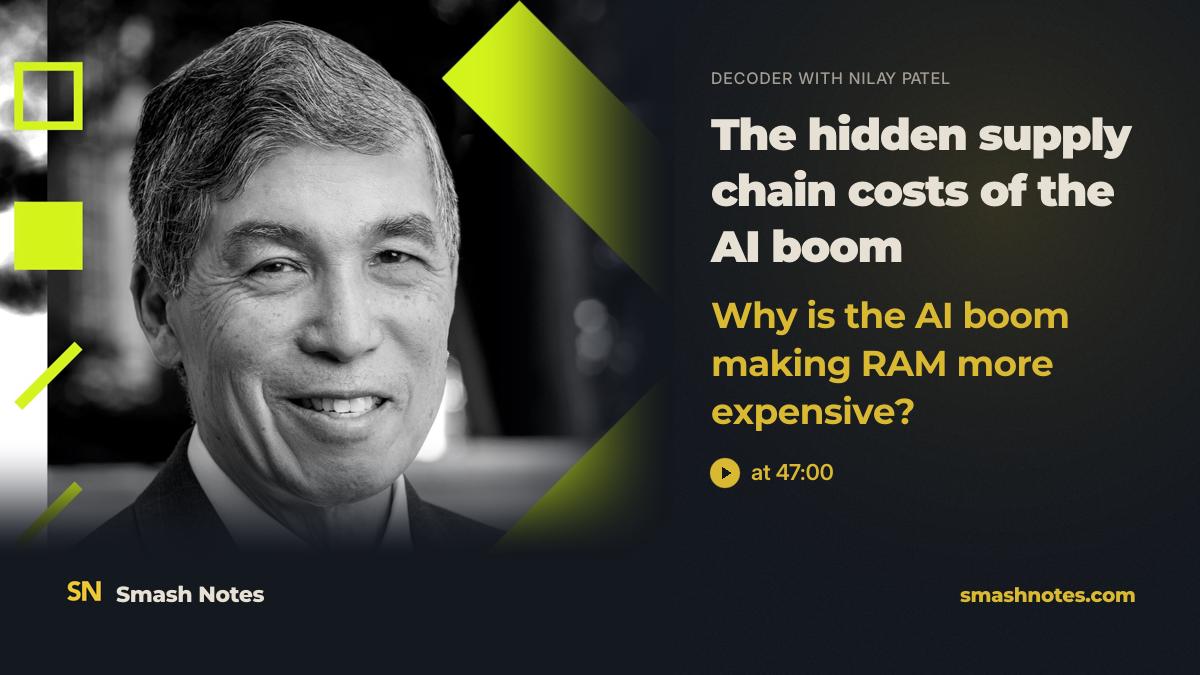
The hidden supply chain costs of the AI boom
My guest today is Willy Shih, an economist, a professor of management practice at Harvard Business School, and the author of the upcoming book, Where Does My Stuff Come From? The Powerful Economics Behind Global Supply Chains. Willy’s new book is all about the economics underlying global trade, which our politicians and regulators seem to insistently…
People
Notes
Related notes
- Is China Actually Crushing It Right Now?
- How Do Chinese Open Models Spread Chinese Chips?
- Why Did It Cost More to Ship Oil Than to Refine It?
- Why Are Phones and Laptops More Expensive?
- Is Apple to Blame for Rising Memory Prices?
- Why Is Hardware Still Hard?
Related episodes
-
![]() Bill Gates says to prepare for 20 years of ‘tumultuous’ AI disruption
-
![]() Inside Anthropic’s trillion-dollar AI gamble
-
![]() Kevin Roose is AGI-pilled. Why aren't you?
-
![]() Why Peacock is making a huge bet on YouTube
-
![]() Big Tech’s $3T AI Bet, Claude Writes 90% of Anthropic’s Code, AIs Editing AI Brains | EP #308
-
![]() It's not AI Doom, It's a Fourth Turning
-
![]() Air Pollution: an Unclear and Present Danger
-
![]() Amazon CEO Andy Jassy on the $220 Billion AI Buildout





Full transcript
The episode notes above make this conversation easy to skim.
0:01
Support for the show comes from Atio. There are sales teams out there who never seem to stop moving, always a step ahead, always working with a level of precision that doesn't seem normal. It's no secret, they're on Atio, the agentic CRM. Atio runs the work behind every win. It's built for humans and agents with the guardrails of human software and the scale of agentic infrastructure.
0:24
This is the frontier of go-to-market. Teams like Parallel, Turbo Puffer, and Wardsmith are already using Atio to set the pace. Now it's your turn. Try Atio for free by going to atio.com slash decoder. That's A-T-T-I-O dot com slash decoder.
0:47
Support for the show comes from CrowdStrike. It's not a huge stretch to say that AI is the next major computing platform. Every platform shift changes the way we build software, and it changes security too. CrowdStrike is defining cybersecurity in the AI era with AI Detection and Response, or AIDR, a solution for seeing, monitoring, and securing AI across the enterprise.
1:11
Learn more about how leading companies are turning to CrowdStrike to secure AI and secure their business at CrowdStrike.com slash decoder.
1:21
Support for the show comes from ServiceNow. AI is moving fast across the enterprise, but without visibility, it's just chaos. Different tools, different models, different teams using AI in completely different ways. ServiceNow turns that chaos into control. With the AI Control Tower, you see all your AI across the business in one place. What it's doing, what it's done, and what it's about to do, so you stay in control.
1:49
To put AI to work for people, visit servicenow.com.
1:58
Hello, and welcome to Decoder. I'm Nilay Patel, editor-in-chief of The Verge, and Decoder is my show about big ideas and other problems. Today I'm talking to Willie Shih, an economist, a professor of management practice at the Harvard Business School, and the author of the upcoming book, Where Does My Stuff Come From? The Powerful Economics Behind Global Supply Chains.
2:14
Willie is one of my all-time favorite Decoder guests. His way of looking at the world through supply chains is a fascinating way of making sense of the global economy. I actually first met Willie in 2019 while The Verge was covering Foxconn's promises to build an LCD plant in Wisconsin. That obviously never happened, but Willie called it right away because he could see the supply chain to support an LCD plant simply wasn't in place.
2:35
We also had Willie on the show in 2021 to talk about what was then the pandemic-era chip shortage. Now, five years later, we're in the middle of another manufacturing mess, as we stand in the middle of a worldwide fight over whether globalization itself is coming to an end. Trump's tariffs keep changing, the factories that were supposed to reshore manufacturing in America mostly haven't materialized, and AI is devouring the planet's computing resources during an unprecedented infrastructure build-out.
2:58
Willie's new book is all about the economics underlying these complex systems, which our politicians and regulators seem to insistently ignore. You'll hear us talk about why supply chains and markets have been so resilient in reacting to all these disruptions in the way they have, and why China remains a global manufacturing powerhouse, even though every other country knows that's so risky.
3:16
I loved this conversation. It's deep in the weeds, and Willie really knows his stuff. Before we get going, do me a favor and subscribe to Decoder on YouTube, where we put out new episodes every Monday and Thursday. Okay, economist Willie Shih on his new book, Where Does My Stuff Come From? Here we go.
3:41
Willie Shee, you're an economist, you're a professor of management practice at Harvard, and you're also the author of the new book, Where Does My Stuff Come From? The Powerful Economics Behind Global Supply Chains. Welcome back to Decoder. Well, thanks for having me back. I am very excited to talk to you. You and I first started talking ages ago when The Verge was covering Foxconn in Wisconsin, and you were a reliable source of information on what it takes to actually build an LCD plant anywhere, not just in Wisconsin.
4:06
You know, the Foxconn in Wisconsin thing was kind of funny because, you know, I tend to go on first principles on these things. Once I knew they weren't going to build a glass plant across the street, it's like there's no way there's going to be a factory. Now, what happened afterwards, of course, is people heard your show, And then I start getting calls from people who live in the community.
4:27
Okay. And they would go to the zoning hearings, you know, in town. And then they send me the plans and they say, is this going to be a panel factory? I said, no, I told you it's not going to be a panel factory. You know, so they send me the plans. I said, well, there's not enough concrete to make this a panel factory. Right. Because, you know, for a panel factory, you need the stability.
4:47
So you've got to have all this structural steel and you have to have all this concrete. My favorite part of this Foxconn story, and I don't mean to rehash it, it's just fun to talk to you about it again, is when you said there's not enough concrete and steel. It's great. We should actually talk about LCD manufacturing a little bit. There's an entire chapter in your book about why all of it is in China and China's investment in that.
5:07
But I wanna just take a big step back for a second It seems to me that you've written a book about the end of globalization in one particular way. We had big global supply chains. The pandemic came, shocked the just-in-time manufacturing system to its core. And then the Trump administration, in the second round, has imposed a whole bunch of tariffs.
5:30
And I've had a number of guests on the show straightforwardly tell me, we're de-globalizing the economy. That's what's happening here. We can't rely on it anymore. Your book, as you read it, is a little bit of a reaction to that, but you're also pointing out globalization is one of the smartest ways to do it just based on first principles economics.
5:50
Tell me about the state of the world and the state of our supply chains right now from your point of view. Well, you know, I think the point about first principle economics is actually spot on, okay? And I often tell people, it's like my father was an economist, and I used to see him come home from work, and I thought, I never want to do that, you know? And I'm gonna go into science and technology, right? And so I go into science and technology and take all these engineering classes and I'm in product businesses only to discover to my horror, if you don't get the economics right, then it doesn't matter about the science and technology, okay? And the book is really, you
6:28
know, the subtitle is, the powerful economics behind global supply chains. And I talk about all these principles behind global supply chains, but they're all actually driven by economics. And in fact, what you see today is market forces responding to all this stuff. So for example, when we put tariffs on stuff coming out of China, then manufacturers say, OK, let me move that supply chain and I'll do my assembly in Vietnam or I'm going to do my assembly in Mexico or let me find some way to circumvent these tariffs.
7:07
OK, and that's that's really what I find is like when you look at how these supply chains are structured, why do, you know, Cashew nuts say they come from Vietnam when they were actually grown in the Ivory Coast or Ghana, right? It's like, well, there was an economic reason for all of these things. It's like, why do frozen fish that are caught off the coast of Alaska go to Qingdao, China for processing before they come back? Well, again, it's because it's cheaper to do it that way.
7:40
So when we put up these trade barriers... You know, the first reaction tends to be, you know, it's like, how can I circumvent that? Okay, and we saw a lot of that, especially last year. You know, I remember Liberation Day was April 2nd, right? And if you look at the quarter right before, people knew stuff was going to be happening. You know, so we had this circumvention going.
8:06
And that's why, you know, first quarter 2025, all-time record imports fell.
8:11
from Ireland and then the first half of 2026 kind of slow imports from Ireland. That's because we're burning off all the stuff we imported in the first half of 2025. And it all gets down to economics. I'm getting all these TV set ads because the holiday season is coming up, right? It's like, great, you know, and they're all coming from Mexico.
8:31
It's like, how can they all be coming from Mexico? Because I know the flat panel factories that supply all these TV sets these days are all in China, right? And they're all in China because the plants have been subsidized so heavily or because of industrial policies that have encouraged those plants to be there. If you watch the trade lanes, you'll see this stuff.
8:51
What happens is there've been all these new shipping routes from China to Mexico over the last two years, direct ocean container service from China to Mexico. It's like, huh, I wonder what that's about. I'll tell you what it's about is moving parts and components from China to Mexico so that I can assemble them in Mexico and then bring them in under the USMCA agreement, right? So what you're actually seeing is these supply chains are organized the way they are You know, partly because sometimes it's because some places have the capabilities, okay? But more often than not, a lot of these are just responding to economic forces.
9:32
If I'm gonna throw on tariffs or if I'm gonna make it more expensive to ship something, between two points, the market will find a way around that. That's something I want to come back to several times in this conversation. It's cheaper was a real driving force of globalization. Americans like cheap things. They like cheap flat panel TVs.
9:52
The fact that I can go to Costco right now and get a 50-inch TV for $300 is a miracle of the modern supply chain and of modern manufacturing. It is a miracle, right? And it's cheaper, and it's because there's a place that, for better or for worse, can make it cheaper, okay? And by the way, American consumers benefit from that. One of the reasons that we pursued free trade and globalization so heavily in the United States is we thought that creating economic ties between all these various countries would reduce the potential for an armed conflict.
10:26
There's a lot of ways to think about that. But in general, if you tie the economies together, the price of having a war shoots up, and also then you won't have free or cheap TVs, and maybe the public won't like that. That is under pressure now, right? I mean, we're sitting here in the middle of an AI conversation where China is routinely invoked as the great threat that will rise up if they get to AI, AGI before us.
10:50
We are putting up tariffs, particularly on China. In the United States, the policy administration is to bring manufacturing back to the United States through the use of tariffs. Your point of view is that simple economics will provide enough contortions to avoid that blunt outcome. you know, when we seal the borders for some products everywhere, right, then the price is gonna go up.
11:13
Okay, so for example, putting tariffs on steel,
11:17
you know, initially when we just put tariffs on imported steel and aluminum, then what happened is like, well, gee, you know, I happen to be making construction equipment and more than half of the cost of that construction equipment is medium carbon steel, right? So therefore it makes it easier for me to, import construction equipment from somewhere else.
11:40
And then we say, okay, now we're going to tariff stuff based on your steel content. Okay. Eventually when you close off all those things, you know, which means you're basically tariffing everything, then stuff gets more expensive domestically, okay? And, you know, you could look back on the period from, you know, 2000 until really 2012, 2014.
12:03
We had relatively low inflation. Part of it is because we were getting cheaper stuff from China, okay? I think there are a couple things that drove a breakdown of this model, if you will, okay? One is... People didn't really recognize that connection between moving work out of the US to China meant you're leaving behind people who now don't have any more work, okay? And that cost was spread over people
12:36
who, by the way, also shop at Walmart and benefit from the cheap goods, right? But we didn't really, as a country, didn't think about is like, how are we gonna retrain all those people who weren't making furniture in North Carolina, okay? Or who were making, castings and forgings in you know kentucky or wherever that was one part of the problem the other part of the problem is like we have this gigantic trade deficit now a lot of that is fueled by government spending and borrowing and and so on like that but typically you know in some respects you would have expected the exchange rate or some other adjustment mechanism to uh uh you know, compensate for that.
13:20
I remember the last time exchange rates moved was really in the 1980s, okay? And that was also the last time the US ever had a trade surplus, right? When, you know, the dollar got a lot cheaper relative to, especially then, it was the Japanese yen, okay? And that... had an adjustment on trade flows as well. All right, so now you have China running this ginormous trade surplus, okay? And basically what they're doing is they are exporting their economic problems in China to the U.S., okay? And they're exporting...
13:56
that at the expense of jobs elsewhere. The Europeans have suddenly woken up to that. And especially you go to a place like Germany, where half of the economy is... revolving around the auto industry. And they have now figured out it's like, wait a minute, this is an existential crisis for us. Okay, but those two things, it's like kind of the controls on this that you would have expected to rebalance things didn't pan out.
14:25
That's why we have so much discussion about this right now and so much
14:31
view of this as a problem. It feels like my entire teen experience was a conversation about NAFTA, right? And we should open free trade in North America. And then later I got to college and all the economic discussion was about the EU and creating the single market in the EU. And we're going to stand up these big open markets and there's going to be free trade inside of those markets.
14:54
And that will lead to a kind of economic prosperity, right? We're fast forwarded to 2026 and the desire to tear a lot of that down has gone way up, right? Particularly as you look at the USMCA and Chinese goods coming to Mexico to come to the United States, sort of nakedly circumventing the entire policy goal of imposing tariffs. The goal is to build the iPhone in the United States.
15:17
The goal is to build manufacturing in the United States. I know that you have never really thought that's an achievable goal, but that is the goal. That is what the administration promised. And we've created these sort of trade groups, trade associations that allow that goal to be circumvented. Do you think the walls are going to keep going up or do you think they're going to come back down? I think we're going to see more pressure to kind of moderate our behavior a little bit, okay? Because let's face it, there are a lot of goods where we as a country need access to inexpensive labor, okay? So I'm actually very pro-USMCA as a successor to NAFTA because I actually think
15:59
You know, there are things that we need in expensive labor. Mexico is a good place to source things like that, right? There are things that we need from Canada, right? So if we were to look at North America as a trading block, then what you would see is you would see the benefits of specialization, right? Which is the whole rationale for trade in the first place.
16:23
It's like, we're better at doing this, you're better at doing that. You
16:29
specialize in that, we'll specialize in this. we trade, everybody's better off, okay? And if you can do that with a community of countries that understand the need for that type of balance, then everybody is better off, okay? I think the problem with China is they're very happy to have this imbalance where they want... the world to be dependent on them, but they don't want to buy stuff from the rest of the world.
16:57
When you have that, then trade doesn't really work, right? So I think that's the problem.
17:03
I'm hoping we're going to realize that we're better off among a group of like-minded countries where we can trade within that block. So, for example, if
17:17
the U.S. were to view North American partners and European partners and Japan and countries in Southeast Asia and Australia and New Zealand and, by the way, parts of Central and South America and even Africa and say, okay, let's trade across this block we'd have access to most of what we need, whether it's critical minerals or, you know, low-cost labor or a lot of technology specialties, right? So, you know, we could do much better with that, much better than a kind of go-it-alone strategy in my view.
18:00
Support for the show comes from Granola. Think about how much time you spend in meetings trying to listen, contribute, and take notes all at once. Somewhere in all the multitasking, it's easy to lose things that make a conversation valuable in the first place. Being fully present. That's where Granola comes in. Granola is an AI-powered notepad that makes your meeting notes useful.
18:20
It captures what happens in your meetings and turns it into clean, structured notes with decisions and action items pulled out and made easy to find. And it gives space to do things that matter most, like paying attention to the person sitting across from us. Granola integrates seamlessly with how you already work. No setup, no configuration, no friction.
18:39
It transforms messy meeting calls into organized notes you can actually reference weeks later. Once you use Granola in your first meeting, you'll never want to take manual notes again. You can try it totally free. Head to granola.ai slash decoder. That's granola.ai slash decoder to get your time back. Go to granola.ai slash decoder and try it on your next call.
19:03
Support for the show comes from CrowdStrike. AI is already fundamentally changing how companies build products and run their businesses. If you listen to the show, you probably already know this. But while AI drives innovation, every new model and agent also creates new cybersecurity vulnerabilities. That's why CrowdStrike built AI Detection and Response, or AIDR.
19:27
AIDR helps organizations discover where AI is being used, monitors AI activity at runtime, and helps teams detect, investigate, and respond to threats involving AI systems. As companies adopt AI, security has to be built in from the start. More than 70% of the Fortune 100 trust CrowdStrike to protect their businesses. Now CrowdStrike is helping secure the AI era.
19:52
You can learn more about AI detection and response at CrowdStrike.com slash decoder.
20:03
This episode is brought to you by Indeed. You're ready to level up your business, but the pressure to find the right person to make that happen is intense. Indeed sponsored jobs can help carry the load. It boosts your job post to help it reach quality talent fast. Cut through the chaos with Indeed sponsored jobs. Get a $75 sponsored job credit at indeed.com slash podcast.
20:24
Terms and conditions apply. Hiring now? Then this is a job for Indeed sponsored jobs.
20:38
It's funny, the first part of the book, which I highly recommend the audience reads, it's a fun read, is just setting up the first principles of why we trade at all in the very concept of labor arbitrage, which seems like we're having a national policy conversation that is 500 steps removed away from these basic ideas of why we would trade.
20:57
And it is entirely centered around, can you bring manufacturing back to America? Because we let all the manufacturing jobs go to Mexico and then go to China, and particularly in high tech, and we're behind. And there might be some extraordinarily bad event, like a war, where it's exposed how little manufacturing capability we have in the United States.
21:16
And that sort of has nothing to do with the basics of specialization in various countries around the world. It's another problem, and the blunt instrument is... boy, it's bad that all of our drones are made in China. We're going to prevent the drones from being sold here. And of course, our industry will set up drone manufacturing in the United States.
21:36
I don't see that connection. Do you see that working? No, I think that's kind of... a transactional view where you look at one piece at a time as opposed to looking at the bigger picture, right? I think we have to start with a core principle that the US is a high cost country, okay? And therefore, if you want manufacturing jobs coming to the US, then you've got to have high labor productivity, okay? And in fact, if you look at the types of jobs that are coming back to the US, they tend to be using a lot of automation, using a lot of sophisticated manufacturing processes and stuff that is high skill that you can justify the high labor cost.
22:20
Either that or they are things where we have a technological lead that nobody else knows how to do in the world, right? I was looking at like
22:32
the high temperature super alloys that are used in the hot section of jet engines, right? There are only
22:40
companies in the world who know how to cast those and two of them are in the US and one of them is in the UK and there's things like that the rest of the world has to buy from us okay so you know if you have high labor productivity or you know highly differentiated products those we can make in the US we can make them successfully and by the way most of them never left the country right jet engines you know the US
23:09
and France and UK are major suppliers of those to the entire world market. Even the Chinese buy those
23:20
from the West, okay? And so it's like, if we have these things that we do better than anybody else, We should invest in those and make sure that we're always in the lead. And then everybody else will buy from us. And then nobody will hold, you know, then you'll have some balance where you can't be held up, right? There's a lot of this thinking is like, I wish I could turn the clock back to the 1980s or the 1970s when manufacturing was the path forward.
23:48
uh to the middle class in the u.s it's like no manufacturing has changed worldwide okay and those jobs that you want to have manufacturing in the u.s you've got to have the high labor productivity or the high differentiation that'll go with it I want to stay on the iPhone for one more second. Apple just inked a new deal where they're going to source a bunch of titanium from a Pennsylvania-based company called Perryman for the iPhone 18 Pro and the new iPhone Duo.
24:14
They're going to source that titanium here. They're going to ship it to China. They're going to assemble the phone in China. They're going to ship the phones back to us. They do that with Corning and Glass as well. I've always looked at that, at Tim Cook's job in particular, is he's a statesman. Right. He's got to negotiate with Donald Trump and Xi Jinping about iPhone production and tariffs in these supply chains.
24:35
And the iPhone kind of holds the global economy together. Like if the price of the iPhone gets too high because of tariffs, like maybe there's an electoral impact in the United States. How do you see products like that? Are they as load bearing as it feels to me or are they just examples of the larger system? I think the iPhone is a terrific example of how difficult this problem is, okay? Because right now you have components that have high technological complexity, right? I mean, iPhone uses the most advanced chips produced by Taiwan Semiconductor Manufacturing, right? And by the way, most of those chips are still gonna be made in Taiwan.
25:18
TSMC has a fab in Arizona, but its capacity is piddling compared to what they have in Taiwan. Okay, so those chips come from one place and those chips require the most sophisticated processing tools that come from ASML in the Netherlands, but also companies like Lam Research and Applied Materials in the US, right? And so it's kind of that global thing.
25:45
But the key thing is iPhones also require assembly labor. Okay, they require manual assembly because we're not to the point yet where you can assemble the whole thing with a robot. There's actually a chapter in my book where I talk about, it's like, what do Henry Ford and lifestyles of the Chinese Communist Party have to do with assembling iPhones? And it turns out it's a lot, right? The lifestyles of the Chinese Communist Party have to do with how they mobilize workers in what's called this Donway model, which was established after the communist revolution where I have a production site, kind of a walled city where I have housing for workers and I have a means of
26:28
production and warehouses and ways to feed them and stuff like that. If you ever go to a phone factory in China, the real question is, how do I mobilize 100,000, 200,000 workers to do this kind of manual assembly on a scale that an Apple needs, right? They're trying to do it in India. They're having some success with India, but that was really hard.
26:52
But once again, it's how do I mobilize people manual labor at that level of scale, right? So the iPhone, as you point out, is a great example of a global product because it needs the highest of tech, and it also needs the huge workforce to do the manual assembly.
27:14
And it's a challenge, and that's why it's a global product, as you say. There's actually a great book called Apple and China, which I also recommend. The narrative is... the Chinese government subsidized an awful lot of manufacturing for China. They built these cities, they built the culture that enables the labor at scale. Your example in the book, again, is LCD factories, where the Chinese government invested in overcapacity and that drove the price of LCD manufacturing down.
27:40
Basically, it's all centered in China now. The flip side of that is, Boy, it's pretty obvious that they stole a bunch of American intellectual property along the way, right? They developed these manufacturing capabilities. They took a lot of the know-how that Apple imported in that country. They did the same with Tesla in a lot of ways. They stood up an entire electric car industry on the back of the innovations Tesla started manufacturing in that country.
28:05
And now they have those capabilities and they're racing ahead of our companies because we don't actually have the manufacturing know-how. Can you rebalance that? I hear this concern a lot, that you can't rebalance it. If all the manufacturing happens there, they will actually be the state of the art and we will fall behind. I'm not sure if STOL is the best description of how they got these capabilities.
28:28
I would say they learned it, and in many cases, we taught it to them.
28:37
Being a supplier to Apple is often referred to as a golden ticket, okay? And people say, well, why is it golden ticket? Well, obviously you get cashflow from selling product to them, okay? But the other thing is Apple is a real taskmaster, okay? And, you know, by making you work hard to improve your products, improve your specs and meet their performance specs and meet their cost targets, you get better.
29:05
The same thing happened when Tesla set up their factory in Shanghai. The fact that they qualified local suppliers,
29:14
it raised the game in the Chinese EV market. Another thing I think a lot of people miss about China is that there is actually this very interesting competition going on, which is Beijing sets policies and they set objectives, but then all the regional governments, the provinces, the major cities, they're all competing with each other, right? So they set up this free market dynamic.
29:44
So you have this fierce competition between regions, okay? And the regions are also very smart about setting objectives, right? They keep raising the bar on people so the technology gets better. And so you have a dynamic where it's really cutthroat competition in the Chinese market. And it's about survival to make better products at lower prices, right? And that's something that's really driving it right now.
30:11
To your point about how to the extent we've lost the ability to make things, the Chinese have a lot of capabilities. You should walk through some Chinese factories these days. They're way ahead of the US in terms of using automation.
30:27
You know, because they're investing like crazy. I had a student, I was talking to him about his father's factory in Shanghai. And he said, his father's answer to everything, right? Every competitive threat was, is like more capex. I'm going to throw more capital at it. I'm going to buy the latest machine. I was in one factory a couple of months ago where the equipment was two years, maybe three years old, and they were ripping it out and upgrading it to the latest generation, right? Because it's like, this is how we're going to survive it.
30:59
We have to make the product more efficiently and we have to make better product, right? So there's this internal competition in the Chinese marketplace that is really fearsome and it's hard for Western companies to compete there. But that, that is an important dynamic that's going on as well. The interesting thing about that, as I compare and contrast China with the United States, is the system in China is understood.
31:26
It's stable. You can make a lot of criticisms of that system. I think you can make an endless number of human rights criticisms of the Chinese government. They're obviously a repressive government in a lot of ways. But the economic system is understood, and it's controlled at the top in a meaningfully stable way. The goals are apparent, the investment is apparent, and there's a lot of competition to achieve those goals with that investment.
31:47
Two things about that which I think are significant. The first is they engage in long-term planning, five-year plans. Now, when I was a kid growing up, I used to look at China's five-year plans and I thought this is a big joke because they would make a lot of mistakes, right? Like Mao Zedong's great leap forward and we're gonna do this new type of tillage on farming and they cause this huge famine and millions of people die.
32:13
Okay, but to the credit of the government there, when they do this type of long-range planning, they learn from their mistakes and they get better. And if you look at their current five-year plans and the last couple of five-year plans, they're good plans, right? They understand what's important and they focus on those things that's important.
32:36
Then the second point is, it's like, what kind of people do they have implementing these plans? I was in
32:44
One of these third tier cities some number of years ago, and I was having dinner with the economic development commission there. And I said, you know, at the beginning of dinner, it's like, hey guys,
32:58
just for fun, let's go around the table and talk about what did you study in school, right? Mechanical engineering, industrial engineering, electrical engineering, metallurgy, metallurgy, mechanical engineering, right? You go to Washington, it's like, what do you study in school? Political science, economics, government, you know? And so you have these technocrats, competing in technology-intensive businesses and having that kind of understanding, Okay.
33:27
And by the way, that's one of the reasons I wrote this book, right? Because I was serving on these committees appointed by the commerce secretary on supply chains. And I realized it's like we have several servants who don't have the exposure to supply chains and how stuff is actually made. And China had this plan that was called the 863 plan.
33:48
Okay. And the 863 plan was when four scholars went to the government in Beijing in March of 1986. That's why the 863, right? 86 March, right? So the 863 plan. I remember the first time I looked at the 863 plan and it was all about, if we want to be a modern economy, we got to be good at these things. And I looked at that plan in the 1990s and I said, This is a good plan.
34:14
And they've executed every one of those things. They said, we need to be good at all these things like information technology, biotechnology, you know, semiconductors, they still have a ways to go. But, you know, they identified civil aircraft. They identified all these different technologies, communication technology, software, you know, robotics.
34:34
I would contrast that with the Trump administration here in Trump's second term, where we already talked about Liberation Day. Howard Lutnick is on television saying, we're going to move manufacturing back to the United States. This is the goal of the tariffs. And then three weeks later, there's 900 lawsuits about the tariffs. And Howard Lutnick is back on TV saying, robots will do all the manufacturing now.
34:54
This is the goal. We're going to do heavy automation, and then the tariffs get struck down, and they find a new law for different tariffs. And it does not seem like the same kind of long-term planning that can be stuck to, or the same kind of environment where businesses... understand the stability of the trading system such that they can compete ferociously.
35:16
Every CEO who does manufacturing and comes on the show usually ends up talking to me about how they scramble to buy RAM at affordable prices to make their products, which has to keep them from doing anything else. How would you contrast that? Can we get out of this moment where it's a pure scramble or is this fully shaken everything up? We're in a very transactional environment.
35:36
Everything is short-term. And these rapid changes that you see, like on the tariffs, if you look at a map of 2025 and 2026 and put a dot
35:49
everywhere there was some tariff action, it looks like a shotgun hit the wall, right? You know, there's all these spots all over the place. And the problem with that is when you have that type of instability, it's very hard for a company to make any kind of long-term plans, right? Before I built the factory, I want to know that I'm going to have stable demand for a couple of years, at least until I have a chance of earning a return on that thing.
36:21
I've talked to a couple of companies about, and these were overseas companies thinking about coming into the U.S. market, and they said, well, you know, I can't do it because things keep changing. Okay, do I go into Mexico? Do I go into the U.S.? What part of the U.S. do I go into? Especially things like semiconductor fab is like, you need to know that you're going to be able to get 10, 20 years out of it, right? And it's like when things...
36:48
change every couple of weeks, what that does instead is say, I'm just going to hold off on investment, right? Because it's just too uncertain. It changes too often. Are you seeing that slow down in investment? Are you seeing companies say, we can't actually invest in manufacturing in the United States? It varies. You know, I see that for a lot of companies saying, you know, where do I want to put my production operations? Okay, now we see some things like car plants coming into the U.S., and usually that's a function of the pain has just been too great.
37:24
Okay, but, you know, the whole auto tariff thing
37:29
is also a little bit crazy, okay, because... If you look historically at production strategies in the auto industry, okay, typically when you build a plant, you size a typical plant to build about 200, 250,000 units of a model or a model family, right? Because that's sort of like the efficient scale for an auto plant. Okay, so then what you have is you have a company like BMW that says, great, I'm going to build all my X series SUVs in South Carolina.
38:06
Okay. I'll build, you know, uh, three series somewhere else. I'll build five series somewhere else. Uh, you know, and I'll build seven series somewhere else. And then what I'll do is I'll exchange them, right? So BMW in South Carolina or Mercedes in Alabama, uh, They'd build certain models in the U.S., export them to the world, and then import other models so that you have the whole product line.
38:32
Toyota does that. For example, they build more Camrys in the U.S. than everywhere else, and they were exporting some of those as well. Okay, but then when you start putting tariffs on imports, that screws up that whole strategy, right? And again, it's a decision that was made not understanding how the automakers had laid out that strategy.
38:55
You need to understand how the supply chain is structured, why it's structured the way it is, and then you can be more thoughtful.
39:10
Support for this show comes from OutShift by Cisco, which is Cisco's incubation engine for frontier technology. Imagine a company where every department can talk, but none can work together. Decisions stall, people spend all day chasing updates, mistakes slip through the cracks. That's the challenge facing multi-agent AI today. The fact is, when AI agents work in isolation, more AI doesn't mean better AI.
39:33
and if agents can't work together, you're just scaling the confusion. OutShift by Cisco is here to help. OutShift by Cisco knows communication doesn't equal collaboration, and in the age of AI, that difference changes everything. OutShift by Cisco is building the Internet of Cognition, an open-source foundation for building multi-agent systems.
39:53
Agents share context, memory, and guardrails to get excellent results from design all the way to production. So instead of simply passing messages, agents can build on each other's work and move towards shared goals. Read the paper, experience the demo, and grab the code from outshift.com. That's O-U-T-S-H-I-F-T dot com.
40:17
Support for the show comes from Framer. Framer is the AI website builder that helps creators, teams and businesses ship production-ready sites faster than ever while getting every detail right. Prompt, inspect, edit and publish in one place at a whole new pace. On Framer, agents and humans work in tandem. Agents bring speed and scale while people bring taste, judgment, and control.
40:40
Agents solve the gap between AI-generated ideas and production-ready website work. The agent works in the same place where the real site is designed, managed, reviewed, and published. It lands on the canvas, stays editable, and can be published when the team is ready. Here's everything that can happen when your team and agents collaborate.
40:58
You can build custom code components, optimize SEO settings, audit for issues, and ship everything all in one place. Learn how you can get more out of your site from a Framer specialist or get started building for free today at framer.com slash decoder for 30% off a Framer Pro annual plan. That's framer.com slash decoder. Rules and restrictions may apply.
41:23
Why can't we get AI to production? Our competitors are already... How do we keep data secure? When do we actually see ROI? All this talk about AI, but talk doesn't transform businesses. AWS AI cuts through the noise, making AI easier to securely deploy and scale. With ready-to-use agents and the broadest set of AI tools and services, you can build, buy, or partner your way.
41:49
Stop overthinking. Start building. AWS AI is how.
42:00
Do you see tariffs as mostly protectionist? I was in France earlier this year and I took an Uber and it was, I think it was a BYD seal. It's Chinese EV. And, you know, I asked the French Uber driver, how do you like this car? And he's very French. And he literally did the thing. He goes, oh shit. Like literally said, like I almost started clapping because it was like amazing.
42:22
And he's like, if they would, if the French government would just allow the Chinese government to sell these cars here, these companies would all be dead. In the United States, I think Jim Farley is the CEO of Ford, and he's running around saying the Chinese EVs are superior to American products. And it's the tariffs that protect our markets, protect our manufacturers, because you could import the cars.
42:43
You just pay such high tariff, they're economically infeasible. That's just pure protectionism. That goes against what you're saying, which is you need to protect your industry until their products are good enough to compete on the global scale. But we're not doing that with our car makers. We're just protecting them. Yeah, and there's a cost associated with that.
43:01
So, for example, one of the famous tariffs is the so-called chicken tax, okay? And I talk about this in the book as well. The chicken tax resulted from this trade spat where basically what we do is we put tariffs on imported light trucks, okay? And SUVs are built on that platform, and it's one of the reasons— the Detroit automakers have focused on SUVs and light trucks.
43:29
That's their profit center because there've been tariffs on that. And it's only been in the last decade or so where Toyota and Nissan and others have made more light trucks in the US, okay? And Mexico for that matter. So that's one of the results of that type of tariff distortion. But that's a policy victory, right? Is Toyota, Nissan, and all the other foreign manufacturers going to make trucks in the United States? You've gotten some economic benefit, and they can compete, and maybe all the trucks are going to get better.
43:58
You get some economic benefit, but one of the reasons the Detroit guys still make so many trucks and SUVs on those platforms is because they're more profitable, which says the price is higher than it might otherwise have been. But I do see the benefit of that. Although I have to say, I was walking around the Toyota factory in Georgetown, Kentucky, okay? I'm walking around with the plant manager and I said, you're making sedans here.
44:28
He says, yup. And a lot of the Detroit guys have given up making sedans because they can't make any money. And I said, and you're using parts that mostly come from Kentucky and Ohio and Indiana and Alabama, Mississippi and Texas, and some from Mexico and Japan, but mostly domestic content. He's like, yup. And you're using American workers.
44:54
He said, yup. And I said, and you're using American made steel.
45:03
And I'm trying to get out of them. It's like, okay, look, I know American steel costs a lot more than imported steel. Cause I've been in other factories that are still importing steel in spite of the steel tariffs, because they still say it's still cheaper in Asia. Okay. But I said, you're using American made steel. I'm trying to get out of them.
45:20
It's like, how many is she paying for steel? Obviously he's not going to tell me, but he does say we have a strategic long-term relationship with our supplier. Okay. And that tells you a lot, right? Which is there are ways you can do these things. Okay. You have to work with your suppliers. You have to, you know, give them longer term arrangements, be less transactional, more strategic on things like that.
45:45
So, I mean, I think you can do it. Okay. But it really takes a comprehensive approach, right? And it takes a more thoughtful approach. I understand the rationale for putting tariffs on foreign goods that undercut our markets. You're just going to increase their cost, and then maybe the consumer will buy the domestic product, and that's better for our economy.
46:04
It just hasn't seemed to have worked. I don't see Liberation Day as having done anything except generally raise prices on everything. We haven't actually remapped the global economy. And a lot of what you're describing is, well, the system is pretty resilient. The system was pretty resilient to COVID. The system was pretty resilient to an oil tanker getting stuck in the Suez Canal.
46:27
The system has been pretty resilient to the war in Iran. The system has been pretty resilient to COVID. Absolutely chaotic tariffs. Maybe some prices have risen, and I'm sure we're going to get listeners pointing out that all the prices have risen. It feels like the only thing the system isn't resilient to is the AI industry wanting every scrap of RAM that the whole world can produce, and so now there's not going to be inexpensive cell phones.
46:50
What will push the system over the breaking point? Because globalization has seemed generally resilient to a bunch of people who kind of want it to be over. I think what you're highlighting is it's really the power of the market. In the case of closing the Strait of Hormuz, Brent Norsey crude prices didn't go to $150 a barrel like I was afraid they would, and a lot of people were afraid they were.
47:15
because the market adjusted, right? We applied a lot of tariffs on liberation day. The first response was circumvention. Okay. Or front running. Okay. The next response was tariff engineering. Okay. And the next response has been, it's like, okay, let me move production to Vietnam and, or let me move production to Mexico. Okay. And I'll find a way around that now, eventually when you, uh, close down all those things, then prices eventually have to rise.
47:46
Now, in the case of memory chips, that's a different problem because the demand far outstripped the capacity. I used to always buy memory cards on Black Friday. Forget that this year. I'm just glad I stocked up on a previous Black Friday. If you want to know my prediction for when the AI industry will meet its true political end. It's when Grand Theft Auto 6 comes out and everyone goes out to buy a PS5 and they realize it's more expensive now at the end of its life cycle than it was at the beginning.
48:19
No kidding. Because the price of memory has skyrocketed. Yeah, no kidding, right? And we're talking about huge amounts. But, you know, that's the same thing. We're in a phase where we see all these... tactical actions
48:34
taken by the government, okay, very transactional, very tactical, without necessarily understanding the interconnections and all the complex interconnections and interdependencies. But you see some of those things. You may have noticed, for example, the administration temporarily suspended the Jones Act. Right? I don't know if you remember that.
48:59
Why did they temporarily suspend the Jones Act? Because oil refineries on the east coast of the US couldn't get their oil from Texas cheap because there were no domestic supertankers, right? Because, you know, the Jones Act requires to move stuff from Texas to New Jersey, you have to have a U.S. owned, U.S. crude, U.S. built, a very large crude carrier.
49:25
There aren't any, right? Because we don't build those in the U.S., So that's why it's cheaper to bring oil from Algeria to New Jersey than it is to bring it from Texas. I know at least some of our audience is going to be listening to this conversation. And you're steeped in global trade. You wrote a book to educate our government about how it works on the basics, which I think is sorely needed.
49:49
But a lot of the promise for young people in our politics lately is we will rebuild American capacity. We will rebuild manufacturing capacity. We will bring back a bunch of jobs where you don't need an advanced degree in AI prompt engineering or whatever to see the future. We will bring back the dignity of work. Politicians on both sides are making these promises all the time.
50:14
And a lot of that requires closing down trade, forcing that economic activity back within our borders. It just seems like that isn't likely. So I'm not going to ask you whether or not that is totally likely. I'm going to say, what's more likely instead? Well, I think what's more likely is we will see efforts, as you describe. I mean, I would love to sit down with people and say, OK, we want to move this type of production back to the US.
50:42
Let's take a more strategic, a more nuanced approach understanding that bigger picture, what kind of levers are available. I mean, the U S is still a big, attractive market. It is the largest market in the world. It is the most attractive market in the world. That's by the way, why the Chinese all want to come here because they can make some money here that they can't make elsewhere.
51:05
Okay. So then how do we harness that market power and that market poll with a more nuanced understanding of why our supply chains organize the way they are today. And recognizing that, can I build a strategy to bring kind of important things that are very strategic for the U.S. to know how to do? Okay, so then let's think about how do we fix this problem with an understanding of that bigger picture.
51:34
Willie, it's been great to talk to you. It is always just a pleasure. We have to have you back faster than five years. Thank you so much for being on Decoder. Thanks for having me.
51:44
I'd like to thank Willie Shee for joining me and thank you for checking out this episode of Decoder. His new book, Where Does My Stuff Come From? is out on November 3rd. I really recommend it. To get new episodes every Monday and Thursday, subscribe to our YouTube channel at DecoderPod and find us on TikTok and Instagram under DecoderPod as well for more fun stuff we put out every day.
52:00
If you'd like to let us know what you thought about this episode or really anything else at all, drop us a line. You can email us at decoderattheverge.com. We really do read every email. Or hit me up directly on Threads or Blue Sky. If you like Decoder, please share it with your friends and subscribe wherever you get your podcasts. Decoder is a production of The Verge and part of the Vox Media Podcast Network.
52:15
The show's producers are Greg Ott, Kate Cox, and Nick Statt. This episode was edited by Eileen Felix. Our editorial director is Kevin McShane. Decoder Music is by Breakmaster Cylinder. We'll see you next time.
52:26
Support for the show comes from Firefox. Anyone with a pulse and working Wi-Fi can agree, the internet can be an annoying place. No one person or product can fix that, but the browser you choose definitely makes a difference. Pop-ups, autoplay videos, and other interruptions can make even simple online tasks frustrating. Firefox still supports the powerful ad blockers some other browsers have shut down, And it also protects your privacy while you browse automatically without you having to do a thing or without you having to think about it.
52:54
Firefox is independent and backed by nonprofit Mozilla. Choosing it supports an internet that puts people first. So come back to Firefox. Visit Firefox.com to try it yourself.