Should Teams Use the Best AI Model First?
Nikesh Arora says that in the experimentation phase a company should use the best model it can find, in the easiest way. He says not to restrict the team, not to cost-optimize, and not to stitch a private stack yet.
Two teams at his company, twenty people rather than twenty thousand, have just discovered AI in the last twelve to eighteen months, and adoption is not fully diffused. Making the tools harder slows that down. Arora calls the easy-adoption stretch phase one. After that, different tasks need different models. Inspecting all traffic at an endpoint costs twenty dollars a year, or twenty to twenty-five dollars a year. Sending that traffic through a token-priced model is not practical. He says to compress a small language model, make it task specific, and train it until it reaches 99.9 percent accuracy.
A frontier model is for the rare case, such as an active breach whose business impact he puts in the billions of dollars. For most practical enterprise use, and for a defender model in peacetime, Arora says to take an open-weight model, train it on proprietary data, and manage the weights.
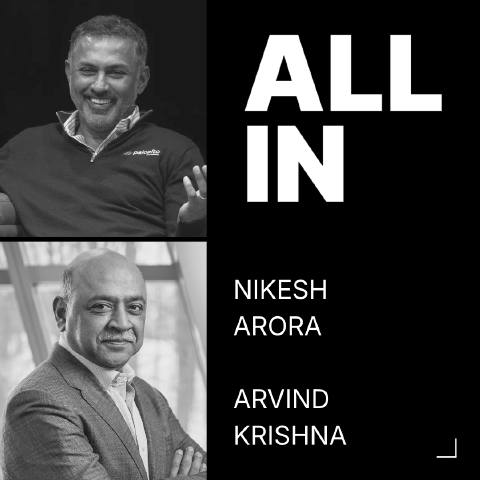
Arvind Krishna & Nikesh Arora: Quantum Threat, Open vs Frontier AI, AI Cyber Warfare & SaaS Collapse ·
From the transcript
alternatives that are open weight at a minimum your philosophy around the entire spectrum and just give us a sense of how we should think about models and capabilities over the next couple of years Nikesh you want to start sure look I think earlier in the day somebody said don't restrict your teams in terms of capability in the experimentation phase don't start trying to cost optimize don't start trying to stitch your own in that phase because two teams who work for us twenty not twenty thousand people have just discovered AI in the last twelve to eighteen months and it's not fully diffused across the organization so if you make it harder for them to adopt if you make it
harder for them to understand it's gonna take longer for us to be ready so right now I'm saying go use the best model you can find the easiest way to use it so you can understand that can be validating the things that these things can do whether it's from an efficiency perspective a revenue perspective or product development perspective that's kind of I'll call it phase one but in phase one what we've discovered is there's different courses for different courses right what people don't understand there there was a moment when every thought the cyber security was gonna get consumed by AI models and you know our lives are over because mythos is gonna solve every problem