Smash Notes

Back to The history and future of AI at Google, with Sundar Pichai, with Sundar Pichai.

Where Will Quantum Computing Matter Most?

Sundar Pichai says quantum computing will matter most as a way to simulate nature, because nature is inherently quantum and quantum systems are what it takes to simulate nature better. His instinct is that the advantage shows up in weather, in physical reality, and in chemistry such as the Haber process, which is still not understood in real life.

Classical computing might still reach a useful simulation in a surprising way, through enough compression and abstraction. The deeper view is that quantum would still have an edge for simulating nature. The practical path follows the history of technology: get something to a scale where it works, then use it, and other people's creativity on top finds the applications.

Quantum will have many applications if it can actually be made to work. Mobile phones plus GPS enabled Uber, and nobody who was working on phones would have predicted that outcome of the platform shift. Once quantum machines work at scale, the same pattern is the reason to expect many uses nobody can name in advance.

Grokipedia·Sundar Pichai·Uber

Transcript

The history and future of AI at Google, with Sundar Pichai ·

From the transcript

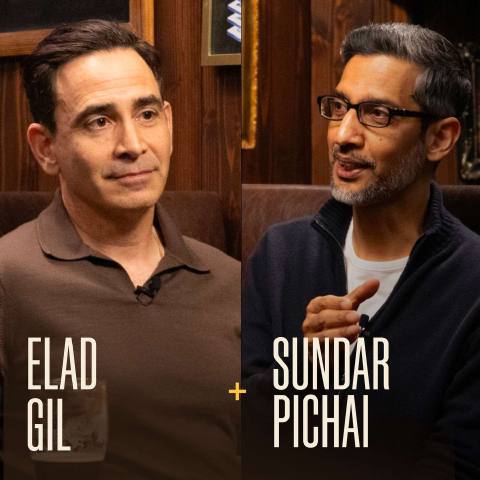
I mean, you all pioneered that with AlphaFold. Do you think quantum will actually matter? And if so, where do you think it'll have the biggest impact? Look at abstract level to me, it feels like to simulate nature more and more, like, you know, like given it's inherently quantum, you would need quantum systems to better simulate it.

We may get there with classical computing techniques in a surprising way, or get at it with enough compression and, you know, abstraction, it may work. but I fundamentally felt like quantum would have an edge there. And I don't know, we still don't understand the Haber process for real life. I mean, it's probably your background, going back to what you did in college more.
See in transcript

Cheeky Pint

More from this episode

  1. Why Didn't Google Ship ChatGPT First?Sundar Pichai says the story that Google invented transformers and then left them unused is misunderstood.
  2. How Does Sundar Pichai Judge a Great Product?Sundar Pichai treats latency as one of the distinguishing features of a great product.
  3. How Does Google Think About Gemini Versus Search?Sundar Pichai says Google should keep both Search and Gemini.
  4. Why Did Google Design Gemini to Be Multimodal?Sundar Pichai says the model where people first saw Google at the frontier was probably Gemini 2.5, and the strength was multimodality.
  5. Does Google Believe AGI Is Close?Sundar Pichai says Google is not less convinced about the curve than the labs people call more AGI-pilled. The spending is the evidence.
  6. Why Can't Spending Solve the AI Memory Shortage?Sundar Pichai says no capitalist incentive will really solve the memory limits of 26 and 27, because there is only so much memory in the world.
  7. How Does Google Decide to Keep Funding Waymo?Sundar Pichai says Google decides to keep funding Waymo by reading the underlying technology, not the mood around the demo.
  8. How Does Google Budget Scarce AI Compute?Sundar Pichai says Google has always had a compute budget, including for classic compute, and machine-learning compute is planned next to headcount.
  9. Why Is Google Cloud Benefiting From AI?John Collison says it feels like Google Cloud is really benefiting because the product is so broad that someone can tell AI to go add a Google Cloud feature…
  10. How Is Google Changing How Its Teams Build Software?Sundar Pichai says the workflow change inside Google is moving in concentric circles.
  11. What Limits AI Adoption Inside a Large Company?Sundar Pichai says the Gemini teams, the Gemini enterprise teams, and the Anti-Gravity teams are working on the adoption problems that show up once the models…

People

More answers like this

More with Sundar Pichai

More with John Collison

Related episodes

Plays from this note through the rest of the episode.

Weekly highlights

One letter a week.

The notes worth hearing, with the minute they were said.