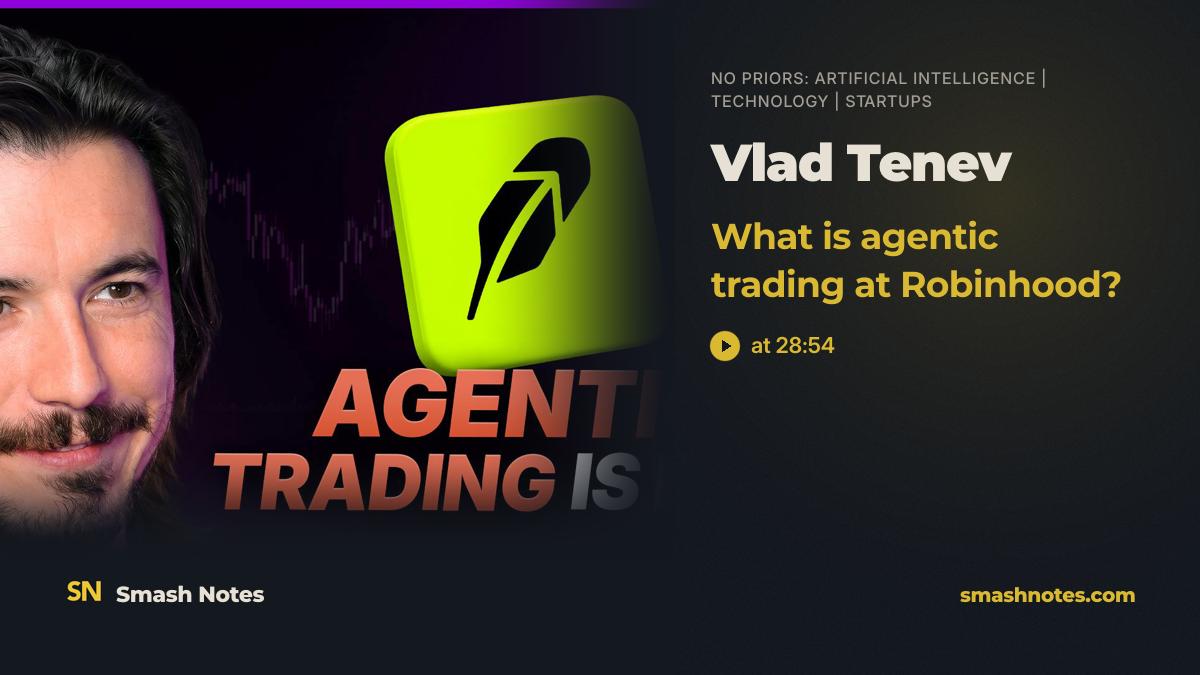
Tokenization, Agentic Trading, Harmonic: Robinhood's Mission to Expand Ownership with CEO Vlad Tenev
What does it mean to build wealth as an individual investor in today’s society, especially as gains continue to get concentrated into smaller groups of VCs or institutional investors? Robinhood’s CEO and co-founder Vlad Tenev has a vision that can be summed up in one word: Ownership. In this episode, Sarah Guo chats with Vlad to get a closer look at how…
People
Notes
-
-
-
-
-
-
What Is a Prediction Market? at 26:09
-
-
What Is Robinhood Ventures? at 41:46
-
Related notes
- How Does John Collison Think Agents Will Change Online Commerce?
- Did AI Solve the Riemann Hypothesis?
- Why Does Predicting Behavior Fail to Show What to Do?
- Why Did Franklin Templeton Start Late-stage Venture?
- Why Can't Investors Time an IPO?
- Why Did Rory O'Driscoll Want Stock He Could Sell?
Related episodes
-
![]() Beam: The Great American Open Model with ReflectionAI Co-Founder and CEO Misha Laskin
-
![]() Democratizing Security for the Agentic Web with Cloudflare CTO Dane Knecht
-
![]() Frontier Chips for Frontier AI Labs, with Walter Goodwin, Founder/CEO of Fractile
-
![]() Taking on ServiceNow: Coding Agents the Rest of Us with Serval Co-Founder and CEO Jake Stauch
-
![]() The Changing Physics of Cybersecurity and Drug Development with OpenAI President Greg Brockman
-
![]() The New Apex Predator: CrowdStrike CEO George Kurtz on Adversaries Armed With AI Agents
-
![]() #503 – AI Crisis in Math: Navier-Stokes, Riemann Hypothesis & Complexity Theory
-
![]() Inside $17B Index Ventures: Anthropic, Wiz, Datadog & the Future of AI
Full transcript
The episode notes above make this conversation easy to skim.
0:00
Prediction markets are an evolution of news. You just can see what's happening and what's likely to happen in the future through the odds. What is your reaction to the revolution in math that's happening with AI today? It's too centralized, right? It's like AI companies with their big data centers and their employees using secret models to sort of do all this work.
0:21
Do you think people will let agents trade for them? So agentic trading, clearly product market fit. We're seeing really strong adoption. Over 150 ,000 customers have opened agentic trading accounts with us. Many of these things that you describe, institutional traders have the ability to do this, but it's expensive and sophisticated. If that's democratized, what does that mean?
0:47
Hi, listeners. Welcome back to No Priors. Today, I'm here with Vlad Tenev, the founder and CEO of Robinhood. We talk about what Robinhood is today as a financial conglomerate trying to expand ownership in the economy from tokenization to prediction markets to how AI agents will trade for everyone in retail. We also talk about Harmonic, his effort to make a math superintelligence and whether there can be distributed discovery and science rather than centralized.
1:16
Welcome, Vlad. Vlad, thank you so much for doing this. Thank you for having me. So everyone knows Robinhood, but it's also evolved a ton as a company. Can you just put it in context for our listeners? Like, what do you describe it today? We do a lot of things. We're live in some form or another in over 120 countries. And if I had to sum up Robinhood in one word or one idea, it would be ownership.
1:43
I think we're the ownership company, the companies that that's most associated with that. And when I say that. So why does ownership matter? I think on an individual basis, people want to own things. It's the tried and true route to financial freedom, financial independence. You know, if you're if you're if you're an asset owner and you accumulate assets over time, it's just the the best way to build your wealth.
2:19
So there's a individual element to it that really, you know, whether you're trading, whether you're accumulating assets, whether you're investing in venture, I think it's very, very important. And also, you know, the things you own say a lot about your personality. It's almost like it becomes like a part of your identity. Like if it's a car collection or your collect collectibles, your your cards, your stock portfolio.
2:48
I think there's a lot of individuality into it. So I think there's an individual benefit. But I think there's also a collective benefit in the sense that a society without broad ownership is inherently very unstable. It's a fragile society. And if you have more people that own things, they're more bought in. They have more more stake in the outcome and they become kind of defenders and protectors of the system.
3:20
So I think especially now when people are kind of pushing back against society and it feels a little bit fraught with AI and all of this disruption, I think giving people the ability to own companies at earlier stages is is increasingly important. So it's really what ties together all of our things from Trump accounts, which is ownership at age zero.
3:50
Robinhood Ventures, ownership of private companies before they go public. Tokenization, you can think of as ownership gone global. Like, how can we make all the people outside the U .S., people in 120 plus countries that don't sometimes even have functional banking systems? How can we kind of plug them into this economic fabric of society? So, yeah, that's how I think about it.
4:16
We started off as just a simple app to buy stocks at zero commissions on your phone. And then we've kind of expanded from that into a increasingly global financial conglomerate that allows customers to own things across a wide variety of surfaces and asset classes. You might be the only large financial I think of as a as a missionary organization with the other being like Vanguard or something like that.
4:47
Can we talk about how you got here? Like, you know, so you I learned recently that you studied math under Terence Tao and you worked on HFT. Neither of those sound like a missionary for people, if I may say that. How did you how do you discover this mission or, you know, come to come to it? Yeah. Yeah. So, I mean, rewinding back even even further, I was born in Eastern Europe in the late 80s, kind of on the brink of the collapse of the Soviet Union and the lifting of the Iron Curtain.
5:27
And actually in the 1990s. So I immigrated to the U .S. after my parents. My dad had an opportunity to come study at the University of Delaware for his master's and then was also was able to take advantage of that and stay in America full time. And so my mom came about a year after and I came about six months after her, which was a pretty unique experience.
5:55
I mean, you talk to a lot of parents. I didn't see my dad for a year and a half and my mom for six months when I was a small child. I lived with my grandparents and a large portion of that was we just didn't have the money to send the whole family. So we had to you know, we weren't sure that my dad would have a long term future in this country.
6:20
So we thought maybe he'd come back after a year or two years. And anyway, he did quite well and was able to send for my mom and then me. And my last year in Bulgaria, 1991, the inflation rate was something like 170 percent in Bulgaria. So my early memories were the rolling blackouts. And, you know, my my family huddled around the radio, which was battery operated, just listening to what was going on.
6:49
And the lines at the bodega, which I could see from my window for buying milk and eggs, the milk would come in these big plastic bags. And, you know, the one week a year you would get bananas from other communist countries. So Cuba would the Cuban bananas. I remember were just amazing. Now I would I would come to the U .S. and there were just bananas everywhere.
7:15
But they weren't as good. And so, yeah, and even after I moved in 1997, Bulgaria had the unfortunate distinction of having the number one inflation rate in the world. It was something like 2000 percent annualized. So they were just adding zeros to the currency every couple of months. And so from that point, I just developed kind of understanding of money.
7:40
I had to be very independent. You know, my parents, it was always a topic of conversation and we'd have to send money to my grandparents back home as they were dealing with this inflation crisis. And my grandparents actually would keep their assets in copper cookware. So there was this closet in my grandfather's house where, you know, he worked as a doctor kind of in the shipbuilding and naval industries.
8:09
So he was on a boat a lot of times. So he had his contacts at the port. And as soon as he would get salary, he would exchange it for copper cookware. So it was kind of the first real world asset that I encountered people investing in. Like stocked, sorry, stacked like pans. Exactly. Yeah. In the closet you have. Holds value. Yes. Pots and pans.
8:31
Much better than the local currency at the time. And so, yeah, I just I grew up with that. I grew up understanding, you know, what happens in a broken system where you don't have, you know, free markets and good, healthy capital markets. And I'd say for me, I pretty quickly discovered that academically I was quite strong and also independent, basically by choice.
9:01
You know, my parents couldn't really afford babysitters or after school activities or any of that stuff. They were both working multiple jobs. And my dad was a full time graduate student. So it was kind of like, you know, when I was in kindergarten, five years old, they would I would walk back from school by myself. They would tell me, OK, go to the neighbor's house.
9:24
We lived in apartment buildings at the University of Maryland. Knock on knock on the door. Your neighbor will watch you for, you know, a couple of hours. And then they realized, all right, our son's going through this like complicated ritual to get home. We might as well just give them the key. And, you know, pretty soon after that, I would let myself in, do my homework, go outside, play with my friends.
9:46
So I was I was very independent. And there was always this like pressure of having to succeed and do well in school, probably for a couple of reasons. One, I was good at it. And so everyone just everyone around me was like, do more school, skip grades, like do better in math, more math, you know. And, you know, the teachers would have these meetings with my parents like, hey, you're your son, you know, do you know he's he's really good at math? You should, you know, put him in this thing.
10:15
So I think that was one of the benefits of growing up around the University of Maryland, which is a very academically oriented community. And they would try to sort of like identify the kids that had potential and accelerate them. The other thing was my parents would just sit me down and say, look, the financial status of this family is very insecure.
10:36
We're not making any money. So you're going to have to basically get a scholarship if you want to go to college. And to get a scholarship, you are going to have to do very, very well in school. And also, by the way, we might get where we're like visa holders here. So, you know, if we lose our jobs, we're going to have to get sent back to Bulgaria.
10:57
So there was all this pressure to succeed academically. And, you know, and for me, you know, my math PhD program, at some point it became kind of this challenge, like what's the hardest thing? How can I do better at the hardest thing? And it was this almost like competition with myself and with my parents. who are also very academically strong, like, oh, what was the hardest subject for you at school, dad? Oh, chemistry.
11:28
Let me just do really well at chemistry. Yes. You know, what was the most advanced math that you did? And I think math has this like ladder of achievement. It's almost like playing a really good video game. Like you always know what the next hardest thing is. And it's almost like how quickly can you go to algebraic geometry or algebraic topology? And can you learn that earlier and kind of understand it? And I think what appealed to me when I got to grad school was this idea that if you are, if you create a new mathematical theory, you know, maybe you'll be remembered for a really long time.
12:08
And, you know, just like kids in school, everyone learns, you know, Gauss and Riemann and all these greats. If you create a theory, maybe kids will be learning and sort of like thinking about your work hundreds of years from now. So that was kind of what appealed to me. Just given that background and, you know, you should also explain what harmonic is as an effort.
12:32
What is your reaction to the revolution in math that's happening with AI today? I think on the one hand, it's very exciting and sort of predictable because the rise of AI models and the ability to verify the outputs put together has led to kind of automation of the of the math pipeline. And I think it's really, really exciting. Right. I think that the the power and the tools, I mean, the math is changing so quickly.
13:08
And, you know, math as a field hasn't changed very rapidly at all in thousands of years. I mean, when I was in grad school, most of the work was still being done in person with like chalk and a chalkboard. It's like there was no collaboration. People weren't even using computers. So now math is kind of converged with coding. Mathematicians are using the same tools.
13:31
They're using version control. They're using like lean for for verification. And and the field is accelerating very rapidly.
13:42
About about a year ago. So harmonic, which is a startup that I co -founded a couple of years ago with the goal of building mathematical superintelligence. So last year, we created a model called Aristotle that was one of three that got a gold medal on the International Math Olympiad. And then subsequently to that, we rolled it out to the public.
14:07
And we had people using Aristotle to tackle unsolved math problems. And so it was used to like solve these Erdos problems. There was these other there were these other mathematicians that were using it for new results and so forth. And so then I started thinking a lot about, OK, what's the future of math? Like what how should these tools be used? And I think for me, it was very important for the tools that I build, not just harmonic, but also Robin Hood, to be empowering to individuals, to people.
14:50
And so the one thing I don't love about like this latest wave of AI models solving math problems is that it's too centralized, right? It's like AI companies with their big data centers and their employees using secret models to sort of do all this work. And I think what's more attractive and what would ultimately win out in the end as a model is rolling these things out and actually putting them in the hands of people and having having the users make interesting discoveries and inventions.
15:30
So I am probably like a pretty fundamental believer in decentralization as a philosophical premise. And I would love to believe that's true. I think that there are a lot of people who work at large centralized AI companies who would say, like, if I may push back a little bit, that this is cope and centaur play will just be outclassed by, you know, more compute in an agent loop.
15:56
Like, how do you like, do you believe that's that's true? Or what will be the human input here that is productive in math? Well, I think it's sort of like two separate things, right? One is what's the role of the individual mathematician? And the other is, is this going to be like a product that people use or are the AI labs going to be producing the products? I mean, I have thoughts on both of them, but on the second one, it's much more interesting.
16:31
I think that a world where you have the AI labs on a proprietary basis making all the discoveries and you have like the open AI or anthropic data centers that are just running code, you know, managed by the employees of those companies. And, you know, they're vertically integrating and, you know, producing all the drugs and selling the drugs to people, making all the mathematical and physical discoveries and publishing all the papers.
17:02
If all of that is happening and it's owned by the AI labs themselves, I think that's a bit of like a dystopian outcome and unlikely to happen for a couple of reasons. Not just like technological and market, but I think also like if that happens to a significant degree, people will lose their license to operate. Yes. Yeah. I think it's much more.
17:33
I think you could have the same outcome of Navier -Stokes being proven or, you know, the light, the partial Riemann hypothesis or any one of these things. And it will be much more accepted if it was like a random layperson using. It might be celebrated. Yeah, I think for sure. And I think that's how it's going to happen. That's the likely scenario one year from now.
18:01
I think you also have the confounding factor of a lot of the people that are going into these AI labs are former researchers. And so they're like excited by doing research. And I think they're confused as to why this is being poorly received. From their perspective, it's like, oh, I'm a researcher. I was brought into a research organization to do research.
18:27
And now all these academics are mad at me. But yeah, I think that, yeah, and I've said this to folks that work at the companies, I think it would have been much better if they found some mathematicians and kind of collaborated with them to not make it seem like, you know, there's this dark data center dystopian future where, you know, one company is going to make all of the scientific discoveries.
18:50
Can we talk a little bit about both the, you know, new ways you want to extend ownership as part of Robinhood and then also how Robinhood is intersecting with what's happening in AI? Maybe we can just start with what you guys are doing with tokenization or your vision for it. Yeah. So tokenization is really it's a new innovation. And the idea is almost similar to stablecoin.
19:15
So the way a stablecoin works is you take some dollars or treasuries, put them in a wrapper, put them in a box, and then you mint and burn tokens against the box. And the traditional assets stay custodied at a traditional institution like a bank. And then the tokens can trade freely on DeFi. So they can move anywhere around the world. They can trade in fractional amounts.
19:41
They can be swapped in different protocols or lending pools. And that opens up just a ton of possibilities. Yeah. So you can kind of extend that concept to any real world asset. So we've done it with stocks. So you can put stocks in a box and mint and burn tokens against them. And they can trade all over the internet on blockchains like software.
20:09
You can do it with private companies. You know, instead of a stock, it's like a SPV with private company shares. Behaves the same with some slight differences around redeeming and things of that nature. You could do it with art, collectibles, real estate. So what we launched, and we've been playing around with tokenization and experimenting with it for many years.
20:35
So last year, we had an event in the south of France where we launched stock tokens, which are tokenized versions of U .S. stocks. And we did it in Europe. But it wasn't fully DeFi enabled. So if you're a European customer using Robinhood, you could trade them. And they felt very much like real stocks. But you couldn't actually, you know, send them out on Ethereum or on the blockchain and put them in pools or compose them with other smart contracts.
21:05
Now, this year, we took it one step further. We relaunched stock tokens with fully DeFi enabled characteristics. And we launched it in conjunction with Robinhood Chain, which is our new blockchain built for real world assets. And Robinhood Chain has become one of the fastest growing, I think the fastest growing across a lot of metrics, blockchains in history.
21:27
And what we've seen is just an explosion of developer activity. I think we announced recently it's the number one chain in developer activity, too. And, you know, developers have taken stock tokens, which have become kind of like Legos, and have started building all sorts of interesting smart contracts, NFTs, pooled assets, where you'll take, for example, a meme coin and link it with a stock token.
21:54
And, you know, this is just sort of month one and month two type of activity. Yeah, I think these financial primitives as the foundation of a developer platform will become really, really big. And I think what's more exciting to me than this is Robinhood Chain is a way to enable the long tail of countries. So people in countries that don't have highly functioning capital markets or financial systems like, you know, places in South America or Africa.
22:26
Anyone with a smartphone and a non -custodial wallet can now get exposure to U .S. markets at incredibly low cost. So in the same way that I think stablecoin became the default way for people in these countries to get access to dollars, stock tokens and products like that will be the default way to get access to U .S. equities for all of these people.
22:50
May they have access to not just copper pots, but wealth creation. Exactly. And private companies. And really the vision for Robinhood Chain and tokenization is let's just take all the things that work on Robinhood and put them on chain and make them available to people in all these countries. And I think one thing I've learned is a lot of people.
23:11
So, you know, we're new to operating a blockchain or new to operating these on chain smart contract products. And a lot of the criticisms that, you know, Robinhood has received, like we've been called a corpo chain, right? Like the best blockchains are so. So they told me that they said the best blockchains are managed by these like organizations and consortiums and everything's decentralized.
23:38
And, you know, you guys are a corporation managing a chain. How is that going to be as good? Well, maybe you sacrifice a little bit of like organizational decentralization purity. But what you get is just focused leadership and someone, you know, or some group of people with very, very clear direction pushing things forward. And the other thing is also, I think it is good to have Robinhood backed products on the chain too.
24:07
A lot of chains take the approach of, you know, let a thousand flowers bloom, let the developers just build all this stuff. And we love the developers as well. But I think having primitives like stock tokens that have our backing that people can trust.
24:22
We've seen that that just creates more interest to build on them because, you know, to some degree people know, okay, Robinhood's backing them. They're legit. Like that's a trusted brand. We know they're not going to go away. So that gives them much more confidence to build than, you know, if it was just a team of, you know, two or three engineers somewhere that are offering these primitives.
24:46
Is there an example of a composition that you think should exist on stock tokens or has already come from the ecosystem that you're excited about? I mean, one of the things that I'm thinking about is, yeah, it's like, how can we take some of these derivative products like options? Can you make like really nice smart contract native options contracts? You know, there's been a tremendous amount of innovation in the traditional markets that's to some degree like stymied by how hard it is to just move off of mainframes onto more modern things and take all the counterparties that are, that rely on the system being predictable and slow moving.
25:30
So I think a big part of it is just let's provide the primitives and let the developers kind of put them together in new ways. And I don't want to, you know, presuppose what developers come up with because I wouldn't have been able to tell you that, you know, stock linked stock token linked NFTs or stock token mean pairs would would become a thing.
25:59
Like I just had no way to no way to foresee how quickly those things would grow and become become real. It's not necessarily ownership. What is your perspective on prediction markets? Yeah, I mean, I actually think prediction markets do tie into ownership because a lot of people have unique knowledge and ideas and they have hot takes on things that maybe not everyone knows.
26:24
Like you might be an expert in AI model development. You know, we have lots of contracts that allow you to speculate and hedge on what AI model will be best this week or this month or this year. And the way to kind of like monetize that knowledge before prediction markets was highly indirect. Like maybe you could trade derivatives on, you know, Google stock or NVIDIA stock.
26:51
And so there is there is an important thing with being able to monetize your your own knowledge and and and doing it more directly. It's actually one of the reasons we announced and we're planning to launch KPI contracts. So for a long time, if you wanted, like, say, your study, let's say you're studying a company and you have a pretty good idea that it's going to beat earnings, EPS or revenue.
27:20
Well, in the past, if you bought the stock or, yeah, you bought like an option on the stock, sometimes the stock would be the company would be earnings. The stock would go down for some unrelated reason, you know, guidance and one of these things. So KPI contracts now allow you to actually trade the EPS print, the revenue print or any of the other KPIs that that might matter to a company.
27:47
So I think there's that aspect where you can actually monetize your belief. You can hedge more precisely. For example, there's a will the California billionaire tax pass contract, which I think is a useful hedging instrument for some people.
28:06
Not me personally. I'm not hedging with it, but one could. The other thing about it is I think it's a new source of of information. I think of it almost as in the pure form. Prediction markets are an evolution of news. So what does news look like in the future? I don't think it's the New York Times, but I think it could be something like it where you have your front page, your business section, lifestyle, culture, sports and sports is a big part of it.
28:36
And you just can see what's happening and what's likely to happen in the future through the odds. So a lot of people don't even trade these things. They just like to open the app and just check out what's going to happen. Yeah. Do you think people will let agents trade for them and when and what's the impact of that? Yeah. So we launched a product earlier this year, which is basically a Robin Hood MCP.
28:59
We call it agentic trading and we have agentic credit card as well. So in the broader realm of agentic finance, I think there's two things that have product market fit. One is agentic trading very clearly, like having an agent execute your trades and do a strategy for you. And we're seeing really strong adoption. Like over 150 ,000 customers have opened agentic trading accounts with us in the few months since we've launched it.
29:30
Wow. And if you look at the tool calls, you know, the tool calls have just been following this smooth exponential where the last number we announced was something like 30 million tool calls per day. So agentic trading clearly a product market fit.
29:49
And, you know, we started by just having an MCP. And a couple of weeks ago at our Hood Summit event, we announced Robin Hood agents, which is basically taking it one step further. And the harness and the entire UI is now inside a Robin Hood account. So you can kind of think of it as if you're a Claude code or a Codex user, it's almost like a tool like that that's optimized for trading.
30:15
So you can run loops and say, OK, every day, you know, execute a run of my strategy, rebalance my portfolio, look at opportunities. We have skills. So you can, you know, do like a portfolio rebalance or all sorts of other things. We have agent apps. So we launched an app store where you can, for example, connect to a source of satellite data.
30:42
And if you want to create a strategy that like counts cars and parking lots of retailers or, you know, something of that nature, we'll make that available. And the way that I think that'll evolve is we're going to look at all the capabilities that the coding harnesses have and see how we can provide really nice, clean trader native versions of that that just make it really, really easy to be an active trader.
31:09
Amazing. Amazing. Do you what do you think the impact is of this on either, you know, participant mix or financial infrastructure? Just because many of these things that you describe institutional traders have the ability to do this, but it's expensive and sophisticated. Right. And so if that's democratized, what does that mean? Well, that's really the north star of the product.
31:32
It's can we put the capabilities of a hedge fund or a sophisticated algorithmic trading firm into the pockets of normal individuals. So in the same way that, you know, if you were a sophisticated, you know, grad student in computer science or something, you could write a trading strategy. And if you went through even more effort, you could deploy it, you could get, you know, rack space in the data center connected to the exchanges.
32:01
Can we just sort of like streamline all aspects of that so that, you know, in the same way that it's made it easier for anyone to be a software engineer, Robinhood agents and our MCP can make it easier for more people to be quant traders. And I think the outcome of that is there will just be more trading activity. I think at first it'll be concentrated on a relatively small group of sophisticated people, but their trading activity will likely increase quite substantially.
32:33
And then over time, it'll just filter to more and more of the population. Yeah, I think coding is a good analogy. It's like there's lots of people that want to there's people that code. And for them, you know, they were first to adopt the coding agents and their output multiplied. But then now there's people that just wouldn't have picked up, you know, VS code or cursor before, but someone showed them how to use Claude or Codex, and now they can build a website just really easily.
33:03
So it'll lift, I think it'll lift the tide across the across the board. I believe the desire to make software or automate things is much broader than I did, perhaps before any of the coding and agentic coding and coding AI and agentic coding happened. But wanting to make money off of a belief feels like a much more universal thing. Yeah. And I think that, you know, as people get, as it becomes easier, here, as you can really, a lot of people have ideas, right? And if you can take that idea and turn it into a strategy with as little friction as possible, if we can get it to approach the friction of just buying a single stock, then I think a lot more people will do it.
33:48
There may not be an answer to this question, but is there an obvious way in which financial infrastructure or risk management needs to change in reaction to this? I don't think so. So I'll tell you the safeguards we have on day one. So right now you have to create a new separate account, which is segregated from your main Robin hood balance.
34:09
So you can create an MCP account. You can create an agentic account. You have to move money in there. And then, you know, for customers that choose to have trade approvals, by default, you have to approve your trades, but then you can turn it off so that you could dangerously skip permissions. Yeah, exactly. Well, actually, it's it's not as dangerous as that because it's not like it can go into your other accounts and it's not my core code for you.
34:36
Yes. So it's it's sandboxed. It's a sandboxed, maybe not quite air gapped, but but pretty close. And we built a lot of the we refine a lot of the infrastructure for the sandboxing and the harness in house at Robin Hood. Yeah. So far, I think that it's not just a huge percentage of the market. The reason I don't think I don't see any clear massive overhauls necessary is that high frequency trading has been a thing for a really long time.
35:06
I mean, markets went fully electronic about 20 years ago. And so, you know, everything from the exchanges to a lot of the brokers have sort of conformed to this new reality of most of the workflows being algorithmic trading that happens in data centers in New Jersey rather than what a lot of people still think happens, which is have paper tickets and floor traders and in a trading pit.
35:36
So I don't think it's not clear to me that anything fundamental has to change with regulation. But, you know, as as it gets bigger and which I don't doubt it will, we might run into special cases for which we we need more regulatory clarity or Yeah, I was more from an infrastructure perspective. If you just use coding as a proxy, I did not maybe we all should have, but I think it was not obvious that CICD was going to completely fall over, like in the face of orders of magnitude growth in code generation.
36:14
Oh, yeah. And so that was my question, which is like, yes, of course, we've had HFT. But if like everybody is a high frequency trader, that feels like new load. Yeah, I mean, there's a couple of different layers in the stack, right? And we should expect our on chain stack is slightly different that already has MCPs. But you have our on chain tools, which a lot of it is, you know, I talked about Robinhood chain being the best chain for real world assets.
36:43
Also, it's the best chain for AI agents. So we're seeing a lot of agentic trading there on our C5 centralized offerings. You know, we we we have a lot of end to end control over the entire system, right? We have our databases, we have our code that the strategies are running on the sandboxes. We build a lot of those tools, we have to optimize all of that.
37:12
But you know, once it gets through our system, you get to places like the Algo, the market makers, which are all extremely sophisticated software shops. I mean, you're talking Citadel, Jane Street, jump trading. These are like latency, low latency, high frequency folks. So I'm not so worried about them scaling to meet the demand. And then and then you have the exchanges.
37:38
And the exchanges because of pressure from HFTs and algo trading have really optimized their APIs to to handle huge volumes. But that said, I think that we're still we're still at a low percentage of the total trading is agentic. So I think we'll have some warning. I mean, we'll see it increasing. And I don't think that, you know, we're, we're going to be at the point, you know, imminently where agentic mediated trades are, you know, a double digit percentage of the activity.
38:13
I think we'll have some time. Given you're such a strong believer in ownership and then democratized ownership as important to societal stability and also like just opportunity for people. I think there's a sense that the AI revolution is not a broadly owned thing. Do you have an idea of, you know, what the solutions here might be? And maybe you can talk about Trump accounts as well here.
38:37
Yeah. And I think we identified this problem last year. You know, it's a couple of things, right? First, all of the major innovative AI companies are private. I mean, with some exceptions, you can look at NVIDIA and, and, and Google. But, you know, yeah, but those companies were already quite big before they really got into this new phase of of AI.
39:02
So if you wanted to invest in a large language model, a couple of years ago, and you wanted exposure to open AI or Anthropic, you're basically out of luck as a, as an individual investor. And, and I think there's a lot of reasons for that. One is private markets have gotten, it's, it's gotten really easy for high growth, successful companies to raise money in the private markets.
39:27
You know, they basically have. At massive scale. Massive scale. And that didn't used to be the case. You know, back in the eighties, a company like Microsoft, even in the nineties with Amazon, you know, they went public at valuations in the hundreds of millions. So individual investors that got in during the public offering could make a thousand X.
39:48
Now, if you have a, an AI lab that goes public at a trillion or 2 trillion in order for an individual investor at IPO to make that type of return, they have to get into the quadrillions, right? Crazy. I think it's unlikely basically, maybe it could happen, but I think it's going to be much tougher. And instead, you know, the, the gains keep getting concentrated into a smaller and smaller group of venture capitalists or institutional investors.
40:19
And, you know, then we're wondering, well, why are people upset about data centers? Well, I mean, if you think about it, if I'm an individual, I don't benefit economically from any of this activity. In fact, you could say, well, it's threatening my livelihood, my job, it's polluting my neighborhood. They're making all this noise.
40:41
And yet juxtapose AI with something like crypto. Crypto has not been, it's not like everyone trading crypto makes money, you know, and right now, Bitcoin is, what is it, 85 ,000. If you bought at 120 ,000 a couple of months ago, you're down.
41:02
2022 and 2023 were rough for the crypto industry, to say the least. A lot of people lost money in those years. But yet in 2024, they came out in full force and swung the election, I think, in a meaningful way. And if there's even a hint of regulatory overreach for crypto, you have this army of people that are just blasting social media and, you know, messaging their congressman or woman and just fighting every inch of it.
41:35
And I think a big part of it is crypto is distributed broad ownership by individuals from the beginning. And it's almost institutions are coming in late, whereas AI is the difference. So what do we do about it? Well, we launched two things. We believe that everyone should be able to invest in private companies. And I can't convince companies to go public earlier too effectively.
41:59
Neither can I. Even though I try doing that sometimes. We do have our IPO. I mean, we're an underwriter. We're active in that pipeline. But individual investors should benefit from private companies and be a huge shareholder. That's really the vision behind Robinhood Ventures. How can we make it so that it's an anomaly to not have individual retail investors as a big constituent of your seed and series A cap table? So they should actually be at the earliest possible stage.
42:31
And so Robinhood Ventures Fund One, we actually have an innovative structure for this. You can kind of think of it as a publicly traded venture capital firm. And so what we did was we used our IPO channel, which were the largest retail channel for IPOs. And we use that to raise capital in an IPO from Robinhood customers, individual retail.
42:54
And then we use that to invest in startups. And then the funds are publicly traded on the New York Stock Exchange. So they trade just like a stock. And so Robinhood Ventures Fund One was late stage privates. Open AI is in that fund. You have a couple of other companies. FinTechs, a lot of AI companies. Eleven Labs. Cruzeau, we recently announced.
43:21
So that was ultra late stage. And then we asked ourselves, well, how can we actually go to the extreme and give people exposure to seed in series A? And that's where Robinhood Ventures Fund Two, the idea came to partner with YC and use a structure to give people exposure to the earliest possible stage where the risk is highest, but the opportunity is also greatest.
43:47
And that's the fund that Rich Aberman is running for us. And then we have tokenization of privates, which solves that problem in a different way, but right now for outside of the U .S. And the North Star is, can we get a private company to be real -time tradable 24 -7 in fractional quantities, just like a stock or a crypto? So you should be able to just trade Anthropic 24 -7 in low dollar amounts with some degree of high -quality ownership, at least as good as owning LP interest in an SPB, right? And that should be available to everyone.
44:29
So that requires pushing on a bunch of things in the U .S., accredited investor rules being one of them. But yeah, we're highly motivated to lead that and make that happen. That was my question for you, which is, you know, if you are, for example, a venture capitalist with a portfolio you think is going to make money in privates, then some people will have a choice of LPs.
44:53
There's institutions. There's your friends you can make money for. Obviously, there are rules around, you know, QP and accreditation around taking retail interest. Your view is clearly like some of those rules need to be updated. Yeah. You know, and there was an initiative by the SEC. It was announced last week to allow a separate path. So they directed FINRA, which is the primary broker -dealer regulator, to create an exam, an accreditation exam, where, you know, you can go as an individual and get accredited by, you know, taking a two -hour exam at a testing facility.
45:32
You know, and I think that's... Versus it being asset -based. Versus it being asset -based. Or there's also, you know, you can be affiliated. You can have a Series 7, which is an affiliation with a financial firm licensure. But, yeah, so it's a knowledge -based exam. And I think it's definitely a positive step. I think they're doing stuff.
45:52
But, yeah, I think the goal would be to make it lower friction because how many people are going to go and sit for an exam at a testing facility? So I think more work needs to be done. And we're going to be at the forefront of continuing to push for that. I think the main argument against such, you know, evolution of rules would be some sense of, like, you know, protection against fraud and paternalism there.
46:17
How do you think about that? For our customers, you know, we spend a lot of time talking to them, figuring out what they care about. And one of the things they care about most that they agree with is the statement that I should be in charge of my money. And nobody should tell me how to spend or invest my money. When we say to our customers, do you agree with this? I mean, just overwhelming agreement.
46:45
So not to say that they'll personally want to do every type of risky speculative investment, but they don't think that it's the government's place or anyone's place to tell them what to do with their money broadly. Now, of course, I think that people should be absolutely clear on what these products are. And so we should make sure to tell you what it is, give you as much information as possible.
47:13
But, you know, I think about this. Am I going to tell you not to invest in the hot IPO? IPOs are risky, for sure.
47:22
Meme coins, even. Meme coins have, like, perfect regulatory clarity. If you want to buy a meme coin, you are free to do so. And the SEC even wrote a letter saying these are not securities, they're collectibles. You know, it's clear the way. So I think it's silly to, from a couple of different angles, not the least of which is, you know, meme coins are completely fine in any amount, but private companies.
47:49
It's not rational from a just, like, pure risk orientation to restrict private companies. Yeah, I think that's right. And people are smart, right? I think that, I mean, there should be some sensible regulation. I'm in favor of that. But I think that we've just gone too far. And the conditions that made the accredited investor rule necessary no longer hold.
48:15
I mean, these rules are from a time before the Internet. You couldn't even get any information. And now there's just an influx of information about everything, particularly private companies and AI models that can just scour and synthesize it for you. So, yeah, I think it makes a little bit less sense now. Can you talk about what Robinhood is doing to support Trump accounts? Yeah.
48:39
So this is like our way of serving our country, which we're very proud of. So Robinhood was selected as the sole initial trustee and broker for the Trump accounts. And we're working with BNY, which is America's oldest and most storied bank, and with Treasury and IRS to make this program happen. And, yeah, the idea behind it is, can we get every child from birth to own a chunk of the U .S.
49:10
economy through the S &P 500, through a low -cost diversified ETF. And for every newborn child, so everyone born in January 2025 onward for the next three years, they get $1 ,000 ceded by Treasury. And Michael and Susan Dell, through their foundation, added another over $6 billion to children in lower -income zip codes. And a bunch of other people are following, like Gwynne Shotwell committed a donation in SpaceX shares.
49:46
Brad Gerstner, who is the brains and the architect behind the program, he pushed it forward and also made a really big donation to the citizens of Indiana and their children. And so we're kind of powering the infrastructure, building the app. And, you know, we love it because I think it's the best thing for actually getting household stock ownership from 65% to 95%.
50:21
So when it's successful, I think it'll lead to a much more stable and prosperous society in many decades. Our goal is to make this like the best product the government's ever launched and the most enduring positive aspect of President Trump's legacy. That's our goal. It's an amazing effort. Sign your kids up. So a last question for you. Andrew Reid, who we both know well, described you as a strange combination of like unlimited IQ and the steadiest possible hand when working with, you know, the vagaries of the financial markets and PR and large user bases.
51:05
Yeah. How do you keep your level -headedness or cool or what advice do you have for the many business leaders that listen? I think going through a lot of challenges as a child just made me very used to going through challenges, right? And, you know, I had a very supportive and amazing family, great parents. But we were kind of in this together, right? We kind of all immigrated to the U .S.
51:42
at the same time. And I wasn't like a child that was given things, right? It was almost like you're a member of this family and we all kind of have to figure this out. I had my part. They had their parts. So, you know, obviously they're a child, but kind of treated with a lot of autonomy, almost as an equal from a very young age. And, you know, we run through a lot of– we come across a lot of business challenges at Robinhood, at Harmonic, at all these things.
52:11
But, you know, when you step back and say, all right, well, does it compare to the threat of deportation? What about, you know– and we talk about inflation here of 5% and freak out about it. What about the 2 ,000% inflation that, you know, we went through as children?
52:31
So, you know, sometimes I think about that with my own kids, right? Do you create challenge for them? We try– I mean, I try to construct challenge, but you have to construct it, right? It's a little bit harder. And they get a lot of positives. Like, they could have tutors. They could, you know, go to all kinds of museums that I didn't have.
52:50
They have safety. Yeah, but they have safety. And, you know, I think there's something very important about having to, like, struggle and endure. I try to, like, create that environment as much as possible, but I think I haven't figured it out. So, I think that's a big part of it. And also, probably, as we were talking before, it's a good bit of, like, nature versus nurture.
53:15
Maybe I was just born like that, and I don't know how much of it's the environment either. I think if we take it away for advice for other leaders, it is just the optimistic take that whatever challenge you're going through will make you more level in the future. I think Bezos said this, right? The best approach to all of these challenges is just grow thick skin.
53:35
You can control that about yourself, but you can't control the outside world. So, if you can actually do that, I think it seems to be a big superpower that not everyone is capable of. Awesome. Thanks so much, Vlad. This is great. Thanks for having me.
53:50
Find us on Twitter at NoPriorsPod. Subscribe to our YouTube channel if you want to see our faces. Follow the show on Apple Podcasts, Spotify, or wherever you listen. That way you get a new episode every week. And sign up for emails or find transcripts for every episode at no -friars .com.