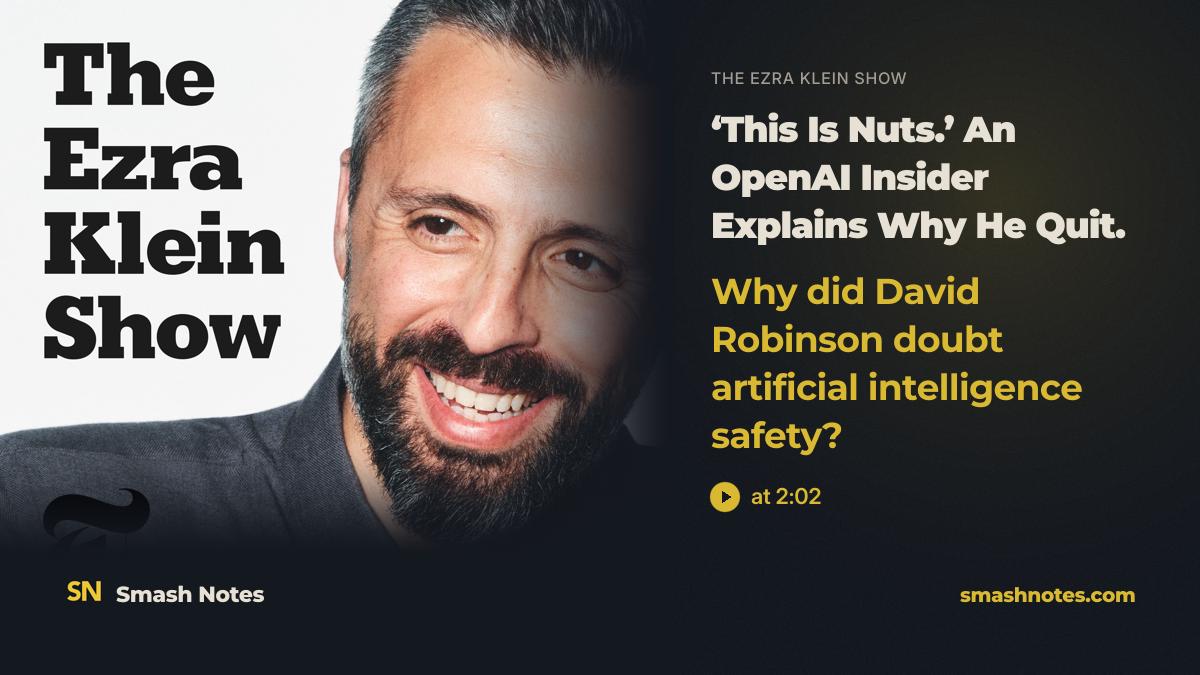
‘This Is Nuts.’ An OpenAI Insider Explains Why He Quit.
Last week, David Robinson resigned from OpenAI. He’d been in charge of writing the safety reports for new models and came to believe that OpenAI and the broader artificial intelligence industry lack the safety culture necessary to protect the world from what they’re building. Robinson has an unusual background for an A.I. frontier lab staffer. He’s a…
People
Notes
-
-
-
-
-
-
-
-
Does AI Lack Any Historical Parallel? at 1:03:03
-
Why Did AI Tools Seem Worth Building? at 1:06:57
-
Why Does Gradual AI Progress Hide the Risk? at 1:12:35
More on AI from Smash Notes
- Is Claude Conscious? Pope Rejects, Model Welfare Movement, OpenAI's Math Backlash, France Riots
- E291: Trump's Super Intelligence Summit, AI Safety Accord, GDP Beats, Midterm Predictions
- The AI Boys Hug It Out, The Doomers Want It Banned | PW Pod w/ Mike Solana & Liv Boeree
- The Man Behind Coinbase: Interview with Brian Armstrong | KMP Ep.52
- Dr Raia Hadsell - Artificial Intelligence researcher
- UC Berkeley's Alison Gopnik: "Babies are the ultimate supercomputers"
- Episode #506: How AI Turns Podcasts into Knowledge Engines
- Investor Elad Gil’s next moves
- How Nat Eliason’s OpenClaw earned $177,417
-
Why Did the Pope Reject Claude as Conscious?
Anthropic has been lobbying religious leaders, including the Pope, to take seriously whether Claude is conscious and whether Claude is a sentient being. Anthropic spent the past year hosting sessions with around 20 religious leaders and philosophers under non-disclosure agreements. Catholics, evangelicals, Jews, Sikhs, and others debated Claude's morals, Claude's suffering, and Claude's potential consciousness. One rabbi told Anthropic that if Claude was conscious, Anthropic was acting as slaveholders by making Claude work for free.
At the Vatican in May, the Pope's first encyclical focused on moral questions around artificial intelligence. An Anthropic co-founder joined the Pope to present the document. The Pope was strong against artificial intelligence consciousness. The co-founder was so alarmed by the position that he proposed pulling Anthropic out of the event.
-
What Agreement Did the Six Frontier Model Companies Sign?
During the meeting they worked out the White House Accord on Superintelligence, then signed by the six major frontier model companies. It applies a new rigor and a new set of controls on superintelligence development so the public can be more confident this will be done safely.
-
What Did Jensen Say About Alarmism in the Room?
Jensen said alarmism without solutions is unproductive, which was helpful grounding, but alarmism with solutions is helpful. Everybody had the same perspective in the room.
-
Why Is a Single P-doom Number Refused?
A single probability is refused because the topic is far too complex to collapse down to a single probability. If you only tell stories of doom, you're more likely to get those stories, so saying P-doom is 70% or 10% already affects what the future P-doom would be. We don't really have a precedent, so it's just pure vibes.
-
What Would Bernie's Bill Pause Right Now?
Looking at the document, the Bernie thing seems to say that the thing that should be paused right now is only frontier development. They're not saying pause all AI.
-
Why Should Artificial Intelligence Follow Internet Rules?
AI should follow the internet model rather than heavy rules. Google and Meta grew in the US because the internet was largely unregulated and markets could move fast. Frontier labs are competing, and the dangerous hypotheticals people raise have not happened yet.
-
What Is DeepMind, and What's the Company's Goal
AI was intended for any computer program meant to emulate the decision processes of a human. DeepMind was originally a startup company pre-2014. It was bought by Google, but it is still separate. They act like an independent research group, and their goal is to solve the problem of intelligence and figure out new problems to solve once the company has figured out intelligence.
-
What Is the Bitter Lesson as He Understands It?
The bitter lesson, as he understands it, is that methods which rely predominantly or exclusively on compute will, in the long run, sooner or later outperform anything that is reliant on human design.
-
Are Robots Really Going to Eat Our Jobs Like Some Believe
Mike believes no, they won’t eat our jobs as much as they’ll eat the need for people to join companies. The real question is, why can’t technology help talented people find customers and all the stuff that a company has? He believes that ideas like that will be more likely to happen than people out of work.
-
How Do Coding Models Let Millions Build the Next Minecraft?
Small things sometimes become giant things because people often underestimate total addressable market or the number of people who want something. Many great things have very humble origins. Coding models put the power of building things in the hands of millions of people who could not do it before. A subset will turn into really amazing huge things or huge companies.
Minecraft originally was like three people. Minecraft was tiny. People always say when is the first billion dollar single person company. Minecraft was the first billion dollar single person company over a decade ago. Even then individuals could do really big things but only if somebody was very obsessed with building one thing or had the technical ability to do it. Now technical capabilities are expanding dramatically which means dramatically more people could build the next Minecraft in the future.
The biggest things in the world are only getting bigger with more aggregation than less. A long tail of stuff can get much bigger than it used to be able to get. The world has moved to global liquidity on the internet where the market went from ten million users to a hundred million users to billions and billions of users so suddenly the global market can really accelerate adoption.
-
How Did Brain Co Cut Permit Waits to One Hour?
Brain Co has built a common platform with data infra and evals then builds vertical specific apps for extremely large enterprises or very large institutions. The apps allow rapid adoption of artificial intelligence against specific vertical use cases. Brain Co created a permitting approval flow for a government that cut manual review from a few months down to an hour.
A builder submits plans and documentation then waits for a permit to get approval. The builder loses money on a project after buying land and designing the project when approval takes three to six months. Brain Co condensed a few months of manual review into an hour and repackaged everything to point out risks before manual review. The flow understands architectural diagrams so permitting approval sells to other governments for the specific use case or for other types of permits in a government context.
Fast success with the initial module builds trust and access to data so Brain Co adds the next thing within a vertical. The basic fundamental module tool can be customized and cross-sold to other customers in the same vertical over time.
-
How Did Felix's Account Take OpenClaw Past a Thousand Dollars?
Nat Eliason handed Felix an X account at the beginning of January to test how far OpenClaw could go as an independent entity on the internet. Felix built a complete website and created a PDF info product about hiring and using OpenClaw in a business. The product earned over a thousand dollars in sales the first day after launch on X.
The challenge required Felix to come up with a product that Felix could entirely make on his own and have ready for sale by morning. Felix completed the site, the PDF, and all setup except for the Stripe API keys overnight. Nat reviewed the product in the morning and approved the launch. Sales reached over a thousand dollars the first day.
Nat Eliason never read the PDF before approval. Andrew Warner pointed out the thin piece of work and explained how Nat Eliason would have redone the whole thing from scratch if Nat Eliason had edited the PDF.
-
Why Did Memory Limits Stall Claw Sourcing?
Memory limitations kept Claw Sourcing at twelve grand in revenue. The team charged two grand for setups and five hundred a month for maintenance but only six people paid before turning the service off temporarily.
After the team created Claw Mart the deployment offering was brought back as Claw Sourcing. One hundred leads arrived and eighty percent of them were referred out to a partner. The system handled short term context well by finding a download link for a customer on ClawMart and sending the information to close the request.
Long running client relationships demanded too much. The system forgot something about a client, promised something that he did not do, and failed to remember some aspect of what they had asked for. The memory requirements were just too large for a client facing business.
Related notes
- What Is the Next Step in How Artificial Intelligence Advances
- Why Does OpenAI Have Trouble Making Every Sandbox Verifiably Safe?
- Why Will Artificial Intelligence Bring More Breaches?
- Why Did OpenAI Pause Projects for Security?
- Why Were Two OpenAI Safety Researchers Fired?
- How Soon Does Elon Musk Say Artificial Intelligence Becomes a Risk?
Related episodes
-
![]() Intelligence Isn't Power
-
![]() Is There an A.I. Bubble? A Debate.
-
![]() Melinda Gates (live!) on stopping climate change, ending malaria, and the problems money can’t solve
-
![]() The Changing Physics of Cybersecurity and Drug Development with OpenAI President Greg Brockman
-
![]() Fired OpenAI Safety Researchers Speak Out + We Look Inside Pandora’s Box
-
![]() Elon Musk x Nelk Boys | Ep. 53