Smash Notes

Back to 20VC: Horizontal vs Vertical Agents: Who Wins | Model Routing: Commodity or Increasing in Value | The Future of the Inference Market | Why Founders Should Take Discounts for Tier 1 Firms with Harrison Chase, LangChain, with Harrison Chase.

Should Founders Discount for Sequoia and Benchmark?

Harrison Chase says taking money from Benchmark changes a company's trajectory completely, and a discount is absolutely worth it for Sequoia and for Benchmark. On other tier one firms, a discount is only probably worth it, and Sequoia and Benchmark are the firms he has actually worked with.

The Benchmark partnership invested when the company was two people, and he treated the firm like a third co-founder. The team is now about 400 people, and Benchmark has been the most consistent partner on the journey from two people to that size. He is not a venture investor and has never done venture capital. Other market dynamics probably matter as well, because a strong Benchmark round sends a signal. Sequoia joined two months or three months after the Benchmark round and has been a tremendous partner too. The partner from Sequoia is one of the most plugged in people in the space.

Benchmark spends more time on the core nucleus of the company and acts as a sounding board for company building and positioning. Sequoia helps with everything and works like a machine: recruiting ICs and executives, plus marketing and launches. A lot of candidates, including very strong ones, have come from Sequoia references and Sequoia's talent network, and the help works.
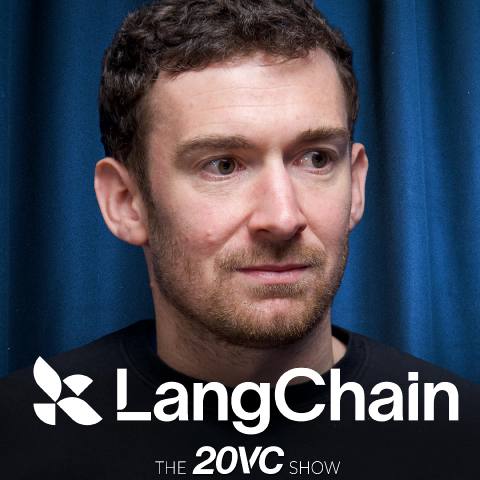
Grokipedia·Harrison Chase

Transcript

20VC: Horizontal vs Vertical Agents: Who Wins | Model Routing: Commodity or Increasing in Value | The Future of the Inference Market | Why Founders Should Take Discounts for Tier 1 Firms with Harrison Chase, LangChain ·

The Twenty Minute VC: Venture Capital | Startup Funding | The Pitch

More from this episode

  1. Should I Take a Sequoia and Benchmark Discount?Harrison Chase says it is absolutely worth taking a discount for Sequoia and Benchmark.
  2. What Is the Hardest Part of Building AI Agents?Harrison Chase says the hardest part of building agents is getting the system to behave reliably. Models are non-deterministic black boxes.
  3. Will Model Labs Eat the Agent Harness?Harrison Chase says the agent harness should stay neutral, so the memory and context an agent builds are not locked to one model lab.
  4. Why Do Domain Experts Win With Vertical Agents?Harrison Chase says a founder should start a vertical agent at the harness layer, doing context engineering before any post-training of the model, because…
  5. Why Hasn't Anyone Solved AI Memory?Harrison Chase says the hardest part of AI memory is the intelligence that decides what to keep, not the database.
  6. What Kind of Agent Do Most Apps Need?Harrison Chase says most apps probably need a vertical agent of their own.
  7. Why Are AI Bills Rising Even as Models Get Cheaper?Harrison Chase says AI bills rise because agents burn far more tokens, even while frontier models get cheaper on price for performance.
  8. What Share of Engineering Salary Goes to Coding Tools?Harrison Chase says they spend roughly 30% of engineering salary on coding tools.
  9. Should Companies Fear Open Source Chinese Models?Harrison Chase does not think fear of open source Chinese models is justified. Some enterprises are fearful of working with open source Chinese models.

People

More answers like this

The other side

More with Harry Stebbings

Related episodes

Plays from this note through the rest of the episode.

Weekly highlights

One letter a week.

The notes worth hearing, with the minute they were said.