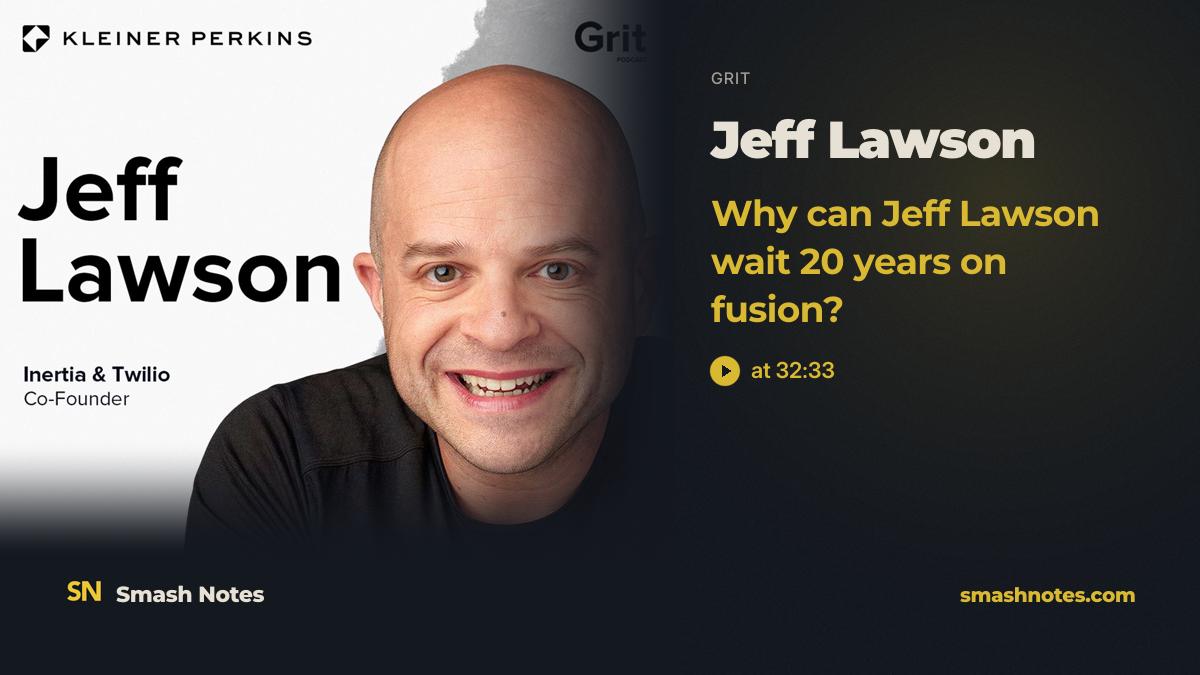
The 20-Year Bet to Make Fusion Energy Work | Jeff Lawson
“Don’t go public without understanding your go-to-market.” Jeff Lawson reflects on Twilio’s go-to-market mistakes, including how the company generated hundreds of millions in revenue with just 7 sales reps. He also shares how AI is changing the economics of software and why he’s betting on fusion energy instead of entering the AI startup race. Guest : Jeff…
People
Notes
Related notes
- When Should Founders Start Thinking About Communities
- How Does Product/market Fit Occur
- How Did Twilio Get Their Start With Developers
- How Did Twilio Break Into the Enterprise Market
- Why Are AI Token Prices Falling?
- How Does a Founder's Story Make Paid Ads Cheaper?
Related episodes
-
![]() How Vercel Is Rethinking Go-to-Market With AI | COO Jeanne Grosser
-
![]() Inside the AI Startup Making Customer Support 65% Cheaper
-
![]() The AI Race Has a Leaderboard | Arena CEO Anastasios Angelopoulos
-
![]() The Difference Between 1% Improvements and 10x Growth | Immad Akhund
-
![]() #092 – The Business of Bringing People Together with Derek Andersen and David Spinks of Bevy
-
![]() Developer-Focused Go-To Market with Arthur Johnson and Yasmin Razavi
-
![]() Ep 4: Hiten Shah. Building FYI, Crazy Egg, Kiss Metrics and advising 120+ startups
-
![]() Graham on Start-ups, Innovation, and Creativity

Full transcript
The episode notes above make this conversation easy to skim.
0:00
people are not tapping into software budgets, they're tapping into headcount budgets. In the past, you'd look at SaaS and you'd say, oh, well, maybe if I buy CRM for my salespeople, everyone got 10% more productive, but I'm still probably gonna hire the same number of salespeople. But if you look at customer service and you're like, wow, I can actually deflect now 80, 90% of my customer service requests with AI successfully, you just tapped into a huge budget opportunity.
0:23
That's what enables that scaling. One of the most brilliant values in corporate history. We move fast and break things. The assumption is if I break things, I'm in trouble. That's a career-limiting move. The heavy lifting that that value does is it gives people permission to behave in a different way at this company than you probably will at any other company.
0:40
If it's in the interest of progress and moving fast, you have my permission to break things. As long as we're learning, as long as we're moving fast. It's pretty powerful.
1:00
Welcome to Grit. I'm Juven, partner at Kleiner Perkins, a show where we go beyond the highlight reel and explore the personal and professional challenges of building history-making companies. Today on the show, I'm talking with Jeff Lawson, formerly the co-founder and CEO of Twilio and now co-founder and CEO of Inertia. Jeff spent 16 years building Twilio from a startup founded during the financial crisis into a $4 billion plus revenue public company.
1:25
After stepping down, he bought The Onion and then started over in an entirely new field, Fusion Energy. We talk about the hardest years at Twilio, walking away from the company he built, becoming a beginner again, and why he's betting his next chapter on Fusion. Enjoy. Can I ask you the question I was going to ask you? Yeah, go for it. Which is, well, what we were just talking about is like...
1:46
people from the previous generation who join series, actually it could be this generation, actually it might even be more so in this generation, who join post PMF, series B,
1:58
and you just have to scale your function, taking for granted
2:04
how rare it is to have product market fit. Maybe, can you expand on that before I get to the next question?
2:13
Well, you know, it's interesting because when you're growing a company, you really end up with kind of two sets of folks. Let's just talk about go to market.
2:21
There's a set of folks that come in before you have product market fit and you're exploring and you're trying to find it. So for example, the first salespeople that you might hire in that universe, they actually look a lot more like business development. Because I think of business development as essentially creative sales. Sales where there's no playbook.
2:38
You have to go figure something out with each customer. And the goal of that era of your early go-to-market folks is to A, close some sales, get some revenue coming in, but really it is to figure out what the playbook is. So if you do five deals and all five deals look completely different, you don't really know much, but if you start finding that pattern and your folks are trained, like my job is to close deals, but more importantly, find the pattern so that we can write the playbook so that we can train up and scale, because in order to scale, you have to give people a playbook.
3:13
And then before you have it, you can't scale. And so you end up with like the pre-product market fit, trying to find the playbook, but really be creative in your sales to then write the playbooks. So then post-product market fit, you now have the playbook in your hand and start hiring, you know, sales after sales after sales and just scaling out that function.
3:29
And so I just think that's really interesting. And so there's a big difference between people who've joined pre and post-product market fit, because the people who've spent their whole career in post-product market fit always assume that there is a playbook. Right. I show up, there's a playbook and yeah, we're going to iterate it. We're going to scale it.
3:45
We're going to learn. But ultimately we know how to sell this product, which is a completely different world from the, we have no idea how to sell this product. And therefore we have to explore a whole universe of different buyers, different messages, different problem statements, and maybe even evolve the product to solve a problem. We didn't even anticipate on day one.
4:04
And you made the comment, like, I don't think people. appreciate how uncommon it is to actually find product market fit when you tend to just join the companies that have them. Well, there's a survivorship bias, right? So the companies that you hear about and may be likely to join, or even the companies that are hiring salespeople to begin with, or sales leaders to begin with, those are the companies who've already made it past that stage to where they're scaling.
4:33
And they probably raised their series B or I don't know, who knows, maybe their series A at this point, but they've raised money. They probably have some product market fit and they're scaling. So just numerically, the number of salespeople that are employed in the world statistically are gonna work at companies that have found product market fit, right? And so therefore, if you have never experienced that and you join a company beforehand, that can be a big shock because you realize like, well, we don't know what we don't know about how to sell this product.
4:59
But you, as a go-to-market person in the early days, you're given a canoe and an oar and sent out onto the ocean to try to find revenue. And that's a different personality. In fact, we hired folks at Twilio in the early days. They were very different profile of salespeople than who we ended up hiring later as we were scaling out. And that's just the nature of the beast.
5:22
And how long, in hindsight, would you say it took Twilio from incorporation to product market fit? And I'm curious if... Your definition now has changed from when you were in the midst of the action. I think when you're in the midst of the action, the reality is you're not like every day asking yourself, like, do I have product market fit or not? But I'm curious, like in hindsight.
5:46
Maybe you should. Maybe that should be what founders wake up every day asking themselves. Maybe, but like, maybe I suppose the pretense to that is what is the definition of that? Yeah.
5:56
I'll give you a quick background on Twilio. So when I started Twilio, I had only done consumer products before. This was my first sort of B2B-ish product. And I remember one meeting with, you know, one of our early investors was Mitch Kapor.
6:12
And I met with him in our seed round. Hadn't raised a dollar yet, but it was one of the, you know, early investor meetings I had. And I remember Mitch declined. And his reason for declining, he was like, I'm really interested. Actually, I think this developer thing could be super interesting. but I don't think you know how to run a product.
6:29
I don't think you know how to run a go-to-market for developers. And so come back to me when you figured out more about how to run the go-to-market here. And I kind of like made my notes. Okay, I got to go figure out the go-to-market. Now I, secretly, didn't tell him this, but he could not have been more right because I went home and Googled, what does go-to-market mean? I literally had no idea what I, I didn't know what I didn't know about how to run a B2B go-to-market.
6:54
And so in the early days, we were not thinking about, do I have product market fit? Am I running a go-to-market? Like, didn't even know what the word meant. All we were saying was, are we building a product that we think developers want to use and have use cases for? And we used to say, you know, our company has no strategy other than build a product that customers will pay us for, right? That's the strategy of the company, because if you lose sight and you have some convoluted strategy that statement that isn't just completely centered around solving a problem for a customer, then it's easy to get lost.
7:29
And so when I think back to like, when did we get product market fit? Well, very early on, I'm saying the day we launched, we started seeing developers come sign up, put in their credit card and start building things with Twilio that were useful to themselves as developers and to the companies they worked for. And so, You could argue that Twilio didn't really go through this period of like, don't have product market fit, don't have it, don't have it.
7:55
Ah, we did one magical thing and now we have product market fit. I think the bigger question is like, when did we make this transition
8:04
from purely developer to more of a traditional B2B go-to-market motion? Because you might say that's when we found product market fit, when we were able to convert those developers into scaled commercial contracts with the companies they worked for. Like some predictability into the business. Yeah. I mean, with a usage-based model, you know, you don't always have predictability, but at least you've got, you know, contracts with, you know, companies, enterprises, contracts that are worth, you know, five, six, seven figures, right? Like, you know, when you started seeing that happen, you might argue that's when really the company found product market fit.
8:39
But again, that wasn't very long into the company. I'll give you an example. I remember... Okay, we were in our office that was a few blocks from here. So that was probably about two, three years in, maybe 2011 probably. And I remember the desk I was sitting at and we were still pretty sparse office, maybe 2010.
9:00
In the very early days of Twilio, I was under the impression we wouldn't need salespeople. I'm a software developer. I didn't want to talk to a salesperson. I wanted to pick up an API and just go. That's what I wanted to do. And therefore I assumed the developers of the world were similar to me and therefore wouldn't want to talk to salespeople.
9:18
By the way, that's largely true. The thing I got wrong was though that the relationship that we needed to build with their company would go well beyond the developer. That's where I didn't anticipate that. And I remember realizing, you know, I sort of said, okay, I don't think we're going to need salespeople. It's just going to be the self-service magical adoption model.
9:36
And one day, and this was back when, you know, I and the other co-founders, we were still doing, you know, all the customer service for Twilio. So we'd, you know, be in Zendesk answering, you know, emails and tickets from customers. I got an email from a product manager at Intuit. And the product manager said, hey, one of our developers built this amazing thing on Twilio.
9:56
It allows you to do two factor authentication. So when someone tries to log into QuickBooks, it will call them and read them a pin that they have to enter in order to make sure that they are who they say they are. It's a security feature. And again, 2010, 2011, somewhere in there, pretty early, like 2FA was not actually commonly used at that time.
10:14
And so this product manager, but she says, but hey, you know, we're into it. Like, we got some questions. You know, are you secure? Are you scalable? Like, are you a real company? Like all sorts of questions. And I very excitedly was like, happy to hop on the phone with you. And so I hop on the phone with this product manager and walk through all this stuff and we set up a next step.
10:31
Okay, well, it'd be a security review or a, you know, a commercial contract. and got off the phone and was like, that was amazing. Like Intuit wants to use Twilio, this is so cool. And that kind of is how I'm like, I think I was just doing sales though. You know, and I kind of had this slow realization of like, oh yeah, that's what a salesperson would do.
10:51
And that's the, you know, essentially the follow-up to the developer opening the door, bringing us in. And then we have to then, you know, take the ball and, you know, I think I'm mixing metaphors at this point. But, you know, if the developer opens the door, we have to walk through it and actually close the deal with the customer. And how long into the company did that part happen? Yeah, that was probably about two years into the company.
11:13
Two years. So at that point, we did not have salespeople at that point, but I think that's when we started down the journey of like hiring our first salespeople and all that. And can you like, but by the way, I'm going to say I was a complete moron. Like I did not learn the lesson of go to market. You know, at that point, because we did hire salespeople, but I'm going to tell you a terrifying story for any go-to-market person.
11:38
We went public in 2016. We went public in 2016. That year, I believe we had about 230, 240, somewhere in there, million of revenue. Do you know how many salespeople we had?
11:50
I ask you because at the time, I didn't know the answer to that question.
11:56
I remember I hired George Hu as my COO to help me scale out go-to-market. And we agreed. He started in, I think, January of 2017. So that year, we probably did about $400 million in revenue. He started in January 2017. He did the usual thing when an executive comes in and says, well, I'm going to spend my first three months just talking to a lot of people and learning the ropes and figuring out what's going on and not make any changes.
12:18
And then I'll come back to you after three months with all my observations, and we'll figure out what to do from there. Great. Comes in. 30 days in, he comes to me. He says, Jeff, I know I said I wasn't going to make any changes for 90 days, but I can't not do something about this. He said to me, do you know how many quota carrying reps we have? And I said, God, I think like, I don't know, 50.
12:38
And he said, no, we have seven. I was like, well, who are all those other people? He's like everything else, but they're not carrying quota. You know, you've got sales engineers and BDRs and all these people, but the actual quota carrying reps, seven. And I remember, because I remember someone had said to me, you know, we have two enterprise reps.
13:01
We have the U.S. East and the U.S. West. So everyone west of the Mississippi, which at that point probably represented, you know, just because we had a lot of Silicon Valley companies, like probably represented a few hundred million dollars of revenue. One salesperson. One salesperson.
13:19
And, you know, and I remember George said, he said, you know, I'm pretty sure he's like, I don't know what the right number of sales reps is. I'm pretty sure it's not seven, given our opportunity and the size of the business, even that we have today. Oh, and
13:33
if you go look on LinkedIn, you can see our lesser competitors who are much smaller businesses than we are. They seem to have about a hundred reps.
13:41
Oh, and by the way, a Wall Street analyst just wrote a report where they spoke to one of the prior sales leaders at one of our competitors. And that person said their entire business was built upon people who Twilio didn't call back when they reached out to us.
13:59
And then the last data point he had was, and I sat in on a call with one of our BDRs. And it was interesting. We have this inbound lead. Someone filled out the forum. They took an inbound call from, it was a Fortune 100 company. I can't remember which one it was. Let's just say it was General Motors. General Motors is on the phone and says, we want to use Twilio for this use case and the BDR.
14:19
And I'm going to make my Simpsons 18-year-old impersonation. This BDR is on the phone like, yes, hello. Thank you for calling Twilio. And they're like, yeah, we want to build whatever it is on Twilio. And they're like, oh, that's amazing. Well, let us know how it goes. Click. You know, like that was the conversation. We were completely still bought into this idea that like, yep, they're gonna go build it on their own and they'll come to us if they have issues and all that kind of stuff.
14:44
And he was like, yeah, I'm pretty sure you don't just tell, like, again, I don't remember which company it was, but it was like a Fortune 100 company. I'm pretty sure you don't just tell them, like, good luck, let us know how it goes. Like, you follow up with the salesperson. So all these data points point to I'm pretty sure we could scale from the seven quota-carrying reps we have today to 100 and still be doing a pretty, you know, still probably be under-resourced there.
15:04
And so we did. We made the call. And within six months, we had hired, like, almost 100 sales reps. It was bonkers. We like did this blitz and absolutely it was correct. We were leaving so much on the table. You were public at that point? We're a public company. Like, I guess my... Growing at 80% year over year or whatever it was at the time.
15:23
It was close to that. Like, so we were like, there isn't a problem here, right? But like, I guess... How do I ask this elegantly? I don't know how. What were you doing? I already told you I was an idiot. What were you doing? But like, did you not you know, like, want to know what was going on in that part of the organization. When you're growing, like, I can't remember the exact, it was 70, 80%.
15:47
So when you're growing 80% year over year at a few hundred million of revenue, it's like you focus on the things that are problems. Yeah, yeah, yeah. That's totally fair. Right? I mean, that's kind of, I think, the mindset. Like, that's not a problem. We're growing really healthfully. Totally. So that's working. What am I going to focus on over here? Like over here or just something in the product world is not working or somewhere in the whatever.
16:07
I don't remember exactly. I mean, I'm pretty sure that a lot of that time was spent going public. That is a big drain on a lot of your time. But the more interesting lesson there, I think, is that I actually still didn't understand quite enough about the B to B sales motion. because we were succeeding with developers inbound, light touch.
16:28
And in fact, that was our sales pitch to Wall Street. Look at this really light touch go-to-market motion we have. And so, you know, we saw it as a positive. Yeah, that makes sense. But it turns out that when we did hire a bunch of, you know, you've got a lassie out there who was saying, oh, sales is for suckers, right? Like, you know, all that kind of stuff.
16:45
And so we just thought we were pretty clever that we didn't need to have a huge sales team. Yeah. And so what were we doing? You know, really focusing on product. But the interesting thing, the framework we ended up coming up with, I'll credit George again with this one, which I really like. You know, one time he said,
17:03
So at any point in time, any company is either product constrained or distribution constrained. Okay, so if something is constraining the growth of the company, it's either that you've got a great product, but you just need to distribute it. You need to get it in the hands of more customers. You've got 1% penetration of your market. And if you had more marketing or sales or whatever, distribution channels that you could go saturate that market, but you've got the product and you're distribution constrained, then the thing you should focus on as a company is how do you solve that problem? You know, more distribution, more sales reps, more marketing, getting out there, like
17:41
that's the thing you should be focused on. On the flip side, other companies are product constrained, meaning you've sold your product into, like you've saturated the market. You've got all these customers and all these sales reps and they've already bought all the stuff you have. And so at that point, what you need is more product to go back and sell those customers.
18:03
And so the thing is, a lot of founders, especially those who come from a product background, engineering background, developers like myself, you think of the world through the lens of product. Because you're builders. You want to build. You're like, oh, I have an idea. Oh, the customer has this problem. I want to go build that or this. I think, you know, you're always thinking the world through the lens of what's the next product we're going to build? What's the next problem I can solve for the customer? Like, that's your lens on the world.
18:28
And that was certainly my lens on the world. We were putting out products all the time. Meanwhile, we were not a product-constrained company. By the way, very few startups are. Almost every startup is distribution-constrained. And so while we were building all this product, what we should have been focused on was building out that distribution.
18:50
And that's the thing that we shifted gears on in that moment of when we actually, like literally, like as an executive team, we made a hard decision. We said, great, we thought we were gonna go hire this many engineers this year and this many product leaders, whatever. pulled all those heads back and said, nope, those are all sales heads now.
19:05
And all the supporting infrastructure you need for growing the sales team. Because we literally, you know, pivoted from having, you know, whatever, you know, less than 10 salespeople to having 100 in the course of less than a year. It was like six to nine months. Do you think it's true that Most, almost all companies are distribution, not product constrained.
19:23
Okay, so seed stage, when you don't have product market fit, you're product constrained. You haven't found, now, it's almost not entirely fair to say which one it is because you don't really know yet. But let's just say you're product constrained because you don't have a product that clearly the market is pulling you into. Okay, once you have product market fit, you are almost certainly distribution constrained.
19:43
because you're in the early stages of having a product the market wants, but chances are you've got a tiny, tiny, tiny fraction of the number of customers you could have actually using your product. So in that moment, you are not product constrained, you are distribution constrained. And the thing the CEO and the executive team should spend all their time on is figuring out how do we unlock And so we're not distribution constrained anymore.
20:02
Hiring salespeople, scaling marketing, building maybe a channel program, like whatever you're going to do, but you've got to get your product into market and you should not obsess about all the things your product can or should or might do. Now, yes, you'll continue to do product development and you'll continue to answer customers' needs.
20:19
And, you know, if you're like, oh, okay, well, we enterprises, you know, we need to get in the enterprises. Oh, they want some security features. Great, go build those. But don't be like, Twilio did is say, oh, okay, well, we got this product here. Customers seem to love it. Great. Let's go all the way over here and like find the next product.
20:33
You're like, what? There's no point in that. Because now you just have two products that are under distributed. And at that point in time, Twilio, and we were pretty proud of this, we probably had a dozen products all under distributed. So you can see like the next dollar we put into R&D or into software development or product was wasted because we weren't even distributing the products we already had.
20:53
Can you give me the to a hundred million, like a rough approximation of a year by year revenue growth? Yeah, this is off the top of my head. Rough approximation. I think it was about a hundred, maybe 150K our first year, about a million our second year.
21:12
I think it was about a 4 million. Oh no. I think we jumped to 2 million and then we jumped to 10 million and then we jumped to 50 million and then we jumped to about 120 million and then we were at about two 50. So that was the first, whatever, six, seven years of the company. Okay. So it took whatever, five, six years to get to a hundred million.
21:30
Yep. And by the way, like in the, that era, the, which you're like one of the preeminent figures of, that is about as fast as you could go. You know, like the triple, triple, double, double, that's like pretty much, that's what this is. And the thing is, the thing that obscured a lot of the things that we didn't know, that I didn't know about go-to-market and sales and everything like that, we had such a strong expansion rate.
21:56
So DBNE was the metric that we used, which I think we invented. Dollar-based net expansion was, I think at the time of our IPO, like 140%. Meaning a customer spent a dollar last year, spent $1.40 this year. And then you compound that every year. And so that's what propels you to these massive growth rates without any salespeople. Because once you land the customer, lifetime value is infinite.
22:20
And so you would just keep growing these customers. And so that is a luxury, but also a curse in the sense that if you don't build the muscle to have go to market, if that DBNE ever slows down, which it eventually did, Now you have to learn a new skill, which is actually selling to new customers and cross-selling and upselling and doing all those things, which we had to learn very quickly because we did start to see a slowdown in about 2017, right after we went public.
22:45
What happened right after you went public that you saw a slowdown? Don't go public without understanding your go-to-market. This is my lesson for everybody. I don't know which camera. I'm talking all the cameras. Do not go public without understanding your go-to-market. What do you think of these companies that I'm sure you're tracking now? Let's take like, I don't know, maybe like Cursor and stuff is anomalous.
23:11
But like, I don't know, just looking at the Harveys and the Sierras where it's like 18 months to get to 100. I'm just like, I'm just curious, like what you're.
23:24
When you see this, what goes through your mind? Like, I'm curious, like seeing what you were best in class now is completely rewritten by an order of magnitude. Let's just look at opening eye and anthropic. Right. You know, that's what's anthropic. It's like five years to like a hundred billion or something. Like, I mean, like this is bonkers.
23:47
I mean, talk about product market fit, first of all. The token business is
23:55
incredible in the usage-based model, right? It's kind of the next evolution of the usage-based model, but taking something that's like, I always thought you've got communications, one of the fundamental human things, and we made it a usage-based model to buy communications.
24:14
Okay, that's pretty cool. And then, you know, kind of Stripe does it and they are doing it. Oh, but even more fundamental in communications is payments. Usage-based model for payments. It's like, oh, that's so good, right? Well then, you know, an AWS is doing it for compute and storage and taking the fundamental building blocks of technology and saying, we can sell those to you on a usage basis.
24:37
And therefore our revenue is essentially a function of just like, you know, human activity built on top of these things. Brilliant. But now you look at it and you're like, well, wait a minute. This isn't even like apps anymore. It's just intelligence. Selling you intelligence in a utility model is, you know, in some ways like the ultimate you know, utility ultimate usage model, which is astounding.
25:04
And that was actually one of the early things that I saw and I would love for have Twilio have gotten into because we were a company very accustomed to selling things in a utility way. And so I saw a lot of companies I thought would have struggled to make a transition into a world where, yeah, you're building software, but then you're selling it in this usage-based way, especially if you're trying to like resell, markup, or just embed tokens into your business model, that's a really hard thing to do.
25:29
And Twilio already had this business model based on, you know, we had carriers and we're kind of passing through their stuff. We could do that with tokens quite easily, both technologically, but also from a business model standpoint. Because if you're a company that has a structurally lower gross margin, which a lot of companies do if they're reselling tokens, you know, that's a challenge as well.
25:48
But back to the point, like, what is it? It's just ultimate product market fit for in some ways, like one of the ultimate markets on the planet, which is intelligence. Yeah. Now, my question is not or no, none of these companies are public. So how durable is that revenue going to be? And I actually would say it's proven to be a lot more durable than I would have guessed three or four years ago.
26:06
Kind of at the very beginning of this era, I would have thought more of a race to the bottom. But I think, and I think there is, right? Look at the price, the token prices over that period of time. You know, it has been a race to the bottom. It's just the demand is so far outstripped. the pricing dynamics, that it didn't matter. Right. And that's the amazing thing.
26:28
Right. So it's all about use case expansion. And so you look at what, you know, Anthropic in particular, I think they've done a really good job of, you know, building out enough use cases to ease adoption while still being a horizontal. Even though they've started to creep into verticals like law, uh, but they do it in a way where they're such horizontal and then such penetration, those use cases in many ways, I think they have, uh, the foundation models have sucked the wind out of a lot of the application space.
26:55
And again, I don't know, I'm not a VC, I'm not an investor. I'm not, you know, looking at a lot of the financials of these companies, uh, But I do think that if you asked a few years ago, I think you would have guessed that, A, the foundation companies would not have grown this fast, and there'd be way more application companies built on top of them.
27:12
I think that's what you probably would have thought three, four years ago, looking at this space. And so I do think that the foundation models have eaten the market in a way that a lot of people maybe wouldn't have expected.
27:26
That's an interesting take. You don't think so? How many...
27:33
those you you know you mentioned harvey you mentioned yeah um sierra sierra right like but you can count on kind of one hand i mean you've got coding yeah coding couple of law companies made it out but not as many as you would have thought maybe a few years ago and it seemed like oh my god legal you know legal ai tech is going to explode uh one customer service agent company Maybe two, you could say, oh, you know,
28:01
Intercom, but that was a nice acquisition, but not a ton of revenue, I don't think. So, yeah, I mean, can you count on one hand the number of really scaled companies that have emerged at this point? Yeah, I think...
28:14
Other than the foundation? Sure, yeah. Maybe more of my contention would be that probably
28:22
the fact that any company... is over a hundred million on top of these lab, on top of these models when really the models weren't good enough until two years ago. let's just say generously to even build a sustainable business on that was actually transformative for the customer is pretty astounding in general that there's any. And then maybe the other thing I will say is like, at least the way I think about it is that the companies that you listed are categories that are particularly good
29:04
what the models can do. And so like when a model has a certain type of problem that is structured and unstructured data in nature that it can reason with, it is great at doing that. And then the byproduct of that is you can build on top of it a great product.
29:22
Harvey, case law, Sierra, customers, coding.
29:30
And so I think as the models continue to mature, I think it will continue to unlock new categories that then can race to the 100 plus million. And in the meantime, I do think that it's pretty amazing that anybody has even... grown that quickly. And I think the key to it, and this is not a unique insight, but the key to it is that people are not tapping into software budgets.
29:53
They're tapping into headcount budgets, which are far, far bigger. So if you're saying, oh, you don't need to hire as many lawyers, as many developers, as many customer service agents, because you've got AI that can essentially do their job. You know, in the past, you'd look at SAS and you'd say, oh, well, you know, maybe if I buy CRM for my salespeople there, I mean, you just have to.
30:15
But like, you know, everyone got 10% more productive. Okay, great. But I'm still probably going to hire the same number of salespeople. But if you look at customer service and you're like, wow, I can actually deflect now 80, 90% of my customer service requests with AI successfully. I need 90% fewer humans. You just tapped into a huge budget opportunity.
30:34
And that's the big difference between prior eras where you had to tap into a technology budget and this area where you're tapping into essentially the headcount budget. Totally. That's what enables that scaling. Yeah. And I do think that, like on your point on legal, you said, hey, I'm surprised there aren't more. I think the question is, maybe not more for me, but like how much revenue is there? Like what's the terminal value of one or two companies? And do they dominate the market? Because that tends to be how these things go.
31:04
Like if you're a YC founder and you look at Harvey adding you know, a gobstopping amount of revenue every quarter, are you gonna enter the legal space? Maybe, maybe not, right, at this point. So I think that that's what we're gonna see play out. I think that's what we're gonna see. You know, it's interesting. Part of my lack of a good answer for this is I kind of decided that I thought for myself that this was not a good time to start an AI company.
31:34
because the ground, the foundations you're building on are so uncertain.
31:41
Like existing companies, absolutely. They have to go into AI. They have to answer the innovator's dilemma and figure out how do they disrupt themselves. Like absolutely. But if I was starting a new startup, personally, I think that there's gonna be so much seismic activity in the world of AI over like what ends up shaking out that to me, it's like not a great time to start a company.
32:05
And the other thing is, especially in a, as an investor, in a
32:13
valuation weighted market, I think it's hard to, could be hard to make money in a market where it is so hot, it is so frothy, So for me, like I like kind of zagging when others are zigging, I guess, you know, in 2008, when everything was consumer and SaaS, like we started a developer company. So for me now, I was sort of like, I want to watch AI not as an active participant, because I think the market five years from now will be so different.
32:43
and that potentially that's the time to start durable companies, unlike, you know, say, well, sort of like the dot-com era, right? You had an initial boom, a lot changed, a lot shook out, learned a lot, a few companies survived, but then the real next era began. My gut has been, and I may be very well wrong about this, that a similar thing will shake out in the world of AI, and therefore, like, I was not excited to jump into the fray.
33:09
which is why I started a fusion energy company instead of a AI software company. You did put your money where your mouth is. Yeah. It was also just more interesting to me. Like when everybody is jumping into AI, that to me is just less interesting. Also, it means you're going to have huge competitive dynamics in terms of talent, in terms of capital, in terms of everything, when everybody's walking in doing the exact same story, roughly.
33:34
You know, I was just with Deju from Robin Hood. who's doing a cowboy space corporation. I think it's called space company. Okay. He was one of the co-founders of Robin hood. And then obviously Bezos is in his rocket era. Um,
33:51
is it one of those types of things where like you can only take this swing? After you've made it big, like this, like, it feels like such a big swing and please tell us more about it. But do you know what I mean? Like, it's like, you know, for anyone to even take you seriously in a space like this, do you have to have been or done something before? I think, and by the way, there are plenty of people in deep tech who have, you know, this, you know, they have not.
34:20
For me, though, I do think that there is something that you're, you know, in some ways a luxury you're afforded to be able to do a long play like this that is, you know, it is a classic long shot, moonshot, whatever you want to call it. but I have the luxury of doing it. Like, I don't have to prove anything to anybody. You know, I feel like a lot of founders start their companies because they want to prove, like, I can do it.
34:43
You know, I can build something. And they're proving it to themselves or others or whatever, but they got something to prove, right? And you could look at this as a good thing or a bad thing, you know, that I don't have something to prove. Therefore, I can put in the time, I can put in the effort, and this is going to take 20 years, and I'm completely comfortable with that.
35:01
So I can take that big risk and take that big swing because I don't need an exit in the short term and I don't need some, you know, validation in the short term. Now, you could say that's a negative thing. I've heard some people say, oh, well, you know, if you don't have that hunger, you don't have something to prove, then, you know, you're not a good founder.
35:17
And, you know, I don't particularly believe that. But, you know, I think there is something that is afforded afforded you after you've done it. after you've shown the world, like, yeah, I can do that thing. And now I want to take an even bigger swing. And that to me is what's really exciting about this. Because
35:38
at some point at the end of the day, like software, Jeff Bezos said it well, I was in all hands in the early days of Amazon. And I can't remember what the question was, but I remember his answer. His answer was, folks, We're in the software business. Our job is to arrange magnetic particles better than our competition. Like that's what we do.
36:00
And I always stuck with me. Wow. The job of software is arranging magnetic particles in a profit-making order. And at some point you realize like, God, that's not very fulfilling, actually. It's a great business model. Don't get me wrong. What an amazing, astounding way to build a business and make money. But as a life's work, I did start to feel this like, I want something more tangible.
36:24
I want something more lasting, more durable. And that's where something like fusion energy, which is a long shot, but if it works, will change the world in a positive way, by the way.
36:37
That's so exciting. And I say in a positive way, because I also think for some folks, myself included, some of the effects of the software world and the internet on society are starting to be a little disappointing. And so you start to say, oh, like this world where we thought we could create this amazing utopian world of... information for everybody and information is going to be free and therefore everyone's going to reach their maximum potential.
37:02
Yeah, it turns out when you connect a billion people together, it's mostly scams and frauds and people trying to take money from each other. You know, that's kind of a disappointing outcome in a lot of ways.
37:13
And so as I look to like what's next for myself, I was kind of ready for like, OK, Let's think about something where there's tangible real world impacts if we succeed and we're not dependent upon the behavior of human beings
37:30
for that success. How did you land on Fusion Energy? Total accident. I mean, I wasn't looking to actually start my next company. I was perfectly content. I bought the onion. I was perfectly content doing some fun things like that. Which is epic, by the way. Completely epic. Yeah, yeah. Wait, okay, so you bought The Onion, so you left Twilio in 2024.
37:45
Mm-hmm, yep. After 20 years? 16 years. 16 years, epic run. Started in 2008. Right before AI?
37:56
Post-AI, post-ChatGPT. Okay. Yeah. Then you buy The Onion.
38:03
We brought back, by the way, so the onion was swirling. It was owned by private equity who were absolutely destroying it. It was in a death spiral, right? They laid people off to try to squeeze more cash out of it. The product got worse. Fewer people read it. It made less money. They laid more people off, like death spiral. This private equity is not the right owner for a satirical publication, especially in this era of media, right? So
38:30
my first interest was in buying it, and I realized it actually wasn't buying it, it was saving it. So I bought it from private equity, and immediately, just like, we put it back on solid footing because the product had gotten horrible because the last owners had said, hey, you know, the business model of the internet is to... Great content that gets maximum clicks, make people refresh their pages a lot to view more content and load the pages up with awful ads.
38:54
That was the business model. And so the product was god awful. So we reset the whole thing. We said, okay, first of all, who's at the center of our universe again? The reader. That's our customer. It's not the advertiser and it certainly isn't private equity.
39:07
And so we're putting the reader back at the center and we're going to go back to the world's oldest business model, which is if we do something people like, they will pay us. So we introduced a membership model. And with that membership model, if you pay $99 a year, we brought back the print edition of The Onion. We will mail it to your door 12 times a year.
39:25
So every month we now make, again, a print edition of the paper, which they hadn't done in a decade. They killed it in 2013, I think it was. So brought back print and now have a model where our readers support it. And since then, we brought it back. We've 5X'd the revenue from when I bought it. By the way, we took the revenue to zero because it was all like chum box ads.
39:47
You know, it was like awful AI ads that don't make any sense. It was like, oh, the page was loaded with those. And it didn't even work on mobile because there were so many ads, your phone would start overheating, right? It was like the worst thing. So we got rid of all the ads. There's no ads on the site anymore. And then, so we took the revenue to zero.
40:05
And now two years on, we have more than 5X the revenue that it had before I bought. And we would be profitable, except that in this current era, we said, you know what, we should invest. We should invest to go actually grow and to, you know, be the satire that the world needs right now in this era of MAGA and everything else, right? And so that's where we're at.
40:27
Yeah, it was losing money. They kept, under private equity, they kept slashing, you know, the budget to try to make more money and they ended up losing more money. It was bonkers.
40:36
That kept you busy for a while. Not really. I hired a management team on day one and was just like, you know, you guys run with it. I'm here to support you. I'm helping you with the strategy and I'm here to support you as a team, but you guys are running this thing. So, but while all this was going on, one of the other things I'd had in the back of my head was, you know, like I took a lot of physics classes in college because I just thought it was so interesting.
40:59
Obviously not what I did with my career, but I thought physics was just fascinating. And so as such, I learned about, you know, nuclear energy and fission, which is the power plants, you know, we have today, but also fusion, which is the process that powers the sun. So unlike fission, which is splitting heavy atoms like uranium, plutonium and bizarre things like that, fusion is taking light atoms, hydrogen, and getting it to fuse into a heavier helium atom in the process, giving off a ton of energy.
41:28
It's the process. It's the process that powers the sun, and we have known about it and pursued it because it is considered to be the holy grail of energy. Because it is clean, it is safe, it is cheap, and the inputs to it are abundant on Earth. And so the only problem with it is, it's never actually worked. That's been the problem. Because we know, and we've known since the 40s, how to convince, you know, a plasma of hydrogen atoms to fuse into helium.
41:59
with by imparting a huge amount of energy to create a plasma that is, you know, tremendous temperatures and pressures. We've known how to make it happen. It's just it took more energy for us to put in than we get out. So you can spend a ton of energy to create this high energy plasma and you get a few fusion reactions happen and get out a little tweak of energy here, but you spent way more energy to try to create those conditions than you got out.
42:24
Well, and that's where in December of 2022, the world changed because one of the world's largest science experiments It's just 80 miles east of here. We're in San Francisco right now. 80 miles east of here in Livermore, California, there is the Lawrence Livermore National Lab. And they have an experiment there called the National Ignition Facility.
42:43
And it's one of the world's giant science experiments. And what they do is they have a little target about the size of a peppercorn full of deuterium and tritium, so two isotopes of hydrogen. And they shoot this tiny peppercorn-sized target with the world's largest laser.
43:00
literally a laser that is three football fields long and 20 stories tall. And they shoot it with two megajoules of energy, all converging on this tiny little peppercorn of fuel. And guess what? In December of 2022, after 60 years, $30 billion our government has put into this experiment and its predecessors, they finally created the conditions where more energy came out than it took to start.
43:27
It's called ignition. And it's the thing scientists have been pursuing for 75 years. And it is the only experiment where that has ever actually worked. And so I saw this news. It was a huge news story. They did a press conference at the Department of Energy and the president was talking about it and all around the world. This is front page headlines.
43:46
I saw this news. It's like, holy crap. Maybe fusion energy, which I always thought was a thing of science fiction. Right. Maybe this will actually happen in our lifetimes. Holy crap. And I kept expecting to see, you know, the news of some spin out, you know, the lab spun out a startup that's going to go commercialize this for energy. And, you know, at the time, though, I was still running Twilio and I was like, oh, my God, I hope, you know, I must.
44:11
I'm sure I'm going to see that headline one of these days. Right. And I never saw that headline. So one of the things I had in the back of my head was, let me go figure out what's going on in that world of fusion. Because I would certainly expect that after having reached this huge milestone for humanity, that this would be the next great, the next great step would be to turn it into an energy source.
44:29
And so I met the lead designer of this experiment, Dr. Annie Kreutzer. And my question for her was quite simple. How come I haven't seen a startup?
44:41
And her answer was super interesting. She said, Yeah, I've kind of been wondering the same thing. Because it would seem like the hard part we did, now commercializing it's the next step. But she said, you know, there were a bunch of people that came through and they looked at the NIF, the experiment, and they said, oh God, this thing's three football fields long and 20 stories tall.
45:00
And these targets are made by hand and you only make a dozen of them a year. And in order to make energy, we have to produce a million of them a day. And this laser is really inefficient. And so we'd have to build a much more efficient laser. God, this just seems too hard. And so people declined to go take that next step. And so we re-looked at this and we said, well, hold on a second.
45:20
There's billions of dollars of investor money going into the fusion space already into approaches that have never actually achieved that milestone. And, you know, God knows humans have tried, you know, hundreds of fusion machines have been built over the decades. Each time they think, oh, my God, like this is going to be the one we're going to make it.
45:40
And then they build the machine and turn it on and realize, oh, we didn't know we didn't know. And they so we failed to achieve ignition. But, you know, we learned a few things. And and so we asked ourselves this question. If we want to see fusion happen in our lifetime, what's a more likely outcome? that one of these startups that have collectively raised $10 billion of investor capital in the last few years, they're going to be the ones to go make their approach work for the first time after some of the smartest people in the world have spent billions of dollars trying to make it work for 75 years? Do we think that's more probable? Or do we think it's more probable that
46:13
we can take the one approach that has actually worked and go make it economical? Go make a laser that's much more economical. Go make targets that are much more cheap. Make them in factories. And we said, you know what? Those two things are engineering problems, not basic science problems. Those are supply chain problems. And so we started this company to say, you know what? While everyone else is exploring basic physics, we're going to go commercialize.
46:39
We're going to go build an industrial supply chain to go build a giant semiconductor powered laser and go build the supply chain to be able to go mass produce these fusion targets. And in doing so, bringing the cost of this whole operation from what is, you know, if you look at this giant science experiment, not very economical at all, but actually bring it into the realm of economical power.
46:59
Hmm. And that's what we're here to do. Our company's called Inertia. Who's we? So myself, Annie, the lead designer of the NIF experiment. She's my co-founder. And our third co-founder is this guy, Mike Dunn, who used to run the experiment at the Stanford Linear Accelerator. You know, that three-mile-long laser, basically, they used to explore the universe.
47:19
So that's a multi-billion-dollar experiment that he ran, including multi-billion-dollar projects to it. So he's the power plant designer. Annie's the science, and I'm the business. And so between all the three of us, We kind of have all the bases needed to go, you know, take this proven science, go commercialize it, and with Annie, make sure that in the act of commercializing it, we don't accidentally screw up the science, because it's super easy to do.
47:43
Did you have to, like, cut a deal with the lab with Lawrence Livermore? Yeah, so we spent about a year, actually. The first year of the company was just trying to create the conditions for this spin-out to happen. So we cut multiple deals with them. First, I licensed all the IP for Fusion. A bunch of 200 patents, about 37 of them are exclusive to us.
48:03
The second one is we stood up three joint research agreements where we are taking the field forward, where we are designing the next generation of high-power lasers. We are driving forward the fusion target design using the same models that they used to design the current experiment. We're designing the next-gen targets. And we have a research program to go scale up mass-producing these targets.
48:31
Today, they're made by hand. We're going to make them in a factory. And then the third thing, we struck a first-of-a-kind agreement. Believe it or not, this had never been done before. An agreement that allows Annie to split her time between continuing to work at the lab and working at the company. Believe it or not, that had never happened before in the history of the national lab system.
48:52
Wow. Universities have it figured out. Universities do. The National Labs. In fact, it took the CHIPS Act. It was written into the CHIPS Act that national labs are encouraged to enable their employees to become entrepreneurs and create tech transfers and things like this. It's an unknown part of that act. I had no idea. Annie discovered it.
49:11
She took it to the lab's layers and said, hey, look, you're supposed to let me do this. And they're like, oh, we've never read that before. Interesting. Right? Wow. And how big is the company now? So we finished all those deals with the lab last summer, basically last September, like a year ago right now. So we got the company off the ground.
49:28
We had 450 million of committed capital, and we've built now a 50,000 square foot facility in Livermore where we are doing all these research streams for how to mass produce these targets and how to build this very large semiconductor powered laser. And we've grown the company from, God, the beginning of the year, we were probably five people and now we're about 70.
49:47
So we've grown quite a bit. And basically we've got all these research streams where today we're doing all this component level development, each part of the target, each part of the laser, developing what it needs to look like and how the supply chain is going to work. In the next phase of the company, we're actually going to go build up prototype scale subsystems of the power plant.
50:04
So the laser systems and the target assembly line. And then in about 2030, our goal is to break ground on the first power plant. And that's a gigawatt scale power plant, like a utility scale, you know, powering millions of homes, like that kind of scale power plant. Are you full-time on it? Yeah. And the nice thing is we don't have any salespeople.
50:21
That's right. You're repeating the lesson all over again. Yeah, right. We'll see. In a few years, you'll come back to me and be like, were you correct that you didn't need salespeople? That's right. This is what might be different than enterprise software. When you left Twilio... I noticed a wedding ring on, like, you know, your family, you're married.
50:39
Managed to stay married through starting and scaling a startup, yes. And even though probably,
50:47
like, you know, I can't imagine your partner wasn't like, all right, finally, you know, you're out of Twilio, you know, we spent some time together. Like, was the plan to, like, kick it a little bit? I think my wife knows me well enough to know that I'm not just going to kick it. You know, like I need to be building something. You know, actually in the year after I left Tulio, one of the things I did, I built a car
51:17
and I just, I always need to be building. And then she knows me well enough. And I, you know, I did, I sort of said like, you know, I really am, I'm thinking about starting this fusion energy company, which would be like, you know, another 20 year run probably. And her answer was, like, I know. I knew you weren't going to just retire because that's just not who I am.
51:37
I need to be building. Why is that? It's how I've always been. Even when I was a child, I was always building things.
51:47
I just get a tremendous amount of joy of taking something that wasn't here yesterday and is here tomorrow. Like, that's... That's the thing that I love doing, whether it's small, trivial things like little electronics projects or woodworking, I like woodworking these days,
52:01
or companies or software products or fusion energy. Like, that's what I love doing. I love imagining something that doesn't exist that I think should exist and then kind of wheeling it into existence. And like, that's the ultimate, you know, founder drive. Sure is. I know we're out of time. Can I ask you one or two more questions? Yeah. Do you mind? There's one thing I actually really want to talk to you about, which is the values that you espoused at Twilio.
52:27
I don't know if you call them values or not, but
52:32
I think that is like one of the most underrated values
52:36
things that you did i don't know why but those values resonated so deeply with me and i would talk to kp portfolio companies about the red chucks and like living in the customer's shoes and you would hang the red chucks all over the office and there's a bunch um how did you come up with them Are they still at the new company? I assume they're probably a little bit different.
53:04
And maybe, do you have any favorites? I'm really curious about this part of your business. This is probably like a whole other podcast. But actually, you can Google this. I gave a talk at First Strong Capital in 2016. So there was a whole talk I gave at one point. It's online. But here's the key things about it. Number one is, The things I figured out about building company culture.
53:27
Number one, there's two separate but related concepts. One is the culture and the second is values. So culture, that's what you feel every day when you go to work. How do I feel? Am I excited to come? Am I excited to work with these people? You know, what happens if we have a disagreement? How do we settle it? And do we still like each other at the end of the day? Like culture is a feeling you have when you go to work every day.
53:47
Values are words that you create to describe that culture and that give you handles on the, like in my head, cultures like this amorphous cloud around your company of things that are happening all the time. But with values, you put a handle on it and you can steer that cloud in the direction you want it to go. Because if you don't have any way to steer it, well, guess what? It's just a bunch of human beings doing whatever they do, being whoever they are.
54:12
And it just kind of, you know, becomes whatever it happens to become. The cloud kind of dissipates and, you know, becomes localized clouds here and there, right? But with handles of words you can use to describe it, you can tell people, this is what I want you to do. When these situations happen, here's how we behave. So that's the first thing, culture versus values.
54:30
So then the question is, okay, what are the words that you're going to come up with? I think there is such a thing as doing it too early. So for example, at Inertia, we've been operating for less than a year.
54:41
We still have not articulated the values of the company, but it's a very active conversation. We've not declared these are values. Why? I actually think it's very possible to do it too early in the life cycle of a company because you don't yet know who you are. You haven't done enough work together yet to figure out how do we act? What are, what do we value? Who are we? Because chances are, you know, whatever company you are, the thing that influences that is number one, who are the early employees, the founders in particular, but the earliest employees, how do they act? You know, what do they do? Who are they? And the domain of the company, what the challenge the company
55:16
has to go solve is like that also plays into it. And so after you work for a while, you start to realize this is what we value and this is what we don't. Okay, great. Now you can start to write them down. I think about a year in, you know, or maybe, you know, when you're 50 people or so is a good time to do it. That's why we're doing it, you know, right now, actually, at Inertia, because we recently crossed that 50 mark.
55:36
And the question you're fundamentally asking yourself is,
55:40
how do I want people to act when things are difficult, when we have hard decisions to make, when we are disagreeing with each other? when the path forward is unclear. Those are the things that are most important in your values. So a lot of people think about values as like, oh, we want to have fun together. Of course, everyone wants to have fun.
56:04
But you don't have to write that down. Like that's imbued in it. And guess what? If you build a system that everybody can work in, you'll have fun. If you build a system where everyone hates each other at the end of the day, you're not going to have fun, right? So the job of the values is to describe how do we deal with the hard parts of building the company, which usually have to do with conflict, usually have to do with, I think we should do this, I think we should do that.
56:25
How do we resolve that at this company? That's what you're looking to articulate. So, for example, you know, at Twilio, one of our values was wear the customer's shoes. And so what you want, when you write down these values, you want people to be able to use them to settle arguments. So if one person says, I think our product should do this.
56:43
And the other person, I think our product should do that. What I would want them to do is say, okay, well, hold on. Let's wear a customer shoes and come to the right answer.
56:52
And that's the thing. So those are the values and you want to write them down in a way where they're memorable. So I'll give you another example.
57:00
A lot of companies have a value that's, you know, literally the word integrity. Why? Because we want people to, you know, be stand-up citizens, right? Like we want to be able to trust each other. Great. Sounds good. Integrity. Sure, I think we all understand what the dictionary definition of integrity is. But do you walk around every day asking yourself, does this have integrity? Do I have integrity right now? Like, no, it's like a textbook definition of the word, but you don't actually think about it.
57:26
And so at Twilio, we called it no shenanigans. Because pretty sure you know when you're engaging in shenanigans. You know shenanigans when you see it. And it's a more memorable term. It's more applicable. And you could say, you can call it out, hey, look, that's shenanigans. Have you ever heard someone call out, hey, that doesn't have integrity? You never hear that.
57:47
That's not how people are. But shenanigans, you're like, that's shenanigans. And that's, by the way, a value that I am pulling forward into Inertia. In fact, that was one of my sort of founding things with my co-founder to say, you know what? I strongly believe no shenanigans. That's just how I live. Always deal in an honest, direct, and transparent way.
58:05
And that has to be a value of the company if we're starting this thing. So that is one that we are pulling forward. So you want something that's memorable. You want something, I often think about If you cannot come up with the opposite of one of the values, like you cannot make the argument that the opposite of this thing is what we should do, then you really have to ask yourself, should we bother making it a value? Like if the value is have fun, you know, like would any company ever put like don't have fun as one of their values? And if the answer is no, then you can ask yourself, well, then do we really have to say it or is it just obvious? Because no shenanigans.
58:38
Okay, was there some company that would say shenanigans? Probably not in that word, but there's companies that say things like, do anything to win. We're here to win. That's an invitation for shenanigans. And so, yes, you do have to say it. In fact, I think one of the best values, and look, I don't love a lot of the culture of what Facebook's become, but one of the best values that Mark ever put out there, one of the most brilliant values in corporate history, is move fast and break things.
59:07
Why? Because the signal to noise ratio on that statement is huge. At how many companies do you have permission from the CEO to break things?
59:17
Usually, the assumption is if I break things, I'm in trouble. That's a career-limiting move. And so the heavy lifting that that value does is it gives people permission to behave in a different way at this company than you probably will at any other company. which is if it's in the interest of progress and moving fast, you have my permission to break things.
59:36
As long as we're learning, as long as we're moving fast. It's pretty powerful. Like the signal noise in that is huge. So then the last thing that I think about with values, and I know this is like a Cliff Notes version, is you have to make them real or else they don't matter, right? So if you don't actually embed them into the company, then they're just words on the wall.
59:57
So you start with words that you think are true and real and memorable. They can't be too aspirational. They're a little aspirational, but they're too aspirational. Then everyone looks at that word and you're like, well, that's not how it works here. Like, you know, if you say, oh, we always take the high road and you regularly see the leader, you know, doing shady things, you're like, well, that's not how it works, right? So it can't be too aspirational.
1:00:17
But then to make it real, real, real, you got to bring it into the company. You got to make it a real part of the company. And the way I think about that is when you're creating the culture of the company, one of the things that you're doing is you're creating a tribe. You're trying to create this loyalty to this group of people and this mission.
1:00:32
You're trying to create a dividing wall between working at this company, what it means to work at this company versus working at any other company. You could walk in the door of any other company, but you wouldn't be a part of this tribe if you did. So you're trying to create that distinction. The way you do that, we can learn a lot from how human beings have done this for millennia.
1:00:53
Because in our lives, we are, you know, parts of a bunch of different tribes that we affiliate with. We probably affiliate with the school that we went to. We affiliate with the city we live in. We affiliate with the sports teams that we like. We affiliate with the religion that we are. There's all sorts of affiliations that we have. And what makes us aligned to those groups and makes us feel part of that group and belong and actually feel responsible to that group is, I think, three things.
1:01:24
And I don't know where I found this. I don't remember if I made it up or if I read it somewhere. I don't know where it came from. So I won't take credit for it because I don't actually remember. But three things, symbols, rituals, and heroes.
1:01:39
And in fact, I think we can learn the most about how to build durable culture from religions. Why? They've been around for thousands of years. So it clearly works, right? If it didn't work, they would have died long ago. So when I think about, you know, particularly like religion, I'm like, okay, symbols, rituals, and heroes. These are the things that have propagated the major religions of the world for thousands of years.
1:02:01
Okay. So let's think about what these things are. First of all, symbols. So symbols of who we are. Tangible things that get invoked that this group values and others don't. So let's look at, you know, sports teams. You know, a symbol would be the mascot of the team.
1:02:19
Let's look at, you know, nations. A symbol would be the flag. Let's look at a religion. The symbol would be whatever, you know, in Judaism, a menorah.
1:02:31
Okay, those are the symbols. We value those. They have a meaning to us. They're kind of sacred in our universe. Okay, those are symbols. So at Twilio, we had wear the customer's shoes was one of our values. The symbol of that were literal customer's shoes hanging on the wall of our office. Because you could point to them and people would often ask, like, you know, we're interviewing, you know, a candidate.
1:02:53
Hey, I have a question. Why are all these shoes on the wall? Let me tell you about our value. Where are the customer's shoes? Symbols are a reminder of who you are and what you value.
1:03:02
Okay. Heroes. That's the second thing. Symbols, heroes, and rituals. Heroes. Who do we hold up and put on a pedestal and say, this is a hero to us? So nations, the founding fathers, right? We look at those folks, you know, Abraham Lincoln.
1:03:17
At, you know, each religion usually has like, you know, a prophet or, you know, many prophets that are the heroes you kind of look at in the religion. Sports teams. Who's the coach? Who's the manager? Who's the quarterback? Who's the, like, those are our heroes. And so companies, who are the heroes that you point to? Often they kind of end up being the founders in a lot of ways, but they often can be customers who did something amazing, can be employees who were epic and great at what they did and really moved the company forward.
1:03:44
Like those are the heroes that you put on a pedestal and say, see, this is what we want to be. This is what we aspire to is being like that person. Those are your heroes. Okay, then the last thing, symbols, heroes, rituals. What are the things that you do to remind you that you're a part of this tribe, that we do, that other people don't do? And you just look for excuses to make these things up.
1:04:08
But every company should have rituals. So let's go back to our, you know, America, like country. What are some of the rituals that we have? Well, every 4th of July, we light things on fire for some reason, right? Like religions. Well, what do you do? Well, you go to synagogue or temple or church or mosque or whatever. Like those are rituals.
1:04:29
You've got holidays. Those are rituals. Let's look at sports teams. You put cheese on your head. That's a ritual, right? Like each of these groups of human beings, you have these rituals. So at companies, what do you do? Okay, well, you come up with these rituals. So at Twilio, we valued building. Our customers were software developers. We had a ritual, which was we had red track jackets with the Twilio logo on them.
1:04:53
They were only for employees. By the way, red track jacket, a symbol. A symbol of what it means to be a Twilioan. And the jacket you did not get when you show up your first day of work, say here you're issued your track jacket, good job. You had to earn it. And you earned it by writing an app on Twilio. And it didn't matter if you were a software developer, product manager, an accountant, a lawyer, Everybody was expected to write an app on Twilio.
1:05:20
And we taught people how to code and we gave them like, here's how to get started and all this. Like we actually, but the idea was to be a part of the Twilio tribe, you had to understand what our product did. And writing code, it got easier and easier and easier. Time goes on. Like we, anybody can do this. In fact, we're going to prove it.
1:05:36
And we want people who are up to that challenge. One of our values was live the spirit of challenge. We wanted people who are up to the challenge. And therefore, the ritual was writing an app, demoing it in front of your peers, and then earning your track jacket. So in some ways, it almost brought together all of the symbols, rituals, and heroes into that one big thing.
1:05:59
That was epic. I'm so glad I got to ask about it. Thank you for doing this. You are an absolute legend. I know the best... I'm sure you would say the best is still ahead of you. And I'm excited to... I'm grateful that people like you continue to have the itch of building because we're all better off for it. So thank you. Are you hiring? Yeah.
1:06:19
Yeah, we're hiring a lot of roles at Inertia. So a lot of scientists, engineers, a lot of those types of roles. When you hear the word. Every kind of engineer you can imagine, basically, like materials and industrial and, you know, whatever. When you hear the word grit, I ask every guest, what's the first thing that comes to mind? Just tenacity, right? Just keep running at the problem until you tackle it.
1:06:45
Jeff, thank you. Thank you. I appreciate it.
1:06:50
That's it for now. If you liked the episode, please leave us a review or go back into the archives where we've done more than 200 episodes with some fantastic folks. This podcast is a Kleiner Perkins production, and I'm Juven. Thanks for listening.