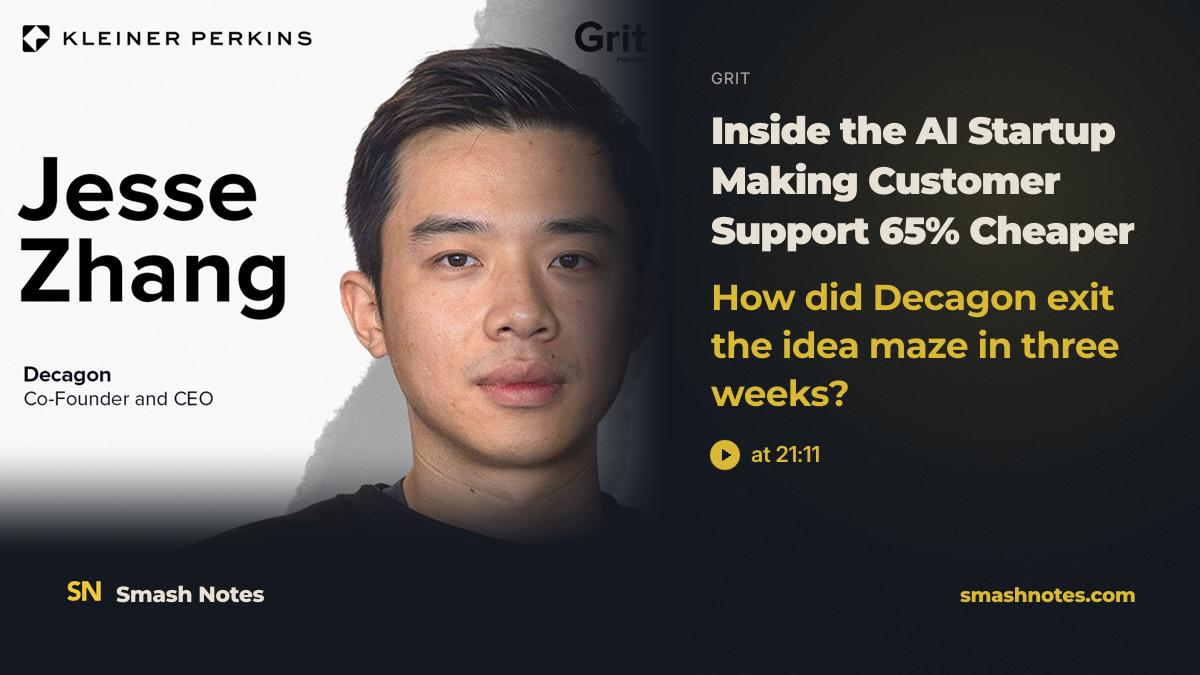
Inside the AI Startup Making Customer Support 65% Cheaper
How do you keep up when you go from 50 to 500 employees in a year? Jesse Zhang shares how Decagon scaled that quickly, from hiring ahead of demand to keeping the company connected as the team grows. He also explains why the zero-to-one phase is so different from scaling, and how Decagon found its way out of the idea maze in just three weeks. Guest: Jesse…
People
Notes
-
-
-
-
-
-
-
-
-
Can 200 People Eat Dinner Together? at 51:42
-
When Does Office Politics Start? at 54:38
Related notes
- How Should a Business Person Think About Their Technical Co-founder
- How Does Tribe AI Decide What to Build Next?
- Why Does Cogent Hire Aspiring Founders?
- How Can I Pick the Right Startup Cofounder
- What Does Aman Singh Think of Managed Agents?
- Why Do Founders Think Their Startup Is the Next Facebook?
Related episodes
-
![]() How Vercel Is Rethinking Go-to-Market With AI | COO Jeanne Grosser
-
![]() The 20-Year Bet to Make Fusion Energy Work | Jeff Lawson
-
![]() The AI Race Has a Leaderboard | Arena CEO Anastasios Angelopoulos
-
![]() The Difference Between 1% Improvements and 10x Growth | Immad Akhund
-
![]() What to Look for in a Tech Cofounder? With Philip Camilleri
-
![]() Matt Oppenheimer of Remitly
-
![]() Vineet Edupuganti (Cogent Security) - First Principles in the AI Era
-
![]() Kevin Rose — the Man Who’s Seen It All



Full transcript
The episode notes above make this conversation easy to skim.
0:00
One of the main benefits of AI, especially agentic AI, is that it really empowers people on the team to do more. Our whole thesis is like, how can we empower your team and how can we deliver an end result where the AI is fully in there, it gets built in the product, it's tested in the product, all the conversations that it's having, you can monitor in the product.
0:17
We think that is probably our big differentiation right now, this deployment model where ultimately the customer owns the results and the process.
0:37
Welcome to Grit. I'm Juven, partner at Kleiner Perkins, a show where we go beyond the highlight reel and explore the personal and professional challenges of building history-making companies. Today on the show, we've got Jesse Jang, co-founder and CEO of Decagon, the AI concierge platform reimagining customer experience. Decagon is building AI agents that help enterprises deliver faster, more personalized support across voice, chat, email, SMS, and beyond.
1:04
We talk about why customer support is the perfect wedge for agentic AI, and how Decagon scaled from an idea in 2023 to a $4.5 billion company. Enjoy the episode. Do you have the feeling when like, uh...
1:19
Okay, the feeling that I just had, like I started a company here at KP, it's growing. Yeah. Like that we incubated here. I moved in out of this KP office into a new office in January. And I was like, all right, this is like going to fit 30, 35 people. That'll last the year. Yeah. And then, you know, four months in, we're like spilling on top of each other.
1:39
Things are going well. It's a good problem to have. Yeah. And then we moved into a new office Monday. Fits like 120 people. Great. And I had this like weird cognitive dissonance where on the one hand I was like, this is nice. But on the other hand, I was like freaking out inside because I'm like, are we going to fill this? How quickly are we going to fill this? Right now it's too big.
2:01
Like, is this too nice? Like, have we earned this? You ever have that? Yeah.
2:08
Not really. I mean, we've never gone for like super nice offices. Nice meaning like too much space. There was a little bit of that in our last office just because it was a small group at the beginning, but we knew we were going to grow pretty fast. Why? I mean, we just had a lot of roles we were hiring for. Yeah. Yeah. And yeah, it's engineering.
2:29
It's like all the roles kind of all add up pretty quickly. Now you have to get all the GNA people and so on. So this, our current one probably fits like 250, 300. The previous one was like 70 max. And so that was kind of a big jump. But this one's two floors. So, you know, we start with one floor first, then we add another floor. That makes sense.
2:50
Um, the new one, we're trying to get everyone on like the same, cuz like, I actually feel very strongly, um, having one big open space is like very, very undervalued. And this is, this office is our first office out of all of our offices. That's more of a donut shape cuz it's like in a high rise and just like, you know, when you're on one side, you don't really see the people on the other side as much.
3:11
You can't really tell when people are eating food and, um, yeah. So the new one is like one big like rectangle. Where you can like see everything? Yeah. 500 people in one rectangle. Come on. Yeah. That's the goal, yeah. Good, man. Well, congrats on everything. I'm excited to do this. In the beginning, when you were,
3:31
were you not unnerved to be hiring ahead of like, okay, like in the beginning of Decagon, you know, whatever, 18 months ago, you were like eight people, 10 people, right? Okay. And like you felt demand. Yeah. The market was beating you down. And you were like, all right, great. I got to go hire a bunch of people across all these roles.
3:54
Was it not unnerving in any way to like hire ahead?
4:00
It was a bit. I mean, I think like now in hindsight, you're like, yeah, I should have hired more. Like, obviously, like the demand was there. These customers are going to close. But you didn't know that then.
4:12
I actually think for the first year and a half, we took a very conservative approach to hiring. So we didn't really hire ahead. We only hired someone when we actually felt the pain of, okay, we need someone doing this. That went for sales as well. I mean, in the beginning, Ashwin and I were doing all the sales. And eventually when we hired our first salespeople, it was like we already had deals for them.
4:35
So we didn't really have hire ahead. So we didn't really have that concern. I think in hindsight... You could maybe say that was a mistake where, okay, you know, in hindsight, this is such a great market. There's like so much to do here. Like maybe we should have just hired ahead. But when you're in a moment, when you're in the moment to your point, you don't really want to hire ahead because you know, you have all these stories of companies that hired ahead and like that worked out disastrously.
4:59
And then you have the fire people. So for us, we've always kind of taken a pretty conservative approach with building the team and like keeping it lean. Now, of course, we do hire ahead just because you have to. You have to plan out where you, because otherwise you just cannot reactively hire this many people and things are going to break.
5:16
So we do hire ahead now, but for the first year, like first 100 people, I don't really think we did too much ahead. You said the first 18 months you felt like you didn't hire ahead for too much? Yeah. How many people were you at? First 18 months, not that many, like maybe 50 people, 50, 60 people. Yeah. We pretty much 10X the team the last year.
5:36
We're 500 now. 500? Yeah. You were 50? Roughly. A year ago? Something like that, yeah. 500? Yeah. Come on. So you don't know everybody's name in the company anymore? No. I'm actually pretty good with names, but that probably stopped at around 200-ish people. Okay. Yeah.
5:55
500. Yeah. I mean, we're not all in SF anymore. So we have a bunch of different offices. Yeah. Like sales. Yeah. Sales are remote. We have a big hub in New York and London. When did you break the, when did you relent on not hiring in, in office anymore? It's probably our first couple, like sort of strategic salespeople. Yeah. because we found people that we thought were really good, and we realized that these people are not, they're gonna be traveling a lot anyways.
6:25
So we'll just have them be in the office when they travel here, and then the rest of the time, they're just traveling around meeting customers. That's pretty common for teams, I think. It's like, you're not always gonna have all your salespeople in one office. That also kind of defeats the purpose. And then we started the New York office, I wanna say,
6:44
roughly nine months ago. And so that office is, we're already on our third office there. Come on. In hindsight, maybe we did not do a good job of planning offices, but yeah, we were constantly just like overflowing. It's a pain in the butt to move offices. Yeah. And they're only like dealing with the lease, the furniture. Yeah. It's just like things all the time.
7:05
I mean, you're not dealing with it anymore, but it's just things. Yeah. I mean, your first office could be like a WeWork or something. That's not too bad. And then, yeah, we just moved into our new New York office and we like it a lot. And again, it's like that big rectangle. So we're a big fan of the rectangles. The vibe's just nice. How often are you going there now to get it up and running? Or did you go there to get it up and running? Pretty frequently.
7:29
I go to New York at least every month, pretty much. How much more are you traveling now that the business has taken a scaled tone, if you will? Yeah, I do travel a lot. I don't really like traveling, but, you know, it's part of my job. So traveling is usually not that bad. The international trips are the tricky ones. So we announced we opened up Australia.
7:51
So going there is like kind of rough. Do you have to go?
7:56
I was out there for the sort of launch of the office. Okay. And then I go to Europe a decent amount. So maybe quarterly. For customer meetings? Yeah. And we have our office there. We have like 50 people there now. Yep.
8:09
And yeah, you just got to see the team. Like last time I was there, Like before the previous time we had maybe 12 people. So now all the new people, they onboard in the US, but you know, I haven't met all of them. And so it was important for me to go and just like meet the people. We have a good team getting built out there. And yeah, Europe's also tough.
8:29
Cause it's not even just the time zone. It's like, oh, it's 12, it's like midnight. And actually there's still a ton of calls or there's still a ton of stuff to do. Cause it's like, I don't know, afternoon here, so.
8:41
Um, that, that's the tough part with traveling, but I'm getting a little bit more adjusted to it. Why don't you like traveling generally? I've never liked traveling. Ever. I don't like traveling for fun. I just don't, I just like being at home. Yeah. Home is comfortable. I don't like sitting on planes. I don't like sitting in cars. I don't like walking long distances.
8:59
Really? Yeah. It's kind of funny, but I just don't like it. It feels like a waste of time to you? I guess, yeah. It's just not physically pleasant either. It's like being in a nice air-conditioned room doing what I want to do.
9:15
My wife's a lot more into traveling, so we kind of go to the places that she wants to go to. We just came back from the Dolomites for July 4th. How long were you there for? Just July 4th, like that weekend. Sweet. Do you feel guilty when you go travel?
9:31
Not really. Um... You mean as in like, oh, I should be doing work? Yeah. I mean, I do work when I travel, but also it's also not super responsible to like be burning full force every single day. Yeah, but you could still know that and still feel guilty. I think maybe I did at some point. I don't feel guilty anymore. Yeah. There's like people.
9:52
Yeah. Yeah. And we also have a skilled team now that are all hard workers. That's what I mean. You have, like, leverage. It doesn't feel like,
10:02
yeah, if I go to sleep, that no one's pushing. In the 10xing of the people from 50 to 500? Yeah. That's insane, by the way. Like, that means you're doing conservatively about... probably 2000 interviews. Does that feel right? We've maybe done more than that. That's what I mean, conservatively to get. Yeah, but it's split across the team. So the team does spend a lot of time interviewing.
10:29
That's fine. But your company is doing 2000 plus interview over, over, definitely over. You're not hiring more than one in four. I mean, that's just what you have to do.
10:41
there's no way around it. I mean, there are companies out there that are growing faster than us, headcount-wise. It's like everyone's growing fast. The hard part is not so much hiring the people because there's a lot of people that want to work in high AI companies. It's making sure you keep your bar high. So one of the things we do is
11:00
like Revolut does this. Amazon has a version of this. You kind of have these... filters that you add on to the interview process at the end bar raisers or whatever you want to call them where they're just mostly selecting for culture and you know intensity and so on and we've added those to you know make sure that we keep the bar very high as we grow did you add that like when you're gearing up to go from 50 to 500 basically pretty much yeah and who's the bar raiser are you
11:31
Oh, it was me and Ashwin for a long time. We met everyone up until maybe like 300 people. Now we don't meet everyone, but now there's like, you know, some fraction of the company that's been here a while and we think are very good representations of the culture. And so they do these bar raising interviews. What percentage of people make it past or don't make it past the bar raising?
11:54
uh i don't have a super do you have like a sense i mean it's definitely the majority of people make it past okay because it's the last step in the process right if you're cutting the majority of people the last step of the process that's probably something wrong i don't know the exact number though it's definitely a majority when you when you add people that quickly how often are you like having to basically reinvent every new process inside the company like how quickly do you have to tear down a set of meetings add a new set of meetings
12:25
Yeah, pretty quickly. I mean, it does feel like kind of a new company every quarter or two, roughly.
12:32
And I mean, this is my first time or Asha and I both first time, you know, doing company of the size. And so there are sort of some learning some mistakes we make. And we're just trying to do our best to iterate. there are also some benefits on doing the first, uh, doing it for the first time. Cause you're a little bit naive in a good way.
12:49
It's kind of the same thing with founding a company. Like you're a little bit naive around how hard things are. And so you actually have optimism. And so there are some things we've, we, you try to do differently just from first principles, but, um,
13:03
yeah, in general, the team is structured, you know,
13:07
kind of just based on like iterative, like iterative process as we grow. Yeah, my observation, like, in KP with founders is, like, even if you've done it before, you've never done this. Meaning, like, if you're Arvind at Glean, you, like, started a rubric. Yeah. But, like, okay, Glean at this size and scale with this, like, technology wave with, like, the set of variables that are on the field today, he's, like, never done this.
13:36
Mm-hmm. You know, like Benioff has never done this in this moment. Oh, yeah, sure. You know what I mean? And so, I don't know. I think in many ways, everyone's kind of making it up. Yeah. And I think that has always given me solace. That's a good perspective, actually. Yeah, that's pretty true. You know, like even your fiercest rival, like at Sierra, Brett, who's a stud.
13:56
Like, I love Brett. He's making it up. Like he has never been for all of the things that he has accomplished. He's never been at a company in this market in this time at this scale. Yeah. Growing this fast. Just never happened. Yeah. And so the type of competition, the type of like, you know, sales cycles are also different. And so everyone's learning.
14:20
I agree. That's what I mean. Yeah. It's like a new pricing model. Like it's all different. Yeah. For sure. Like how relevant really was your last company? You sold it to Niantic, right? Yeah. Oh, zero relevance. Zero. I think the only relevance is like it just teaches you learnings as you mature, right? So
14:42
that company, I was solo founder, which I didn't like. So that was learning. And so with Ashwin, it's like 10x easier. You kind of have to get lucky at finding a co-founder, but we're also remote because it was during COVID. That was also learning. I didn't like that. So now we're in person. And it was also a consumer app. So very different.
15:00
And I also, I think learning there is consumer is very different from, you know, B2B and I just gravitate towards B2B a bit more mentally. So those are the types of learnings that you get. And you kind of also learn like intuition of how to evaluate if like an idea is a waste of time or not. There's like stuff like that, but yeah. In terms of, like, tactically, like, how to lead a team, how to, like, you know, run a company, almost zero learning.
15:26
So most of those things you just pick up along the way or you try to learn from, like, people that are doing it a year ahead, you know? Yeah, I guess, like, let's just imagine that was, like, a B2B SaaS company. I'm still not convinced that you would have learned that much. Yeah, I agree. Does that make sense? Because everything's faster now.
15:42
In fact, you might have learned some bad... Bad habits. Bad habits, yeah, exactly. So...
15:48
So anyway, maybe if your head hits the pillow tonight and you're like, oh my God, what's happening? You're like, well, most people feel that way. Yeah, yeah, that's true. Why don't you like, besides the obvious, like it's lonely, why don't you like doing the solo founder thing? I think it's two things. Like one is the psychological piece, right? It's, you know, you feel like you're like a single point of failure for a lot of things.
16:09
Regardless of how big your team is, it's like
16:13
you're the only one that has like the founder responsibility and context, right? And so, I mean, yeah, tons of respect for solo founders, but it's just very difficult. And the second one is that you don't really have someone with the same level of like context and commitment to bounce ideas off of. And so a lot of, ideation just takes a lot longer.
16:34
Like I think if I have just anyone on our team, if we're just like talking out loud and speaking, you, you arrive at decisions and like probably correct decisions way faster. Cause you're just kind of like, just kind of like another brain or another like processing unit. Now you can actually do some of this with a cloud, which is kind of interesting.
16:51
You can use that as bounce ideas, but it just gives you like a talking, like a, a way to vocalize ideas and like kind of hear feedback and you kind of eliminate bad ideas really quickly. Whereas when you're alone and you're saying your own thoughts, it just takes way longer to arrive at ideas. That's the other learning I had.
17:09
I was listening to, I read or listened to something that Ashwin did where your co-founder, where he was talking about in the beginning,
17:19
you guys were in every day, the two of you. That changed at some point, or maybe you're still in every day. When did you stop asking the team to be in every day? And was that, like, weird? Was it hard? Like, did you feel like you were degrading performance? Oh, interesting. So, Asha and I are always in every day. I mean, we're in every day except for Saturday.
17:46
Saturday is, like, wife day. Sacred. You have to have one day at least. But we're in every day. Wife day? Yeah. What? do whatever, but don't do work, just hang out there. Exactly. Yeah. And the, I think early on, yeah, people would come in on Sundays as well. We never had expectation for people to come in on Sundays. Like it was never like when you, Hey, like you're joining this job, like you're going to have to come in on Sunday, you know, we're also okay with people like having lives and, um, not, not being on Sundays, but yeah, around maybe 20 to 30 people.
18:20
It's like, not everyone's going to be in every Sunday. Yeah. Um, now we still have like, you know, roughly that size of people that come in on Sundays, but it's, most people are just doing work. They're just not in the office. Totally. Um, because Sundays is a great time. There's no meetings. You can just like, you know, get your thoughts in order and catch up on stuff.
18:37
So people like that. Um, so Sunday is kind of like a pseudo workday, but again, there's like zero expectation. Like no one's expecting you to respond on Sunday.
18:45
And it wasn't like a single time where that happened. It was just kind of like a spectrum. Like when you're hundreds of people, not everyone's going to come on a Sunday. Like that's just, that's not going to be reasonable. But people are just, you know, thinking about stuff.
18:59
And yeah, now it's a pretty good balance. I mean, we're in on Sundays just because Asha and I live super close to the office. And so we just go in and there's a group of people that come in and
19:10
it's a good time to get some deeper work done.
19:14
Are you enjoying it more or less than you did in the beginning? Like realistically, the job today is like you're traveling a lot. Like. I think it's one of those things where it's like, you know, when you're little, you're short and at some point you like get tall, but like no day does it feel like, oh, I was taller than I was yesterday. It just feels like you're the same.
19:35
That's kind of what it feels like. Like I would say from the early days to now, the feeling hasn't really changed that much. I would say the only time it does change is like when you're in the idea maze to like maybe post PMF and you're scaling. Like that is a pretty different feeling. And I think no matter what anyone says, the early like zero to one phase is like way more, way harder.
19:55
It's awful. Yeah. So yeah, every stage has its challenges, but the zero to one phase is like by far the hardest. Once you're past that phase, at least in my experience, the general feeling is the same. Like the stuff you're doing is different, but like... you know, it's enjoyable. You
20:13
know, it's like kind of a privilege to be in a fast growing company or have like, this is even though like every day is not easy. It's like, you know, this is what we wanted to do. And so you have to be a bit thankful that this is, you know, things are going well. And I had my last company as well where I was in that first phase forever. How long? Like three years, maybe.
20:36
Come on. Well, yeah, I was a new grad. I was like 20 at the time. And I like... So when you're a new grad, you're like super fresh. You, you probably think you're like, I mean, we thought we were like quite smart and very technically strong, whatever, but you just like, don't really know how to do stuff. Yeah. So we like spent a bunch of time, like working super hard on stuff that was like, okay, we just thought about this for a few, for a little bit more.
20:59
It's like, you could tell that this was a bad idea. Uh, and now, yeah. So that, that phase is just much tougher. And so now because I have that perspective, it's like, it's easy to have appreciation for when you're not doing that, you know? How long were you in the idea maze for Dekagon? Like three weeks. Come on. Yeah. So we, um,
21:18
we arrived, uh, maybe a bit longer than that, but it was like rough, rough order of magnitude. It was very fast. Because we, our main goal when starting the company was like, let's not be an idea base. You know, that sucks. So instead of picking idea, we just, we were like very aggressive about doing this, like almost like sales discovery.
21:39
I talked about this before, but like, I think most founders shy away from being as aggressive as you need to be in that phase because it feels like you're being too pushy or too salesy. but no one really cares about that. Your founder is starting a new company. They'll appreciate if you're asking more tough questions like, how much do we pay for this?
22:00
Where's the budget coming from? How do you justify ROI internally? Who are the people involved? Those are questions that a salesperson should ask in a sales cycle, but early on, founders tend to not do that and they're just doing things like, Would you use this? Like, you know, how useful would this be for you? And if you're not asking the hard questions, it's hard to tell.
22:22
So I think through that process, we decided like, hey, this is like the obvious thing to build. And
22:29
that was in hindsight helpful. I mean, you have to be a bit lucky, obviously, but... I think that process helped us avoid a super drawn out initial phase. How long before you raised your first round? Well, technically we raised our seed round like before Asha and I started working. Like we decided like, hey, let's be co-founders. And then we hadn't even incorporated yet.
22:48
And we had like zero ideas. But then we just raised a small seed round from A6 and C.
22:55
That was before we had anything. That's nice. It is, yeah. I mean, yeah, people have different perspectives on seed rounds. I think for us, it was like, yeah, definitely the right choice. I mean, I think everyone in our seed has been like a great partner for us. It's just any inch of credibility that you otherwise wouldn't get at that point is worth it.
23:17
Yeah, like people often ask me, like, what do you optimize in the early investors? I think...
23:23
like no investor will help you find pmf faster like that that's like not an expectation like no matter how good the investor is so the only thing that you can ask from them is like like one first of all like don't be a negative impact um but then two just be like emotional like just like emotionally supportive and help with like help hustle for like introductions and stuff like that introductions to hires and introductions to customers and But no one's going to...
23:49
In fact, when we were first deciding to do this, most of our investors and some very smart founders we knew were like, no, don't do this. This is a dumb idea because it's too obvious.
23:59
In hindsight, obviously, we didn't listen to them. But no one really knows. No one's going to have...
24:06
ideas like when people ask me for like perspectives on like what they're working on it's like you know no one's really gonna have nearly close to the level of depth to give like a credible you barely even know about your own business like yeah you're figuring everything out for the on the fly right now so i think um so i think optimizing for mid-career investors in the early stages i think is like actually the sweet spot because They have the time and the sort of motivation to like really grind for you.
24:35
Yeah. A lot of the super senior GPs I think are very good while you're scaling. But in the early days, given that no one's going to help you find PMF anyways, you might as well get someone that has like a lot of time and like prioritizes you. Yeah. Yeah. I've taken a different approach, but, but yeah, I mean, there's not only one approach.
24:54
That's just the approach that we did. I took more of the like Avenger ring approach. Yeah. Just purely signal. Yeah. And then I have like the team of KP people that are amazing at helping me, but I'm not relying on the board member themselves. Right. In the same way. Yeah. And like, you know, Founders Fund's whole thing is like, we don't want it.
25:14
Like it's anti-signal. You do you. Yeah. Yeah, exactly. I think they're really good investors though. They're great. Yeah. But like Trey's whole thing is like, you know. Yeah. Trey's whole thing is like the board meeting should be an hour, you know, like that type of thing. Yeah. So true. Um, how long did it take before you, it became clear to you that you had PMF and what was the, was there like an obvious, like, Oh yeah, here we go.
25:40
I wouldn't, I don't think there was like a, like a clear cliff or anything. It was like a gradual. Yep.
25:48
Scale up. I think maybe we were like a million in revenue. It was just me and Ashwin then still, but I think it was repeatable enough where- How many customers-ish? Six, maybe. Yeah, six customers, a million in revenue. It's like, okay, well, yeah, there's a lot of people that want this. People are willing to pay us real contracts.
26:08
There's probably something to be done here.
26:12
In hindsight, I would say, yeah, there's also, we're kind of lucky to choose a space. I mean, this space and coding maybe are like the two big ones for AI that are like very horizontal and just like very obvious. Maybe law. Use cases. Yeah, law, those are a bit more vertical. I think there's other vertical use cases as well, like law, like some healthcare use cases.
26:33
But just in terms of like big horizontal, like...
26:39
We didn't know that going in, obviously. It wasn't like we were mapping out the market. In fact, I don't think it's wise to do that because that's pretty noisy. But it's not like we were mapping out the market. It's like, okay, we got to do this. But I think around that time, we felt like there was product market fit. Mm-hmm. And then did you raise the A right after that? Pretty much, yeah.
26:58
So all of our rounds so far have been aggressively preempted. I mean, it's not always going to be like this, but we never really did a fundraise. Every round, it was just someone giving us a term sheet, I guess. And then we had to decide if we wanted to do it. Most of the time in the past, we were pushing it off because we're pretty adverse.
27:17
This goes back to, like, generally, we've been pretty conservative about hiring. We've also been very conservative about fundraising because... I mean, there's so many like instances where you raise too high of a valuation and then, oh, well, you know, there's like cycles, you know, it's like it's not always going to be super easy and super hot in the market.
27:36
So we have always tried to push it off. But yeah, I mean, there's obviously some benefits of raising. In the early days, raising gives you validation, gives you sort of more people around the table. Well, after a certain point though, I think there's diminishing returns of that and like raising mostly helps you just like reprice your equity.
27:58
If you're hiring really fast, then like maybe raising a higher valuation helps with that because people just, people shouldn't do this, but pretty much everyone just like takes the dollar value of your equity.
28:12
And it's like kind of a marketing event, right? Yeah, it's a good marketing event. Yeah. I think like one thing you could do is just like raise small rounds more frequently. Yeah. Like Rant does this very well, for example. Yeah. Because every time you raise, you could announce something and it's like something that a lot of people will guarantee to read.
28:28
So you just put some messaging in there. Totally. That's good for you. Do you have a perspective on getting to know investors versus not? Yeah. You mean like ahead of the raise? Yeah, ahead of the raise. Because they're all reaching out to you. Like your inbox has been and will be flooded with them. Yeah, I think you should definitely get to know them.
28:47
Even if the sole purpose is just like you can gauge how helpful they'll be. So like no one, no investor will ever be as helpful as during that like phase where they're trying to close a deal. Cause like you're like, they're sole focused. They're like super incentivized to help. So if you ask them for help then, and they're not that helpful, then you know that they're not going to be that helpful when they're on your cap too.
29:07
So you can kind of just, you know, get to know them, just be friendly, just get a feel for like how you vibe with them. And like, if you get along with them long-term, if you feel like, you know, there's trust and then you can ask them for help. introductions or help with a problem that you're dealing with. And if you feel like they're helpful, then that's a really good signal.
29:30
So we've done that for pretty much all of our rounds. And I think that's led us to construct a very good cap table. I think we're probably one of the companies out there, if not the single company that leverages their cap table the most. Mm-hmm. Just because, I don't know, we've just found it to be effective. It's like a self-reinforcing loop, right? If someone helps you and then you close a deal and you get to tell them and their whole team that, hey, you guys, this led to real value, then
29:58
that's great for them and then they'll help you more. So it's self-reinforcing. Do you ever reach out to the investors that you want to talk to, or do you just respond to the ones that reach out to you? Like, do you buy into the leverage thing? So far, it's been mostly the latter. Like, people just... Like, we respond to people that reach out.
30:18
Because the investing world is not that big. So, like, generally, we know people. And so... I don't think there's anyone that we haven't met that like, oh, we really want to meet this person. Yeah. Were the B and the C basically back to back? All the rounds were roughly like six months apart. Six months. Yeah. Okay. Which again, it's not always going to be like that.
30:38
So we shouldn't plan for that. But six months, I think is a little bit too frequent.
30:43
Do you? Yeah. And like all things equal, they're too frequent. But if you're in like the heavy growth mode, like you kind of have to raise to keep the momentum going. You know, one of the feelings that I get deep down that makes me quite uncomfortable is that everybody...
31:03
how do I say this? You just kind of, everyone just kind of assumes like, yeah, the good times have been good for the last few years. You just like, it normalizes. It just normalizes. And that means like customer budget continues to like fall out of the sky. That means fundraising continues to, like it hasn't been that hard. Yeah. You know, I think like probably your team feels that way.
31:24
Like it's just growing. It's just, you know, it's growing faster than anything ever. Yeah. You know, I don't know. I wonder if you like, how you relate to that. Yeah, I mean, you just want to, like, have a steady mindset across everything, right? You can't get too high during the highs. You can't get too low during the lows. So you're always trying to counterbalance.
31:42
Like, we say internally all the time that it's not always going to be like this. You do? Yeah. Even when we do say it, even though we say it, we also know that, like, just viscerally, like, yeah, everyone's kind of expecting just constant growth, right? But most businesses aren't like that. Like... A lot of the ones that are now growing fast, like, grew super fast during Zerp era, and then, like, there was, like, a couple years of, like, kind of roughness, and then now they're growing again.
32:09
Like, it is cyclical. And, yeah, we want to make sure we're talking about that. Like, you know, we've had very good quarters the last few quarters. Like, when we recap the quarter, we tell everyone, like, hey, obviously it's great right now. Like, everyone should be ready that it's not always going to be so easy. Mm-hmm. So you got to build the toughness right now.
32:31
You got to build, uh, you know, the grit right now. And
32:36
that's, that's a message we try to, you know, make sure we emphasize. Doesn't matter. Does it? Yeah. It doesn't matter. We have, um, we have like very few people that have, uh, sort of left the company, but, um, you know, we've had a few go start their own companies
32:55
and, um, Yeah, maybe there is a world where like if it ever becomes harder to start your own company, like that will happen less. But I actually don't think, I think even when there's a downturn, it'll still be pretty easy to start a company. I think the only good thing about a downturn may be that it might be easier to just recruit. That's the hope.
33:14
Yeah. Because there's so many companies right now. Too many. Yeah. And that's a good thing for the world generally. But yeah, it makes recruiting very difficult. And it's also really easy to be a founder. So a lot of people, a lot of people at Decagon have like a very strong entrepreneurial sense, like they were founders before or they want to be founders.
33:36
And so if the barrier to entry is very low, then people just do it. Even if they don't have an idea, even if they're not sure if it's the right time. Yeah, I was, we did a debrief on a candidate yesterday and at Roadrunner, there's a lot of people that are ambitions to be founders. Yeah. They're very spiky. And you know, this candidate during the, like when we were talking about her, I was like, Hey, this is going to sound like a weird comment, but like, um, she is like a software engineer, a software engineer.
34:08
This is what she loves to do. Yeah. And this is what she wants to do. And in two or three years, she just wants to be better at this craft. And I was like, you know, There's something low maintenance about that that I really like. I like, I don't know, just like, that sounds nice. Like you can't have a team full of those people. You can't have a team full of, but I'm like, you know, like having some people that just like love this thing.
34:30
I appreciate that. Why don't I get both? Yeah, you can just get both. You can get both, but there is more maintenance with spikier people that have
34:41
huge ambitions. Yeah. There's a tax and there's obviously upside that you get with it too. I think that happens across all roles. So like early days when you're spinning up anything, like the generalists are very valuable because it's like one person with all the contacts, they can do a lot of things. As you scale, you kind of start hiring more specialists because, you know, now that now the functions are defined and it's like, okay, let's just get someone that's really good at this because they're going to be spending all their time doing this.
35:07
And I think that that's applicable to all roles. Like I think even our sales team, our original team
35:14
was very, very, I think we got quite lucky with the team. It was very smart, very creative, like very just like self-starting. And you cannot find like hundreds of those people. So I think as we've grown, we've kept the bar very high in terms of just like intelligence but now we have different personalities right like some of them are much more experienced they want to kind of come into like a playbook organization and just execute and
35:42
i think that's very normal you presented to a group of 50 cios and this thing called kiosk that
35:51
I represent for KP and I was sitting next to you and you know what I thought was interesting. I really want to get your reaction to this. Like I think Brett at Sierra was in the last one. You were at this one. I kind of like got to watch them both and see how they play out. One of the things that you. that I thought you really emphasized was the implementation.
36:12
Yeah. Like on the deployment. Yeah. And I thought you went out of your way to make a point that this was like a unique differentiation. Yeah. For how you think about your business. Is that true? And like maybe like what's your. Yeah, happy to. What's your thoughts on that? Yeah, maybe maybe I can just like zoom out, contextualize everything.
36:34
So Historically, we don't really talk about competition, et cetera, just because, like... the space is actually like pretty noisy and there's like all these different things going on. I think now is a little bit more solidified. I think we're a bit more established. Sierra is more established. And so I think we have a more clear perspective on, on the two.
36:54
And I think broadly, like when you're building a company, I'm sure you relate to this. Like everyone, so you, you want to build a culture where like, you know, you're the main character, right? Like we, we just, we view the world as like, we're the main character. There's like all these challenges and competitors that might be out there, but like it doesn't really matter.
37:11
Like we're kind of on our journey. So we want to want to come up with things from first principles. And like, you know, again, like we're the main character on our journey. If I could hand select like a competitor, would I have chosen Brett Taylor? Probably not. It's like, if you could choose like who you're competing against, like, you know, the ex CEO of Salesforce and CTO of Facebook, like, yeah, obviously we have a lot of respect for them, but that's just like, that's not how life works.
37:39
You know, life is very honest and true. You're like, you're on your own journey and you like challenges will come up. So you have to deal with them yourself. Right. And like, that's how, that's how we view it. And so like, you know, if we're, good then we should figure out a way around it so the way the way i with this like from my perspective at least this space has played out is you know you have sierra they're very good at uh getting into like enterprises and they're uh you know they've scaled their team really quickly and you know i'm sure brett is great at talking with leaders and obviously that's a skill that you know we've we've developed um but their deployment
38:15
model is uh more similar to like a Palantir where they, they're really focused on, you know, forward deployed engineering and Hey, like we can do it for you or like, trust us. Right. We have really smart people and we can, we can solve the problem for you at dead.
38:32
And, uh, I think our, our main thesis, right. And like, this was, again, it's like not in the context of CR. Like when we were first starting the company, our main thesis for like, Hey, what, what is our viewpoint on this space is, uh,
38:46
that model doesn't really make that much more sense that much sense as the ai models get better like that model makes a lot of sense where like hey you're a big enterprise you maybe don't have the talent internally to like move at that speed or like kind of do something and so working with a partner having them do everything for you could be attractive but one of the main benefits of ai especially agentic ai is that it really empowers people on the team to do more and And so if you think of like cloud code or stuff like that, it's like, yeah, you can have non-technical people that can build a lot more now than they could before.
39:20
So that's like a big theme of AI, right? So our whole thesis is like, hey, can we create a deployment model where we're still going to be white glove because, again, we're working with enterprises. It's never just going to be like, here's software, go use it. So we still have people that are staffed, but it's more about how can we empower your team and how can we deliver an end result that is fully in control of your team, right? So everything that gets built is not code.
39:46
It's not like... something that engineers have to go and configure every time, or you have to ask us to come and configure it. It is in the product. So it's like, can you build a product where the AI is fully in there? It gets built in the product. It's tested in the product. All the conversations that it's having, you can monitor in the product.
40:06
And that's kind of the main thesis, right? It's like kind of this deployment model where ultimately the customer owns the results and the process. So,
40:19
yeah, I mean, we think that is probably a big differentiation right now, right? Like back to the point of, you know, we're in a space where there's a lot of sort of defaults, right? Like if there's all these big platforms like Salesforce and Google, like, you know, you can use their solutions. You know, maybe, you know, like, you know, Brett well, and yet we're winning a lot of these big deals.
40:41
And so the only way we can do that is through product, right? And obviously I hope they like me and they like Ashwin, they like our team, but it's like, you have to build a product that is superior. And the way we've done that so far, at least is kind of a product that really enables people to build and empowers them and makes it so that, you know, the AI is owned by them.
41:04
Was there a part of the company as it grew that you feel maybe like an org or a function that you most misunderstood? the first one that comes to mind is probably marketing. I think a lot of people probably say marketing like is so broad, right? And so fuzzy. Yeah, so fuzzy. And the people in marketing, just like in sales, are very good at marketing or selling themselves.
41:28
Yeah, yes, yeah. That's a good point. Yeah, marketing, I would say,
41:35
one, I think we hired it a little bit slow. I think that goes back to one of those, like the original question of like, Could we have hired a head there? Like probably yes, but it's so hard to like decide, like what is the pain point for marketing? I think my perspective on it has changed now. I've also learned a lot more about, you know, the field and, you know, we are very strong marketers, but like marketing itself is also super different, right? Like, like product marketing, like kind of really being able to talk about like what you're working on is like very different from like growth and demand gen, which is also very different from all like all like trying to
42:10
improve your brand and like all like social media strategies and whatever. It's just like,
42:16
like none of these are like very like, systematic in a way where you can just like reason through everything. There's like, there's a little bit of art to it. Obviously you can build systems to track everything closely, but
42:29
yeah, that's probably the function that where I had to learn the most on. What hire was your first marketing person? Like what number? It was first 30 people. 30. Yeah. Okay. And what type of marketer was it? Product marketing. And do you think you should have done something different?
42:49
We don't know the counterfactual, but I think product marketing has worked out for us as the starting point. So Ploma, who's our VP of marketing and actually came from Glean. Yeah. Yeah, I think she's done very well. And I think the thing with product marketing is because it's more amorphous, that actually like fits better in your early...
43:11
early company, because your early company is like very amorphous. So like having a product marketer that's just smart and can kind of like flex around like what the needs are is like good. And then once you kind of get to a point where you can be more systematic and like, you know, do more skilled like performance marketing, that's when it's time to have, you know, growth people.
43:31
At least that's my POV. Have you found it hard to
43:36
prioritize your time in the right areas? Is the company shape-shift so much?
43:42
hard not really but it's definitely like a constant effort that needs to be like we constantly have to be self-reflecting on should i be spending my time on this or should is like is there more valuable stuff that i should be working on
43:58
but i wouldn't say that's like necessarily that hard I think the hard part is forming the initial bench of just teammates that can do a lot of things that you would be doing and do it better than you.
44:12
That's hard because in the early days, you may have no clue what you're doing. So it's like, if you have no clue what you're doing, how do you evaluate if someone's going to be way better at you than this and also be world-class? But once the team starts forming, that becomes easier. How did you and your co-founder meet?
44:29
We had a lot of mutuals before, so I knew one of his previous co-founders, who's now one of the founders of Cognition. And we,
44:40
yeah, we met just through mutual friends and we officially like started chatting about working on a company at a Andreessen Horowitz offsite. Got it. Yeah. And do you feel like dumb luck? Like you got lucky. Uh, in terms of finding a co-founder. Yeah. That you like, yeah, actually like, like, you know, it is very luck based, I would say, but it's not that dissimilar to like finding a spouse.
45:03
You just have to like, it's like right person, right time. And you just like, if you have enough shots, like opportunities, then like, hopefully someone fits, but yeah, but that's like very contrary to popular belief. You know, at YC, they tell you like, you know, make sure you work with someone that you've known for
45:19
five years. By the way, my experience is more similar to yours. I count my lucky stars every day. Interesting. I didn't know that was a prevailing advice. Yes. Yeah. If that is, then I don't agree with it. I think the thing that doesn't matter a lot more are, hey, do you want the same things out of life? I think that's like the most important thing.
45:36
Like, are you equally committed to being a founder? Do you want the same thing out of the company? If that's not aligned, which I think is not aligned for most founders, I think that's going to be tough to work out. And then after that is like, do you guys kind of operate at the same level?
45:51
But yeah, so maybe if you are friends for a long time, maybe it's more likely that those are true. But I think that matters a lot more than knowing someone for a long time. When founders come to you now, like asking you stuff, what are the types of things that they're trying to figure out? It's all sorts of stuff. Like usually it's,
46:11
I mean, the same thing, right? So you always kind of pay it forward. Like anyone that is like maybe a year ahead in terms of progress has a lot to offer, you know, someone. Because it's like the most, it's like you're in the same time period. It's like everything's relevant.
46:25
Like for us, Um, like there are a lot of founders of who I really like, uh, you know, ramp is a company I really like, but you know, they're a bit older, et cetera. But you know, those guys, I think I've executed really well. Uh, I think Harvey's been really gracious with their time just cause they're exactly a year older than us. And like, we've been pretty much on the exact same journey.
46:46
So yeah, you just ask them about everything. And like, you know, when people ask me, it's like pretty much anything back to our earlier point, it's like, can only really talk about your own experience like i think venturing out like trying to give opinions on people's situations is a little bit dangerous because like you don't really know their situation that that in death but if you can talk to your own experience that's hugely valuable yeah because then people have a data point of like oh okay so this is this is what the team look like this is what the customer base look like um here's how we dealt with like you know, when execs don't agree on something or whatever.
47:22
Yeah, that's the, you know, like, that's the point of the show. You know, it's like, you know, you tell your experience, and then if somebody listens and is like, okay, I can, like, glean something from that. Like, I mean, right now, this is my own selfish endeavor of being like, all right, what number was your marketing hire? You know, like, okay, like, doesn't mean it's necessarily perfectly true for me, but, like, it's interesting.
47:40
Yeah, it's just a data point. That's all you need. Like, it's interesting. It's just the data points, yeah. You know? And then as the company grows, there's fewer and fewer unit points that you can ask. So each one is very valuable. What do you mean? Well, like there's, like at our current stage, there's fewer and fewer companies that have been at this stage in this environment, like a couple months ago or six months ago.
48:01
So like, you got to make sure that you know this guy as well, gals, that like, hey, we spend time together and like, they like us. And as a result, they're like down to like give us advice, you know? And yeah, to your point, the advice could just be a data point. Like it doesn't have to, we don't have to be like, get their opinion. In fact, the advice is preferably a data point.
48:19
Exactly, yeah. Yeah, yeah, yeah. You don't want people to, yeah, it's like, they just don't know, but it's like, hey, here's how we did it. It's like, oh, okay, cool. Like, here's how we ran a sales leader search. It's like, okay, that's very helpful because I hadn't done a sales leader search before. So it's great to hear. Yeah.
48:40
Yeah. When was your first finance hire? Maybe like 40 people, 30 to 40 people. Yeah. And so were you setting like comp plans
48:49
on your own? Yeah, roughly. Okay. Uh, we didn't find that that hard. Like sales comp plans? Yeah. Sales comp plans. We just asked like some sales leaders that we knew and we just use them. They've changed a lot over time, but, uh, Yeah. That's, that's just what happens. I'm stoked for you. Thank you. It's amazing what you're doing. Like amazing.
49:14
Yeah. I hope the show goes on for a long time. You too. Um, I hope you continue to move into new offices that continue to feel big and rectangular. Yeah. At some point the rectangles get too big that there's no offices that exist, but yeah, I guess you have like multiple floors. So you stack two floors.
49:33
Right now we have two floors. And the thought was like 200, then the next 200 go above type thing. No, actually the thought was like, okay, once this floor is done, we'll just find a bigger like rectangle. But then that took us like way longer than we could. So, cause in the past it was like pretty easy to find office space. Then this, this one like took a while.
49:53
In fact, it's still getting built out right now. Like they have to like tear down walls and stuff to achieve the rectangle that we want. And yeah.
50:02
So we were like, okay, well, yeah, it turns out the floor below us is available. So let's just get that.
50:07
Crazy. Yeah. Yeah. There's a whole, uh, there's a whole like
50:14
arts to office spaces. How often do you get the team together? Like, uh, does the sales team come at the end of the month, end of the quarter? Oh,
50:25
um, at least once a quarter. And we have like other reasons for teams to get together.
50:33
it's much harder for the entire company to get together now. Cause it's just too big. Yeah. But we had like our first big offsite, uh, I want to say January or maybe like 200 people then.
50:47
And that was your first ever offsite. No, that's not true. We did offsites before, but we're way smaller. An offsite for 20 people is like, just get dinner somewhere. Yeah, yeah, yeah. Yeah, that was like a big offsite. And then now we're trying to think like, oh man, like how would you even do a full company offsite now? That's funny. Like, I mean, obviously we're not even like, you know, we're at whatever, 35, about to be 40.
51:10
And we do dinner together at Roadrunner every Wednesday. Oh, nice. Everyone's day dinner together. Yeah. Whole company. Used to be easy. Yeah. It's like, you know, eight of us, six of us. Yeah. Go get like a table somewhere. Now it's like
51:24
40 people. Yeah. Where do you go? You can get the whole restaurant. You know, it's like, yeah, it's like, these are just like, yeah, you got to enjoy those times though. We all, we all, that's the other thing we tell everyone. It's like, You got to enjoy the stage you're at because it won't last that long. Yeah. Hopefully. The good old days will always be now.
51:45
It's like when we were in the old office, we always told people, you should remember this office. Our old office is not nearly as nice as the current office, but it's like, you should always remember this office because you'll think back at this as the good old days. Yeah. When everyone was eating dinner together. Now it's impossible for 200 people to eat dinner together.
52:00
Yeah. Um, but yeah, we still want to, we still need to try doing more. It's like one of the things is one of the values of doing catering is that everyone eats at the same time. And so,
52:15
Yeah, so we ran an experiment with catering and people liked it because it felt more like the old days where people were eating together. Because now people still eat together, but you just order and it comes at different times, so it's trickier. But then people thought the food was bad, so I'll figure out better food. But I think the dynamic is important.
52:33
Of catering. Yeah. Yeah, we started to do the break-even math on catering. Yeah. How many people does it make sense to start catering? Yeah. Because we're trying to, like, solve the same problem. Yeah, yeah, yeah. And then, like, you know, we're, like, you know, we're talking about doing an offsite because things are growing quickly and people are, you know, remote now and just sales, whatever.
52:51
I'm like, oh, we got to do it soon. Otherwise, like, this is just, like, unwieldy and expensive. Yeah, stuff. There's not many menus. You can do it. Yeah. You know? Yeah, yeah, yeah. But, um.
53:03
Yeah. My, my EA is actually like world-class at planning stuff. Come on. So she's like done all the offsets. They've all been like super smooth. So yeah, you guys want suggestions, but I think we, we mapped out basically a ton of the locations around the bay. That would be good for 40, 50 people. Yeah. So we, so where we, where we netted out, this could be a disaster.
53:22
We'll find out. Yeah. Is, um, Yosemite. Uh, and we're doing, uh, like glamping. Hmm. It's called auto camp. Yeah. Probably the last time we'll be able to pull this off was my thought. That's super cool. You know, like a three and a half hour drive, get a bus,
53:40
gave the company like, you know, basically our first holiday type thing. And
53:47
everyone's like giddy. Yeah. It's important though. More giddy than like the biggest deals that we've ever closed. You know? Yeah. I mean, it's like a, it's just a great experience. Yeah. Yeah. It's like most of the time people don't spend time together doing like outside of work stuff, you know? Like they may spend a ton of time together, so it's not a lack of time, but they're just talking about work.
54:12
But I think like people really bond when they're like playing basketball together or something. When did, this is going to sound weird, but like when did like politics start to creep into the company where you're like, oh my God, like people are jockeying for this and that and roles and, you know, starting to point fingers if, you know, deployment says it's engineering and engineering says it's a product.
54:30
And like, you know, you don't, when did you start worrying about that stuff?
54:35
Slash how annoying is it? I mean, I think it starts pretty early. It's like as soon as there's a team, then there's going to be some element of that. And I think Ashwin and I have always been very allergic to stuff like that. So we try to stamp it out aggressively as soon as possible.
54:53
And yeah, it's like someone's complaining about
54:59
I think this doesn't happen that much in Decagon. I think we're fairly apolitical, hopefully, but... As far as you know. As far as I know. Because when stuff does happen, we are pretty... adverse to it like if someone is coming to you and saying like hey like i should own this other thing and like someone else is owning it right now
55:20
shouldn't you be worried about your own stuff right now totally yeah a lot of stuff you need to do like what's up with this what's up with that and yeah hopefully that helps a bit over time but i don't think it's i don't think it's possible to avoid
55:33
One of our early engineers came to me yesterday, two days ago, was, you know, had feedback on someone based on something they saw. Started telling me. I'm like, dude, don't tell me. What are you telling me for? I don't want to hear any of this. Go tell the person. Like, don't tell me. What do you want me to do? You want me to go tell them on your behalf? Like, go tell them.
55:57
Like, or worst case, what are you going to do? Like, sit on it and let it fester?
56:02
Yeah, like I think one of the big lessons that we've learned or we've kind of been coached on is most of these cultural things result in things like that. They're very actionable, right? It's like if one of your cultural tenets is, you know, go direct to people to give feedback, like I have no opinions if that's a good one or not, but at least that's very actionable, right? It's like your culture has to be built on stuff like that rather than
56:31
We're going to be a transparent org. We value transparency.
56:36
It's like that is much weaker than like, okay, anytime you want to give feedback to someone, you tell them directly. Yeah. I think you have to build a list of actionable things like that. Yeah. After he did it, one of our values is the truth sets us free. And after he did it, I texted him. The truth set you free. Like you have been unburdened.
56:57
From this thing that you felt. Yeah. Like you've been set free by that burden. Yeah. It's important. Yeah. True. Good, man. Thanks for doing this. Thanks for having me. Yeah. It was really fun. Yeah. Really fun. How often do you do these? Used to be weekly. Okay. It's worth 300 episodes or whatever. Yeah. You do this on top of the company still? Yeah.
57:18
It used to be, but I would do it for like, you know, in the spirit of like go and talk to founders. Yeah. Yeah. I would do this. Without a microphone. Yeah, it's a great... I would do this without a microphone. You know? Like, this is just... I enjoy... Like, this is fun. I enjoy this. Cool. And it is, like, my own... Like, you know, I don't have, like, a bunch of questions that I gave you or whatever.
57:40
It's just, like, shooting the breeze. Yeah. And I enjoy that. What's been the most surprising thing with your company before? Because before starting, I'm sure you've seen so many companies. At Roadrunner? Yeah. Most surprising. One is we basically had...
57:56
pmf without the p like from incorporation
58:01
and i know how rare that is just like getting demand breathing down your neck and we're starting like in the enterprise you know like playing on hard mode in a lot of cases except for the market
58:17
and i don't take that for granted um like I'll maybe some things that I've been experiencing recently. We used to brag about how our, um, tell the board, like, you know, our hiring acceptance rate is so high. Yeah. And now it's like much lower and it's because we're trying to scale the company. And so we're just in more fights. Yeah. You know, we probably lost, you know, candidates to you guys, you know, like we're in more like with great candidates, but like we're in more fights and the types of candidates now it's a different profile.
58:51
The economics are different, you know, like first 10 people. Yeah. It's easier to, you know, like they have ultimate ownership. Yeah. Now you have like, you know, you can still tell them they have like great ownership, but it's, you know, like you're part of a team. Sure. You don't own one product, you know? So like that has been a different recruiting motion.
59:10
I have been the most common question that I guess get asked is like, are you having fun? That tends to be the question. Yeah. And. I would not describe it as fun. It wouldn't be the first word I would use. I feel alive. That's the most surprising feeling that I've had is how alive I feel, how everything feels visceral to me. And most of the time, it's not fun alive.
59:36
It's like, holy shit, this thing, are we gonna ship this thing? Is this customer actually gonna buy? Now that they've bought, are we actually gonna deploy it?
59:46
And I think that's like the scope of things that I now care about is insane. I just can't believe how many things I have to care about. Yep. I don't know how else to say that. And there's some things that I just don't want to care about. Honestly, like finance.
1:00:06
I just like don't. You have a finance leader? No, we need to hire one. That'd be a good way to not care about it. We need to hire one.
1:00:15
Um, but I'm like, okay, great. Like I need to go hire one. Yeah. But like the, then I look at the list of like the other things and I'm like, eh, it's like probably not top three, but I hate it, you know, but it's probably not top three, you know? And so, um,
1:00:35
those have been a few things that have been surprising, I guess. Um,
1:00:40
I don't do any of those resonate with you. Yeah, for sure. Yeah. Um, the, I think like at some point we realized that the only way out of certain situations like that is to hire because until you hire, you're not going to get that leverage. That's true. But like the,
1:00:58
like a layer behind that is like, The opportunity cost of the time that it takes to do that is taking me away from doing things. Right. And then everybody has that same feeling by the way, across the entire org. Yeah. So one of the things that we're feeling right now is like my head of sales always wants my head of essays, like our head of implementation to be on all the calls with them, even pre-sales.
1:01:23
Yeah. And I'm like, dude, why are you doing this? Like she needs to go higher. And he's like, well, you know, she's going to help us put our best foot forward. And I'm like, yeah, but then we're going to be stuck in this forever. Yeah. And I'm like, you know, I could be selling still. Yeah. And I would probably be putting the company's best foot forward if I was selling still.
1:01:42
But like, you're here. Now you have like a couple AEs on your team. Was there a tax that we had to pay by like not putting our best foot forward in air quotes? Maybe. Yeah. Uh, but like eventually, like, what am I going to do? Just like be the bottleneck to every customer. It doesn't work. And so there's like some, even I go through these like growing pains where I'm like, oh, like there's something more, you know, like best foot forward in anything.
1:02:07
Sure. Does that make sense? And I can feel both me and the company, like even my co-founders, AJ and Eugene, like geniuses. Brilliant. I can feel them. They got to go recruit engineers. But... You know, like AJ has like 15 really important customer calls today. Yeah. Roadmap. There's no easy answers. It's just hard. And like recruiting feels like short-term opportunity costs, but if you don't do it, there's going to be longer, long-term, way higher opportunity costs.
1:02:35
Yeah. Because then you're always going to have to do all the finest things that come up. That's true. But then like on the recruiting front, it's kind of like juxtaposed with this feeling of like, if we don't ship this thing, nothing else matters. Like we don't earn the right to go do anything else. Yeah. If this thing doesn't get out the door.
1:02:51
Yeah, it's tough. You know? You have to do both, I guess. The other thing that I...
1:02:58
And then I'll pause. It's just like, I was doing seven days a week in the office, which is why I asked about the like wife day. I think it's really interesting. Like my ability to have stability and like bliss at home is like almost a prerequisite for me to be good in my job. I just can't, there's just too many things in my job for me to not have like peace of mind at home.
1:03:27
And that requires like deposits in life. And it took me, it's taking me, I'm just like, that's not easy. Yeah. If that makes sense. It's just like harder. Yeah. And it, you know, now I'm like giving myself Saturdays, giving us, you know, me and my partner Saturdays. Uh, I didn't expect that. Like I thought I could basically just redline this thing all the way through in a lot of different ways.
1:03:55
You know, now like I'm doing it, I'm kind of like, then the team is doing it kind of follow suit anyway. Yeah. I don't think there's like one answer for everyone. I think even just in a vacuum, if I'm working seven days a week, I feel a lot less energized the following week. So having a day, at least for my natural cadence, is pretty important to keep up the intensity in the other days.
1:04:19
The other thing that I think has been surprising to us is like every time we think, we're like, oh, by April of this year, like we're going to be doing all of these things on the product side. And like, you know,
1:04:32
the way that we're building this agent that has to work deterministically
1:04:38
on customers, price books, approval rules, discounts, all the things that when you want to send a quote out, you have to make sure like it follows policy.
1:04:47
It's like kind of actually the same problem that you're solving applied to our vertical. And there is, nobody has figured this out. So it's just like really hard. And there's like a million edge cases. And if we go down, we get sued. And so it's like the gift that keeps on giving of like, You know, it's just harder, longer, more bleeding edge than we thought.
1:05:12
And the techniques are changing. Like, I mean, you're writing about it right now. Yeah. They're changing like monthly. Yeah. So you're just like, kind of like, it's uncomfortable. Yeah. You know, it's like, are you doing enough on the team? How do you hire? You know, like you just like, there's so many variables that are uncomfortable. I don't know how else to say it.
1:05:30
Yeah. Does that make sense? Yeah. Totally. Believe me. The same sorts of decisions have to be made on our end. So, well, keep blazing the trail for everybody. Keep doing it. Keep pushing, man. Thank you. Yeah, thanks for having me. It's great. Really fun. Yeah, appreciate it.
1:05:50
That's it for now. If you liked the episode, please leave us a review or go back into the archives where we've done more than 200 episodes with some fantastic folks. This podcast is a Kleiner Perkins production and I'm Jubin. Thanks for listening.