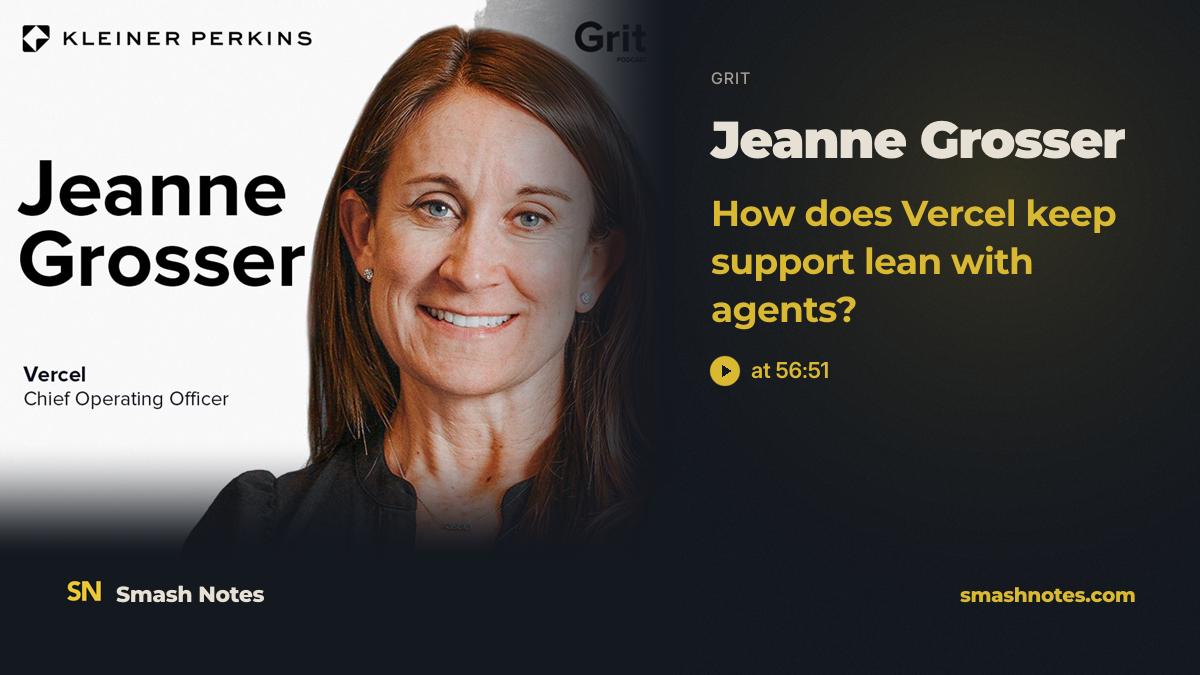
How Vercel Is Rethinking Go-to-Market With AI | COO Jeanne Grosser
At Vercel, 91% of support volume is already resolved by an agent. After spending a decade at Google and another at Stripe, Jeanne Grosser shares how AI is changing the way Vercel goes to market. She also talks about the founder relationship as a “professional marriage,” what she looks for in a company she can stay at for a decade, and why she believes…
Notes
Related notes
- Does Submittable CEO Michael FitzGerald Think Startups Get Easier?
- How Does Guillermo Rauch Decide Vercel's Next Move?
- Why Did Vercel Build an Intranet for Agents?
- Do Founders Have to Be Unrealistically Optimistic?
- Why Does Guillermo Rauch Skip Salesforce for Slack?
- Why Do Agents Want Markdown Instead of Web Pages?
Related episodes
-
![]() Inside the AI Startup Making Customer Support 65% Cheaper
-
![]() The 20-Year Bet to Make Fusion Energy Work | Jeff Lawson
-
![]() The AI Race Has a Leaderboard | Arena CEO Anastasios Angelopoulos
-
![]() The Difference Between 1% Improvements and 10x Growth | Immad Akhund
-
![]() Submittable CEO talks startups, life, cancer and living in Missoula, Montana.
-
![]() Vercel CEO Guillermo Rauch on Building the Internet for Agents
-
![]() Deel Head of Product on How AI Agents Do the Work of 600 Employees and Added $140M in New Revenue Without Hiring | Aaron Goldsmid, SVP of Product, Deel
-
![]() Advice Line with Tope Awotona of Calendly

Full transcript
The episode notes above make this conversation easy to skim.
0:00
Vercel gets a lot of support volume, as you'd expect, and 91% of it we resolve with an agent. A lot of outbound we do with an agent. All the inbound qualification is done with an agent. So like the remaining support team that we have really is now finding legitimate problems in the product. and then working really closely with engineering or in some cases writing PR to go fix things versus turning through tickets.
0:23
We have a great data science agent that you can ask it anything you would have sent to RevOps. Even sales, we've raised quotas every six months. You join a company like Vercel because you believe you're going to be part of building something more generational. Certainly a big reason that I'm there is I want to go write the go-to-market playbook for this era.
0:44
Thank you. Welcome to Grit. I'm Juven, partner at Kleiner Perkins, a show where we go beyond the highlight reel and explore the personal and professional challenges of building history-making companies. Today on Grit, I'm talking with Jean DeWitt Grosser, the COO of Vercel. Jean spent nearly a decade at Stripe, helping take it from $100 million in revenue to billions, before leaving to run go-to-market at a company a fraction its size.
1:18
We get into why she walked away from one of the most valuable private companies in the world, what it's like to take a 10-person sales team down to one person and an AI agent, and the brutally honest feedback that reshaped how she leads. Enjoy the episode. How big was Stripe when you joined it? About 400 people. And when you left, how long were you there? I was there a little over nine years.
1:39
I think it was 8,000-ish. What job did you have when you left? Chief business officer. Can I ask you maybe more of a simplistic question? Yes. What is that? Why are you working? Why am I working? Like, if, like, yeah, why, like, you don't need the money. Like, why, like, let's just be honest. Like, why do any of this? Stripe is one of the most, like, why do any of this? Like, why are you even doing this? I mean, why, like if in any area, like top athletes, like they, why does LeBron still want to play basketball? He doesn't need the money.
2:10
Like, I think it's because you have a passion for the thing that you've been getting out of bed for, for, you know, however long that you're not, you don't feel like you've left it all out on the field yet. You know, there are things I still would like to do to sort of feel professionally self-actualized. I think I'd be bored if I weren't working.
2:30
Certainly going through the moment we're in right now, you sort of have a sense that you'd be, you know, quickly irrelevant if you aren't in the thick of it. So, but I think a lot of it is just actually legitimately enjoying problem solving, intellectual stimulation, the people that I end up being around, things I think about as a result of doing my job.
2:50
Um, do you actually enjoy it or have you told yourself that over time you enjoy it? Uh, no, I mean, I think I actually enjoy it because I get out of bed in the morning ready to go. Um, I mean, is that 365 days a year? No. Um, like there are certainly things that are heard about a job. Um, there are days I wish it were Saturday, not Wednesday.
3:13
Um, but like on average, like I wake up thinking about the things that I want to go tackle today. Yeah. In fact, I often wake up at two o'clock in the morning thinking about the things I want to go tackle. Do you actually? I did this morning. Um, But do you think, can I like, maybe let's play this forward. Like, let's imagine you had no job.
3:30
Yeah. Do you think you would still be the type of person that wakes up in two and can't fall back asleep? Oh, no, that's definitely work related. Meaning you wake up and then your brain just can't turn off. Yeah. And do you find that you loop on the same thing? Or maybe like for me, I start with one loop and then I almost like have this unique ability to then hopscotch to a bunch of other things that are worrying me.
3:53
And by the way, like they're not actually that worrisome. Totally. I'm just like, I then project my worry of this one thing onto like basically my entire life. Yeah. All in one long loop. Yeah. But it's not one loop on one specific thing. Does that make sense? Yeah. Oh, totally. Like for me, it depends. Like sometimes there's something hard that like I haven't like seen the matrix on yet.
4:14
And so like basically it's one thing where I'm just trying to think through like chess and But in a lot of cases, it's what you're describing where it's like a set of things you're going through that, again, when you wake up in the morning, you're like, I'm not stressed about any of those things. Like I find them all to be tractable. But at two o'clock in the morning, for whatever reason, they do not feel that way.
4:35
Yeah. And then maybe on this idea of like being bored and relevance and like quickly atrophying everything. Yeah. If you were to like kick back after Stripe. Um, couldn't you go to like, you'd come to like Kleiner Perkins, you'd go to venture firm. You'd be very relevant. Yeah. You'd be in the scene. You would be out of the house, like feeling like you're, you'd probably get like a good.
5:00
you would scratch your itch on like talking to entrepreneurs and all those things. Like, you know, you could do something like that. You could advise companies. I think you were advising Vercel before you decided to actually jump in full time. Yep. You don't have to deal with anybody's HR problems. Yep. Right? Like, you know, why not that? I think I've always been like a hardcore doer.
5:21
So like my sense of satisfaction is tied to did I tangibly, you know, move the chains today? So I just get a lot more, yeah, satisfaction out of like I can at the end of this week be like there's something I can point to that had I not worked this week would not have occurred.
5:42
Just a different way to value what you do. At Stripe, after Stripe, were you considering not doing anything? No. Definitely not. No. I took three days off in between Stripe and Vercel. But you started advising Vercel while you were at Stripe? Yeah. Stripe was very generous along those lines. They, you know, Stripe obviously cares deeply about the startup community.
6:08
And so one of the ways I think it allowed people to give back was broad support for advisorship. Yeah. And what year was that when you, when did you, how long have you been at Vercel? I've been at Vercel almost a year and a half. And I think that had started a year and a half before I came. So at least three years ago. Okay. You took three days off? Yeah, my last day of work was a Thursday and I started on a Monday.
6:33
People, I think, misunderstand the toll of hypergrowth. I think it's like the faster you grow, the more taxing it is physically, mentally. Not growing is also its own version of taxing. Yep. But like you do that as Stripe and then you join Vercel and then you're like right back on the bullet train. Yep.
6:58
That's been going, how long, eight years at Stripe? Over nine. Nine. You're basically in a going on 10, 10 and a half plus year consecutive run. Yeah. Of basically an all out sprint. Yeah. How do you feel? I mean, it depends on like the given moment. So I remember when I was at Stripe and new people would join Stripe who similarly, you know, took maybe a week or two off after long term, very successful runs.
7:24
And I always thought that they were crazy. And then I did the exact same thing, you know, even before. more so. When I started at Vercel, there was a lot I ended up needing to transform, and that was very hard to come in and be new, make some very substantial changes that were not straightforward to pull off. And so there were definitely points through that window where I was like, man, I should have taken time off because my battery did not get recharged, and I'm now probably utilizing it more than I ever have in my career.
7:57
And then you come out the other side of it, actually, Remember, we announced a bunch of changes exactly this week, last year. The day I announced them, I had the best sleep I had had in a year because it was like, okay, finally, I have been able to figure out what I thought was wrong, how I wanted to change it, actually get a group of people to go make those changes, and at least this first step has landed.
8:20
You know, and then you come out the other side and like, you know, I think things, you have peaks and valleys where like you've got weeks like I can't wait to jump out of bed. We're launching something cool. We're getting something else out of the gates. And then other ones where, you know, there's something else that's either zapping your energy or tough about this particular week, but tend to come out the other side and back up again.
8:41
What's it within your purview at Vercel now? So it's the entirety of go-to-market. So marketing, sales, field engineering, which is all of your technical sales roles and support partnerships. So I sort of like to say if it touches a customer or makes a dollar, it's my job. When you have really good product market fit and you have technical founders,
9:07
there tends to be– it's not explicit, but it is implicit– that like the product should kind of sell itself. This is manifested in a bunch of ways. One of which is like when a, you know, let's just say the average CRO's tenure is less than two years. A large part of the reason, in my opinion, that that's the case is that most of the founders in Silicon Valley are technical.
9:36
And so it's easier to blame sales than it is to blame the product. Because the product is more of a reflection of you. And that's a really hard thing to look in the mirror and say like, maybe we got this part wrong. Yep. And so then you, you know, you, you shoot the sales leader. And by the way, like that has, that happens to marketing too.
9:55
Totally. Um, and you know, that creates like a tricky dynamic I have found for people in your position. Yep. Because you're like, again, not explicitly, but implicitly like having to justify like why, right. You need to do a lot of things. And I'm curious, like, you're going to probably have to tiptoe around this question. So however you feel like answering it is great.
10:21
I'm curious what your just broad reflection on is that. And by the way, do you agree with me? I totally agree with you. I experienced this earlier in my career. I talk about this actually a lot because like CROs that, you know, early stage company CROs will reach out to me for advice. And unfortunately, no one's ever came up with a test for do you have product market fit? And it is sort of the perennial question when things aren't growing as fast as you'd like, is it a product market fit problem or a go-to-market problem? We had this a little bit when I joined Vercel, where I came in, you know, I didn't know the product enough, all these types of things.
10:59
You had to personally have a point of view, but it was like definitively this product is ready and this is a go-to-market problem. One of the ways we ultimately unpacked that was, okay, on the sales side, we had a number of large existing enterprise customers who were using Vercel but didn't yet have Vercel in front. So we're like, great, let's go get 10 of those.
11:20
Let's get the product manager, lead engineer, and let's run them through conversations with all 10 in a row so they can get pattern recognition. And what do you know, coming out of the other side of those 10 sessions, we all came to the conclusion that we did not have full enterprise product market fit. And there were a set of things that we needed to work on in the product to make it so it was going to be much more easily sellable.
11:45
doesn't mean like zero enterprises bought it. Like, I think that's always the thing that's like really tough is someone will buy it because there's always a visionary. There's someone who buys into you, is willing to work through the pain or whatever it is. So I feel like that's one way to solve the problem is actually just let's go hear the feedback together at the same time and see if we took away the same thing.
12:09
Similarly, get your product managers or engineers in front of customers and watch me deliver the pitch. Every single time G and I take a sales call together, I ask him afterwards. I was like, did I screw up anything on that pitch? Anything you think I should talk differently about the product? Because whenever he talks about it, all I'm doing is like deeply listening to like Osmo's as much as I can into how...
12:31
he talks about it. So I think that's the other one, which is like, if your founder, if your product manager agree that you're talking about the product appropriately, you know, then that might also be indicative of something. I think there's a ton of stuff you now can do too with like AI and listening to like call transcripts and looking for patterns as well.
12:48
We're like, one of the things we do at Vercel is actually we proactively extract objections from calls and score the degree to which we've handled them. And if they aren't handleable because it's a gap in the product offering, we actually will automate it automatically create, we have a GTM feedback tool, but like a submit an entry for a product ask.
13:11
That's cool. Yeah. So I think there are like a bunch of ways where like you can at least attempt to get on the same page about what is and isn't working across products and go to market. Did you walk into a forecast of the business? I did. At Bowstripe and Vercel, I walked into a forecast that I ended up having a different point of view on.
13:32
And where did you land? Did you end up acquiescing to the forecast or did you get to do your own forecast? Before you answer, can I give you the why? Yeah. I had this conversation on Tuesday with someone asked me to talk to an early stage CRO. Yep.
13:52
He's like three months in, two months in. Yep. And he was like, uh,
13:58
um, we're going to go to 10 million this year. And I'm like, great. Like, uh, you know, they started a year of one. I'm like, that'd be a great, amazing year. How much pipeline do you have?
14:10
Can't get an answer. I'm like, okay, how many reps do you have? Well, we just turned off two. We just hired two more. I'm like, okay, so how much pipeline do you have? And like, oh, well, we're creating like we need to create this amount of opportunities at this ACV. I'm not talking about the future, like just like today. Yeah. How much pipeline do you have? Couldn't get an answer.
14:33
Like, OK, so. I'm just going to assume that you don't have the data in front of you, but that I think you hopefully know it somewhere. Right. OK. How are you going to get to 10? Just like how are you going to get there? And he's like, well, we have the self-service product. And I'm like, okay, how's it doing? We haven't released it yet. Okay.
14:55
We have this deal with this big, I'm not going to name the tech company, but big tech company. I have relationships there. My founder has relationships there. Okay, great. Like how big is the deal? Million dollars. I'm like, wow. Okay. How far along is it? Oh, we just had like our first meeting. Yeah. Okay. And I'm like, hey, like, and I just met him.
15:14
like 10 minutes into meeting this guy. And I just said, hey, do not take this as anything else other than I'm actually looking out for you. You will get fired in a quarter. If you take this number and you don't know the data, you're imminently going to get fired. And I was like, dude, you are inheriting a founder's forecast. Founders are default optimists, extremely exuberant.
15:38
And by the way, do not know how to forecast a business. It's just not in their like bread and butter. Yeah. And for the most part, they're like probably out like pitching the dream to investors and somehow they got to like justify the valuation that they want to raise. And so they need a big number. Yep. And I just kind of was like, you know,
15:57
I'm not gonna assume anything other than like your founder is exuberant, but
16:04
you need to re-forecast what you think you can do in the business. I would not forecast the PLG product that doesn't exist yet. I would work backwards from a set of data that you better go get answers to very quickly and like give a reasonable forecast and then put the pressure back on the product team To make sure that they can fill the gap with the self-serve product that needs to be released.
16:27
Yeah. Otherwise, like I promise the product leader is not going to be the one that gets fired before you. Yeah. And I have some version of like this thing all the time. Okay, that's my long preamble. Yeah. No, I think that happens constantly. Like at both
16:46
Stripe and Vercel, one of the first things I come into a business when I do is build what I call an operating model, which is effectively the math behind what needs to be true to pick whatever number the founder has picked. If you sort of build that spreadsheet, then we can all look ourselves in the eyes and say the degree to which we think that can be true, either because history would suggest it or there's an assumption we're willing to make that would suggest a different trajectory.
17:16
So like at Stripe, when I came in, we picked a nice, large, round, top line number. And I owned like the new business, which it turned out sort of the existing customer base revenue was relatively forecastable. And the new was the delta between the nice large round number and the forecastable existing business. You know, and so I went and I built, you know, the model of like, here's what would be true.
17:41
And you could see really rapidly that like that that was not likely to occur. Again, the company was growing rapidly. gangbusters and just picked a very big number. Then you can have a conversation, actually a strategic one, which is like, guys, we don't have enough pipeline. Actually, that was the case at Stripe, also the case at Versailles, I'll get back to, to do this.
18:03
We have a couple of options. We had one marketer at the time. We could invest in more marketing, put more dollars behind that. We could invest in outbound. We could move up market and get a larger ACV so, you know, we could have a conversation about that and then also be able to say, you know, I don't see line of sight to this number unless the following things change that may or may not be possible to change on this time horizon.
18:26
It's the same thing in Vercel. Everybody at Vercel knows lead to revenue model. That's what I call it at Vercel. It's the same thing. It's your full funnel math by segment, by geo. When we first built it, the data was messy also because I changed the segmentation. In a lot of cases, it's not like I had clean data, but you can put in a reasonable assumption as well.
18:47
Also, if we do or don't hit the number, we know why, which underlying driver was different than we thought. So my first board meeting was like a handful of weeks after I joined the company, and I was already able to take to the board at that meeting. Our current trajectory in these areas does not imply an ability to hit this number. In fact, we'll start falling off.
19:12
We were gonna be just fine for the first two quarters, and then the way it was meant to ramp, there was just no way at that point it looked like we could hit two quarters. Yeah, exactly. Like we weren't creating enough pipeline. We had not created enough pipeline in Q4 before I showed up and weren't in Q1 when I showed up to get you to where you needed to go by Q3.
19:31
That was also super helpful, right? Because like if I wasn't showing the trajectory the whole year, I could have had the first two quarters be good and everybody be like, oh, this is great. And then just like falling off a cliff. But actually you could already predict that in the business if you did math. Mm-hmm. So, you know, and then again, we could have a conversation.
19:46
So like I prioritized, I needed to hire a number of leaders. The first one I hired was the CMO because it was immediately obvious. Our top issue is marketing pipeline, top of funnel. Got him in within 90 days. And by the time we got to Q4, we actually had done enough to change some levers and we just barely beat actually.
20:08
But if I hadn't done that, I probably would have prioritized other roles as an example. So you come in, first few weeks, you have your board meeting. You're like examining the business. The model does not make sense to you. How do you approach that with, gee, you're a CEO, like, because that's not, That's not an easy conversation. You're not just going to go to the board and be like, hey, by the way, this guy gave me this number and I just disagree with it or whatever.
20:36
You have to kind of delicately, because you also don't want to make the founder feel like you're not signing up for, you're not in it with them. It's delicate, right? Maybe not. Maybe it's fine. Part of the reason I came to Vercel was like, Gia and I had gotten to know each other for a year and a half. Totally. And so one of the things I did that not enough people do is like, I mean, we had had extensive conversations about the business, what he thought was working, what he didn't think was working.
21:03
You know, I interviewed with like 12 plus people. So I had points of view coming in. Like they walked me through board decks. Like it was very exhaustive of like, I was super clear. I picked companies for a decade. You know, he was super clear, I want a leader who we're not going to turn over, you know, in a year's time. So it was super open kimono on both sides.
21:24
I came in with G being, me being super clear G and vice versa, like, hey, I'm hiring you because I want you to come in and effect change.
21:34
And like, I didn't pick a different number. We kept the number and we ultimately got there. You did, good for you. Yeah, I just exposed the risk at the beginning of the year. And I made a huge number of changes. One of the things we actually locked arms on was, you know, one of the things that's hard about changing go-to-market is people have quotas and your livelihood is based on your attainment of those.
21:56
So you can't sort of on a random Tuesday decide you're gonna go change everything. So it's easiest to change a sales team sort of at the haves, at the beginning of the year, obviously, or in the middle. You can close out a plan, basically, which is what we decided to do, which meant that I made a bunch of changes four and a half months in, which was a little faster than I probably naturally would have done it.
22:19
But at six months, we would have been in the middle of Q3, and that wouldn't have been workable. So like we all sat down as an executive team and locked arms and said, hey, like we think I've come up with the right plan. We think we're going to do this a little faster than we all necessarily want to. That might actually cause some near run downside, but we all believe in the upside coming out of it.
22:44
And so we're going to we're going to. take a bet and go, even if it means like near run trough so that we're positioned to come out the other side and accelerate, which is also super important because I can tell you six months after I made a lot of those changes, I definitely was not sleeping well again. I mean, you can't perfectly operationalize everything.
23:06
So at a certain point, you've done everything you can to try to make it as clean as possible. But there are a bunch of things I knew weren't done. There are a number of things that, you know, you roll it out and you're like, didn't think of that one. And so it was definitely a little rough. And but another six plus weeks after that, it looked like the right change.
23:31
When you were evaluating Vercel, what were you looking for? Like, what were the things that you keyed in on
23:40
aggressively? Yeah. So I started my career at Google, where I stayed for a decade. I left for a Series B startup that it didn't end up being a perfect fit and then went to Stripe. So what got me to Stripe was I realized when I left that company that I knew exactly why I had left Google, but I had not taken the time to figure out, well, why did I stay there for 10 years? So when I was trying to figure out, like, hey, I want to go spend, you know, 10 years at the next company, like, let me go really try to understand why I stayed at Google for 10 years.
24:19
And I decided that it was three things. One was it had very well articulated values that it truly used as like decision-making criteria. They were part of the vernacular and they were like naturally aligned to my own.
24:37
Two was played in a truly large market with natural adjacencies. So you could be there a decade and there was always going to be something new and interesting to work on. And then three, and this was probably one that I'm not sure that many other go-to-market people would have said in 2015, was that it had like an engineer's engineer system.
25:00
You know, like Google had PhDs who were inventing things like, you know, always wanted to run through walls. And I felt that, you know, I'd gone from working on Gmail where like launches with a gig of storage and everyone's mind blown. It took Yahoo over a year to figure out how to replicate that to, you know, now you're in 2015 and like average software engineer wasn't exactly building that type of stuff anymore.
25:25
Yeah. So I wanted the ones that were going to go, you know, build hard things. And that was what led me to Stripe. I stayed there for a decade. And so I was like, OK, I think I might have gotten my three criteria right.
25:38
And so and what had happened when I'd gone to Stripe was when I started to evaluate companies, I was like, OK. I think there might be like five companies on the planet that I'm interested in working for right now. At the time, it happened to be Stripe, GitHub, Slack. I forget who else that I interviewed Sarah Staley with. Good list. Good list.
26:01
Yeah. So sort of same thing. So you look at Vercel. It also had really well-articulated values. They could really talk to me about how they used them in onboarding, all-hands performance reviews across the board.
26:16
Large horizontal market. You know, the thing I said to G when I started and he asked me one of the reasons why I joined was, you know, I felt like in the fullness of time, every pixel on the Internet could theoretically be built on on Vercel. So that's, you know, an outcome you can chase for a decade. And you could see it was getting into CDN.
26:36
It was getting into security. Obviously, it's now in AI. So I think I'm going to have some challenging go-to-market stuff to do for a long time. And then also, I mean, it's just that it's a company of entrepreneurs and inventors. Everything they do in open source, they're building the stuff that other engineers are going to go use. And so I feel like I'll hopefully continue to be on the right side of innovation.
27:01
Is this your first time owning marketing? No, I did at Dialpad when I was there, had also like soup to nuts go to market, not support at Dialpad. But I would say this is the first time I'm owning it at a legitimate scale. I do. I mean, I'm glad I have a CMO who like, you know, does the actual hardware. And Keith is fabulous. I've learned a ton from him.
27:27
But I've always sort of felt that one of the things companies don't nail is... The human-based customer experience is a product just like the actual product. And when you have different chunks of it, like it's super common for marketing and sales and support to roll up to three totally separate leaders.
27:47
And so that you don't create an integrated experience. You often have like the diagrams of strategy. Like multiple times in my career, there's been different segmentation for support and sales. I don't think that's workable. You know, similarly on between marketing and sales, you know, often where people are putting dollars versus where sales is putting people aren't perfectly aligned.
28:13
So now it's my problem to make sure that's one unified thing. The reason I ask is like kind of like how. every it seems like every engineer in the valley right now wants to be a founder it also seems like you know every exec wants to be a ceo you know like they're just kind of like there's just like a natural progression and i don't know silicon valley life or whatever and then i talk to people like chris degnan and what chris is like a cro cro yeah like he is through and through A salesperson salesperson.
28:49
He just loves that. Yeah. And he's like, he's like, look, I like, I don't want Frank's job. Like, I don't want, I don't want to do that. I do not want to do that. I'm curious, like what your reflection is on that. Yeah. I think for me, I haven't really ever wanted to... In coming to Vercel, I was very clear what I wanted to be was number two, like a very strong right hand to a technical founder.
29:18
And I so far haven't totally wanted to be a CEO. I like taking a
29:27
technical vision and turning it into something people are buying. But I also wanted to own enough of it that it really, you know, sort of the revenue outcome truly like rested with my ability to drive that. It's really hard to own it all because you can't point a finger at anybody. No. Like if we don't have enough pipeline, that's my fault.
29:55
You know, I can't be like I'm the, you know, I'm the CRO and that's marketing's fault or vice versa. So I will say like that it's definitely another layer of accountability. If a someone in your position comes to you for advice, which I imagine happens all the time of like working with a founder.
30:15
Have you like done things that you're like, this is good for us? The question behind the question is like most, when an executive comes to me asking about, should I work at this company? And I ask them like what your priorities are for like how you're going to evaluate the company. My general advice maybe is wrong, but my advice, my opinion is the relationship with the founder is maybe 10 times more important than everything else on the list.
30:43
Okay. Like I just feel so strongly that your ability to work effectively with the founder is like such a core ingredient. So maybe you disagree or agree with that, but I'm curious, like have you figured things out that you think are unique? I do agree with that. I mean, again, when Gia and I were getting to know each other, I talked about it.
31:05
I was like, this to me is a professional marriage. We're going to spend a lot of time together. And so we've got to be able to have productive conversations to feel like we can disagree.
31:17
So I would strongly agree with that. I mean, I think there are some things I figured out, but I wouldn't say I've nailed this either. I mean, I think getting time together is really important. Not all founders are big believers in scheduled meetings. When I joined, I did not have a scheduled one-on-one out of the gates. And I was like, we will have a scheduled one-on-one.
31:49
Like I'm in a customer facing role. I take meetings for nine plus hours a day. So like I can't just find you serendipitously in the hallway. Like I need dedicated G&G time to discuss things. We started, I should have done this way sooner, but getting dinner. That was like a big unlock too. Really, what? It's longer time period, you're two hours, you're going to naturally talk about other stuff, so it makes it feel less transactional than like, I got a 30-minute one-on-one, let's work through some stuff.
32:24
I thought that was more personal, let us get into other topics that I think were interesting to both of us, but would naturally get punted because they're important, not urgent.
32:36
I think... Also, like, the way the broader executive team interacts, like, matters. The Roussel, like, core leadership team, I think, gets along better than pretty much any leadership team I've worked with, cross-functional one in my career. Like, super candid, non-political, just sort of, like, talks stuff out and really supports each other,
33:03
which I think helps then because you can also triangulate with, like, Are we seeing amongst ourselves any patterns in the types of feedback we're getting from, you know, founder, things that are top of mind, et cetera? So I think that's helped, particularly because also people have, like, different relationships and different duration of relationships.
33:23
I was the newest executive for a long time, like, trying to, you know, figure that out versus somebody who'd been there for three years.
33:30
But, yeah. Yeah, I don't know. I bet it's also very situational. What works with one founder might not work with the next one. Do you do weekly one-on-ones? Yeah.
33:42
Has anybody else been able to break in through his one-on-one calendar? I don't know. Actually, I'll ask that tomorrow. This is a very sensitive subject for me right now because, like, I'm running a company and we're growing. Let's just say, like, we're playing different growth games. But nonetheless, like, we're growing. Yep. And we have, like, a leadership team and, you know, new managers.
34:05
And I would say I'm also the, like, anti one-on-one. Mm-hmm. Like, I hate it. Yeah. And I'm like, just find me. Just find me. Yeah. You know, like, just call me. Like, I'm like, you know, what if we what if you have something on a Monday, but our one on one's on a Wednesday afternoon? Are you going to wait for the one on one? No. You know, like, but that's how we think.
34:27
Yeah. Right. But then I'm like, OK, if you're not going to wait, then what are we talking about in the one on one? Like important strategic topics that need more time. Like, are we transacting on the thing right there? Yeah, but, like, okay, what you probably do is, like, you just fire off a bunch of shit in Slack. And then I'm like, all right, well, that's not what I meant to talk about at 11.59.
34:47
And now I got to figure out how to, like, take some complex thing that you've just, like, dumped in my lap and explain to you the context for, like, why what you think is rational is not in fact rational, which doesn't belong in Slack half the time. Right. So, like... Um, I, I think I would purport that you might be more effective if you picked what belongs in Slack in real time and like what might be like a more IRL substantive conversation.
35:14
Let's revisit the one-on-one thing. I've gotten a sore spot. Is the, um, is the, uh, yeah, I didn't like where that answer was going. So, uh, is the, um, The thing that founders tend to do is as executives and leaders come in, they have to like give up a part of the job. But just like you, founders tend to be control freaks. And as they give up responsibility, they start panicking because they're like, what is happening? Yeah.
35:46
And they want to know what is happening. And no matter how good your communication cadence is or your systems of getting things, they still have this like weird thing where they want to like, okay, let's say they, like, yeah, like I don't need to project. I want to know, like, are you paying attention to like random details that I would pay attention to? Yeah.
36:05
And so like my version of the slack dump is like, I'll just notice something. Yeah. And it's just like one thing that like really bothers me Bad grammar in an email. Bad grammar in an email. That could be one. Or, you know, hey, in the all-hands slide, I noticed that this person's title was software engineer, but it's an FDE, for example.
36:29
Just like random things that actually don't matter in the business, like truth be told. But like there's just this thing. It's like a tick. Yep. Where I'm just like, I need to make it known that I'm paying attention to these things and care. But like, I'm not on the receiving end of those things. I have been. And when I was on the receiving end of those things, I'm like, this is so annoying.
36:48
Because usually the tone in which it is sent is not the tone in which it is received. Yes. Meaning when I receive it. The way that I receive it is like drop everything and like he or she is pissed. Yep. And like, you know, all hell, like all hell's breaking loose. And when I send it, it's like,
37:14
I'm just sending it. It's like one of a million things that I'm kind of sending. Yeah. I expect a response, but I don't expect it to be received in the way that I am feeling when I send it. Yep. Does the T up make sense? Yes. I am on the receiving end of feedback like you likely said. And have you figured out a way to navigate that effectively without it ruining your life every time you get one of those messages? It has its moments.
37:44
Okay. So, I mean, maybe this is an example of things one can be good at in working as a founder. I think there are a set of things where you get good at being, like, herd chief. Like, I'm on it. Act. But, like, I'm not on that right now because I'm trying to do something that's going to go build a billion-dollar business. And this misplaced semicolon, I will deal with in the fullness of time.
38:09
Okay. But if you point out bad grammar in emails, you know, three times in two weeks and I'm like, systemic problem, like we suck at grammar. Right. So like what I'm trying to discern is like signal from noise. Like, are there patterns to what you're saying that are actually indicative of a flaw in like my broader understanding? function set of functions um you know or that like clearly indicates something you care about deeply that like may still be a p2 for me but like at the end of the day you are the founder so either we're gonna have a direct conversation around why you think that's a p0 and i think it's a p2 and we can agree to disagree and go forth um you know or
38:51
sometimes you have to like check in on like, okay, is this really important? It's not always easy to be on the receiving end of that. By the way, in all fairness, this isn't just a founder thing. Like I have a feeling that you also are on the giving end of this. Oh, I totally am. Is that fair? not at the same order of magnitude. But yeah, I mean, there are a set of things
39:18
that I'll get uppity about. I try to have mine be at least like a little bit more thematic and know when to like let stuff go. I mean, you'd have to ask my team if they agree, but I think they largely would be like, there's a set of things that you can, I try to have my behavior be predictable. And so, like, in most cases, when I ping you on something, are you like, yeah, you know, that's one of the things she seems to care about? Or is it like, you know, constant deluge of whatever happens to be on my mind? Yeah.
39:49
Now, to be fair, the difference is that you get paid the big bucks to be able to basically deal with the deluge of unpredictable, unpredictable things. Yeah. Whereas your team should expect something a little bit differently from you. I think so. Right. Yeah. That's not fair. I think so, because my job is to be an operator. An operator's job is to build systems that produce predictable output, basically.
40:15
For me, revenue. And so I need to make much more active trade-offs around this thing that bugs me. Is it a P0 right now in moving us towards, like, whatever next evolution I'm trying to drive in, like, our system? And sometimes, yeah, sometimes it is and sometimes it doesn't. And sometimes there are things that just bug you. Like, I can't be sent a doc and not add commas where they belong.
40:41
I often won't tell people I'm doing it, but they got to go. They got to go in there. Yeah. My latest pet peeve, if you care to know, is the slopification of everything that I read. Yeah. And it shows up in a bunch of ways. One of which is that every deck... Seems to look. The same. The same. Yeah. And it never used to be this way until the models got good enough to be able to produce these decks.
41:07
Yeah. But it feels like the analog version of how every, you know, M-Dash. Yeah. Showed up in writing. Right. And it looks the same. And now it's just like the visual version of the M-Dash. Yeah. And, you know, it's like sales will take the granola, summarize it through Claude. Send it out to the team. And I'm like,
41:34
you know, we don't pay you for this. Like your job is to synthesize what actually matters. Yep. That is like selling.
41:47
Claude can't do that very well. If Claude could do it well, I would ask Claude to do it. Yep. And so I like went on like a kind of mini tirade internally where I'm like, stop, please like stop. Like we can't, I can't read these. And by the way, if I'm reading them, like, I'm pretty sure like you're asking customers to read them. And I'm like, if you don't think I want to read them, they definitely don't want to read them.
42:14
And our like engineers don't, you know, like, I'm like, this is like, there's a, anyway, whatever. But like, that's my, that's my latest pet peeve. Yeah, mine is the tone and word choice of AI is like often not natural. So like I'll get prep docs for sales calls I'm meant to take with executives and the prep doc will tell me what to do.
42:39
in a tone that like a doc should not take with me. And I'm like, this is just not, no human would have written this and sent to me to be like, I've had multiple that are like, this is an exact call, don't sell. And I'm like, I'll sell if i want to sell it's my call like you can give me context you can give me some like things you'd like to hit home but like and i promise you no ae wrote that you know but like claude loves to tell me this is an exact exact call no don't sell no hard sell
43:15
can you can you tell me about um this concept of recel of recursive founder mode like do you know what that is Yes, I do, but you've got to define it for me. Basically, like, how do you carry as an executive team the intensity and autonomy and...
43:35
And like basically like how do you not just make it the founder's responsibility to push the company forward in a way that like actually moves the business along? Because like it can't just be one person's engine that drives the entire thing. Like that has to be like kind of distributed through the leadership team in some way. Maybe like, I don't know if you have a reaction to that.
43:57
Yeah, I mean, so Vercel, you've seen it on billboards. One of our like mantras is you can just ship things. And that's been around for a while. So I think the company sort of even pre this, you know, the AI moment we're in now has like a real bias towards action and a real like, you know, the ability to ship comes from anywhere on the org.
44:19
I mean, when somebody new joins Vercel, you're expected to ship something in your first week. So there's just this like real bias towards action. And then you combine that with, you know, the roots of the company is open source and therefore very working in public oriented, which also means people are generally aware of what everybody's working on.
44:42
They will comment on what everybody's working on. You have to be comfortable getting feedback on the stuff that you're working on. So I think those two things combined like tend to mean that there's a fair amount of autonomy at the company. a decent amount of accountability that comes with that. And a certain fearlessness around like, go do it.
45:03
If it doesn't work, like, you know, you better clean up after it. But, you know, better to have done. And then one of our other values, ITG, iterate to greatness. So go do and iterate, then, you know, sit here contemplating it for a month. How big was the company when you joined? It was around 600 people. And now? A little over 800 people.
45:24
And maybe it's been a year and a half. Yeah. Like revenue growth. You don't have to say the numbers, but like. A lot. Well, well north of triple digits. And is it growing faster than anything you had felt at Stripe yet?
45:38
Um, that's a good question. Stripe was always, excuse me, had a bit of a similar dynamic. Like one of the early Stripe values was efficiency is leverage. And so Stripe had this similar
45:51
deal of revenue growing relatively exponentially while headcount grew pretty darn linearly. So I feel like, and actually Google was like that too. I sort of, you know, tend to pick companies that are going to have that like standard non-scale with headcount dynamic. So I think it's similar in that way. I also do think like the incorporation of AI into a lot of what we do has changed the dynamic of like hyperscale and feeling like you're underwater because there are a bunch of things where like, you know, the equivalent human is getting NX productivity.
46:25
So Even though it is hyperscale, I don't feel like I really felt when Stripe decided to like double in a year during COVID that I really remember being like, wow, we are adding a lot of people right now. And I haven't felt that way at Vercel. It's felt digestible. Can you maybe double click on the efficiency is leverage point? Yeah, I mean, it was basically, Stripe was, it was always like, let's run as leanly as possible.
46:59
Actually, so one of the things that Stripe was excellent at was rewriting its values every, call it 18-ish months, because as you were scaling, often what got you here won't get you there. And so John and Patrick were, I always thought this was just really impressive, would be sort of like, okay, let's reflect. We had this set of values, which ones do we think are like really important for us to continue in you having in this next phase and which ones do we need to discard and which behaviors are we seeing crop up that we need to correct for and sort of need to insert a new value to work around.
47:32
So efficiency is leverage was one for the first couple of years I was there and it was just basically be very lean, figure out how to do less with more, don't throw people at a problem. Um, at a certain point, I think we realized actually that the leanness was potentially rate limiting. And so that, um, that, uh, that value went, um, and others came.
47:54
Yeah. Like the counter argument to the efficiency is leverage, right? Is like, do you truly know the X, like, are you leaving revenue in the table? Like, do you truly know, like, you know, I was having this conversation with Bipple, the rubric CEO on Friday. Yep. And, um, we were talking about Roadrunner and he was like, uh, You need to go like, and I'm like, I know it's easy, easier said than done.
48:17
I'm like, we're gonna six X headcount in nine months. Like, how could I go more? Like literally like, like just like physically. Right. And he's like, listen, like you don't know the limits of where you could grow. Yep. And I'm like, OK, I'm like, but like, you know, you grow out ahead of your skis. The market changes. You don't hit your numbers like you do.
48:48
And he's like, that's true. But like, do you believe in the market? Just like what you're solving? Yeah. Is it like an enduring problem? And I'm like, yeah, I really think so. And he's like, then, you know, he's like the product there. I'm like, yeah. And he's like, like, you know, I think his point was like Rubrik went from call it, I think it was
49:11
one to seven, seven to 40, 40 to 180, 180 to 400 or something, something crazy. And he's like, the first four hires that I made were in sales were four BDRs. And I just like literally tried to suffocate the company in demand and pipeline. just to like know how explosively we could grow. And then at some point we hit like an air pocket where we had to like figure things out.
49:39
He's like, but at that point it didn't matter because the thing that we were solving for was relevance. And the thing that we needed to be as quickly as we could possibly be was a relevant company. And I thought that was a really interesting perspective that stuck with me. And...
49:57
You know, maybe that's the counter argument, I suppose. Yeah. I mean, I think there's probably some magical rate at which one should grow. I've certainly seen both sides of it. I think the other downside to, like, overgrowing, even if actually revenue doesn't become a problem, is...
50:18
It just, like, everybody stops having well-defined jobs. You step on each other's toes. You actually just slow the entire machine down with coordination cost. You have more people who don't know what they're doing because they're brand new than do. So...
50:35
Yeah, I mean, I probably will always be on the, like, leaner side of grow as fast as you can. It's one of the things I actually, like, have to consciously push myself on because I liked the efficiency is leverage phase of Stripe because it actually is, like... It forces you to think very deeply about what your priorities are, how you can achieve them through automation, data, any number of things.
51:01
So it's actually, I think, a more intellectually interesting way to force yourself to grow the business. But to your point, I do think there were points at Stripe where we probably could have grown revenue faster with more people. But we're having actually like a really interesting leadership team offsite in a couple of weeks. And that's one of the topics is like, what is the theoretical end state of your function? To get us to all reason really clearly around, you know, within GoToMarket, let's call it, I have 10 plus functions.
51:33
How many of those actually I have 10 people today and I'll never need more than 10? Um, I have 10, but I'll only ever need to add two a year. Um, or like these are going to scale non-linearly with revenue, but certainly with revenue. And then do we all agree? Is there anything else we could be doing to change the shape of the curve for the things that do need to scale? Um, which I think are good questions to be asking yourself.
51:58
Yeah. The thing that, the thing that I talked to my team about yesterday was
52:03
The one thing that I want to protect against is that there's this very seductive feeling of adding headcount. Yeah. Meaning, like, you get to go and tell your friends that you 7x'd your headcount this year. And there's some, like, it is a proxy for success and growth. Just like valuations. That's just like valuations. In a way that is...
52:29
Somewhat detached from the actual business. And I think, you know, you then get to manage more people. It creates a new type of complexity that problem solvers enjoy. If it's you, this idea of a theoretical end state is probably not that interesting for you because you're like, well, then what? Right. Like if all of your leaders actually have a theoretical end state where there is like literally no more hiring, like, well, then, you know, do you are the jobs then less interesting? Right.
52:58
Like, like, you know, do you know what I mean? But like that's like where your head goes. And and so anyway, one of the things that I was talking about just yesterday internally was just like, you know, let's just be. really sure that we're not pretending like we have incredible PMF, but what we're actually doing is like, you know, wanting and willing this idea of growth, using headcount as a proxy for growth to make us feel ourselves feel good.
53:23
Yeah. You know? Yeah, I don't know. I feel like a lot of people's mental models on this are going to have to change. Like I was talking to a woman today that we're interested in hiring and she runs a team here. She would come and be an individual contributor. And if she does her job right, we will never hire a team under her. That job, I think, is capable of being done by one human going forward if you're doing the right version of the content of it and applying AI to it.
53:55
I think a lot of people are going to have to use to value yourself as a leader by empire building. I run a 500 person org, a 1,000 person org. I think a lot of people are going to have to start value themselves much more with the actual output. you know, this much revenue, this much impact and people were an input and maybe people are gonna start asking, what was your head count to revenue ratio rather than did you manage a thousand person org? Which seems like it might be a healthier outcome too.
54:23
Yeah, one of our new leaders came to me after two weeks recently and was like, I have more to give, like I wanna push more. And I was like, okay, well, question one, do you need me to push you or can you push yourself? Like, because I can push, but I'd much prefer the latter. Like, I hope I hired you so that, you know, it comes from within.
54:42
And she said, definitely, like, the latter. I said, okay, great. Well, then my prompt for you is can you be the highest performing team with the least amount of people? Like, that's the goal. And if you can do that, that is in my version of pushing. Because you're right. Like, the easier version of this is just, like, go hire a million people.
55:04
Yeah. That's a different version of pushing, if you will. Yep. I agree. What has surprised you that when you were growing, let's just say revenue. Yep. Non-linearly. Yep. Whether it's at Stripe or Vercel or wherever. What surprises you that breaks? Meaning, you know, it's interesting to hear you say that every 18 months, Patrick and John at Stripe would revisit their values.
55:33
To me, 18 months feels like forever right now, like in how quickly and dynamic this market is. Yeah, I'm just curious what reflections you have. Oh, it's a break. Typically...
55:49
For go-to-market, there's value in... If you're growing that quickly, you probably are starting to tap into new markets, just organically or purposefully. And so typically there's some amount of incremental specificity that becomes more valuable. So in
56:11
Stripe, when I joined, there were two segments and really just... Excuse me. account executives and account managers. Like we didn't have any sort of technical sales role. You know, we didn't have BDRs, like any of those things. And so basically, like every six months, you realize like, like we now these conversations are way more technical because we've moved up market and now you're having to have migration conversations.
56:40
Right. Or like, We're now getting access into this regulated industry and that's a fundamentally different conversation, so do you need to verticalize? At Stripe, I always talked about it was like, we're going to do a go-to-market evolution every six months. If I'm doing my job right, we'll never reorg. We will take the natural next step in focusing our go-to-market.
57:06
which I think for years people would say was the case, that basically every six months we did something slightly more specific. And that's—we're starting to do that. That's been the case a bit more at Roussel as well, where— You know, for us, selling into e-com is like a pretty darn different sale than, say, selling into a tech company.
57:27
So we just this week carved out an e-com vertical, you know, to pursue that. So I think I think that's what I see is like you stop being as effective in pursuing the market because a more generic sale is no longer relevant to the part of the market that you've opened up. Mm hmm. That makes sense. What team do you feel like you can operate way leaner in today than you could at Strout? Like what part of your business? Yeah, I mean, we've already demonstrated this.
57:57
So like BDR, way, way leaner. Support also way leaner. So, you know, Versailles gets a lot of support volume as you'd expect. And 91% of it we resolve with an agent. Similarly, all of our inbound is with a homegrown agent. Yeah, it's like our own in-house CRF. A lot of outbound, you know, we do with an agent, all the inbound qualification is done with an agent.
58:26
So those those teams are a lot leaner. And then the function becomes much more interesting. So like the remaining support team that we have. really is now finding legitimate problems in the product and then working really closely with the engineering org. In some cases, it's a technical support team writing PRs to go fix things versus turning through tickets.
58:49
Same in BDR, either they're doing much more complex prospecting into enterprise or we're using the function more for hypothesis testing on a new player or messaging, etc.
59:03
So those are leaner. Our RevOps org, I would say, is also leaner. Given everything we'd be able to do, we have a great data science agent that, like, I mean, you can ask it anything you would have sent to RevOps. Like, so that team, I would say, is a lot leaner and efficient than I've seen or than we had in prior lives. Yeah. You know, even sales, like we've raised quotas every six months that I've been at Vercel.
59:35
Part of that is product maturity, market readiness. So I wouldn't say that's all like AI efficiency gains, but like, you know, our headcount to revenue ratio continues to rise meaningfully. As opposed to just adding more feet to the street with the same quota capacity. Yeah, exactly. I mean, historically, that's more or less been what, you know, sales forces will do is just, you know, whatever your number is, it's a million bucks a head.
59:59
And if I want 10 more million dollars, I'll get 10 more heads. You know, we're now able to say, OK, I want 10 million, but I can take the million bucks to a million five. And so now I don't need 10. And do the salespeople riot about it?
1:00:15
Well, when you have an exponential growth curve, most people are willing to come along for the ride. I'm sure not everybody loves me at the start of every half. That's fair. But I also think you join a company like Vercel because you believe you're going to be part of building something more generational. And certainly a big reason that I'm there is I want to go write the go-to-market playbook for this era.
1:00:41
I think if you join our org, you probably that probably played a role in you picking Vercel over any other number of companies that you could have joined. Have the types of people that you've hired changed at all? In some places, yes. In some, no. I mean,
1:00:59
trying to think like we... hire a fair amount of like former founder founders into different roles in go to market um we have a lot in for the set of bdrs that we hire the profile is really interesting so actually uh we just twice twice a year we'll do internal mobility where people can um move between teams um etc we have a whole process for it um And our BDR function, we graduated as many to be account executives as to be solution architects, which like you have to be technical.
1:01:34
But that's because a lot of them actually had been a failed founder who was technical, figured out they loved like that. customer discovery, you know, that interaction part and decided to get into sales and you had to be a BDR to get into sales at Vercel and they were willing to do that. And so, yeah, I think it was like three of our BDRs went on to be SAs.
1:01:55
Sometimes some founders that are interviewing salespeople right now are like doing these like these brain busters, like these cognitive tests. you know, like, you know, whatever the more complicated version of like how many marbles are in the jar type thing. And I'm like, you know, this has maybe zero, if not negative correlation to their performance on the job.
1:02:24
And, you know, just like I wouldn't ask an engineer about like, MedPick? Yeah, exactly. Like quota capacities. MedPick, right. So anyway, it's an ongoing battle all the time, isn't it? Yeah. But, you know, if you're deciding to work at like an engineering-led company, on some level, you need to know what you're signing up for. That's right.
1:02:48
Thank you for doing this. Yeah, thanks for having me. This is so fun. I agree. This is really fun. Yeah, it's good stuff. Are you hiring? Of course we're hiring. Are you like until for 240 more headcount?
1:03:00
Yeah, no, we're meant to end the year definitely shy of 1024. 1024, and then maybe after this offsite, you can maybe come revisit. Yeah, exactly. But yeah, no, every role in go-to-market and frankly across the company has at least one open head. Cool. When you hear the word grit, what do you think of? Grit. Probably ability to endure pain.
1:03:24
Thank you for doing this. Thank you. So fun.
1:03:28
That's it for now. If you liked the episode, please leave us a review or go back into the archives where we've done more than 200 episodes with some fantastic folks. This podcast is a Kleiner Perkins production and I'm Juven. Thanks for listening.