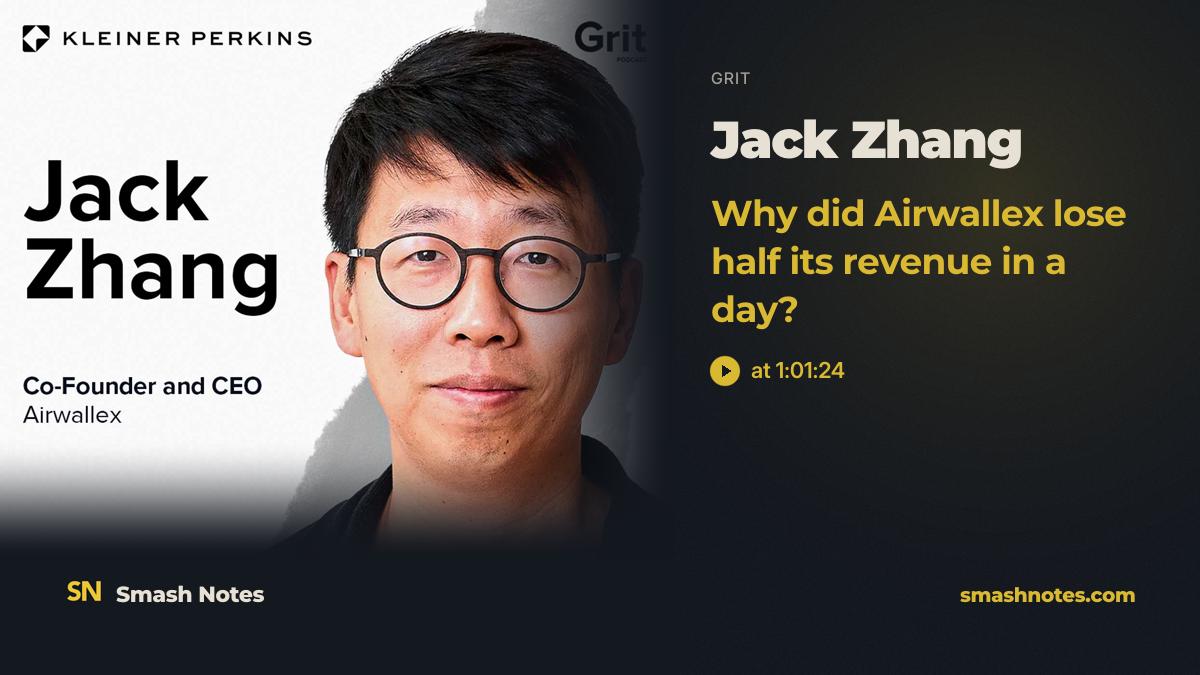
Airwallex's Jack Zhang on Fintech, Failure, and Growth
Airwallex lost half its revenue in a day during COVID, and Jack Zhang had already turned Stripe down. A blocked coffee payment pushed him to build Airwallex after his family lost everything when a bank failure froze their assets. Transaction volume grew more than 100 times in 2018.
People
Notes
-
-
-
-
-
-
-
-
How Fast Did Airwallex Grow in 2018? at 44:17
-
-
Why Did Jack Zhang Turn Down Stripe? at 57:00
-
Related notes
- Why Did Nick Kokonas Shut Down a Risk-free Trade?
- Why Does Hiring Great People and Getting Out of Their Way Fail?
- How Did the Acquisition of Indie Hackers by Stripe Take Place
- How Did Indie Hackers Fit Inside Stripe After the Acquisition?
- Why Did Stripe Need Dozens of People for Bank Returns?
- How Much More Revenue Can a Better Stripe Checkout Create?
Related episodes
-
![]() Booking.com CEO on AI and the Future of Travel
-
![]() Data Centers in Orbit by 2028: Baiju Bhatt on His Plans After Robinhood
-
![]() Ex-Twitter CEO on Why AI Needs a New Internet | Parag Agrawal
-
![]() How Vercel Is Rethinking Go-to-Market With AI | COO Jeanne Grosser
-
![]() Inside the AI Startup Making Customer Support 65% Cheaper
-
![]() The 20-Year Bet to Make Fusion Energy Work | Jeff Lawson
-
![]() Getting acquired by one of the biggest companies on the internet
-
![]() Katie Dill: Quality Control
Original episode description
0:00
On the Friday evening, I met Lucy and we sit down at a dinner. And during the dinner, I talk about the idea of building a swift alternative, a global money moving infrastructure. And she got excited. She's like, how much are you raising? I was like, probably like a million. And
Expand full transcriptCollapse transcript
The episode notes above make this conversation easy to skim.
0:00
On the Friday evening, I met Lucy and we sit down at a dinner. And during the dinner, I talk about the idea of building a swift alternative, a global money moving infrastructure. And she got excited. She's like, how much are you raising? I was like, probably like a million. And she's like, what if I give you two million? Out of nowhere. I was like, hey, Lucy, if you want to do it, why don't you join us as a co-founder and you can see how we spend your money, right? So we agreed she would invest a million dollars, a five million dollar post for 20% of the company.
0:27
And what's that investment worth now? Half a billion dollars. Thank you.
0:42
Welcome to Grit. I'm Jubin, partner at Kleiner Perkins, a show where we go beyond the highlight reel and explore the personal and professional challenges of building history-making companies. Today on the show, we have Jack Zhang, co-founder and CEO of Airwallex. The company is now worth over 11 billion. We get into his founding story, the early days of his struggle, and how he's gotten to where he has today.
1:07
It's actually, it's amazing. He's the personification of Grit. Enjoy the episode. Airwallex today is how big? 2,200 people in 26 offices globally. I read you're at like a billion of revenue growing 90%. Is that true? Now we're at 1.2, close to 1.3 billion revenue growing 85%. I actually started my, I wouldn't call it business. I started like a magazine when I was 14.
1:34
And think of it as like a Yelp, but offline. And we're writing, you know, computer games, Counter-Strike, and we're writing about student love stories. We write about, you know, comics. And it just got viral in the city. It's called Urban Exploration. And we made a bunch of money because we don't have to pay anything. And we have a few thousand merchants doing ads on the magazine.
2:02
And by the end of that sort of period, I know I was going to go overseas to study. And we donated the money to the school to build six basketball court. And we also sponsored the basketball team to play a tournament in Canada. And I just sort of stayed around to study English afterwards. How much money did you make on this magazine? Probably close to $100,000.
2:33
But this is like 1999, right? So it's a lot of money. Like a quarter mil. More inflation-adjusted. I don't know about that, but it's like a fair bit of money. I mean, it's no cost, right? I mean, students just do everything for free. You're 14 years old? Yeah. I mean, essentially, it's like a magazine out of the school, right? Where did you spend that money on at that age? We donated.
2:58
We didn't... So you donated all of the basketball to the basketball course. Yeah, we built a course and then we sponsored the tournament. Come on. I grew up in a wealthy family, but my family lost everything when I was 16 when I was in Australia. So it's a very kind of upside down in one day kind of story. Sorry, can I like dig into this a little bit? So when you were growing up in China, you come from money.
3:26
Like your family had a bunch of money when you were growing up. Yeah. Yeah. Okay. My dad is like a CEO of a regional bank. Okay. Okay. So like, especially in your small town, like you were definitely well-to-do. Yeah. Fine. So then you start a company. It's not a company. It's... Whatever. A magazine. Yeah. A magazine. There's no company.
3:46
A magazine. You're making money. You made a bunch of money as a kid. And you're like, well, I don't need the money. I come from money. So I'll give it away. I mean, to be fair, I didn't know what money is at that time. It just don't have a concept of rich or poor. Because I never need to struggle with money. I never need to buy anything.
4:13
I don't have a very good concept. The first time I actually understand what money is, is actually when I don't have it.
4:19
So that when I lost everything, I was trying to buy a $1.50 chocolate and I couldn't afford it. And that is the first time I was like, wow, I need to make money. Right. That's crazy. At 14, life is good. Your family says, go to Canada, build the basketball courts. spend the money you just made. And so then you go to Canada for what? For a basketball tournament.
4:42
Okay, for a tournament. Yeah. So you built the basketball courts in China in your town. In my school. In your school? Yeah. You spent all the money on that? Yeah. It's expensive basketball courts. Six, like, you know, one of the best basketballs you can do, right? Like indoor courts? Outdoor. Okay. Yeah. It's expensive. Okay. And then you go to Canada for a tournament.
5:06
At this point, you'd spent your money. And your family's obviously, like, paying for you to travel around the world and play basketball. Life's good. Then...
5:22
Why did you leave Canada after a year? Not less than a year. I was staying with my relatives, my uncle, and I just didn't get along super well. And I want freedom. I don't want to be restricted on what I can and cannot do. And I told my parents I want to go somewhere that I have complete freedom. Huh. So you went to Australia. Yeah. Were they there? No, I went there by myself.
5:57
And I live in the Aussie Navy family for a couple of years before I went to college. With who? Like an Aussie family. How did you find them? The school recommended. So you found a school there? Yeah, I found a school there. And the Australian couple become my legal guardian. And, you know, the guy is a Navy. He's like not at home every day.
6:20
And I'm just hanging out with his two kids and his wife. And going to school. Yeah, and going to school. And they are taking care of me.
6:33
At like 15 years old at this point. Yeah. And at this point, your parents are... Still in China. Still in China, sending you money. Yeah. Like helping pay for your school. Yeah. I assume paying the... Yeah, the... People that are taking care of you in Australia. Yeah. Then what?
6:51
Then I just sort of lost everything when I was 16, 17. I left her a year and a half. In Australia? Yeah. When I went back to China and, you know, I realized, you know, there's no driver picking me up in the airport.
7:08
And I went home and like, you know, the place we live is different. So I just realized we lost everything. Like a different house? Yeah. Yeah. your parents didn't tell you that they lost everything? You just started to see signals?
7:24
They intentionally didn't tell me because I was, you know, they just didn't want to sort of creating issues for my study or like mentally give me burden. So you get to the airport and you're like, wait, where's the driver? Yeah.
7:41
I literally have to figure out how to get a taxi to... What you've never done in your life. Yeah, and when I got home,
7:50
it's, you know, like, we always owned that place, but it was, you know, we didn't live there for, like, a decade, and just all of a sudden, you know, my parents told me to go there, and I was there, and my dad was smoking, and, you know, he's not a smoker. And I realized,
8:07
you know, something happened, you know? And you were 17 at the time? Yeah. What happened?
8:17
My dad just sort of, you know, was managing the bank, and the bank lost a lot of money, and he got investigated for many years. And all the assets got frozen, and, you know, lucky he didn't go to jail. Wow. Yeah. And do you have any siblings? No. Just you? Yeah. And so they were very protective of how you felt? Yeah, especially my mom. And was he like in the news? No, I mean, it's not like...
8:48
It didn't get out? It's a small town, right? It's not like a big city. We were wealthy in a very sort of absolute sense from that city perspective, right? It's an 8 million people city. It's a second tier or third tier city in China, but it's not Beijing or Shanghai or Hong Kong. 8 million people is not that small. Well, I mean, there's a lot of cities with 8 million people in China.
9:13
It's not a, you know, he's not a very, you know, in a kind of from a country perspective. Bigger than San Francisco. Yeah, but it's very different, you know what I mean? Yeah, yeah, I know what you mean. Capital per capita, probably like, I don't know, 1% of San Francisco back then, you know? And
9:31
did you care? Of course. I mean, like, I would literally need to figure out what do I do to finish my high school and go to college. Because they couldn't pay for it? Like, you didn't go from a lot of money to less money. You went from a lot of money to no money. Yeah, zero money. They had to sell the house that you lived in. Well, everything got frozen, so it's not even sell.
9:55
Everything. Yeah. So we kind of just have like a few houses we bought like over 10 years before that happens and, you know, very old places. And we kind of lived there. And my mom also was working for the bank and she had to resign from her job to become entrepreneur. to help to pay for my stuff. And obviously, I have to figure out how to pay as well.
10:18
And because I already left the China education system, that's a very competitive system, and it's extremely hard once you leave, left for two years almost, and then try to come back into that system. You've got no chance of competing with the guys who are studying 15 hours a day, right? And I basically had to figure out how to survive by myself in Australia and pay for my tuition.
10:40
And my mom obviously... become entrepreneur, she kind of helped as well. But it's still not enough, right? So I have to work 15 hours a day. Initially, I was washing dishes in a restaurant between 4 p.m. to midnight after high school. And after I went to uni, I was doing bartender from like 4 to midnight. And then I work overnight in a petrol station from midnight to 8 in the morning.
11:04
Where? Like a petrol station, like a cashier. Oh, like a gas station. Yeah.
11:10
So you basically do like from 4 p.m. to 8 a.m., you know, 16 hours a day.
11:17
And why didn't you at that point just stay in China where it's like a little bit more
11:25
familiar? Your mom's there. Your dad's there. Well, I don't think I'm competitive anymore. I used to be. you know, top 10 in the entire city from an academic standpoint. And I just, you know, after two years, honestly, I didn't study much at all in Canada and Australia. You know, like, it just feels like the academic competitive level in Australia is, like, not even close to where I was.
11:52
And I can just get the best score without studying. Um, and you know, just going back, it's not realistic. Like I would go to like a tier two university, you know, I would never go to the Stanford and, and, um, you know, university in Australia. I mean, it's the best one in Australia. Yeah. Like, it's not kind of Stanford or anything, right? It's the University of Melbourne.
12:15
But, you know, that's already the best in Australia. Wow, it's fascinating. And how long were you able to do the 4 p.m. to 8 a.m. back-to-back shifts? I probably do, like, at least sort of three, four days a week throughout the entire college. Through all of college? Yeah. And I was also working on the weekends in a computer repair store doing, like, PS3 jailbreak and, you know, putting together servers and do some basic coding and stuff.
12:53
Do you still have that in you today? I mean, what, writing code? No, like, working like that.
13:00
I still work, like, 15 hours a day in most of the days. And the last three weeks, I'll ever just sleep four hours a day.
13:10
what's been going on the last three weeks? Just lots of stuff happening on AI, a lot of kind of new initiative on international expansion, and also, you know, need to deal with regulatory audit in many markets, right? So because the path we chose is It's very complicated. We regulate it in 60 plus markets around the world. In every single market, we have multiple licenses.
13:36
And we're interfacing almost every single regulator in every single jurisdiction. And there's always some sort of audit and onsite and RFI going on that we kind of have to maintain the largest financial and regulatory infrastructure in the world. And that is
13:53
lot of pressure. And maybe like 15 seconds on what Airwallex does.
14:00
Airwallex is a global financial and payments platform to empower modern businesses to operating and grow globally. Think of it like the easiest way to think about it is like a RAM plus Stripe sort of together, but with sort of Citibank as the infrastructure. Right? So the, you know, the ultimately Airwallis wanted to build the next generation of Citibank.
14:24
But in a sense, like the global bank, you know, is different, right? The future of global banking is not how you're looking at JP Morgan or Citibank today. It's a fully sort of vertical integrated financial and regulatory infrastructure layer, but with a genic finance on top. That to creating not only autonomous finance, but also able to executing
14:48
on the infrastructure layer that to creating financial outcome or payments outcome, right? So imagine like what you do today, you do a bunch of stuff in your, I don't know, finance software, payroll software, or vendor spend management software. Then you download a bunch of stuff, a file, you go to Citibank and you upload it, then you process the payments.
15:07
It's very kind of separate process, but with Airwallex, it's all fully integrated that you not only able to operate the financial operation, with agent to help you. And when the agent wanted to confirm the actual payments or actual money in, money out, that our infrastructure were able to get instruction and get it done straight away. And with the money out, that you're able to reconcile the cash and the actual ledger without any extra work.
15:35
Yeah, that makes sense. Yeah. So you're in Australia. Mm-hmm. If you're working at, you know, gas stations and computer stores, but you had already started a company when you were 14, company, whatever, a magazine that had made a bunch of money, a bunch of money, some money. Why don't you try that path again instead of doing it this way? I was zero capital.
15:58
I was barely surviving. I think I was also initially working on the lemon farm and picking up lemons for 12 hours a day. And the trend in and out took three and four hours.
16:13
when you're at a surviving mode, it's very hard, right? You basically, you need to pay for the tuition and you need to pay for your living expenses. You just have no bandwidth to think about what you can do. And even you want to do it, you just have no capital to do it. And, you know, my English wasn't great either at that time. And I was barely speaking English.
16:36
And also, like, I lost a lot of confidence as well, right? Imagine that you... You're wealthy and you're academically one of the best in the city. And all of a sudden, you kind of become this, like, in a foreign country, you don't speak the language very well. You know, people look down on you and you're just awkward, right? And I also just feel wanted to hide somewhere and just work and go through this.
17:03
you know, like worst period of my life. And then hopefully by the time I graduate, I can find a job. I never thought about drop out, start a company, raise VC money. It's a thing, right? There's no venture capital in Australia back then.
17:16
Still not much now. No. Yeah. I mean, like,
17:20
we're probably the only unicorn in Melbourne. And it's not many tech companies at all. When I started the company, you know, if you start a company in Silicon Valley, you raise venture capital. You got a lot of founders surrounding you to give you tips. And the VC tell you, you know, certain things and how to recruit people, help you to close candidates.
17:39
I've got none of that. and I made every single mistake the founder shouldn't make. I got no one to ask opinions and to get help. It is a very different environment. It's very hard to imagine what I can do in Silicon Valley versus You know, like it's just not a thing. The mentality was just not there. So did you drop out? No, I finished my degree.
18:07
And you paid for your tuition through this work? Yeah. Finished? Yeah. Then what? Then I interned at Goldman. Then financial crisis happened in... Where? In Melbourne. In Melbourne, okay. Yeah, and I went to work at an insurance company in Melbourne and London as sort of a software developer slash investment analyst under a portfolio management side of the insurance company.
18:37
And this is like... a crazy time, 2008, you know, and insurance company does a lot of weird stuff at a time, you know, they, they does a lot of
18:48
investment and proprietary trading and obviously after GFC, they all shut it down. But, you know, at that time was, was interesting technology. And, you know, I worked at a bunch of investment banks in Australia on the trading floor, routing algorithm trading or market making kind of algorithm to, you know, like kind of as a career. And I was doing a lot of stuff on the side.
19:14
I started many small businesses in architecture, real estate, coffee, burger. Come on. What do you mean coffee and burger? Like I had a burger shop, I had a coffee shop, like a blue bottle. We were actually going to, you know, franchise and, you know, the aim is to build one of the largest coffee chain in the world. And, you know, but that's how AirWallet still started.
19:37
Sorry, continue. Yeah, we were. My co-founder's name is Max Lee. He was actually an architect. And we started the architecture firm together. We started the real estate development company together. We started the burger store together. Then we look at the fast 50, we call Telstra fast 50 in Australia. It's essentially showing the fast-growing businesses in Australia.
20:03
I was like, wow, two-thirds of those fast 50 actually are retail businesses, some sort of retail chain in the food and beverage sector. And I was like, we should do that. And Melbourne is very famous for coffee. And we were like, let's just take the Melbourne coffee to the rest of APAC.
20:23
And I convinced him to resign from his architecture job to start the coffee chain. And his name is Max Lee, and the same name is on the OFAC blacklist. On the what? On the OFAC blacklist. What is that? OFAC blacklist is like this blacklist by the OFAC, the regulator in the US, right? So if you are... a criminal, like politically sanctioned person that you end up on this list, right? So, and the same name is on that list, right? It's a different person.
20:52
Then wherever he's sending money to Brazil, to Indonesia to buy coffee beans, because we rose our own bin to scale, right? And the money just disappeared for a couple of weeks and then bounced back. And he come to complain to me, you know, what is going on with this global money movement system called SWIFT that built in the 1970s? And I just...
21:13
look under the hood, like how that works, right? If you're sending money from, say, National Australia Bank to a small bank in Indonesia, it goes through, maybe it goes to CBA, one of the largest bank in Australia, then goes through Citibank, or goes to DBS, then go to Bank of Indonesia, then land at a smaller bank. So it's like three, four banks in the middle, and none of these banks have enough information about Max Lee, because the swift messages only have 140 characters.
21:39
And it doesn't have date of birth, doesn't have address. And so there's a bunch of people in India or Malaysia, like, you know, handling manual fax between the banks. And it's just a lot of middlemen. And I was like, why can't we just go direct to the Indonesia central bank and from the payment system to Australia, go direct to the payment system in Indonesia, build alternative network to SWIFT? And I thought actually doable.
22:05
And that's how Airwallet was born. And you wrote it? Yeah, me and I got my CTO join me. He's kind of a genius engineer. Max Lee has become my head of design, head of product design. And I got the guy that used to do trading together, also a hacker to be my last co-founder. So four of us started the company. Are all four of you still there? Yeah.
22:33
And also we add another sort of fifth co-founder slash investor, Lucy, which is another crazy story. I basically met Lucy when I was in a coffee shop. Your coffee shop. Yeah. Which is downstairs the place I work. I work in National Australia Bank on the, actually, yeah, I was working a nap and I set up the shop downstairs my workplace. What do you mean? Wait, sorry.
22:55
So what was upstairs? I work upstairs. Like where? Like in Melbourne. Like in a bank? Yeah, in a bank. Yeah, on the trading floor. Like in an investment bank. Yeah. And I built a coffee shop right next to my work. No way. Yeah. And if you log into the NAB internet banking, the cover, it's my coffee shop picture. No way.
23:19
Okay. So I basically just finished work and I go down to see Max in a coffee shop. Who was working there, like register? Yeah, as a barista and, you know, coffee shop owner. It's our first shop, right? And the burger shop is next door. You're doing them together? Yeah. No way. Why not? It's like two different shop fronts, like two different shops.
23:42
I know, but who's at the burger shop when you're in the bank? Max going back and forth. When you're in the bank and Max is in the coffee shop, who's in the burger shop? No way. I mean, when the burger shop is busy, it's lunchtime, right? Then Max will ship from the coffee side to the burger side. And then you close the coffee shop? Not close.
23:58
Somebody, you know, I mean, we have staff, right? And why didn't you quit and go run the burger or the coffee shop? Why was Max not like, dude? I mean, I never sort of
24:12
So that's kind of the business for me, and I was basically using that experiment. And Max has a lot of passion for coffee, so he volunteered to do it himself.
24:24
And this could be a very big business, right? I mean, this is 2013, and if we persisted, you know, you could build a multi-billion dollar coffee chain. Um, and, uh, you know, we, during the first phase of the coffee shop that we were finding upon a sales, uh, and we actually are going to do a square, which is the first idea. Uh, and my CTO just like, ah, this is a bad idea and blah, blah, blah.
24:50
And we never did it. Uh, and Airwallet is the second idea. Okay. Sorry, Lucy, you met her at the coffee shop? Yeah. And she's friends with Max. Just on a Friday evening, a random day, I went downstairs, met Lucy. And we talked about it. She just resigned from her investment banker job in Hong Kong. And then she's like, what are you guys doing? Do you need an investor for the coffee shop to expand? And I was like...
25:21
Not really. I mean, I actually don't want to do this coffee business anymore. I have some bad ideas. I mean, the coffee business is very operational. It's not quite my thing. We have random staffers just disappeared one day and we look for her for a week and then realize she's partying somewhere. And that kind of stuff just happens all the time.
25:38
And you're dealing with a lot of people just not very responsible. And I was like, that's not the type of business I want to run. And we sit down at a dinner. And during the dinner, I talk about the idea of building a SWIFT alternative, a global money movement infrastructure. She's like, wow, that's a long way from coffees and burgers. And she got excited.
26:00
She's like, do you need money? And I was like, yeah, I'm going to raise money from VCs. And...
26:07
She's like, how much are you raising? I was like, probably like a million. And she's like, what if I give you two million?
26:14
And just out of nowhere. And this is like within four hours I met this person, right? But we went to the same college and she's like, you know, I'm really interested. Why don't we go to the law school tomorrow, eight o'clock, and let's talk about it. Um, and then we met next day in the law school, uh, eight o'clock and, uh, her husband was there.
26:36
Uh, they just recently, you know, was, was married, you know, at that time, just to go married. And, you know, they have, they were planning to buy a house in Melbourne and to settle down and have kids. And, uh, and Lucy wanted to invest some money into air wallets. Uh, and her husband was like going crazy. He's like, no, no, no, I'm not doing that.
26:53
If you want to do it, you do it yourself. Uh, and, uh, uh, and you know, I was kind of, Smart, I was like, I kind of sensed that Lucy want to do it. I was like, hey, Lucy, if you want to do it, why don't you join us as the co-founder and you can see how we spend your money, right? So we agreed she would invest a million dollar, a five million dollar post for 20% of the company.
27:15
by 11 o'clock. And, you know, because her husband refused to invest and she had to call her dad, you know, to get the million-dollar funding, which I'm amazed that, like, a 23-year-old can convince her dad to invest a million dollars on her behalf. And what's that investment worth now? About half a billion dollars. That's pretty good. Yeah, with all the dilution.
27:41
That's pretty good. Yeah. And she owns, well, owned 20%. Yeah, back then, obviously it's diluted. Now she's like 5% probably today. Pretty good. Yeah, that's her first investment and also probably the last investment. And she still, does she like run finance? No, she's our president. She runs all the comm and she runs our charity foundation.
28:06
And she does, yeah, a lot of the public affairs stuff. And so she gives you the money. Yeah. You close the coffee shop and the burger shop down? No, that was still going. The shop's still there. Today? Yeah. No way. Yeah. I mean, some of the else is running. We're not really involved anymore. Do you own it? Not anymore. We sold it after, I don't know, four or five years after we started Airwallex.
28:37
So you quit the bank? We're not like entirely sold it. We just give it to a friend. Okay. And your friend still owns it? Yeah. Do you ever go back? Yeah, the shop's still there. Doing pretty well. I mean, it almost died during COVID. But, you know, she struggled a bit. But still there. I mean, you're, you know, in a position where you could probably buy it back.
29:02
Yeah, but like... Make it an office. Make it an office.
29:08
I don't think that way. Like, why? I mean, the coffee shop's doing well. Just let it be.
29:14
And move down, right? Maybe, how do I say this? The feeling that I seem to get is
29:22
that it didn't really matter what business you're really in.
29:28
The end goal was the business, like going and building a big company. And you have belief that that company could be a national franchise burger shop or coffee shop or magazine. Is that fair? I think I was just trying to be happy. And I wasn't happy
29:49
between 20 and 30. I mean, literally since 17, right? I wasn't happy with where I was. You know, I grew up very happy. You know, I was one of the most family in the town.
30:05
My academics are very good. I was very popular as a kid and I played basketball really well. I'm just kind of have everything. And I was really happy. But since my family moved to a new country, don't speak the language, you just feel that your life have fundamentally changed. And really it's just struggle to find my belonging and find my happiness in a society.
30:29
And I think building businesses is one way for me to keep discovering how can I get back to where I was from both of a mental and spiritual perspective. Like when you were a kid? Yeah. Like when I was like a teenager, right? It was like building... the magazine, I was, you know, the happiest period of my life. And I had everything I need to have in life.
30:54
And I was extremely happy. And I just never able to get back to where I was. And it's just sort of that struggle throughout my 20s. Literally all of your 20s. Yeah. I mean, just really, I mean, I work in a decent job in an investment bank. Goldman's not bad. I mean, I write in code. But I just don't feel comfortable. that's where I'm belonging.
31:17
I feel I can do bigger things. I feel I can, I'm smarter than most of the people I'm interacting with. And I'm just different, right? I always complain about, oh, this is so bad and why can't we fix it? And why can't we do this and that? And you always have some sort of management and the management come to tell you, I just, you know, that's not your job.
31:38
Don't worry about it. And I look up to the people that are my managers and my manager's manager and the head of The entire investment bank, I'm like, I don't want to do that job. That's kind of like a shitty job.
31:52
and just become part of this machine and doing nothing relevant. You're not creating anything. And especially as a trading, as a sort of writing code to trade, and you just see a P&L, you know, I used to say daily P&Ls of hundreds of million dollars, right? And then you're running this machine behind this massive number and then you feel like a sense of, you don't feel a sense of achievement.
32:15
You feel that you're just dealing with a number that what do you do have zero impact to the society, you know? helping anybody. You're playing a zero-sum game. All you try to do is showing that you're smarter than the guy sitting next to a computer, in front of a computer screen in Chicago, probably just also doing algo trading and half-finished trading.
32:35
I just fundamentally don't know the value I'm creating for this world. I just really lost. But I don't want to resign from my job because I love writing code and I feel that if one day I can do something, it's probably technology. And that's the scale I would love to see. And I wanted to keep writing code so I can do something one day. That's why I always get Max to do the stuff full time and I'm always like keep writing code.
33:10
Do you feel happy now? Better than... you know, like when I was in the 20s, I feel I've found something I really enjoy doing and able to scale, right? The economy scale is really exciting and building something that changing the financial infrastructure landscape globally, building a new generation of a global bank is very exciting. And now you're able to leveraging AI to creating a genetic finance on top of this infrastructure, even make it more exciting.
33:42
But if you ask me, like, am I as happy as I was 14 years old and building that magazine? Probably not. Do you think you'll ever get there? Do you think it's possible? I don't think so. Why not?
33:53
Have you reflected on this? As you're getting older, you're just getting more complicated that you see more, you know, the ugly side of the world. And you just don't have the spiritual mindset anymore when you as a kid, as a 14 years old, that the world is so pretty. You know, you're building something that from nothing and you work with the people you like and no one's getting paid.
34:21
But you get a lot of you know, how do you call it? Like, everybody just love what you do, you know? And I couldn't say all the employees and everyone love what I do. I mean, they, you know, I've not, you know, they might not understand the decisions I'm making sometimes, right? But when I was 14 years old and everybody just truly, truly believe in what we're doing, enjoy what we're doing, there was no such, it's almost like a fantasy, if you know what I mean.
34:50
It's just like a perfect fantasy Well, there's no downside. It's just people are just happy and have a lot of upside.
34:58
And people are just simple as a kid, you know?
35:02
Are your parents still around? Yeah, my parents live in Melbourne. And do you keep in touch with them? Yeah, every week. You enjoy running a company of this scale? I think you enjoy... I don't sort of think that way, right? If you think about me, I describe myself as a professional athlete. It's like a basketball player. Right. And I have a team.
35:25
And, you know, if you are sort of the lead player of this basketball team, you wanted to play in NBA, you want to play with the best team in the world. Or if you're like a tennis player, you wanted to play with Sinner and Akros. You don't want to play with
35:45
some number 20 player in Southeast Asia or whatever. Right. So that. You know, when you are not on the court to compete, that you are training to make yourself and your team better. It's like a very professional sort of
36:04
athlete type of mentality and spirit. And you do that with everybody in Airwallex, try to build something amazing and competing with the best in the world.
36:15
So competing with Stripe, competing with Ram, give me a lot of joy. Does it? Yeah. I mean, if you already, you know, winning, you're not a challenger anymore. I don't know. I mean, you know, I feel like Stripe now is like a default for payments for startups in Silicon Valley. Right. And... You know, I mean, that's a great position to be in, but I'd rather be in the position I am.
36:40
And I'm like, okay, I need to figure out how to beat them. And it is a very difficult challenge. And achieving that is fascinating and interesting for me. I started a company that we incubated here at Kleiner Perkins that I'm leading.
36:54
And people, it's like 17 people now. People have been asking me, like, how is it? Like, are you having fun? And I'm like, I wouldn't describe it as fun. That's not the word that I would use to describe how I feel on a day-to-day. And they're like, why not? I'm like, well, let me just give you my lived reality on most days. I'm either negotiating with a lawyer or a VC or a candidate or a customer or somebody on my own team.
37:31
Almost at all times. And no matter how many times I try and become not the bottleneck, and maybe this changes, maybe somehow I end up, it ends up coming back to me on these things. And I'm like, and then they'll say, well, but Jubin, you're good at those things. Like you're a good negotiator. And I'm like, maybe, but like, that doesn't mean I like it.
37:54
Like that doesn't mean it's fun. And they're like, well, why are you doing it?
38:02
And I'm like, because, you know, for the last six and a half years,
38:10
I've been sitting across the table from people like you and sitting shoulder to shoulder with Kleiner Perkins founders, watching them do the hardest thing and talking to them like in intimate detail. I feel like I knew more than anybody. And I come from the startup world about what it actually means, like how hard it really is. And I still couldn't help myself.
38:39
Still couldn't help myself. And so I think like at the end of the day, like it didn't really, it felt like I had to do it. If for no other reason than to prove to myself that I can do it. Otherwise, like I ended up just becoming the talking head that gives like blanket advice empty empty words and almost like um is jealous of the people that are willing to do
39:11
what it takes and sacrifice maybe it's not fun but i just couldn't imagine a world where i lived with myself
39:21
not seeing like what my potential was um but i would not describe it as fun No, I don't. That's why I don't describe, you know, you ask me, are you happy or are you having fun? You're enjoying. I don't think I enjoy most of the work I do. I do feel I, you know, as a professional athlete and team leader, I have the responsibility to
39:46
of the team and I wanted to win. I wanted to keep competing and I wanted to be the best in the world, right? So that is continued to motivate me. And then when you actually see that you're supporting a greater mission and you're supporting millions of businesses around the world to able to transact and grow in the sort of, without the restriction of the current financial infrastructure, that is very fulfilling.
40:09
And then you feel that you have a higher order of happiness, right? So that, I think that higher order of happiness, it's the ultimate motivation. How quickly did things start to grow?
40:19
As in the business? We pivoted twice, right? So the first idea we had is we need to figure out how do we connect to the interbank market. But as a startup, that is very hard to connect to the interbank market on the FX side. On the payment side, you need to get licenses. So I was an engineer in an investment bank. Why would a regulator give me a license? So I had to write a pitch letter to the commission of ASIC, which is the regulator in Australia, to pitch innovation in Australia that that for some reason he actually read it and give me that chance.
41:00
So one of the two lessons they granted that year Um, you know, the asset commission commissioner specially approved it, uh, which is amazing as a, as a regulator. Um, I kind of remember that, that, you know, forever. And, uh, that is not how most of the regulator works. Uh, but we had the chance to, to do that. You know, uh, we've got a license as a small team of, of less than 10 people.
41:28
but one person does legal compliance and risk and everything.
41:33
And, you know, we got a license and we start building the product and
41:38
we need to figure out how to do FX at an interbank rate. And the way we thought about it is doing peer-to-peer, right? If you have transaction happen from Australia to the US and you have the other way around that you can net it off and then give you like a fair market value. But then we built the algorithm and we did a simulation. It just, we need like billions and billions of volume to do even, you know, a fraction of the netting.
42:06
And then people need to wait for too long for, you know, the two side of the transaction to be netted. And we just thought it's not going to work. And I cold called one day Macquarie Bank
42:20
7.45 a.m. The guy pick up the phone is a guy actually doing an overnight shift to cover, you know, the other hours in an investment bank. And I pitched the idea that we raise this, you know, at that time we raised $3 million.
42:39
Sold him the dream of building one of the largest FX and money movement platform in the world. And he believed in it. And he convinced his management to allow us to have a fixed connectivity, or I say fixed, it's a kind of protocol in FX trading into the Macquarie front office that allow us to connect to the interbank market. And this is like the biggest bank in Australia.
43:04
Yeah, the biggest investment bank in Australia. It's very rare. Because in the investment bank, when you trade on the interbank market, the minimum ticket size is, you know, like tens of millions. And sometimes you trade in the billions per ticket, right? And, you know, we convinced the Mercurial Bank guys to change the API to allow us to trade a minimum of $50,000 tickets.
43:31
And it's amazing how that kind of all happened. The guy who was doing overnight shift in a bank now is the head of FX distribution in Mercoro Bank. So I kind of helped his career as well. That's amazing. And we've become the largest customer of Mercoro Bank. That's amazing. On the FX desk. How long into the business was that? This was the first year.
43:51
So after the P2P idea failed and we basically co-called Mercurial Bank to try to connect to interbank market and pivot the business to a SMB invoicing type of business so that you can send invoices or bills to pay overseas, right? Or getting paid. And targeting SMB didn't quite work because we were running out of money and SMB acquisition is very costly and we couldn't raise more money with that idea.
44:17
And we pivoted again to an API sort of business that allow larger businesses to move money around the world. And that is basically the third idea. And that succeeded. By early 2017, we started building the API and then we signed up two very large customers who also end up being
44:42
One of them being an investor, which is MasterCard. And we also signed up Shein, which is one of the largest e-commerce companies in the world now. And we were able to ride with these customers. Well, MasterCard promised like a billion dollars, but ended up delivering almost nothing. That's a different story, but we had some very large customers that took off in between 2017 and 2018.
45:07
So the business is growing over 100X in 2018 from a transaction volume point of view. Before that, when you were pivoting, was Lucy freaking out? She's like, what have I done?
45:22
At that time, she was a CFO. She's leading finance. When we try to pivot to the API idea, we already raised from Sequoia and MasterCard and a few other famous VCs.
45:45
That is, you know, obviously that the brand, um, kind of helped, uh, the VC's brand helped and we were able to build a better team and, uh, and then we have the money to pivot to this API first business. That's how the business took off. And then within like two years by end of 2018, we got a $1.2 billion offer from Stripe to buy us. Right.
46:06
So that is a pretty insane two years time. How big was the company when that offer happened? People wise?
46:15
let's see, 160, 170 people. So you grew from five to 170 in two years? Yeah. It's fast. That's fast. Um, yeah, half my engineers and, um,
46:29
and we made a lot of mistake, uh, in recruitment. Like what? Um, we hired a bunch of people from Citibank, from, you know, big banks and, um, fancy pedigrees. Yeah. And, uh, they told us, you know, this is how it's supposed to work. And, uh, And, you know, they've been building Swift systems and, you know, what you're doing is wrong and you need to do this and that.
46:51
And, yeah, we pay a lot of price for that. Like what? I mean, you still got an offer, a pretty good offer of $1.2 billion. Yeah, but that is probably considered the team and the future of the company. At that time, in 2018, we only did $2.6 million in revenue. But forward, we probably did $10 million in revenue. The next year. Yeah. So they paid like, you know, more than, you know, it's $800 million on the cap table and $450 to me and my co-founders.
47:21
So, and it's 80 times forward revenue, which is, you know, better than most AI money pool right now.
47:30
Uh, obviously you said no. Sorry. And can I actually like ask you a personal question? Cause I, uh, I like this morning, but like right before I walked in here, I had a decision on a candidate. This just reminded me of it.
47:47
Um, right now it's me and basically, basically like 16 engineers, one person in GNA, one person in design, basically all my two co-founders and all engineers, um,
48:00
And the company, it's called Roadrunner, has like, it's got quite a lot of demand. But I also know all of the customer base. It's definitely, I am becoming the bottleneck on everything non-engineering related. And we've starved this plant for long enough where I need to go like build
48:20
the company around the product. Let's put it that way. Which is probably what you felt like after you started hiring all these, you know, bankers from Citi. And I have resisted hiring anybody from this industry because I think the industry is, like, old and sucky. So, like, why would I hire those people? And there has been a guy that's been trying to get a meeting with me for six months, basically since the company started.
48:45
He knows somebody inside of, uh, he knows somebody well inside of Roadrunner and, uh, he comes from sales, but he just, he's, he's like, I'll, I'll be the janitor. I don't care. Like, uh, inside sales, cold calling, like he has AE offers at real tech companies. He's like, I don't want those. I want to be a roadrunner. And the thing that I've been like struggling with, it's not the first hire that I should make in this function.
49:15
It's just not. There's like several other priorities in this function. I need like a finance person, like probably someone on marketing. There's like several other roles in sales that I should hire for first. A bunch on engineering, some platform engineering, some QA engineering, some infra. We have like an agent team that we need to build.
49:33
All these things, right? He's never done a POC before. Like the sales that he comes from is like green tax sales. Anyway, I could go on. Eventually, I was like, nothing makes sense about the timing of this, him. If somebody, like if my board looked at it, they'd be like, what are you, this seems weird.
49:57
And I just couldn't help but have this overwhelming feeling that despite nothing making sense, Like, how can this guy fail? I just can't see him failing.
50:09
And what's the worst that happens? He sets, he creates too much customer demand. And so it puts more product pressure on us, puts more engineering pressure on us, puts more pressure on us to hire. So anyway, I call him right before I walked in here and I said, like, let's, let's do it. And he was about to call me to back out because he was like, obviously the timing is not right.
50:29
And I'm like, yes, the timing is not right. That's true. But, like, the timing's never right. Meaning, like, I've told myself that if I find the best person in any function, I'll hire them. Independent of timing. Because I know I'm going to need them all. And best people don't just, like, come around on trees. They don't just grow on trees whenever I need them.
50:48
So, anyway, I pulled the trigger. And as I was walking in here, I was like,
50:56
this is going to look dumb if I'm wrong.
51:00
And the people from Citibank, you don't look dumb because they have all this experience. And from the outside, you know, they know everything. They've done it all. They have all the answers to the test.
51:17
And anyway, I don't have like maybe anything other than you saying that reminded me of the thing that I was just deliberating all morning. I think like founder's intuition in recruitment is extremely important. Sometimes you see this like CV, it's, you know, looks like a really good fit, but you just have this like a weird intuition. It's like, maybe it's not the right fit.
51:39
And sometimes that you don't trust your intuition and you just trust professional advice and you end up being very, very wrong. I think able to recruit and
51:53
fire people very fast is extremely important in an early stage company. And we made way too many mistakes that we shouldn't.
52:02
And we made a lot of mistakes in recruitment by looking at experience, which is completely irrelevant. I wish I had known that 10 years ago, and I just didn't, right? So I hired a lot of these experienced people and end up all create a lot of issues for the company. And then we have to fire them all. And which taking years to do that, which is also another big mistake.
52:23
We should have done that in weeks, not years. Why did it take years?
52:29
Because I kind of just doubt myself, right? Because they're very good at... convincing you you are wrong and and i think maybe i am wrong uh because i've never done that what do i know about it right so they they uh wanted to build a product in a certain direction and maybe i was like well you have built this same similar system in city for last decade and you probably know better than i do probably better know than yeah i have to rewrite a lot of the system afterwards because end of the day first principle thinking is a lot more important than the experience What were the highest performers?
53:05
They didn't have experience? The initial sort of playbook is all quite random. It does, you know, because we are from Melbourne and there's not a sort of, it's not like, oh, there's like 10 companies you can just recruiting from, you know, like you can just sit in the front of that door of that company and just try to talk to everything or engineer.
53:24
There's no such thing in Melbourne. And we kind of have to go
53:29
everywhere and then try random places and it is very kind of coincident you know you know we um Our chief power officer came from Palantir. He spent 12 years at Palantir, which is the first higher Palantir asset of the US, become the GM of Palantir Australia and New Zealand, and then started the Palantir European office and built a European business.
53:56
Then went back to New York to become an engineer manager or product manager to build a fountain product.
54:03
But then like after a decade and more, he is Aussie and he wanted to go back to Melbourne and live in Melbourne. And we just randomly,
54:12
he applied a job in Airwallex at a random job and we just randomly met and then end up, he's like, wow, amazing. You know, how do you end up in Melbourne? But can you find another person like that in Melbourne? You can't. Right. So it's just like a lot of luck and a lot of random things. things have happened. And I think we raised the most amount of money in Melbourne also probably helped that some of the talent will come to us and want to talk to us.
54:41
But it's very difficult. It just There's no playbook that you could borrow from somebody to build a business out of Melbourne. Two years in, Stripe, what happened? Tell me, like, Stripe calls you? Sequoia connects you? Yeah, Sequoia connected us. And they wanted you to sell to Stripe? Yeah.
55:06
Makes sense. They have a big position in Stripe. Yeah. They have a big position in Aerolux. You're starting to compete. Not really. At that time, Stripe was doing payments. Okay. And Airwallis was doing global money movement. Okay. So they saw it as symbiotic. It's like perfect match. Okay. You were international. Yeah. They were in the Bay.
55:25
Yeah. It's like a perfect match, right? We have global money movement, which they haven't built anything. They have payments and we want to get into payments because money in is where everything gets started. We want to pursue a banking business. They didn't have any plan to do banking. So it's just like a perfect match from a vision perspective.
55:47
Everything's aligned. So Sequoia connects you. Yeah. You talked to what, John or Patrick? I talked to Will initially. Okay. Yep. Okay. Then I connected with Patrick. Mainly just Patrick. I haven't really, you know, I only met John once in that process. Okay. And how many conversations did you and Patrick have? A lot. Probably like...
56:10
you know, 20, 30, 40 conversations and spend a lot of time together. Over how many months? Two, three months. That's a lot in a short period of time. Yeah. We on WhatsApp every day. Um, and talk about, I mean, he, he started like, uh, he really liked writing things down. So he started like a memo on Google doc and to share about, he sought and asked me to comment and contribute.
56:30
And, uh, Yeah, quite amazing that we just figured out, wow, the company's mission ultimately aligned. Okay, and so then he says, hey, I'd like to buy you.
56:43
I don't know how that kind of conversation started. I think I remember what Michael Morris said. I mean, this is 70 years ago, right? So Michael Morris said, start building a trillion dollar company. And, you know, I was, you know, I think initially I was like, I'm not sure I want to sell. We're only like three years in. I haven't even enjoyed the journey yet.
57:06
I mean, it feels like half-baked something and then had to sell after three years. And am I going to have the energy to do another startup? And Michael Myers said it's like the earlier that you're compounding, the faster you can get to a trillion dollar. And if collectively you guys can achieve that faster, and that is a better thing for everybody and for the world.
57:29
And you should seriously consider that. And that was quite convincing. I was like, if you're going to end up getting there ultimately in the next 10, 20 years and, you know, getting there faster makes a lot of sense if we can work together.
57:45
But ultimately, it's come back to the question, what makes me happy, right?
57:52
I was 33, 34 at a time. You know, it's a five-year journey. I'll be 39 when I finish the five-year lockup.
58:01
as a CEO of APAC or the GM of APAC, am I going to be happy at that time? I'm going to be proud of what I've been doing for the last five years.
58:15
The answer is very unclear. It's like, probably not. I mean, do I have the energy to build another startup that I feel super excited about? Like to go zero to one again. Yeah, I mean, when I'm 39, am I able to do that again? So it's just a lot of question mark. And then if even I wanted to do a zero to one and build another business again.
58:37
What are the odds that happens? What I'm going to do. Yeah. Right. I don't even, I don't have a next idea. I, you know, I mean, again, it's like five years away. And then, you know, it's a very difficult decision. I walked around in San Francisco for two weeks and, you know,
58:52
and I actually verbally told Patrick we should do it. I mean, it's kind of makes sense, like logically makes sense. And, but when I'm back to Melbourne, I was like, hang on a minute, I'm actually going to be happy by doing this.
59:07
I'm going to have a lot of money, but like, what does that mean
59:10
to kind of, you know, from a happiness standpoint? And I ultimately asked my co-founders and they all said, like, it's your call. And I, you know, it's a bit of a naive, right? That, you know, I said, you know, if I think that we have more possibilities of doing this on our own. Did anybody want to do it? Anybody want to sell?
59:33
Max suggested we should sell, but all the other founders... Why? Money?
59:41
You know, Max, you know, Stripe was one of the best tech companies in the world, you know, even at that time, right? And Max... Right, of all the places to go. Yeah, I mean, if it's all the places, there's one company we should consider selling. work together, it's probably Stripe. It's not like a random bank want to buy you and you just, you know.
1:00:02
You're not going to Citibank. Yeah. So, I mean, it's a very exciting place to work and it's a very aligned mission. Patrick's one of the best entrepreneurs in the world. It's not a bad outcome, logically. How much money would you have made? I'll probably get half a billion. Yeah. And then 70% Stripe stock. Because it's 800 on the cap table, and then I think it was 380
1:00:28
to me and my co-founders, or 375. 375 million. Yeah, like as a sort of sign-on. And obviously that provided... In addition. Yeah, in addition to the 800. Dang. And that was just between me and my CTO. Mainly just me. So you made like 150 mil just on the sign-on bonus. 100 million on the sign-on, like on the retention. More like 250. In addition to the...
1:00:55
The cap table, the 800 million on the cap table, which I own, I think, I don't know, 40% of the time. Holy smokes. Man, that's a lot of money. It is. And by the way,
1:01:08
that Stripe stock now, Yeah, I mean, that strike was $10 billion at the time. $10 billion, what is it now? $9 billion. I mean, now I think they just did around $160, so they went to $16,000 as well, right? You've gone $60,000 and they've gone $60,000. Yeah. Do you ever regret it?
1:01:27
Yeah, when the things got really tough, right? We almost got run out of money during COVID. And, you know, we were very close to getting a term sheet from SoftBank before COVID happened. And then the WeWork stuff blowed up. And all of a sudden, the term sheet's gone. Gone. Pulled it. Yeah. Well, they didn't pull it. I mean, we haven't signed it yet.
1:01:49
But we kind of almost like getting the term sheet to sign, right? And then they just disappeared after the WeWork stuff. And we're running out of money. Then COVID happened.
1:02:01
So we had to do a convertible. We had to do a convertible from the existings. Then we, lucky, we found an investor out of London called Hedo Sophia to kind of basically lead a round at 1.7, 1.8 billion. Without that round, we would have been run out of money again. And then the COVID happened and we lost half our revenue in a day. And at that point you're like, what, how did I not sell?
1:02:34
You had that moment, but it's not like a burden, if you know what I mean. It's just like, ah, you know, it's one of those things, you know, it's like, why do I have to choose this part that's so hard? Right. Yeah. Yeah. And I imagine like, you know, probably the reality of the head of APAC job
1:02:55
settled in. You're like, Come on. Do I really want to do that job? Yeah. I think if I live in the US, I'll probably have done that. Done the acquisition? Yeah. Why? I think just
1:03:10
everything is, money is just a lot more important in the US.
1:03:15
And it's just a lot more, the society is a lot more kind of capital-driven, then wealth means a lot in the States. Where in Melbourne, it doesn't matter if you're a billionaire or you work in an investment bank making 200K a year, it's kind of the same. You go to the same supermarket, everything's cheap. 20 years ago, the best house cost five, $6 million.
1:03:46
Everything's cheap. You don't need a lot of money. And I already have money at that time because I started many businesses from real estate and everything so that I can afford to buy the best houses and living the best life in Melbourne. And that kind of played a big part of it as well. Oh, you had a decent amount of money from the coffee shop and the burger stand? Mainly real estate, real estate development and architecturing.
1:04:09
Okay. So you did some other side projects in addition to the coffee shop and the burger stand. Yeah. I made like more than $10 million before I started Airwalks. Whoa. So you had a cushion.
1:04:21
Not a lot, but you know, good enough in Melbourne. Enough where you weren't like starving. You weren't like a starving entrepreneur. No. Why didn't you move to the US? Why haven't you lived here?
1:04:34
I don't know. I mean, I moved to New York during COVID, right? Because Melbourne had the longest lockdown in the world. We had a 15-month lockdown. I was crazy. You can only do three things in a day. You can do caregiving. You can do exercise within an hour within five kilometers of your residence and where you live. I think the last one was caregiving, exercise.
1:05:00
The other one is like shopping. You can buy stuff. And you can only do, yeah, you can only do one hour a day within five radians, five kilometer radians of your house. And 15 months. I was going nuts. And then if you want to leave the country, you have to apply.
1:05:16
And I applied five times and the six times approved me and I get on the first, you know, yeah, I have to, yeah, I literally fly out of the country and yeah. Yeah. And, uh, so that, that, that is like, you know, but like, you know, I also, you know, remember all my friends in Melbourne, all my, you know, connections and family, you know, it's, it's, it's, it's not that simple that just like, Hey, I'm kind of just moved to the U S.
1:05:44
Do you keep up with the stripe guys now? Nope. Now you're competing. Yeah. Now you're officially competing. Yeah. I mean, we have a payments product and that launched in 2021. You're competing with Ramp. Yeah. And that, you know, payments is 40% of our revenue, right? And of course... You have some serious... I mean, man, these are... Big market, but these are not fun competitors.
1:06:10
No. Ramp and Stripe are seriously good companies. Yeah, but we're also competing with Citibank and HSBC, which make our life a bit easier. That's true. That's true. I was laughing when I saw one of the
1:06:25
Ramp investors just start going crazy on you. about basically being like a Chinese spy. Basically, right? He's basically calling you a Chinese spy. That was insane. From 15 years old.
1:06:43
That was insane. What random stuff you have to deal with? And then you have to respond, right? Yeah, but you have to, right? Because we have a lot of large platforms doing payroll and doing defense payment and It's kind of funny that it's quite eye-opening for me what competition... takes nowadays is it's, you know, I mean, I rather, you know, I'm an engineer, right? I rather people just competing based on the product, based on the experience they give it to the customer.
1:07:14
But launching in the US is quite eye-opening for me. And I'm not really sure this is something new, but
1:07:24
I never need to deal with it in the past. And this is pretty mind-blowing
1:07:29
what people do to compete. You must have gotten such annoying calls from customers and partners. It's fine. I mean, we did an audit and, you know, we were able to demonstrate everything. So, you know, people fact-check everything. So the U.S. business is still doing extremely well. So we're fine. I mean, just that, actually, if it's anything, investors care about it more than customers.
1:07:50
Investors. Yeah. I mean, you know how Silicon Valley works, right? There's a lot of chatters and a lot of perceptions and, you know, like it's, it's kind of interesting. Is, um, is most of your cap table Silicon Valley investors? Uh, majority of it. Um, that, uh, we, we do have Sequoia Chana as early investor. Uh, but you know, the last time the investor was like seven, eight years ago, you know, it is, uh, So it's, you know, we have a lot of big investors from Australia, you know, all the three big VCs in Australia.
1:08:23
It's actually a funny story that SquarePak, you know, one of the largest VC, invested in a company nine years ago. And Paul, kind of my mentor, and also he's like, you know, one of the biggest internet entrepreneurs in Australia, started Seek.com, which, you know, was the biggest tech company in Australia, and then started SquarePak. He's on my board and being our biggest supporter.
1:08:46
in the last decade. And the other two VCs, Blackbird and Airtree, they never, you know, when I cold call them and email them and they never responded. And they funny that they invested last year at a 6.2 billion valuation the first time. And, you know, because they still believe that it's like 10, 20 X offside from where they're investing.
1:09:07
And now we have all the three biggest VC on the cap table. And we have a lot of pension fund in Australia, like Future Fund Australia, the Solvenge Fund. You're giving back to the country that adopted you yeah australian super aware super host plus we have the whole country it's pension fund investing us and also we have a lot of you know u.s investors yeah like a long pine edition grand oaks and salesforce etc right so pressure yeah well i'm happy for you i'm really glad we got to do this you're in london yeah mostly Yeah, half my time.
1:09:40
And the other half was in Australia? New York. I don't really go back to Australia much anymore. You know, North America and Europe is close to 40% of our revenue now. You don't go back to Australia much anymore? No, it's just too far. Yeah. And, you know, I mainly focus on the expansion in North America and Europe. And that business went from 0% of our revenue to like close to 40% in three years.
1:10:00
Damn. Which is why you opened an office here. We have 300 people here. Damn. And we have another 300 in UK and Amsterdam. So, you know, I think, and we're looking to double that number this year in the US, right? So we'll probably have 500 to 600 people this year, by the end of this year. Wow, amazing. And US is growing 3X, more than 3X this year.
1:10:24
So it's extremely exciting period. Wow. I'm happy for you. Are there any roles you're hiring for specifically? I'm hiring a GM of North America. Okay. That's a good one. Yeah, that's a good one. And we're hiring a head of sales for our SMB business. All right, also a good one. When you hear the word grit, what do you think of?
1:10:45
Grit. Resilience. Persistence. And... keep failing and keep trying.
1:10:59
That's definitely the story of Airwallex coming out of Australia. And, you know, the harder you work, the more luck you get and the more lucky you get and the more amazing people you attract.
1:11:12
I think having a clear mission and vision will attract a lot of amazing people and you can build something together. You know, it has ups and downs, but You just have to hang in there and keep building. No doubt. Well, thank you.
1:11:32
That's it for now. If you liked the episode, please leave us a review or go back into the archives where we've done more than 200 episodes with some fantastic folks. This podcast is a Kleiner Perkins production, and I'm Juven. Thanks for listening.