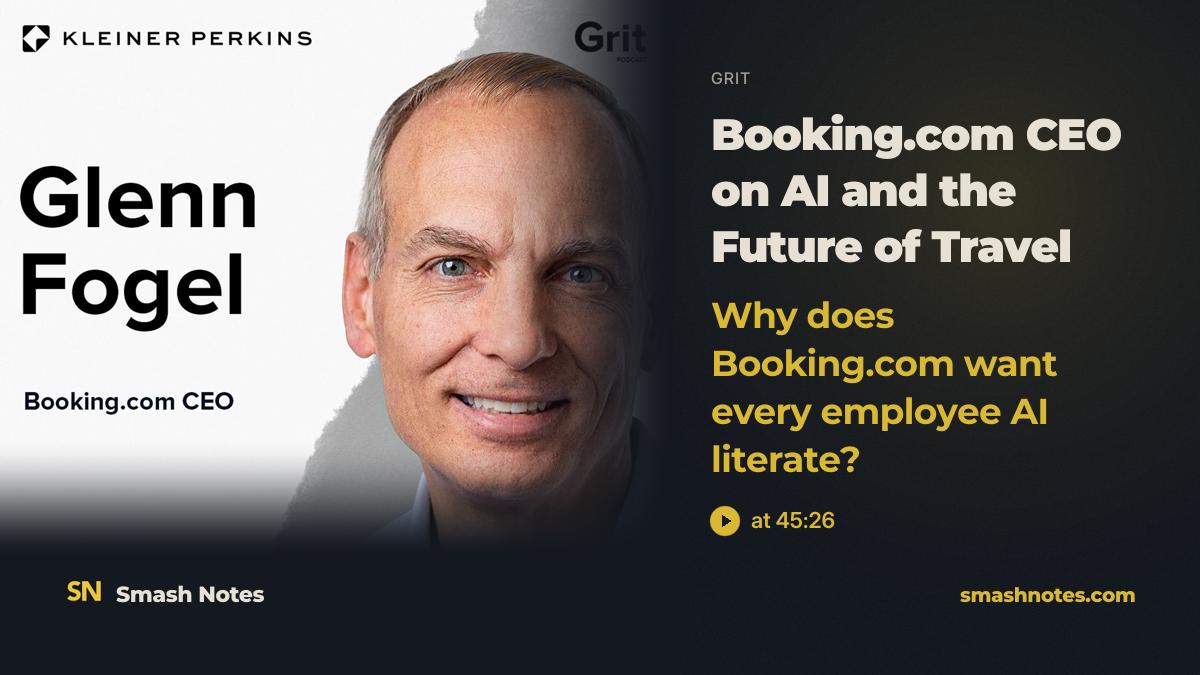
Booking.com CEO on AI and the Future of Travel
"Our mission is to make it easier for everybody to experience the world." From the dot-com crash to AI, Glenn Fogel has spent nearly three decades helping Booking Holdings evolve through every major technology shift while staying true to that mission. He also shares with Joubin Mirzadegan why "you're always selling," and how Booking is using AI to amplify…
People
Notes
Related notes
- Why Did Teledyne Stop Buying Companies in 1969?
- How Did Arnold Schwarzenegger Teach Himself Discipline?
- Why Did Yahoo Shut Down Its Ad Tech Business?
Related episodes
-
![]() Data Centers in Orbit by 2028: Baiju Bhatt on His Plans After Robinhood
-
![]() Ex-Twitter CEO on Why AI Needs a New Internet | Parag Agrawal
-
![]() How Vercel Is Rethinking Go-to-Market With AI | COO Jeanne Grosser
-
![]() Inside the AI Startup Making Customer Support 65% Cheaper
-
![]() The 20-Year Bet to Make Fusion Energy Work | Jeff Lawson
-
![]() The AI Race Has a Leaderboard | Arena CEO Anastasios Angelopoulos
-
![]() #417 Arnold Schwarzenegger
-
![]() Apollo’s Yahoo Playbook, 5 Years After the $5B Deal
0:00
I remember what it used to be like when you did not have access to things that you have now with technology. The problems of communication. How am I going to get from here to there? Where am I going to stay? I don't know, is this a good place or a bad place? That's something
Expand full transcriptCollapse transcript
The episode notes above make this conversation easy to skim.
0:00
I remember what it used to be like when you did not have access to things that you have now with technology. The problems of communication. How am I going to get from here to there? Where am I going to stay? I don't know, is this a good place or a bad place? That's something that AI should be able to solve much faster, much easier, much more reliably.
0:20
There's a cost, and the human cost is, what does it do to employment? How are we going to be able to have every single employee be AI literate, able to use the tools that helps the company, but also helps them.
0:46
Welcome to Grit. I'm Juven, partner at Kleiner Perkins, a show where we go beyond the highlight reel and explore the personal and professional challenges of building history-making companies. Today on the show, we have Glenn Fogel, CEO and President of Booking Holdings and CEO of Booking.com. Glenn has been with the company for more than 25 years.
1:05
First as the architect of its global M&A strategy, orchestrating the acquisitions of Booking.com, Agoda, Kayak, and OpenTable before becoming CEO in 2017. Under his leadership, Booking has grown into a $27 billion revenue business operating in over 220 countries. He's now betting the next chapter on Connected Trip. An AI powered vision for what travel could look like when everything finally works together.
1:26
Were you born here? I was born here. Yes, I was. I was born in 62. You kind of look all American through and through. Well, I mean, that is like, you're in great shape, by the way. How old are you? 64. You're in amazing shape. 64 year old. I'm okay. You're in good shape for a 34 year old. So my, my, well. And we can talk about that if we want later.
1:48
But part of it, my parents are first-generation, or they're gone now, long gone, but they're first-generation Americans. But similar type immigration story of people fleeing their homelands, my grandparents fleeing their homelands and their families.
2:05
It's so interesting about America nowadays, where you and I were the benefit of people who unfortunately were forced to leave their place where they were. But it's been such a benefit for the community of America. So many great great things in America came about from people who were families that had to leave. I mean, look at our science.
2:27
Look at the leaders of the companies in the, you know, the tech world. How many of them are either not born in the U.S. or are first-gen U.S. people? Look at those statistics. It's fantastic. It shows how important it is, talent is, and you want to get talent from around the world. From around the world. If you want to have a great team in a company, you want to get the best people.
2:52
Well, same thing for a country. It should be. Interesting. Would you ever run for politics? God, no. Are you sure? Oh, yeah, I'm quite sure. Have you ever been considered? Not seriously.
3:06
When somebody got to know me. Why not? Why wouldn't you do it? Why would I not do it? Partly because my wife would absolutely positively say no. And what's most important is family. And, you know, there's some things my wife has made tremendous, you know, willingness, sacrifice. I'm away more than half the year, according to the IRS. I am not in my home.
3:31
Where's home? Home is the New York metropolitan area. Yeah. But... Unfortunately, part of my job is circling the world. And sometimes people say, where's your home? Where's your office? Where's your base? I say, I think it's either a Boeing or an Airbus. I'm not really sure. And that's hard. So if I went to my wife and I said, hey, I'm thinking about running for office.
3:56
I know she would say, I've made a lot of sacrifice, so we're not making that one. I have to ask you, if you're traveling half the year, how are you working out like this?
4:07
I'm being dead serious. Well, the honest truth is it's easier when you're traveling to work out than it is when you're home with all the responsibilities of all the other parts of your life, family, friends. It's easier if all you have is work and work out. Yeah.
4:27
Every day? I try and work out every day. Just go to the hotel gym or what? Well, many hotels around the world do not have a gym. But that's okay. You can work out anywhere at any time. Body weight stuff can do great things. And I do carry one band with me just in case I want to do something a little heavier. And you can run outside if you can run.
4:50
If you can't run, you can walk. Walk outside. If you can't walk, you can do other things. You don't need, people have excuses. Oh, there's no gym. Oh, I don't have enough time. So this morning was a tight time. I only got 20 minutes in this morning. That wasn't really great. But that's still better than zero. Sure is. Yeah. Given the nature of your business, do you have a favorite hotel in every major city? Maybe I do, but do you really think I would say right now? No, no, but do you? But do you? I have a lot of hotels that I really like a lot.
5:28
Like you're a regular at some in certain places. I am at one that because of our big office in Amsterdam, I choose the hotel that is the closest quick walk to work. That's where it is. It is a...
5:43
It's a four-star, I guess, though I'm not sure if it really should be or not. There's no one would go there for luxury, but it serves its purpose. Yeah, okay. And that's fine. And the price is right. You're getting the value for the price. That's all good. And the location's perfect for me. Do you care about price? I care about price tremendously.
6:06
Come on. Hugely. Come on. I'll give you an example. How much revenue? I saw the earnings. You guys are growing. You printed $27 billion in revenue last year, growing 13%. Yeah, but you know what we really like to talk about? Because that's true. It's just the way you count revenue or not. So it's interesting because we don't actually own a hotel room, for example.
6:29
Our revenue is only the commission. But if you're selling a book and you take just moment ownership of the book in a warehouse, now you get the full value of selling that book for the revenue. But if you don't actually own the book itself, but on your... platform. You sold it, and it got shipped from a different warehouse. You never took ownership.
6:53
Now you're only getting whatever commission or whatever sort of way you were getting compensated for providing that service. It's weird about accounting what revenue recognition terms are or not. Fact is, I like to think about the fact that we did $187 billion of total travel volume
7:13
last year. And what's really interesting about that one sometimes, one of the things that we've changed the company greatly over the last few years is going towards the merchant model, where it's not merchants being, you're not a principal taking ownership, but what you're doing is you are taking the money you're actually charging that credit card, for example, and we take the cash and then we're transferring it over to, say, a hotel supplier.
7:36
So we're actually doing, you know, a lot. We're doing an incredible amount of money through the system. That's our merchant method. And by being able to do payments, by taking that payment, that flow is huge. And there are a lot of things that we're gonna be able to do with that that are gonna be great for our partners who are our suppliers, and it is right now, we're doing it already, great for our other customers who are the travelers, and we'll do well too.
8:03
So for example, a lot of people, Americans, you're an international type guy, I'll bet, so you would know this, but most people around the world do not pay with Visa or MasterCard. They wanna use their payment method If you're in China, you think that people use Visa? No, they don't. They use Alipay. They do WeChat. If you're... I'll do a little test.
8:27
If you're in Kenya, what kind of payment would a person in Kenya use? Cash. In Pesa. If you're in the Netherlands, what kind of payment would you use? I don't know. Ideal. And I can go through a whole... We use... We do...
8:42
Right now, God, the number is so huge. It's many, many dozens of payment methods that we can take from a traveler. Take that money that way. And then when we give it to our partner supplier, let's say a hotel, they want to have euros in their bank account, we can do that too. Now, there are issues there in payments, of course. You're going to have FX risk, perhaps, potentially.
9:06
You got to deal with that. When you're taking money, you got regulatory issues you have to deal with that are very complex in different parts of the world. A lot of complications go in. So that's a long segue into just saying how the world that we're in, we're doing a lot of the revenue is wonderful. And this flow, but the wonderful, all these are really, really, really good.
9:30
But the fact is to get to those levels, you gotta be really careful how you spend your money. And you said, sort of like, yeah, you don't care about how much you pay on the hotel or not, right? I care a great deal. And I was talking this morning with, I had breakfast with our CEO of OpenTable, which is part of our organization. And she was talking, we were talking about the hotel and pretty cheap.
9:54
But now I'm going tonight to a place down in in the valley and uh we're i think i'm paying 178 bucks for the uh hotel room and she was like are you where are you staying it's just i can't believe that and i said you do and you don't say that to me i'll start thinking are you being careful enough in the money or not oh my gosh
10:15
why why not just spend is it okay honestly is it to make a point absolutely you gotta leave from the front it's by the way this is why Being an actually great CEO is hard. This is why. Because you've got to do the shit that you want people to do. Yeah, you really,
10:38
you do, but I also believe it's the right thing. I mean, so we're talking about literally at breakfast, we're talking about it, and I'm like, what do you need in a hotel when you're on a business trip? I'm staying there. Two nights, okay, what do I need? I need to have a bed. And I'd like to have, you know, the bathroom, the toilet in my room.
10:55
I prefer not to share. I'm at an age where I'm not doing it. And what else do I really need? Oh, a nice gym? Yeah. And actually, I think the place has an okay gym. It's not bad. It's fine. What else do I need? It's close to where we're going. What else do you need? Are you a good sleeper? I, my wife is one of the things she's incredibly jealous of is the fact I sleep anywhere, anytime.
11:17
Oh, that's helpful. Any method that's helpful. You know, I sleep in a plane sitting up. No problem. I don't need a flat bed. That's nice. Yeah. That's nice. Well, you do when you travel, I do. You have to be able to do that. How about food? Are you, are you equally as I'll eat anything, anything, anything. So you own open table. We own open table.
11:35
Correct. And I imagine similar question is what I'm asking you with the hotels. You can get any reservation anywhere. You probably have your favorites. Well, that's part of the thing, though. I would never, ever call up. People who are well-known restauranteurs say, Hi, could you get me in on this night? I would never, ever do that. That's fine.
12:01
But Glenn, are you making your own reservations? My wife makes the reservations and she uses OpenTable. Just want to make that point. Through the system. Through the system. Yeah, okay. Damn right. All right. Though she does occasionally, this is good too, sometimes she calls and one of the wonderful things we have nowadays is OpenTable, it's really great.
12:21
is in working with a third party. So it's a three-way type thing with the restaurateur, us, OpenTable, and it's one of the companies that produces a voice AI thing. So I call, or my wife calls the restaurant. Yeah. to leave the reservation and you're talking to an AI. And you can leave the restaurant. It's wonderful. Because the restaurant doesn't want to have somebody there to talk.
12:48
It's great. And somebody doesn't want to actually use the service. They want to speak to somebody or you can speak to somebody. Wait, so Glenn, are you not particular about the healthiness of the food that you eat either? Unfortunately, it is a well-known fact that I am a lousy eater. I'm trying to get better, though. I'm doing the best I can.
13:06
I'm really trying, but I'm not great. I'm not great at that. I eat a lot of junk. I eat a lot of crap. I really shouldn't. How do you look like this? I'm still stunned. No, I'm literally stunned. When's our date? I'm literally stud. What are we going at? I'm stud. No, the thing is, it's, you know, again, got to be lucky in life. And one of the lucky things I imagine is my genetics, I assume, are just fortunate that I, you know, burn a lot of calories genetically.
13:34
I'm fortunate that way. Some people don't. Some people work a lot. They work out all the time and they try and diet all the time. They haven't yet gone on to Wegovia or one of those things. And unfortunately, they aren't able to control their weight and stuff. That's probably genetics or whatever. Amazing. It's how it works. How long have you been at the company? This is my 27th year.
13:53
What was your first job in the company? First job was head of corporate development. Serious sales guy. Well, one could say that, yeah. Yeah, well, isn't everything selling? That sure is. Let's just cut to the chase. Sure is. You're always selling. Sure is. Always selling. Sure is. But, you know, I had such, you know, it's funny. But weren't you, didn't you come from law? No, I've never been a lawyer.
14:15
I have a law degree. I have a law degree, but I never practiced. Well, I didn't call you a lawyer, but I said you came from law. I like lawyers. My wife's an ex-lawyer. Okay. All right. So it's really, again, how you end up where you are. How does this happen? So I came out of college, and I had only taken one course in programming, one course.
14:38
And I got a job. Morgan Stanley, back in the day, this is the early 80s, they saw the need for technology, but they couldn't recruit the high, you know, great people. They came up with a program, this guy named Bill Cook. And it was this training program where he was going to hire really smart people out of college and turn them into be great developers, great coders.
15:02
And I won't say I was a great college student, but I did okay. And- Didn't you go to Harvard and then- I went to Wharton undergrad. And then where? I went to Harvard. But before I went to Harvard, I first took this first job. So I graduated early, saved my folks money. And I get a job at Morgan Stanley in their quote unquote MIS department, which is back then, the IT development area.
15:25
And I learned to be a programmer. I learned to do stuff. We're working IBM mainframe stuff. So anybody who needs somebody to fix some JCL stuff, I'm there for you. I'm right there. You know, you need that.
15:39
You really don't want to... Back then, we were using, like, APL. The database was... It was...
15:48
God, it was Atabase was the database. The language was natural. I guess the maker was,
15:55
boy, it was a German company. It doesn't matter. So anyway, everything I learned then is dead now. Of course, it doesn't exist. So of course, the mainframes are still there. People are still trying to fix MBS stuff. But I was not very good at that. I wasn't good at all. And I looked across the
16:15
business. I see the investment bankers in the 80s were making fortunes. And a lot of my classmates were in the undergraduate. They had gone to these two-year analyst programs where I went to MIS. And I said, I can't get out of this. I want to do that M&A stuff. I want to make all that money those investment bankers are making. That's what I wanted to do.
16:31
And so I realized I couldn't just jump. Now I'm in the back office programming. I'm not going to jump. Just got to get a graduate degree. Well, I had a degree, an undergraduate degree in business from Wharton. So I said, well, I'm not going to spend my money on that. So what is another route? Well, another route would be a law degree. And I could do that because there were a lot of people who were bankers who were former lawyers.
16:51
So I could do that. So Harvard let me in. And I graduated in 88.
16:57
so it's you're looking for a job in the fall of 87 you know it's uh the way it works and back then not anymore now but back then in law school you'd be recruiting for your you know final position your permanent position in the fall of your third year which is now 87 of course in october was of course the crash of 87. And now all of a sudden all the jobs are now kind of gone.
17:24
So it was really hard to get that job, but I got lucky. I got a job at Kidder Peabody. And so I was an investment banker there for a number of years. I rode it all the way until it augured in and got sold by, it was owned by GE. GE sold it to Payne Weber. By the way, Jack Welch, he stuttered. He's an incredible CEO, but he had a stutter. People said his stutter got worse after he bought Kidder, a real bad deal.
17:55
And then they sold it to Payne Webber, and Payne Webber, they let all the bankers go, and I'm a banker, so I'm let go. But here's the thing that's interesting. They didn't let go, actually, every banker. they let go most of the bankers. So therefore there was a little bit of choosing. They kept some people and that's kind of saying, well, you weren't good enough to be one of those people.
18:22
So now I'm out of a job and I've been fired. And that's actually a very good learning to be fired because if you've been fired, you now know what it's like. So when you fire somebody, you had to tell somebody that I'm sorry, but your services are no longer necessary or there's not a role for you here. You've experienced it from the other side of the table.
18:45
And that's really important to actually learn that lesson. So I was out of a job for a while and I was a single at the time and
18:56
I said, well, what do I want to do with my life? My father had recently passed away. And I
19:02
said, what do I want to do? And I said, I always want to write a novel. So I write a novel. And I'm writing the novel. Come on. No, I'm serious. I'm writing the novel. I'm writing the novel now. Now I'm finishing. Now I got to sell it. And back then, this is... mid-90s. And it's not big in self-publishing for a joke. So you got to find somebody who's in the business who can help you, an editor, or even better, an agent.
19:26
And I'm dating people, and a friend of mine says, do you want to be set up with this woman? I said, what's she like? And he and his wife say, well, she's a lawyer.
19:40
I'm like, yeah, I don't know, lawyer, I'm not sure. She says, well, she used to be an editor at Random House. Oh, I very much would like to have a date with her. I think that'd be a great date. So long story short, we go out on the third date, And I can see this is going south. And I show up with my manuscript. And she sees it in the box, and she knows what it is in there.
20:03
And it's like I'm carrying dog shit. That's how repulsive it looks to her as I'm carrying this box. I know this is like the end. I say, listen, He'd just take a look at it and maybe something. And she takes it reluctantly. And I leave that as brunch, because I'm trying to conserve my funds at the time, because I'm not working. I'm like, no.
20:24
And I leave thinking, I just killed a whole bunch of trees printing that out for no reason. A couple hours later, she calls me. And she says, hey, this isn't that bad. And I'm thinking, not that bad. To me, I'm thinking this is Nobel Prize literature, not that bad. Long story short, doesn't get sold, but we end up married, got two great kids, and life's good.
20:43
What an amazing story. Yeah. Wait, so from there... Yeah, well, she said, Andrew wasn't being, she couldn't really help in selling it. She says, you know, if this relationship's going to go forward, you should think about getting a job. What job did you take? So I didn't know. I didn't want to go back to banking. So I called a friend of mine who was a pretty senior guy at Morgan Stanley Asset Management, buy side, asset management, mortgage asset management.
21:08
And I said, Amy says I have to get a job. What do you think? Any thoughts? He says, well, we got a job here. It's a trader. I said, I've never traded anything in my life. He said, ah, you'll be fine. Maybe that explains 2007, 2008, who knows? Who knows? So I said, okay. I take the job, more for a guy, pretty much a legend on Wall Street called Barton Bix.
21:30
End up being a head trader for him. And we're running back then about 16 bill.
21:36
Back then, that was a lot of money and stuff, but I hated the job. I didn't like it. I wasn't enjoyable. So now it's the late 90s. I said, I want to get into it. And I said, well, you know, this internet thing, really cool. And I got some technical, a little technical knowledge, right? I got some banking knowledge. Um... So maybe I'm a lawyer.
21:57
So maybe there's something here around. And a company called Priceline was looking for a head of corporate development. And I'm thinking, wow, this is great. So I decided I'm going to leave my job of being a trader. I'm going to go be a corporate development guy at Priceline. And this is now the fall of 99. I say, OK, I'll come. but I want to get my bonus for 99.
22:21
That doesn't get paid till February 2000. So can I start the end of February? And they said, no problem. So, okay. So I leave being a trader, Morgan Stanley, and I go long internet. the last week of February 2000, which is a week before the Nasdaq peaked, thereby proving I should not be a trader, having just top ticked the internet trade in 2000.
22:46
And I go there, and when Priceline was the only really big internet company on the East Coast, and we went public earlier before I joined the company in 99, in a week, it had a mark cap of over $30 billion, which again, back then, those numbers were really big numbers. Very small number of revenue, but a huge market cap. When I joined, it already dropped about $15 billion or so.
23:10
And by the end of the year, it had gone down to a few hundred million. Think about that, 99% decline. And everybody just thinks that, even my mother at the time thought our company had gone bankrupt. And so now it's 2001, and
23:26
then we start climbing, we figure out a few things to do right, and then 9-11 happened in 2001, and travel goes down again.
23:34
But we keep at it and it ends up being okay now. Now, you know, 27 years into the company, we're doing okay. And Priceline got acquired? No, no, no. Priceline was the acquirer. Okay. So I was head of corporate development. And I'm going around, also at the time, commuting to London because I'm running Priceline UK. We don't have the time to go through everything, my God.
23:58
But anyway, I'm looking around because we have only one product. It's called Name Your Own Price. I don't know if you remember this product or not. So Priceline was built not as a travel company. It was the guy who started it. His name's Jay Walker. And he had this idea of coming up with an idea you can sell things in opaque way, not showing everything about it.
24:23
You bid for it and you are committed. You're going to buy it without knowing everything about it, but obviously a lot less than what the actual published price would be. So for example, as an airline, which was the first big product for it was the idea like, okay, you can bid. You got to go from New York to LA. Now, say how much you want.
24:43
You figure I'm going to bid a lot less than what the published price is, and you're committed to doing it, but you don't know when you're going to take off that day. You don't know when you're going to land that day. You may make one, two stops on the way. You obviously have no seat at all where you're going to be at all, and you've got to commit to that.
25:01
So you've got to have... incredible flexibility in your thing, but you're going to save a lot of money. And it was actually pretty popular. A lot of people saved money. They would do that. So that could work for that. A hotel, it works even better because while you don't know which hotel you're going to get, we would say which area of the city it was.
25:20
And we, you would say what, what, star rating you want to go for. So what you're really giving up is sort of like a commodity type thing, a hotel, you know, I'll go for a four star center city. Some of them may say it's not that big a deal. If I could save 50%, it's great. Right. but they want to expand. That would be you. Yeah, well, I...
25:41
That would be you. So we had nine name your own price for airline tickets and hotels and rental cars. He was, we're going to build this out to name your own price for new cars, which is kind of an odd thing when you think about that one, or name your own price for... for food because we set up this separate thing, which was going to be with all sorts of supermarkets that you would be able to work out.
26:06
You bid what you want online and what your bid is. And then you go and you go pick it out and go, but you know, so you say something like what, like tuna fish, but you don't know which tuna fish you're going to get. It's like weird. Obviously a lot of this stuff was crazy and it wasn't good and it all shut it all down. But when I, you know, in corporate development, now we shut down all these ridiculous things, and we're just doing, we're doing flights, we're doing hotels, we're doing rental car, which would make good sense in the US at the time, because for, you know, planes, hub and spoke, a lot of people are going to have to make a stop anyway.
26:38
It's kind of a ruined day anyway. But I'm now doing this in the UK, and of course, naming a price for an airline in Europe is a really bad idea. Think about it. You can go from London to Paris on Ryanair, for, let's say, 10 pounds back then, because it's incredibly cheap. And that's direct, you know what you're going to get. How many people say, well, I can save 50%, so I'll pay five pounds, but I may have to go to Frankfurt? No one's going to do that.
27:02
It's ridiculous. So let's do it. The hotel thing is all right, but I'm looking around saying, we're going to find somebody who knows how to sell hotels here. And I found a little company called Active Hotels, came out with a bunch of young startup guys in Cambridge University. And they were really smart people. And long story short, we ended up being able to buy them.
27:23
And then with them, met some people, a company called Booking.com in Amsterdam, very similar thing, disclosing the price. The one big difference was it was called the agency model where you get a commission from the hotel after the person stayed at it.
27:42
agent means that you don't, as a company, you don't get the money up front. So booking and active hotels have that model, which is a lot of people like it. Who likes it? Let's say, well, the traveler likes it because they don't have to pay their credit card right away when they make the reservation. They may not be staying for three months.
27:59
They're happy. The hotel likes it a lot because they get the cash right when the person checks out. The person is paying at the checkout. You only supply the credit card in the system to guarantee a reservation. Your credit card is not being charged. You actually pay the hotel when you leave the hotel. Hotel gets their payment right away.
28:22
Instead, with people under the merchant model back then, the hotel would get paid a month later or two months later. So the hotel liked it a lot. But it was one thing really bad for Active and Booking was the fact is that they weren't getting the cash until after the hotel got their money and then sent the money, the commission, to Active.
28:43
or booking, and when Google, and you're paying money to Google for performance marketing, Google would like to have their money right away. So when you're growing real fast, you have a very bad cashflow. You're spending more and more buying keywords, and you're getting more and more reservations But your cash situation is just getting worse and worse and worse.
29:07
Thereby, after having been more active and talking with the people at Booking, you know, they saw a good thing. Oh, here's somebody who has some money who can help fund the growth. And of course, there wasn't a big venture community, and this is 2005 now. for that. So it ended up being great. And we merged active hotels with booking. And in addition, I had Priceline Europe.
29:29
We put those all together into one company. And that was that. Two years later, similar, went out to Asia, found a little company called Agoda, which is now the biggest pan-European travel company. They were doing the merchant model that I just talked about. And somebody said, well, why do you, You know, our board, should we buy another company doing the same thing in hotels? And my thing is, well, it's different because they're doing merchant booking.
29:55
We combine the two into just one name, booking. Actually, what bookings do, the agency model, and I don't know in Asia which one's going to go better. Mm-hmm. so we went with buying that and then we had a golden then later on we bought rentalcars.com a bigger company's doing rental cars then we buy kayak we buy open table and it's really been great so far when did you buy kayak kayak uh what 2012 maybe an open table uh 2014 maybe and when did you become the ceo ceo of the whole thing 2017.
30:28
Have you made any serious acquisitions since you've become the CEO? Oh, we tried to. Well, I like to think that it's always a combined group. It's always a team effort. Fair. Every one of those things. Obviously, you had your hand in it. Every single one of those, I pretty much... Yeah, sponsored it. Right, yeah. But we tried to buy eTraveli.
30:48
We have, what, a number of small companies. Yeah, yeah, major. We tried... Well, major. What's major nowadays? We tried to buy eTraveli...
30:57
Oh, God, two years ago now. More. And unfortunately, the EU Commission... Classic. ...said no. Classic. Here's the thing, though, that's really interesting about this. So we have Booking.com. Yes, we have a lot of... We do a lot of business in Europe, no doubt. About 15, 1.5%, 15%.
31:20
We at the time had essentially no air business in Europe at all, none. We set up a commercial agreement with eTravly where people could get an airline ticket through our booking.com business in a way using eTravly as the backend and all that, but tiny little nothing. We have really no business to speak of into that. And the EU decides that, well, we have a novel theory.
31:50
Literally, this is what it says in the decision. A novel theory about ecosystems. And the fact is, you are a quote-unquote dominant player in selling hotels. Therefore... if you were buying this e-travel company, it will make you more dominant because you'll be able to sell more hotels. Now, this is very different what the rules were, what the law says.
32:16
And they prevented us from buying that company. Now, it is in court right now. In fact, as of yesterday or today, they finally announced that we will hear a decision on this case in September 9th. And it's a very important case because the EU Commission deviated from their merger guidelines tremendously. And we'll see. Now, some other subsequent things since we tried to buy eTravelEye, there's the introduction of a law called the DMA, Digital Markets Act in Europe, very important law in Europe about
32:53
the role of large digital companies. And they chose that certain companies are so big, so powerful, that they should be called gatekeepers and are under subject to certain special rules. There are seven companies in the world that are considered gatekeepers. We are one of the seven. The idea that we are on the same par as Google or Meta or Amazon or any of the other six is absurd.
33:23
And I say that all the time. However, the law is what the law is. And we have to obey it. And we do. And we do. Why? What's the steel man the other side for me? Why would they make you part of the seventh? Well, their belief, the way I've read it and the way I've heard it, is spoken in terms of the way they describe what are the qualifications to be in the DNA.
33:44
There are certain quantitative levels. What is your market cap for a certain number of time? How many users are you? And basically... And their belief is that we have a dominant position in selling online hotels in Europe. Now, during the whole issue of domain discussing with people in the EU, I would say, though, I said, OK, let me get this straight now.
34:16
Are you telling me that you feel the only way you can get a hotel is to come online and use booking? Really? Let me ask you another question. How many times do you actually use us versus other ways to get your hotels over the last five years or so? Would you mind if we all look at each other? Let's just compare everybody's travel history and where you bought your hotels.
34:36
Of course, it's absurd. But it is what it is. It is the law, and we obey it incredibly strictly. We do everything we can to make sure we are following the law because that is the law. And it's important. Look, you may disagree with the law. You may not think it's good for society. You may think it's bad. But it is the law, so you must obey it, which we do.
34:57
What is your market cap-ish? now yeah well i like to look where it was in the summer 180 something billion but of course the world since um some of the drop of some of the models and some people's mistaken belief that there's going to be more problems for people who are software-based companies such as ourselves yeah how bad did you get hit or uh we're down about 25 percent that's nothing That's nothing compared to- Some, some are worse.
35:24
So you're like 150. Well, I like to say this too. It's also exciting. You're talking about 150 billion, right? 125, 130, yeah. But here's the part of the thing too. You're 130. You're 186 billion? I have to say this. All right, all right, all right. We'd be better, but for the war? You know, that war is really bad for travel. When you have the Middle East in this kind of a conflict, again, a lot of people in the U.S.
35:48
may not be aware of how important the Middle East is for travel in terms of Asia to Europe, Europe to Asia. They don't understand the incredible size of Dubai, the airport there, or Doha, and the amount of transit business just disappeared. It's horrible. Look, war is horrible. The impact on the people, Terrible. Terrible, terrible. But from a business perspective, for us as a travel company, obviously, we have to also, you know, we look at what are our numbers being impacted.
36:21
And it's not small. So it's a combination of the conflict and AI is going to eat your business. The first thing was AI. You remember, that was like February or something. And then, of course, the end of February, the war starts. It's like, boom, boom. Yeah, yeah, yeah, yeah, yeah. Yeah, not a good time, but we've been through it before. Look, we were the biggest player in Russia, by far.
36:43
And then, of course, Russia invade Ukraine, and we immediately pull out of our business there. That hit us mid-single-digit par, just poof. It was high-margin business there, gone. Of course, you know, pandemic wasn't so good for our business either. That had a little impact there, too, to say the least. Again, terrible for everybody who's been impacted by the pandemic, of course, but from a business perspective, I mean, we had days that we had negative revenue.
37:09
It means you're refunding more than you actually have coming in. I'm just trying to get over the fact that you're a deflated $130 billion business and you are saving a couple hundred bucks on your hotel room. I'm still- No, but you have to have that attitude for everything. It's not just cost savings are really important because you only have so much money in most companies.
37:34
Some companies seem to get away with it. Some companies, they can have unlimited ability to raise money to spend it. Yeah. I'm a firm believer that you should always be cautious about your costs and don't spend foolishly and spending money on luxury that you don't need. Look, people say, don't you fly private? I'm like, do we have a plane? Of course we don't have a plane.
37:55
How can we have a plane? We're a travel company. You got to eat your dog food. That's for sure. How big is, how many people are in the company now? 25,000. How many direct reports do you have? More than I should, 12 or 13 right now. You think it's more than you should? I think that to have real attention to everything going on, I, you know, it's probably a couple more than I should.
38:20
But say, I mean, should, that should, because you want to have everybody who's in charge of each of the companies. Right, right, right. And then you have some of the core people, and I count my assistant. Right. It's direct report, count that. Probably more than 13, sorry, a little bit more.
38:35
It is something that I would like to spend even more time with some of my direct reports. I know they would like me to spend more time with them too. What was the most surprising part of when you made the jump to CEO? What was the thing that you were least expected? God, there's so many things. And so where do you start? I would say the one thing I just didn't think about at all was that
39:01
every single thing you do is being looked at. You know, I walked through the building, I walked through the office and stuff, and it occurred to me that you're being looked at by a lot of people that,
39:17
by the way, they shouldn't because there's no reason, but that everything you do, everything you say has to be thought of and measured and be thoughtful.
39:28
You know, you're more careful about joking because when you actually speak to the person in the joke, it can be funny and good, it's fine. But if it's recorded or somebody else hears it and it's misinterpreted, it can be very damaging to somebody that may not find it so humorous after all. So you have to be a little more cautious about that.
39:52
Certainly, I wasn't ready for some of the
39:56
security issues. that I didn't think about it at all.
40:03
Like in what sense? Personal security. Anything you thought was more fun or interesting as a CEO?
40:12
The list is endless. So many things. You prefer it. If somebody gave me a
40:19
time machine, you go back in time, what would you have done different? There are probably an incredible number of things I would do differently, but choosing to take the job as CEO would not be one of them. I would still take the job. Amazing. Why amazing? Tell me, why do you find that amazing? I don't know. I think like most people... Talk about how it's lonely and hard and...
40:43
Well, it is. You know. But so is a lot of other jobs. And... I don't know about you, but I haven't had a job yet where I wasn't hard. Yeah, that's right. I think... I don't know. I don't know if I particularly...
40:58
envy the types of problems that you have like being able to joke around like that sucks like you can't you know you don't mean any harm and you have to filter yourself which means like by default most of the time you can't actually be yourself that like that sucks that just sucks like the security stuff your family's security your security that sucks like you know you got to deal with Those are some of the, it's just that that sucks.
41:25
And so it's good to hear that you enjoy it. It's good to hear that you enjoy it. That's why I say it. But there are pluses and minuses to everything in life, right? There are good and bad in everything. Every job has good and bad. And in the scheme of things, it's, you know, by the way, nobody put a gun to my head and says, you have to take this job.
41:42
And The same way I work at the pleasure of the board of directors and at any single time, they can decide my service are no longer necessary. Thank you very much for playing the Exodus that way. Anytime they want, they can do that. And I am, they did. I'd say, okay, thank you very much. Thank you for the honor of having served. However, it works the other way too.
42:05
At any time that I feel that, you know, Not writing anymore. I need to move on. Then I have to, it's my obligation to myself and to the board and the company is arranged for somebody else who I think would do the job better than I'm doing it.
42:24
I don't know, I don't find this as some sort of existential crisis type thing. And I say, you know, I'm very glad to have the opportunity to help what I believe is actually a good thing. I mean, travel's wonderful. Let me ask you a question. I'm gonna ask you for some memories. Tell me a few memories of yours, or I'll tell you how that you really think are great memories in your life.
42:51
Now, how many of them were with travel? I'll bet a bunch. I'll bet a bunch of them in your mind. And you go to anybody asking that question, sure, they'll say, maybe their wedding day, maybe, you know, the birth of their kids. Absolutely, they'll show up, obviously, all the time. But other times it'll be like the trip they took with their parents.
43:08
There's so many, travel is so, it brings people together. Look, our mission is to make it easier for everybody to experience the world. I really love the fact that we're helping to contribute to that. And through technology, we're able to do it so much better. I mean, I'm an old guy. I remember what it used to be like when you did not have access to things that you have now with technology.
43:31
I mean, look, I remember so well the problems of communication, of how am I going to get from here to there? Where am I going to stay? And the issue of, I don't know, is this a good place or a bad place? Now we can do so many things with technology. They're so much better. And it's only going to get even better now with AI. The things that we are doing are just so fantastic.
43:54
What was the last trip you took? I am going on one tomorrow. Where? To Todos Santos in Mexico, Cabo, and then... Yeah, okay. How are you getting there? I'm flying, and then I'm getting in a car to a dear friend's wedding. Okay. Friend's wedding. Now, destination wedding. Can you imagine the complexity of that? It must've been incredible, right? Putting that together.
44:17
Do we think that's something where AI could solve that problem so much better and easier? And I'm even thinking, I mean, the person think, obviously they probably had to hire someone to be the wedding coordinator, right? Okay, now, what that person's doing is going around, and that person already knows who the good florist is, who's the good band, who's the good, all that stuff.
44:41
Well, that's something that AI should be able to solve much faster, much easier, much more reliably Then it's done by a human perhaps, or the human can oversee, but still there's so much that could be made done much more efficiently. And that's going to happen all trips, particularly complex trips. And that's what we're building right now.
45:03
And we're seeing it right now. We have some tools out that are just so fantastic and it's only going to get better. Well, it seems like from what I can tell, you're not retiring anytime soon. I don't have any plans. Yeah. Yeah. Thank you for doing this. Well, thank you for, thank you for, this is really fun. I had no, I had no idea. Are you hiring? We're always hiring, but we didn't talk much about this.
45:26
Unfortunately, we're always thinking, what are the changes in our workforce going to be due to the benefits of AI? There's a cost, a human cost to that. And the human cost is, what does it do to employment? And what are we going to have to do? What changes are we going to have to make? One of the things I've made very clear, too, my head of human resources, and he's just such a great person.
45:54
It's really kind of how are we going to be able to have every single employee be AI literate, able to use the tools, and that helps the company, but also helps them. So their careers are more advanced than they are able to do. So if such things happen that this person's job role is no longer necessary, and we can't find another spot for that person, at least that person now has been developed so they will have a better opportunity going forward somewhere else.
46:23
And that's really important for, in my mind, to be able to make sure that we're doing what we can. But it's going to be a very interesting question in society, how we handle this very rapid change. And everybody who is, and I'm a boomer too about AI, but part of the problem is that we have to also consider that there are going to be costs.
46:45
There are going to be impacts on people that we need to think, how are we going to deal with this? And how do we try and make sure that we don't do the way we've done in the past is let people just fall off the wayside? I mean, look at Harvey, right? Harvey and all the other types of legal type software that's making it much more efficient.
47:07
or look at the number of investment- Hey, you need less lawyers because of Arby. Exactly. And you'll need, how many- Or paralegals. Wouldn't it be interesting if we went to all the big investment banks and we asked, how many analysts out of college did you hire in 2018? And how many are you planning to hire in 2028? And I'm willing to bet that that number will be significantly lower.
47:28
So you have people who spend a huge amount of money to go to universities, get good degrees, and they were expecting to come out and maybe get a job at a big investment bank as a good starting career job, pays extremely well. Those jobs aren't there. So you say, oh, well, they'll just go over and be tech people or something. Maybe, maybe not.
47:48
So I think we'll have some significant rough waters ahead of us. Yeah. When you hear the word grit, I ask every guest, What do you think of?
48:00
First thing is, of course, the book, because just by nature, I mean, how could you not?
48:05
And I went, you know, I wore an undergrad pen and she's a pen. She's a legend. Right. So, of course, that's what I first think of. But what I think the great thing about it is, and I talked about this morning and we had a town hall with our open table employees. In person, the question was, career advice for people. You know, what could I, what would I give them? And I said, work harder than anybody else, because most of your life is going to be determined by things you have zero control over, most of your life.
48:39
However, there are a couple of things you can control. One thing you can control more than most, obviously, will be other impacts. Can you even do that? But you can try to work harder than anyone else. And I believe, I can't prove it, of course, but I believe that part of my ability to do okay in terms of career was due to very hard work.
49:05
Not because I was that much smarter, but hard work. And just going back, we didn't talk about this stuff. Part of that came... So I was, unfortunately, I had a stroke when I was 17. Pretty significant, left hemispheric. I was completely paralyzed, right side. Lost all my language abilities. Couldn't speak, couldn't read, couldn't write.
49:28
And that was the end of my junior year in high school. And that was a hard time.
49:33
but I really worked hard to get back to work really hard to try and recover and do better, better. And that discipline working hard grit,
49:46
don't let, don't let the obstacles block you find a way around it over under it. You have to through it. So we talked a little about working out and I try and work out every single day and A lot of days I don't want to do it, but I know there's a benefit to working hard in working out because I know there are health benefits to that. So I do it.
50:10
So I would say grit, grit is that perseverance when faced with difficult problems and pushing forward. And I think that is something that it'd be better if more people had that, I think, is grit. No doubt.
50:31
That's it for now. If you liked the episode, please leave us a review or go back into the archives where we've done more than 200 episodes with some fantastic folks. This podcast is a Kleiner Perkins production, and I'm Juven. Thanks for listening.