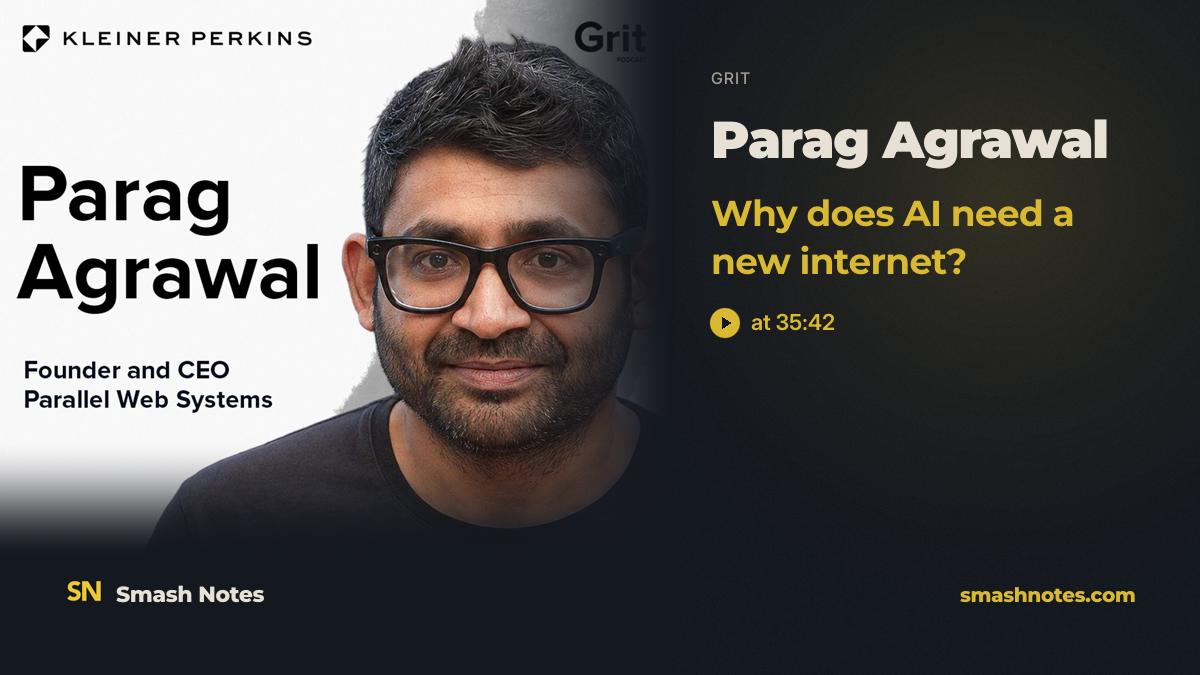
Ex-Twitter CEO on Why AI Needs a New Internet | Parag Agrawal
"The answer to every problem is a model." Parag Agrawal shares the ideas behind Parallel: products that continuously learn, and teams designed around versatile problem solvers. He also shares why he built an AI agent for himself, and why AI's biggest opportunity is expanding what people can achieve. Guest: Parag Agrawal, founder and CEO of Parallel, and…
Notes
-
-
Should I Overspend on AI Tokens? at 14:14
-
-
-
Why Does AI Need a New Internet? at 35:42
-
-
-
-
-
Related notes
- Why Did Mustafa Suleyman Leave Google?
- Why Does Parallel Keep a Machine Version of Its Website?
- How Should AI Agents Pay Content Owners?
- How Does Parallel Build a Web Index Over Time?
- Why Won't Web Ads Last With AI Agents?
- How Much Do Companies Spend on AI Tokens Per Employee?
Related episodes
-
![]() Booking.com CEO on AI and the Future of Travel
-
![]() Data Centers in Orbit by 2028: Baiju Bhatt on His Plans After Robinhood
-
![]() Ex-Twitter CEO Says We’re Underestimating AI Agents by 10,000x
-
![]() How Vercel Is Rethinking Go-to-Market With AI | COO Jeanne Grosser
-
![]() Inside the AI Startup Making Customer Support 65% Cheaper
-
![]() Parallel’s Parag Agrawal: Building a New Web for AI Agents
-
![]() Deel Head of Product on How AI Agents Do the Work of 600 Employees and Added $140M in New Revenue Without Hiring | Aaron Goldsmid, SVP of Product, Deel
-
![]() AI for the Fortune 2000: How Tenex Builds an AI-Native SDLC — Alex Lieberman & CJ Hess

0:00
The answer to every problem is a model. You're tempted to write a bunch of code for it. No, instead, collect some data, figure out what a good output would look like, figure out what model architecture is right, train the model and put it in a loop so that you can keep
Expand full transcriptCollapse transcript
The episode notes above make this conversation easy to skim.
0:00
The answer to every problem is a model. You're tempted to write a bunch of code for it. No, instead, collect some data, figure out what a good output would look like, figure out what model architecture is right, train the model and put it in a loop so that you can keep improving the model. That mindset just allows you to get out of that decision-making process and hire people who are very versatile and problem solvers.
0:19
It's simple once you sort of just internalize that worldview. Agents and AIs will just use the web a lot more than humans ever have. New business models will be needed. And now there's going to be like a second birth of what the future of the open web is. A parallel web. A parallel web, if you may. If we just figure out how to incentivize being open, how to reward high quality, unique, differentiated content, that we get to keep the web open.
0:58
Welcome to Grit. I'm Joubin, partner at Kleiner Perkins, a show where we go beyond the highlight reel and explore the personal and professional challenges of building history-making companies. Today on the show, we've got Parag Agrawal, former Twitter CEO and now founder and CEO of Parallel, the company building web infrastructure for AI.
1:16
Before starting Parallel, Parag spent more than a decade at Twitter, where he rose from engineer to CTO to CEO. Now he's asking a different question. What happens when AI becomes the web's second user? We're also joined by my partner, Mamoon Hamid. Enjoy. When we were sitting in the kitchen right now, Um, I, we were talking about fundraising, all sorts of stuff.
1:37
And, uh, I said, can you take a, can you take a breath? And you're like, did you take a breath? This company's dead.
1:46
And I was like, okay, that's a fair and dramatic point of view. I like, but okay. Like I understand. And he's like, do you not feel that way? And yeah, probably asked me like, do you feel that way? And I said, well, I definitely feel that way, except I just want to make sure that whatever I'm running at is the right thing, because there's so many things that are feel like they're on fire and is full chaos.
2:11
And let me ask you, can you take a breath? No, but I just want to make sure that... You know he's running a company, right? I know, I know. He just told me. I didn't know that. I didn't know it until that conversation. He has a whole team elsewhere. It's half your team size at this point. I did not know that. Yeah, walking in today. I found out in the kitchen.
2:27
And I'm on his board too, man. Yeah, that's right. That's right.
2:32
Your point resonated. The reason I took a beat was because I was like, the temptation when everything feels like it's so insane, where if you take a breath, you die, makes you feel like you have to do everything all at once. And for me, I was like, okay, what am I actually doing that moves the needle? Because otherwise I could be doing stuff, making myself feel like the most productive human in the world.
2:53
We can talk about all these things. We're live. We can just talk. We're already live. We're just recording. Just go.
3:00
I am the kind that is extraordinarily comfortable dropping balls. And I don't know if I should say this in front of my board, but like I drop balls all the time. And so there'll be like a bunch of things that'll come at me, but every week, every day, I have like a few things that I care about or that matter. I'm just going to do those things.
3:21
And there'll be a bunch of other balls that are less important that I will drop. But you will ultimately catch them though, right? No, someone will. Someone will. I am betting that my team, because I drop balls, is just built in the structure of evolving to catch the balls I drop. And so now you build this sort of culture, this team, where, and if it's important enough, it's going to come back to me.
3:46
It's going to bounce back to me. What if the ball that is dropped is only known to you? You know, that is a problem. And you don't drop those ones. So you, again, you don't get to drop random balls. Yeah. You drop the balls you can drop, partly by design. So you have to prioritize the ones that you don't drop. How many tiers of memory do you have? So you have cache, and then the second tier.
4:09
I wish it was... And then you have a hard disk drive, you know, you have a flash memory in between. I
4:15
think it's like a lift of three things every week, every day. It's like three things. Can you give an example of what, I would be surprised that you're dropping, that you're willing to drop. Like what are some balls that you're like, yep, no problem. Let's see if it bounces back.
4:33
That are hard. Like in the moment that you're like, oh, I really don't, I should respond to this, but I can't because it's not the most important thing. So it's... You'd think it would be that deliberate and intentional a process. It's not. Right? It is more that... Like, for example, I separate out reading and responding to emails. The two different work cycles for me.
4:56
But instead of sitting down and trying to respond to emails, I read all emails. Then I... sit down in the morning and I'm like, okay, what are the three things this week or what are the three things today that I need to proactively do? And a bunch of things you do reactively, but you can't let the reactive stuff swarm the proactive stuff.
5:19
And so I'll write down these proactive things and they're informed by the things that are in the back of my mind because I've been reading emails, because I've been thinking, because I've been doing stuff, because I've been hacking, right? But I'll write three things down and I will make sure those three things get done. Now other things almost by definition have a risk of getting dropped.
5:38
Now I'll try to go skim at my, I reread my email all the time.
5:43
And if it's important enough, it will bubble into the top three
5:48
and make its cut. So I'm not making the decision that I'm going to drop this ball. I'm making the decision that it like, which is like, and I'm not even making the decision. This is not in the top three, but then when you do the top three, you're not looking at your inbox. If something was important enough, it better stick in your head as being an important enough upside opportunity, downside protection opportunity, something you should do.
6:10
And... So those are three things that I must do. Now, I have time beyond doing those three things. And so I will correspond to a lot more emails. But then I'm not like some machine trying to prioritize every decision because that's exhausting too. Can you, when we were in the kitchen, you were describing how Friday afternoons you have like demos, 4.30 to 6.
6:33
And it's your way as a founder to... kind of internalize the rhythm of the business on the product side. And then going into Friday night, you feel like, all right, things are happening. Like I know what's happening. And then Saturday morning, you'll wake up with some existential panic that something is breaking. Can you describe that? Yeah.
6:53
So this is my rhythm, weekly rhythm. So there's like, our team is amazing. We're doing a bunch of really cool things. And I am often not even fully aware of really good things that are cooking every week or some cool result that someone came up with or some cool insight someone came up with and they shipped something. And The best way I've found is I like to see things which are like raw and in progress.
7:22
So demos are designed to be not like, oh, here's a package product that's going out to customers on Monday. That's not what Friday evening demos are for. Friday evening demos are for,
7:35
I was doing this this week. It's not done. It's raw. Here's why I'm excited about it. And you should all know about it. And so that is the stuff that like, if I'm prioritizing the three things that matter, that is the stuff that never bubbles up. And then I just wouldn't know. And I would find out when it's like a packaged up thing. And that's what sort of gets both the job satisfaction and the ideas and the rolling for me.
8:03
And so getting that dose of infectious excitement about the work we are doing every Friday is really rewarding because you start thinking about it. And then some of those boil into
8:16
Oh, why did I? There's so much more we could do with this thing. And so now you're paranoid about like a missed opportunity. Some of those are about... Wait, this is so cool if someone else figured this out. And then your mind goes in many, many different directions. And then you have to boil all of those things into the one that matters to be truly either paranoid about or excited about or is actionable, right? And by Monday, you have to make it actionable.
8:47
Can we go back to the top three things? So a few weeks ago, you showed me this vibe-coded thing that you built for yourself. Can we talk about that? Of course. Why not? So you showed it to me, and it's incredible, actually. And I think it was, we were having lunch together. This is at our CEO summit. And you showed me the app, and I'm like, this is mind-blowing.
9:09
What was even more mind-blowing was that by 1 p.m., when we were having lunch together, you had spent, I believe, $378 in
9:18
on tokens that day. And I asked you, like, what the heck are you doing in the background? And you're clearly token maxing. And I think at the time you're saying, hey, like, I'm just trying to do as much as possible and actually don't care right now. Two questions embedded. One is like, how does that help you with the top three things for that day? And then how does it help you, those drop balls that come back up How does that help you with that? And then thirdly, anxiety.
9:44
How does it help you on Saturday morning? Like, oh, you know, the anxiety is less because I just built this amazing thing that helps me be less anxious. So number one, me building that wasn't one of those top three things, just as a clarification. It is just because I was just excited about it. I wanted to play with it. And I
10:05
built it with the rationale of making a to understanding that if I built a thing that was that could see everything I can see and it was doing all the work proactively that I should be doing with the most limited access that I could give it
10:21
what would that thing do how much would it rely on all of my internal data like slack and granola and emails versus the open web like we obsess about the open web at parallel and ideally like i tell investors i tell customers that when you do work you're combining across all the information available to you whether it is your personal information whether it is your company information or whether it is the open web and so this project's rationale was to see what the machine likes to spend on parallel versus everything else in terms of tokens in the purest form I could while being productive on my behalf.
11:04
And so this was a journey to, one, be useful and discover that for my role. But it has ended up being pretty useful for me for my top three things. Like it makes me feel more secure that I am
11:21
not dropping the important balls because it is also paranoid on my behalf. It is inferring my priorities.
11:29
I write down my top three priorities so it knows what those are.
11:33
It will push back on other things. Balls I'm dropping. And I'm slightly more deliberate about dropping those balls than I was before I had this thing. Its token use is outrageously inefficient. And I wouldn't read too much into... The goal isn't token maxing the...
11:50
Yeah, I just... It was not worth it to optimize. But I think it can be materially, materially optimized. Just not worth it. The second part of the question was, would you let everyone on the parallel team... go build that version of themselves and spend, let's say $500 a day on things to make people less anxious.
12:13
Probably. Yeah. I haven't thought it through. I haven't done the full math. But yeah, if once useful, totally. I think it's like the utility. It takes some real work and effort to make it actually useful to who you are. At least today for me. Like out of the box, nothing is useful unless you mold yourself and mold it around you. And I don't know if you can, if I yet know how to productize it for everyone and all the different roles at Parallel.
12:42
And, but yeah, anyone who does the work and can drive true value, like $500 a day is fine if you can really maximize yourself. Yeah, and I remember you had an offsite coming up the week thereafter. So you were really token maxing because you had some stuff running in the background. And I imagine today, less tokens have been used. I have since optimized it.
13:04
It uses far less tokens and it works in certain periods more intensely and other periods less intensely. And how much do you think you'll spend today? Like a hundred. Okay. A couple hundred bucks. Do you care? Like, if you look at your portfolio now, like, obviously, token spend is going up. Like, we're spending a lot of money on Claude Code, basically.
13:25
Everybody. Are you starting to look at that? As you dig right now, do you actually care or are you more curious? Do you think this is a line item that's going to show up at the board level where you're like, this is getting insane? Yeah, I ask most of my CEOs at this point and we talk about it because I'm trying to understand the curve of token use, like use and cost coming down.
13:47
And at what point does it sort of stabilize? Or does it keep going through the roof where if it's right now, maybe like one-tenth of a person's salary, does it go to 50% of someone's salary to one times a person's salary? And I don't know where it sort of lands, but I'm trying to make a sense. And that's part of our job is to understand where do these
14:08
macro trends land for knowledge work, for other types of work in the future. I will say my...
14:16
I have two takes on this. Number one, I think most token maxing, a lot of token maxing that is happening isn't that valuable.
14:27
Including a lot that I have done over time in the last few months. So,
14:32
at the same time, if you have to, so clearly there's a failure mode to just token maxing. Not because it's expensive in terms of tokens, but it's expensive in terms of like,
14:47
AI psychosis or time you spend token maxing, right? It takes some effort and energy to token max. And sometimes it's actually not super productive. So I think it's, there are some people who are really, really good at it and actually drive themselves and accelerate themselves forward.
15:08
And not everyone is. So I think it's really important to not measure by token maxing. The second framework though I have is, like, listen, none of us know what the perfect line is at any time on this. Which way would you rather be wrong on, right? Would you rather be wrong because you're too conservative and just not spending tokens? Because you're too afraid of either spending tokens the wrong way or spending your time on tokens the wrong way.
15:36
Or would you rather go on the other side and spend a little bit too much time where the models aren't good enough? Spend a little bit too much tokens? And at least my personal decision is I'd rather be wrong on the token maxing side than the non. Right? And you're never going to be right. But if you know which way you'd rather be wrong, that tells you what you should do.
15:58
Do you track it at Roadrunner? uh my co-founder eugene tracks it we first it was like let it rip that was like that's been the last six months was let it rip and everyone let it rip and then you're like okay this is getting expensive and so then we started to make sure that it's all on one credit card so you can track like all right where is it actually being spent And then you started to ask yourself, okay, well, what model is it being spent on? Okay.
16:28
So then we started figuring out like, all right, should we just let everybody use whatever model? And so we've kind of like kept pushing in a little bit. And the short answer is we track it, but we don't enforce anything today.
16:46
We're also watching to make sure that at some point, if an engineer is spending their salary on tokens, they better be pretty good.
16:57
They better be pretty good. And so we, I would say we, um, We watch it, but our best engineers are doing such unique techniques and how these agents are working that I think limiting the ways that they're using these tokens feels like a mistake to me because they're on the bleeding edge of pushing the boundaries of like sequencing five agents together to do all these interesting things.
17:20
And I would rather spend more now to let them be on the bleeding edge. And look, they happen to also be the best engineers that we have. Do you agree with that? Yeah, I think there are, we definitely see, I think one way people perhaps undersell the use of tokens is like, oh, you're doing the same work that you would do faster. I actually think the,
17:44
what excites me is people like broadening what they could have done or taking more end to end ownership of things.
17:54
by using agents and models. So the example is like a back-end engineer will now do more front-end work. Or a front-end engineer will change more of your API shape. Or
18:08
someone will use agents to do a bunch of security reviews. Someone will use agents to push a bunch of optimizations which they would otherwise not have been doing and design something into it. So it's actually... People expanding their span of influence and ownership on the product. That's where I think there is true business value being generated in my mind.
18:33
And so people who end up sort of feeling comfortable about that and like really pushing their own sort of learning curves really fast. That's where I think the real value is, at least for me, that I see. Mm-hmm. Yeah, the real life use case that came up this morning for me was every time a customer wants to see the proof in the pudding of Roadrunner, they want to see it with their SKUs.
19:00
They want us to do like hairy SKUs and show a demo of what it looks like. And so I asked our head of solutions architecture, how long does it take you right now to like set up this environment? It's like hand-to-hand combat. And she's like, a couple of days. And I'm like, what would you need to make it a couple of hours? And so you just start, I started like peeling back like a few whys and eventually it was like, well, I need an engineer and I need these skills that they have to do these things.
19:29
And then I'm like, okay, but like, can't you just embed those skills into Claude and then start to try, by the way, you might fail, but at least start to try to automate this away. Because if we have 15 customers at the same time, This isn't going to work. So like either we go hire another 10 people or we figure out how to automate this process and we can hire three.
19:53
And I think like that to me is where I'm like, yeah, let it rip. Like go, go. Because the trade-off is I have to go hire more hands and I'd prefer not to. That is interesting. Can I at least,
20:08
I struggle with this. I think there's this,
20:11
We're hiring engineers as fast as we can, despite all of this today. I find that
20:20
counterintuitive, but also not, because if you think about it, like if you have an extremely interesting set of things that you can build, which are extremely valuable, and your customers need it,
20:38
even if each engineer is more productive by a lot,
20:43
more is better until you start saturating your opportunity space. Right? So I do think what's interesting is, and I think there is an explanation for why there is a class of businesses growing at crazy rates. It is because you get to multiply the two effects together, which is like how fast and well can you hire and how quickly you Can you channel your capacity to build into really valuable things? And how fast your customers can adopt these new things that you're making available? And all of these things are multiplying together into these outrageous growth rates that we're starting to see now.
21:21
And so I have never once sat down and been like, oh, everyone's going to be so much more productive. So maybe I need fewer people.
21:33
And it's the exact opposite that you feel. Yeah, I think I agree with you, except like, so we have insatiable appetite to hire as many engineers as we can, which is, yeah, counterintuitive, maybe. I don't even know if it's that counterintuitive anymore. It's not counterintuitive. It's like, you know, you guys have the tools. You know how to use them.
21:51
You know how to build more product. You have large, wide, blue oceans to go after. And yeah, like, go build more. And if you know, and you've got capital. You've got all the ingredients
22:06
to go build and sell and generate revenue, which is why it goes back to the point, the multiplicative effects of all this are that companies are growing at rates we've never, ever seen before. And that's great. That's amazing. And so if you're
22:24
not growing at those rates... You're a good company, not a great company. But don't you think there are certain types of work that the truly great engineers just don't want to do? Like this example of seeding a customer environment and having to do that 20 times. That seems to me a little bit adjacent to core product development.
22:46
Or do you also have infinite appetite for hiring hands in that type of work as well? No, but I think instead of defining... What kind of work? I think great engineers want to do high impact work, which happens to be hard. So if you have great engineers, you have to kind of trust their judgment and their taste that if they can automate something away with the existing tools, they will.
23:19
And so we just, we have a few simple things we talk about, which is like beyond the meta layer, if you can like use an AI to automate something, like there are big parts of our system, which are loops with models in them, which in an old world, you could have thought that this was a
23:41
like an engineer would have done that, right? Like if you're doing quality work, like if I think back to our time at Twitter when we were building like these sort of recommendation systems and you were doing a bunch of work to improve its quality and run, build better models, improve them. And there were engineers, a bunch of them, iterating on models by using intuition, running A-B tests, finding new features, building data pipelines.
24:08
You can take some of those things and now have
24:12
them be in a more automated loop because wherever there is a nice clean way of measuring things right you can automate a lot of those things and not a lot breaks because they're going to go into opaque models anyways right so those things are in our system and we don't even think about them as oh this was work that an engineer did earlier which are being done by models now Does that make sense? And so to me, it's like what an engineer does become more and more meta over time as you find feedback loops that you trust and can automate and make measurable.
24:51
And you can trust on your models and then you have to look less under the hood of how it's working, right? And our goal is to push more things inside learned models rather than in code.
25:08
So if there is a, I've been saying one sentence internally quite a lot, like the answer to every problem is a model. And which is sort of how we work. So you have a problem, you're tempted to write a bunch of code for it. No, instead collect some data, figure out what a good output would look like, figure out what model architecture is right,
25:31
train the model and put it in a loop so that you can keep improving the model, the more data you can collect. And where do you want to point it? So it's
25:42
simple once you sort of just internalize that worldview. And the whole debate of like, is this worth, like I can't sit there and curate what work is worth doing versus not.
25:55
And so that mindset just allows you to get out of that decision-making process and hire people who are very versatile and problem solvers how many engineers do you have 30 odd and how many did you have six months ago 15
26:10
i want to say yeah so about two a month ish yeah yeah in about six or seven months we've doubled i want to say We haven't gotten to Parallel yet. I know, I was about to. Yeah? Well, I guess we're kind of talking about it, but can I tell you a story about Parallel? Yeah, let's do it. So I like, I haven't gotten to know you that well yet until recently.
26:33
And I got a call from Liam on my team. I was on a work trip and this was, gosh, eight weeks ago, not even, six weeks ago. And he was like, hey, I got to tell you something. And I'm like, what? And he's like, you know how sometimes founders, when we work really well together, you know, they kind of want to see if there's ways for us to work more formally together.
26:57
And Liam, for those listening as their sales operating partner, I'm like, yeah, he's like, and you know how I always like, I'm, you know, I'm not interested. I'm like, yeah, he's like, I think I'm interested in one. And I'm like, huh? Why? And he's talking about Parallel and he was like, well, number one, they've sold like tens of millions of dollars of revenue with like four people and like it's in spite of themselves and And he has spent a lot of time in your company at this point.
27:30
And he's talked to all the reps. And so he can, like, see it. Like, you know, sales has a really good nose for, like, is this product going to sell? And so that was one. And then he was like, two, Parag and your co-founder, Travers, they're the real deal. Like, they're the real deal.
27:49
And I said, handicap for me. Like, how serious are you? And he was like, at least 50%.
28:00
And within a week, we went from 50%, Mamoon and I talked, we talked to Liam. It was very obvious. This was like his calling was materializing in front of us. I think it's a fair way to describe it. And this happens all the time. I tell the team, your measurement of if you're doing a good job is if a founder tries to hire you. That is truly the measure of greatness.
28:23
That's like the highest compliment you could give someone. and you know eventually uh he it became obvious that this was his thing and um and so that was the first time i had like that was the first time you really caught my attention and mamoon and i talked and um were genuinely both two things happened at once in my opinion tell me if you think i'm wrong one we were sad to see liam go but really excited and two way more bullish on parallel
28:55
I think, you know, to be fair, we've been, fortunately, our job is investing in great companies and the things that Liam saw, we'd seen six months before. That's how I'd put it. Yeah, that's fair. But then when you see Liam and Graham and like this group of people also then see it and then Parag's ability to recruit them, that's like the vision coming to life.
29:15
It is, but let me tell you the... I'll double down on the in spite of ourselves comment. So the way this whole thing happened, I think there is a real story to tell here. So we were at this board meeting at the beginning of the year. And Mamoon, in his sort of simple way, asked a question,
29:38
which was like, you guys, like, You're in some... When a customer is looking at you, like, when you show up, like, how often do you win? How often do you close? And we said, we tend to always close.
29:55
And everyone's like, so you're just not in enough deals. It's a very simple comment and the one that really hurts when you hear it and think about it. And so it really hurt me that you're like, you're just not in enough fights. You're just not showing up. So I called Mamoon back the same day. I was like, okay, I have a problem. Help me fix it.
30:17
And Mamoon was gracious enough to get Liam to help us solve this problem. We'd been looking and recruiting for a head of sales for some time, but these things take time. And I don't think we fully internalized
30:32
how well our product was being pulled by the market
30:38
until Liam just showed up as an outsider on week one and looked at things objectively. And it was him
30:49
telling us about how unusual it is what we were seeing on the inside because we had no calibration points he did
31:00
that actually gave us more confidence in what we were doing and more direction in what we were doing so it was really helpful in so many ways to get to work with him
31:12
and yeah I think we It's amazing to get to work with Liam, and I'm forever grateful. I keep telling... It was like a hard conversation to call Mamoon and ask about this.
31:25
I knew it when you texted me and said, hey, can we go for a walk tomorrow? I was out of the country, and I said, I land at 3 p.m. on Friday. How about 4 p.m.? And we met at 4 p.m. for a walk, and I sort of knew what was coming. Yeah. It is... Listen, like it was on the top three for the week, right? So then you do not waste time. You're like, you land at 3.15, we can leave at 4.
31:49
Like, why would you? I did take a shower and then I met you after a 12-hour flight. But yeah. I generally also think like when you want something from someone, them being jet lagged is usually in your favor. That's right. Crafty, crafty. Tell me, tell Joubin, how was the conversation? No, it was great. So one, I'm glad you knew what it was because Mamoon came.
32:12
Mamoon's first reaction was amazing. He's like, number one,
32:18
we're all about founders. And so if it's right for you and Parallel, it's right for me.
32:24
Second, don't do it. And I kind of needed to hear both of those things.
32:31
Because if he had not said the second thing, then I would be like, wait,
32:35
why is he not trying to save Liam? and so then he went and went to bat to save liam and negotiated compromises and it was clear that from that conversation that i had made the right bet both on trying to hire liam but more importantly in working with mamoon so i felt validated on two of my big decisions that I had made over the last few months in that one walk.
33:09
And you also got Graham. Which happened right after. Yeah. Also, Mamoon's design. Mamoon first introduced me with Graham. Who ran sales at Windsurf previously. Yes. And Mamoon introduced me with Graham well before you invested in the company. Graham
33:31
believed in what we were doing early and i think ultimately you're building a company of believers and missionaries and no matter what you roll what function you're in and so he him and i like spoke
33:48
quite a lot for several months and it was when we truly
33:54
got to the point of being able to fully benefit from someone like graham like really just like
34:02
scaling up the gtm motion and crushing the market
34:09
but that early introduction with graham getting to know each other for several months him being enough of a believer in the company to want to invest in it Those are all small things that all compound into being able to build a really powerful, really deep partnership with extremely special people. And to be clear, he was at Codium before he was even called Windsurf.
34:32
Yes. And my intent was purely for you to get to know someone who could be a really good sounding board for GTM way before you had any salespeople. And obviously, I didn't want you to hire him from Windsurf because we were on the board there too. Yeah.
34:48
yeah no I think but I think once I every special person you end up talking to as a company builder you think about hiring if they are the right person like it's very hard to not
35:03
think about like it's simultaneously very hard to believe that someone is exceptional at what they do and at some point I will need that kind of exceptional in my business And also not visualize trying to make that happen. Right? Like, I just don't know how to do that. So
35:22
I walk the world trying to figure out how parallel can be better because there are some amazing people that can, who are great at what they do and actually believe in the mission to join us. Can you talk about the mission? Why did you start the company? What are you trying to do? Yeah, we started because I got obsessed with this notion that I wrote down one day, which is like agents and AIs will just use the web a lot more than humans ever have.
35:52
And I wrote down a number which is like 1000x. This is like two and a half years ago. We wrote down this random number, 1000x more than humans ever have. And I said, like, I built systems before at 1000x the scale, none of, no system works. No system is designed for it from an architecture perspective, from infrastructure perspective. I also wrote down that new business models will be needed for how agents use the web.
36:17
All the business models that have existed on the web and have been built and evolved for the last three decades, let's call it,
36:25
are about to evolve and change completely. And that seems like an opportunity. And it seems like an opportunity that is like really close to me because like the open web is like for where I grew up and how I grew up. Open web is like this generational change in the world that I have experienced and lived through. And now there's going to be like a second
36:48
birth of what the future of the open web is. A parallel web. A parallel web, if you may. That came to us later, by the way. Not at the founding moment.
37:02
So this notion of like... this observation that the business model will change and like there is this existential threat, right? That the whole contract, the whole bargain of the open web is that people put content out in the open because there are amazing ways of getting distribution, driving monetization, selling goods. There are many incentive systems built in which keep things open.
37:32
Now, the risk is if we don't innovate enough, that the web starts closing up. And we're starting to see that already.
37:42
And so there is some missing incentive alignment today in terms of agents using the web and people putting content out on the open web. That needs solving. Now the good news is if agents are going to use the web 1000x more, and I actually think 1000x is really undershot. I'm already using the web with this token maxing 1000x more. I think it's going to be way more than 1000x.
38:12
That's not work that is just a pure waste. I actually think we will generate real value, satisfaction, all kinds of things as a result of these tokens over time. And if we do that, there is enough value generated so that if we just figure out how to incentivize being open, how to reward high quality, unique, differentiated content, that we get to keep the web open and prospering and becoming like a whole new thing like we can't imagine.
38:45
And so that's the core mission of the business to keep
38:50
the web open, to create incentive alignment between all of the plenty we will create with agents having access to more high quality information and the people who curate, create, produce that information. So when we, I think, first spoke about this two and a half years ago, I remember it was like Thanksgiving of 2023, 23, 23, right? Yeah.
39:21
And the notion of a web for AI agents completely 100% made sense. And a lot has happened since then in terms of models that are actually utilizing the web in ways that at the time you maybe not had foreseen. I certainly hadn't foreseen that. But I knew that AI agents would exist and they would need a web or a parallel version of the web that they would use a lot more than humans use the web presently today.
39:52
And so maybe take us through what that inflection point was in the significant tailwinds that Parallel has gotten as a business. So two or three things, and some of this is fitting to what we've observed over the last couple of years, right? If we all go back in time and think about the initial version of ChatGPT, it did not use the web. And we still thought it was illegal, right? For people who've now been using any of these products, ChatGPT, Claude, for a period, if you go back and just use a model without giving it access to the web,
40:33
for 75% of what you do with them, you'll find it unusable.
40:40
Now, why is that? We should observe. Why did we suddenly reorient ourselves? It's because these models
40:49
present interfaces and a mental model, which is that they're both smart and all-knowing.
40:58
Once you build that mental model into a product, you must use the web. Because otherwise you're not all knowing. It feels entirely stupid that the thing doesn't know the date of the last Super Bowl. It just, it just is so confusing to people. The same thing happened with coding agents, right? Coding agents, I remember
41:18
every coding agent, like I would be pasting links to docs into
41:25
a UX to have it fetch and index it locally. so that it could build in an API that was not in the pre-training dataset. Now, we'll feel like cavemen doing it.
41:40
And so, really what's happening is, almost every application we build with models
41:49
creates the customer expectation of that application that this is all-knowing. And that intuition has gone from, oh, a model is smart to a model plus the web. And now over time, it's evolving into, and it has access to all of my data, right? But the web is going to remain in that expectation. So we really think of
42:12
parallel as adjacency, infrastructure adjacency. every model to inference for all kinds of work, right? So if you think of how we evolve, it's when different categories of work, when people derive value from models in the work context, we take off. And that really started happening in my observation last summer in some, like nine months ago, in some areas.
42:45
and has been exploding since then. And we
42:49
show up with like the highest quality way, which is extremely agent native to help an agent do more, do it faster and do it cheaply. When you're building an agent for any kind of knowledge work end to end. And so since last summer, we're now seeing like across categories, the people who are at the, the tip of the spear, the frontier of using agents to do really cool things,
43:18
incorporate our APIs and make their own products even better than they already were. And we write that. And then as
43:28
sort of, so we've seen these models being really useful in finance, really useful in sales. Can you give some examples? Maybe like the Harvey use case. So you guys just announced a big partnership with Harvey. Yeah. What are they using it for? We have a pretty big product suite at that point. So they use it for multiple things. One of the things they do is just use our search products so that all engagements with Harvey, the product always knows what's out there.
43:58
And it knows it without burning too many of its tokens. It knows it with fresh data. It knows it with hard-to-reach data. Now, there is a second element to this, which is there is a lot of data that over time, let's call it like, I think in the 2000s, this was called the deep web, which is content that is extraordinarily hard to get to on the web.
44:28
Let me give you an example. There are many portals where
44:32
there's content not in the typical search index, which is optimized on 10 blue links. Why isn't it there? Because a lot of this content isn't reachable by just clicking on a link. You kind of have to end up at a portal. You have to either navigate somewhere or search somewhere. And it doesn't have a
44:53
a URL for that content. Now, historically, people, one, it's hard to crawl. Two, it's less valuable to crawl because you can't actually land a person on the content. In a world of AIs, our job is to bring the content into the context window of an AI. So we now go crawl
45:14
We built crawlers for things that historically search engines haven't been crawling.
45:22
And when you're building Harvey, when you're optimizing for having access to authoritative source documents
45:34
across the world so that every bit of output in Harvey is well grounded with an authoritative document. You care about one, having completion on these hard to crawl information that is in the public domain. And two, you care about really good search ranking and search quality on that. And these are two things we do really, really well, right? And so through this partnership, we're able to push and stretch our capabilities because they're a very demanding customer.
46:06
And they're able to have access to extremely hard to reach high quality public data with great ranking on top. You want to talk about just...
46:17
having run one of the largest web scale system at Twitter and the, the parallels that you draw to what you have to ultimately build at parallel or what you may have already built in terms of the supporting the scale latency, obviously latency being so critical and important for, you know, a real time social network.
46:42
Yeah. No, I think so. Parallel is fundamentally a technical product. It's an extraordinarily large scale system.
46:54
I would say over time, its scale is meaningfully larger than Twitter, mostly because
47:02
Twitter is like amazing and influential and I'm really proud of what we built. It's a small slice of the web. It's a small slice of public content out in the world. The opportunity with Parallel feels like outrageously larger in terms of keeping the web open. The mission is the same, right? Twitter was trying to keep more
47:23
high quality, unique content out in the open versus it disappearing
47:31
into closed worlds, right? Giving direct access to the best minds, to everyone in the world at the same time, instead of via intermediaries or via closed off groups. That is the same mission at Parallel to keep the web open and having more information out in the public at all times.
47:56
But it feels materially larger. Now going to the infrastructure though, I think having great, having known great engineers, having known how to build and design systems pragmatically for a level of scale, knowing when to rebuild them for the next level of scale, having done that like several times over at Twitter. At Twitter, like we went from this ride off trying to grow systems and like every year we would have to rebuild entire systems.
48:29
because they weren't built for the next order of magnitude of scale. But if you build for like four years out, you don't ship anything. And so you have to constantly keep evolving for scale. And we're running the same-ish
48:46
set of lessons at Parallel. The other, I think, really interesting thing that I carry from the ML infrastructure part of Twitter is, you know how
48:59
At Twitter, when you're building these recommendation systems or these models, they initially start as these sort of cobbled up things, which are like you train a bunch of models and then you have a bunch of heuristics on top. And over time, as you learn about your problem space more, things become more end-to-end trained. This is the same story that's played out with, like, self-driving cars in Waymo.
49:21
Started with, like, a few perception models and this model. And over time, things become more end-to-end as you know how to collect more data, right? I think today, you don't necessarily have to go down that journey that slowly the way we used to do 5, 7, 10 years ago in building these systems. And you can shoot more end-to-end from the very beginning at scale.
49:45
And I think doing so puts you on this path of rapid self-improvement. And so in some sense, we saw the journey at Twitter. And at Parallel, we're sort of taking a leap to not have to go through the three steps and jumping to the fourth step. Parallel started. You had an amazing run at Twitter. CEO, start Parallel. Was everybody clamoring to come work with you? You had this vision and this mission.
50:14
Did you come out of the gates? Tell me about the very, very early days.
50:21
Was it obvious? Because you are like pretty bona fide to go work with as a founder. So we were very quiet and stealthy. So we literally, no one knew that I was starting a company. I had worked with a bunch of people. I... Called the people I wanted to join me at Parallel and then there was this mission alignment problem. So I didn't get an inbound call because no one knew what I was going to do.
50:56
The one thing I did early on was decided that we would keep more than half the team.
51:02
new and not people i had already worked with and i had sourced really talented people through the almost a year before i truly started hiring for parallel where i'd met a lot of people exploring lots of things and i asked them a standard question which is like who are the best three people you have ever worked with and i would go meet some of them over time And so I ended up hiring and working with the initial founding team of me plus six other people.
51:31
And half of them were people I had not previously known, but met via this sort of multi-hop dance of them being among the top three of someone I thought was already exceptional.
51:50
And so this way, I think we got to build a team that was beyond my starting network from Twitter and would ultimately, we've done a lot of hiring via this kind of a channel of like extraordinarily unique and talented people,
52:09
but built via this sort of network hiring approach of exceptional people to tap outside of my personal network. And I think that's been really, really good for us.
52:20
40 people today? 50? Yeah. What do you think you'll be at the end of the year?
52:26
I don't... Are you hiring? I am hiring as fast as we can. Across every function? We would hire across every function, but we proactively put our energy towards a few. Which are?
52:41
Always engineering... now GTM and the new ones are marketing developer relations or the top new ones on my list where
52:57
we just need to do more Yeah, it's like time to build the company around the product. Exactly. So we started with building the technology. When we launched the product last year, we were building the product. Now we're building the company around it, which includes GTM, but includes all the other things you need to actually show up for customers.
53:22
So maybe just... jump on that uh so some of my favorite products that i use ai native products use parallel and i'm not sure they're all fully announced in terms of as customers or you have some public statement with them but uh maybe just help us what are these products uh rogo harvey profound granola
53:49
uh clay There's more. It's a good list. Yeah. We love, listen, I... It's a good list. I love...
54:00
So one of our core beliefs is that you have to experience your product in the context of every customer. So we are particularly interested in being a part of the journey of products that we personally love. Right? So...
54:22
It gives me deep, deep, deep personal satisfaction. Like I think at Twitter, like I was a heavy duty Twitter user before I even started working there as an engineer. I was an addict before I went to work at Twitter. And the reason I ended up there was because I was in love with the product, right? And it's the same thing. Like my team derives extraordinary satisfaction to have built something that is useful for products that we love using ourselves for our work.
54:49
And it is truly the most rewarding thing to be able to solve problems that these have. The other side effect is, I believe we have good taste in the products we like to use. And to be able to,
55:07
those products are often built by people with really good taste. And so to have them as customers, we put ourselves in a place where we are demanding, extraordinarily demanding in terms of what products they would use.
55:22
They push us and our technology and our product forward.
55:27
And my core belief is that if we can be a product that they love putting into their products to power them,
55:39
there's a lot more that follows from that. And so it's really nice that over the last several months, we've sort of built our product up to the place where the best products we like are starting to use us.
55:55
So with that, I imagine more AI native products will use Parallel. I think you'll blanket sort of that world. What else can we dream about where Parallel is deeply embedded? And so in other words, how does your market expand and how does this company really rise to the level of one of the most exciting companies that is being built right now?
56:22
So one, I don't think we have to expand the market. Like we are like, if you use a model for building
56:31
anything, it's a product, a workflow, automation, for anything related to work that you do, I almost believe you must give it the web. And if you must give it the web, the question is,
56:48
through which of our products, right? And we have and must have the best way, no matter what your circumstances, for the product or the workflow that you're doing to use us. Now, this need is broad-based. If you're a large enterprise that is now trying to make your operations more streamlined and you're starting to use a model for it,
57:14
you could, there are many ways you could use Parallel. You could have an internal team, buy an LLM API and parallel APIs and hook it up to your internal data via a bunch of MCPs or CLIs and build workflow automation. For example, like I've built my own app for my productivity, right? Or you could go and you can say, no, no, I don't want to do it myself.
57:39
I actually want someone who's productizing it for others like me for this function. And then we must be working with whoever it is that solves the end problem. All we care about is when agents access the web, we have the best products for them, no matter who they are. What you're going to see over the next year is there'll be a class of the best AI native agent products that will incorporate Parallel if we do our jobs right.
58:12
there'll be a class of large enterprises which will take all kinds of differentiated work that they do themselves and supercharge them with parallel. And the big F thing that excites me is people often frame this as like, oh, we were already doing this work, now we're going to make it more efficient and we're going to do the same work but it's going to be faster and it's going to be cheaper and more automated.
58:37
No. People do work beyond what was previously happening. I'll give you a very simple example. Let's say you're a semi-hypothetical, a P firm
58:52
thinking about buyouts. And in a previous world, you'd say, okay, I could buy out these categories of businesses and these kinds of neighborhoods and these kinds of cities. And you'd use some gut and human judgment to narrow down to like four or five interesting opportunities and then you'd go do extra work into them, right? Their biggest limited resource is how many of these they can do through capital and human capital in a year.
59:20
And the biggest job is to figure out which ones to do and prioritize that well. Now they can use parallel and models to really run what feel like almost simulations on various criteria that they set and do a lot of compute to exhaustively come up with a rational list of opportunities to actually explore and then pick the ones they do better.
59:44
They're previously pruning the space of what they would explore to this tiny top-down intuitive thing. And now they get to see real information real data about what it could be and if it makes them pick one better there's so much value created that it's worth token maxing in that context right and so when you see these use cases about like just entirely new ways of operating businesses that have existed forever that's really exciting to me and i think that's the next year of growth which isn't just like replace what we're doing today it's going back to what does it take to make it thousand x right it is work that was not happening yesterday
1:00:31
well said thank you for doing this well said uh when you hear the word grit i ask everybody the same question what do you think of
1:00:40
the conversation we were having earlier when you asked me in the kitchen
1:00:45
about taking a breath. I think grit is just doing hard things. And the only way you can do it is if it's for something meaningful to you. And it's fun.
1:01:03
Thank you. Thank you. That's it for now. If you liked the episode, please leave us a review or go back into the archives where we've done more than 200 episodes with some fantastic folks. This podcast is a Kleiner Perkins production and I'm Joubin. Thanks for listening.