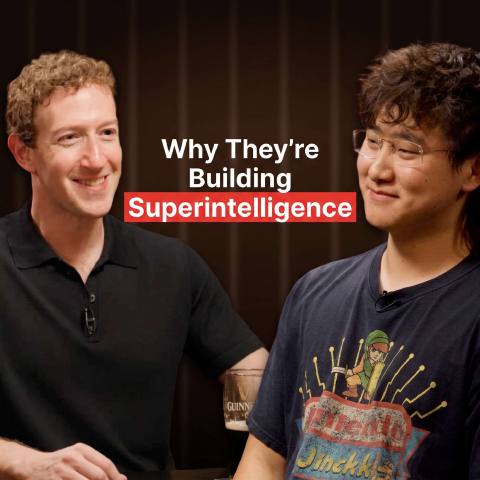
Back to Muse Wonder: Zuckerberg and Wang's $100B AI, with Mark Zuckerberg & Alexandr Wang.
Why Do Winning AI Products Look So Simple?
John Collison says winning AI products look simple because the field collapses quickly onto a few designs you could describe on the back of a postcard. Making a good version is still massively complicated and takes huge amounts of frontier work.
At Stripe, spelling out a winning product would take him pages: developer experience, payment methods that differ from country to country, and stablecoin. In AI, transformers worked, then the chat agent interface worked, and companies are now collapsing on a persistent agent that has a computer and can act out in the world. Once people see Muse, everyone treats that shape as clearly how an AI agent product should work, and future AI agent products will be fairly Muse-shaped.
Mark Zuckerberg disagrees. From the start, he expected an agent to be quite different from a text assistant. Meta AI reaches a ton of people, and every company has one, but people use it for information, not as something that gets stuff done: retrieval rather than delegation. Only the most recent wave gives the agent a dedicated virtual machine. He treats that machine as incredibly important for confidence in the security and privacy of a person's information, rather than a connection to elastic compute that everyone uses.