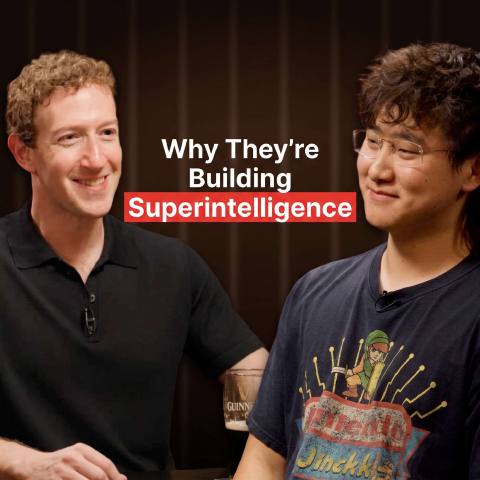
Back to Muse Wonder: Zuckerberg and Wang's $100B AI, with Mark Zuckerberg & Alexandr Wang.
Why Did a Meta Lead Reject a Reasoning Model?
John Collison · Mark Zuckerberg · Alexandr Wang
Alexandr Wang heard a key lead on Meta's existing effort reject a reasoning model because the lead did not think consumers needed one and said a normal model would do. In one of Wang's first meetings after he joined, he told the leads that the first milestone was to train a really good reasoning model by some timeframe, since that was clearly the most important step. The answer hit as a heart-sinking moment. He felt he had joined the wrong company and would have to take 10 steps back.
The decision to do a full reboot had more than one input. A main input was external, and the meeting was another. Wang took the comment as proof that Meta needed leadership much more committed to how fast the technology was moving, where it was going, and what was possible. As Mark Zuckerberg pivoted the company in that direction, he became deeply AI-focused, people saw where Meta was heading, and many existing leaders picked the shift up quickly.
The person who runs Instagram built one of the most polished and effective personal coding and mini-app setups Wang had seen. Long-time Meta leaders proved very adaptive.
Muse Wonder: Zuckerberg and Wang's $100B AI ·
From the transcript
think there's some other dimensions here that are worth mentioning too. When deciding we had to do the full reboot,
A lot of it was, you know, one of the main inputs was external, but also one of the inputs, I don't think I've ever, actually I can't remember if I told you this story, but one of the first meetings I had when I joined, I was in this meeting with some of the leads of the existing effort, and I was like, Okay, I think the first thing we need to do is train a really good reasoning model by some timeframe, I don't know when, but this is clearly the most important milestone.
And one of the key leads in the group, who no longer works in meta, was like, oh, we don't need a reasoning model. Do our consumers need a reasoning model? I feel like we don't need to do a reasoning model. We could just do a normal model. And I had this heart-sinking moment. Oh, no, I've joined the wrong company. I was like, oh, I've got to take 10 steps back.