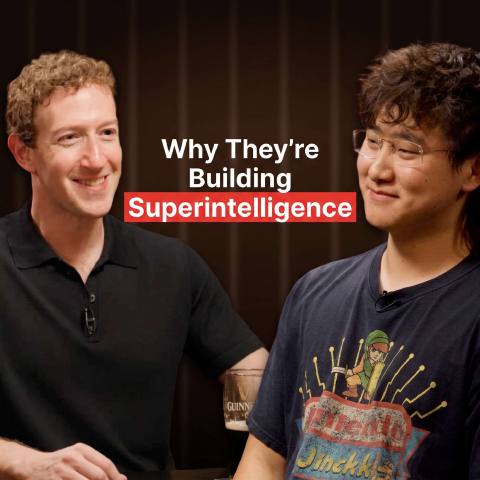
Back to Muse Wonder: Zuckerberg and Wang's $100B AI, with Mark Zuckerberg & Alexandr Wang.
Why Is Meta Spending $100 Billion Before the Model Exists?
John Collison · Mark Zuckerberg · Alexandr Wang
Alexandr Wang says frontier AI is the opposite of a lean startup. A lean startup gets something working and only then doubles down. You cannot do that here. The bets have to be made before there is proof the thing works, or you end up radically behind. He calls it entrepreneurship on hard mode, and he gives Mark Zuckerberg credit for taking those decisions.
Zuckerberg retells the end of last year. They were excited about the progress and had not seen the models yet. The check they were going to write was, as he put it, like $100 billion or $200 billion, and he asked Alex if he was sure it was going to work. John Collison describes the same constraint as pushing the chips all in before the cards are dealt, because at this scale the clusters have to be this big.
At an executive offsite in Hawaii at the end of last year, Susan pulled Wang aside more than once. She told him that if it did not work it would be really bad in financial terms, and that the model had to be good. If it was good, they would be fine. If it was bad, it would be very bad.
Muse Wonder: Zuckerberg and Wang's $100B AI ·
From the transcript
And Silicon Valley famously likes to run on metrics, but ultimately, do you just need someone who... is the esthete. It's nice when you have metrics, but I think the state of being an entrepreneur is how well do you make decisions in an information-poor environment. But there's that on steroids, right? Mega steroids. think that this is and and i think mark gets a huge amount of credit for this like the because of how long everything takes like there there were many points along over the past uh year since i've been here but also you know as you mentioned like long before that where you have to make very large investments or make very big decisions about you know how
you're going to uh invest or develop the technology or you know what decisions you're going to make long before there's proof points around, you know, whether or not even the thing is working. And so I think this is, this is like, you know, in some sense it's like entrepreneurship on hard mode. It's like the opposite of lean startup. Like lean startup is like, yeah, you like see if you get something working and then you double down and then you see if that works and then you double down.