On Huberman Lab, dietary cholesterol plays no role in serum cholesterol and has no bearing on it. Ancel Keys acknowledged the finding in the 1960s, and the American Heart Association acknowledged it another 60 years later. Saturated fat is a separate molecule, and saturated fat consumption raises LDL cholesterol in many people.
Cholesterol in food is esterified, and an esterified cholesterol molecule cannot pass into circulation the way non-esterified body cholesterol can. On Huberman Lab, the body probably de-esterifies ten to fifteen percent of dietary cholesterol. Small amounts do reach circulation, yet they remain a small fraction of the total body pool. Saturated fat is a fully saturat
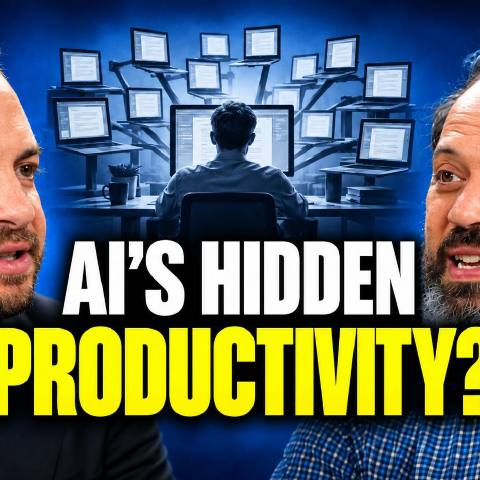
Ethan Mollick says 40 percent of the advantage of American companies in the 20th century came from better management, according to a paper by Raffaella Sadun and other Harvard researchers. Companies used to experiment with how to organize themselves and get work done. American manufacturing and firm organization transformed. That exploration has not happened as much in the last 30 years.
Firms now let SaaS vendors dictate how to run part of the business, hire consultants, and point R&D at customers. A lot of organizations have very little muscle memory left for organizational change. It is rare to see a company fundamentally redivide how work operates, how roles operate, and what mandate pe
Fabian Theis says linear baselines still matter because a field rushing toward a virtual cell sometimes skipped them. On the plain task of naming a cell type from a new transcriptome, some models close to the state of the art are logistic regression. CellTypist does a good job. A paper from his group about five or six years ago said, in a plain title, that deep learning is not needed for cell type prediction. The claim holds inside one organ. Across organs the task gets subtler, because cell types show up again in different organs and immune cells change with the tissue.
Early perturbation analyses used classical linear models. Around 2019 his lab introduced linear shifts inside a latent sp
David Heinemeier Hansson says the Fable release was held back because the model was so good at finding holes an attacker could exploit that it was not safe to ship. The same systems are unusually strong at finding those holes and at fixing them.
The hard cases are combo moves. One small vulnerability is not fatal on its own. Combine it with four others and it becomes remote command execution. People who can chain those steps are rare, and they usually work inside state-sponsored or other clandestine groups rather than publishing what they find. On that kind of security work, he thinks the models have reached a level virtually no human can match.
Jordan B. Peterson says a story is a description of identity, an idea he thinks is right. It was a hypothesis in Maps of Meaning and has been a predicate of his work ever since, including We Who Wrestle with God.
People seem to have two ways of representing knowledge. The scientific endeavor gives a robust description of the facts that make up the world. A story informs a mode of being, meaning patterns of attention and action. In a movie or a work of fiction, the author puts the protagonist in a variety of situations. The aim becomes visible there. The world the character inhabits becomes understandable by inferring the aim, and the character's emotions follow from understanding the aim.
On Hanselminutes, Microsoft is starting to move cloud services to the dot Microsoft top-level domain, and Microsoft says the change is more secure. Running the name and controlling the registry leaves one less point somebody can attack.
The Domain Name System was developed in the 80s, in a gentler time, when people worried about jokes more than about other people doing bad things. The web was still a gleam in someone's eye and was not even going to be a thing yet. Anthony Eden says Sir Tim Berners-Lee may have been thinking about the web then, and is not even sure. The protocol has withstood the test of time, with pains along the way, from letter variations and from the operational side. Th
Jason Jacobs has spent months talking to experts tackling climate change to figure out where he fit in, in order to help. He brings the questions, and experts share their stories. This podcast is his way to go through the journey together, to learn, and discover climate change from different angles.
Jordan Harbinger says he has mostly taken one piece of consumer advice to heart. Food safety lawyer Dennis Stearns buys whole heads of lettuce instead of bags of pre-cut lettuce. A bag of spinach can mix leaves from lots of different plants, lots of different spinach plants, and maybe even different farms. Eating more plants raises the odds that one of them had something bad in it.
One solid head of lettuce is not perfectly safe, because it could have cyclospora in it. A salad from a hundred different heads of lettuce makes the odds a hundred percent greater. A whole head has to be cut, washed, and dried, which means getting out the salad spinner, and the spinner takes up the whole dish rac
Eric Betzig says biology is the last frontier. He studies it at the last stage of his career and says he is never going to be a biologist. Mystery sits everywhere, and people understand so little that biology is still in the pre-Kepler era and the phlogiston era. So many things people think they know are bullshit. Biology is the final frontier because it is the most complex matter in the known universe.
A virtual cell, the goal people say they want now, will take generations, if not eons, if it ever happens. The missing piece is enough mechanistic understanding. Eric Betzig says people do not grasp how big the mystery is. Asked whether there is a SpaceX of biology and where a biologist shou
Edward Lemay says people project how they feel about a partner today onto the future of the relationship. If they are unhappy now, they often assume the unhappiness will last, and that forecast is often wrong because the feeling is temporary.
Listener Morgan is 23 and has been with her boyfriend for a year and a half. She does not want children and does not expect that to change. He wanted children when they met and is now mostly unsure. They agreed to reconsider near the time she finishes her studies, around age 29. He has told her the choice is all right for him now. She still hears hidden resentment and future regret. Lemay says she may be projecting her own certainty onto him. For her,
Walter Goodwin says chip design has to follow the model architectures already on the way, and a chip with a new limit can pull later architectures toward it. Models today are trained on high-bandwidth-memory GPUs and XPUs, so a useful accelerator still has to run today's autoregressive mixture-of-experts transformers faster. Fractile's planning bet is memory bandwidth, about 25 times more per chip than an HBM-based chip.
That extra bandwidth changes which designs are practical to serve. A sparser mixture of experts saves flops for the same intelligence, from about one expert in 16 toward one in 128 or one in 256, but those models are often bandwidth-prohibitive on today's HBM chips and get
Robert Caro knew Robert Moses had lost power when a long interview ended and the secretary brought no telephone calls. He had begun the book in 66 and 67, writing while Moses was losing power and his career was not yet over.
Moses's office was still at the Triborough Bridge Authority. While Moses held power, Caro interviewed him there several times. The power was obvious: people waited outside for his decisions. As soon as an interview finished, the secretary came in with a list of calls from people who wanted something from him. On one long interview, maybe the last, there had been no calls. The secretary had nothing to tell him. Thinking of Moses then brought the poignance of someone losi