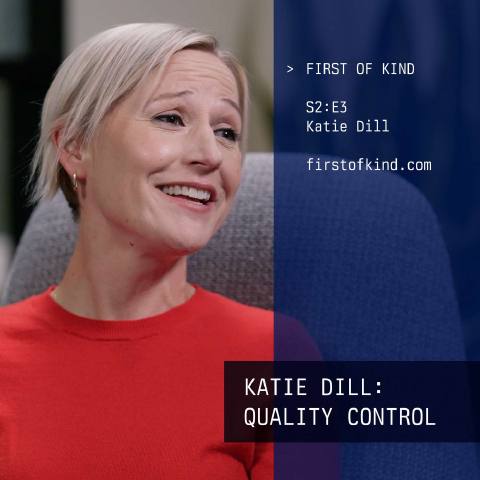
Back to Katie Dill: Quality Control, with Katie Dill.
Why Did Katie Dill Study History?
Katie Dill chose history for her undergraduate degree because she wanted to know why things are the way they are. She was infatuated with where lines were drawn between countries, how cultures came to be, and why architecture took one direction and then shaped how people live. Push that question into the future and it becomes why life cannot be a different way and why it cannot be better, and that next step is design.
The turn happened in Florence, where she studied abroad in her junior year of college. Art and architecture were everywhere, history and beauty interwoven. On a class trip to Santa Maria Novella, the church in Florence, the group talked about the history of the space while she was taken by a building from the 1400s. Alberti did the facade, and she remembers it as a perfection of harmony, balance, and proportion. Time with the church made her think about what people could do in the 1400s and how such work can shape lives and history. She wanted to spend her time closer to that work, so she thought she wanted to be an architect. She finished her degree at Colgate, a liberal arts school in upstate New York, and planned to go into architecture after college.
From the transcript
So I'd love to hear a little bit about how you arrived at that field of study and where design kind of emerged for you as a path in life. I totally agree. I think it is so interesting about design and, you know, because perhaps it's defined as a bit of a newer discipline, but yes, we all have such securitist paths to it. The reason why I chose to study history in my undergrad was because I just wanted to know why things are the way they are.
I just infatuated with the stories of, you know, where, you know, lines were divided between countries and the stories of how different cultures came to be and You know, why the architectural direction went that way versus this and how it's ended up impacting the way we live and how we are. And, you know, of course, if I speed up to the future, it's like, well, of course, the next juxtaposition was then like, well, why can't it be a different way? Why can't it be better? And that is, of course, design.